CHAPTER 1
SOIL
Al-Hafzan Abdullah Halim
DEFINITION






The simplest classification of geological
deposits falls generally into two major classes
to provide engineers and others with basic
information which is:
“ROCK”- which refers mainly to a hard rigid
and strongly cemented deposit, and
“SOIL”- which refers to the soft, or loose and
cemented deposis
IMPORTANCE





For construction purposes
Structure implementation
Foundation choices
Reduce the risk of soil/foundation failure
SOIL STRATUM


2 layers



Top soil
Ground soil
Top soil






150-300mm from soil surface
Contains vegetation, rubbish & rotten
materials
Not suitable in supporting foundation/structure
Usually the top soil will be cart away before
construction
GROUND SOIL





Situated between top soil & rock layer
The thickness of the soil varies depending on
the rock formation
This layer are compacted naturally which
occasionally can support light construction
SOIL FORMATION


3 types of formation




Transported soil
Residual soil
Organic soil
TRANSPORTED SOIL




E.g. – gravel, sand, silt and clay
Produce by the formation of wind and water
Dust flown by wind
RESIDUAL SOIL



E.g. – top soil & laterite
weathering action on rock fragments which
breaks and crushed and becomes smaller
pieces
ORGANIC SOIL



E.g. – top soil and peat
Produce by the formation of rotten vegetation
and animals
ROCK FORMATION


Divided into 3 major groups:




Igneous rocks
Sedimentary rocks
Metamorphic rocks
IGNEOUS ROCK



E.g. – basalt & granite
Formed by solidification of molten materials
which has ascended towards the surface from
the hot lower levels of the earth crust
SEDIMENTARY ROCKS



E.g.-sandstone, shale, limestone
Formed by deep fissures and swallow holes
which are cavities formed at some time by the
passage of water through soft rock.
METAMORPHIC ROCKS



E.g.-slates, quartzite, marble
These rocks include any sedimentary deposit
or igneous rock which, after consolidation, has
become altered by heat or pressure
TYPES OF SOIL


2 types of soil



Non-cohesive soils
Cohesive soils
COHESIVE SOILS
•

•
•

•
•
•
•

•

Fine grained particles are closely integrated and stick
together
Particle size ranges between 0.06mm or less
The level of cohesiveness depends on the size, shape and
water level
When its wet, it is soft and when its dry it becomes hard
Has a high level of moisture content
Always experiences shrinkage and extension process
The increasing of water level can caused soil strengths to
differ
Therefore the depth of the foundation should be constructed
at least 1m from the earth surface




High level of water content can caused
difficulty in earth excavation which will flood
the construction site
E.g- clay,silt, peat and laterite
NON-COHESIVE SOIL









The soil particles are not sticking to each other
The particle size ranges between 0.06mm200mm
Non-cohesive soils has a high value for a
construction site
Water are easy to flow out because of its
hollow particle
E.g- gravel, sands
CLASSIFICATION OF SOILS


Soil classification can be done by:


Grain size-divided into several sizes
 Coarse

grain non-cohesive
 Fined grained cohesive
 Organic soil
Can be done by sieving and sedimentation technique
- Sieving : for non-cohesive soil such as gravel and
sand
- Sedimentation : for cohesive soil such as clay and silt


Moisture content
 Moisture

content classification for cohesive
soil such as clay and silt
 Can be classified by moisture content test or
plastic limit/liquid limit test. Refer to BS
1377:1975
GROUND WATER





Usually refer to the ground water level
Water usually come from rain and water penetration into
the earth opening which can penetrates until 12000m
Water content depends on:
Surface slopes/gradients
 Vegetation
 Weather
 Soil opening and penetration
- Ground water content will influence construction works where it
involved the stabilization and strength of the soil.

- Usually high level of water content require a much
more complicated foundation system.
- It will also make more difficult when water
penetrates into excavation work and will obstruct
workers and machineries.
- Water proof retaining wall needed in such cases
SOIL CHARACTERISTIC IN
RELATION TO CHOICE OF
FOUNDATIONS


Soil have different attribute when load implied
on them. The characteristic are:




Compressibility
Permeability
Plasticity
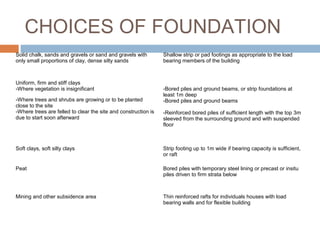
CHOICES OF FOUNDATION
Solid chalk, sands and gravels or sand and gravels with
only small proportions of clay, dense silty sands

Uniform, firm and stiff clays
-Where vegetation is insignificant
-Where trees and shrubs are growing or to be planted
close to the site
-Where trees are felled to clear the site and construction is
due to start soon afterward

Shallow strip or pad footings as appropriate to the load
bearing members of the building

-Bored piles and ground beams, or strip foundations at
least 1m deep
-Bored piles and ground beams
-Reinforced bored piles of sufficient length with the top 3m
sleeved from the surrounding ground and with suspended
floor

Soft clays, soft silty clays

Strip footing up to 1m wide if bearing capacity is sufficient,
or raft

Peat

Bored piles with temporary steel lining or precast or insitu
piles driven to firm strata below

Mining and other subsidence area

Thin reinforced rafts for individuals houses with load
bearing walls and for flexible building

Chapter 1 soil

  • 1.
  • 2.
    DEFINITION    The simplest classificationof geological deposits falls generally into two major classes to provide engineers and others with basic information which is: “ROCK”- which refers mainly to a hard rigid and strongly cemented deposit, and “SOIL”- which refers to the soft, or loose and cemented deposis
  • 3.
    IMPORTANCE     For construction purposes Structureimplementation Foundation choices Reduce the risk of soil/foundation failure
  • 4.
  • 5.
    Top soil     150-300mm fromsoil surface Contains vegetation, rubbish & rotten materials Not suitable in supporting foundation/structure Usually the top soil will be cart away before construction
  • 6.
    GROUND SOIL    Situated betweentop soil & rock layer The thickness of the soil varies depending on the rock formation This layer are compacted naturally which occasionally can support light construction
  • 7.
    SOIL FORMATION  3 typesof formation    Transported soil Residual soil Organic soil
  • 8.
    TRANSPORTED SOIL    E.g. –gravel, sand, silt and clay Produce by the formation of wind and water Dust flown by wind
  • 9.
    RESIDUAL SOIL   E.g. –top soil & laterite weathering action on rock fragments which breaks and crushed and becomes smaller pieces
  • 10.
    ORGANIC SOIL   E.g. –top soil and peat Produce by the formation of rotten vegetation and animals
  • 11.
    ROCK FORMATION  Divided into3 major groups:    Igneous rocks Sedimentary rocks Metamorphic rocks
  • 12.
    IGNEOUS ROCK   E.g. –basalt & granite Formed by solidification of molten materials which has ascended towards the surface from the hot lower levels of the earth crust
  • 13.
    SEDIMENTARY ROCKS   E.g.-sandstone, shale,limestone Formed by deep fissures and swallow holes which are cavities formed at some time by the passage of water through soft rock.
  • 14.
    METAMORPHIC ROCKS   E.g.-slates, quartzite,marble These rocks include any sedimentary deposit or igneous rock which, after consolidation, has become altered by heat or pressure
  • 15.
    TYPES OF SOIL  2types of soil   Non-cohesive soils Cohesive soils
  • 16.
    COHESIVE SOILS • • • • • • • • Fine grainedparticles are closely integrated and stick together Particle size ranges between 0.06mm or less The level of cohesiveness depends on the size, shape and water level When its wet, it is soft and when its dry it becomes hard Has a high level of moisture content Always experiences shrinkage and extension process The increasing of water level can caused soil strengths to differ Therefore the depth of the foundation should be constructed at least 1m from the earth surface
  • 17.
      High level ofwater content can caused difficulty in earth excavation which will flood the construction site E.g- clay,silt, peat and laterite
  • 18.
    NON-COHESIVE SOIL      The soilparticles are not sticking to each other The particle size ranges between 0.06mm200mm Non-cohesive soils has a high value for a construction site Water are easy to flow out because of its hollow particle E.g- gravel, sands
  • 19.
    CLASSIFICATION OF SOILS  Soilclassification can be done by:  Grain size-divided into several sizes  Coarse grain non-cohesive  Fined grained cohesive  Organic soil Can be done by sieving and sedimentation technique - Sieving : for non-cohesive soil such as gravel and sand - Sedimentation : for cohesive soil such as clay and silt
  • 20.
     Moisture content  Moisture contentclassification for cohesive soil such as clay and silt  Can be classified by moisture content test or plastic limit/liquid limit test. Refer to BS 1377:1975
  • 21.
    GROUND WATER    Usually referto the ground water level Water usually come from rain and water penetration into the earth opening which can penetrates until 12000m Water content depends on: Surface slopes/gradients  Vegetation  Weather  Soil opening and penetration - Ground water content will influence construction works where it involved the stabilization and strength of the soil. 
  • 22.
    - Usually highlevel of water content require a much more complicated foundation system. - It will also make more difficult when water penetrates into excavation work and will obstruct workers and machineries. - Water proof retaining wall needed in such cases
  • 23.
    SOIL CHARACTERISTIC IN RELATIONTO CHOICE OF FOUNDATIONS  Soil have different attribute when load implied on them. The characteristic are:    Compressibility Permeability Plasticity
  • 24.
    CHOICES OF FOUNDATION Solidchalk, sands and gravels or sand and gravels with only small proportions of clay, dense silty sands Uniform, firm and stiff clays -Where vegetation is insignificant -Where trees and shrubs are growing or to be planted close to the site -Where trees are felled to clear the site and construction is due to start soon afterward Shallow strip or pad footings as appropriate to the load bearing members of the building -Bored piles and ground beams, or strip foundations at least 1m deep -Bored piles and ground beams -Reinforced bored piles of sufficient length with the top 3m sleeved from the surrounding ground and with suspended floor Soft clays, soft silty clays Strip footing up to 1m wide if bearing capacity is sufficient, or raft Peat Bored piles with temporary steel lining or precast or insitu piles driven to firm strata below Mining and other subsidence area Thin reinforced rafts for individuals houses with load bearing walls and for flexible building