FIELD IDENTIFICATION TESTS
OF
SOIL
Er. S S A Rufai
Principal S S M Polytechnic College
J&K
•Identification of soil types in the field, is limited
to defining the colour, texture and plasticity
• Done without the benefit of major equipment
• It is necessary to do general assessment of sites
during field reconnaissance and during the initial
phases of work
•Sometimes these tests may be sufficient for
ordinary works, but in most cases it will serve as
an aid.Detailed and precise identification requires
laboratory testing.
VISUAL EXAMINATION (TEXTURE)
By looking at the soil, we can make distinction
between gravel, sand, and fines (silt and clay
combined) components.
• However silt and clay particles cannot be
separated without further magnification.
•The examination is done by drying a sample,
spreading it on a flat surface, and then simply
segregating it into its various components
SEDIMENTATION/DISPERSION TEST
•This test is done by shaking a portion of the sample
into a glass container of water and allowing the material
to settle.
•The gravel and coarse sand will settle almost
immediately
•The fine sand will take 30 seconds to less than 5
minutes
•The silt may require as much as about an hour
•Clay shall remain in suspension for several hours
•The material will settle in layers.
•The percentage of each component is estimated by
comparing the relative thickness of each of the layers in
the bottom of the jar
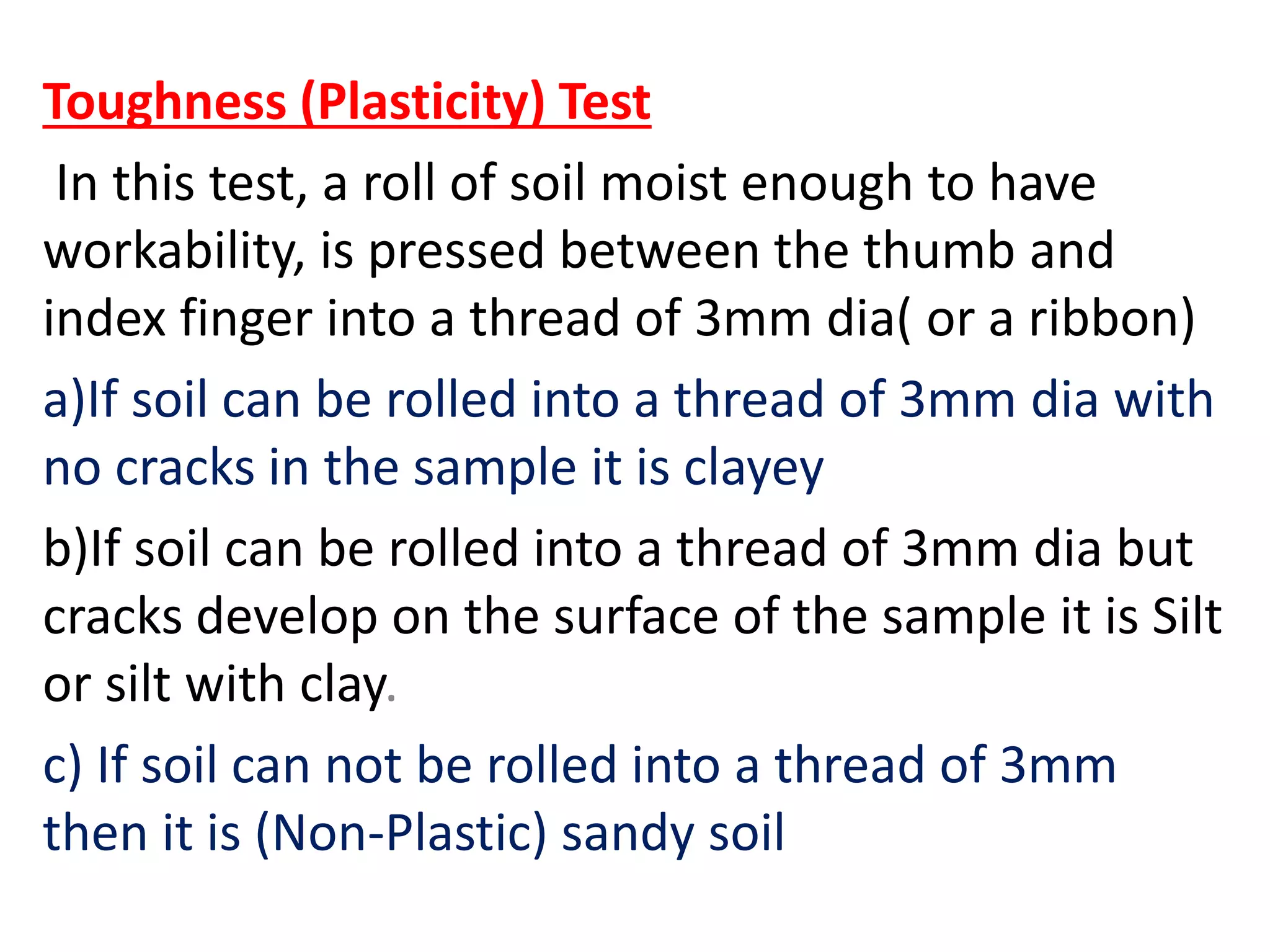
Toughness (Plasticity) Test
In this test, a roll of soil moist enough to have
workability, is pressed between the thumb and
index finger into a thread of 3mm dia( or a ribbon)
a)If soil can be rolled into a thread of 3mm dia with
no cracks in the sample it is clayey
b)If soil can be rolled into a thread of 3mm dia but
cracks develop on the surface of the sample it is Silt
or silt with clay.
c) If soil can not be rolled into a thread of 3mm
then it is (Non-Plastic) sandy soil
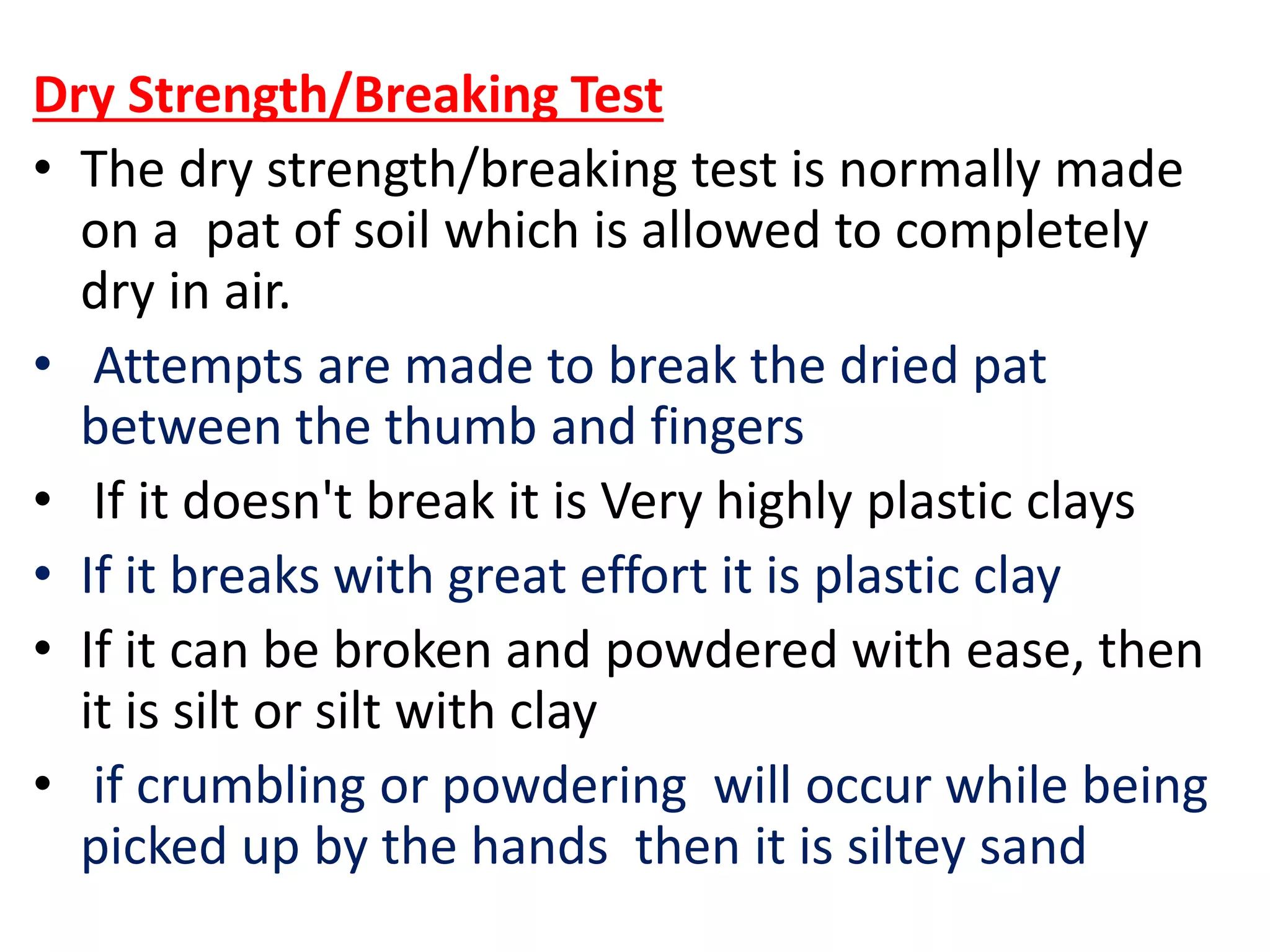
Dry Strength/Breaking Test
• The dry strength/breaking test is normally made
on a pat of soil which is allowed to completely
dry in air.
• Attempts are made to break the dried pat
between the thumb and fingers
• If it doesn't break it is Very highly plastic clays
• If it breaks with great effort it is plastic clay
• If it can be broken and powdered with ease, then
it is silt or silt with clay
• if crumbling or powdering will occur while being
picked up by the hands then it is siltey sand
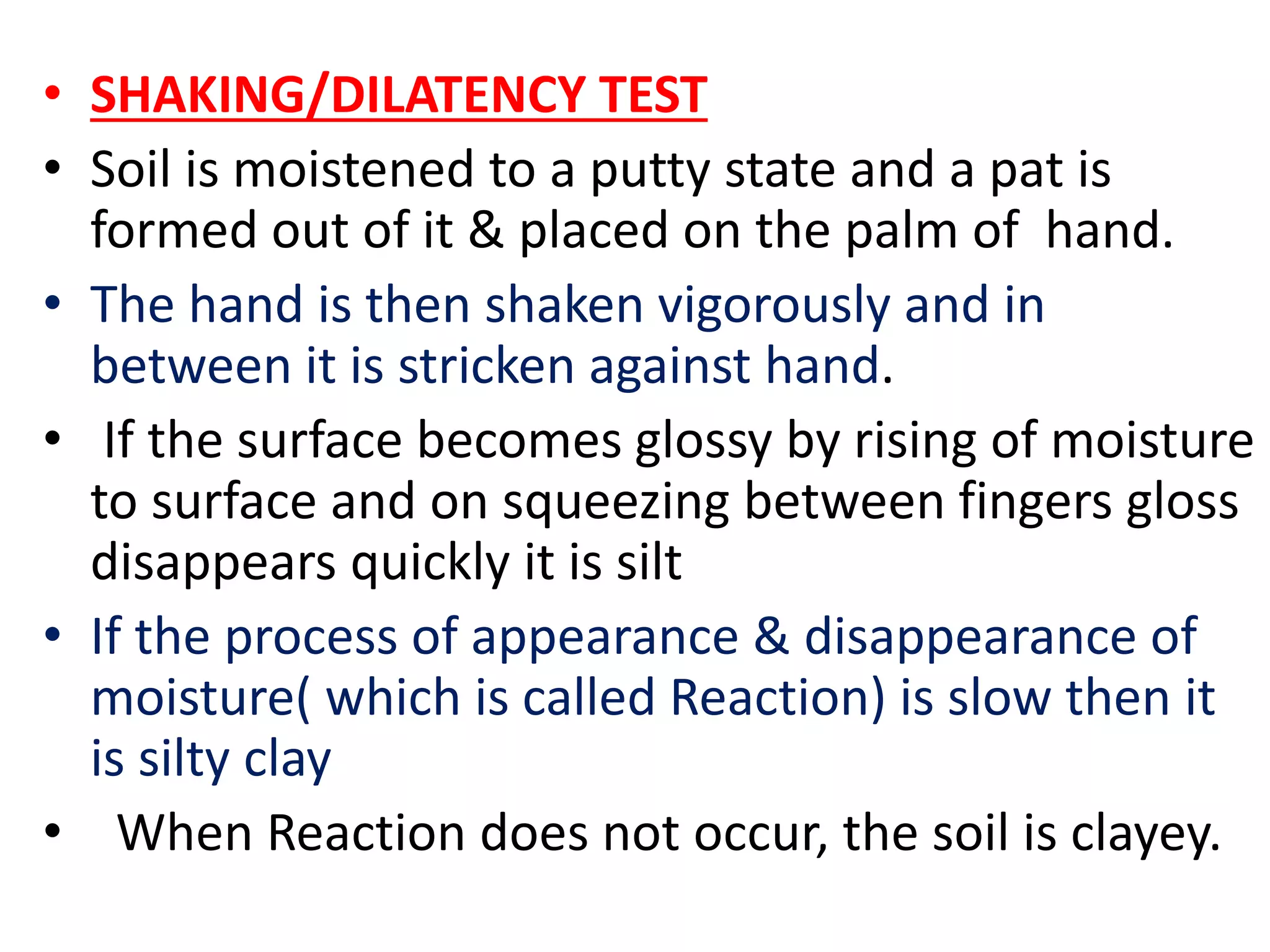
• SHAKING/DILATENCY TEST
• Soil is moistened to a putty state and a pat is
formed out of it & placed on the palm of hand.
• The hand is then shaken vigorously and in
between it is stricken against hand.
• If the surface becomes glossy by rising of moisture
to surface and on squeezing between fingers gloss
disappears quickly it is silt
• If the process of appearance & disappearance of
moisture( which is called Reaction) is slow then it
is silty clay
• When Reaction does not occur, the soil is clayey.
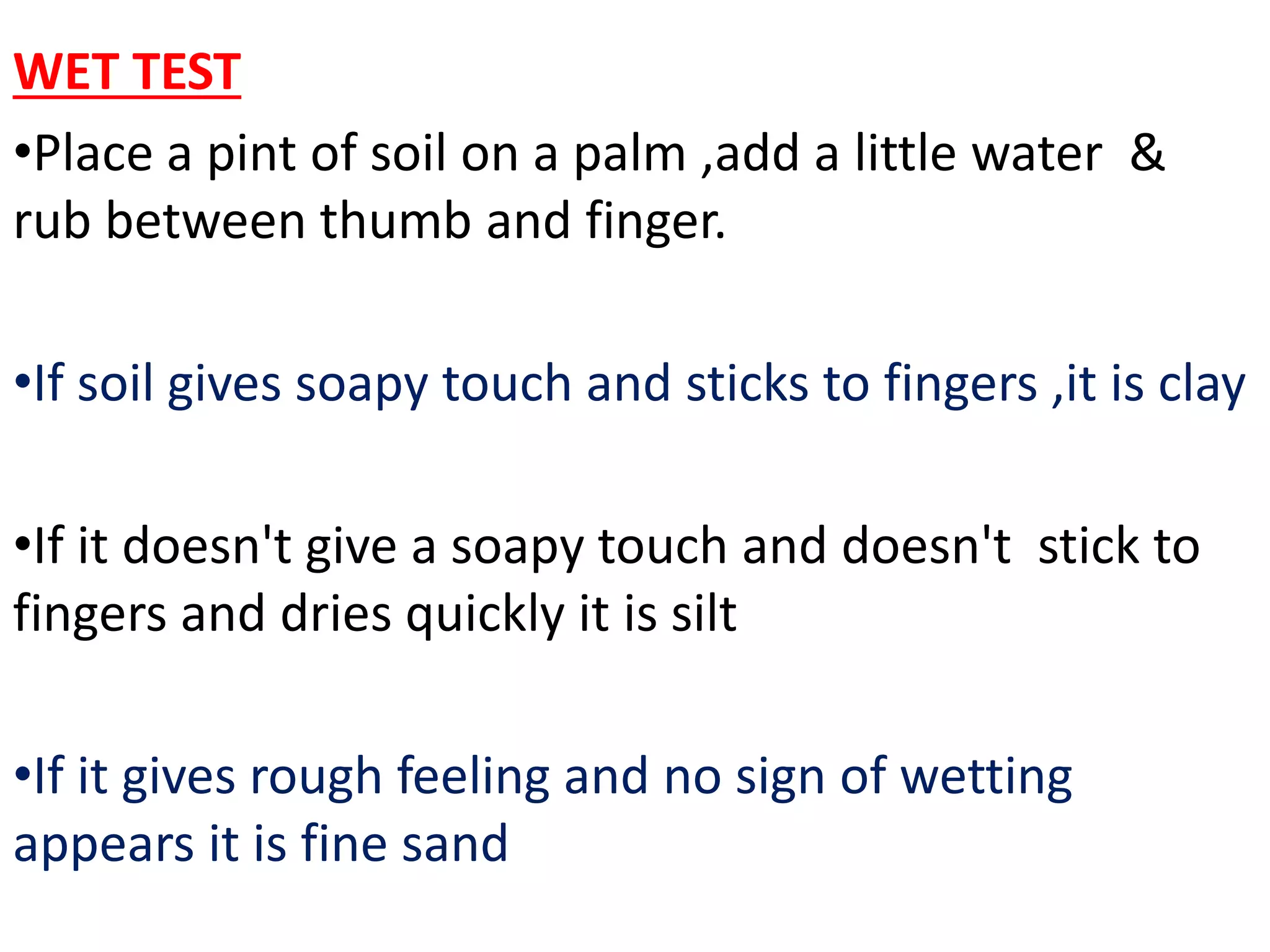
WET TEST
•Place a pint of soil on a palm ,add a little water &
rub between thumb and finger.
•If soil gives soapy touch and sticks to fingers ,it is clay
•If it doesn't give a soapy touch and doesn't stick to
fingers and dries quickly it is silt
•If it gives rough feeling and no sign of wetting
appears it is fine sand
SOAKING TEST
•Put a small lump of soil in glass container containing
pure water
•Observe lump disintegrating in water
•If the soaking & disintegration takes place quickly ,it
is silt or clay of low plasticity
• If the soaking & disintegration takes place very
slowly ,it is clay of high plasticity
Thank You

Field identification tests

  • 1.
    FIELD IDENTIFICATION TESTS OF SOIL Er.S S A Rufai Principal S S M Polytechnic College J&K
  • 2.
    •Identification of soiltypes in the field, is limited to defining the colour, texture and plasticity • Done without the benefit of major equipment • It is necessary to do general assessment of sites during field reconnaissance and during the initial phases of work •Sometimes these tests may be sufficient for ordinary works, but in most cases it will serve as an aid.Detailed and precise identification requires laboratory testing.
  • 3.
    VISUAL EXAMINATION (TEXTURE) Bylooking at the soil, we can make distinction between gravel, sand, and fines (silt and clay combined) components. • However silt and clay particles cannot be separated without further magnification. •The examination is done by drying a sample, spreading it on a flat surface, and then simply segregating it into its various components
  • 4.
    SEDIMENTATION/DISPERSION TEST •This testis done by shaking a portion of the sample into a glass container of water and allowing the material to settle. •The gravel and coarse sand will settle almost immediately •The fine sand will take 30 seconds to less than 5 minutes •The silt may require as much as about an hour •Clay shall remain in suspension for several hours •The material will settle in layers. •The percentage of each component is estimated by comparing the relative thickness of each of the layers in the bottom of the jar
  • 5.
    Toughness (Plasticity) Test Inthis test, a roll of soil moist enough to have workability, is pressed between the thumb and index finger into a thread of 3mm dia( or a ribbon) a)If soil can be rolled into a thread of 3mm dia with no cracks in the sample it is clayey b)If soil can be rolled into a thread of 3mm dia but cracks develop on the surface of the sample it is Silt or silt with clay. c) If soil can not be rolled into a thread of 3mm then it is (Non-Plastic) sandy soil
  • 6.
    Dry Strength/Breaking Test •The dry strength/breaking test is normally made on a pat of soil which is allowed to completely dry in air. • Attempts are made to break the dried pat between the thumb and fingers • If it doesn't break it is Very highly plastic clays • If it breaks with great effort it is plastic clay • If it can be broken and powdered with ease, then it is silt or silt with clay • if crumbling or powdering will occur while being picked up by the hands then it is siltey sand
  • 7.
    • SHAKING/DILATENCY TEST •Soil is moistened to a putty state and a pat is formed out of it & placed on the palm of hand. • The hand is then shaken vigorously and in between it is stricken against hand. • If the surface becomes glossy by rising of moisture to surface and on squeezing between fingers gloss disappears quickly it is silt • If the process of appearance & disappearance of moisture( which is called Reaction) is slow then it is silty clay • When Reaction does not occur, the soil is clayey.
  • 8.
    WET TEST •Place apint of soil on a palm ,add a little water & rub between thumb and finger. •If soil gives soapy touch and sticks to fingers ,it is clay •If it doesn't give a soapy touch and doesn't stick to fingers and dries quickly it is silt •If it gives rough feeling and no sign of wetting appears it is fine sand
  • 9.
    SOAKING TEST •Put asmall lump of soil in glass container containing pure water •Observe lump disintegrating in water •If the soaking & disintegration takes place quickly ,it is silt or clay of low plasticity • If the soaking & disintegration takes place very slowly ,it is clay of high plasticity
  • 10.