INTRODUCTORY

PSYCHOLOGY

Ron Mossler, Ph.D.
Los Angeles Valley
College
RESEARCH METHODS IN
PSYCHOLOGY
 Psychology is the science of behavior and mental processes.
 It is both scientific and applied

Describe, predict and
control behavior
Goals of psychology
Accomplished by using
scientific method
RESEARCH METHODS






Case study and interviews
Survey/Questionnaires – representative sample?
Naturalistic Observation
Operational definition – replication
Correlational research

1-3
RESEARCH METHODS IN PSYCHOLOGY
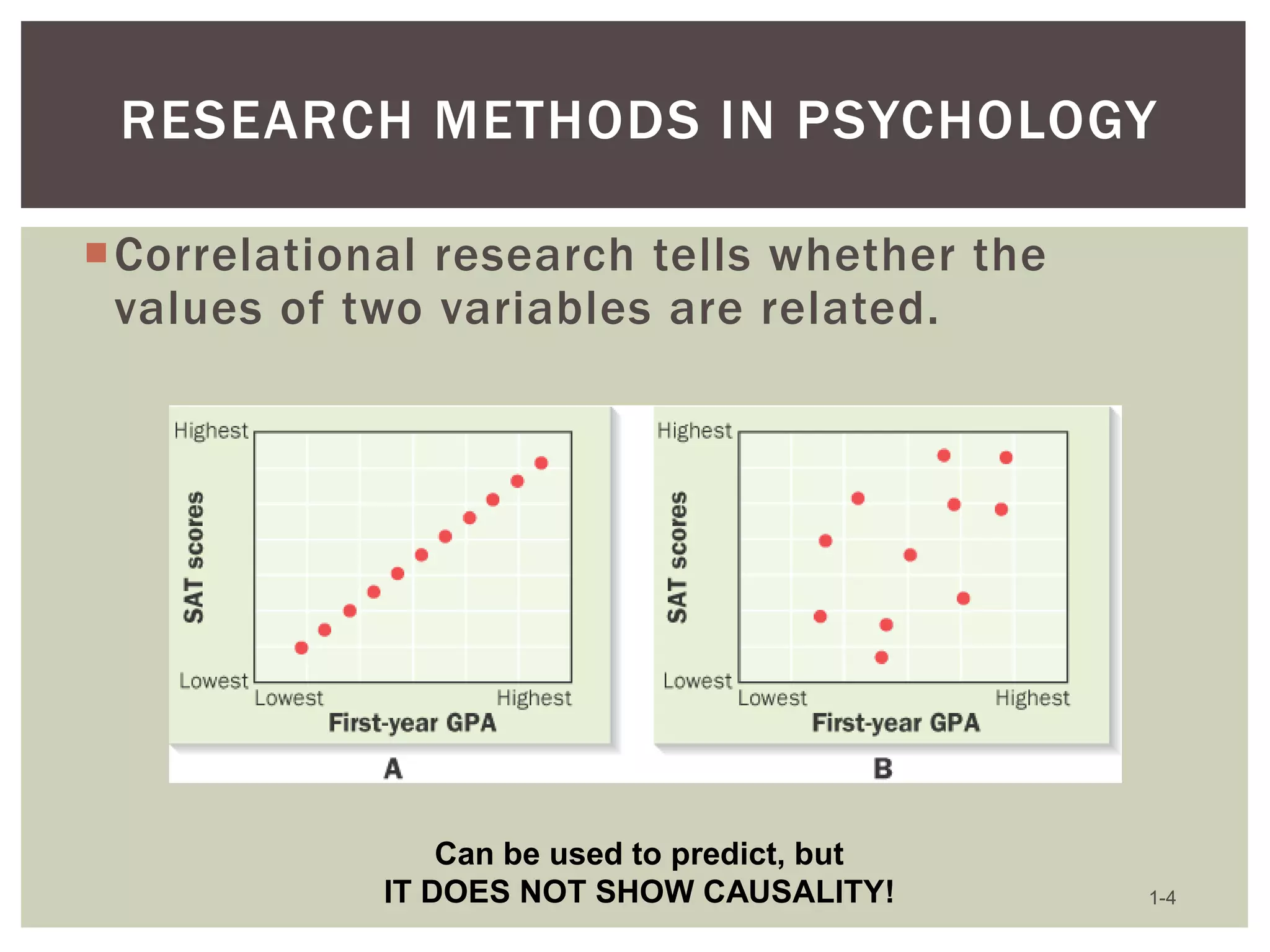
Correlational research tells whether the
values of two variables are related.

Can be used to predict, but
IT DOES NOT SHOW CAUSALITY!

1-4
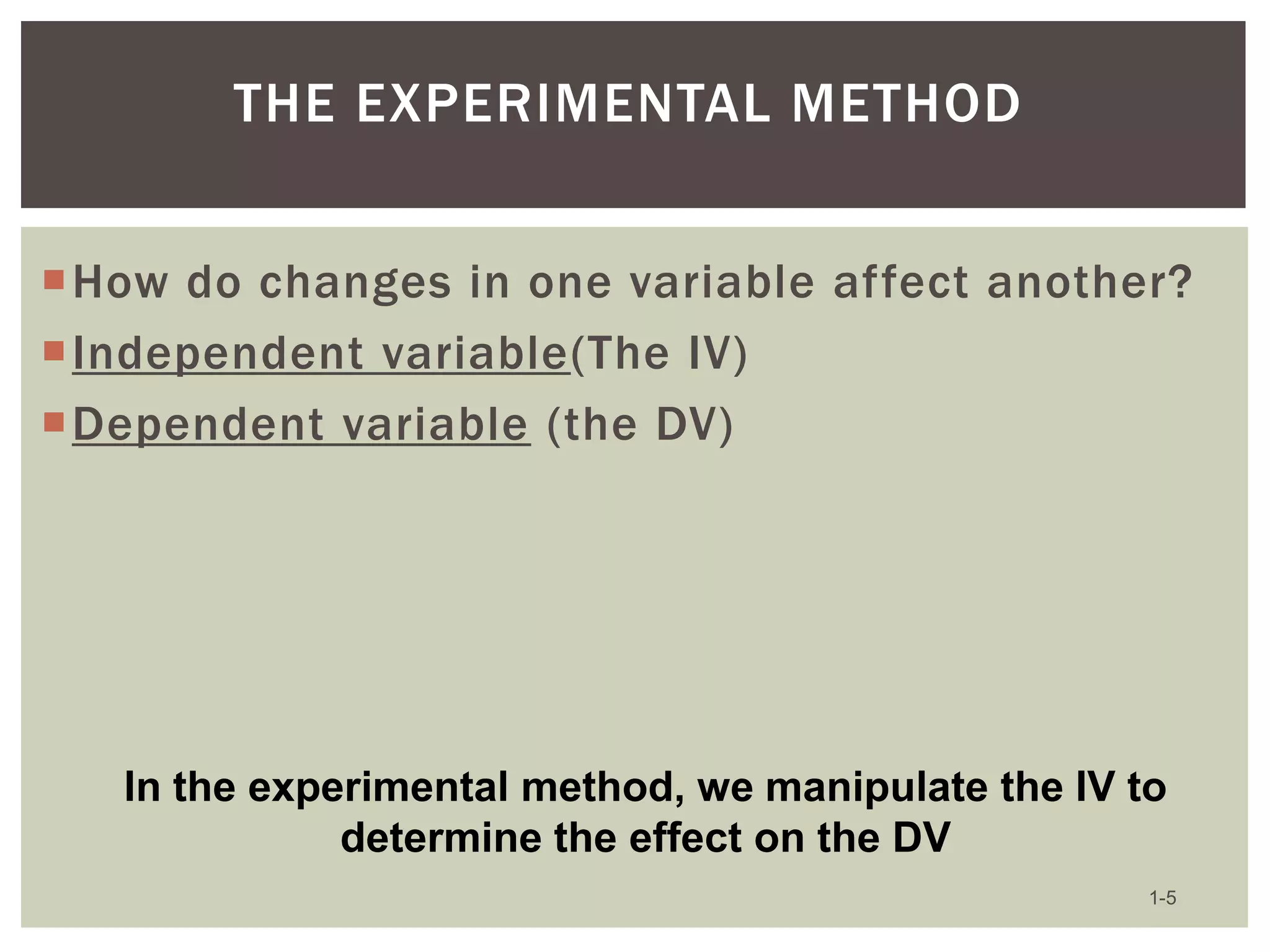
THE EXPERIMENTAL METHOD
How do changes in one variable affect another?
Independent variable(The IV)
Dependent variable (the DV)

In the experimental method, we manipulate the IV to
determine the effect on the DV
1-5
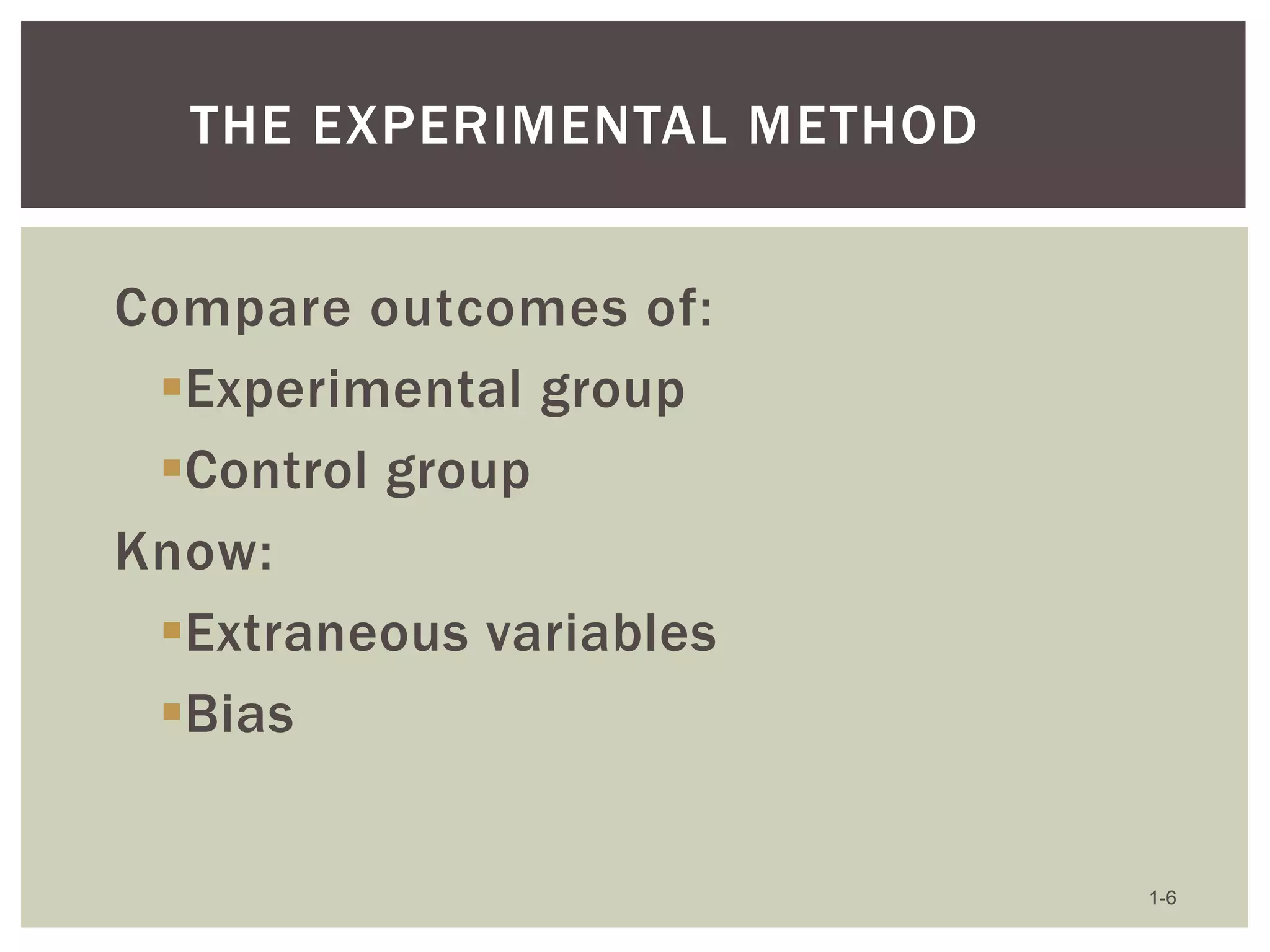
THE EXPERIMENTAL METHOD

Compare outcomes of:
Experimental group
Control group
Know:
Extraneous variables
Bias

1-6
RESEARCH METHODS IN PSYCHOLOGY
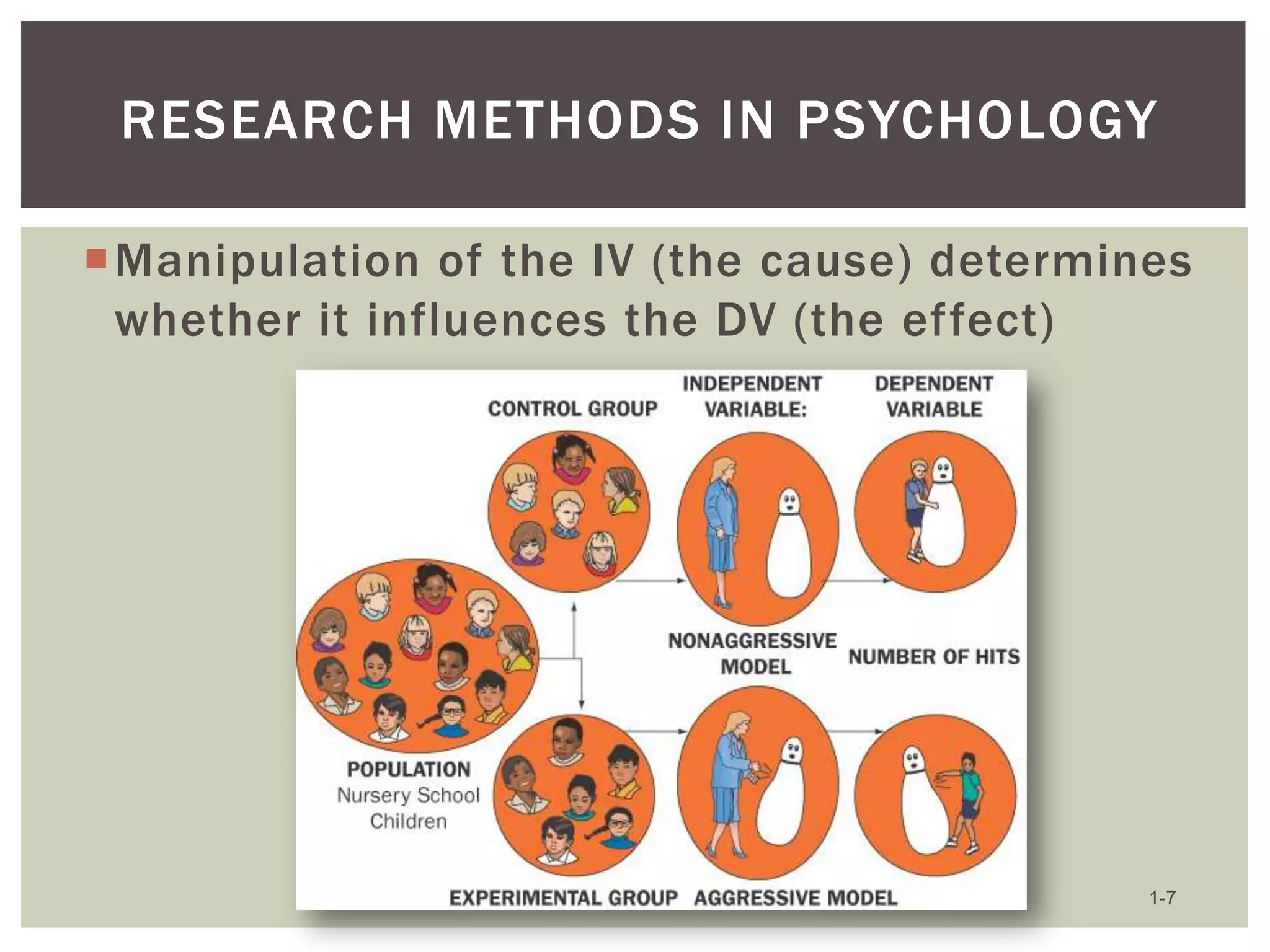
Manipulation of the IV (the cause) determines
whether it influences the DV (the effect)

1-7
THE EXPERIMENTAL METHOD
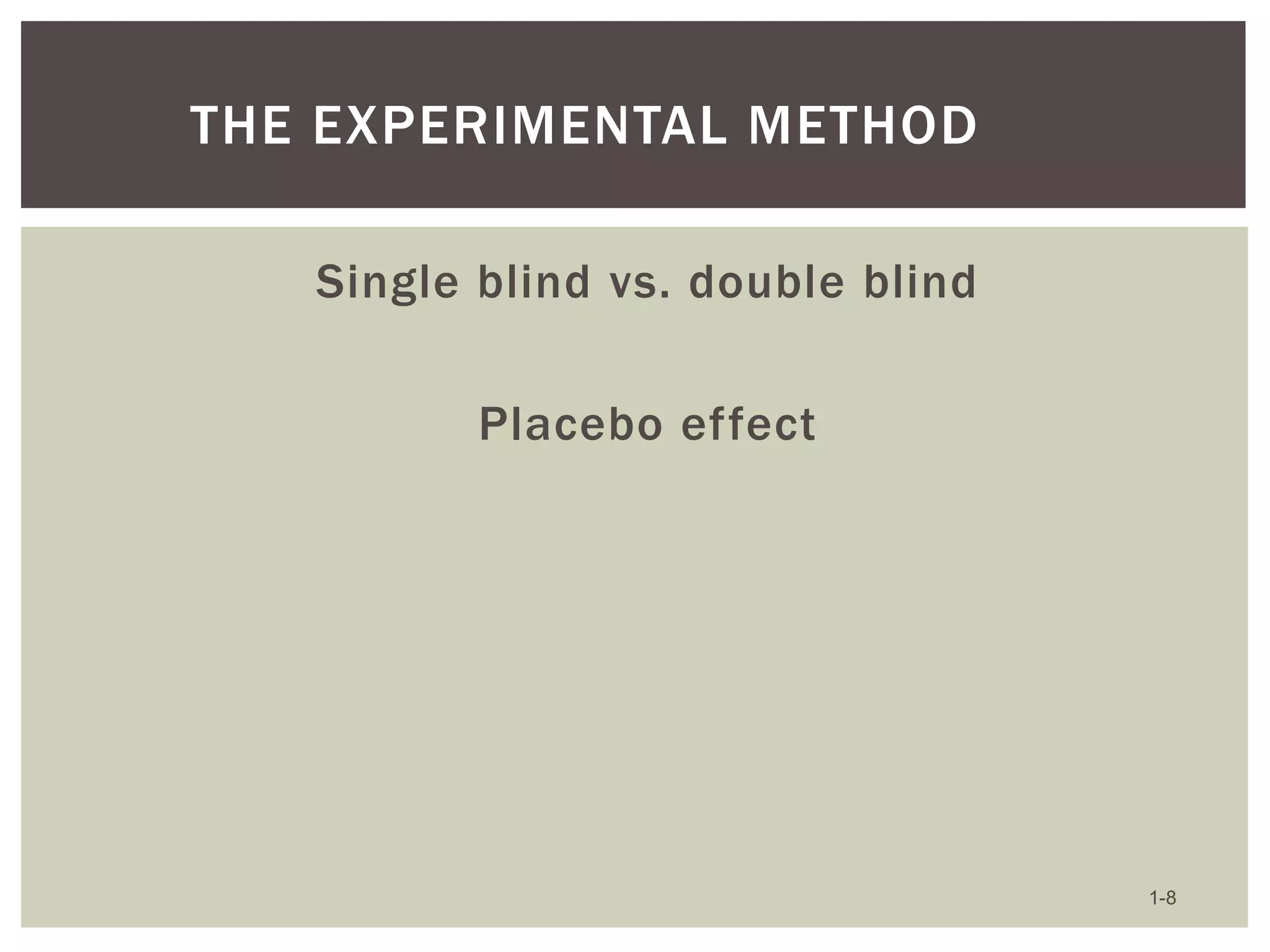
Single blind vs. double blind
Placebo effect

1-8
REVIEW
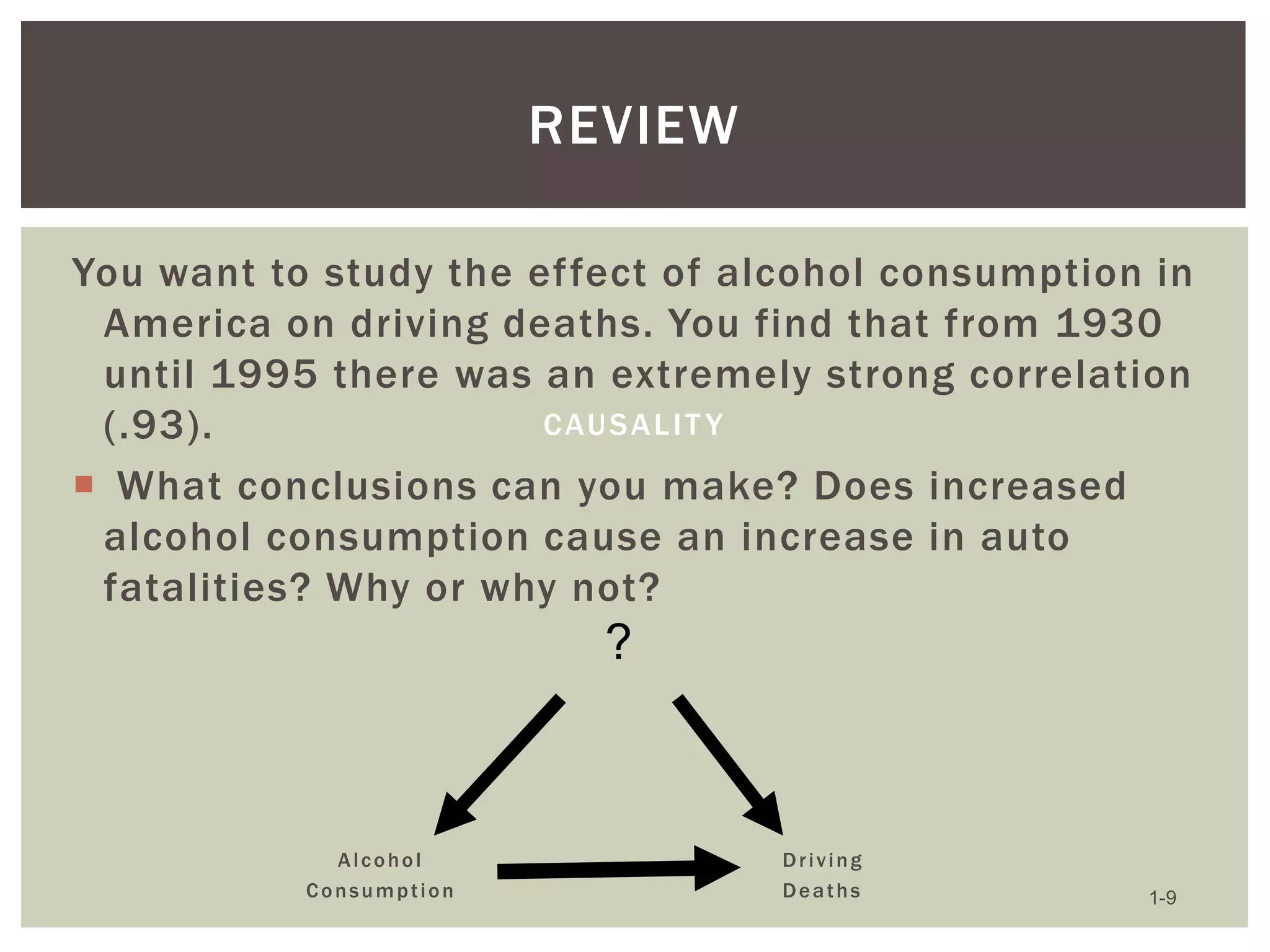
You want to study the effect of alcohol consumption in
America on driving deaths. You find that from 1930
until 1995 there was an extremely strong correlation
C AU S A L I T Y
(.93).
 What conclusions can you make? Does increased
alcohol consumption cause an increase in auto
fatalities? Why or why not?

?

Alcohol
Consumption

Driving
Deaths

1-9
RESEARCH METHODS IN PSYCHOLOGY
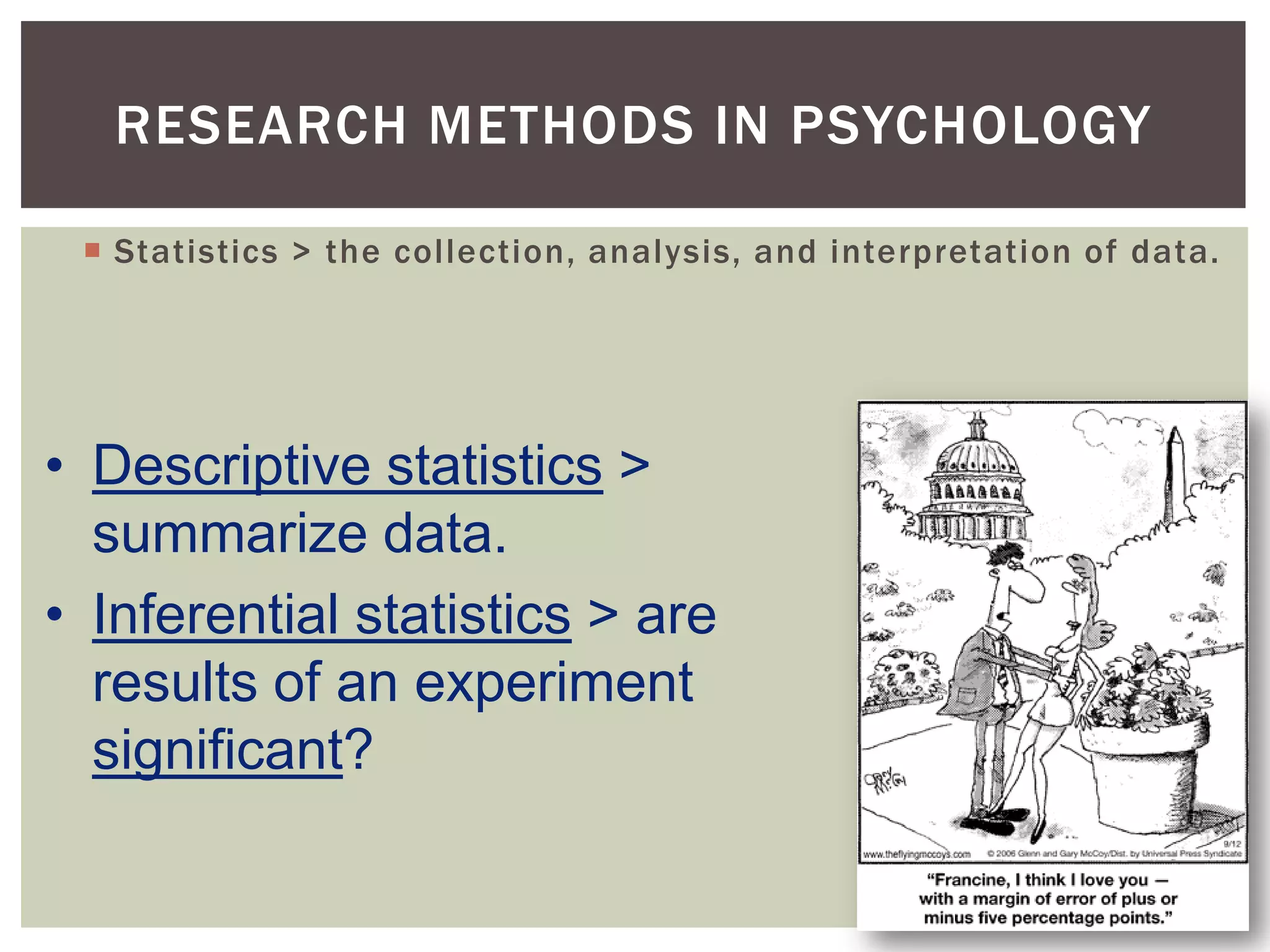
 Statistics > the collection, analysis, and interpretation of data.

• Descriptive statistics >
summarize data.
• Inferential statistics > are
results of an experiment
significant?
1-10
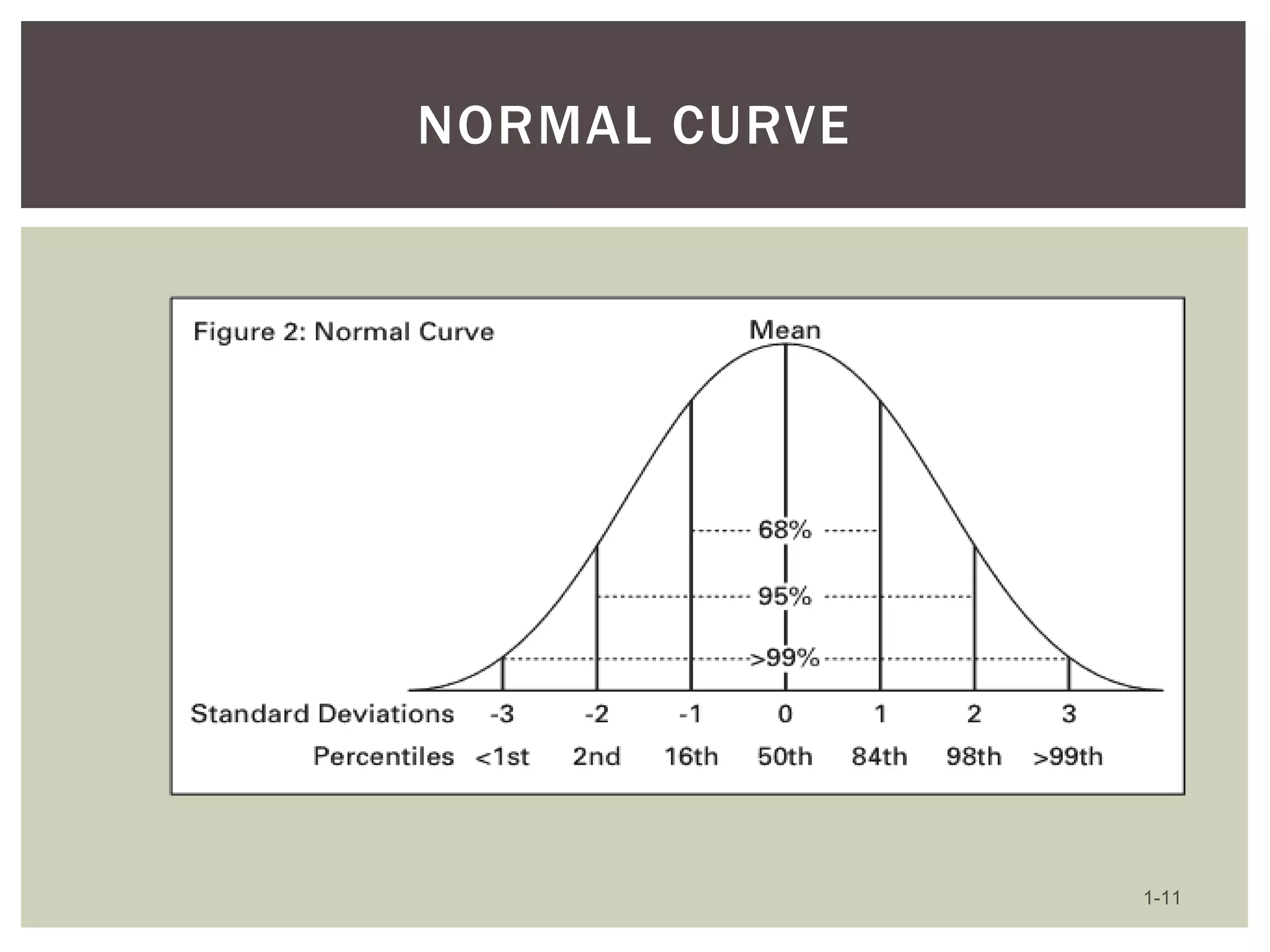
NORMAL CURVE

1-11
RESEARCH METHODS IN PSYCHOLOGY
APA ETHICAL GUIDELINES

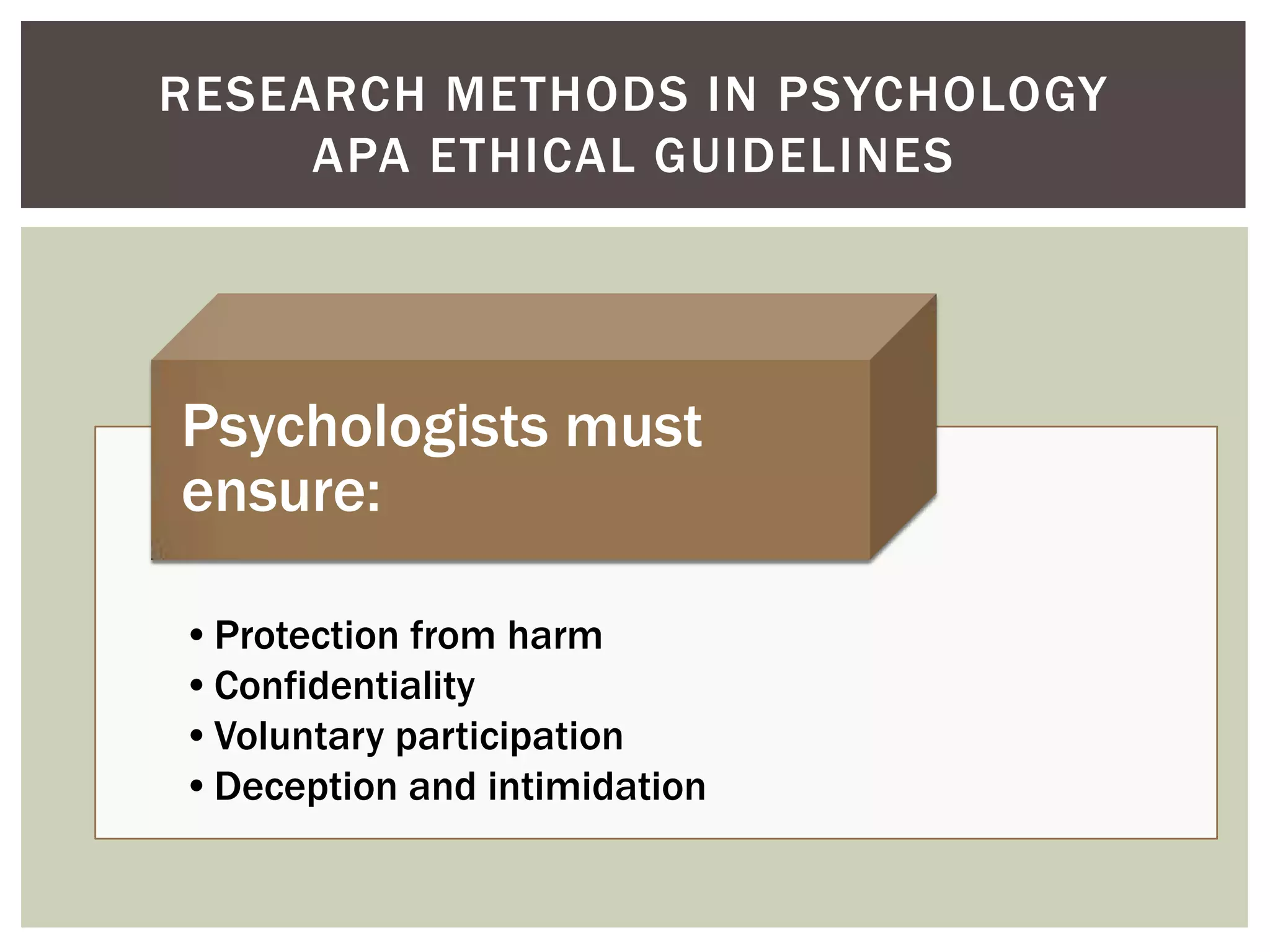
Psychologists must
ensure:
•Protection from harm
•Confidentiality
•Voluntary participation
•Deception and intimidation
THE ORIGINS OF MODERN
PSYCHOLOGY
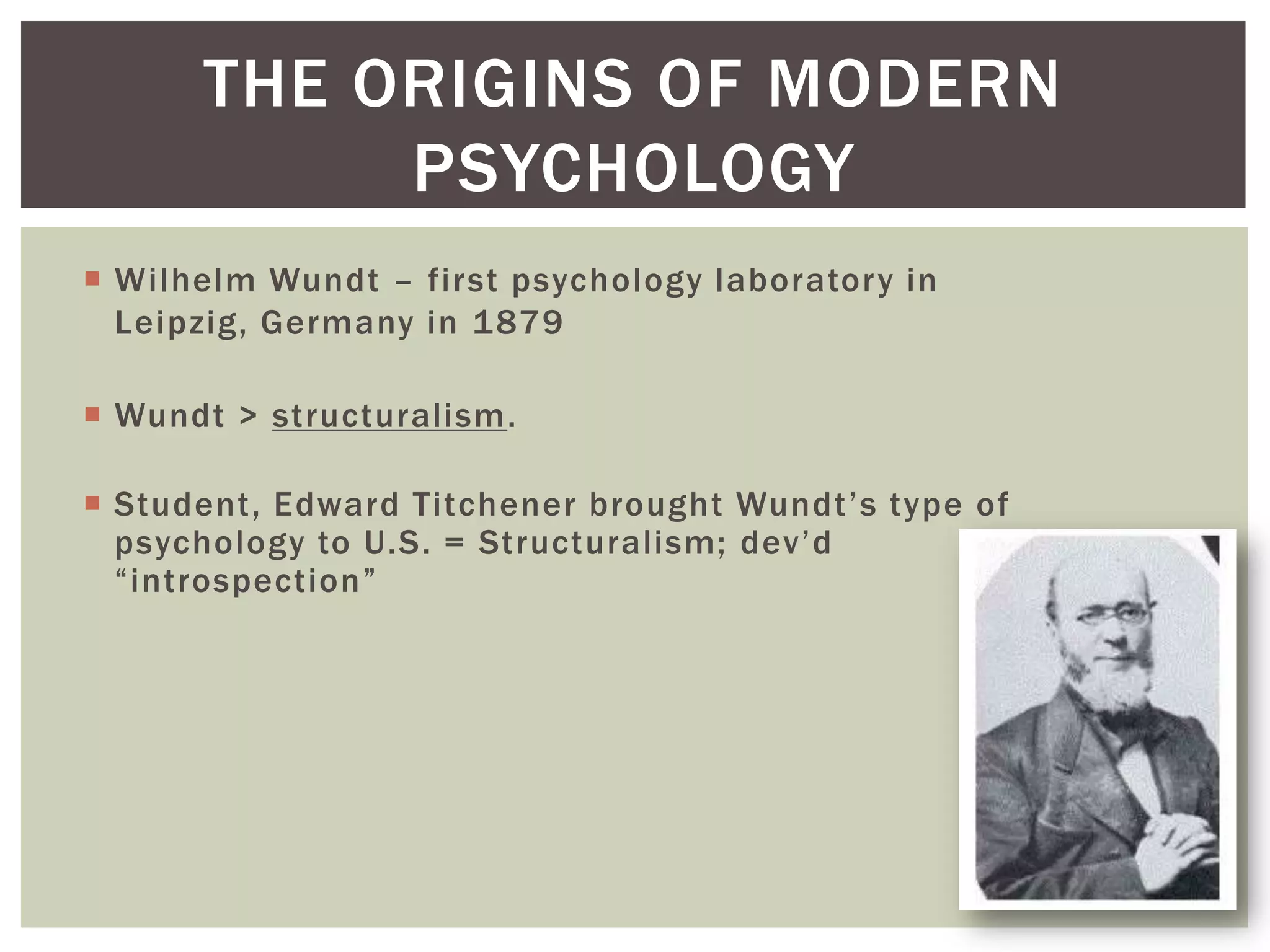
 Wilhelm Wundt – first psychology laboratory in
Leipzig, Germany in 1879
 Wundt > structuralism.
 Student, Edward Titchener brought Wundt’s type of
psychology to U.S. = Structuralism; dev’d
―introspection‖

1-13
THE ORIGINS OF MODERN
PSYCHOLOGY
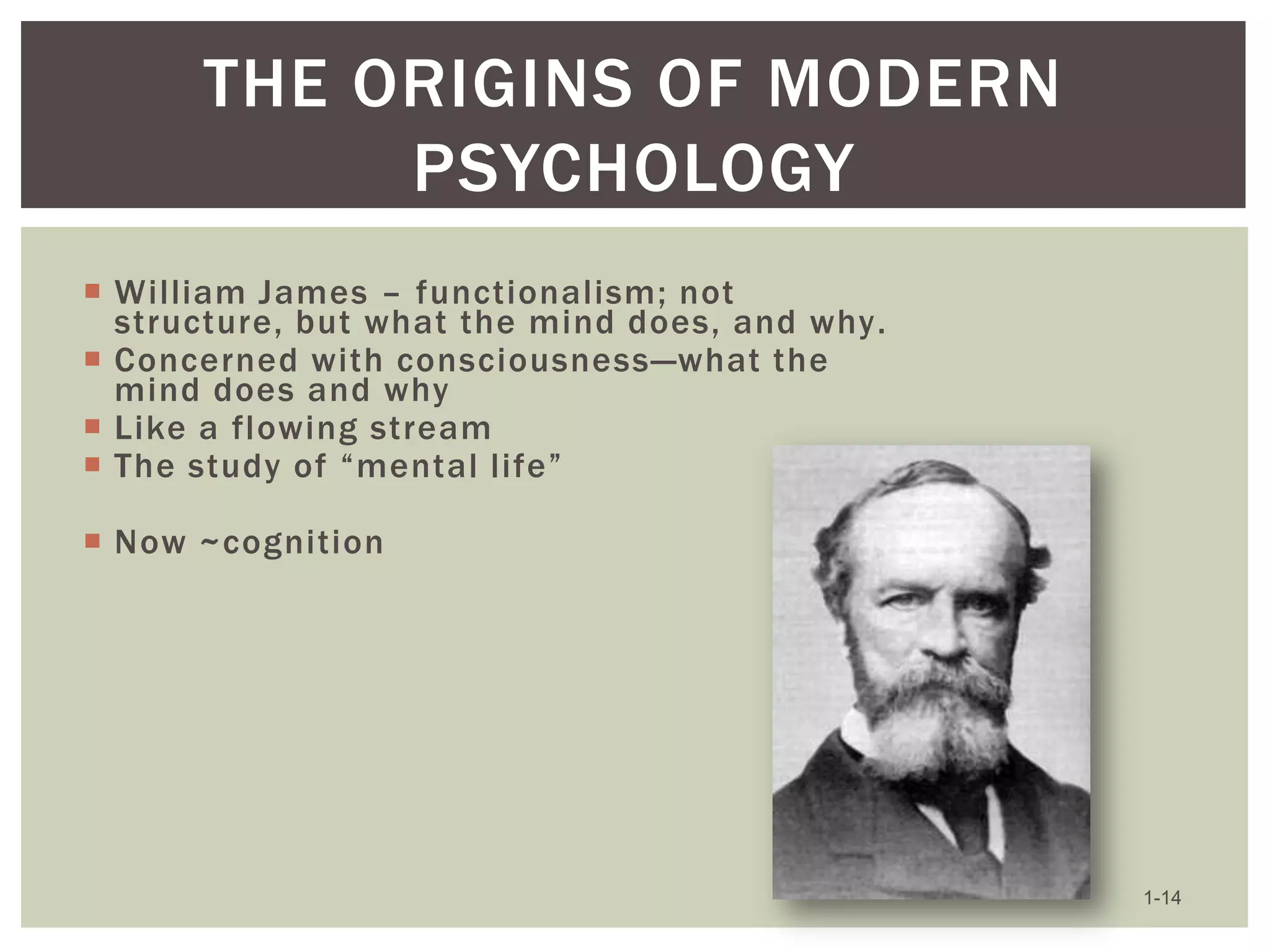
 William James – functionalism; not
structure, but what the mind does, and why.
 Concerned with consciousness—what the
mind does and why
 Like a flowing stream
 The study of ―mental life‖

 Now ~cognition

1-14
THE ORIGINS OF MODERN
PSYCHOLOGY

Gestalt
psychology

•challenge to
structuralists’
notion that
conscious
experience could be
broken down into
elements
THE ORIGINS OF MODERN PSYCHOLOGY
THE RISE OF APPLIED PSYCHOLOGY
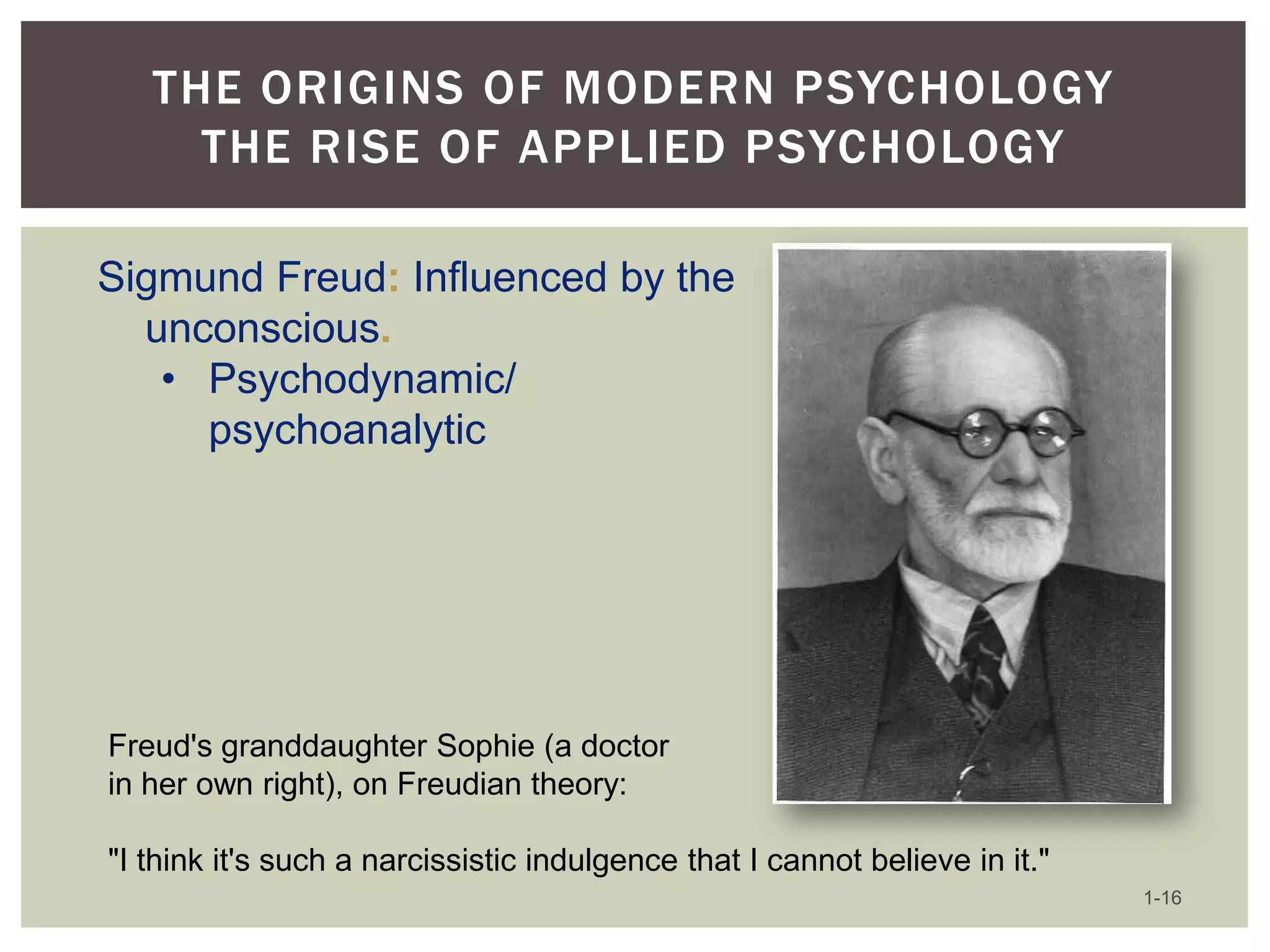
Sigmund Freud: Influenced by the
unconscious.
• Psychodynamic/
psychoanalytic

Freud's granddaughter Sophie (a doctor
in her own right), on Freudian theory:
"I think it's such a narcissistic indulgence that I cannot believe in it."
1-16
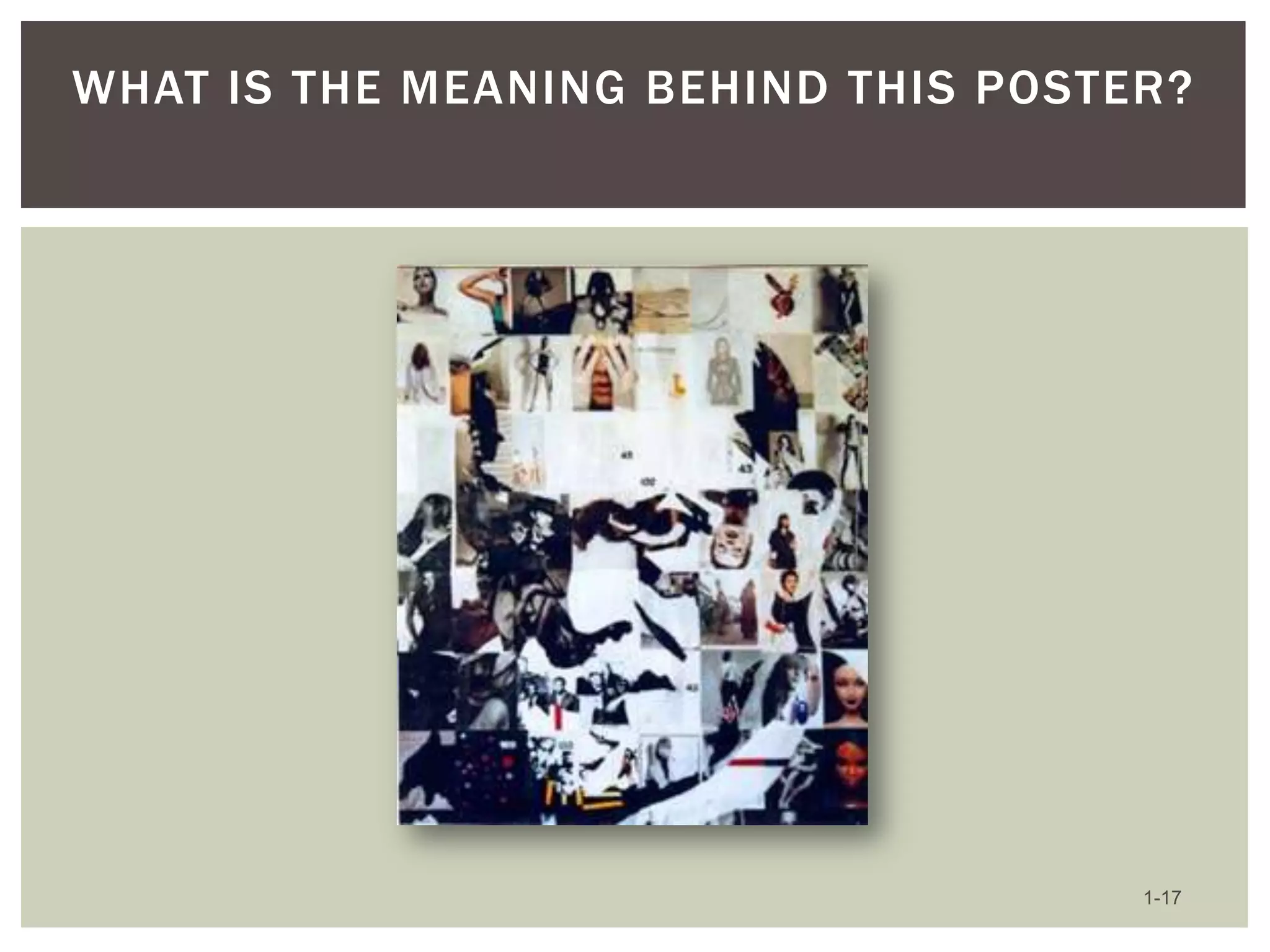
WHAT IS THE MEANING BEHIND THIS POSTER?

1-17
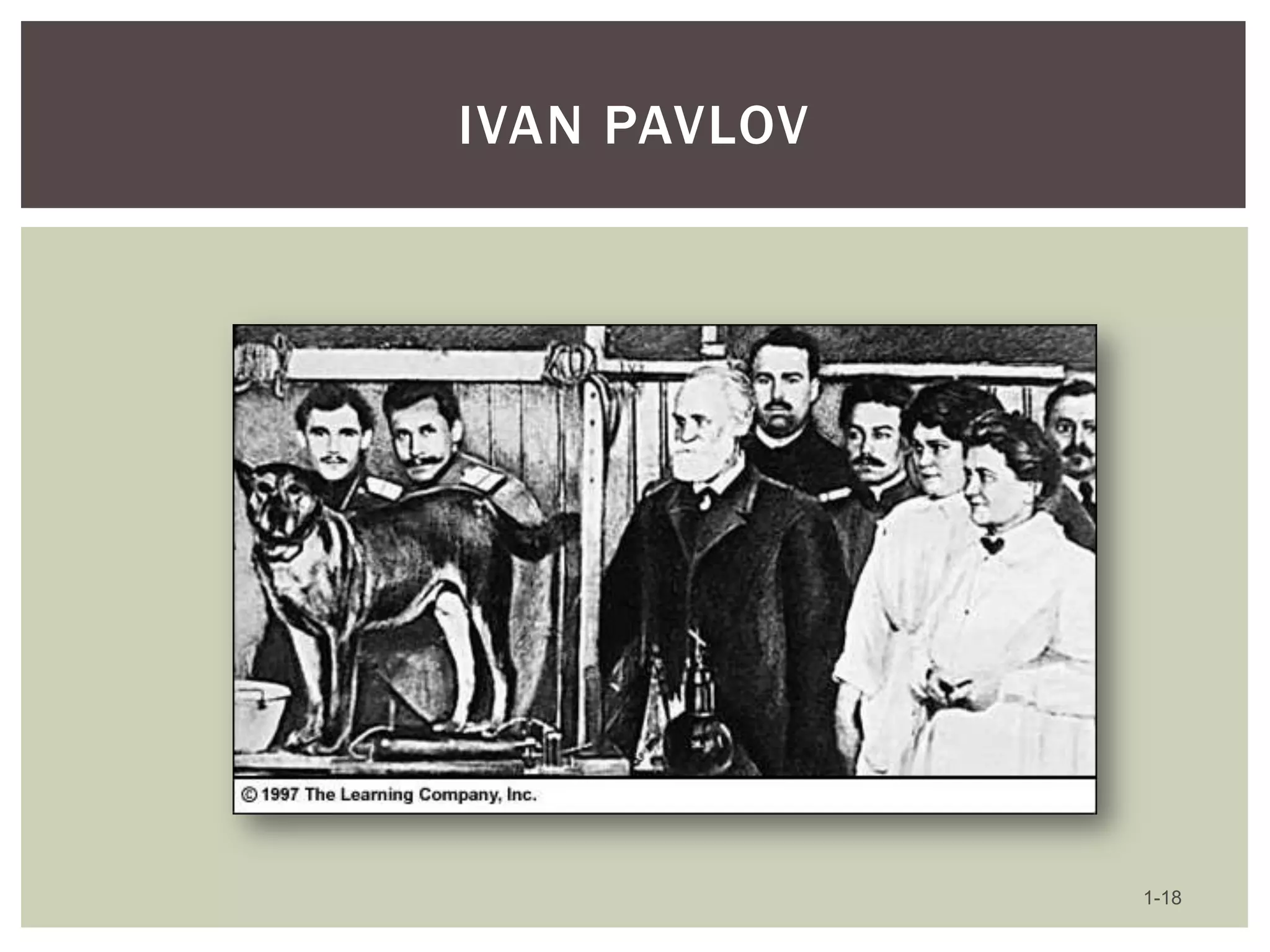
IVAN PAVLOV

1-18
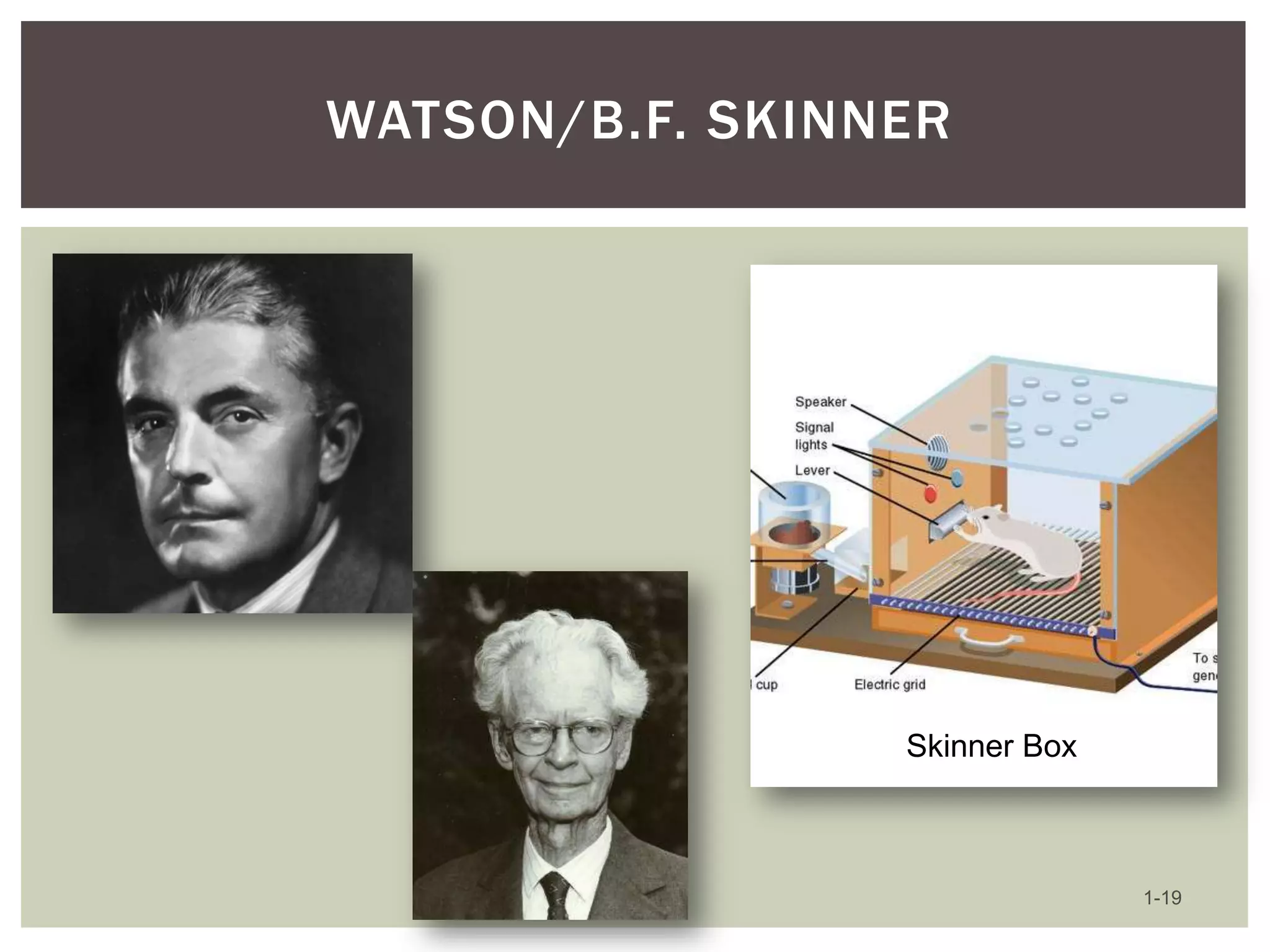
WATSON/B.F. SKINNER

Skinner Box

1-19
THE ORIGINS OF MODERN PSYCHOLOGY
THE RISE OF APPLIED PSYCHOLOGY

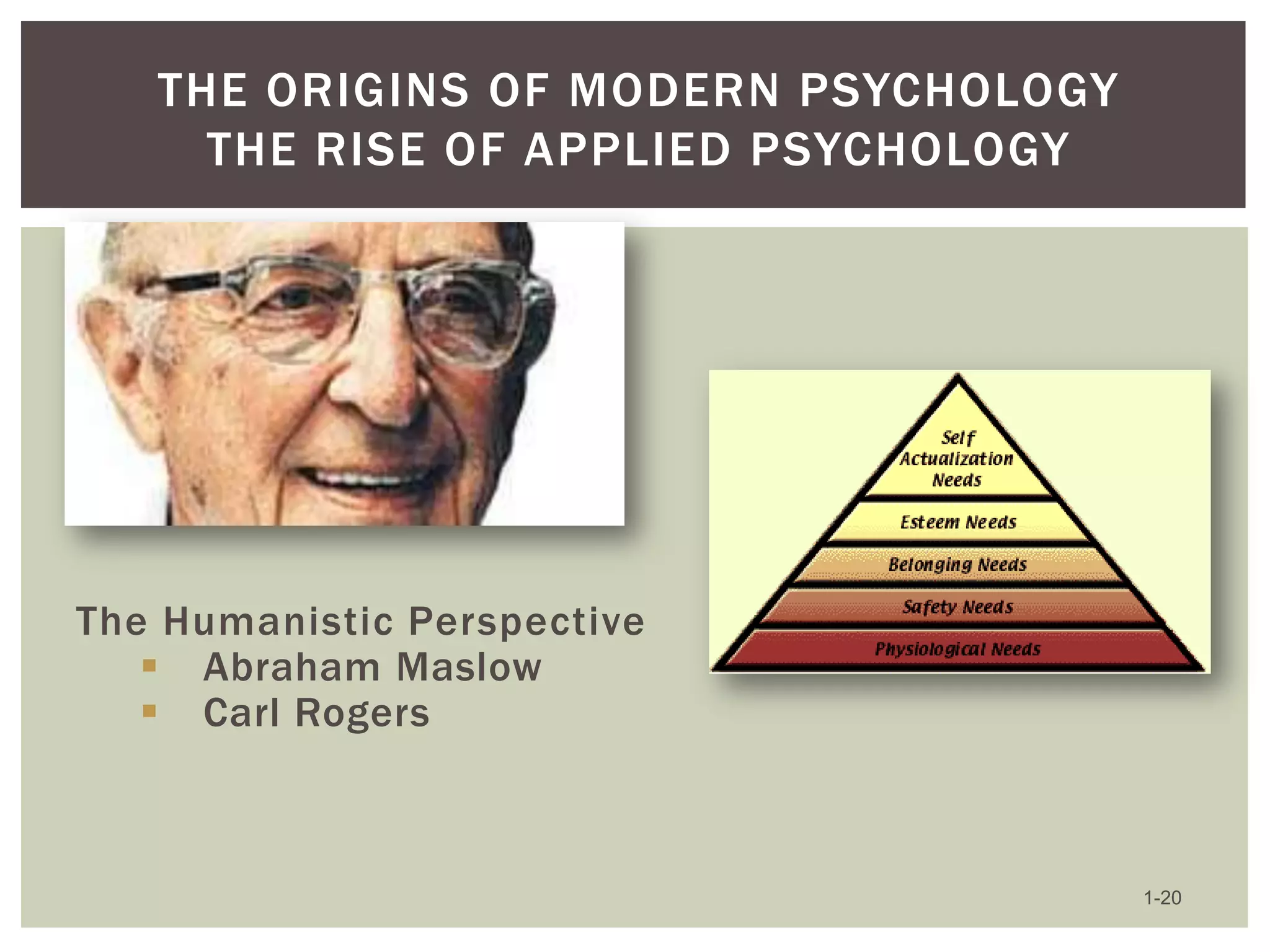
The Humanistic Perspective
 Abraham Maslow
 Carl Rogers

1-20
THE ORIGINS OF MODERN
PSYCHOLOGY

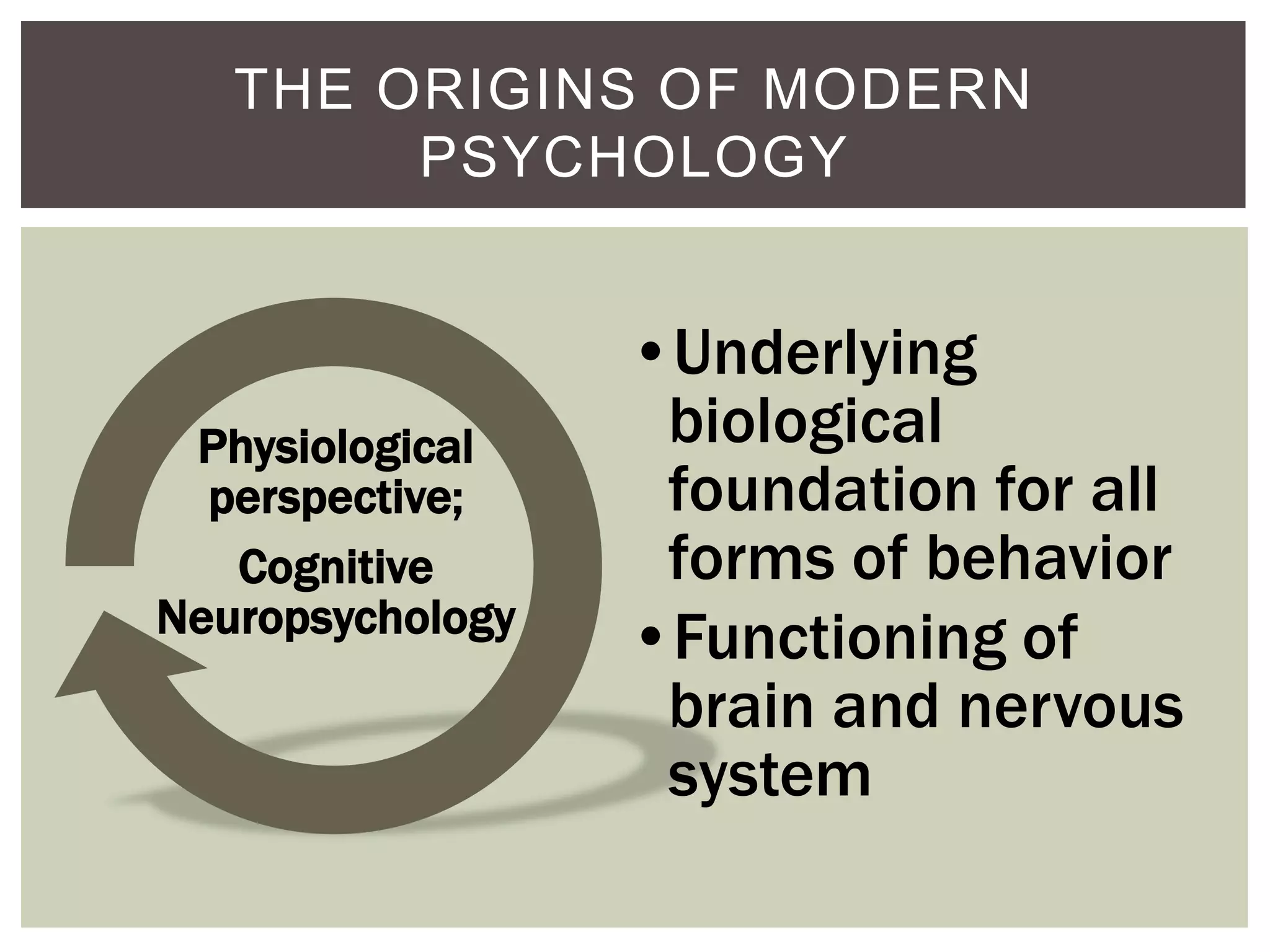
Physiological
perspective;
Cognitive
Neuropsychology

•Underlying
biological
foundation for all
forms of behavior
•Functioning of
brain and nervous
system
THE ORIGINS OF MODERN
PSYCHOLOGY

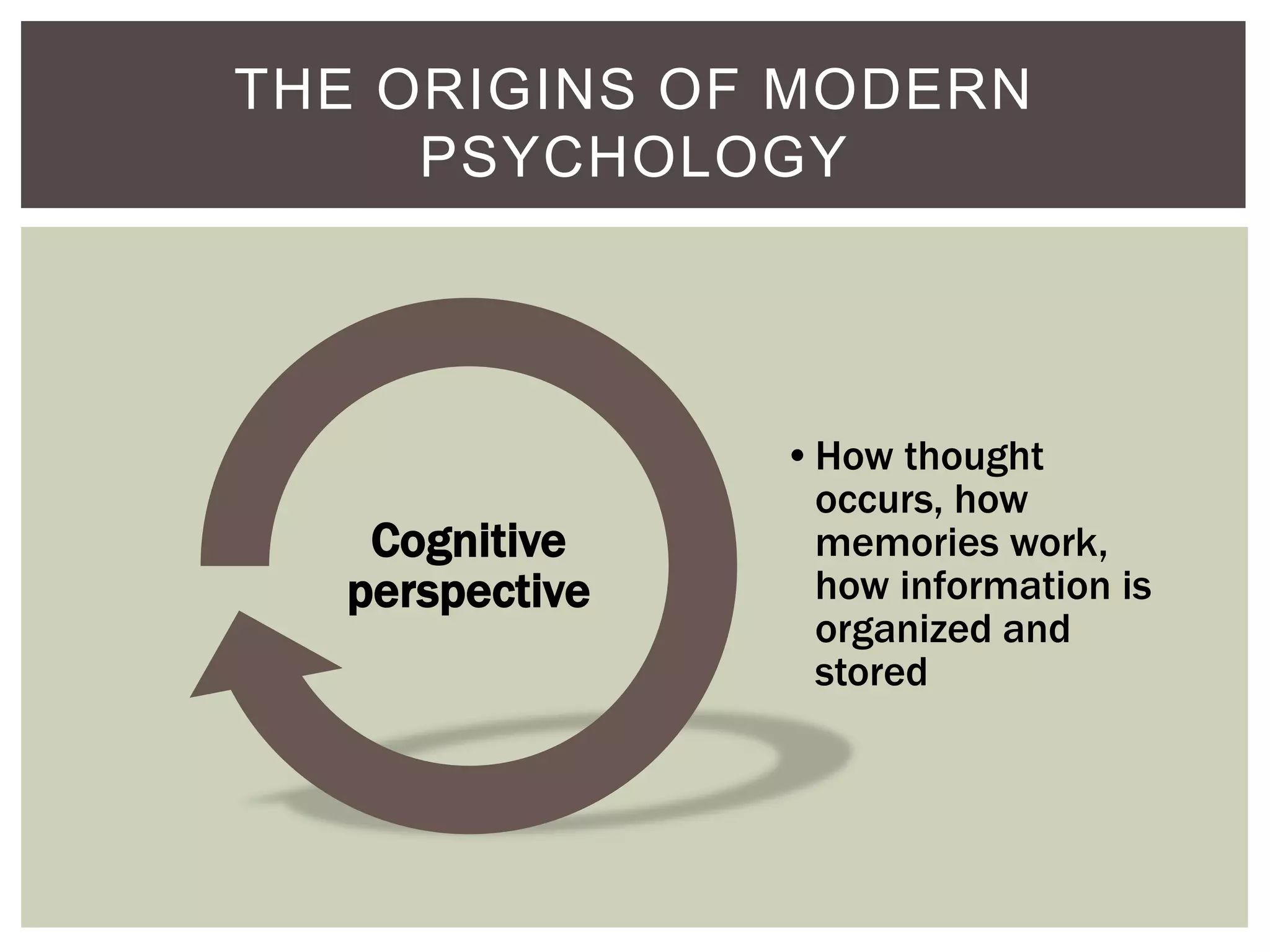
Cognitive
perspective

•How thought
occurs, how
memories work,
how information is
organized and
stored
THE ORIGINS OF MODERN
PSYCHOLOGY

Evolutionary
perspective
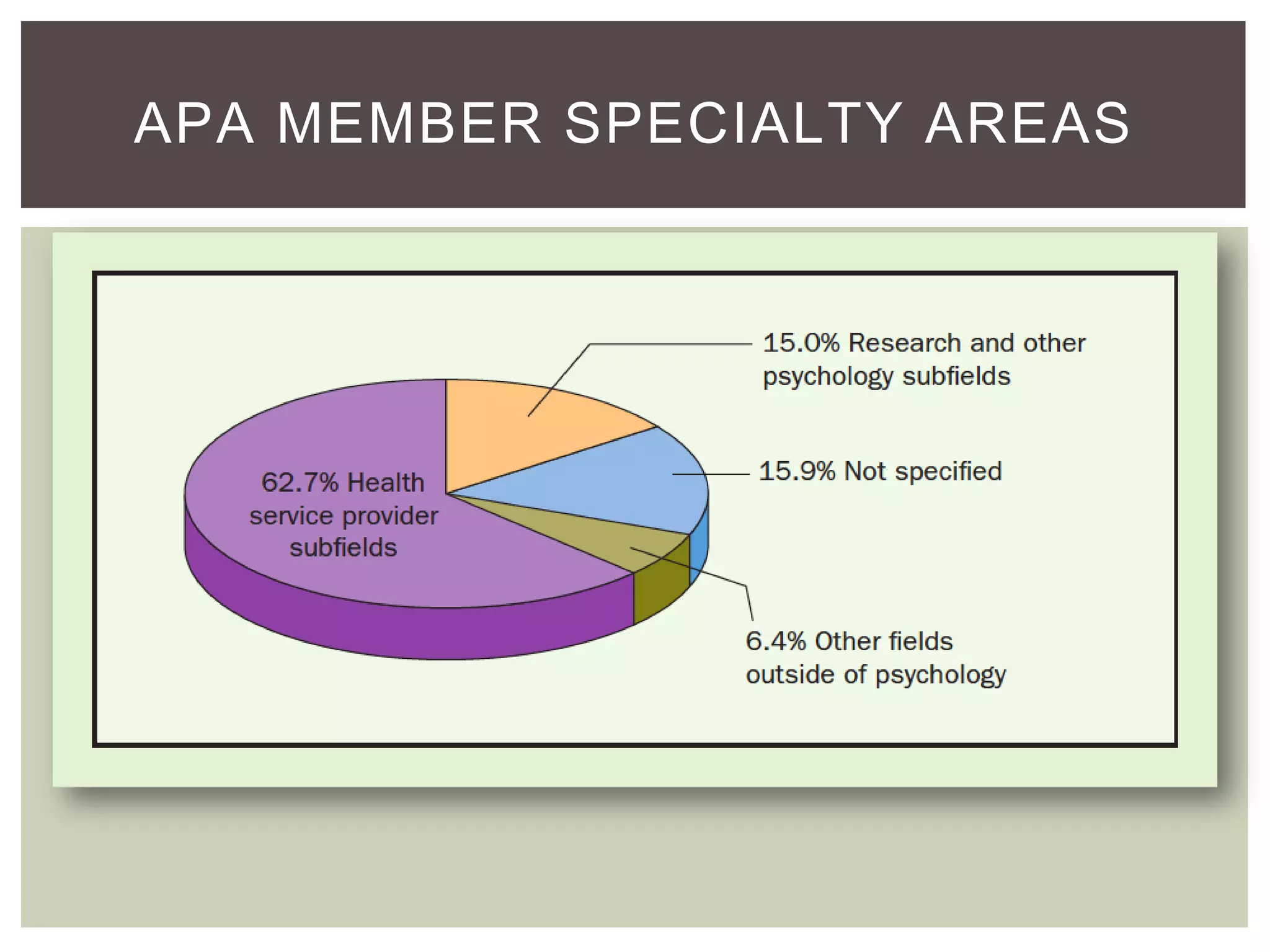
APA MEMBER SPECIALTY AREAS
WHAT DO YOU THINK?

What do psychology
majors do after
college?
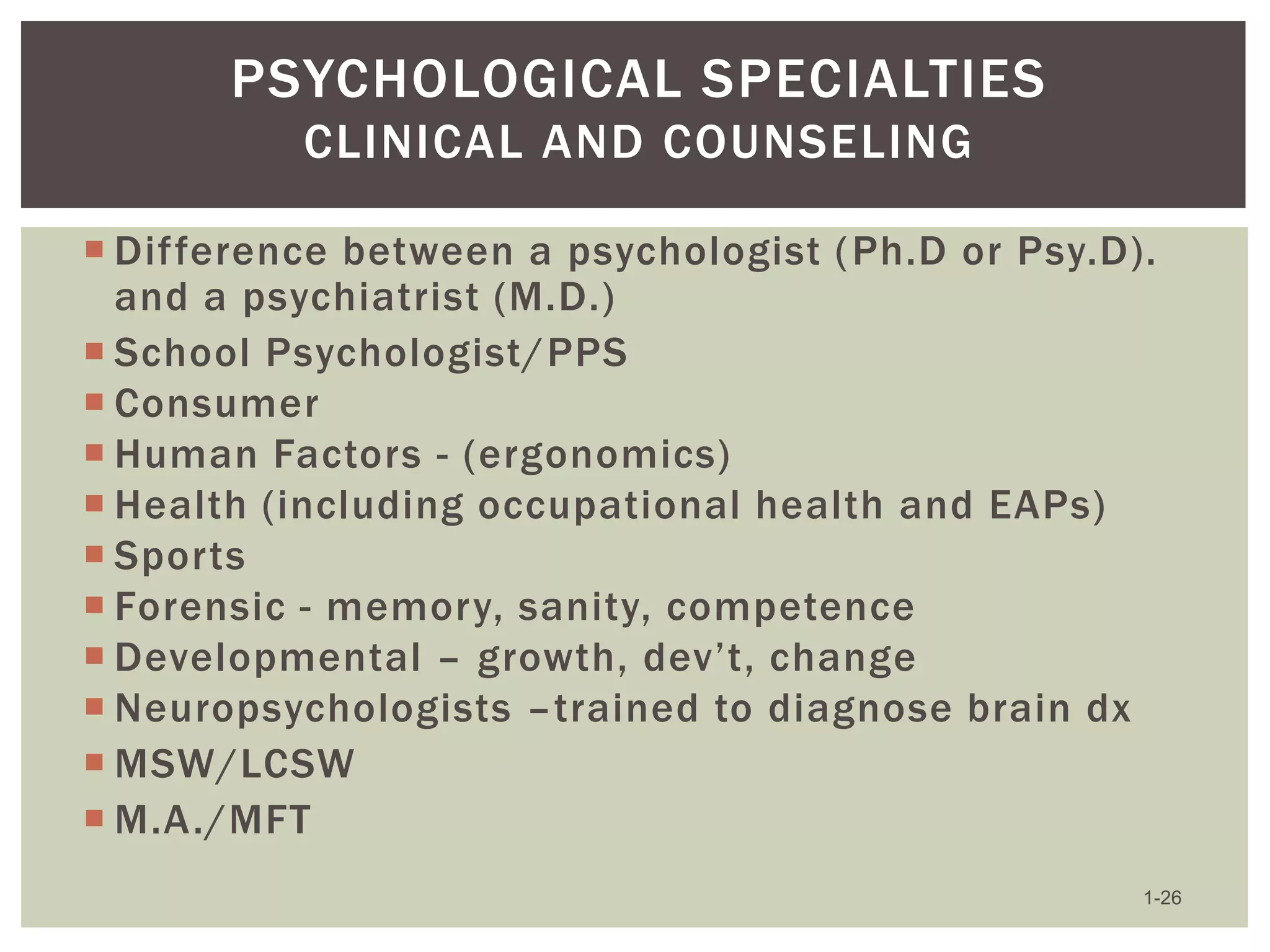
PSYCHOLOGICAL SPECIALTIES
CLINICAL AND COUNSELING
 Difference between a psychologist ( Ph.D or Psy.D).
and a psychiatrist (M.D.)
 School Psychologist/PPS
 Consumer
 Human Factors - (ergonomics)
 Health (including occupational health and EAPs)
 Sports
 Forensic - memory, sanity, competence
 Developmental – growth, dev’t, change
 Neuropsychologists –trained to diagnose brain dx
 MSW/LCSW
 M.A./MFT
1-26
PSYCHOLOGICAL SPECIALTIES
AND CAREERS
 Research Psychologists
 IO
I
Assess basic Knowledge, Skills, Abilities, and Other
characteristics to perform a job.
Testing of job applicants, accommodation
O
 Social process of work
 Consumer
 Human Factors - design equipment and machines
(ergonomics)
 Health (including occupational health and EAPs)
 Sports
 Forensic - memory, sanity, competence
 Developmental – growth, dev’t, change [?]

1-27

Chapter 1 Psych 1 Online Stud

  • 1.
  • 2.
    RESEARCH METHODS IN PSYCHOLOGY Psychology is the science of behavior and mental processes.  It is both scientific and applied Describe, predict and control behavior Goals of psychology Accomplished by using scientific method
  • 3.
    RESEARCH METHODS      Case studyand interviews Survey/Questionnaires – representative sample? Naturalistic Observation Operational definition – replication Correlational research 1-3
  • 4.
    RESEARCH METHODS INPSYCHOLOGY Correlational research tells whether the values of two variables are related. Can be used to predict, but IT DOES NOT SHOW CAUSALITY! 1-4
  • 5.
    THE EXPERIMENTAL METHOD Howdo changes in one variable affect another? Independent variable(The IV) Dependent variable (the DV) In the experimental method, we manipulate the IV to determine the effect on the DV 1-5
  • 6.
    THE EXPERIMENTAL METHOD Compareoutcomes of: Experimental group Control group Know: Extraneous variables Bias 1-6
  • 7.
    RESEARCH METHODS INPSYCHOLOGY Manipulation of the IV (the cause) determines whether it influences the DV (the effect) 1-7
  • 8.
    THE EXPERIMENTAL METHOD Singleblind vs. double blind Placebo effect 1-8
  • 9.
    REVIEW You want tostudy the effect of alcohol consumption in America on driving deaths. You find that from 1930 until 1995 there was an extremely strong correlation C AU S A L I T Y (.93).  What conclusions can you make? Does increased alcohol consumption cause an increase in auto fatalities? Why or why not? ? Alcohol Consumption Driving Deaths 1-9
  • 10.
    RESEARCH METHODS INPSYCHOLOGY  Statistics > the collection, analysis, and interpretation of data. • Descriptive statistics > summarize data. • Inferential statistics > are results of an experiment significant? 1-10
  • 11.
  • 12.
    RESEARCH METHODS INPSYCHOLOGY APA ETHICAL GUIDELINES Psychologists must ensure: •Protection from harm •Confidentiality •Voluntary participation •Deception and intimidation
  • 13.
    THE ORIGINS OFMODERN PSYCHOLOGY  Wilhelm Wundt – first psychology laboratory in Leipzig, Germany in 1879  Wundt > structuralism.  Student, Edward Titchener brought Wundt’s type of psychology to U.S. = Structuralism; dev’d ―introspection‖ 1-13
  • 14.
    THE ORIGINS OFMODERN PSYCHOLOGY  William James – functionalism; not structure, but what the mind does, and why.  Concerned with consciousness—what the mind does and why  Like a flowing stream  The study of ―mental life‖  Now ~cognition 1-14
  • 15.
    THE ORIGINS OFMODERN PSYCHOLOGY Gestalt psychology •challenge to structuralists’ notion that conscious experience could be broken down into elements
  • 16.
    THE ORIGINS OFMODERN PSYCHOLOGY THE RISE OF APPLIED PSYCHOLOGY Sigmund Freud: Influenced by the unconscious. • Psychodynamic/ psychoanalytic Freud's granddaughter Sophie (a doctor in her own right), on Freudian theory: "I think it's such a narcissistic indulgence that I cannot believe in it." 1-16
  • 17.
    WHAT IS THEMEANING BEHIND THIS POSTER? 1-17
  • 18.
  • 19.
  • 20.
    THE ORIGINS OFMODERN PSYCHOLOGY THE RISE OF APPLIED PSYCHOLOGY The Humanistic Perspective  Abraham Maslow  Carl Rogers 1-20
  • 21.
    THE ORIGINS OFMODERN PSYCHOLOGY Physiological perspective; Cognitive Neuropsychology •Underlying biological foundation for all forms of behavior •Functioning of brain and nervous system
  • 22.
    THE ORIGINS OFMODERN PSYCHOLOGY Cognitive perspective •How thought occurs, how memories work, how information is organized and stored
  • 23.
    THE ORIGINS OFMODERN PSYCHOLOGY Evolutionary perspective
  • 24.
  • 25.
    WHAT DO YOUTHINK? What do psychology majors do after college?
  • 26.
    PSYCHOLOGICAL SPECIALTIES CLINICAL ANDCOUNSELING  Difference between a psychologist ( Ph.D or Psy.D). and a psychiatrist (M.D.)  School Psychologist/PPS  Consumer  Human Factors - (ergonomics)  Health (including occupational health and EAPs)  Sports  Forensic - memory, sanity, competence  Developmental – growth, dev’t, change  Neuropsychologists –trained to diagnose brain dx  MSW/LCSW  M.A./MFT 1-26
  • 27.
    PSYCHOLOGICAL SPECIALTIES AND CAREERS Research Psychologists  IO I Assess basic Knowledge, Skills, Abilities, and Other characteristics to perform a job. Testing of job applicants, accommodation O  Social process of work  Consumer  Human Factors - design equipment and machines (ergonomics)  Health (including occupational health and EAPs)  Sports  Forensic - memory, sanity, competence  Developmental – growth, dev’t, change [?] 1-27

Editor's Notes

  • #4 Case Study Goal: Use information obtained from one person to understand behaviors of others+ = depth of analysis; - = not necessarily generalizable; costN.O. = Disadvantage: Effort needed to ensure observation does not affect the behaviors observed and recorded
  • #13 For example, psychologists must maintain high standards of competence in their work, including recognizing the limitations of their expertise. They also must show respect for the rights and dignity of people, such as rights to privacy and confidentiality.The ethical guidelines for conducting research require that all research proposals be reviewed to ensure compliance with the guidelines. Each proposal must be approved by an institutional review board (IRB) established by a college, university, or other organization where research is conducted.The ethical guidelines state that psychologists who conduct research using human participants must ensure that they are protected from physical and psychological harm. The ethical guidelines also require that any research records associated with a person’s name or identity be kept confidential.
  • #16 A group of psychologists who termed their approach Gestalt psychology, which was noted for emphasizing that perception of a whole differs from that of the individual stimuli that make up the whole, spearheaded the challenge to the structuralists’ notion that conscious experience could be broken down into elements.The key members of this group were Max Wertheimer, Wolfgang Köhler, and Kurt Koffka.
  • #17 both normal and abnormal behaviors are determined primarily by unconscious forces
  • #19 focused on observable behavior and emphasized learned nature of behavior
  • #24 Charles Darwin, who popularized the theory of evolution, maintained that evolution unfolds according to the principle of natural selection,which states that the strongest or most fit organisms are those that have adapted best to their environment.
  • #25 Figure 1.5, Davis and Palladino, 7e, p. 33As we have seen, psychologists represent a number of different specialty areas. Members of the American Psychological Association can be divided into several major groups. Those listed as Health Service Providers include clinical, counseling, school, and health psychologists. Research psychologists include industrial/organizational, developmental, social, and educational psychologists.source: Current Major Field of APA Members by Membership Status, 2009.
  • #26 See p. 37 in text (Table 1.5)