INTRODUCTION TO PSYCHOLOGY
Nature and Foundations of
Psychology
Psychology was not a separate discipline
rather it was studied under Philosophy.
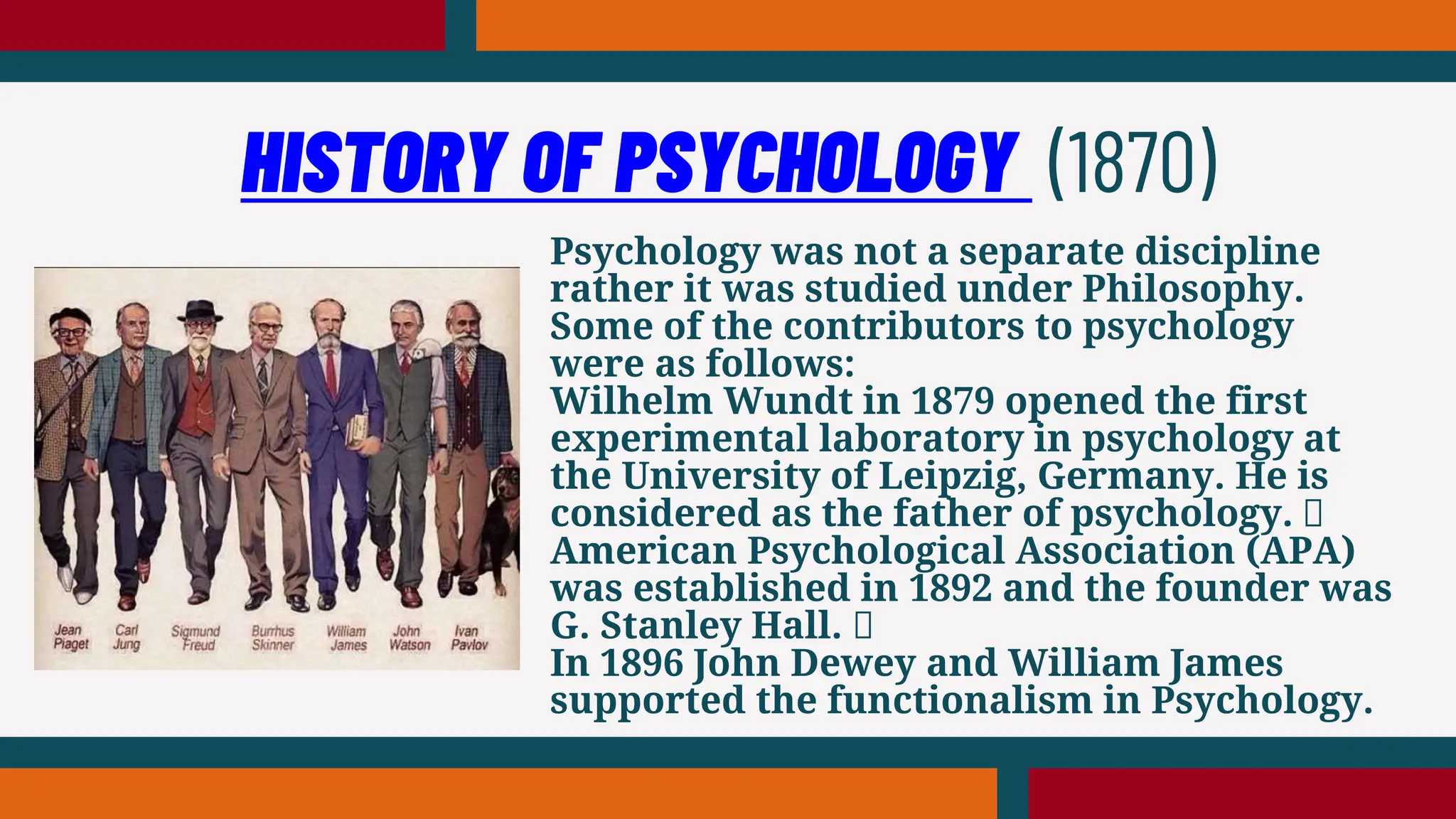
Some of the contributors to psychology
were as follows:
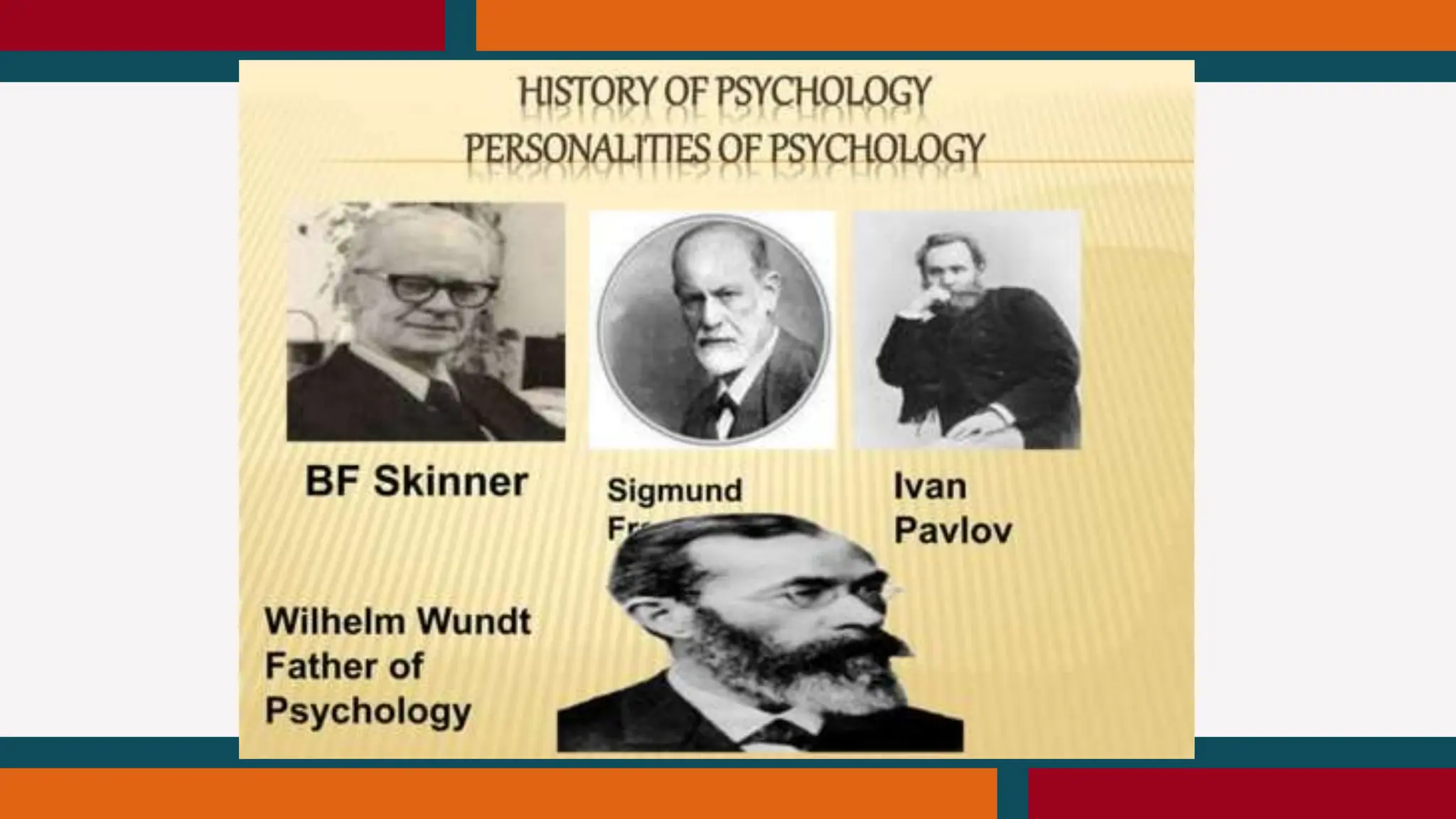
Wilhelm Wundt in 1879 opened the first
experimental laboratory in psychology at
the University of Leipzig, Germany. He is
considered as the father of psychology.
American Psychological Association (APA)
was established in 1892 and the founder was
G. Stanley Hall.
In 1896 John Dewey and William James
supported the functionalism in Psychology.
HISTORY OF PSYCHOLOGY (1870)
SIGMUND FREUD ( 1896)
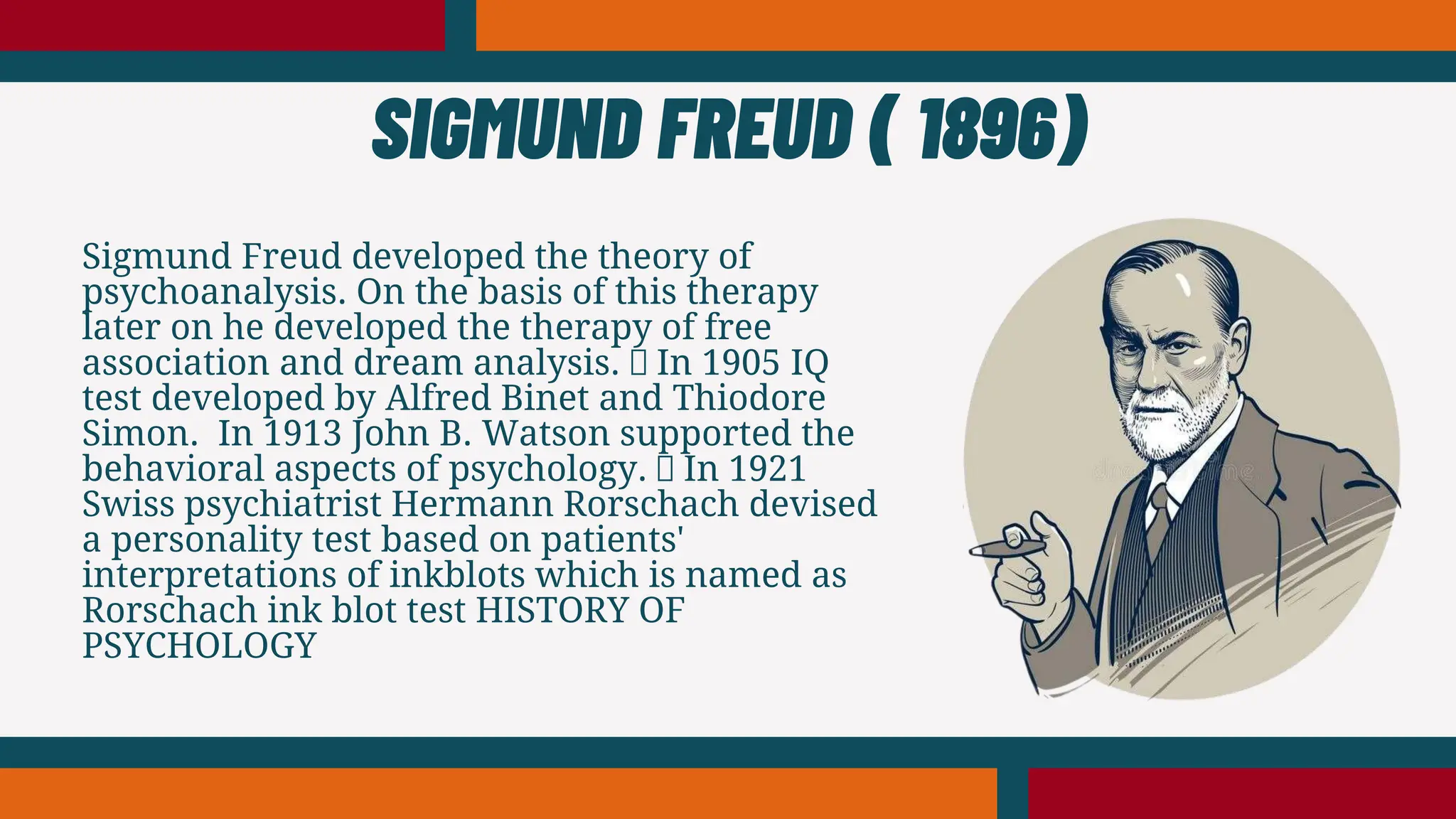
Sigmund Freud developed the theory of
psychoanalysis. On the basis of this therapy
later on he developed the therapy of free
association and dream analysis. In 1905 IQ
test developed by Alfred Binet and Thiodore
Simon. In 1913 John B. Watson supported the
behavioral aspects of psychology. In 1921
Swiss psychiatrist Hermann Rorschach devised
a personality test based on patients'
interpretations of inkblots which is named as
Rorschach ink blot test HISTORY OF
PSYCHOLOGY
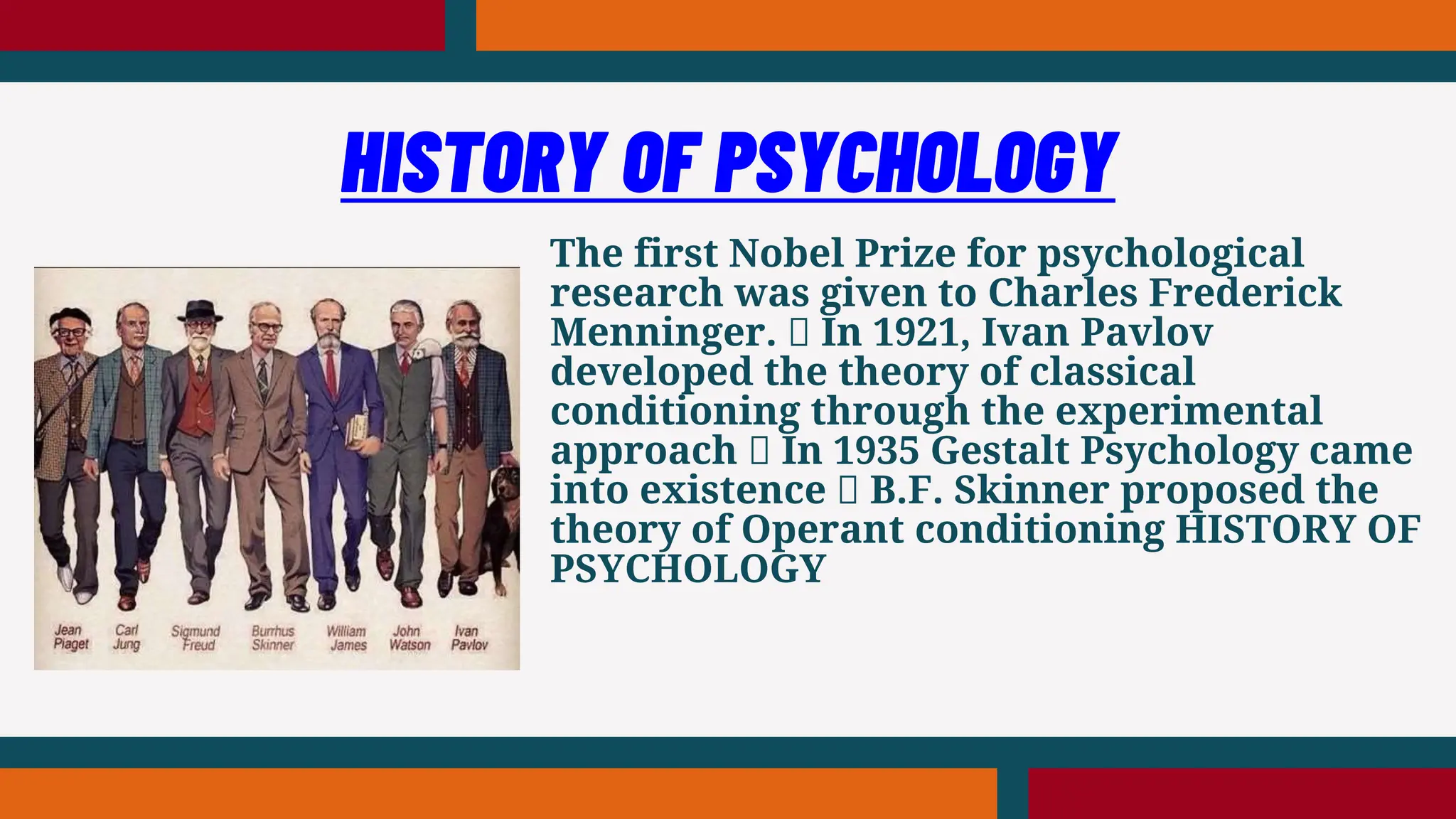
The first Nobel Prize for psychological
research was given to Charles Frederick
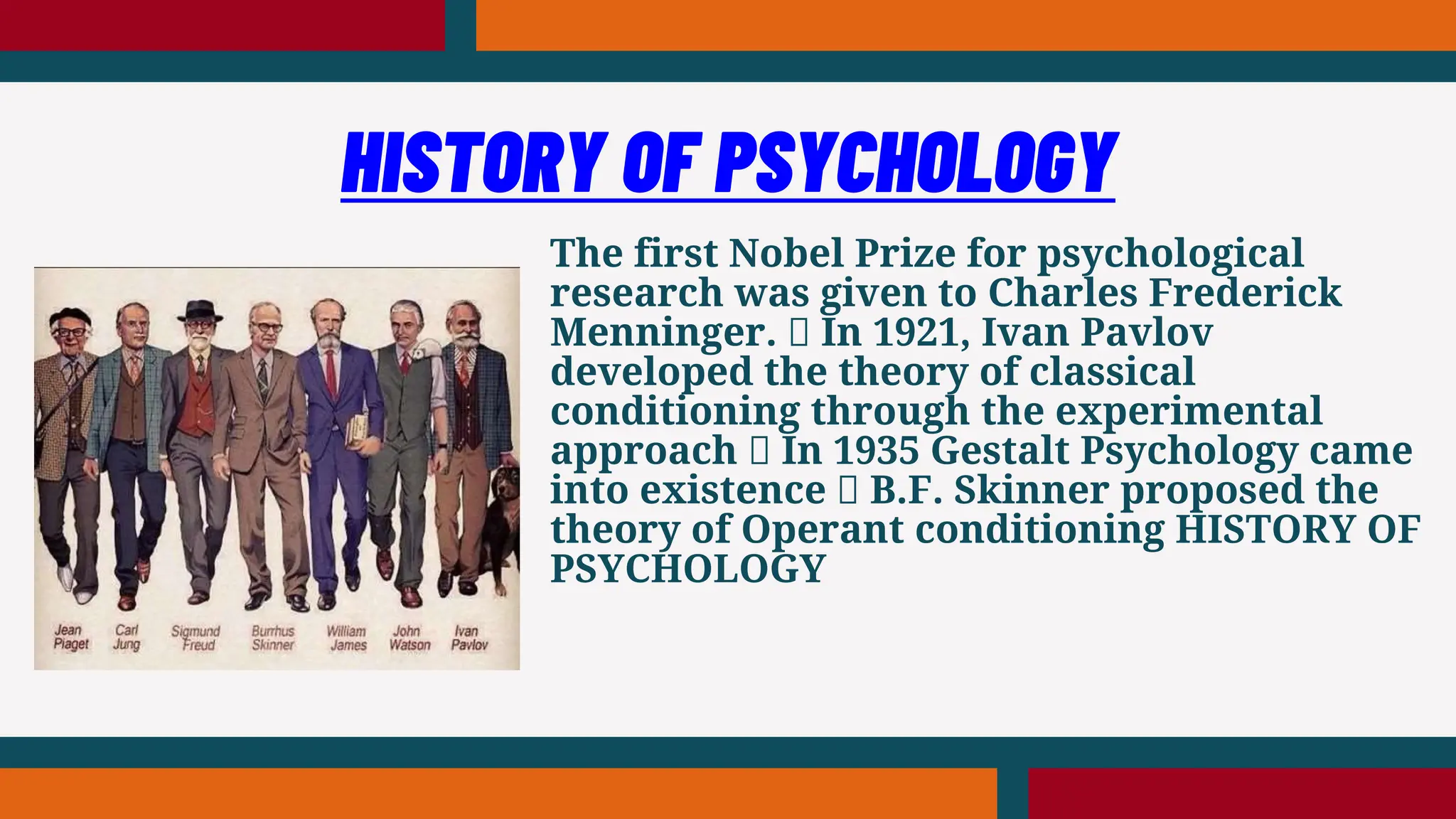
Menninger. In 1921, Ivan Pavlov
developed the theory of classical
conditioning through the experimental
approach In 1935 Gestalt Psychology came
into existence B.F. Skinner proposed the
theory of Operant conditioning HISTORY OF
PSYCHOLOGY
HISTORY OF PSYCHOLOGY
The first Nobel Prize for psychological
research was given to Charles Frederick
Menninger. In 1921, Ivan Pavlov
developed the theory of classical
conditioning through the experimental
approach In 1935 Gestalt Psychology came
into existence B.F. Skinner proposed the
theory of Operant conditioning HISTORY OF
PSYCHOLOGY
HISTORY OF PSYCHOLOGY
“a science is the body of systematized knowledge that is gathered
carefully observing and measuring events.” Like any other science
Psychology is also based on the observations and experiments which
others can repeat and verify. Psychology concerns with the
observation and explanations of human behavior in single
individuals or in groups. “a science deals with a group of related facts
and principles of particular subject” Psychology as a science deals
with the motives, feelings, emotions, thoughts action of men and
women
ORIGIN OF SCIENCE OF PSYCHOLOGY
like a science, psychology discovers and explains the underlying laws
and principles of human behavior. Psychology describes the laws of
learning, feelings, and thinking. Like any other science, psychology
collects the subject matter or facts of behavior. Psychology is a
positive science not the normative as it describes the facts of human
behavior and its laws as they are not as they ought to be. Wundt was
the first psychologist to measure human behavior accurately.
Sigmund Freud, Maslow, Rogers, Watson, Pavlov, and Thichener were
all important in the development of Psychology as science. ORIGIN OF
SCIENCE OF PSYCHOLOGY
ORIGIN OF SCIENCE OF PSYCHOLOGY
"Psychology" comes from the Greek word psyche meaning "breath, spirit,
soul", and the Greek word logia meaning the study of something. Thus we
can conclude that psychology is the study of the soul. There are various
definitions for psychology given by a variety of authors which are-
“study of the mind” “descriptions and explanations of the state of
consciousness” “William James” *
“study of consciousness” …. “Wilhelm Wundt ”
* “Positive science of the conduct of the living creature” “William
McDougall”
* “Psychology is the science which aims to give us better understanding and
control of the behavior of the organism as a whole” “William McDougall”
PSYCHOLOGY
Psychology is the Scientific study Human behavior and
Mental Processes.
The discipline embraces all aspects of the human
experience — from the functions of the brain to the
actions of nations, from child development to care for the
aged. In every conceivable setting from scientific
research centers to mental healthcare services, "the
understanding of behavior" is the enterprise of
psychologists.
PSYCHOLOGY
1.Describe
2.Explain
3.Predict
4.Control
5.Improve
GOALS OF PSYCHOLOGY
Psychology today covers an enormous range of scopes or
fields.
They can be broadly classified into two groups- Basic
psychology Applied psychology SCOPE OF PSYCHOLOGY
PSYCHOLOGY
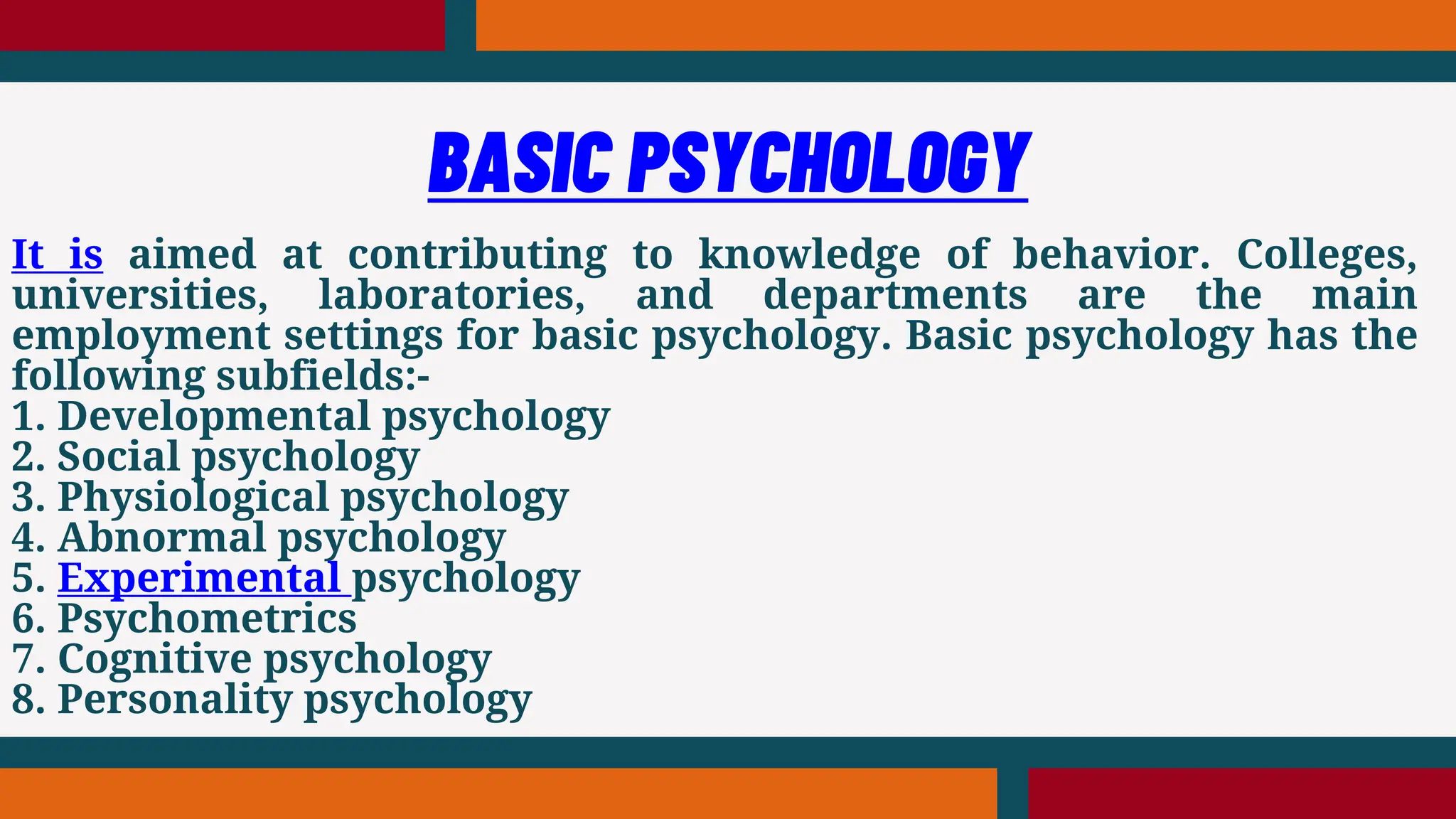
It is aimed at contributing to knowledge of behavior. Colleges,
universities, laboratories, and departments are the main
employment settings for basic psychology. Basic psychology has the
following subfields:-
1. Developmental psychology
2. Social psychology
3. Physiological psychology
4. Abnormal psychology
5. Experimental psychology
6. Psychometrics
7. Cognitive psychology
8. Personality psychology
BASIC PSYCHOLOGY
It studies human development, physical, emotional,
social, moral emotional, and personality
development across the life span Developmental
psychology primarily focuses on child development.
But today devotes a great deal of research to
adolescence, adult and old age group
DEVELOPMENTAL PSYCHOLOGY
It deals with interpersonal behavior and the role of
social forces in governing behavior. It primarily
focuses on attitude formation, attitude change,
prejudice, leadership, conformity, attraction,
aggression, intimate relationships, and behavior in
groups.
SOCIAL PSYCHOLOGY
It examines the influence of genetic factors on
behavior. It also deals with the brain, nervous
system, endocrine system and bodily chemicals like
the neurotransmitters in the regulation of behavior.
BIOLOGICAL PSYCHOLOGY
It is also known as psychopathology. It studies the
models, causes, classification, diagnosis and the
treatment of individuals with psychological
disorders.
ABNORMAL PSYCHOLOGY
Experimental psychologists restricts themselves
chiefly to laboratory research on basic
psychological processes, including perception,
learning memory, thinking, motivation and
emotions.
EXPERIMENTAL PSYCHOLOGY
It is concerned with the measurements of behavior
and capacities usually through the development of
psychological tests. Psychometrics is involved with
the design of tests to assess personality, intelligence,
and a wide range of abilities. It is also involved
with the development of new techniques for
statistical analysis
PSYCHOMETRICS IN PSYCHOLOGY
Focuses on higher mental processes such as
memory, thinking, reasoning, information
processing, language, problem solving, decision
making, creativity and artificial intelligence.
COGNITIVE PSYCHOLOGY
It describes and explains the individual consistency
in behavior which represents their personality.
The area of interest is also concerned with the
factors that determine personality and personality
assessment.
PERSONALITY PSYCHOLOGY
Uses the various fields of basic psychology to improve the quality of life
of human beings in various fields like school, industry, hospital,
consultancy, and community. Applied psychology has the following
subfields-
1. Clinical psychology
2. Counseling psychology
3. Organizational psychology
4. Educational psychology
5. Health psychology
6. Environmental psychology
7. Forensic psychology
8. Sports and exercise psychology
9. Psychology of woman
APPLIED PSYCHOLOGY
It deals with the evaluation, diagnosis, and treatment
of individual psychological disorders. Principal
activities include interviewing the client,
psychological testing, and providing group or
individual psychotherapy.
CLINICAL PSYCHOLOGY
It usually works with somewhat different clients,
providing assistance to people struggling with
everyday problems of moderate severity. Thus they
often engage in family, marital and career counseling
COUNSELING PSYCHOLOGY
It is an outgrowth of industrial psychology and is also
known as organizational behavior.
It tries to study and solve the different organizational
problems exist in the schools, hospitals, universities,
military, companies etc. Here it tries to solve the
problems of leadership, group conflicts, conflicts,
different levels of the organization, organization culture,
organization development etc.
INDUSTRIAL ORGANIZATIONAL PSYCHOLOGY
Educational psychology is mainly devoted to an
understanding of the different aspects of the teaching-
learning process. It is concerned with the application
of the principles, techniques and methods of psychology
to the teaching-learning process.
EDUCATIONAL PSYCHOLOGY
Health psychology is the field that studies the role of
psychological factors in the promotion of health and the
prevention of illness.
It is interested in the relationship between stress and
illness. It describes the interaction of biological,
psychological, and social factors. This model is known
as Biopsychosocial model.
EDUCATIONAL PSYCHOLOGY
Environmental psychologists work in school, industrial
and governmental settings. They design work
environments and study the effects of crowding, noise
and air pollution on behavior
ENVIRONMENTAL PSYCHOLOGY
applies psychology to the legal system. They include
jury deliberation process and the best ways to select
jurors. Some forensic psychologists train police to
handle domestic disputes, negotiates, negotiate with
hostage takers
FORENSIC PSYCHOLOGY
This field applies psychology to athletic activities and
exercise It considers the role of motivation, the social
aspects of sports and physiological impact of training on
muscle development.
SPORTS & EXCERCISE PSYCHOLOGY
uses for gathering information or facts or data
are- Introspection Descriptive research
Experimental method Developmental
method
METHODS OF PSYCHOLOGY
Introspection means looking into oneself or
self-observations or self-analysis. It involves
carefully examining and reporting one’s own
behavior, thoughts, emotions, sensations, and
mental notes. In the method of introspection,
one relies on his memory, and draws on his
past experiences of analysis his current
behavior.
METHODS OF PSYCHOLOGY
It is very helpful in self-observations without
depending on time. It does not require any
device It is the only method by which of the
experiences can be known
INTROSPECTION
They can not be verified objectively They
cannot be confirmed by others Repeatability
is not confirmed Provide little or no
information about the experiences of infants,
mentally ill person or animals.
INTROSPECTION
Descriptive research includes the following
methods-
Naturalistic observation
Case study
survey
DESCRIPTIVE RESEARCH
“making observations into the natural world”
o Subjects individuals and animals are
observed in their natural world. o The
observer remains unobtrusive Naturalistic
observation is also used in studying animal
behavior in the natural environment and it is
called Ethology.
NATURALISTIC OBSERVATION
“studying individual in-depth”
One individual is examined intensively to find out as much
as possible about a certain problem or issue as it relates to
that person.
It is most often used to investigate abnormal behavior.
Biographical data, scores on psychological tests, and
information obtained in extensive interviews are the
measures of the case study or case history methods.
Overgeneralization and nonobjectivity are the limitations of
the case study methods.
CASE STUDY
“asking for responses to interview or questionnaire”
It collects information about behavior, opinions, attitudes, life
experiences, or personal characteristics.
Surveys are commonly in the form of interviews or questionnaires.
The Questions in the survey should be clearly worded and free
from bias Due to financial constraints researcher administered the
survey to a sample of people who represent the target population.
The sample for the population should be representative of the
entire population.
It is best achieved in terms of random sampling
CASE STUDY
“establishing cause and effect relationship” Cause-
effect relationship can be established by experimental
method. In laboratory, the researcher controls the
condition and measures the relations among variables.
A variable is something that can occur with different
value. Independent variable Dependent variable
EXPERIMENTAL METHOD
“observing the period of growth” Used in the field of
developmental psychology Physical, social, moral,
language, and emotions are observed in the children
Developmental method uses the following techniques-
Normative investigations Longitudinal study Cross-
sectional study
DEVELOPMENTAL METHOD
Normative investigation
It describes something that is characteristic of a specific
age
These observation provides norms.
Example of normative investigation is the Bayley scale
of infant development.
DEVELOPMENTAL METHOD
Longitudinal study
In this study changes in the same individual or group
are studied over a long period.
In it, researchers observe for changes in specific
characteristics such as language, personality, or
intelligence.
DEVELOPMENTAL METHOD
Psychology also contributes to many therapeutic
measures like- behavior therapy, play therapy,
psychoanalysis, etc. Psychology helps to understand
the concept of self-awareness, and self-esteem. It
describes the coping abilities, and defense mechanisms
used by the clients and their relevance to diseased
conditions.
PSYCHOTHERAPY
Psychology also contributes to many therapeutic
measures like- behavior therapy, play therapy,
psychoanalysis, etc. Psychology helps to understand
the concept of self-awareness, and self-esteem. It
describes the coping abilities, and defense mechanisms
used by the clients and their relevance to diseased
conditions.
PSYCHOTHERAPY
Structuralism is widely regarded as the first school of thought in
psychology. This outlook focused on breaking down mental
processes into the most basic components. Major thinkers
associated with structuralism include Wilhelm Wundt and
Edward Titchener. The focus of structuralism was on reducing
mental processes down to their most basic elements. The
structuralists used techniques such as introspection to analyze
the inner processes of the human mind.
STRUCTURALISM
as a reaction to the theories of the structuralist school of thought
and was heavily influenced by the work of William James.
It functioned on the mind's functions and adaptations. Unlike
some of the other well-known schools of thought in psychology,
functionalism is not associated with a single dominant theorist.
Instead, there are some different functionalist thinkers
associated with this outlook including John Dewey, James
Rowland Angell,
FUNCTIONALISM
Behaviorism became a dominant school of
thought during the 1950s. It was based upon the
work of thinkers such as:
John B. Watson Ivan Pavlov B. F. Skinner
BEHAVIORISM
all behavior can be explained by environmental causes
rather than by internal forces. Behaviorism is focused on
observable behavior. Theories of learning including classical
conditioning and operant conditioning were the focus of a
great deal of research. The behavioral school of psychology
had a significant influence on the course of psychology, and
many of the ideas and techniques that emerged from this
school of thought are still widely used today.
BEHAVIORISM
Psychoanalysis is a school of psychology founded by Sigmund Freud. This
school of thought emphasized the influence of the unconscious mind on
behavior.
Freud believed that the human mind was composed of three elements: the
id, ego, and superego. The id consists of primal urges while the ego is the
component of personality charged with dealing with reality. The superego is
the part of the personality that holds all of the ideals and values we
internalize from our parents and culture.
Freud believed that the interaction of these three elements was what led to
all of the complex human behaviors.
Freud's school of thought was enormously influential but also generated
considerable debate. This controversy existed not only in his time but also in
modern discussions of Freud's theories.
PSYCHOANALYSIS
Humanistic psychology developed as a response to psychoanalysis and
behaviorism. Humanistic psychology instead focused on individual free will,
personal growth and the concept of self-actualization.
While early schools of thought were primarily centered on abnormal human
behavior, humanistic psychology differed considerably in its emphasis on
helping people achieve and fulfill their potential.
Major humanist thinkers include: Abraham Maslow Carl Rogers Humanistic
psychology remains quite popular today and has had a significant influence on
other areas of psychology including positive psychology.
This particular branch of psychology is centered on helping people living
happier, more fulfilling lives.
HUMANISTIC PSYCHOLOGY
Cognitive psychology is the school of psychology that studies
mental processes including how people think, perceive,
remember and learn. As part of the larger field of cognitive
science, this branch of psychology is related to other
disciplines including neuroscience, philosophy, and
linguistic
COGNITIVE PSYCHOLOGY
Gestalt psychology was born in Germany and it was forwarded by
Max Wertheimer. Gestalt psychologists emphasized the importance
of the role of configuration or organization in the perceptual field
and highlight the role of insight and understanding in learning. The
fundamental tenants of these schools are follows The first principle
of Gestalt psychology is that it is the whole which determines the
behavior of its parts. An individual perceives the thing as whole not
as mere collections of its constituents or elements. A learning
situation is more than the elements of which it part is composed.
GESTALT PSYCHOLOGY
have faded into obscurity, each has had an influence on the course of
psychology's development. Some more recent schools of psychology,
including behaviorism and cognitive psychology, remain highly
influential. Today, many psychologists do not align themselves
solely with a single school of thought. Instead, they may take a more
eclectic approach, drawing upon many different perspectives and
theoretical backgrounds.
SCHOOL OF THOUGHTS
Introduction to psychology.pptx new version

Introduction to psychology.pptx new version

  • 1.
    INTRODUCTION TO PSYCHOLOGY Natureand Foundations of Psychology
  • 2.
    Psychology was nota separate discipline rather it was studied under Philosophy. Some of the contributors to psychology were as follows: Wilhelm Wundt in 1879 opened the first experimental laboratory in psychology at the University of Leipzig, Germany. He is considered as the father of psychology. American Psychological Association (APA) was established in 1892 and the founder was G. Stanley Hall. In 1896 John Dewey and William James supported the functionalism in Psychology. HISTORY OF PSYCHOLOGY (1870)
  • 3.
    SIGMUND FREUD (1896) Sigmund Freud developed the theory of psychoanalysis. On the basis of this therapy later on he developed the therapy of free association and dream analysis. In 1905 IQ test developed by Alfred Binet and Thiodore Simon. In 1913 John B. Watson supported the behavioral aspects of psychology. In 1921 Swiss psychiatrist Hermann Rorschach devised a personality test based on patients' interpretations of inkblots which is named as Rorschach ink blot test HISTORY OF PSYCHOLOGY
  • 4.
    The first NobelPrize for psychological research was given to Charles Frederick Menninger. In 1921, Ivan Pavlov developed the theory of classical conditioning through the experimental approach In 1935 Gestalt Psychology came into existence B.F. Skinner proposed the theory of Operant conditioning HISTORY OF PSYCHOLOGY HISTORY OF PSYCHOLOGY
  • 5.
    The first NobelPrize for psychological research was given to Charles Frederick Menninger. In 1921, Ivan Pavlov developed the theory of classical conditioning through the experimental approach In 1935 Gestalt Psychology came into existence B.F. Skinner proposed the theory of Operant conditioning HISTORY OF PSYCHOLOGY HISTORY OF PSYCHOLOGY
  • 7.
    “a science isthe body of systematized knowledge that is gathered carefully observing and measuring events.” Like any other science Psychology is also based on the observations and experiments which others can repeat and verify. Psychology concerns with the observation and explanations of human behavior in single individuals or in groups. “a science deals with a group of related facts and principles of particular subject” Psychology as a science deals with the motives, feelings, emotions, thoughts action of men and women ORIGIN OF SCIENCE OF PSYCHOLOGY
  • 8.
    like a science,psychology discovers and explains the underlying laws and principles of human behavior. Psychology describes the laws of learning, feelings, and thinking. Like any other science, psychology collects the subject matter or facts of behavior. Psychology is a positive science not the normative as it describes the facts of human behavior and its laws as they are not as they ought to be. Wundt was the first psychologist to measure human behavior accurately. Sigmund Freud, Maslow, Rogers, Watson, Pavlov, and Thichener were all important in the development of Psychology as science. ORIGIN OF SCIENCE OF PSYCHOLOGY ORIGIN OF SCIENCE OF PSYCHOLOGY
  • 9.
    "Psychology" comes fromthe Greek word psyche meaning "breath, spirit, soul", and the Greek word logia meaning the study of something. Thus we can conclude that psychology is the study of the soul. There are various definitions for psychology given by a variety of authors which are- “study of the mind” “descriptions and explanations of the state of consciousness” “William James” * “study of consciousness” …. “Wilhelm Wundt ” * “Positive science of the conduct of the living creature” “William McDougall” * “Psychology is the science which aims to give us better understanding and control of the behavior of the organism as a whole” “William McDougall” PSYCHOLOGY
  • 10.
    Psychology is theScientific study Human behavior and Mental Processes. The discipline embraces all aspects of the human experience — from the functions of the brain to the actions of nations, from child development to care for the aged. In every conceivable setting from scientific research centers to mental healthcare services, "the understanding of behavior" is the enterprise of psychologists. PSYCHOLOGY
  • 11.
  • 12.
    Psychology today coversan enormous range of scopes or fields. They can be broadly classified into two groups- Basic psychology Applied psychology SCOPE OF PSYCHOLOGY PSYCHOLOGY
  • 13.
    It is aimedat contributing to knowledge of behavior. Colleges, universities, laboratories, and departments are the main employment settings for basic psychology. Basic psychology has the following subfields:- 1. Developmental psychology 2. Social psychology 3. Physiological psychology 4. Abnormal psychology 5. Experimental psychology 6. Psychometrics 7. Cognitive psychology 8. Personality psychology BASIC PSYCHOLOGY
  • 14.
    It studies humandevelopment, physical, emotional, social, moral emotional, and personality development across the life span Developmental psychology primarily focuses on child development. But today devotes a great deal of research to adolescence, adult and old age group DEVELOPMENTAL PSYCHOLOGY
  • 15.
    It deals withinterpersonal behavior and the role of social forces in governing behavior. It primarily focuses on attitude formation, attitude change, prejudice, leadership, conformity, attraction, aggression, intimate relationships, and behavior in groups. SOCIAL PSYCHOLOGY
  • 16.
    It examines theinfluence of genetic factors on behavior. It also deals with the brain, nervous system, endocrine system and bodily chemicals like the neurotransmitters in the regulation of behavior. BIOLOGICAL PSYCHOLOGY
  • 17.
    It is alsoknown as psychopathology. It studies the models, causes, classification, diagnosis and the treatment of individuals with psychological disorders. ABNORMAL PSYCHOLOGY
  • 18.
    Experimental psychologists restrictsthemselves chiefly to laboratory research on basic psychological processes, including perception, learning memory, thinking, motivation and emotions. EXPERIMENTAL PSYCHOLOGY
  • 19.
    It is concernedwith the measurements of behavior and capacities usually through the development of psychological tests. Psychometrics is involved with the design of tests to assess personality, intelligence, and a wide range of abilities. It is also involved with the development of new techniques for statistical analysis PSYCHOMETRICS IN PSYCHOLOGY
  • 20.
    Focuses on highermental processes such as memory, thinking, reasoning, information processing, language, problem solving, decision making, creativity and artificial intelligence. COGNITIVE PSYCHOLOGY
  • 21.
    It describes andexplains the individual consistency in behavior which represents their personality. The area of interest is also concerned with the factors that determine personality and personality assessment. PERSONALITY PSYCHOLOGY
  • 22.
    Uses the variousfields of basic psychology to improve the quality of life of human beings in various fields like school, industry, hospital, consultancy, and community. Applied psychology has the following subfields- 1. Clinical psychology 2. Counseling psychology 3. Organizational psychology 4. Educational psychology 5. Health psychology 6. Environmental psychology 7. Forensic psychology 8. Sports and exercise psychology 9. Psychology of woman APPLIED PSYCHOLOGY
  • 23.
    It deals withthe evaluation, diagnosis, and treatment of individual psychological disorders. Principal activities include interviewing the client, psychological testing, and providing group or individual psychotherapy. CLINICAL PSYCHOLOGY
  • 24.
    It usually workswith somewhat different clients, providing assistance to people struggling with everyday problems of moderate severity. Thus they often engage in family, marital and career counseling COUNSELING PSYCHOLOGY
  • 25.
    It is anoutgrowth of industrial psychology and is also known as organizational behavior. It tries to study and solve the different organizational problems exist in the schools, hospitals, universities, military, companies etc. Here it tries to solve the problems of leadership, group conflicts, conflicts, different levels of the organization, organization culture, organization development etc. INDUSTRIAL ORGANIZATIONAL PSYCHOLOGY
  • 26.
    Educational psychology ismainly devoted to an understanding of the different aspects of the teaching- learning process. It is concerned with the application of the principles, techniques and methods of psychology to the teaching-learning process. EDUCATIONAL PSYCHOLOGY
  • 27.
    Health psychology isthe field that studies the role of psychological factors in the promotion of health and the prevention of illness. It is interested in the relationship between stress and illness. It describes the interaction of biological, psychological, and social factors. This model is known as Biopsychosocial model. EDUCATIONAL PSYCHOLOGY
  • 28.
    Environmental psychologists workin school, industrial and governmental settings. They design work environments and study the effects of crowding, noise and air pollution on behavior ENVIRONMENTAL PSYCHOLOGY
  • 29.
    applies psychology tothe legal system. They include jury deliberation process and the best ways to select jurors. Some forensic psychologists train police to handle domestic disputes, negotiates, negotiate with hostage takers FORENSIC PSYCHOLOGY
  • 30.
    This field appliespsychology to athletic activities and exercise It considers the role of motivation, the social aspects of sports and physiological impact of training on muscle development. SPORTS & EXCERCISE PSYCHOLOGY
  • 31.
    uses for gatheringinformation or facts or data are- Introspection Descriptive research Experimental method Developmental method METHODS OF PSYCHOLOGY
  • 32.
    Introspection means lookinginto oneself or self-observations or self-analysis. It involves carefully examining and reporting one’s own behavior, thoughts, emotions, sensations, and mental notes. In the method of introspection, one relies on his memory, and draws on his past experiences of analysis his current behavior. METHODS OF PSYCHOLOGY
  • 33.
    It is veryhelpful in self-observations without depending on time. It does not require any device It is the only method by which of the experiences can be known INTROSPECTION
  • 34.
    They can notbe verified objectively They cannot be confirmed by others Repeatability is not confirmed Provide little or no information about the experiences of infants, mentally ill person or animals. INTROSPECTION
  • 35.
    Descriptive research includesthe following methods- Naturalistic observation Case study survey DESCRIPTIVE RESEARCH
  • 36.
    “making observations intothe natural world” o Subjects individuals and animals are observed in their natural world. o The observer remains unobtrusive Naturalistic observation is also used in studying animal behavior in the natural environment and it is called Ethology. NATURALISTIC OBSERVATION
  • 37.
    “studying individual in-depth” Oneindividual is examined intensively to find out as much as possible about a certain problem or issue as it relates to that person. It is most often used to investigate abnormal behavior. Biographical data, scores on psychological tests, and information obtained in extensive interviews are the measures of the case study or case history methods. Overgeneralization and nonobjectivity are the limitations of the case study methods. CASE STUDY
  • 38.
    “asking for responsesto interview or questionnaire” It collects information about behavior, opinions, attitudes, life experiences, or personal characteristics. Surveys are commonly in the form of interviews or questionnaires. The Questions in the survey should be clearly worded and free from bias Due to financial constraints researcher administered the survey to a sample of people who represent the target population. The sample for the population should be representative of the entire population. It is best achieved in terms of random sampling CASE STUDY
  • 39.
    “establishing cause andeffect relationship” Cause- effect relationship can be established by experimental method. In laboratory, the researcher controls the condition and measures the relations among variables. A variable is something that can occur with different value. Independent variable Dependent variable EXPERIMENTAL METHOD
  • 40.
    “observing the periodof growth” Used in the field of developmental psychology Physical, social, moral, language, and emotions are observed in the children Developmental method uses the following techniques- Normative investigations Longitudinal study Cross- sectional study DEVELOPMENTAL METHOD
  • 41.
    Normative investigation It describessomething that is characteristic of a specific age These observation provides norms. Example of normative investigation is the Bayley scale of infant development. DEVELOPMENTAL METHOD
  • 42.
    Longitudinal study In thisstudy changes in the same individual or group are studied over a long period. In it, researchers observe for changes in specific characteristics such as language, personality, or intelligence. DEVELOPMENTAL METHOD
  • 43.
    Psychology also contributesto many therapeutic measures like- behavior therapy, play therapy, psychoanalysis, etc. Psychology helps to understand the concept of self-awareness, and self-esteem. It describes the coping abilities, and defense mechanisms used by the clients and their relevance to diseased conditions. PSYCHOTHERAPY
  • 44.
    Psychology also contributesto many therapeutic measures like- behavior therapy, play therapy, psychoanalysis, etc. Psychology helps to understand the concept of self-awareness, and self-esteem. It describes the coping abilities, and defense mechanisms used by the clients and their relevance to diseased conditions. PSYCHOTHERAPY
  • 45.
    Structuralism is widelyregarded as the first school of thought in psychology. This outlook focused on breaking down mental processes into the most basic components. Major thinkers associated with structuralism include Wilhelm Wundt and Edward Titchener. The focus of structuralism was on reducing mental processes down to their most basic elements. The structuralists used techniques such as introspection to analyze the inner processes of the human mind. STRUCTURALISM
  • 46.
    as a reactionto the theories of the structuralist school of thought and was heavily influenced by the work of William James. It functioned on the mind's functions and adaptations. Unlike some of the other well-known schools of thought in psychology, functionalism is not associated with a single dominant theorist. Instead, there are some different functionalist thinkers associated with this outlook including John Dewey, James Rowland Angell, FUNCTIONALISM
  • 47.
    Behaviorism became adominant school of thought during the 1950s. It was based upon the work of thinkers such as: John B. Watson Ivan Pavlov B. F. Skinner BEHAVIORISM
  • 48.
    all behavior canbe explained by environmental causes rather than by internal forces. Behaviorism is focused on observable behavior. Theories of learning including classical conditioning and operant conditioning were the focus of a great deal of research. The behavioral school of psychology had a significant influence on the course of psychology, and many of the ideas and techniques that emerged from this school of thought are still widely used today. BEHAVIORISM
  • 49.
    Psychoanalysis is aschool of psychology founded by Sigmund Freud. This school of thought emphasized the influence of the unconscious mind on behavior. Freud believed that the human mind was composed of three elements: the id, ego, and superego. The id consists of primal urges while the ego is the component of personality charged with dealing with reality. The superego is the part of the personality that holds all of the ideals and values we internalize from our parents and culture. Freud believed that the interaction of these three elements was what led to all of the complex human behaviors. Freud's school of thought was enormously influential but also generated considerable debate. This controversy existed not only in his time but also in modern discussions of Freud's theories. PSYCHOANALYSIS
  • 50.
    Humanistic psychology developedas a response to psychoanalysis and behaviorism. Humanistic psychology instead focused on individual free will, personal growth and the concept of self-actualization. While early schools of thought were primarily centered on abnormal human behavior, humanistic psychology differed considerably in its emphasis on helping people achieve and fulfill their potential. Major humanist thinkers include: Abraham Maslow Carl Rogers Humanistic psychology remains quite popular today and has had a significant influence on other areas of psychology including positive psychology. This particular branch of psychology is centered on helping people living happier, more fulfilling lives. HUMANISTIC PSYCHOLOGY
  • 51.
    Cognitive psychology isthe school of psychology that studies mental processes including how people think, perceive, remember and learn. As part of the larger field of cognitive science, this branch of psychology is related to other disciplines including neuroscience, philosophy, and linguistic COGNITIVE PSYCHOLOGY
  • 52.
    Gestalt psychology wasborn in Germany and it was forwarded by Max Wertheimer. Gestalt psychologists emphasized the importance of the role of configuration or organization in the perceptual field and highlight the role of insight and understanding in learning. The fundamental tenants of these schools are follows The first principle of Gestalt psychology is that it is the whole which determines the behavior of its parts. An individual perceives the thing as whole not as mere collections of its constituents or elements. A learning situation is more than the elements of which it part is composed. GESTALT PSYCHOLOGY
  • 53.
    have faded intoobscurity, each has had an influence on the course of psychology's development. Some more recent schools of psychology, including behaviorism and cognitive psychology, remain highly influential. Today, many psychologists do not align themselves solely with a single school of thought. Instead, they may take a more eclectic approach, drawing upon many different perspectives and theoretical backgrounds. SCHOOL OF THOUGHTS