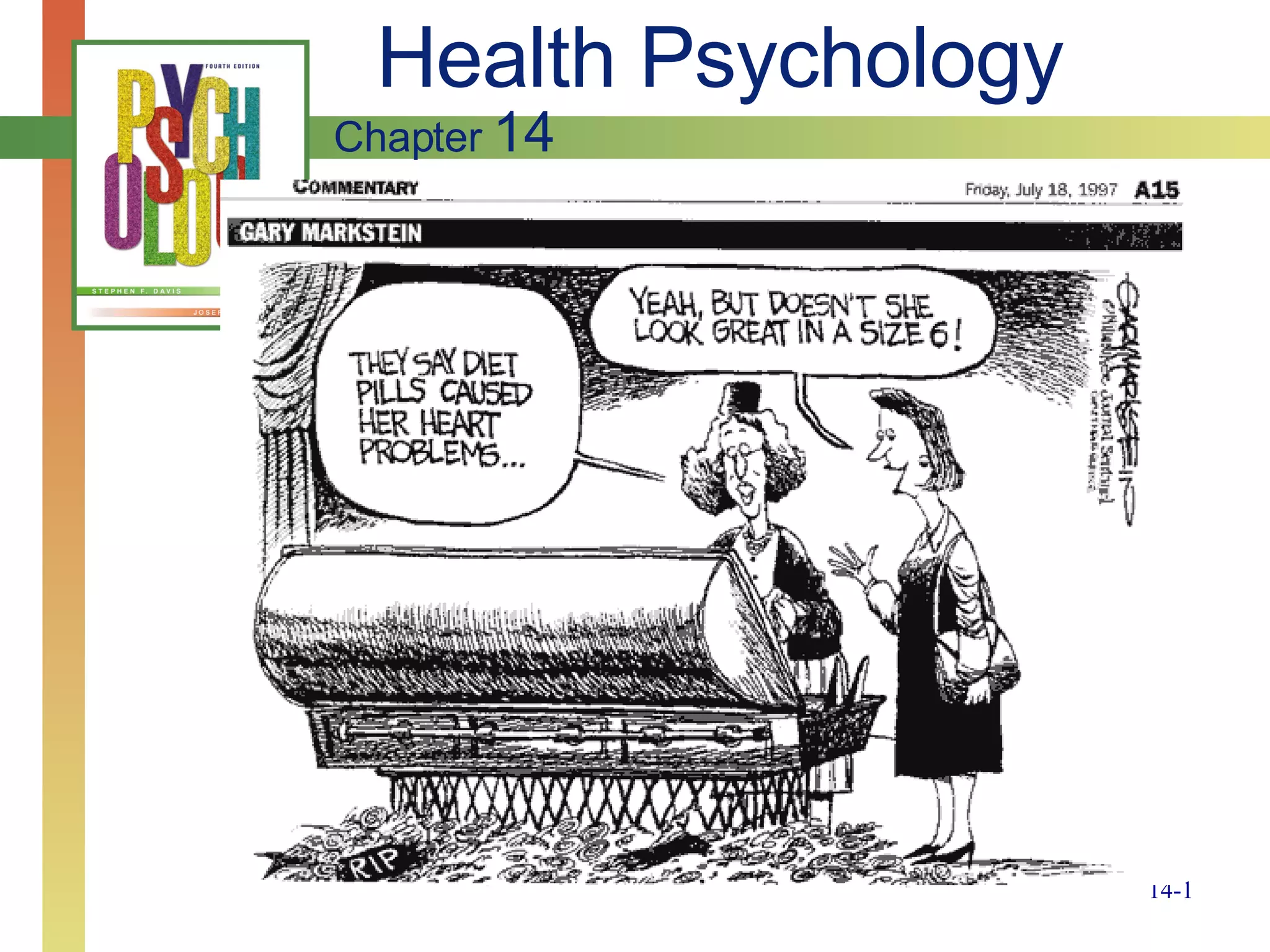
Health Psychology Chapter  14
Health Psychology Health psychology is concerned with the  social and psychological  factors that influence health and illness.
Stress  and Coping Define  stress   A biological reaction to external events; hormones are released that cause a rise in heart rate, blood pressure, and respiration. Psychoneuroimmunology  (PNI)
Stress and Illness Stressors are demands that give rise to the general adaptation syndrome (GAS), which consists of three stages: alarm, resistance, and exhaustion. http://media.pearsoncmg.com/ph/hss/livepsych/media/interface/index.htm?atitle=14.1%20Stress%20and%20Selye%27s%20General%20Adaptation%20Syndrome&id1=32_1&id2=32_2&id3=32_3&id4=32_4&sid=32_1
Stress and Illness Among the circumstances that could lead to stress are catastrophes, major life changes such as divorce, traumatic events and hassles.  Associated with physiological responses such as increased levels of stress hormones High levels of life  change  associated with Illness. Interpretation often determines whether event is stressful. Schedule of Recent Experience:  http://www.mindtools.com/stress/ps/ScheduleofRecentExperience.htm   Social Readjustment Rating Scale:  http://chipts.ucla.edu/assessment/Assessment_Instruments/Assessment_files_new/assess_srrs.htm
Stress and Illness Posttraumatic stress disorder (PTSD) in aftermath of disturbing experience.  A reliving of the traumatic event in dreams, flashbacks, or intrusive thoughts.
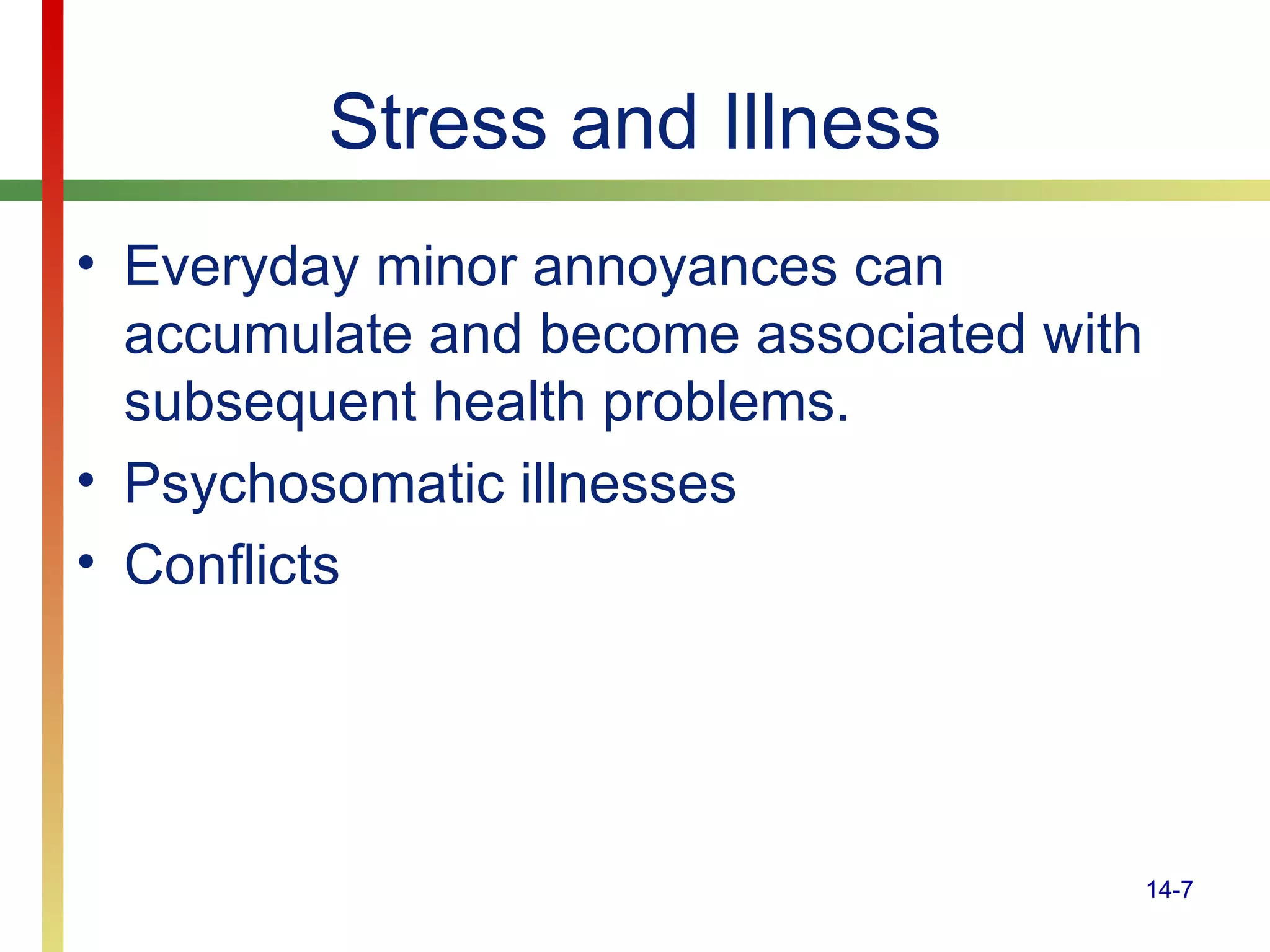
Stress and Illness Everyday minor annoyances can accumulate and become associated with subsequent health problems. Psychosomatic illnesses Conflicts
Stress/Perfomance Connection
Stress and Illness A wide variety of stressful events can affect immune system functioning. These sometimes result in psychophysiological illnesses http://media.pearsoncmg.com/ph/hss/livepsych/media/interface/index.htm?atitle=14.2%20Stress%20and%20the%20Immune%20System&id1=33_1&id2=33_2&id3=33_3
Differences in health among blacks and whites disappear when holding SES constant.  Gender also makes a difference in health. E.g., Arthritis more common  in men < 45;  in women > 45 Ethnic and Gender Variations in Health
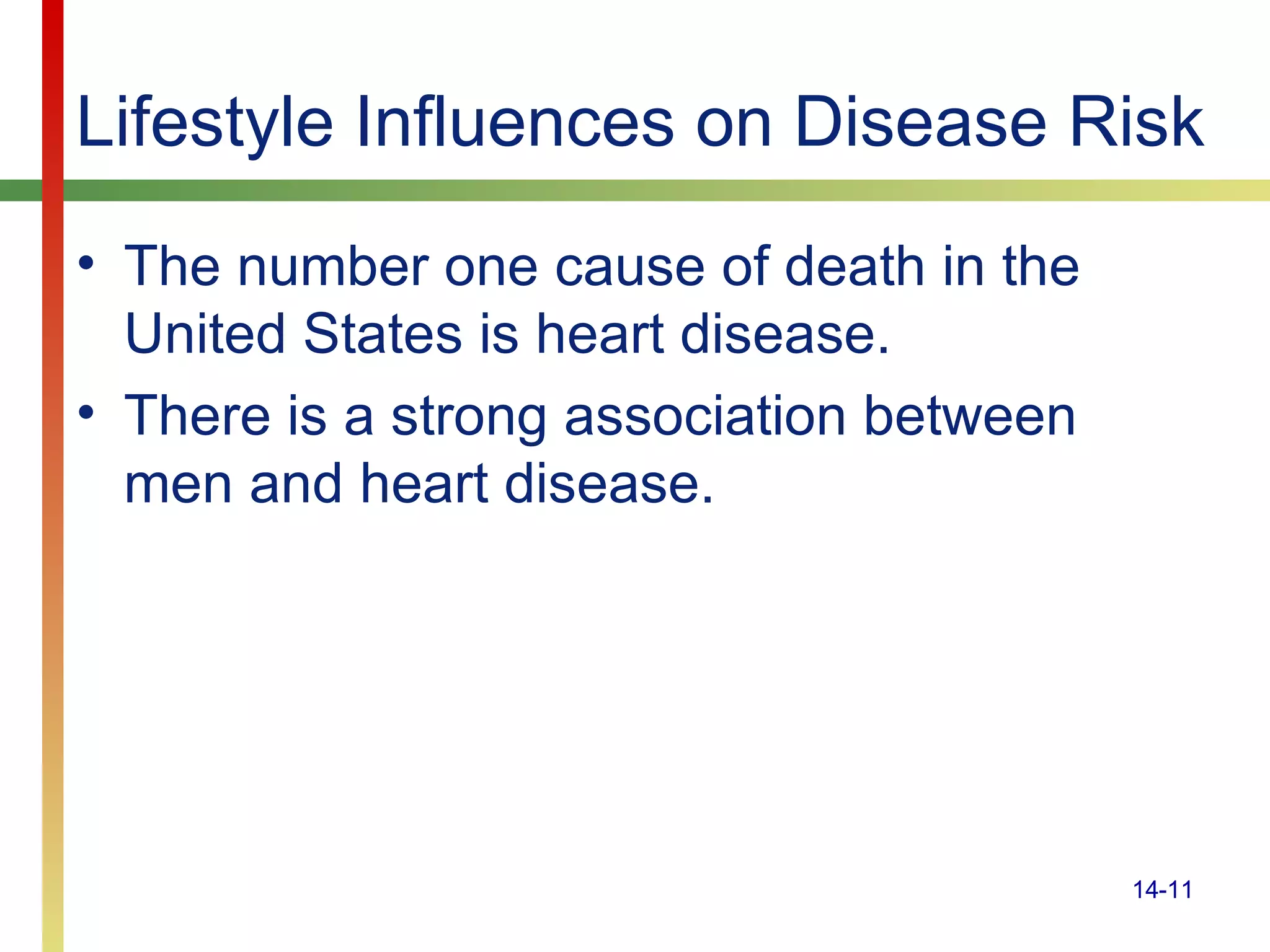
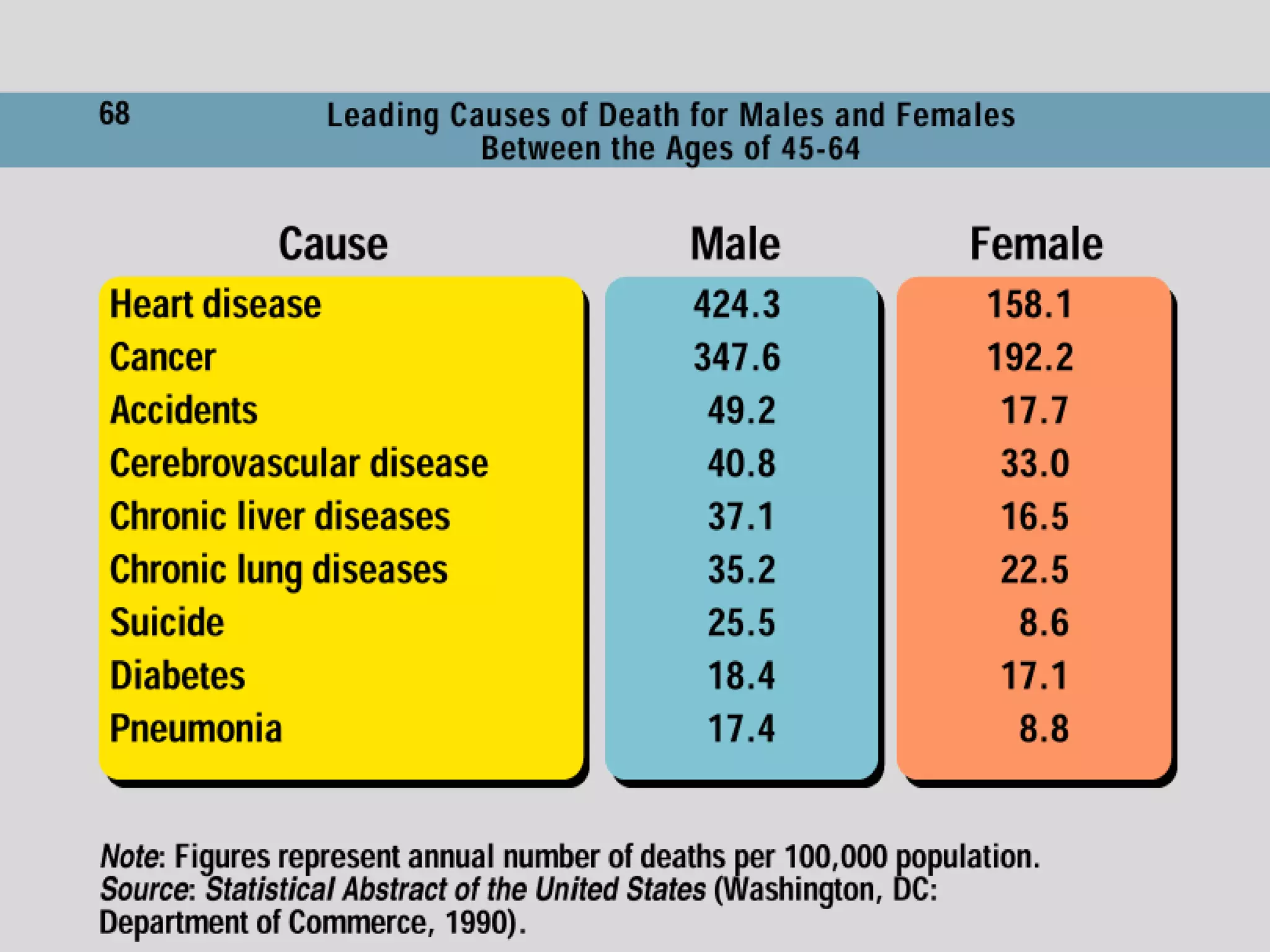
Lifestyle Influences on Disease Risk The number one cause of death in the United States is heart disease. There is a strong association between men and heart disease.
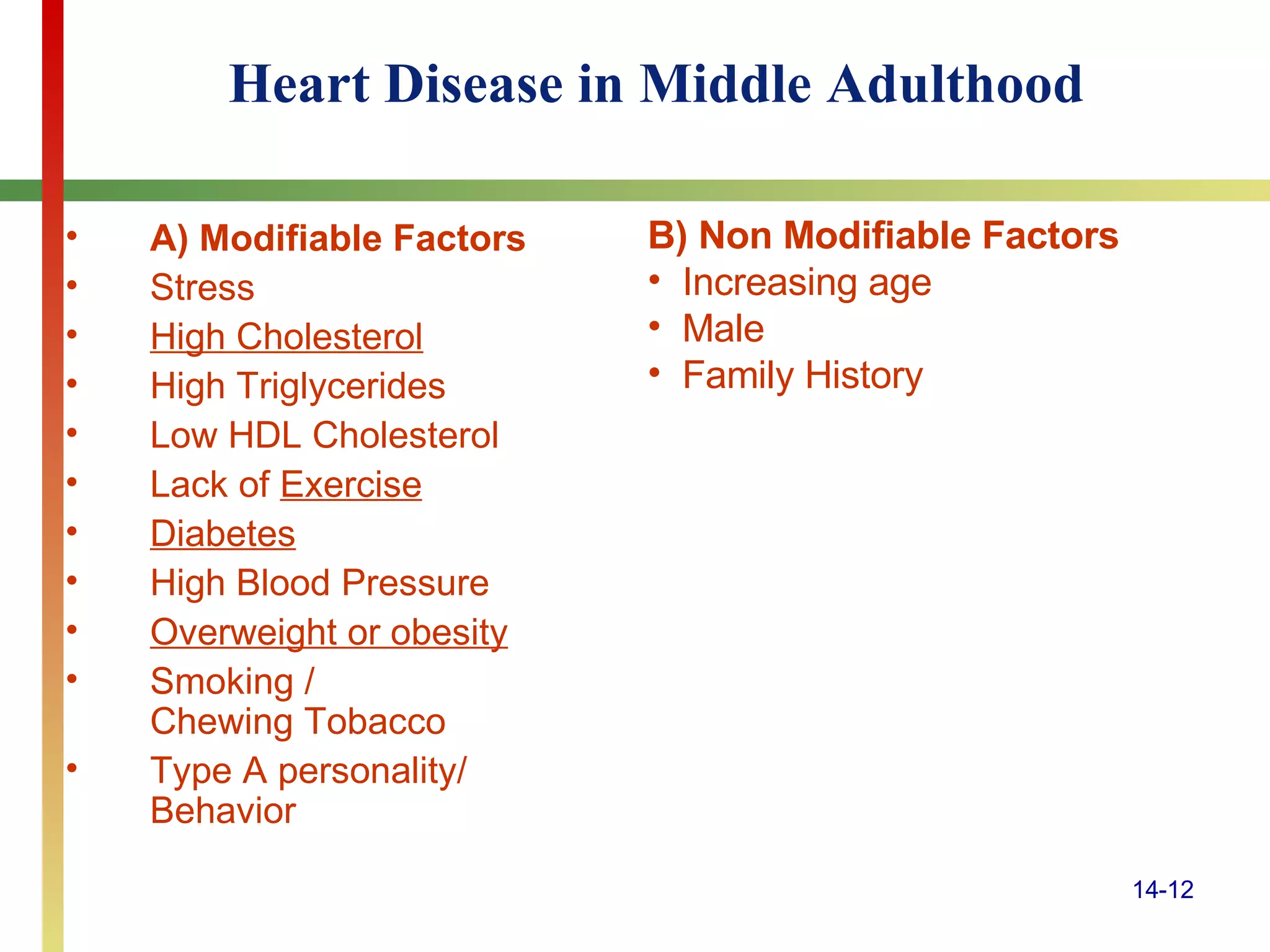
Heart Disease in Middle Adulthood A) Modifiable Factors Stress High Cholesterol High Triglycerides Low HDL Cholesterol Lack of  Exercise Diabetes High Blood Pressure Overweight or obesity Smoking /  Chewing Tobacco Type A personality/ Behavior B) Non Modifiable Factors Increasing age Male Family History
Lifestyle Influences on Disease Risk Type A individuals tend to be aggressive, competitive, impatient, and have difficulty relaxing.  The Western Collaborative Group Study indicated that a Type A individual was twice as likely to develop heart disease as the more relaxed and easygoing Type B person.  Subsequent studies  do not  replicate this finding Type H
 
Lifestyle Influences on Disease Risk Efforts to change type A behavior reduced the rate of recurrent heart attacks as compared with the rate among victims who received typical heart patient counseling
Lifestyle Influences on Disease Risk AIDS is now the 19 th  leading cause of death in the United States (5th among 35-44 yr-olds). Stress speeds onset of symptoms  AIDS cases among men is substantially higher than the number of cases among women.
Lifestyle Influences on Disease Risk Men and women differ in their likelihood of being exposed to infection with HIV.
Coping With Stress Physical activity is associated with increased longevity and positive benefits on physical and psychological health.
Coping With Stress Hardiness Outlook Distractions Social Support Sense of humor

Chapter 14 Psych 1 Online Stud

  • 1.
  • 2.
    Health Psychology Healthpsychology is concerned with the social and psychological factors that influence health and illness.
  • 3.
    Stress andCoping Define stress A biological reaction to external events; hormones are released that cause a rise in heart rate, blood pressure, and respiration. Psychoneuroimmunology (PNI)
  • 4.
    Stress and IllnessStressors are demands that give rise to the general adaptation syndrome (GAS), which consists of three stages: alarm, resistance, and exhaustion. http://media.pearsoncmg.com/ph/hss/livepsych/media/interface/index.htm?atitle=14.1%20Stress%20and%20Selye%27s%20General%20Adaptation%20Syndrome&id1=32_1&id2=32_2&id3=32_3&id4=32_4&sid=32_1
  • 5.
    Stress and IllnessAmong the circumstances that could lead to stress are catastrophes, major life changes such as divorce, traumatic events and hassles. Associated with physiological responses such as increased levels of stress hormones High levels of life change associated with Illness. Interpretation often determines whether event is stressful. Schedule of Recent Experience: http://www.mindtools.com/stress/ps/ScheduleofRecentExperience.htm Social Readjustment Rating Scale: http://chipts.ucla.edu/assessment/Assessment_Instruments/Assessment_files_new/assess_srrs.htm
  • 6.
    Stress and IllnessPosttraumatic stress disorder (PTSD) in aftermath of disturbing experience. A reliving of the traumatic event in dreams, flashbacks, or intrusive thoughts.
  • 7.
    Stress and IllnessEveryday minor annoyances can accumulate and become associated with subsequent health problems. Psychosomatic illnesses Conflicts
  • 8.
  • 9.
    Stress and IllnessA wide variety of stressful events can affect immune system functioning. These sometimes result in psychophysiological illnesses http://media.pearsoncmg.com/ph/hss/livepsych/media/interface/index.htm?atitle=14.2%20Stress%20and%20the%20Immune%20System&id1=33_1&id2=33_2&id3=33_3
  • 10.
    Differences in healthamong blacks and whites disappear when holding SES constant. Gender also makes a difference in health. E.g., Arthritis more common in men < 45; in women > 45 Ethnic and Gender Variations in Health
  • 11.
    Lifestyle Influences onDisease Risk The number one cause of death in the United States is heart disease. There is a strong association between men and heart disease.
  • 12.
    Heart Disease inMiddle Adulthood A) Modifiable Factors Stress High Cholesterol High Triglycerides Low HDL Cholesterol Lack of Exercise Diabetes High Blood Pressure Overweight or obesity Smoking / Chewing Tobacco Type A personality/ Behavior B) Non Modifiable Factors Increasing age Male Family History
  • 13.
    Lifestyle Influences onDisease Risk Type A individuals tend to be aggressive, competitive, impatient, and have difficulty relaxing. The Western Collaborative Group Study indicated that a Type A individual was twice as likely to develop heart disease as the more relaxed and easygoing Type B person. Subsequent studies do not replicate this finding Type H
  • 14.
  • 15.
    Lifestyle Influences onDisease Risk Efforts to change type A behavior reduced the rate of recurrent heart attacks as compared with the rate among victims who received typical heart patient counseling
  • 16.
    Lifestyle Influences onDisease Risk AIDS is now the 19 th leading cause of death in the United States (5th among 35-44 yr-olds). Stress speeds onset of symptoms AIDS cases among men is substantially higher than the number of cases among women.
  • 17.
    Lifestyle Influences onDisease Risk Men and women differ in their likelihood of being exposed to infection with HIV.
  • 18.
    Coping With StressPhysical activity is associated with increased longevity and positive benefits on physical and psychological health.
  • 19.
    Coping With StressHardiness Outlook Distractions Social Support Sense of humor

Editor's Notes

  • #2 Prepared by Michael J. Renner, Ph.D. These slides ©1999 Prentice Hall Psychology Publishing.