Chapter 1
the Internet
Work hard play hard !!!
As Presented by Nobel Mujuji
• The Internet is a global system of interconnected computer
networks that use the standard Internet protocol
suite (TCP/IP) to link several billion devices worldwide.
Definition 2
• It is a network of networks that consists of millions of
private, public, academic, business, and government
networks of local to global scope, linked by a broad array of
electronic, wireless, and optical networking technologies.
• The Internet carries an extensive range of information
resources and services, such as the inter-
linked hypertext documents and applications of the World
Wide Web (WWW), the infrastructure to support email,
and peer-to-peer networks for file sharing and telephony.
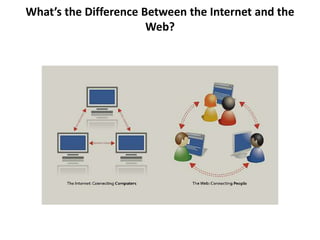
What’s the Difference Between the Internet and the
Web?
• a global computer network providing a variety of information
and communication facilities, consisting of interconnected
networks using standardized communication protocols.
• The Internet, link your computer to other computers around
the world, is a way of transporting content. The Web is
software that lets you use that content…or contribute your
own. The Web, running on the mostly invisible Internet, is
what you see and click on in your computer’s browser.
• The Internet’s roots are in the U.S. during the late 1960s. The
Web was invented 20 years later by an Englishman working in
Switzerland—though it had many predecessors.
• To keep things “interesting,” many people use the term
Internet to refer to both.
World Wide Web (WWW)
• The World Wide Web is a system of Internet servers that support
specially formatted documents. The documents are formatted in a markup
language called HTML (HyperText Markup Language) that supports links to
other documents, as well as graphics, audio, and video files.
• This means you can jump from one document to another simply
by clicking on hot spots. Not all Internet servers are part of the World
Wide Web.
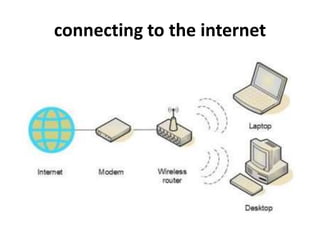
connecting to the internet
Choosing an Internet service
Which service is best for me?
• It all depends on where you live and how much speed you need. Internet service
providers (ISPs) usually offer different levels of speed based on your needs. If
you're mainly using the Internet for email and social networking, a slower
connection might be all you need. However, if you want to download a lot
of music or watch streaming movies, you'll want a faster connection. You'll need
to do some research to find out what the options are in your area. Here are some
common types of Internet service.
• Dial-up: Dial-up is generally the slowest type of Internet connection, and you
should probably avoid it unless it is the only service available in your area. Like a
phone call, a dial-up modem will connect you to the Internet by dialing a number,
and it will disconnect when you are done surfing the Web. Unless you have
multiple phone lines, you will not be able to use your land line and the Internet at
the same time with a dial-up connection.
• DSL: DSL service uses a broadband connection, which makes it much faster than
dial-up. However, it is unavailable in many locations, so you'll need to contact your
local ISP for information about your area. DSL connects to the Internet via phone
line but does not require you to have a land line at home. Unlike dial-up, it will
always be on once it's set up, and you'll be able to use the Internet and your
phone line simultaneously.
Cont…
• Cable: Cable service connects to the Internet via cable TV, although you
do not necessarily need to have cable TV in order to get it. It uses a
broadband connection and can be faster than both dial-up and DSL
service; however, it is only available in places where cable TV is available.
• Satellite: A satellite connection uses broadband but does not require cable
or phone lines; it connects to the Internet through satellites orbiting the
Earth. As a result, it can be used almost anywhere in the world, but the
connection may be affected by weather patterns. A satellite connection
also relays data on a delay, so it is not the best option for people who use
real-time applications, like gaming or video conferencing.
• 3G and 4G: 3G and 4G service is most commonly used with mobile phones
and tablet computers, and it connects wirelessly through your ISP's
network. If you have a device that's 3G or 4G enabled, you'll be able to use
it to access the Internet away from home, even when there is no Wi-Fi
connection. However, you may have to pay per device to use a 3G or 4G
connection, and it may not be as fast as DSL or cable.
Choosing an Internet service provider
Once you have decided which type of Internet access you're
interested in, you can determine which ISPs are available in your area
that offer the type of Internet access you want. Then you'll need to
purchase Internet service from one of the available ISPs. Talk to
friends, family members, and neighbors to see which ISPs they use.
Below are some things to consider as you research ISPs:
1. Speed
2. Price
3. Ease of installation
4. Service record
5. Technical support
6. Contract terms
Hardware needed
• Once you have your computer, you really don't need much
additional hardware to connect to the Internet. The primary
piece of hardware you need is a modem.
• The type of Internet access you choose will determine the
type of modem you need. Dial-up access uses a telephone
modem, DSL service uses a DSL modem, cable access uses
a cable modem, and satellite service uses a satellite adapter.
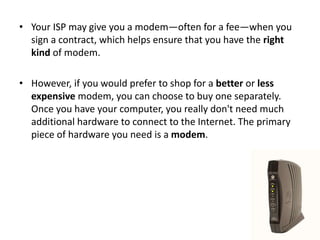
• Your ISP may give you a modem—often for a fee—when you
sign a contract, which helps ensure that you have the right
kind of modem.
• However, if you would prefer to shop for a better or less
expensive modem, you can choose to buy one separately.
Once you have your computer, you really don't need much
additional hardware to connect to the Internet. The primary
piece of hardware you need is a modem.
Router
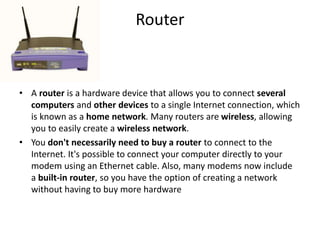
• A router is a hardware device that allows you to connect several
computers and other devices to a single Internet connection, which
is known as a home network. Many routers are wireless, allowing
you to easily create a wireless network.
• You don't necessarily need to buy a router to connect to the
Internet. It's possible to connect your computer directly to your
modem using an Ethernet cable. Also, many modems now include
a built-in router, so you have the option of creating a network
without having to buy more hardware
network card
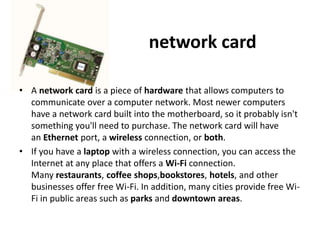
• A network card is a piece of hardware that allows computers to
communicate over a computer network. Most newer computers
have a network card built into the motherboard, so it probably isn't
something you'll need to purchase. The network card will have
an Ethernet port, a wireless connection, or both.
• If you have a laptop with a wireless connection, you can access the
Internet at any place that offers a Wi-Fi connection.
Many restaurants, coffee shops,bookstores, hotels, and other
businesses offer free Wi-Fi. In addition, many cities provide free Wi-
Fi in public areas such as parks and downtown areas.
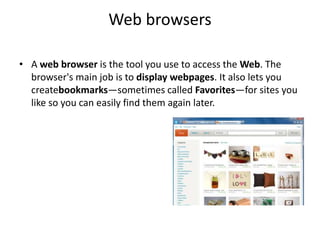
Web browsers
• A web browser is the tool you use to access the Web. The
browser's main job is to display webpages. It also lets you
createbookmarks—sometimes called Favorites—for sites you
like so you can easily find them again later.
Challenge!
1. Research two or more Internet service providers (ISPs), and
compare their service packages. What are the
different connection speeds offered by each provider?
2. Try using a few different web browsers. Do they work
differently? Which one was easier to use?
3. Do you have any devices (computers, mobile phones, etc.)
that can connect wirelessly? Would it make sense to create
a wireless network in your home?
Communication Protocol
• Communication protocols are formal descriptions of digital
message formats and rules. They are required to exchange
messages in or between computing systems and are required
in telecommunications.
Communications protocols cover authentication, error
detection and correction, and signaling. They can also
describe the syntax, semantics, and synchronization of analog
and digital communications. Communications protocols are
implemented in hardware and software.
• There are thousands of communications protocols that are
used everywhere in analog and digital communications.
Computer networks cannot exist without them.
EXAMPLES &homework
• TCP / IP
• HTTP
• IP
• IPv6
• TCP
• UDP
• MPLS
• others
Explain what all these acronyms mean
Internet addressing
• An Internet Protocol address (IP address) is a numerical label assigned to
each device (e.g., computer, printer) participating in a computer
network that uses the Internet Protocol for communication.
• An IP address serves two principal functions: host or network
interface identification and location addressing. Its role has been
characterized as follows: “A( host name) indicates what we seek. An
address indicates where it is. A route indicates how to get there
Definition 2
• An Internet address uniquely identifies
a node on the Internet. Internet address may
also refer to the name or IP of a Web
site(URL). The term Internet address can also
represent someone'se-mail address.
• Eg
• 198.52.105.5
• 202.25.432.9
Host name
In computer networking, a hostname (archaically nodename[1]) is a label that
is assigned to a device connected to a computer network and that is used to
identify the device in various forms of electronic communication such as
the World Wide Web, e-mail or Usenet.
Hostnames may be simple names consisting of a single word or phrase, or
they may be structured.
c-61-123-45-67.hsd1.co.comcast.net
Definition 2
• A name is a label that is used to distinguish one thing from another. A
person's name, for instance, comprises a set of alphabetic characters that
allows a person to be individually addressed.
• Computers are also named to differentiate one machine from another and
to allow for such activities as network communication.
domain name
• Domain names are used to identify one or
more IP addresses. For example, the domain
name microsoft.com represents about a dozen IP
addresses. Domain names are used in URLs to
identify particular Web pages. For example, in the
URLhttp://www.pcwebopedia.com/index.html, th
e domain name ispcwebopedia.com.
• Every domain name has a suffix that indicates
which top level domain (TLD) it belongs to. There
are only a limited number of such domains. For
example:
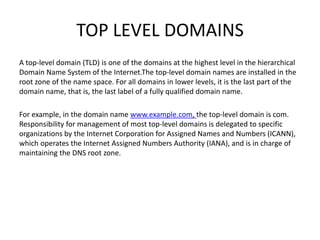
TOP LEVEL DOMAINS
A top-level domain (TLD) is one of the domains at the highest level in the hierarchical
Domain Name System of the Internet.The top-level domain names are installed in the
root zone of the name space. For all domains in lower levels, it is the last part of the
domain name, that is, the last label of a fully qualified domain name.
For example, in the domain name www.example.com, the top-level domain is com.
Responsibility for management of most top-level domains is delegated to specific
organizations by the Internet Corporation for Assigned Names and Numbers (ICANN),
which operates the Internet Assigned Numbers Authority (IANA), and is in charge of
maintaining the DNS root zone.
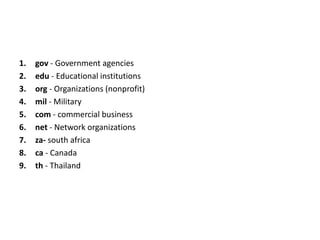
1. gov - Government agencies
2. edu - Educational institutions
3. org - Organizations (nonprofit)
4. mil - Military
5. com - commercial business
6. net - Network organizations
7. za- south africa
8. ca - Canada
9. th - Thailand
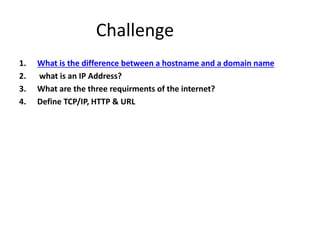
Challenge
1. What is the difference between a hostname and a domain name
2. what is an IP Address?
3. What are the three requirments of the internet?
4. Define TCP/IP, HTTP & URL
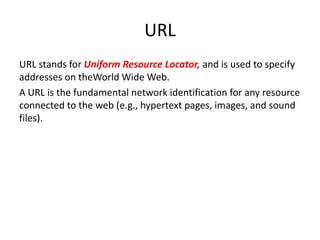
URL
URL stands for Uniform Resource Locator, and is used to specify
addresses on theWorld Wide Web.
A URL is the fundamental network identification for any resource
connected to the web (e.g., hypertext pages, images, and sound
files).
example
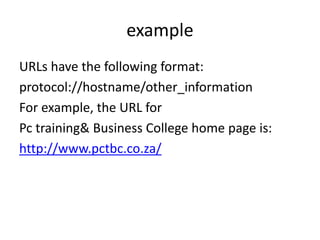
URLs have the following format:
protocol://hostname/other_information
For example, the URL for
Pc training& Business College home page is:
http://www.pctbc.co.za/
UNDERSTANDING THE EMAIL
E-mail is one of the most popular services on the Internet. Everyone likes the
convenience of being able to communicate without having to play the game
of 'phone tag,' in which two people leave telephone messages for each other
without successfully making contact. When you send an email message, it
waits in the recipient's mailbox to be read at the recipient's convenience.
Email started as a simple mechanism in which messages were copied to a
user's mailbox file. That simple mechanism is still used. In Red Hat Linux, your
mail messages are stored in the /var/spool/maildirectory, in a text file with
the same name as your user name.
Cont…
• Messages are addressed to a user name. That means if John Doe logs in
with the user name jdoe, email to him is addressed to jdoe. The only other
piece of information needed to identify the recipient uniquely is the fully
qualified domain name of the recipient's system.
• Thus, if John Doe's system is named yahoo.com, his complete email
address becomes jdoe@yahoo.com. Given that address, anyone on the
Internet can send email to John Doe.
To set up and use email on your Red Hat Linux PC, you
need two types of mail software:
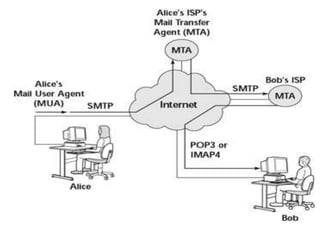
• Mail User Agent (MUA)-This software enables you to read your mail messages,
write replies, and compose new messages. Typically, the mail-user agent retrieves
messages from the mail server by using the POP3 or IMAP4 protocol. POP3 is the
Post Office Protocol Version 3, and IMAP4 is the Internet Message Access Protocol
Version 4. Red Hat Linux comes with mail-user agents such as pine and Ximian
Evolution. Mozilla also includes a mail-user agent and a newsreader, besides the
Web browser.
• Mail Transport Agent (MTA)-This software actually sends and receives mail
messages. The exact method used for mail transport depends on the underlying
network. In TCP/IP networks, the mail-transport agent delivers mail using the
Simple Mail Transfer Protocol (SMTP). Red Hat Linux includes sendmail, a powerful
and popular mail-transport agent for TCP/IP networks.
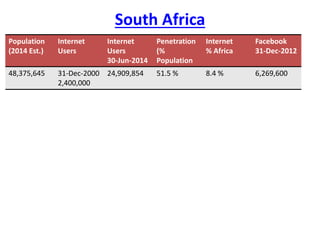
South Africa
Population
(2014 Est.)
Internet
Users
Internet
Users
30-Jun-2014
Penetration
(%
Population
Internet
% Africa
Facebook
31-Dec-2012
48,375,645 31-Dec-2000
2,400,000
24,909,854 51.5 % 8.4 % 6,269,600
End of chapter 1

Chapter 1 html

  • 1.
    Chapter 1 the Internet Workhard play hard !!! As Presented by Nobel Mujuji
  • 2.
    • The Internetis a global system of interconnected computer networks that use the standard Internet protocol suite (TCP/IP) to link several billion devices worldwide. Definition 2 • It is a network of networks that consists of millions of private, public, academic, business, and government networks of local to global scope, linked by a broad array of electronic, wireless, and optical networking technologies. • The Internet carries an extensive range of information resources and services, such as the inter- linked hypertext documents and applications of the World Wide Web (WWW), the infrastructure to support email, and peer-to-peer networks for file sharing and telephony.
  • 3.
    What’s the DifferenceBetween the Internet and the Web?
  • 4.
    • a globalcomputer network providing a variety of information and communication facilities, consisting of interconnected networks using standardized communication protocols. • The Internet, link your computer to other computers around the world, is a way of transporting content. The Web is software that lets you use that content…or contribute your own. The Web, running on the mostly invisible Internet, is what you see and click on in your computer’s browser. • The Internet’s roots are in the U.S. during the late 1960s. The Web was invented 20 years later by an Englishman working in Switzerland—though it had many predecessors. • To keep things “interesting,” many people use the term Internet to refer to both.
  • 5.
    World Wide Web(WWW) • The World Wide Web is a system of Internet servers that support specially formatted documents. The documents are formatted in a markup language called HTML (HyperText Markup Language) that supports links to other documents, as well as graphics, audio, and video files. • This means you can jump from one document to another simply by clicking on hot spots. Not all Internet servers are part of the World Wide Web.
  • 6.
  • 7.
    Choosing an Internetservice Which service is best for me? • It all depends on where you live and how much speed you need. Internet service providers (ISPs) usually offer different levels of speed based on your needs. If you're mainly using the Internet for email and social networking, a slower connection might be all you need. However, if you want to download a lot of music or watch streaming movies, you'll want a faster connection. You'll need to do some research to find out what the options are in your area. Here are some common types of Internet service. • Dial-up: Dial-up is generally the slowest type of Internet connection, and you should probably avoid it unless it is the only service available in your area. Like a phone call, a dial-up modem will connect you to the Internet by dialing a number, and it will disconnect when you are done surfing the Web. Unless you have multiple phone lines, you will not be able to use your land line and the Internet at the same time with a dial-up connection. • DSL: DSL service uses a broadband connection, which makes it much faster than dial-up. However, it is unavailable in many locations, so you'll need to contact your local ISP for information about your area. DSL connects to the Internet via phone line but does not require you to have a land line at home. Unlike dial-up, it will always be on once it's set up, and you'll be able to use the Internet and your phone line simultaneously.
  • 8.
    Cont… • Cable: Cableservice connects to the Internet via cable TV, although you do not necessarily need to have cable TV in order to get it. It uses a broadband connection and can be faster than both dial-up and DSL service; however, it is only available in places where cable TV is available. • Satellite: A satellite connection uses broadband but does not require cable or phone lines; it connects to the Internet through satellites orbiting the Earth. As a result, it can be used almost anywhere in the world, but the connection may be affected by weather patterns. A satellite connection also relays data on a delay, so it is not the best option for people who use real-time applications, like gaming or video conferencing. • 3G and 4G: 3G and 4G service is most commonly used with mobile phones and tablet computers, and it connects wirelessly through your ISP's network. If you have a device that's 3G or 4G enabled, you'll be able to use it to access the Internet away from home, even when there is no Wi-Fi connection. However, you may have to pay per device to use a 3G or 4G connection, and it may not be as fast as DSL or cable.
  • 9.
    Choosing an Internetservice provider Once you have decided which type of Internet access you're interested in, you can determine which ISPs are available in your area that offer the type of Internet access you want. Then you'll need to purchase Internet service from one of the available ISPs. Talk to friends, family members, and neighbors to see which ISPs they use. Below are some things to consider as you research ISPs: 1. Speed 2. Price 3. Ease of installation 4. Service record 5. Technical support 6. Contract terms
  • 10.
    Hardware needed • Onceyou have your computer, you really don't need much additional hardware to connect to the Internet. The primary piece of hardware you need is a modem. • The type of Internet access you choose will determine the type of modem you need. Dial-up access uses a telephone modem, DSL service uses a DSL modem, cable access uses a cable modem, and satellite service uses a satellite adapter.
  • 11.
    • Your ISPmay give you a modem—often for a fee—when you sign a contract, which helps ensure that you have the right kind of modem. • However, if you would prefer to shop for a better or less expensive modem, you can choose to buy one separately. Once you have your computer, you really don't need much additional hardware to connect to the Internet. The primary piece of hardware you need is a modem.
  • 12.
    Router • A routeris a hardware device that allows you to connect several computers and other devices to a single Internet connection, which is known as a home network. Many routers are wireless, allowing you to easily create a wireless network. • You don't necessarily need to buy a router to connect to the Internet. It's possible to connect your computer directly to your modem using an Ethernet cable. Also, many modems now include a built-in router, so you have the option of creating a network without having to buy more hardware
  • 13.
    network card • Anetwork card is a piece of hardware that allows computers to communicate over a computer network. Most newer computers have a network card built into the motherboard, so it probably isn't something you'll need to purchase. The network card will have an Ethernet port, a wireless connection, or both. • If you have a laptop with a wireless connection, you can access the Internet at any place that offers a Wi-Fi connection. Many restaurants, coffee shops,bookstores, hotels, and other businesses offer free Wi-Fi. In addition, many cities provide free Wi- Fi in public areas such as parks and downtown areas.
  • 14.
    Web browsers • Aweb browser is the tool you use to access the Web. The browser's main job is to display webpages. It also lets you createbookmarks—sometimes called Favorites—for sites you like so you can easily find them again later.
  • 15.
    Challenge! 1. Research twoor more Internet service providers (ISPs), and compare their service packages. What are the different connection speeds offered by each provider? 2. Try using a few different web browsers. Do they work differently? Which one was easier to use? 3. Do you have any devices (computers, mobile phones, etc.) that can connect wirelessly? Would it make sense to create a wireless network in your home?
  • 16.
    Communication Protocol • Communicationprotocols are formal descriptions of digital message formats and rules. They are required to exchange messages in or between computing systems and are required in telecommunications. Communications protocols cover authentication, error detection and correction, and signaling. They can also describe the syntax, semantics, and synchronization of analog and digital communications. Communications protocols are implemented in hardware and software. • There are thousands of communications protocols that are used everywhere in analog and digital communications. Computer networks cannot exist without them.
  • 17.
    EXAMPLES &homework • TCP/ IP • HTTP • IP • IPv6 • TCP • UDP • MPLS • others Explain what all these acronyms mean
  • 18.
    Internet addressing • AnInternet Protocol address (IP address) is a numerical label assigned to each device (e.g., computer, printer) participating in a computer network that uses the Internet Protocol for communication. • An IP address serves two principal functions: host or network interface identification and location addressing. Its role has been characterized as follows: “A( host name) indicates what we seek. An address indicates where it is. A route indicates how to get there
  • 19.
    Definition 2 • AnInternet address uniquely identifies a node on the Internet. Internet address may also refer to the name or IP of a Web site(URL). The term Internet address can also represent someone'se-mail address. • Eg • 198.52.105.5 • 202.25.432.9
  • 20.
    Host name In computernetworking, a hostname (archaically nodename[1]) is a label that is assigned to a device connected to a computer network and that is used to identify the device in various forms of electronic communication such as the World Wide Web, e-mail or Usenet. Hostnames may be simple names consisting of a single word or phrase, or they may be structured. c-61-123-45-67.hsd1.co.comcast.net
  • 21.
    Definition 2 • Aname is a label that is used to distinguish one thing from another. A person's name, for instance, comprises a set of alphabetic characters that allows a person to be individually addressed. • Computers are also named to differentiate one machine from another and to allow for such activities as network communication.
  • 22.
    domain name • Domainnames are used to identify one or more IP addresses. For example, the domain name microsoft.com represents about a dozen IP addresses. Domain names are used in URLs to identify particular Web pages. For example, in the URLhttp://www.pcwebopedia.com/index.html, th e domain name ispcwebopedia.com. • Every domain name has a suffix that indicates which top level domain (TLD) it belongs to. There are only a limited number of such domains. For example:
  • 23.
    TOP LEVEL DOMAINS Atop-level domain (TLD) is one of the domains at the highest level in the hierarchical Domain Name System of the Internet.The top-level domain names are installed in the root zone of the name space. For all domains in lower levels, it is the last part of the domain name, that is, the last label of a fully qualified domain name. For example, in the domain name www.example.com, the top-level domain is com. Responsibility for management of most top-level domains is delegated to specific organizations by the Internet Corporation for Assigned Names and Numbers (ICANN), which operates the Internet Assigned Numbers Authority (IANA), and is in charge of maintaining the DNS root zone.
  • 24.
    1. gov -Government agencies 2. edu - Educational institutions 3. org - Organizations (nonprofit) 4. mil - Military 5. com - commercial business 6. net - Network organizations 7. za- south africa 8. ca - Canada 9. th - Thailand
  • 25.
    Challenge 1. What isthe difference between a hostname and a domain name 2. what is an IP Address? 3. What are the three requirments of the internet? 4. Define TCP/IP, HTTP & URL
  • 26.
    URL URL stands forUniform Resource Locator, and is used to specify addresses on theWorld Wide Web. A URL is the fundamental network identification for any resource connected to the web (e.g., hypertext pages, images, and sound files).
  • 27.
    example URLs have thefollowing format: protocol://hostname/other_information For example, the URL for Pc training& Business College home page is: http://www.pctbc.co.za/
  • 28.
    UNDERSTANDING THE EMAIL E-mailis one of the most popular services on the Internet. Everyone likes the convenience of being able to communicate without having to play the game of 'phone tag,' in which two people leave telephone messages for each other without successfully making contact. When you send an email message, it waits in the recipient's mailbox to be read at the recipient's convenience. Email started as a simple mechanism in which messages were copied to a user's mailbox file. That simple mechanism is still used. In Red Hat Linux, your mail messages are stored in the /var/spool/maildirectory, in a text file with the same name as your user name.
  • 29.
    Cont… • Messages areaddressed to a user name. That means if John Doe logs in with the user name jdoe, email to him is addressed to jdoe. The only other piece of information needed to identify the recipient uniquely is the fully qualified domain name of the recipient's system. • Thus, if John Doe's system is named yahoo.com, his complete email address becomes jdoe@yahoo.com. Given that address, anyone on the Internet can send email to John Doe.
  • 30.
    To set upand use email on your Red Hat Linux PC, you need two types of mail software: • Mail User Agent (MUA)-This software enables you to read your mail messages, write replies, and compose new messages. Typically, the mail-user agent retrieves messages from the mail server by using the POP3 or IMAP4 protocol. POP3 is the Post Office Protocol Version 3, and IMAP4 is the Internet Message Access Protocol Version 4. Red Hat Linux comes with mail-user agents such as pine and Ximian Evolution. Mozilla also includes a mail-user agent and a newsreader, besides the Web browser. • Mail Transport Agent (MTA)-This software actually sends and receives mail messages. The exact method used for mail transport depends on the underlying network. In TCP/IP networks, the mail-transport agent delivers mail using the Simple Mail Transfer Protocol (SMTP). Red Hat Linux includes sendmail, a powerful and popular mail-transport agent for TCP/IP networks.
  • 32.
    South Africa Population (2014 Est.) Internet Users Internet Users 30-Jun-2014 Penetration (% Population Internet %Africa Facebook 31-Dec-2012 48,375,645 31-Dec-2000 2,400,000 24,909,854 51.5 % 8.4 % 6,269,600
  • 33.