1
TOPIC1:COMPUTER TECHNOLOGY
FP104
COMPUTER
HARDWARE
LEARNING OUTCOMES
 Understand basic concepts of computer
technology.
2
COMPUTER TECHNOLOGY
Computer Definition
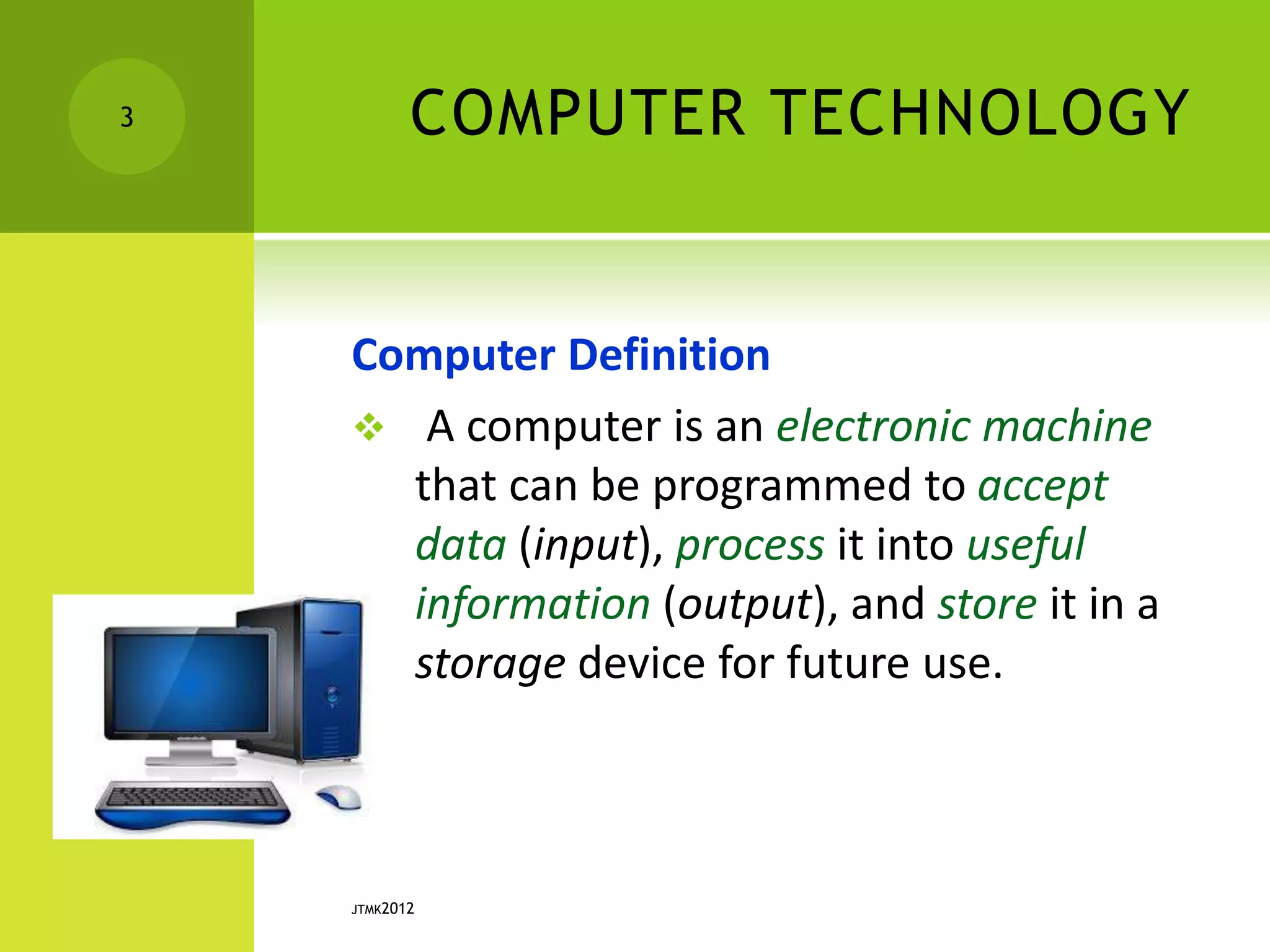
 A computer is an electronic machine
that can be programmed to accept
data (input), process it into useful
information (output), and store it in a
storage device for future use.
JTMK2012
3
TERMS
 USER?
 DATA?
 INFORMATION?
 HARDWARE?
 SOFTWARE?
JTMK2012
4
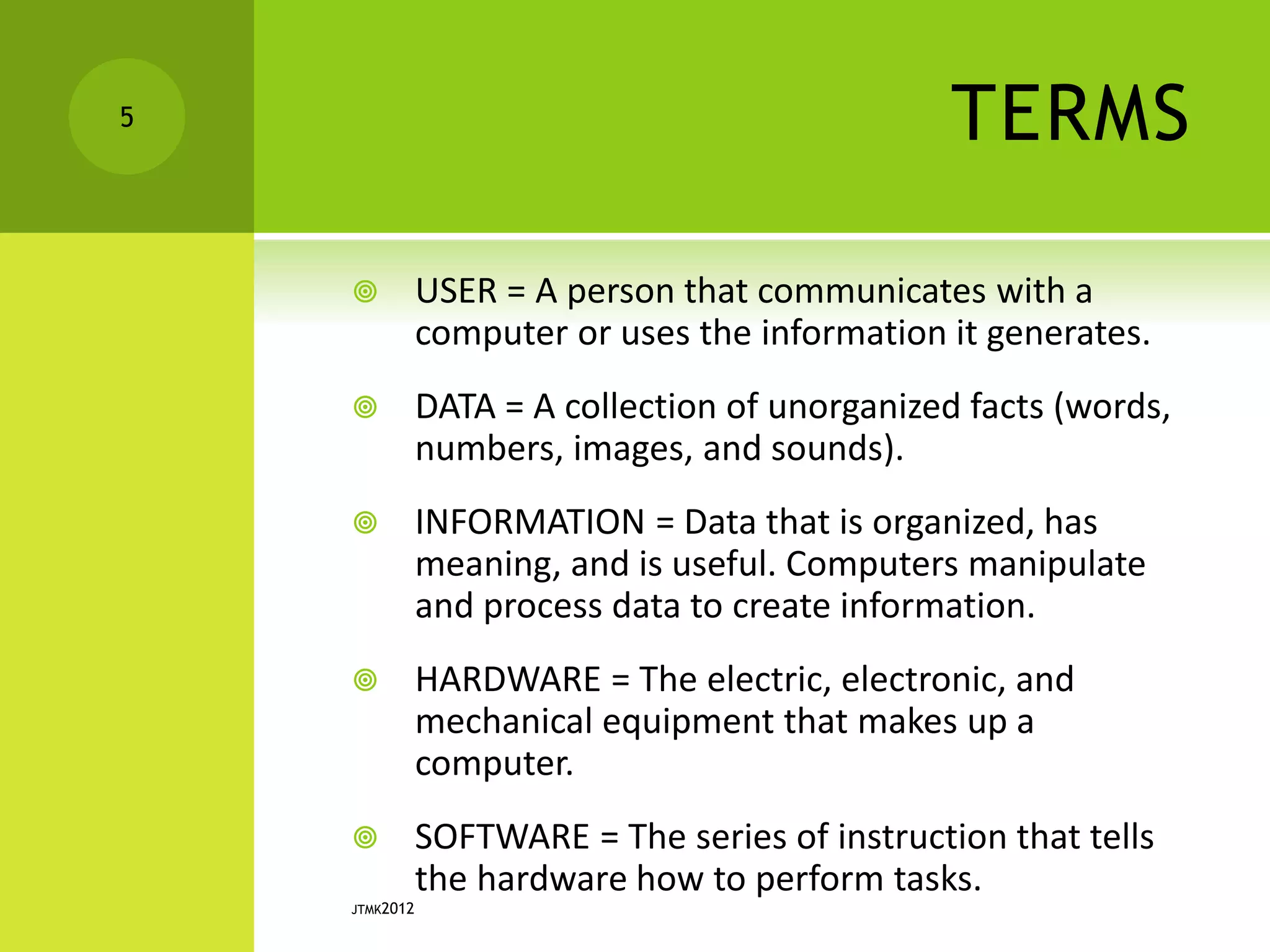
TERMS
 USER = A person that communicates with a
computer or uses the information it generates.
 DATA = A collection of unorganized facts (words,
numbers, images, and sounds).
 INFORMATION = Data that is organized, has
meaning, and is useful. Computers manipulate
and process data to create information.
 HARDWARE = The electric, electronic, and
mechanical equipment that makes up a
computer.
 SOFTWARE = The series of instruction that tells
the hardware how to perform tasks.
JTMK2012
5
COMPUTER EVOLUTION
6
MNIMZ-JTMK2011
7
COMPUTER’S TECHNICAL
SPECIFICATION




8
HOME COMPUTERS
 Store & view data
 Office software application
 Gaming
 Internet
 Does not need high technical specification.
9
ENTERTAINMENT/GAMING
COMPUTERS
 Similar to conventional PCs
 The addition of a performance-oriented video
card
 Capable of playing computationally demanding
video games
 Needs high technical specification such as high
speed of memory, processor and graphic card.
10
MULTIMEDIA EDITING COMPUTER
 A high specification computer
 Capable of creating and editing digital media files
such as photo, music and videos
 High speed of processor, memory and graphic
card
 Some needs dual monitor and high quality of
sound card
11
APPLICATION SERVER
 Handles all application operations between users
and an organization's backend business
applications or databases
 An application server has to have built-in
redundancy, monitor for high-availability, high-
performance distributed application services and
support for complex database access
 high speed of processor, high speed of memory
and high capacity of hard disk drive. The entire
component must be suitable for a server.
12
THE CHARACTERISTICS OF
PERSONAL COMPUTERS, SERVERS,
MAINFRAME AND SUPER
COMPUTER




13
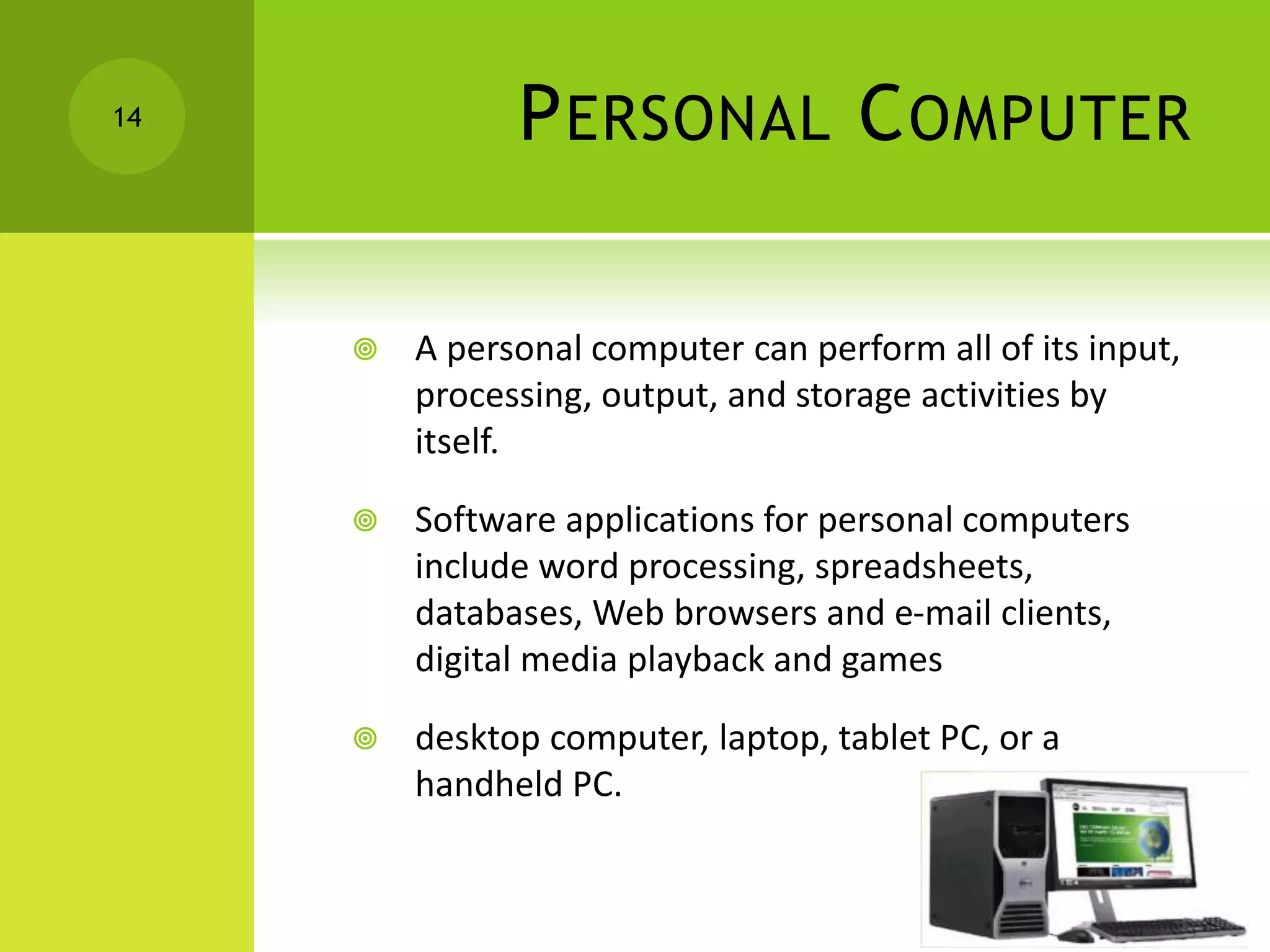
PERSONAL COMPUTER
 A personal computer can perform all of its input,
processing, output, and storage activities by
itself.
 Software applications for personal computers
include word processing, spreadsheets,
databases, Web browsers and e-mail clients,
digital media playback and games
 desktop computer, laptop, tablet PC, or a
handheld PC.
14
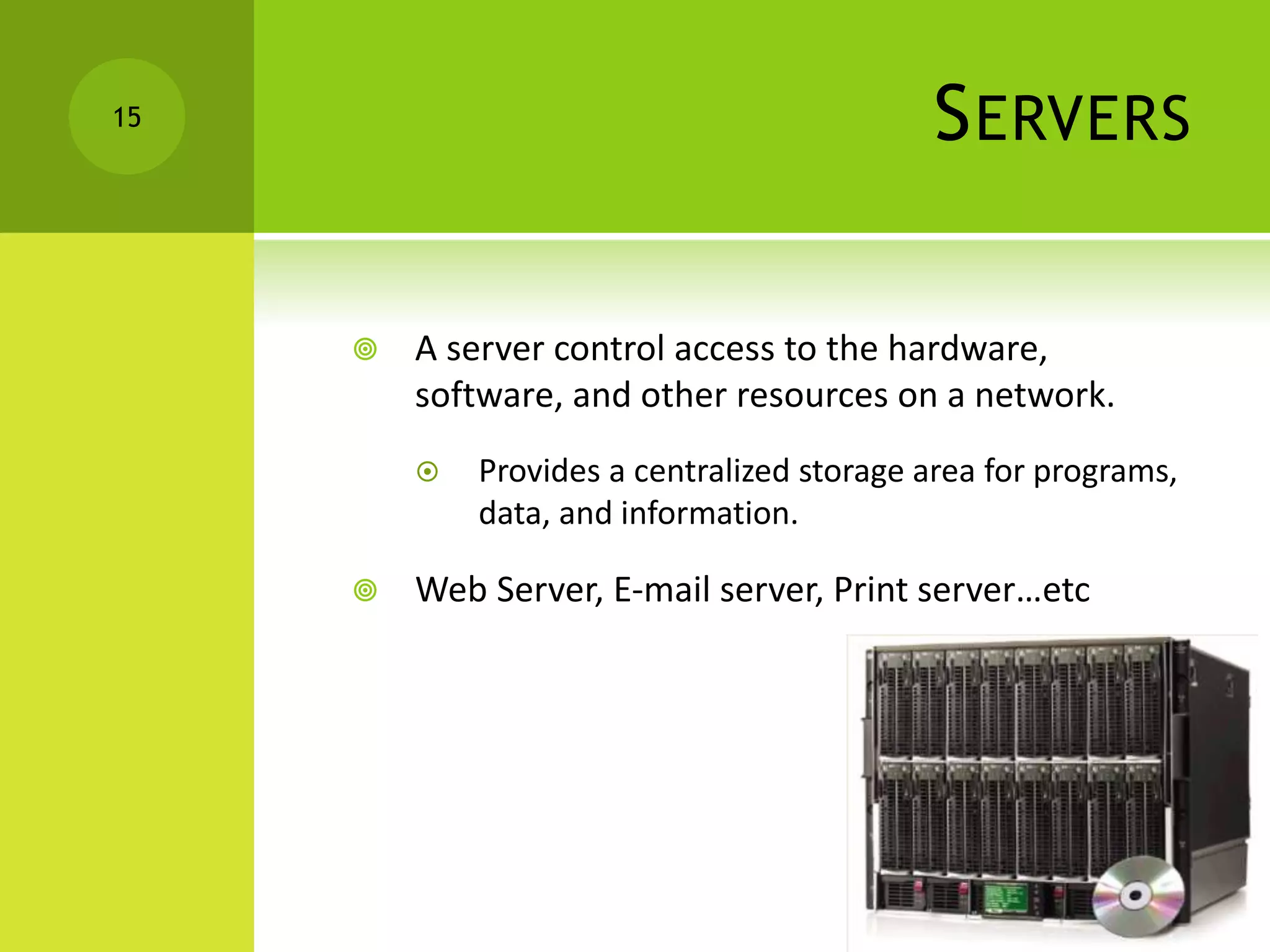
SERVERS
 A server control access to the hardware,
software, and other resources on a network.
 Provides a centralized storage area for programs,
data, and information.
 Web Server, E-mail server, Print server…etc
15
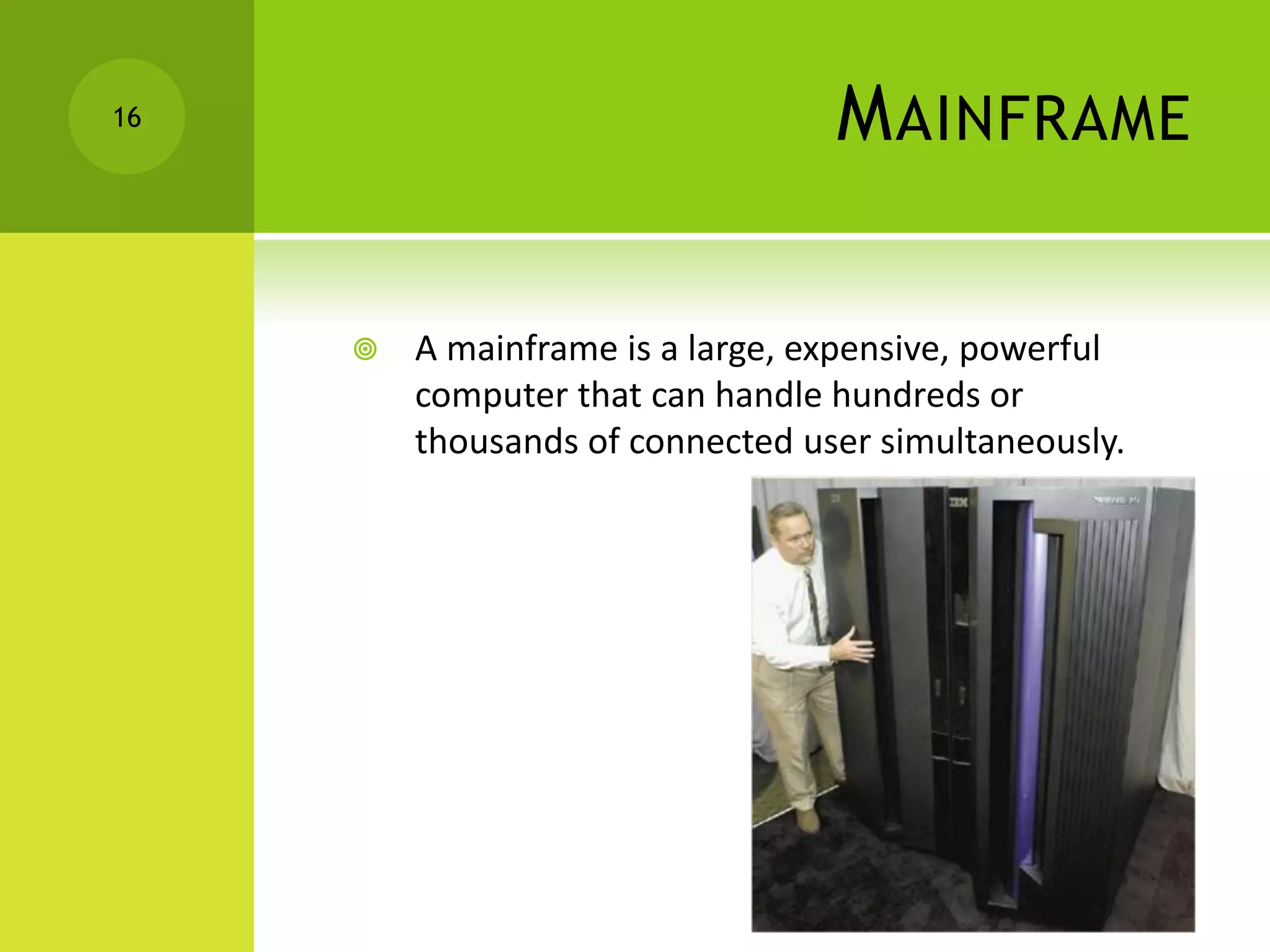
MAINFRAME
 A mainframe is a large, expensive, powerful
computer that can handle hundreds or
thousands of connected user simultaneously.
16
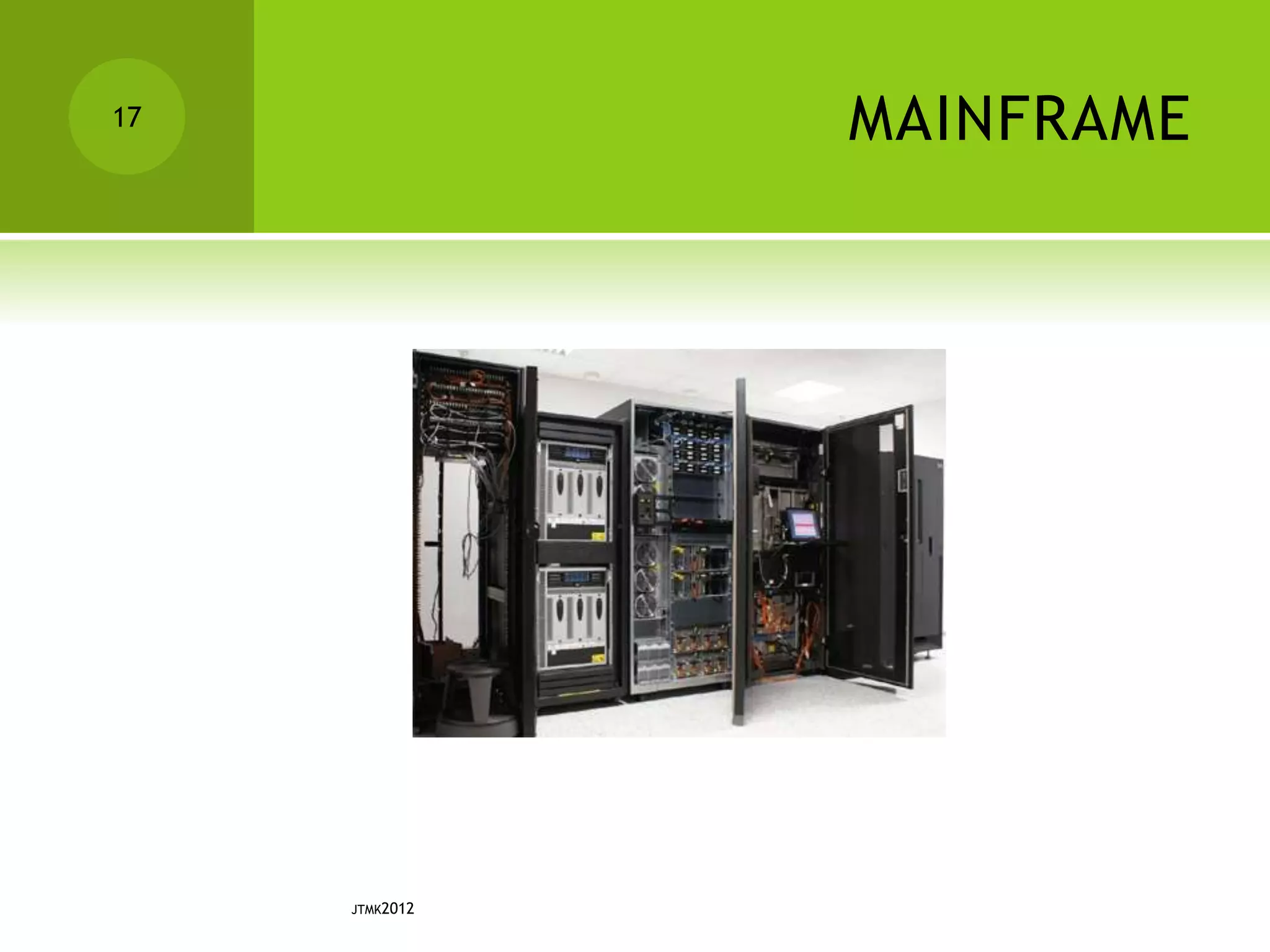
MAINFRAME
JTMK2012
17
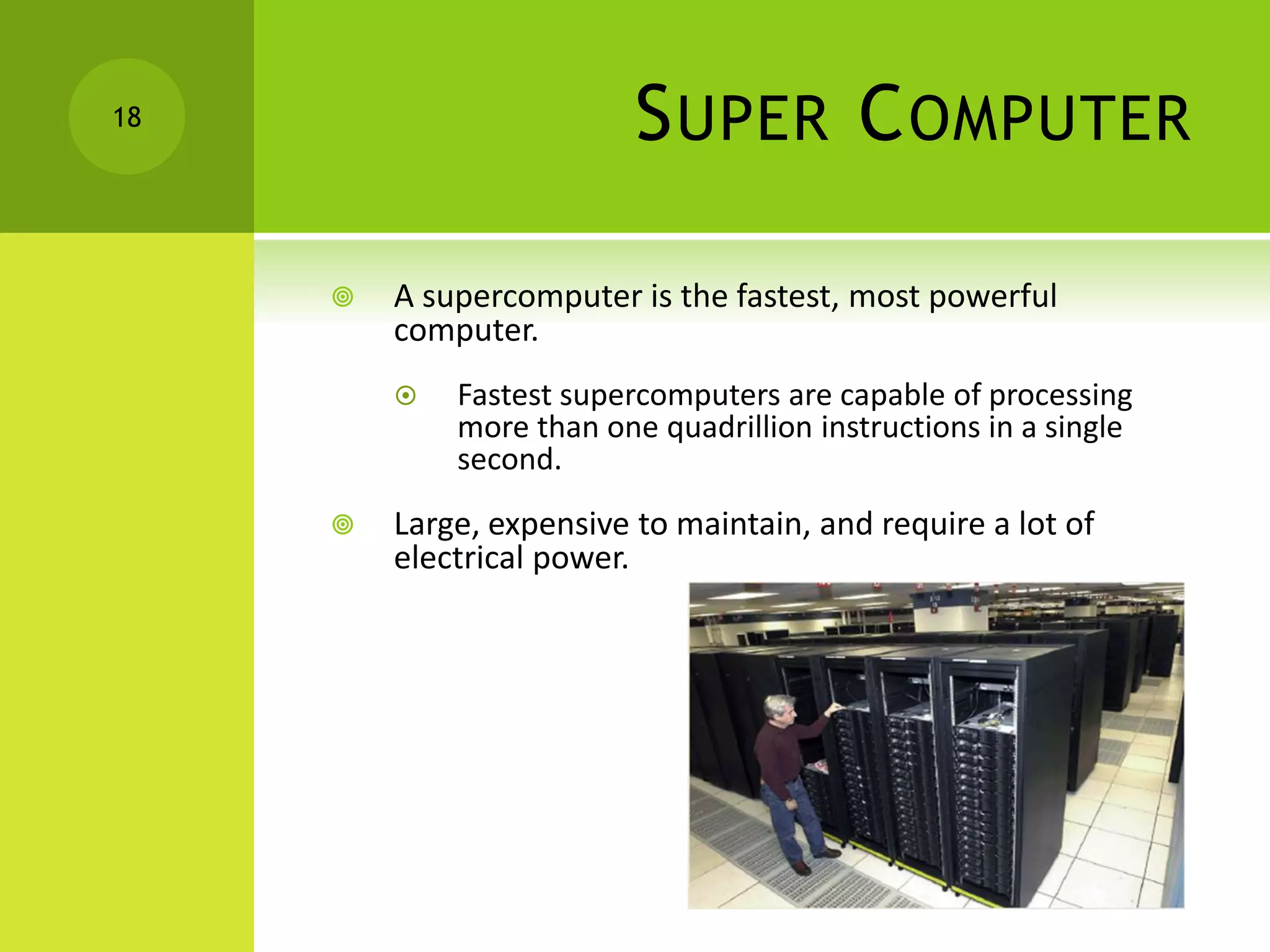
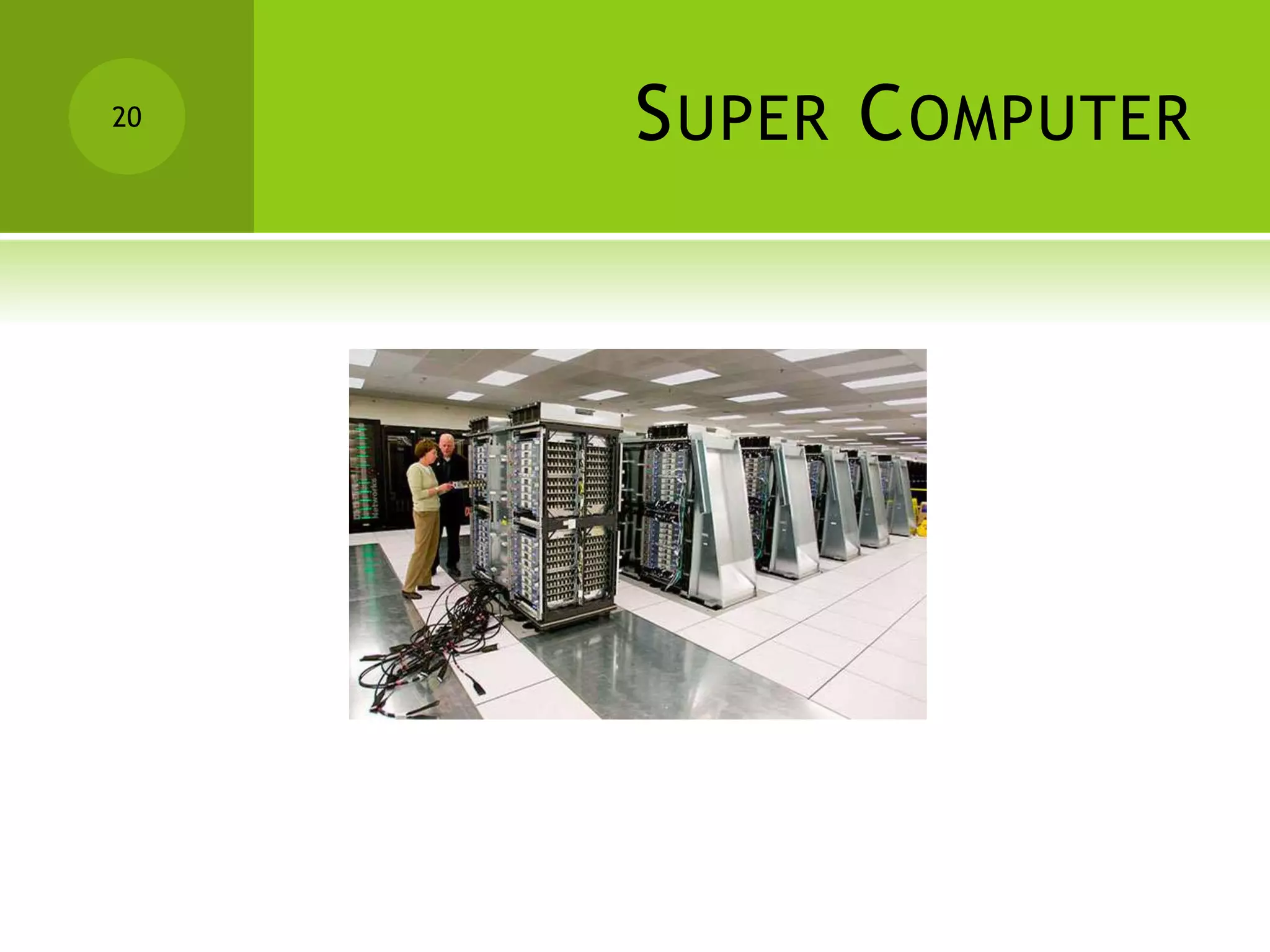
SUPER COMPUTER
 A supercomputer is the fastest, most powerful
computer.
 Fastest supercomputers are capable of processing
more than one quadrillion instructions in a single
second.
 Large, expensive to maintain, and require a lot of
electrical power.
18
 100 times faster than a corporate server
 Today use:
 Airplane simulation
 Auto accident simulation
 Advanced graphics for movies
 And lots more…
MNIMZ-JTMK2011
19
SUPER COMPUTER
20
COMPUTER SYSTEM
SOFTWARE
MNIMZ-JTMK2011
21
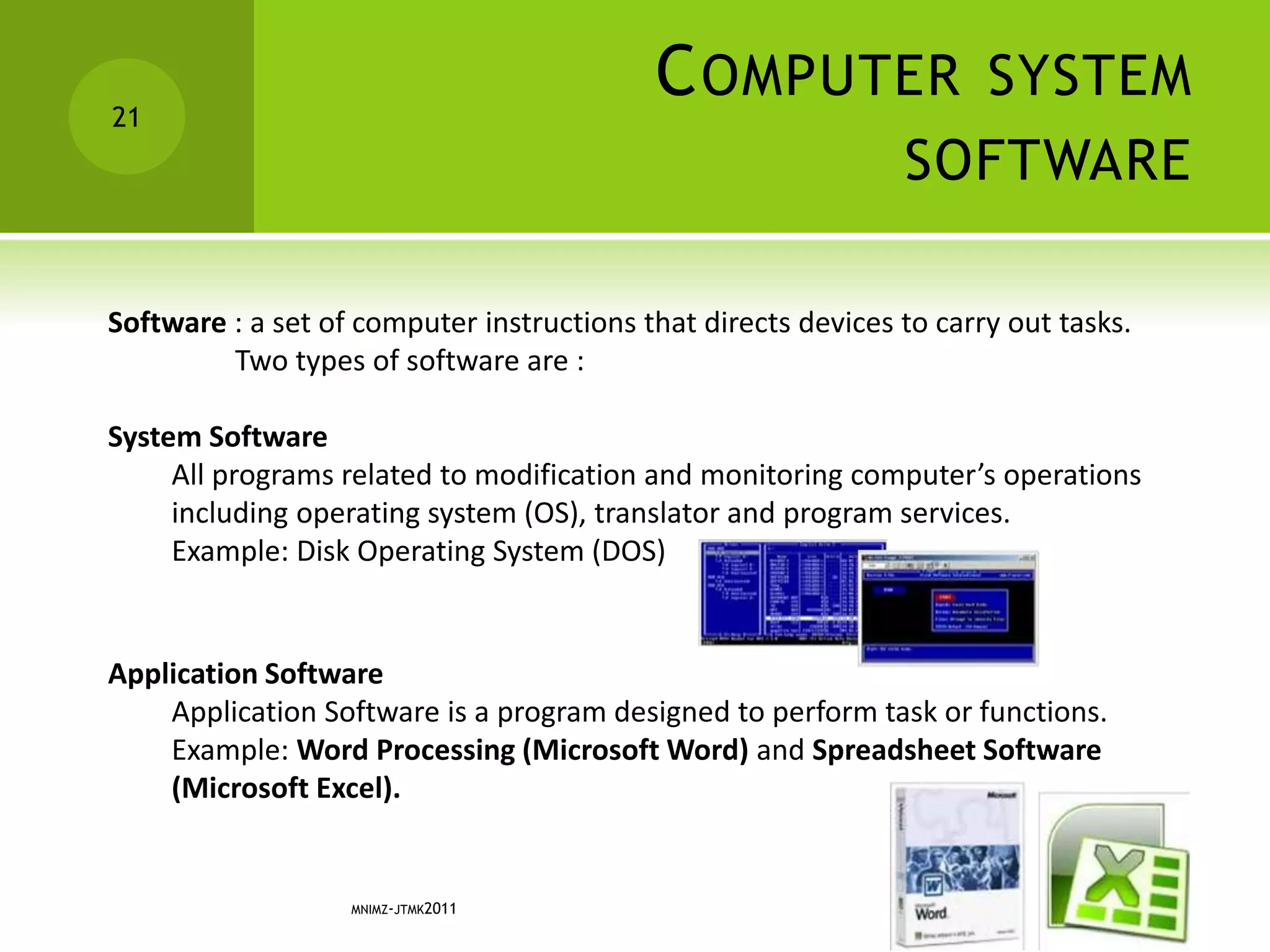
Software : a set of computer instructions that directs devices to carry out tasks.
Two types of software are :
System Software
All programs related to modification and monitoring computer’s operations
including operating system (OS), translator and program services.
Example: Disk Operating System (DOS)
Application Software
Application Software is a program designed to perform task or functions.
Example: Word Processing (Microsoft Word) and Spreadsheet Software
(Microsoft Excel).
TYPES OF OPERATING SYSTEM
 Personal Computer
 Server Computer
MNIMZ-JTMK2011
22
THANK YOU 
23

CHAPTER 1 - COMPUTER TECHNOLOGY.pptx

  • 1.
  • 2.
    LEARNING OUTCOMES  Understandbasic concepts of computer technology. 2
  • 3.
    COMPUTER TECHNOLOGY Computer Definition A computer is an electronic machine that can be programmed to accept data (input), process it into useful information (output), and store it in a storage device for future use. JTMK2012 3
  • 4.
    TERMS  USER?  DATA? INFORMATION?  HARDWARE?  SOFTWARE? JTMK2012 4
  • 5.
    TERMS  USER =A person that communicates with a computer or uses the information it generates.  DATA = A collection of unorganized facts (words, numbers, images, and sounds).  INFORMATION = Data that is organized, has meaning, and is useful. Computers manipulate and process data to create information.  HARDWARE = The electric, electronic, and mechanical equipment that makes up a computer.  SOFTWARE = The series of instruction that tells the hardware how to perform tasks. JTMK2012 5
  • 6.
  • 7.
  • 8.
  • 9.
    HOME COMPUTERS  Store& view data  Office software application  Gaming  Internet  Does not need high technical specification. 9
  • 10.
    ENTERTAINMENT/GAMING COMPUTERS  Similar toconventional PCs  The addition of a performance-oriented video card  Capable of playing computationally demanding video games  Needs high technical specification such as high speed of memory, processor and graphic card. 10
  • 11.
    MULTIMEDIA EDITING COMPUTER A high specification computer  Capable of creating and editing digital media files such as photo, music and videos  High speed of processor, memory and graphic card  Some needs dual monitor and high quality of sound card 11
  • 12.
    APPLICATION SERVER  Handlesall application operations between users and an organization's backend business applications or databases  An application server has to have built-in redundancy, monitor for high-availability, high- performance distributed application services and support for complex database access  high speed of processor, high speed of memory and high capacity of hard disk drive. The entire component must be suitable for a server. 12
  • 13.
    THE CHARACTERISTICS OF PERSONALCOMPUTERS, SERVERS, MAINFRAME AND SUPER COMPUTER     13
  • 14.
    PERSONAL COMPUTER  Apersonal computer can perform all of its input, processing, output, and storage activities by itself.  Software applications for personal computers include word processing, spreadsheets, databases, Web browsers and e-mail clients, digital media playback and games  desktop computer, laptop, tablet PC, or a handheld PC. 14
  • 15.
    SERVERS  A servercontrol access to the hardware, software, and other resources on a network.  Provides a centralized storage area for programs, data, and information.  Web Server, E-mail server, Print server…etc 15
  • 16.
    MAINFRAME  A mainframeis a large, expensive, powerful computer that can handle hundreds or thousands of connected user simultaneously. 16
  • 17.
  • 18.
    SUPER COMPUTER  Asupercomputer is the fastest, most powerful computer.  Fastest supercomputers are capable of processing more than one quadrillion instructions in a single second.  Large, expensive to maintain, and require a lot of electrical power. 18
  • 19.
     100 timesfaster than a corporate server  Today use:  Airplane simulation  Auto accident simulation  Advanced graphics for movies  And lots more… MNIMZ-JTMK2011 19
  • 20.
  • 21.
    COMPUTER SYSTEM SOFTWARE MNIMZ-JTMK2011 21 Software :a set of computer instructions that directs devices to carry out tasks. Two types of software are : System Software All programs related to modification and monitoring computer’s operations including operating system (OS), translator and program services. Example: Disk Operating System (DOS) Application Software Application Software is a program designed to perform task or functions. Example: Word Processing (Microsoft Word) and Spreadsheet Software (Microsoft Excel).
  • 22.
    TYPES OF OPERATINGSYSTEM  Personal Computer  Server Computer MNIMZ-JTMK2011 22
  • 23.