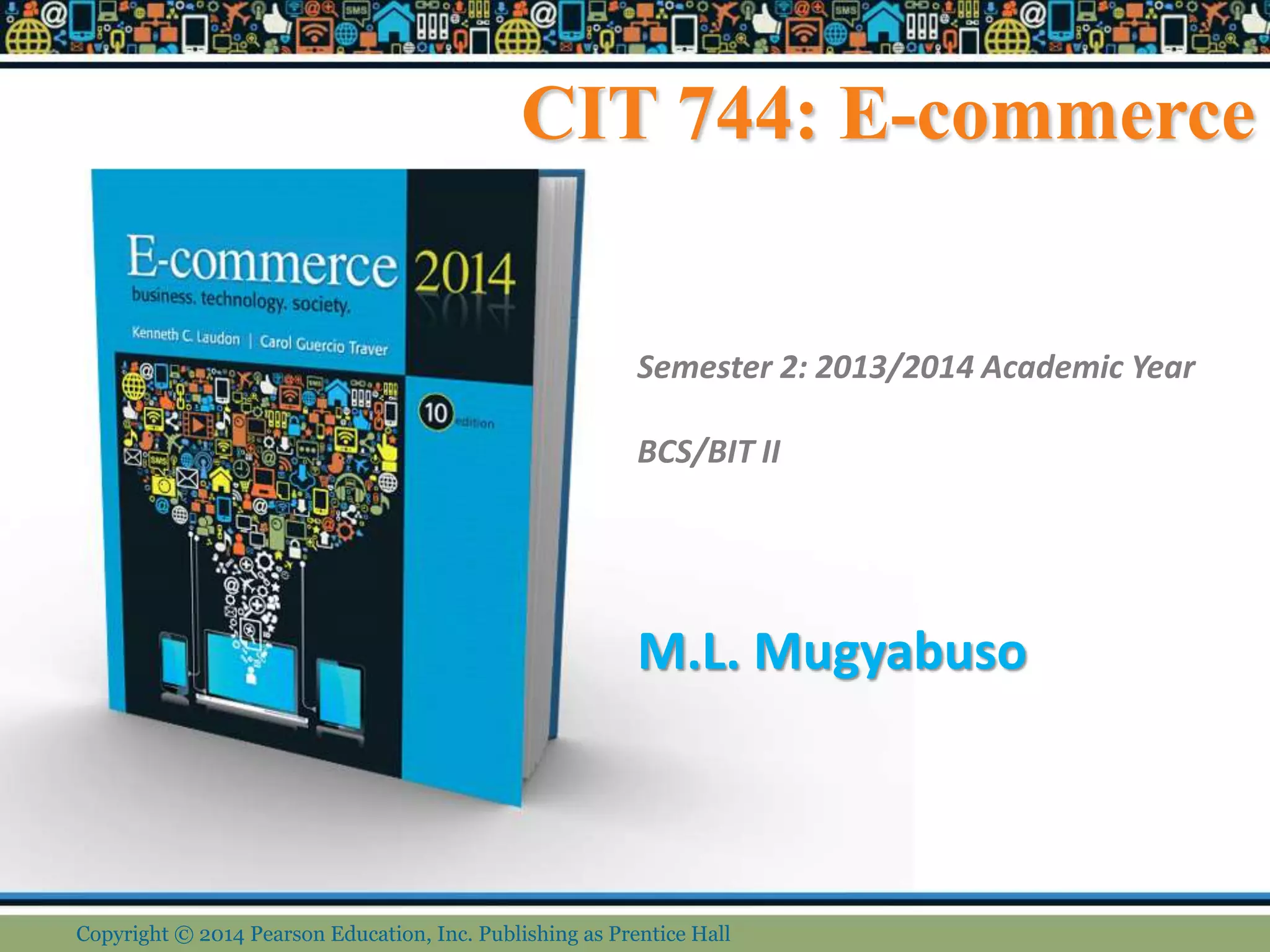
CIT 744: E-commerce
M.L. Mugyabuso
Semester 2: 2013/2014 Academic Year
BCS/BIT II
Copyright © 2014 Pearson Education, Inc. Publishing as Prentice Hall
Lecture 1
The Revolution Is Just Beginning
Copyright © 2014 Pearson Education, Inc. Publishing as Prentice Hall
Class Discussion
Pinterest: A Picture Is Worth a
Thousand Words
 Have you used Pinterest or any other content
curation sites? What are your main interests?
 Have you purchased anything based on a pin
or board on Pinterest or any other curation
site?
 Why do Pinterest links drive more purchasing
than Facebook links?
Copyright © 2014 Pearson Education, Inc. Publishing as Prentice Hall Slide 1-3
E-commerce Trends 2013–2014
 Expansion of social, local, and mobile
e-commerce
 Mobile platform begins to rival PC platform
 Continued growth of cloud computing
 Explosive growth in “Big Data”
 E-books gain wide acceptance
 Continued growth of user-generated
content
Copyright © 2014 Pearson Education, Inc. Publishing as Prentice Hall Slide 1-4
The First 30 Seconds
 First 17 years of e-commerce
Just the beginning
Rapid growth and change
 Technologies continue to evolve at
exponential rates
Disruptive business change
New opportunities
Copyright © 2014 Pearson Education, Inc. Publishing as Prentice Hall Slide 1-5
What Is E-commerce?
 Use of Internet and Web to transact
business
 More formally:
Digitally enabled commercial transactions
between and among organizations and
individuals
Copyright © 2014 Pearson Education, Inc. Publishing as Prentice Hall Slide 1-6
E-commerce vs. E-business
 E-business:
Digital enabling of transactions and
processes within a firm, involving
information systems under firm’s control
Does not include commercial transactions
involving an exchange of value across
organizational boundaries
Copyright © 2014 Pearson Education, Inc. Publishing as Prentice Hall Slide 1-7
Why Study E-commerce?
 E-commerce technology is different, more
powerful than previous technologies
 E-commerce brings fundamental changes to
commerce
 Traditional commerce:
 Consumer as passive targets
 Mass-marketing driven
 Sales-force driven
 Fixed prices
 Information asymmetry
Copyright © 2014 Pearson Education, Inc. Publishing as Prentice Hall Slide 1-8
Eight Unique Features of
E-commerce Technology
1. Ubiquity
2. Global reach
3. Universal standards
4. Information richness
5. Interactivity
6. Information density
7. Personalization/customization
8. Social technology
Copyright © 2014 Pearson Education, Inc. Publishing as Prentice Hall Slide 1-9
Web 2.0
 User-centered applications and social
media technologies
User-generated content and communication
Highly interactive, social communities
Large audiences; yet mostly unproven business
models
Examples: Twitter, YouTube, Instagram,
Wikipedia, Tumblr
Copyright © 2014 Pearson Education, Inc. Publishing as Prentice Hall Slide 1-10
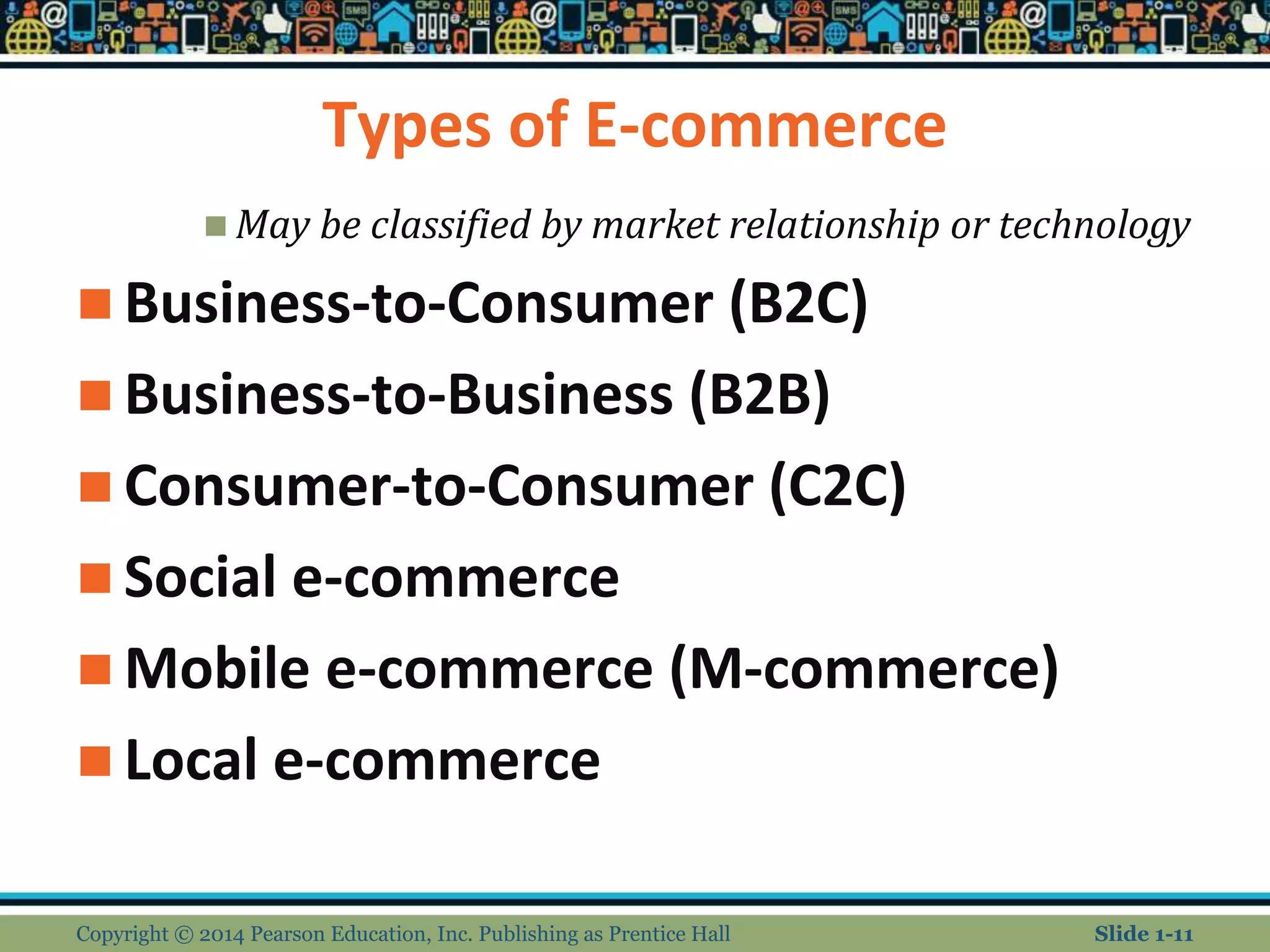
Types of E-commerce
 May be classified by market relationship or technology
 Business-to-Consumer (B2C)
 Business-to-Business (B2B)
 Consumer-to-Consumer (C2C)
 Social e-commerce
 Mobile e-commerce (M-commerce)
 Local e-commerce
Copyright © 2014 Pearson Education, Inc. Publishing as Prentice Hall Slide 1-11
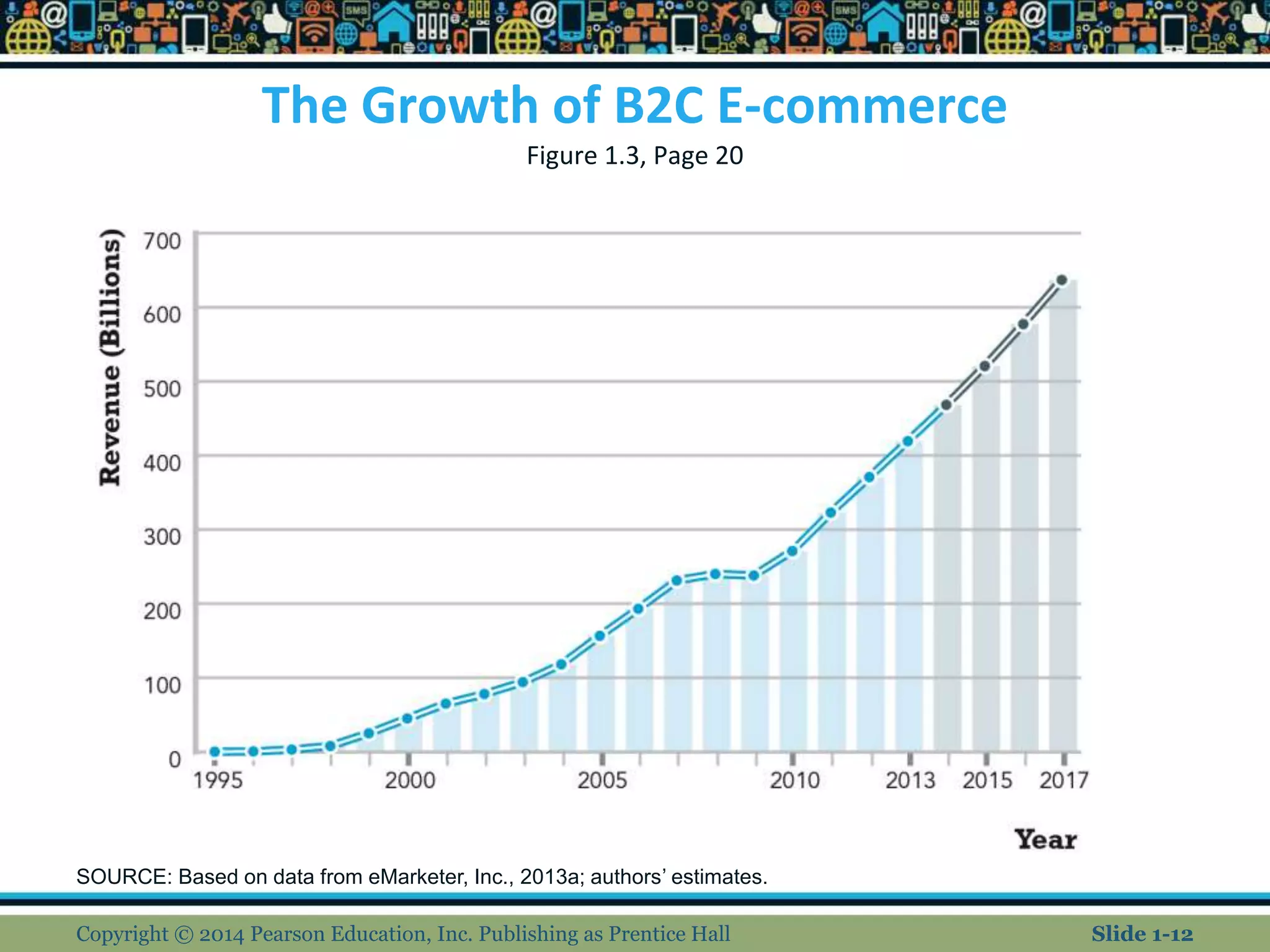
The Growth of B2C E-commerce
Figure 1.3, Page 20
Copyright © 2014 Pearson Education, Inc. Publishing as Prentice Hall
SOURCE: Based on data from eMarketer, Inc., 2013a; authors’ estimates.
Slide 1-12
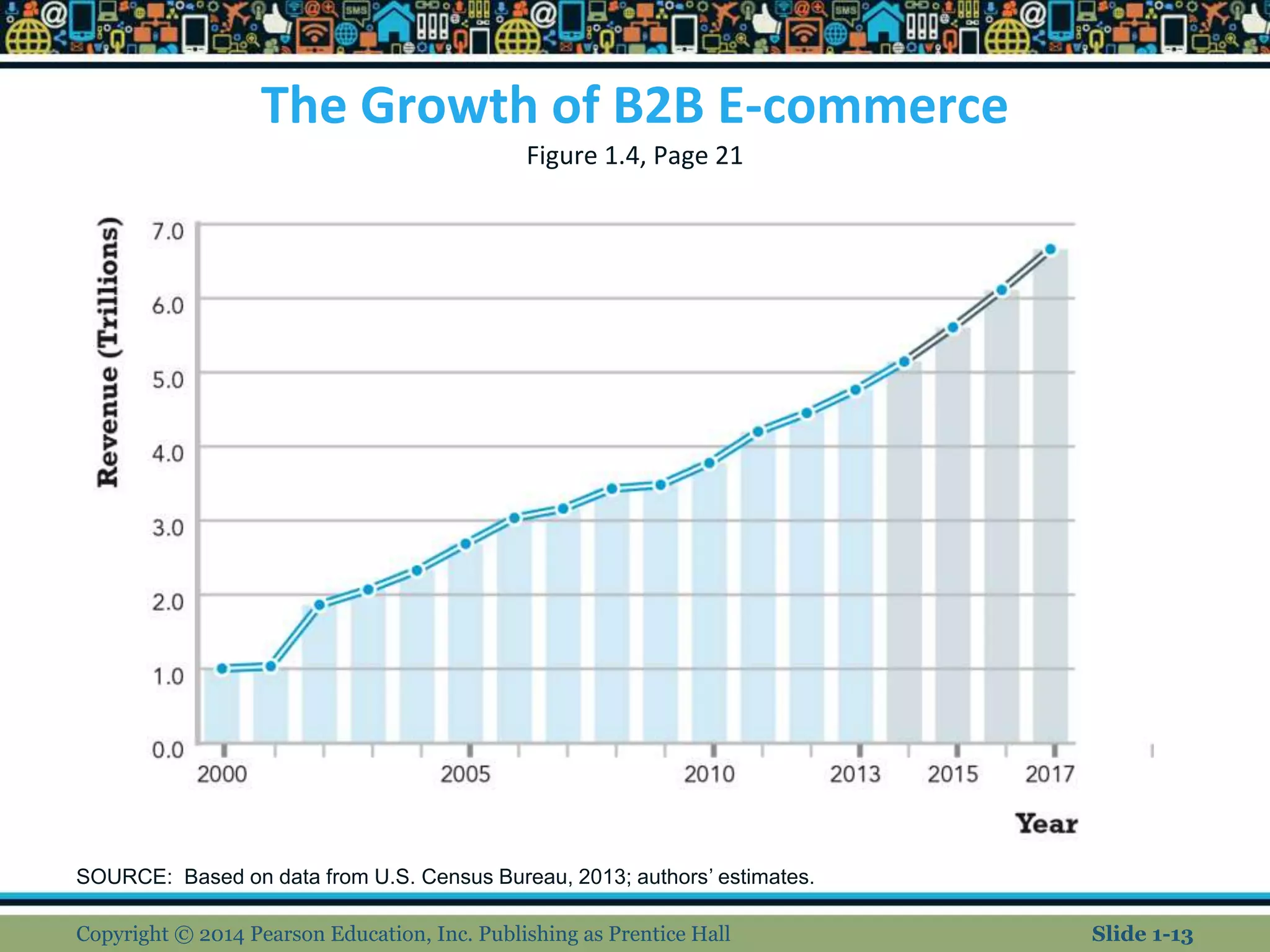
The Growth of B2B E-commerce
Figure 1.4, Page 21
Copyright © 2014 Pearson Education, Inc. Publishing as Prentice Hall
SOURCE: Based on data from U.S. Census Bureau, 2013; authors’ estimates.
Slide 1-13
The Internet
 Worldwide network of computer
networks built on common standards
 Created in late 1960s
 Services include the Web, e-mail, file
transfers, and so on
 Can measure growth by number of
Internet hosts with domain names
Copyright © 2014 Pearson Education, Inc. Publishing as Prentice Hall Slide 1-14
The Web
 Most popular Internet service
 Developed in early 1990s
 Provides access to Web pages
HTML documents that may include text,
graphics, animations, music, videos
 Web content has grown exponentially
 Google reports 30 trillion unique URLs; 120
billion Web pages indexed
Copyright © 2014 Pearson Education, Inc. Publishing as Prentice Hall Slide 1-15
The Mobile Platform
 Most recent development in Internet
infrastructure
 Enables access to the Internet via
wireless networks or cell-phone service
 Mobile devices include
Tablets
Smartphones
Ultra-lightweight laptops
Copyright © 2014 Pearson Education, Inc. Publishing as Prentice Hall Slide 1-16
Insight on Technology: Class Discussion
Will Apps Make the Web Irrelevant?
 What are the advantages and
disadvantages of apps, compared
with Web sites, for mobile users?
 What are the benefits of apps for
content owners and creators?
 Will apps eventually make the Web
irrelevant? Why or why not?
Copyright © 2014 Pearson Education, Inc. Publishing as Prentice Hall Slide 1-17
Origins and Growth of E-commerce
 Precursors:
Baxter Healthcare
Electronic Data Interchange (EDI)
French Minitel (1980s videotex system)
None had functionality of Internet
 1995: Beginning of e-commerce
First sales of banner advertisements
 E-commerce fastest growing form of
commerce in United States
Copyright © 2014 Pearson Education, Inc. Publishing as Prentice Hall Slide 1-18
E-commerce: A Brief History
 1995–2000: Invention
Key concepts developed
Limited bandwidth and media
Euphoric visions of
 Friction-free commerce
 Lowered search costs, disintermediation, price
transparency, elimination of unfair competitive advantage
 First-mover advantages
 Network profits
Dot-com crash of 2000
Copyright © 2014 Pearson Education, Inc. Publishing as Prentice Hall Slide 1-19
E-commerce: A Brief History (cont.)
 2001–2006: Consolidation
Emphasis on business-driven approach
Traditional large firms expand presence
Start-up financing shrinks up
More complex products and services sold
Growth of search engine advertising
Business Web presences expand to include
e-mail, display and search advertising, and
limited community feedback features
Copyright © 2014 Pearson Education, Inc. Publishing as Prentice Hall Slide 1-20
E-commerce: A Brief History (cont.)
 2007–Present: Reinvention
Rapid growth of:
 Online social networks
 Mobile platform
 Local commerce
Entertainment content develops as source of
revenues
Transformation of marketing
 Coordinated marketing on social, mobile, local platforms
 Analytic technologies
Copyright © 2014 Pearson Education, Inc. Publishing as Prentice Hall Slide 1-21
Insight on Business: Class Discussion
Start-up Boot Camp
 Why do you think investors today are still
interested in investing in start-ups?
 What are the benefits of investing in a company
that is a graduate of a Y Combinator boot camp?
 Is an incubator the best solution for start-ups to
find funding? Why or why not?
Copyright © 2014 Pearson Education, Inc. Publishing as Prentice Hall Slide 1-22
Assessing E-commerce
 Many early visions not fulfilled
Friction-free commerce
 Consumers less price sensitive
 Considerable price dispersion
Perfect competition
 Information asymmetries persist
Intermediaries have not disappeared
First mover advantages
 Fast-followers often overtake first movers
Copyright © 2014 Pearson Education, Inc. Publishing as Prentice Hall Slide 1-23
Predictions for the Future
 Technology will propagate through all commercial
activity
 Large, traditional companies will continue to play
dominant role, consolidating audiences
 Start-up ventures can still attract large audiences in non-
dominated arenas
 Integrated online/offline companies will experience
more growth than purely online companies
 Additional factors:
 Increased regulation and control
 Cost of energy
Copyright © 2014 Pearson Education, Inc. Publishing as Prentice Hall Slide 1-24
Understanding E-commerce:
Organizing Themes
 Technology:
 Development and mastery of digital computing and
communications technology
 Business:
 New technologies present businesses with new ways of
organizing production and transacting business
 Society:
 Intellectual property, individual privacy, public welfare
policy
Copyright © 2014 Pearson Education, Inc. Publishing as Prentice Hall Slide 1-25
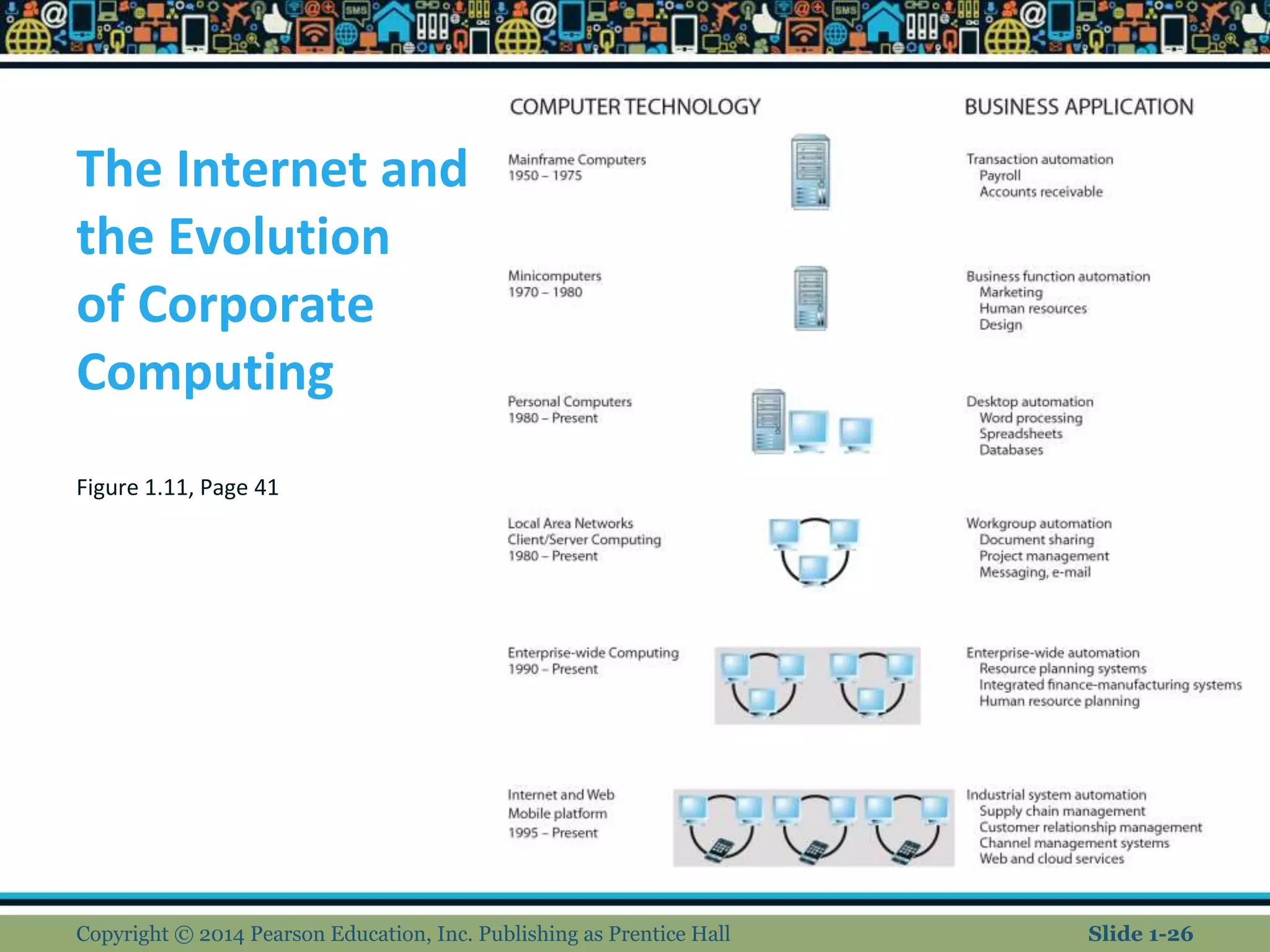
The Internet and
the Evolution
of Corporate
Computing
Figure 1.11, Page 41
Copyright © 2014 Pearson Education, Inc. Publishing as Prentice Hall Slide 1-26
Insight on Society: Class Discussion
Facebook and the Age of Privacy
 Why are social network sites interested in collecting
user information?
 What types of privacy invasion are described in the
case? Which is the most privacy-invading, and why?
 Is e-commerce any different than traditional
markets with respect to privacy? Don’t merchants
always want to know their customer?
 How do you protect your privacy on the Web?
Copyright © 2014 Pearson Education, Inc. Publishing as Prentice Hall Slide 1-27
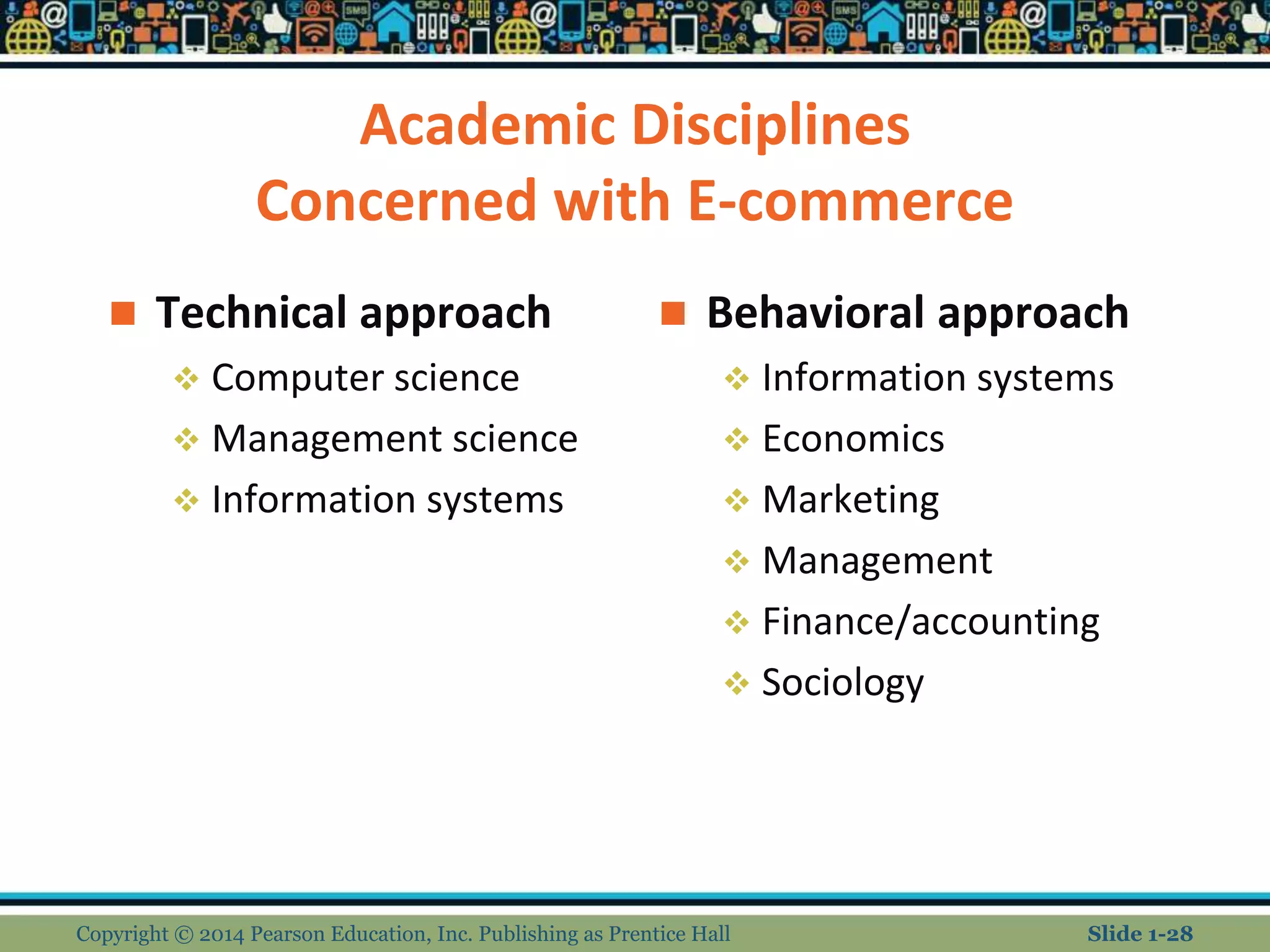
Academic Disciplines
Concerned with E-commerce
 Technical approach
 Computer science
 Management science
 Information systems
 Behavioral approach
 Information systems
 Economics
 Marketing
 Management
 Finance/accounting
 Sociology
Copyright © 2014 Pearson Education, Inc. Publishing as Prentice Hall Slide 1-28

Lecture 1

  • 1.
    CIT 744: E-commerce M.L.Mugyabuso Semester 2: 2013/2014 Academic Year BCS/BIT II Copyright © 2014 Pearson Education, Inc. Publishing as Prentice Hall
  • 2.
    Lecture 1 The RevolutionIs Just Beginning Copyright © 2014 Pearson Education, Inc. Publishing as Prentice Hall
  • 3.
    Class Discussion Pinterest: APicture Is Worth a Thousand Words  Have you used Pinterest or any other content curation sites? What are your main interests?  Have you purchased anything based on a pin or board on Pinterest or any other curation site?  Why do Pinterest links drive more purchasing than Facebook links? Copyright © 2014 Pearson Education, Inc. Publishing as Prentice Hall Slide 1-3
  • 4.
    E-commerce Trends 2013–2014 Expansion of social, local, and mobile e-commerce  Mobile platform begins to rival PC platform  Continued growth of cloud computing  Explosive growth in “Big Data”  E-books gain wide acceptance  Continued growth of user-generated content Copyright © 2014 Pearson Education, Inc. Publishing as Prentice Hall Slide 1-4
  • 5.
    The First 30Seconds  First 17 years of e-commerce Just the beginning Rapid growth and change  Technologies continue to evolve at exponential rates Disruptive business change New opportunities Copyright © 2014 Pearson Education, Inc. Publishing as Prentice Hall Slide 1-5
  • 6.
    What Is E-commerce? Use of Internet and Web to transact business  More formally: Digitally enabled commercial transactions between and among organizations and individuals Copyright © 2014 Pearson Education, Inc. Publishing as Prentice Hall Slide 1-6
  • 7.
    E-commerce vs. E-business E-business: Digital enabling of transactions and processes within a firm, involving information systems under firm’s control Does not include commercial transactions involving an exchange of value across organizational boundaries Copyright © 2014 Pearson Education, Inc. Publishing as Prentice Hall Slide 1-7
  • 8.
    Why Study E-commerce? E-commerce technology is different, more powerful than previous technologies  E-commerce brings fundamental changes to commerce  Traditional commerce:  Consumer as passive targets  Mass-marketing driven  Sales-force driven  Fixed prices  Information asymmetry Copyright © 2014 Pearson Education, Inc. Publishing as Prentice Hall Slide 1-8
  • 9.
    Eight Unique Featuresof E-commerce Technology 1. Ubiquity 2. Global reach 3. Universal standards 4. Information richness 5. Interactivity 6. Information density 7. Personalization/customization 8. Social technology Copyright © 2014 Pearson Education, Inc. Publishing as Prentice Hall Slide 1-9
  • 10.
    Web 2.0  User-centeredapplications and social media technologies User-generated content and communication Highly interactive, social communities Large audiences; yet mostly unproven business models Examples: Twitter, YouTube, Instagram, Wikipedia, Tumblr Copyright © 2014 Pearson Education, Inc. Publishing as Prentice Hall Slide 1-10
  • 11.
    Types of E-commerce May be classified by market relationship or technology  Business-to-Consumer (B2C)  Business-to-Business (B2B)  Consumer-to-Consumer (C2C)  Social e-commerce  Mobile e-commerce (M-commerce)  Local e-commerce Copyright © 2014 Pearson Education, Inc. Publishing as Prentice Hall Slide 1-11
  • 12.
    The Growth ofB2C E-commerce Figure 1.3, Page 20 Copyright © 2014 Pearson Education, Inc. Publishing as Prentice Hall SOURCE: Based on data from eMarketer, Inc., 2013a; authors’ estimates. Slide 1-12
  • 13.
    The Growth ofB2B E-commerce Figure 1.4, Page 21 Copyright © 2014 Pearson Education, Inc. Publishing as Prentice Hall SOURCE: Based on data from U.S. Census Bureau, 2013; authors’ estimates. Slide 1-13
  • 14.
    The Internet  Worldwidenetwork of computer networks built on common standards  Created in late 1960s  Services include the Web, e-mail, file transfers, and so on  Can measure growth by number of Internet hosts with domain names Copyright © 2014 Pearson Education, Inc. Publishing as Prentice Hall Slide 1-14
  • 15.
    The Web  Mostpopular Internet service  Developed in early 1990s  Provides access to Web pages HTML documents that may include text, graphics, animations, music, videos  Web content has grown exponentially  Google reports 30 trillion unique URLs; 120 billion Web pages indexed Copyright © 2014 Pearson Education, Inc. Publishing as Prentice Hall Slide 1-15
  • 16.
    The Mobile Platform Most recent development in Internet infrastructure  Enables access to the Internet via wireless networks or cell-phone service  Mobile devices include Tablets Smartphones Ultra-lightweight laptops Copyright © 2014 Pearson Education, Inc. Publishing as Prentice Hall Slide 1-16
  • 17.
    Insight on Technology:Class Discussion Will Apps Make the Web Irrelevant?  What are the advantages and disadvantages of apps, compared with Web sites, for mobile users?  What are the benefits of apps for content owners and creators?  Will apps eventually make the Web irrelevant? Why or why not? Copyright © 2014 Pearson Education, Inc. Publishing as Prentice Hall Slide 1-17
  • 18.
    Origins and Growthof E-commerce  Precursors: Baxter Healthcare Electronic Data Interchange (EDI) French Minitel (1980s videotex system) None had functionality of Internet  1995: Beginning of e-commerce First sales of banner advertisements  E-commerce fastest growing form of commerce in United States Copyright © 2014 Pearson Education, Inc. Publishing as Prentice Hall Slide 1-18
  • 19.
    E-commerce: A BriefHistory  1995–2000: Invention Key concepts developed Limited bandwidth and media Euphoric visions of  Friction-free commerce  Lowered search costs, disintermediation, price transparency, elimination of unfair competitive advantage  First-mover advantages  Network profits Dot-com crash of 2000 Copyright © 2014 Pearson Education, Inc. Publishing as Prentice Hall Slide 1-19
  • 20.
    E-commerce: A BriefHistory (cont.)  2001–2006: Consolidation Emphasis on business-driven approach Traditional large firms expand presence Start-up financing shrinks up More complex products and services sold Growth of search engine advertising Business Web presences expand to include e-mail, display and search advertising, and limited community feedback features Copyright © 2014 Pearson Education, Inc. Publishing as Prentice Hall Slide 1-20
  • 21.
    E-commerce: A BriefHistory (cont.)  2007–Present: Reinvention Rapid growth of:  Online social networks  Mobile platform  Local commerce Entertainment content develops as source of revenues Transformation of marketing  Coordinated marketing on social, mobile, local platforms  Analytic technologies Copyright © 2014 Pearson Education, Inc. Publishing as Prentice Hall Slide 1-21
  • 22.
    Insight on Business:Class Discussion Start-up Boot Camp  Why do you think investors today are still interested in investing in start-ups?  What are the benefits of investing in a company that is a graduate of a Y Combinator boot camp?  Is an incubator the best solution for start-ups to find funding? Why or why not? Copyright © 2014 Pearson Education, Inc. Publishing as Prentice Hall Slide 1-22
  • 23.
    Assessing E-commerce  Manyearly visions not fulfilled Friction-free commerce  Consumers less price sensitive  Considerable price dispersion Perfect competition  Information asymmetries persist Intermediaries have not disappeared First mover advantages  Fast-followers often overtake first movers Copyright © 2014 Pearson Education, Inc. Publishing as Prentice Hall Slide 1-23
  • 24.
    Predictions for theFuture  Technology will propagate through all commercial activity  Large, traditional companies will continue to play dominant role, consolidating audiences  Start-up ventures can still attract large audiences in non- dominated arenas  Integrated online/offline companies will experience more growth than purely online companies  Additional factors:  Increased regulation and control  Cost of energy Copyright © 2014 Pearson Education, Inc. Publishing as Prentice Hall Slide 1-24
  • 25.
    Understanding E-commerce: Organizing Themes Technology:  Development and mastery of digital computing and communications technology  Business:  New technologies present businesses with new ways of organizing production and transacting business  Society:  Intellectual property, individual privacy, public welfare policy Copyright © 2014 Pearson Education, Inc. Publishing as Prentice Hall Slide 1-25
  • 26.
    The Internet and theEvolution of Corporate Computing Figure 1.11, Page 41 Copyright © 2014 Pearson Education, Inc. Publishing as Prentice Hall Slide 1-26
  • 27.
    Insight on Society:Class Discussion Facebook and the Age of Privacy  Why are social network sites interested in collecting user information?  What types of privacy invasion are described in the case? Which is the most privacy-invading, and why?  Is e-commerce any different than traditional markets with respect to privacy? Don’t merchants always want to know their customer?  How do you protect your privacy on the Web? Copyright © 2014 Pearson Education, Inc. Publishing as Prentice Hall Slide 1-27
  • 28.
    Academic Disciplines Concerned withE-commerce  Technical approach  Computer science  Management science  Information systems  Behavioral approach  Information systems  Economics  Marketing  Management  Finance/accounting  Sociology Copyright © 2014 Pearson Education, Inc. Publishing as Prentice Hall Slide 1-28