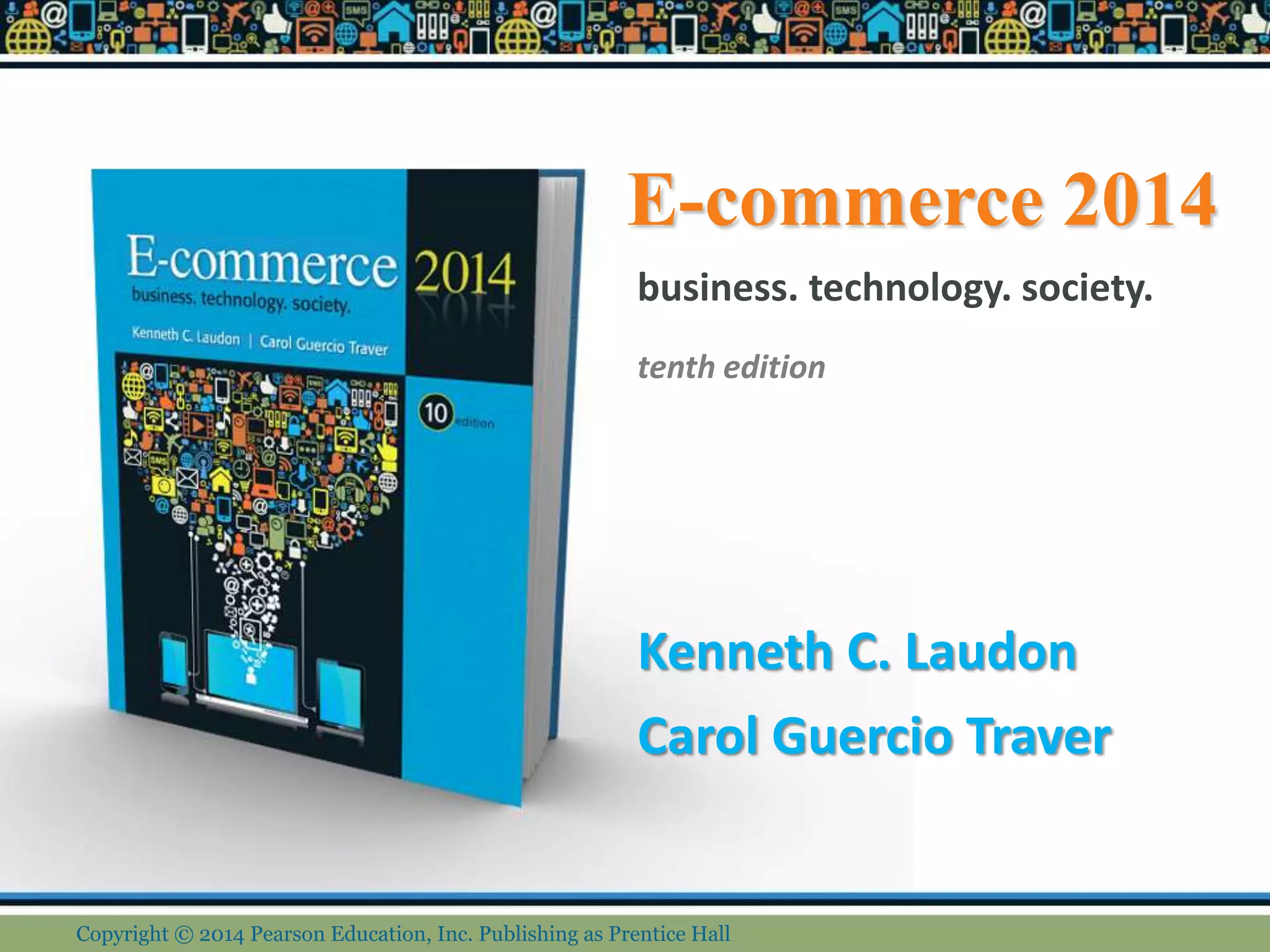
E-commerce 2014
Kenneth C. Laudon
Carol Guercio Traver
business. technology. society.
tenth edition
Copyright © 2014 Pearson Education, Inc. Publishing as Prentice Hall
Chapter 1
The Revolution Is Just Beginning
Copyright © 2014 Pearson Education, Inc. Publishing as Prentice Hall
Class Discussion
Pinterest: A Picture Is Worth a
Thousand Words
 Have you used Pinterest or any other content
curation sites? What are your main interests?
 Have you purchased anything based on a pin
or board on Pinterest or any other curation
site?
 Why do Pinterest links drive more purchasing
than Facebook links?
Copyright © 2014 Pearson Education, Inc. Publishing as Prentice Hall Slide 1-3
E-commerce Trends 2013–2014
 Expansion of social, local, and mobile
e-commerce
 Mobile platform begins to rival PC platform
 Continued growth of cloud computing
 Explosive growth in “Big Data”
 E-books gain wide acceptance
 Continued growth of user-generated
content
Copyright © 2014 Pearson Education, Inc. Publishing as Prentice Hall Slide 1-4
The First 30 Seconds
 First 17 years of e-commerce
Just the beginning
Rapid growth and change
 Technologies continue to evolve at
exponential rates
Disruptive business change
New opportunities
Copyright © 2014 Pearson Education, Inc. Publishing as Prentice Hall Slide 1-5
What Is E-commerce?
 Use of Internet, Web and mobile apps
to transact business
 More formally:
Digitally enabled commercial transactions
between and among organizations and
individuals
Commercial transactions include the exchange
of money or value across organizational
boundary, in exchange for goods, and services
Copyright © 2014 Pearson Education, Inc. Publishing as Prentice Hall Slide 1-6
E-commerce vs. E-business
 E-business:
Digital enabling of transactions and
processes within a firm, involving
information systems under firm’s control
 E.g., Online inventory control
Does not include commercial transactions
involving an exchange of value across
organizational boundaries
Copyright © 2014 Pearson Education, Inc. Publishing as Prentice Hall Slide 1-7
Why Study E-commerce?
 E-commerce technology is different, more
powerful than previous technologies
 E-commerce brings fundamental changes to
commerce
 Traditional commerce:
 Consumer as passive targets
 Mass-marketing driven
 Sales-force driven
 Fixed prices
 Information asymmetry
Copyright © 2014 Pearson Education, Inc. Publishing as Prentice Hall Slide 1-8
Eight Unique Features of E-commerce Technology
1. Ubiquity (available everywhere at all times)
1. Traditional commerce is about a market place
2. Ecommerce creates a marketspace that liberates the market from
physical and time limitations
3. Ubiquity reduces transaction costs, costs of participating in the
market
4. Reduces the cognitive energy, mental effort to accomplish a task
2. Global Reach is accomplished by ecommerce
1. Reach is measured by the number of customers
3. Universal standards
1. Lowers market entry cost, enables easy price discovery, and
network externalities benefit consumers because everyone uses
the same technology
2. Universal Standards such as XML, HTML, helps to integrate,
aggregate, and summarize information.
3. https://www.utdallas.edu/~liebowit/palgrave/network.html
Copyrigh © 2014 Pearson Education, Inc. Publishing as Prentice Hall Slide 1-9
Eight Unique Features of E-commerce Technology
4. Ecommerce enables Information Richness, amount
of detail contained in a piece of textual, graphic, audio,
or video information
5. Interactivity dialog that occurs between a human
being and a computer program
6. Information Density
1. Amount and quality of information available to consumers and
merchants alike
1. Price transparency
2. Cost transparency
3. Price discrimination
7. Personalization/Customization of products/services
8. Social technology
1. Users creating and sharing content on the web
Copyright © 2014 Pearson Education, Inc. Publishing as Prentice Hall Slide 1-10
Web 2.0
 User-centered applications and social
media technologies
User-generated content and communication
Highly interactive, social communities
Large audiences; yet mostly unproven business
models
 Examples: Twitter, YouTube, Instagram, Wikipedia,
Tumblr, twitter,
Copyright © 2014 Pearson Education, Inc. Publishing as Prentice Hall Slide 1-11
Types of E-commerce
 Business-to-Consumer (B2C)
 Business-to-Business (B2B)
 Consumer-to-Consumer (C2C)
 Social e-commerce (Facebook Commerce)
 Mobile e-commerce (M-commerce)
 Local e-commerce
 based on customer geographic location
Copyright © 2014 Pearson Education, Inc. Publishing as Prentice Hall Slide 1-12
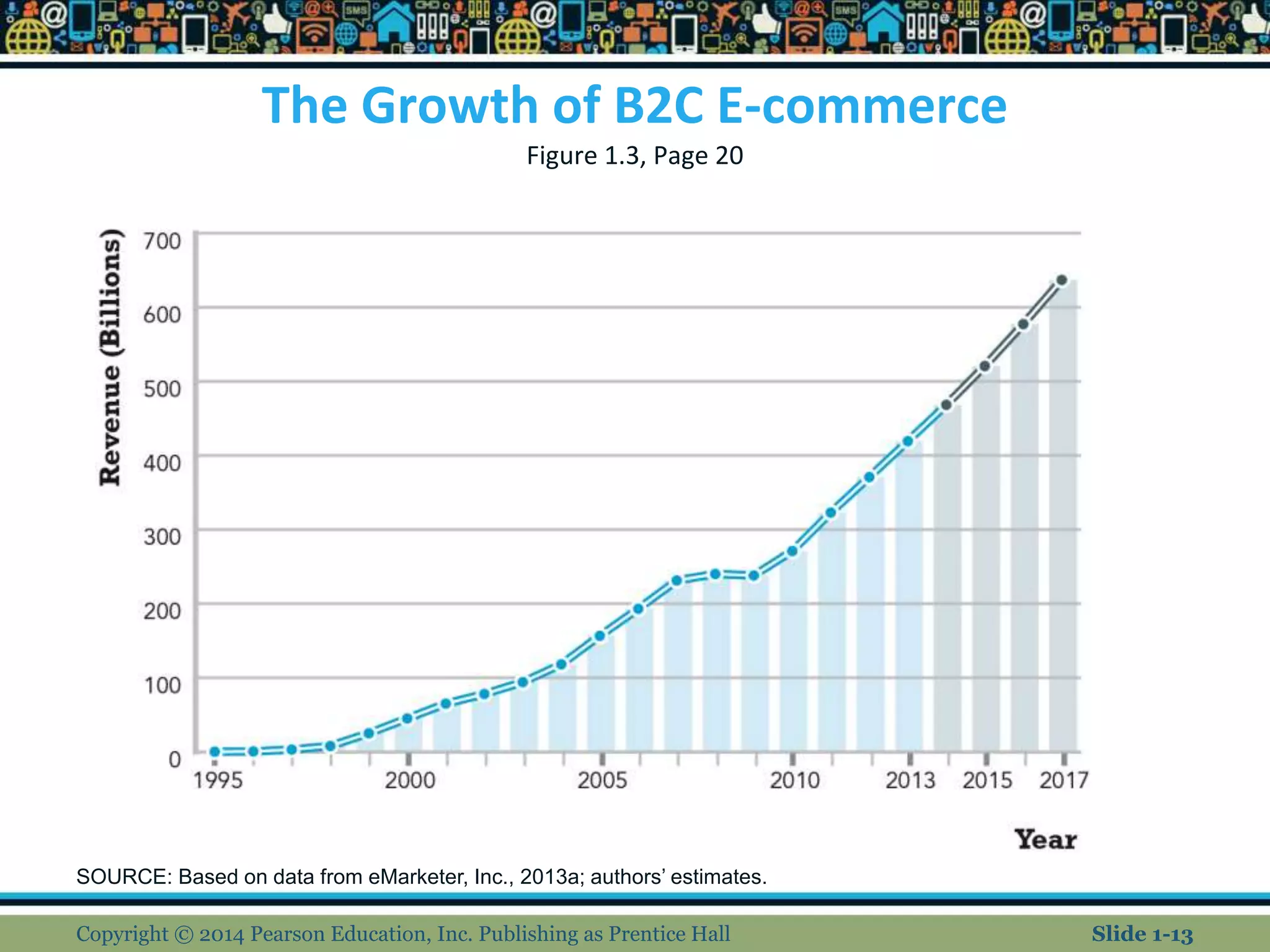
The Growth of B2C E-commerce
Figure 1.3, Page 20
Copyright © 2014 Pearson Education, Inc. Publishing as Prentice Hall
SOURCE: Based on data from eMarketer, Inc., 2013a; authors’ estimates.
Slide 1-13
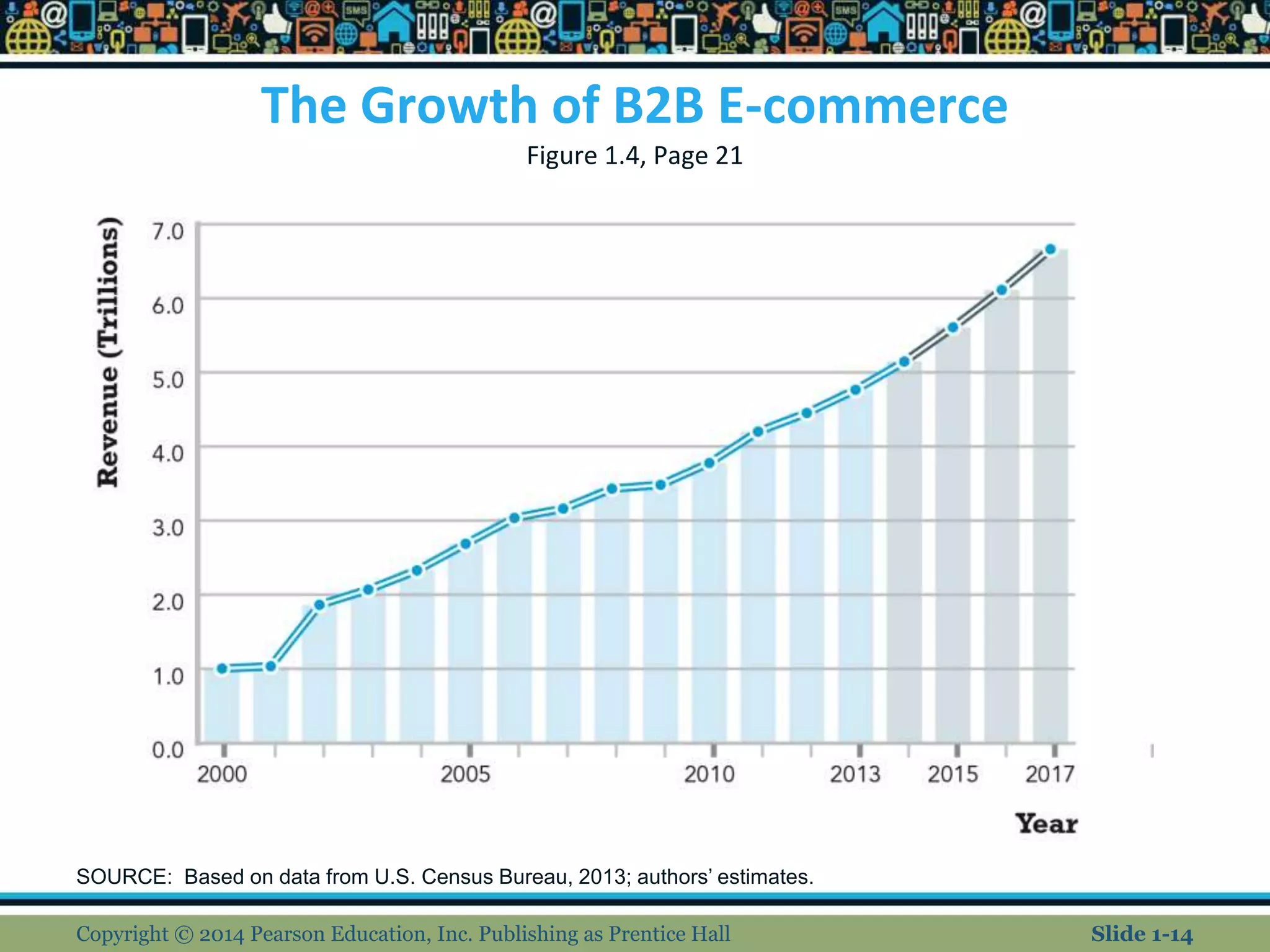
The Growth of B2B E-commerce
Figure 1.4, Page 21
Copyright © 2014 Pearson Education, Inc. Publishing as Prentice Hall
SOURCE: Based on data from U.S. Census Bureau, 2013; authors’ estimates.
Slide 1-14
The Internet
 Worldwide network of computer
networks built on common standards
 Created in late 1960s
 Services include the Web, e-mail, file
transfers, and so on
 Can measure growth by number of
Internet hosts with domain names
Copyright © 2014 Pearson Education, Inc. Publishing as Prentice Hall Slide 1-15
The Web
 Most popular Internet service
 Developed in early 1990s
 Provides access to Web pages
HTML documents that may include text,
graphics, animations, music, videos
 Web content has grown exponentially
 Google reports 30 trillion unique URLs; 120
billion Web pages indexed
Copyright © 2014 Pearson Education, Inc. Publishing as Prentice Hall Slide 1-16
The Mobile Platform
 Most recent development in Internet
infrastructure
 Enables access to the Internet via
wireless networks or cell-phone service
 Mobile devices include
Tablets
Smartphones
Ultra-lightweight laptops
Copyright © 2014 Pearson Education, Inc. Publishing as Prentice Hall Slide 1-17
Insight on Technology: Class Discussion
Will Apps Make the Web Irrelevant?
 What are the advantages and
disadvantages of apps, compared
with Web sites, for mobile users?
 http://www.hswsolutions.com/services/mobile-web-development/mobile-website-vs-apps/
 What are the benefits of apps for
content owners and creators?
 Will apps eventually make the Web
irrelevant? Why or why not?
Copyright © 2014 Pearson Education, Inc. Publishing as Prentice Hall Slide 1-18
Origins and Growth of E-commerce
 Precursors:
Baxter Healthcare
Electronic Data Interchange (EDI)
French Minitel (1980s videotex system)
None had functionality of Internet
 1995: Beginning of e-commerce
First sales of banner advertisements
 E-commerce fastest growing form of
commerce in United States
Copyright © 2014 Pearson Education, Inc. Publishing as Prentice Hall Slide 1-19
E-commerce: A Brief History
 1995–2000: Invention
 Key concepts developed
 Limited bandwidth and media to accommodate
complex products
 Static web pages
 Euphoric visions of
 disintermediation
 Friction-free commerce
 Lowered search costs, disintermediation, price
transparency, elimination of unfair competitive advantage
 First-mover advantages
 Network profits
 Dot-com crash of 2000
Copyright © 2014 Pearson Education, Inc. Publishing as Prentice Hall Slide 1-20
E-commerce: A Brief History (cont.)
 2001–2006: Consolidation
Emphasis on business-driven approach
Traditional large firms expand presence
Start-up financing shrinks up
More complex products and services sold
Growth of search engine advertising
Business Web presences expand to include
e-mail, display and search advertising, and
limited community feedback features
Copyright © 2014 Pearson Education, Inc. Publishing as Prentice Hall Slide 1-21
E-commerce: A Brief History (cont.)
 2007–Present: Reinvention
Rapid growth of:
 Online social networks
 Mobile platform
 Local commerce
Entertainment content develops as source of
revenues
Transformation of marketing
 Coordinated marketing on social, mobile, local platforms
 Analytic technologies
Copyright © 2014 Pearson Education, Inc. Publishing as Prentice Hall Slide 1-22
Insight on Business: Class Discussion
Start-up Boot Camp
 Why do you think investors today are still
interested in investing in start-ups?
 What are the benefits of investing in a company
that is a graduate of a Y Combinator boot camp?
 https://www.ycombinator.com/about/
 Is an incubator the best solution for start-ups to
find funding? Why or why not?
Copyright © 2014 Pearson Education, Inc. Publishing as Prentice Hall Slide 1-23
Assessing E-commerce
 Many early visions not fulfilled
 Friction-free commerce not fully realized
 Online Prices not always the lowest due to shipping
 Consumers less price sensitive
 Considerable online price dispersion
 Some intermediaries disappear but others emerge
(Yahoo, Amazon, hotels.com, PayPal, Travelocity,
etc)
 Perfect competition
 Information asymmetries persist
 First mover advantages
 Fast-followers often overtake first movers
Copyright © 2014 Pearson Education, Inc. Publishing as Prentice Hall Slide 1-24
Predictions for the Future
 Technology will propagate through all commercial
activity
 Large, traditional companies will continue to play
dominant role, consolidating audiences
 Start-up ventures can still attract large audiences in non-
dominated arenas
 Integrated online/offline companies will experience
more growth than purely online companies
 Additional factors:
 Increased regulation and control
 Cost of energy
Copyright © 2014 Pearson Education, Inc. Publishing as Prentice Hall Slide 1-25
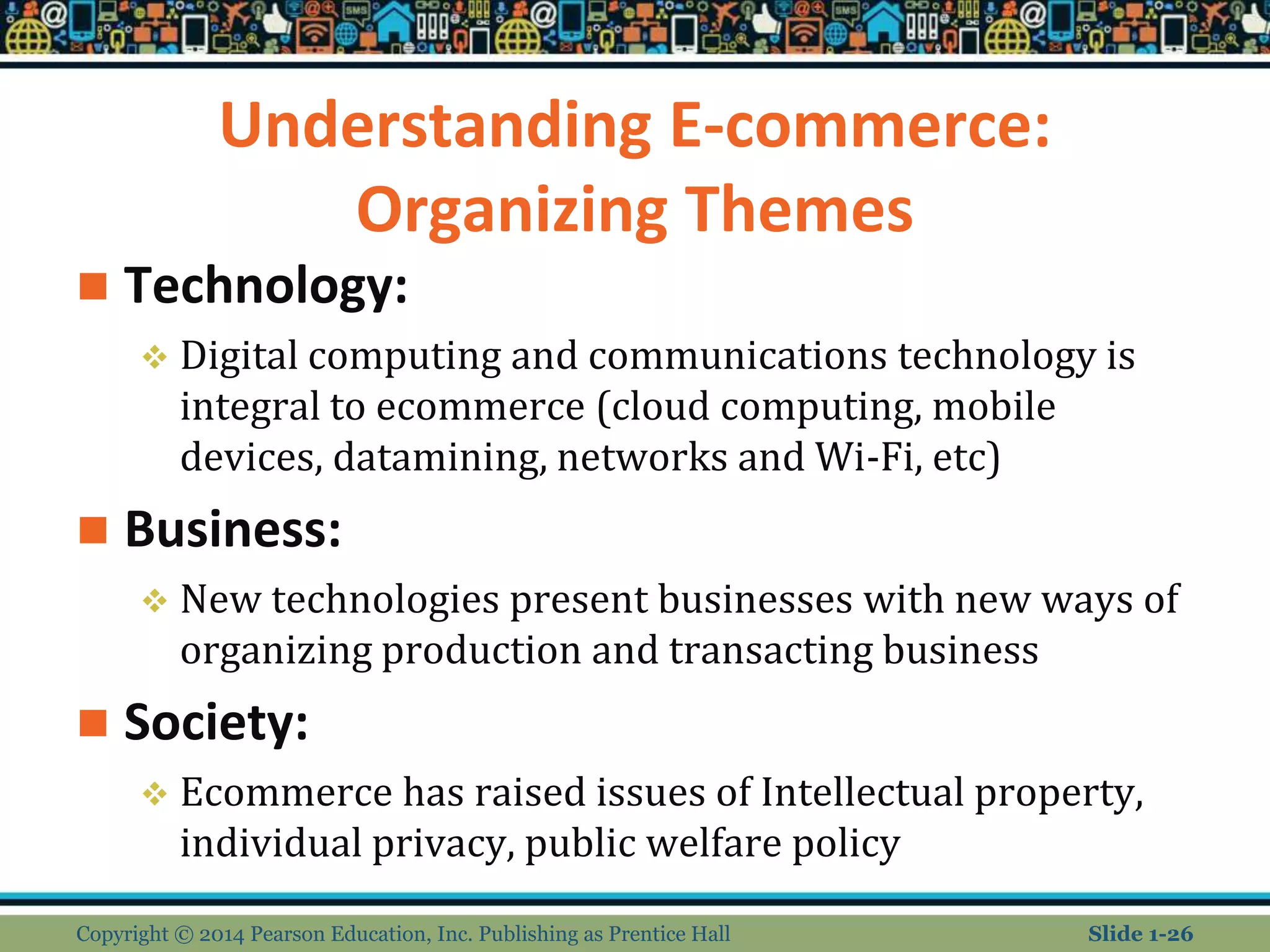
Understanding E-commerce:
Organizing Themes
 Technology:
 Digital computing and communications technology is
integral to ecommerce (cloud computing, mobile
devices, datamining, networks and Wi-Fi, etc)
 Business:
 New technologies present businesses with new ways of
organizing production and transacting business
 Society:
 Ecommerce has raised issues of Intellectual property,
individual privacy, public welfare policy
Copyright © 2014 Pearson Education, Inc. Publishing as Prentice Hall Slide 1-26
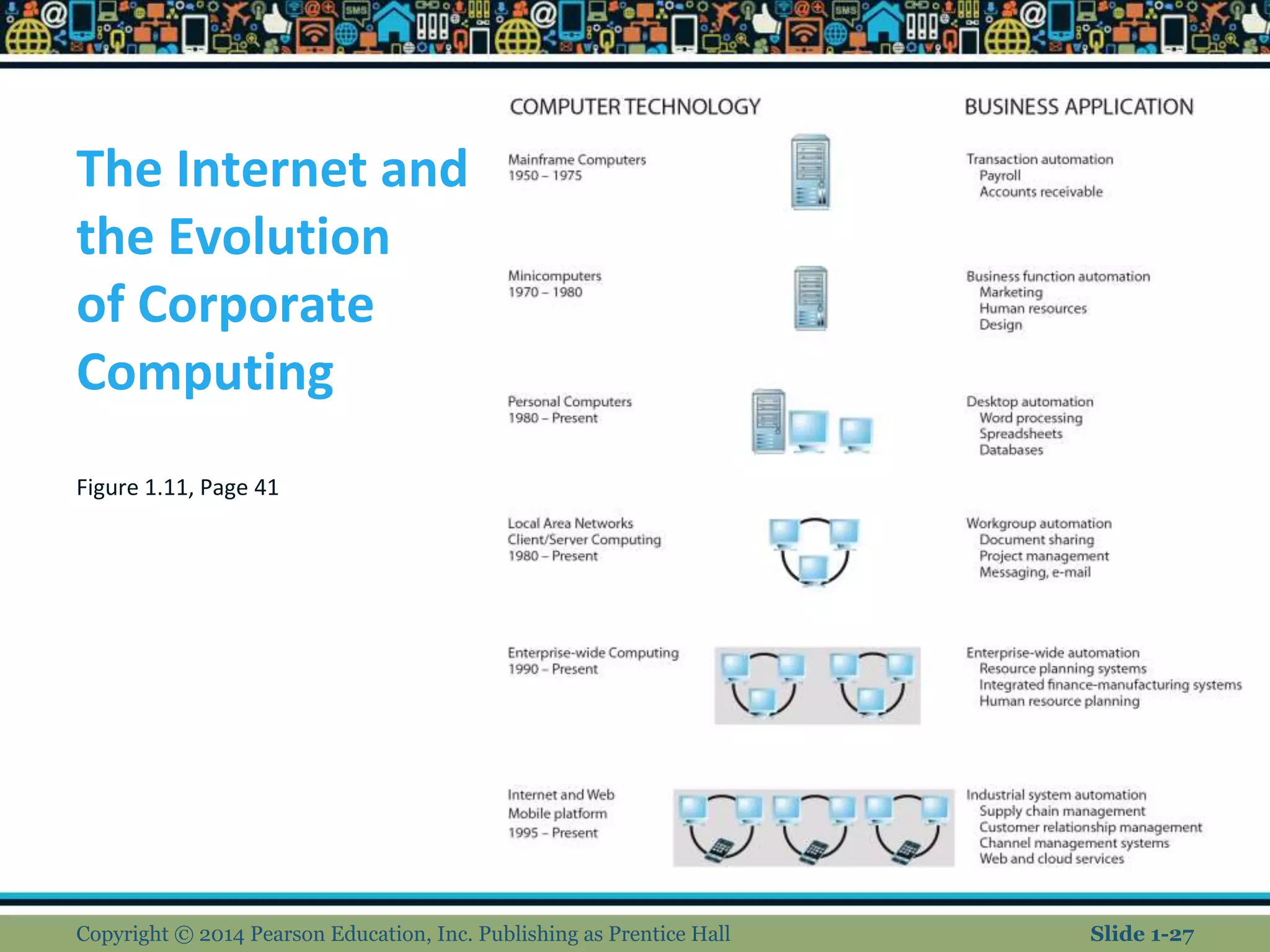
The Internet and
the Evolution
of Corporate
Computing
Figure 1.11, Page 41
Copyright © 2014 Pearson Education, Inc. Publishing as Prentice Hall Slide 1-27
Insight on Society: Class Discussion
Facebook and the Age of Privacy
 Why are social network sites interested in collecting
user information?
 What types of privacy invasion are described in the
case? Which is the most privacy-invading, and why?
 Is e-commerce any different than traditional
markets with respect to privacy? Don’t merchants
always want to know their customer?
 How do you protect your privacy on the Web?
Copyright © 2014 Pearson Education, Inc. Publishing as Prentice Hall Slide 1-28
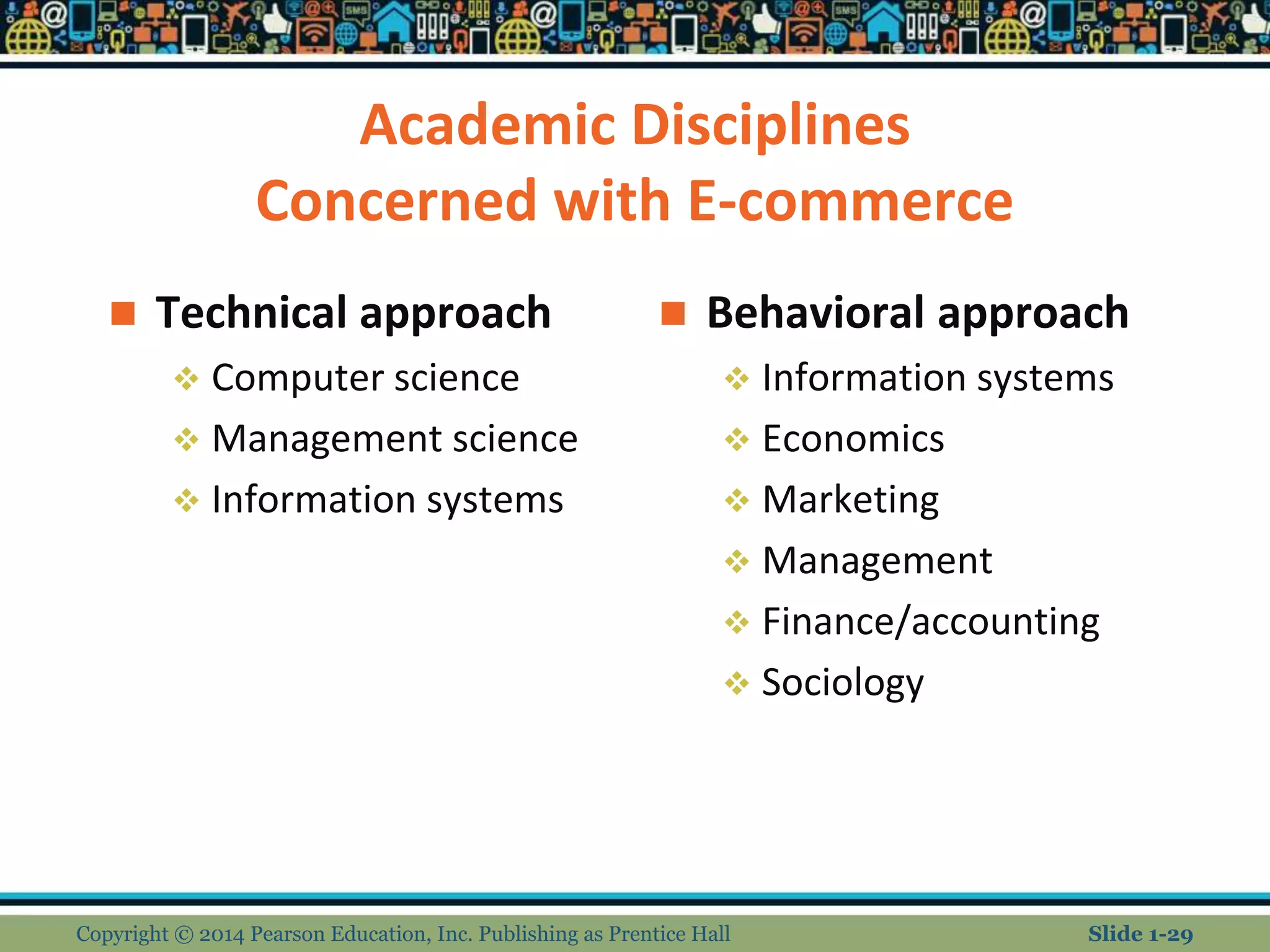
Academic Disciplines
Concerned with E-commerce
 Technical approach
 Computer science
 Management science
 Information systems
 Behavioral approach
 Information systems
 Economics
 Marketing
 Management
 Finance/accounting
 Sociology
Copyright © 2014 Pearson Education, Inc. Publishing as Prentice Hall Slide 1-29
Copyright © 2014 Pearson Education, Inc. Publishing as Prentice Hall Slide 1-30

laudon-traver_ec10_ppt_ch01.ppt

  • 1.
    E-commerce 2014 Kenneth C.Laudon Carol Guercio Traver business. technology. society. tenth edition Copyright © 2014 Pearson Education, Inc. Publishing as Prentice Hall
  • 2.
    Chapter 1 The RevolutionIs Just Beginning Copyright © 2014 Pearson Education, Inc. Publishing as Prentice Hall
  • 3.
    Class Discussion Pinterest: APicture Is Worth a Thousand Words  Have you used Pinterest or any other content curation sites? What are your main interests?  Have you purchased anything based on a pin or board on Pinterest or any other curation site?  Why do Pinterest links drive more purchasing than Facebook links? Copyright © 2014 Pearson Education, Inc. Publishing as Prentice Hall Slide 1-3
  • 4.
    E-commerce Trends 2013–2014 Expansion of social, local, and mobile e-commerce  Mobile platform begins to rival PC platform  Continued growth of cloud computing  Explosive growth in “Big Data”  E-books gain wide acceptance  Continued growth of user-generated content Copyright © 2014 Pearson Education, Inc. Publishing as Prentice Hall Slide 1-4
  • 5.
    The First 30Seconds  First 17 years of e-commerce Just the beginning Rapid growth and change  Technologies continue to evolve at exponential rates Disruptive business change New opportunities Copyright © 2014 Pearson Education, Inc. Publishing as Prentice Hall Slide 1-5
  • 6.
    What Is E-commerce? Use of Internet, Web and mobile apps to transact business  More formally: Digitally enabled commercial transactions between and among organizations and individuals Commercial transactions include the exchange of money or value across organizational boundary, in exchange for goods, and services Copyright © 2014 Pearson Education, Inc. Publishing as Prentice Hall Slide 1-6
  • 7.
    E-commerce vs. E-business E-business: Digital enabling of transactions and processes within a firm, involving information systems under firm’s control  E.g., Online inventory control Does not include commercial transactions involving an exchange of value across organizational boundaries Copyright © 2014 Pearson Education, Inc. Publishing as Prentice Hall Slide 1-7
  • 8.
    Why Study E-commerce? E-commerce technology is different, more powerful than previous technologies  E-commerce brings fundamental changes to commerce  Traditional commerce:  Consumer as passive targets  Mass-marketing driven  Sales-force driven  Fixed prices  Information asymmetry Copyright © 2014 Pearson Education, Inc. Publishing as Prentice Hall Slide 1-8
  • 9.
    Eight Unique Featuresof E-commerce Technology 1. Ubiquity (available everywhere at all times) 1. Traditional commerce is about a market place 2. Ecommerce creates a marketspace that liberates the market from physical and time limitations 3. Ubiquity reduces transaction costs, costs of participating in the market 4. Reduces the cognitive energy, mental effort to accomplish a task 2. Global Reach is accomplished by ecommerce 1. Reach is measured by the number of customers 3. Universal standards 1. Lowers market entry cost, enables easy price discovery, and network externalities benefit consumers because everyone uses the same technology 2. Universal Standards such as XML, HTML, helps to integrate, aggregate, and summarize information. 3. https://www.utdallas.edu/~liebowit/palgrave/network.html Copyrigh © 2014 Pearson Education, Inc. Publishing as Prentice Hall Slide 1-9
  • 10.
    Eight Unique Featuresof E-commerce Technology 4. Ecommerce enables Information Richness, amount of detail contained in a piece of textual, graphic, audio, or video information 5. Interactivity dialog that occurs between a human being and a computer program 6. Information Density 1. Amount and quality of information available to consumers and merchants alike 1. Price transparency 2. Cost transparency 3. Price discrimination 7. Personalization/Customization of products/services 8. Social technology 1. Users creating and sharing content on the web Copyright © 2014 Pearson Education, Inc. Publishing as Prentice Hall Slide 1-10
  • 11.
    Web 2.0  User-centeredapplications and social media technologies User-generated content and communication Highly interactive, social communities Large audiences; yet mostly unproven business models  Examples: Twitter, YouTube, Instagram, Wikipedia, Tumblr, twitter, Copyright © 2014 Pearson Education, Inc. Publishing as Prentice Hall Slide 1-11
  • 12.
    Types of E-commerce Business-to-Consumer (B2C)  Business-to-Business (B2B)  Consumer-to-Consumer (C2C)  Social e-commerce (Facebook Commerce)  Mobile e-commerce (M-commerce)  Local e-commerce  based on customer geographic location Copyright © 2014 Pearson Education, Inc. Publishing as Prentice Hall Slide 1-12
  • 13.
    The Growth ofB2C E-commerce Figure 1.3, Page 20 Copyright © 2014 Pearson Education, Inc. Publishing as Prentice Hall SOURCE: Based on data from eMarketer, Inc., 2013a; authors’ estimates. Slide 1-13
  • 14.
    The Growth ofB2B E-commerce Figure 1.4, Page 21 Copyright © 2014 Pearson Education, Inc. Publishing as Prentice Hall SOURCE: Based on data from U.S. Census Bureau, 2013; authors’ estimates. Slide 1-14
  • 15.
    The Internet  Worldwidenetwork of computer networks built on common standards  Created in late 1960s  Services include the Web, e-mail, file transfers, and so on  Can measure growth by number of Internet hosts with domain names Copyright © 2014 Pearson Education, Inc. Publishing as Prentice Hall Slide 1-15
  • 16.
    The Web  Mostpopular Internet service  Developed in early 1990s  Provides access to Web pages HTML documents that may include text, graphics, animations, music, videos  Web content has grown exponentially  Google reports 30 trillion unique URLs; 120 billion Web pages indexed Copyright © 2014 Pearson Education, Inc. Publishing as Prentice Hall Slide 1-16
  • 17.
    The Mobile Platform Most recent development in Internet infrastructure  Enables access to the Internet via wireless networks or cell-phone service  Mobile devices include Tablets Smartphones Ultra-lightweight laptops Copyright © 2014 Pearson Education, Inc. Publishing as Prentice Hall Slide 1-17
  • 18.
    Insight on Technology:Class Discussion Will Apps Make the Web Irrelevant?  What are the advantages and disadvantages of apps, compared with Web sites, for mobile users?  http://www.hswsolutions.com/services/mobile-web-development/mobile-website-vs-apps/  What are the benefits of apps for content owners and creators?  Will apps eventually make the Web irrelevant? Why or why not? Copyright © 2014 Pearson Education, Inc. Publishing as Prentice Hall Slide 1-18
  • 19.
    Origins and Growthof E-commerce  Precursors: Baxter Healthcare Electronic Data Interchange (EDI) French Minitel (1980s videotex system) None had functionality of Internet  1995: Beginning of e-commerce First sales of banner advertisements  E-commerce fastest growing form of commerce in United States Copyright © 2014 Pearson Education, Inc. Publishing as Prentice Hall Slide 1-19
  • 20.
    E-commerce: A BriefHistory  1995–2000: Invention  Key concepts developed  Limited bandwidth and media to accommodate complex products  Static web pages  Euphoric visions of  disintermediation  Friction-free commerce  Lowered search costs, disintermediation, price transparency, elimination of unfair competitive advantage  First-mover advantages  Network profits  Dot-com crash of 2000 Copyright © 2014 Pearson Education, Inc. Publishing as Prentice Hall Slide 1-20
  • 21.
    E-commerce: A BriefHistory (cont.)  2001–2006: Consolidation Emphasis on business-driven approach Traditional large firms expand presence Start-up financing shrinks up More complex products and services sold Growth of search engine advertising Business Web presences expand to include e-mail, display and search advertising, and limited community feedback features Copyright © 2014 Pearson Education, Inc. Publishing as Prentice Hall Slide 1-21
  • 22.
    E-commerce: A BriefHistory (cont.)  2007–Present: Reinvention Rapid growth of:  Online social networks  Mobile platform  Local commerce Entertainment content develops as source of revenues Transformation of marketing  Coordinated marketing on social, mobile, local platforms  Analytic technologies Copyright © 2014 Pearson Education, Inc. Publishing as Prentice Hall Slide 1-22
  • 23.
    Insight on Business:Class Discussion Start-up Boot Camp  Why do you think investors today are still interested in investing in start-ups?  What are the benefits of investing in a company that is a graduate of a Y Combinator boot camp?  https://www.ycombinator.com/about/  Is an incubator the best solution for start-ups to find funding? Why or why not? Copyright © 2014 Pearson Education, Inc. Publishing as Prentice Hall Slide 1-23
  • 24.
    Assessing E-commerce  Manyearly visions not fulfilled  Friction-free commerce not fully realized  Online Prices not always the lowest due to shipping  Consumers less price sensitive  Considerable online price dispersion  Some intermediaries disappear but others emerge (Yahoo, Amazon, hotels.com, PayPal, Travelocity, etc)  Perfect competition  Information asymmetries persist  First mover advantages  Fast-followers often overtake first movers Copyright © 2014 Pearson Education, Inc. Publishing as Prentice Hall Slide 1-24
  • 25.
    Predictions for theFuture  Technology will propagate through all commercial activity  Large, traditional companies will continue to play dominant role, consolidating audiences  Start-up ventures can still attract large audiences in non- dominated arenas  Integrated online/offline companies will experience more growth than purely online companies  Additional factors:  Increased regulation and control  Cost of energy Copyright © 2014 Pearson Education, Inc. Publishing as Prentice Hall Slide 1-25
  • 26.
    Understanding E-commerce: Organizing Themes Technology:  Digital computing and communications technology is integral to ecommerce (cloud computing, mobile devices, datamining, networks and Wi-Fi, etc)  Business:  New technologies present businesses with new ways of organizing production and transacting business  Society:  Ecommerce has raised issues of Intellectual property, individual privacy, public welfare policy Copyright © 2014 Pearson Education, Inc. Publishing as Prentice Hall Slide 1-26
  • 27.
    The Internet and theEvolution of Corporate Computing Figure 1.11, Page 41 Copyright © 2014 Pearson Education, Inc. Publishing as Prentice Hall Slide 1-27
  • 28.
    Insight on Society:Class Discussion Facebook and the Age of Privacy  Why are social network sites interested in collecting user information?  What types of privacy invasion are described in the case? Which is the most privacy-invading, and why?  Is e-commerce any different than traditional markets with respect to privacy? Don’t merchants always want to know their customer?  How do you protect your privacy on the Web? Copyright © 2014 Pearson Education, Inc. Publishing as Prentice Hall Slide 1-28
  • 29.
    Academic Disciplines Concerned withE-commerce  Technical approach  Computer science  Management science  Information systems  Behavioral approach  Information systems  Economics  Marketing  Management  Finance/accounting  Sociology Copyright © 2014 Pearson Education, Inc. Publishing as Prentice Hall Slide 1-29
  • 30.
    Copyright © 2014Pearson Education, Inc. Publishing as Prentice Hall Slide 1-30