© 2012 Cengage Learning. All Rights Reserved. May not be scanned, copied or duplicated, or posted to a publicly accessible website, in whole or in part.
Chapter Five
Small Business,
Entrepreneurship, and
Franchises
5 | 1
PRIDE HUGHES KAPOOR
INTRODUCTION TO
BUSINESS
ELEVENTH EDITION
© 2012 Cengage Learning. All Rights Reserved. May not be scanned, copied or duplicated, or posted to a publicly accessible website, in whole or in part.
Learning Objectives
1. Define what a small business is and
recognize the fields in which small
businesses are concentrated.
2. Identify the people who start small
businesses and the reasons why some
succeed and many fail.
3. Assess the contributions of small businesses
to our economy.
4. Judge the advantages and disadvantages of
operating a small business.
5 | 2
© 2012 Cengage Learning. All Rights Reserved. May not be scanned, copied or duplicated, or posted to a publicly accessible website, in whole or in part.
Learning Objectives (cont’d)
5. Explain how the Small Business Administration
helps small businesses.
6. Appraise the concept and types of franchising.
7. Analyze the growth of franchising and
franchising’s advantages and disadvantages.
5 | 3
© 2012 Cengage Learning. All Rights Reserved. May not be scanned, copied or duplicated, or posted to a publicly accessible website, in whole or in part.
Small Business: A Profile
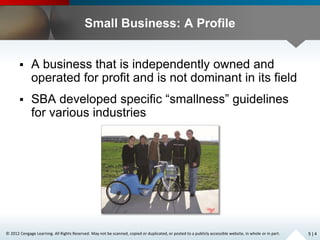
 A business that is independently owned and
operated for profit and is not dominant in its field
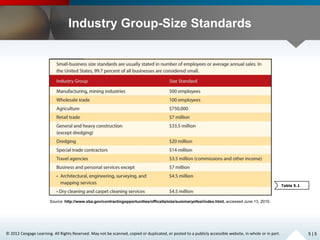
 SBA developed specific “smallness” guidelines
for various industries
5 | 4
© 2012 Cengage Learning. All Rights Reserved. May not be scanned, copied or duplicated, or posted to a publicly accessible website, in whole or in part.
Industry Group-Size Standards
Source: http://www.sba.gov/contractingopportunities/officaila/size/summaryofssi/index.html, accessed June 13, 2010.
5 | 5
Table 5.1
© 2012 Cengage Learning. All Rights Reserved. May not be scanned, copied or duplicated, or posted to a publicly accessible website, in whole or in part.
Small Business: A Profile (cont’d)
 Small-business sector
• There are about 26.9 million businesses in the U.S.
• Just over 17,000 employ more than 500 workers
• In the last decade, the number of small businesses increased
49 percent
• Part-time entrepreneurs have increase fivefold and account for
one-third of all small businesses
• Seventy percent of new businesses survive at least two years,
about 50 percent survive at least five years, and 31 percent
survive at least seven years
• The primary reason for these failures is due to poor
management stemming from a lack of business know-how
• Small businesses provide over 50% of the jobs in the U.S.
5 | 6
© 2012 Cengage Learning. All Rights Reserved. May not be scanned, copied or duplicated, or posted to a publicly accessible website, in whole or in part.
Industries That Attract Small Businesses
 Attractive small-business industry characteristics
• Low initial capital investment
• Some special skill requirements
• High growth and profit potential
 Industries that attract small businesses
• Distribution—retailing, wholesaling, transportation, and
communications (about 33 percent of all small businesses)
• Service—medical and dental care; watch, shoe, and TV
repairs; haircutting and styling; restaurant meals; dry
cleaning; financial services (over 48 percent of all
small businesses)
• Production—construction, mining, and manufacturing
(about 19 percent of all small businesses)
5 | 7
© 2012 Cengage Learning. All Rights Reserved. May not be scanned, copied or duplicated, or posted to a publicly accessible website, in whole or in part.
The People in Small Businesses:
The Entrepreneurs
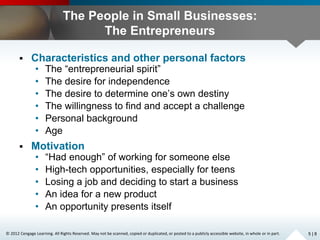
 Characteristics and other personal factors
• The “entrepreneurial spirit”
• The desire for independence
• The desire to determine one’s own destiny
• The willingness to find and accept a challenge
• Personal background
• Age
 Motivation
• “Had enough” of working for someone else
• High-tech opportunities, especially for teens
• Losing a job and deciding to start a business
• An idea for a new product
• An opportunity presents itself
5 | 8
© 2012 Cengage Learning. All Rights Reserved. May not be scanned, copied or duplicated, or posted to a publicly accessible website, in whole or in part.
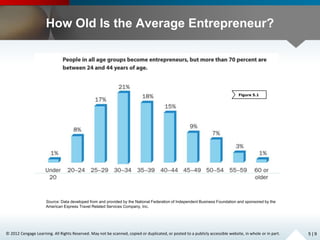
How Old Is the Average Entrepreneur?
Source: Data developed from and provided by the National Federation of Independent Business Foundation and sponsored by the
American Express Travel Related Services Company, Inc.
5 | 9
Figure 5.1
© 2012 Cengage Learning. All Rights Reserved. May not be scanned, copied or duplicated, or posted to a publicly accessible website, in whole or in part.
The People in Small Businesses:
The Entrepreneurs (cont’d)
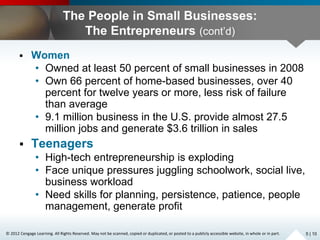
 Women
• Owned at least 50 percent of small businesses in 2008
• Own 66 percent of home-based businesses, over 40
percent for twelve years or more, less risk of failure
than average
• 9.1 million business in the U.S. provide almost 27.5
million jobs and generate $3.6 trillion in sales
 Teenagers
• High-tech entrepreneurship is exploding
• Face unique pressures juggling schoolwork, social live,
business workload
• Need skills for planning, persistence, patience, people
management, generate profit
5 | 10
© 2012 Cengage Learning. All Rights Reserved. May not be scanned, copied or duplicated, or posted to a publicly accessible website, in whole or in part.
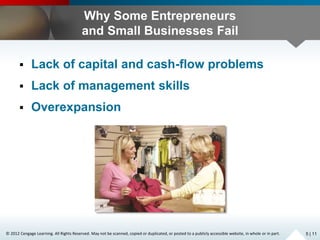
Why Some Entrepreneurs
and Small Businesses Fail
 Lack of capital and cash-flow problems
 Lack of management skills
 Overexpansion
5 | 11
© 2012 Cengage Learning. All Rights Reserved. May not be scanned, copied or duplicated, or posted to a publicly accessible website, in whole or in part.
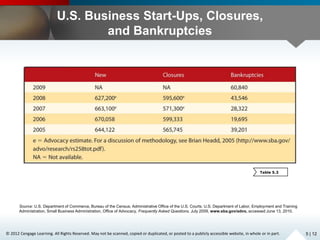
U.S. Business Start-Ups, Closures,
and Bankruptcies
Source: U.S. Department of Commerce, Bureau of the Census; Administrative Office of the U.S. Courts; U.S. Department of Labor, Employment and Training
Administration, Small Business Administration, Office of Advocacy, Frequently Asked Questions, July 2009, www.sba.gov/advo, accessed June 13, 2010.
5 | 12
Table 5.3
© 2012 Cengage Learning. All Rights Reserved. May not be scanned, copied or duplicated, or posted to a publicly accessible website, in whole or in part.
The Importance of Small Businesses
in Our Economy
 Providing technological innovation
• Innovation among small-business workers is higher
than among workers in large businesses
• Small firms produce 2.5 times as many innovations
as large firms relative to the number of persons
employed
• More than half of the major technological advances
of the 20th century originated with
individual inventors and small businesses
• Inventions may spark new industries or contribute
to established industries
5 | 13
© 2012 Cengage Learning. All Rights Reserved. May not be scanned, copied or duplicated, or posted to a publicly accessible website, in whole or in part.
The Importance of Small Businesses
in Our Economy (cont’d)
 Providing employment
• Small firms hire a larger proportion of younger and
older workers, women, and part-time workers
• Small businesses provide 67 percent of workers with
their first job and initial job skills
• Small businesses represent 99.7 percent of all
employers and employ over 50 percent of the private
work force
• Small businesses provide 2/3 of the net new jobs
added to the economy
5 | 14
© 2012 Cengage Learning. All Rights Reserved. May not be scanned, copied or duplicated, or posted to a publicly accessible website, in whole or in part.
The Importance of Small Businesses
in Our Economy (cont’d)
 Providing competition
• Small firms can compete with large firms, forcing the
larger firm to become more efficient and responsive to
customer needs
 Filling needs of society and other businesses
• Small firms can meet the special needs of smaller
groups of customers
• Small firms can act as specialized suppliers of goods
and services to larger businesses
5 | 15
© 2012 Cengage Learning. All Rights Reserved. May not be scanned, copied or duplicated, or posted to a publicly accessible website, in whole or in part.
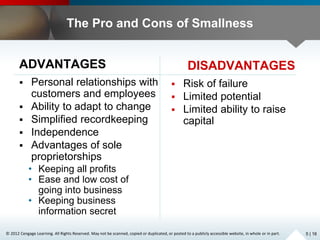
The Pro and Cons of Smallness
ADVANTAGES
 Personal relationships with
customers and employees
 Ability to adapt to change
 Simplified recordkeeping
 Independence
 Advantages of sole
proprietorships
• Keeping all profits
• Ease and low cost of
going into business
• Keeping business
information secret
DISADVANTAGES
 Risk of failure
 Limited potential
 Limited ability to raise
capital
5 | 16
© 2012 Cengage Learning. All Rights Reserved. May not be scanned, copied or duplicated, or posted to a publicly accessible website, in whole or in part.
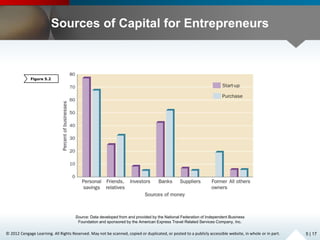
Sources of Capital for Entrepreneurs
Source: Data developed from and provided by the National Federation of Independent Business
Foundation and sponsored by the American Express Travel Related Services Company, Inc.
5 | 17
Figure 5.2
© 2012 Cengage Learning. All Rights Reserved. May not be scanned, copied or duplicated, or posted to a publicly accessible website, in whole or in part.
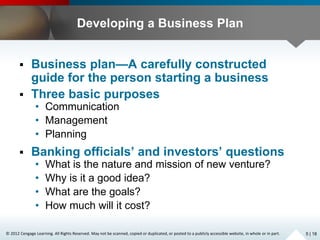
Developing a Business Plan
 Business plan—A carefully constructed
guide for the person starting a business
 Three basic purposes
• Communication
• Management
• Planning
 Banking officials’ and investors’ questions
• What is the nature and mission of new venture?
• Why is it a good idea?
• What are the goals?
• How much will it cost?
5 | 18
© 2012 Cengage Learning. All Rights Reserved. May not be scanned, copied or duplicated, or posted to a publicly accessible website, in whole or in part.
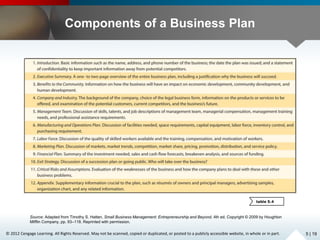
Components of a Business Plan
Source: Adapted from Timothy S. Hatten, Small Business Management: Entrepreneurship and Beyond, 4th ed. Copyright © 2009 by Houghton
Mifflin Company, pp. 93–118. Reprinted with permission.
5 | 19
table 5.4
© 2012 Cengage Learning. All Rights Reserved. May not be scanned, copied or duplicated, or posted to a publicly accessible website, in whole or in part.
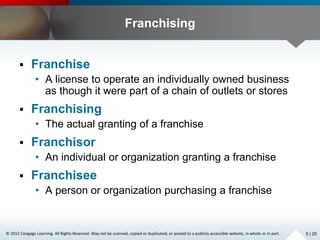
Franchising
 Franchise
• A license to operate an individually owned business
as though it were part of a chain of outlets or stores
 Franchising
• The actual granting of a franchise
 Franchisor
• An individual or organization granting a franchise
 Franchisee
• A person or organization purchasing a franchise
5 | 20
© 2012 Cengage Learning. All Rights Reserved. May not be scanned, copied or duplicated, or posted to a publicly accessible website, in whole or in part.
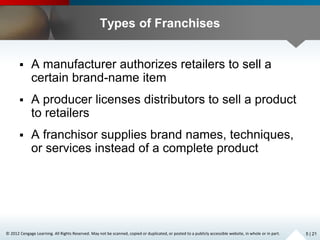
Types of Franchises
 A manufacturer authorizes retailers to sell a
certain brand-name item
 A producer licenses distributors to sell a product
to retailers
 A franchisor supplies brand names, techniques,
or services instead of a complete product
5 | 21
© 2012 Cengage Learning. All Rights Reserved. May not be scanned, copied or duplicated, or posted to a publicly accessible website, in whole or in part.
The Growth of Franchising
 The growth of franchising
• Franchising has expanded with the growth
of the fast-food industry
• Franchising is attracting more women and
minority business owners than ever before
• Dual-branded franchises, in which two
franchisors offer their products together,
are a new trend
5 | 22
© 2012 Cengage Learning. All Rights Reserved. May not be scanned, copied or duplicated, or posted to a publicly accessible website, in whole or in part.
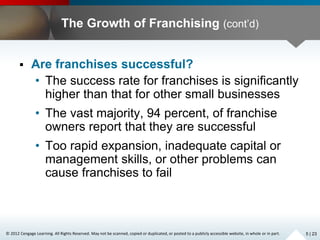
The Growth of Franchising (cont’d)
 Are franchises successful?
• The success rate for franchises is significantly
higher than that for other small businesses
• The vast majority, 94 percent, of franchise
owners report that they are successful
• Too rapid expansion, inadequate capital or
management skills, or other problems can
cause franchises to fail
5 | 23
© 2012 Cengage Learning. All Rights Reserved. May not be scanned, copied or duplicated, or posted to a publicly accessible website, in whole or in part.
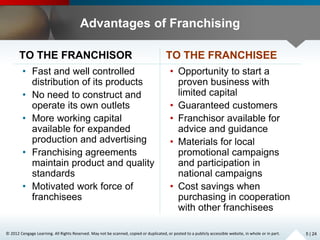
Advantages of Franchising
TO THE FRANCHISOR
• Fast and well controlled
distribution of its products
• No need to construct and
operate its own outlets
• More working capital
available for expanded
production and advertising
• Franchising agreements
maintain product and quality
standards
• Motivated work force of
franchisees
TO THE FRANCHISEE
• Opportunity to start a
proven business with
limited capital
• Guaranteed customers
• Franchisor available for
advice and guidance
• Materials for local
promotional campaigns
and participation in
national campaigns
• Cost savings when
purchasing in cooperation
with other franchisees
5 | 24
© 2012 Cengage Learning. All Rights Reserved. May not be scanned, copied or duplicated, or posted to a publicly accessible website, in whole or in part.
Disadvantages of Franchising
TO THE FRANCHISOR
• Failure of the franchisee
to operate franchise properly
• Disputes with and lawsuits
by franchisees over the
terms of the franchise
TO THE FRANCHISEE
• Franchisor retains a large
amount of control over the
franchisee’s activities
• Franchisor opening
competing franchises within
the franchisee’s market
5 | 25

Chapter 05 small business, entrepreneurship, and franchises

  • 1.
    © 2012 CengageLearning. All Rights Reserved. May not be scanned, copied or duplicated, or posted to a publicly accessible website, in whole or in part. Chapter Five Small Business, Entrepreneurship, and Franchises 5 | 1 PRIDE HUGHES KAPOOR INTRODUCTION TO BUSINESS ELEVENTH EDITION
  • 2.
    © 2012 CengageLearning. All Rights Reserved. May not be scanned, copied or duplicated, or posted to a publicly accessible website, in whole or in part. Learning Objectives 1. Define what a small business is and recognize the fields in which small businesses are concentrated. 2. Identify the people who start small businesses and the reasons why some succeed and many fail. 3. Assess the contributions of small businesses to our economy. 4. Judge the advantages and disadvantages of operating a small business. 5 | 2
  • 3.
    © 2012 CengageLearning. All Rights Reserved. May not be scanned, copied or duplicated, or posted to a publicly accessible website, in whole or in part. Learning Objectives (cont’d) 5. Explain how the Small Business Administration helps small businesses. 6. Appraise the concept and types of franchising. 7. Analyze the growth of franchising and franchising’s advantages and disadvantages. 5 | 3
  • 4.
    © 2012 CengageLearning. All Rights Reserved. May not be scanned, copied or duplicated, or posted to a publicly accessible website, in whole or in part. Small Business: A Profile  A business that is independently owned and operated for profit and is not dominant in its field  SBA developed specific “smallness” guidelines for various industries 5 | 4
  • 5.
    © 2012 CengageLearning. All Rights Reserved. May not be scanned, copied or duplicated, or posted to a publicly accessible website, in whole or in part. Industry Group-Size Standards Source: http://www.sba.gov/contractingopportunities/officaila/size/summaryofssi/index.html, accessed June 13, 2010. 5 | 5 Table 5.1
  • 6.
    © 2012 CengageLearning. All Rights Reserved. May not be scanned, copied or duplicated, or posted to a publicly accessible website, in whole or in part. Small Business: A Profile (cont’d)  Small-business sector • There are about 26.9 million businesses in the U.S. • Just over 17,000 employ more than 500 workers • In the last decade, the number of small businesses increased 49 percent • Part-time entrepreneurs have increase fivefold and account for one-third of all small businesses • Seventy percent of new businesses survive at least two years, about 50 percent survive at least five years, and 31 percent survive at least seven years • The primary reason for these failures is due to poor management stemming from a lack of business know-how • Small businesses provide over 50% of the jobs in the U.S. 5 | 6
  • 7.
    © 2012 CengageLearning. All Rights Reserved. May not be scanned, copied or duplicated, or posted to a publicly accessible website, in whole or in part. Industries That Attract Small Businesses  Attractive small-business industry characteristics • Low initial capital investment • Some special skill requirements • High growth and profit potential  Industries that attract small businesses • Distribution—retailing, wholesaling, transportation, and communications (about 33 percent of all small businesses) • Service—medical and dental care; watch, shoe, and TV repairs; haircutting and styling; restaurant meals; dry cleaning; financial services (over 48 percent of all small businesses) • Production—construction, mining, and manufacturing (about 19 percent of all small businesses) 5 | 7
  • 8.
    © 2012 CengageLearning. All Rights Reserved. May not be scanned, copied or duplicated, or posted to a publicly accessible website, in whole or in part. The People in Small Businesses: The Entrepreneurs  Characteristics and other personal factors • The “entrepreneurial spirit” • The desire for independence • The desire to determine one’s own destiny • The willingness to find and accept a challenge • Personal background • Age  Motivation • “Had enough” of working for someone else • High-tech opportunities, especially for teens • Losing a job and deciding to start a business • An idea for a new product • An opportunity presents itself 5 | 8
  • 9.
    © 2012 CengageLearning. All Rights Reserved. May not be scanned, copied or duplicated, or posted to a publicly accessible website, in whole or in part. How Old Is the Average Entrepreneur? Source: Data developed from and provided by the National Federation of Independent Business Foundation and sponsored by the American Express Travel Related Services Company, Inc. 5 | 9 Figure 5.1
  • 10.
    © 2012 CengageLearning. All Rights Reserved. May not be scanned, copied or duplicated, or posted to a publicly accessible website, in whole or in part. The People in Small Businesses: The Entrepreneurs (cont’d)  Women • Owned at least 50 percent of small businesses in 2008 • Own 66 percent of home-based businesses, over 40 percent for twelve years or more, less risk of failure than average • 9.1 million business in the U.S. provide almost 27.5 million jobs and generate $3.6 trillion in sales  Teenagers • High-tech entrepreneurship is exploding • Face unique pressures juggling schoolwork, social live, business workload • Need skills for planning, persistence, patience, people management, generate profit 5 | 10
  • 11.
    © 2012 CengageLearning. All Rights Reserved. May not be scanned, copied or duplicated, or posted to a publicly accessible website, in whole or in part. Why Some Entrepreneurs and Small Businesses Fail  Lack of capital and cash-flow problems  Lack of management skills  Overexpansion 5 | 11
  • 12.
    © 2012 CengageLearning. All Rights Reserved. May not be scanned, copied or duplicated, or posted to a publicly accessible website, in whole or in part. U.S. Business Start-Ups, Closures, and Bankruptcies Source: U.S. Department of Commerce, Bureau of the Census; Administrative Office of the U.S. Courts; U.S. Department of Labor, Employment and Training Administration, Small Business Administration, Office of Advocacy, Frequently Asked Questions, July 2009, www.sba.gov/advo, accessed June 13, 2010. 5 | 12 Table 5.3
  • 13.
    © 2012 CengageLearning. All Rights Reserved. May not be scanned, copied or duplicated, or posted to a publicly accessible website, in whole or in part. The Importance of Small Businesses in Our Economy  Providing technological innovation • Innovation among small-business workers is higher than among workers in large businesses • Small firms produce 2.5 times as many innovations as large firms relative to the number of persons employed • More than half of the major technological advances of the 20th century originated with individual inventors and small businesses • Inventions may spark new industries or contribute to established industries 5 | 13
  • 14.
    © 2012 CengageLearning. All Rights Reserved. May not be scanned, copied or duplicated, or posted to a publicly accessible website, in whole or in part. The Importance of Small Businesses in Our Economy (cont’d)  Providing employment • Small firms hire a larger proportion of younger and older workers, women, and part-time workers • Small businesses provide 67 percent of workers with their first job and initial job skills • Small businesses represent 99.7 percent of all employers and employ over 50 percent of the private work force • Small businesses provide 2/3 of the net new jobs added to the economy 5 | 14
  • 15.
    © 2012 CengageLearning. All Rights Reserved. May not be scanned, copied or duplicated, or posted to a publicly accessible website, in whole or in part. The Importance of Small Businesses in Our Economy (cont’d)  Providing competition • Small firms can compete with large firms, forcing the larger firm to become more efficient and responsive to customer needs  Filling needs of society and other businesses • Small firms can meet the special needs of smaller groups of customers • Small firms can act as specialized suppliers of goods and services to larger businesses 5 | 15
  • 16.
    © 2012 CengageLearning. All Rights Reserved. May not be scanned, copied or duplicated, or posted to a publicly accessible website, in whole or in part. The Pro and Cons of Smallness ADVANTAGES  Personal relationships with customers and employees  Ability to adapt to change  Simplified recordkeeping  Independence  Advantages of sole proprietorships • Keeping all profits • Ease and low cost of going into business • Keeping business information secret DISADVANTAGES  Risk of failure  Limited potential  Limited ability to raise capital 5 | 16
  • 17.
    © 2012 CengageLearning. All Rights Reserved. May not be scanned, copied or duplicated, or posted to a publicly accessible website, in whole or in part. Sources of Capital for Entrepreneurs Source: Data developed from and provided by the National Federation of Independent Business Foundation and sponsored by the American Express Travel Related Services Company, Inc. 5 | 17 Figure 5.2
  • 18.
    © 2012 CengageLearning. All Rights Reserved. May not be scanned, copied or duplicated, or posted to a publicly accessible website, in whole or in part. Developing a Business Plan  Business plan—A carefully constructed guide for the person starting a business  Three basic purposes • Communication • Management • Planning  Banking officials’ and investors’ questions • What is the nature and mission of new venture? • Why is it a good idea? • What are the goals? • How much will it cost? 5 | 18
  • 19.
    © 2012 CengageLearning. All Rights Reserved. May not be scanned, copied or duplicated, or posted to a publicly accessible website, in whole or in part. Components of a Business Plan Source: Adapted from Timothy S. Hatten, Small Business Management: Entrepreneurship and Beyond, 4th ed. Copyright © 2009 by Houghton Mifflin Company, pp. 93–118. Reprinted with permission. 5 | 19 table 5.4
  • 20.
    © 2012 CengageLearning. All Rights Reserved. May not be scanned, copied or duplicated, or posted to a publicly accessible website, in whole or in part. Franchising  Franchise • A license to operate an individually owned business as though it were part of a chain of outlets or stores  Franchising • The actual granting of a franchise  Franchisor • An individual or organization granting a franchise  Franchisee • A person or organization purchasing a franchise 5 | 20
  • 21.
    © 2012 CengageLearning. All Rights Reserved. May not be scanned, copied or duplicated, or posted to a publicly accessible website, in whole or in part. Types of Franchises  A manufacturer authorizes retailers to sell a certain brand-name item  A producer licenses distributors to sell a product to retailers  A franchisor supplies brand names, techniques, or services instead of a complete product 5 | 21
  • 22.
    © 2012 CengageLearning. All Rights Reserved. May not be scanned, copied or duplicated, or posted to a publicly accessible website, in whole or in part. The Growth of Franchising  The growth of franchising • Franchising has expanded with the growth of the fast-food industry • Franchising is attracting more women and minority business owners than ever before • Dual-branded franchises, in which two franchisors offer their products together, are a new trend 5 | 22
  • 23.
    © 2012 CengageLearning. All Rights Reserved. May not be scanned, copied or duplicated, or posted to a publicly accessible website, in whole or in part. The Growth of Franchising (cont’d)  Are franchises successful? • The success rate for franchises is significantly higher than that for other small businesses • The vast majority, 94 percent, of franchise owners report that they are successful • Too rapid expansion, inadequate capital or management skills, or other problems can cause franchises to fail 5 | 23
  • 24.
    © 2012 CengageLearning. All Rights Reserved. May not be scanned, copied or duplicated, or posted to a publicly accessible website, in whole or in part. Advantages of Franchising TO THE FRANCHISOR • Fast and well controlled distribution of its products • No need to construct and operate its own outlets • More working capital available for expanded production and advertising • Franchising agreements maintain product and quality standards • Motivated work force of franchisees TO THE FRANCHISEE • Opportunity to start a proven business with limited capital • Guaranteed customers • Franchisor available for advice and guidance • Materials for local promotional campaigns and participation in national campaigns • Cost savings when purchasing in cooperation with other franchisees 5 | 24
  • 25.
    © 2012 CengageLearning. All Rights Reserved. May not be scanned, copied or duplicated, or posted to a publicly accessible website, in whole or in part. Disadvantages of Franchising TO THE FRANCHISOR • Failure of the franchisee to operate franchise properly • Disputes with and lawsuits by franchisees over the terms of the franchise TO THE FRANCHISEE • Franchisor retains a large amount of control over the franchisee’s activities • Franchisor opening competing franchises within the franchisee’s market 5 | 25