PowerPoint Image Slideshow
Introduction to Business
Chapter 5 ENTREPRENEURSHIP: STARTING AND MANAGING YOUR
OWN BUSINESS
Learning Outcomes
1. Why do people become entrepreneurs, and what are the different
types of entrepreneurs?
2. What characteristics do successful entrepreneurs share?
3. How do small businesses contribute to the U.S. economy?
4. What are the first steps to take if you are starting your own
business?
5. Why does managing a small business present special challenges
for the owner?
6. What are the advantages and disadvantages facing owners of
small businesses?
7. How does the Small Business Administration help small
businesses?
8. What trends are shaping entrepreneurship and small-business
ownership?
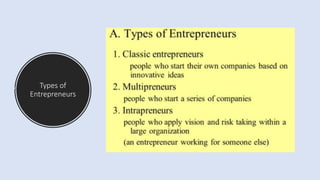
Types of
Entrepreneurs
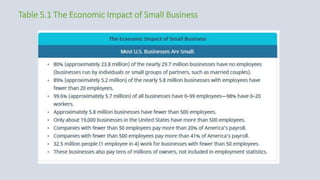
Table 5.1 The Economic Impact of Small Business
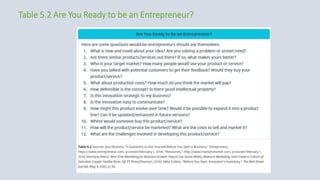
Table 5.2 Are You Ready to be an Entrepreneur?
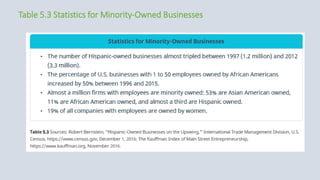
Table 5.3 Statistics for Minority-Owned Businesses
Entrepreneurship
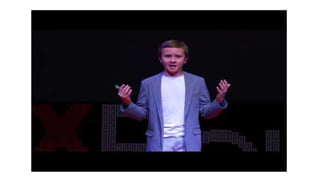
• What drives a person to take the risks associated with
entrepreneurship, and is this drive something that a
person is born with or can develop with education and
practice? In the beginning of Section 5.1, the feature
box Catching the Entrepreneurial Spirit declares Jack
Bonneau the “quintessential entrepreneur”. View both
the short video clip from IndieGoGo and the longer
TEDX presentation young Jack gave in 2018.
Entrepreneurship
1. Explain what could inspire the authors of your Introduction
to Business text to select an 11-year-old for the example
they provide to readers such as yourself of a successful
entrepreneur? Feel free to do additional research on Jack
himself or his company, Jack’s Stands & Marketplaces.
2. Could Jack’s entrepreneurial ventures at such a young age
be proof that entrepreneurs are “born rather than made”?
3. Should parents encourage their young children to follow
Jack’s path, or do you think this kind of success story is rare
and that’s why it’s so fascinating and inspiring?
1. Why do people become entrepreneurs, and what
are the different types of entrepreneurs?
• CONCEPT CHECK
1. Describe several types of entrepreneurs.
2. What differentiates an entrepreneur from a
small-business owner?
3. What are some major factors that motivate
entrepreneurs to start businesses?
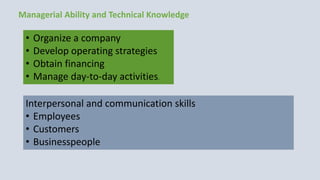
Managerial Ability and Technical Knowledge
• Organize a company
• Develop operating strategies
• Obtain financing
• Manage day-to-day activities.
Interpersonal and communication skills
• Employees
• Customers
• Businesspeople
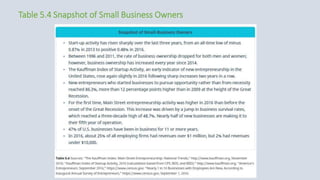
Table 5.4 Snapshot of Small Business Owners
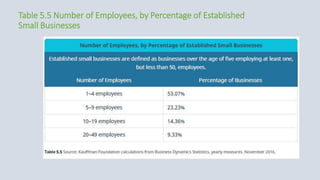
Table 5.5 Number of Employees, by Percentage of Established
Small Businesses
2. What characteristics do successful entrepreneurs
share?
• CONCEPT CHECK
1. Describe the personality traits and skills
characteristic of successful entrepreneurs.
2. What does it mean when we say that an
entrepreneur should work on the business,
not in it?
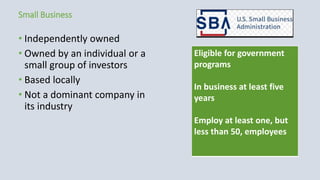
Small Business
• Independently owned
• Owned by an individual or a
small group of investors
• Based locally
• Not a dominant company in
its industry
Eligible for government
programs
In business at least five
years
Employ at least one, but
less than 50, employees
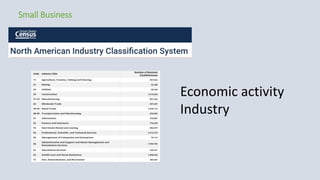
Small Business
Economic activity
Industry
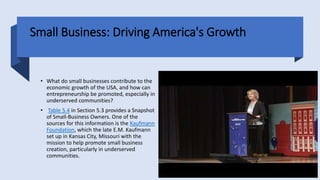
Small Business: Driving America's Growth
• What do small businesses contribute to the
economic growth of the USA, and how can
entrepreneurship be promoted, especially in
underserved communities?
• Table 5.4 in Section 5.3 provides a Snapshot
of Small-Business Owners. One of the
sources for this information is the Kaufmann
Foundation, which the late E.M. Kaufmann
set up in Kansas City, Missouri with the
mission to help promote small business
creation, particularly in underserved
communities.
Small Business: Driving America's
Growth
1. After watching this video, decide if both the
comprehensive presentation and lively panel discussion
that follows meets the stated goals of the 2019 State of
Entrepreneurship Address to discuss “how, together, we
can grow inclusive and empowering economies as we
explore the best ways to support the makers, the
doers, and the dreamers”?
3. How do small businesses contribute to the U.S.
economy?
• CONCEPT CHECK
1. What are three ways small businesses can
be defined?
2. What social and economic factors have
prompted the rise in small business?
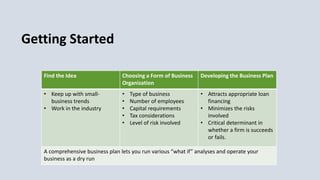
Getting Started
Find the Idea Choosing a Form of Business
Organization
Developing the Business Plan
• Keep up with small-
business trends
• Work in the industry
• Type of business
• Number of employees
• Capital requirements
• Tax considerations
• Level of risk involved
• Attracts appropriate loan
financing
• Minimizes the risks
involved
• Critical determinant in
whether a firm is succeeds
or fails.
A comprehensive business plan lets you run various “what if” analyses and operate your
business as a dry run
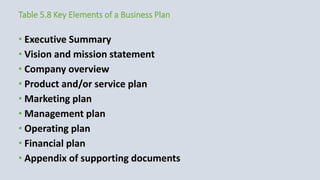
Table 5.8 Key Elements of a Business Plan
• Executive Summary
• Vision and mission statement
• Company overview
• Product and/or service plan
• Marketing plan
• Management plan
• Operating plan
• Financial plan
• Appendix of supporting documents
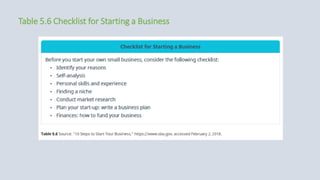
Table 5.6 Checklist for Starting a Business
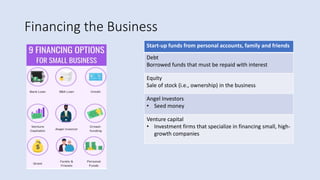
Financing the Business
Start-up funds from personal accounts, family and friends
Debt
Borrowed funds that must be repaid with interest
Equity
Sale of stock (i.e., ownership) in the business
Angel Investors
• Seed money
Venture capital
• Investment firms that specialize in financing small, high-
growth companies
Buy a Business
• Pay yourself and profit faster
• The groundwork has already been done
• You don’t need to use your own money to buy a business
• Make the seller of the business part of the deal
• Target Assets
“When one company purchases most or all of another company's
shares to gain control of that company. Purchasing more than
50% of a target firm's stock and other assets allows the acquirer
to make decisions about the newly acquired assets without the
approval of the company's shareholders.”
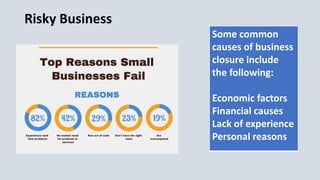
Risky Business
Some common
causes of business
closure include
the following:
Economic factors
Financial causes
Lack of experience
Personal reasons
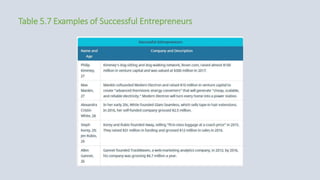
Table 5.7 Examples of Successful Entrepreneurs
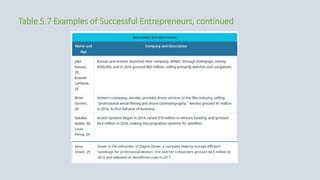
Table 5.7 Examples of Successful Entrepreneurs, continued
Table 5.9 Making a Heavenly Deal
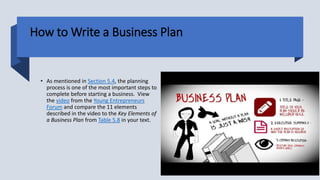
How to Write a Business Plan
• As mentioned in Section 5.4, the planning
process is one of the most important steps to
complete before starting a business. View
the video from the Young Entrepreneurs
Forum and compare the 11 elements
described in the video to the Key Elements of
a Business Plan from Table 5.8 in your text.
How to Write a Business Plan
1. What similarities and differences did you notice? Why wouldn’t the
concept of the Business Plan (B Plan) be universally explained by most
sources?
2. Would it make sense, then, for an entrepreneur to verify specifically
what essential components of a business plan were needed for the
particular audience this B Plan was intended, such as a bank, other
financial institution, angel investor or venture capitalist? For example,
consider FUBU mentioned in Exhibit 5.5, which eventually received a
significant investment from Samsung. What do you think would have
been the most important information that Samsung executives wanted
to see from FUBU management before they wrote a $30 million check?
4. What are the first steps to take if you are starting
your own business?
• CONCEPT CHECK
1. How can potential business owners find new
business ideas?
2. Why is it important to develop a business
plan? What should such a plan include?
3. What financing options do small-business
owners have? What risks do they face?
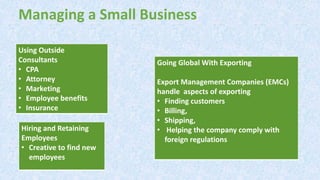
Managing a Small Business
Using Outside
Consultants
• CPA
• Attorney
• Marketing
• Employee benefits
• Insurance
Hiring and Retaining
Employees
• Creative to find new
employees
Going Global With Exporting
Export Management Companies (EMCs)
handle aspects of exporting
• Finding customers
• Billing,
• Shipping,
• Helping the company comply with
foreign regulations
5. Why does managing a small business present
special challenges for the owner?
• CONCEPT CHECK
1. How does the small-business owner’s role
change over time?
2. How does managing a small business
contribute to its growth?
3. What are the benefits to small firms of doing
business internationally, and what steps can
small businesses take to explore their options?
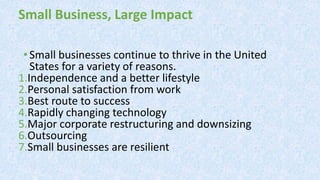
Small Business, Large Impact
• Small businesses continue to thrive in the United
States for a variety of reasons.
1.Independence and a better lifestyle
2.Personal satisfaction from work
3.Best route to success
4.Rapidly changing technology
5.Major corporate restructuring and downsizing
6.Outsourcing
7.Small businesses are resilient
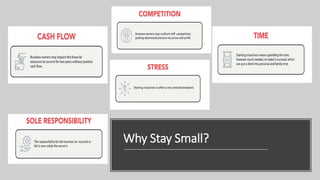
Why Stay Small?
6. What are the advantages and disadvantages facing
owners of small businesses?
• CONCEPT CHECK
1. Why are small businesses becoming so
popular?
2. Discuss the major advantages and
disadvantages of small businesses.
The Small Business Administration
• How does the SBA support small business
growth in the USA, and what specific
resources does the SBA offer to help with
Business Plans?
• Section 5.7 details several ways the Small
Business Administration (SBA) provides
assistance to small businesses, including
start-ups and established organizations. In
2019, the SBA updated their business plan
page to offer two different options, a
traditional and a lean startup plan.
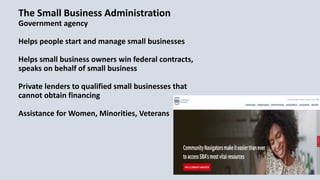
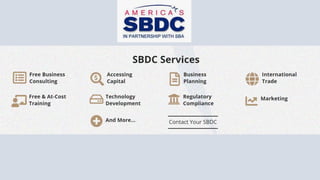
The Small Business Administration
Government agency
Helps people start and manage small businesses
Helps small business owners win federal contracts,
speaks on behalf of small business
Private lenders to qualified small businesses that
cannot obtain financing
Assistance for Women, Minorities, Veterans
Service Corps of
Retired Executives
(SCORE)
• Executives in these programs
use their business
backgrounds to help small
business owners.
• The SBA offers free online
resources and courses for
small business owners
The Small Business
Administration
1. What are the main differences between the lean
startup plan and the traditional version (See Section
5.4)?
2. Which kinds of business ventures do you think would
be better suited to each kind of Business Plan?
7. How does the Small Business Administration help
small businesses?
• CONCEPT CHECK
1. What is the Small Business Administration
(SBA)?
2. Describe the financial and management
assistance programs offered by the SBA.
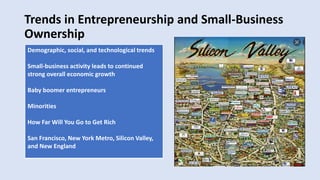
Trends in Entrepreneurship and Small-Business
Ownership
Demographic, social, and technological trends
Small-business activity leads to continued
strong overall economic growth
Baby boomer entrepreneurs
Minorities
How Far Will You Go to Get Rich
San Francisco, New York Metro, Silicon Valley,
and New England
8. What trends are shaping entrepreneurship and
small-business ownership?
• CONCEPT CHECK
1. What significant trends are occurring in the
small-business arena?
2. How is entrepreneurial diversity impacting
small business and the economy?
3. How do ethics impact decision-making with
small-business owners?
This OpenStax ancillary resource is © Rice University under a CC-BY 4.0 International license; it may be reproduced or modified but must be attributed to OpenStax, Rice University
and any changes must be noted. Any images credited to other sources are similarly available for reproduction, but must be attributed to their sources.

IntroductiontoBusiness-PPT-Ch05.pptx

  • 1.
    PowerPoint Image Slideshow Introductionto Business Chapter 5 ENTREPRENEURSHIP: STARTING AND MANAGING YOUR OWN BUSINESS
  • 2.
    Learning Outcomes 1. Whydo people become entrepreneurs, and what are the different types of entrepreneurs? 2. What characteristics do successful entrepreneurs share? 3. How do small businesses contribute to the U.S. economy? 4. What are the first steps to take if you are starting your own business? 5. Why does managing a small business present special challenges for the owner? 6. What are the advantages and disadvantages facing owners of small businesses? 7. How does the Small Business Administration help small businesses? 8. What trends are shaping entrepreneurship and small-business ownership?
  • 3.
  • 5.
    Table 5.1 TheEconomic Impact of Small Business
  • 6.
    Table 5.2 AreYou Ready to be an Entrepreneur?
  • 7.
    Table 5.3 Statisticsfor Minority-Owned Businesses
  • 8.
    Entrepreneurship • What drivesa person to take the risks associated with entrepreneurship, and is this drive something that a person is born with or can develop with education and practice? In the beginning of Section 5.1, the feature box Catching the Entrepreneurial Spirit declares Jack Bonneau the “quintessential entrepreneur”. View both the short video clip from IndieGoGo and the longer TEDX presentation young Jack gave in 2018.
  • 11.
    Entrepreneurship 1. Explain whatcould inspire the authors of your Introduction to Business text to select an 11-year-old for the example they provide to readers such as yourself of a successful entrepreneur? Feel free to do additional research on Jack himself or his company, Jack’s Stands & Marketplaces. 2. Could Jack’s entrepreneurial ventures at such a young age be proof that entrepreneurs are “born rather than made”? 3. Should parents encourage their young children to follow Jack’s path, or do you think this kind of success story is rare and that’s why it’s so fascinating and inspiring?
  • 12.
    1. Why dopeople become entrepreneurs, and what are the different types of entrepreneurs? • CONCEPT CHECK 1. Describe several types of entrepreneurs. 2. What differentiates an entrepreneur from a small-business owner? 3. What are some major factors that motivate entrepreneurs to start businesses?
  • 14.
    Managerial Ability andTechnical Knowledge • Organize a company • Develop operating strategies • Obtain financing • Manage day-to-day activities. Interpersonal and communication skills • Employees • Customers • Businesspeople
  • 15.
    Table 5.4 Snapshotof Small Business Owners
  • 16.
    Table 5.5 Numberof Employees, by Percentage of Established Small Businesses
  • 17.
    2. What characteristicsdo successful entrepreneurs share? • CONCEPT CHECK 1. Describe the personality traits and skills characteristic of successful entrepreneurs. 2. What does it mean when we say that an entrepreneur should work on the business, not in it?
  • 18.
    Small Business • Independentlyowned • Owned by an individual or a small group of investors • Based locally • Not a dominant company in its industry Eligible for government programs In business at least five years Employ at least one, but less than 50, employees
  • 19.
  • 20.
    Small Business: DrivingAmerica's Growth • What do small businesses contribute to the economic growth of the USA, and how can entrepreneurship be promoted, especially in underserved communities? • Table 5.4 in Section 5.3 provides a Snapshot of Small-Business Owners. One of the sources for this information is the Kaufmann Foundation, which the late E.M. Kaufmann set up in Kansas City, Missouri with the mission to help promote small business creation, particularly in underserved communities.
  • 21.
    Small Business: DrivingAmerica's Growth 1. After watching this video, decide if both the comprehensive presentation and lively panel discussion that follows meets the stated goals of the 2019 State of Entrepreneurship Address to discuss “how, together, we can grow inclusive and empowering economies as we explore the best ways to support the makers, the doers, and the dreamers”?
  • 22.
    3. How dosmall businesses contribute to the U.S. economy? • CONCEPT CHECK 1. What are three ways small businesses can be defined? 2. What social and economic factors have prompted the rise in small business?
  • 23.
    Getting Started Find theIdea Choosing a Form of Business Organization Developing the Business Plan • Keep up with small- business trends • Work in the industry • Type of business • Number of employees • Capital requirements • Tax considerations • Level of risk involved • Attracts appropriate loan financing • Minimizes the risks involved • Critical determinant in whether a firm is succeeds or fails. A comprehensive business plan lets you run various “what if” analyses and operate your business as a dry run
  • 24.
    Table 5.8 KeyElements of a Business Plan • Executive Summary • Vision and mission statement • Company overview • Product and/or service plan • Marketing plan • Management plan • Operating plan • Financial plan • Appendix of supporting documents
  • 25.
    Table 5.6 Checklistfor Starting a Business
  • 26.
    Financing the Business Start-upfunds from personal accounts, family and friends Debt Borrowed funds that must be repaid with interest Equity Sale of stock (i.e., ownership) in the business Angel Investors • Seed money Venture capital • Investment firms that specialize in financing small, high- growth companies
  • 27.
    Buy a Business •Pay yourself and profit faster • The groundwork has already been done • You don’t need to use your own money to buy a business • Make the seller of the business part of the deal • Target Assets “When one company purchases most or all of another company's shares to gain control of that company. Purchasing more than 50% of a target firm's stock and other assets allows the acquirer to make decisions about the newly acquired assets without the approval of the company's shareholders.”
  • 28.
    Risky Business Some common causesof business closure include the following: Economic factors Financial causes Lack of experience Personal reasons
  • 29.
    Table 5.7 Examplesof Successful Entrepreneurs
  • 30.
    Table 5.7 Examplesof Successful Entrepreneurs, continued
  • 31.
    Table 5.9 Makinga Heavenly Deal
  • 32.
    How to Writea Business Plan • As mentioned in Section 5.4, the planning process is one of the most important steps to complete before starting a business. View the video from the Young Entrepreneurs Forum and compare the 11 elements described in the video to the Key Elements of a Business Plan from Table 5.8 in your text.
  • 33.
    How to Writea Business Plan 1. What similarities and differences did you notice? Why wouldn’t the concept of the Business Plan (B Plan) be universally explained by most sources? 2. Would it make sense, then, for an entrepreneur to verify specifically what essential components of a business plan were needed for the particular audience this B Plan was intended, such as a bank, other financial institution, angel investor or venture capitalist? For example, consider FUBU mentioned in Exhibit 5.5, which eventually received a significant investment from Samsung. What do you think would have been the most important information that Samsung executives wanted to see from FUBU management before they wrote a $30 million check?
  • 34.
    4. What arethe first steps to take if you are starting your own business? • CONCEPT CHECK 1. How can potential business owners find new business ideas? 2. Why is it important to develop a business plan? What should such a plan include? 3. What financing options do small-business owners have? What risks do they face?
  • 35.
    Managing a SmallBusiness Using Outside Consultants • CPA • Attorney • Marketing • Employee benefits • Insurance Hiring and Retaining Employees • Creative to find new employees Going Global With Exporting Export Management Companies (EMCs) handle aspects of exporting • Finding customers • Billing, • Shipping, • Helping the company comply with foreign regulations
  • 36.
    5. Why doesmanaging a small business present special challenges for the owner? • CONCEPT CHECK 1. How does the small-business owner’s role change over time? 2. How does managing a small business contribute to its growth? 3. What are the benefits to small firms of doing business internationally, and what steps can small businesses take to explore their options?
  • 37.
    Small Business, LargeImpact • Small businesses continue to thrive in the United States for a variety of reasons. 1.Independence and a better lifestyle 2.Personal satisfaction from work 3.Best route to success 4.Rapidly changing technology 5.Major corporate restructuring and downsizing 6.Outsourcing 7.Small businesses are resilient
  • 38.
  • 39.
    6. What arethe advantages and disadvantages facing owners of small businesses? • CONCEPT CHECK 1. Why are small businesses becoming so popular? 2. Discuss the major advantages and disadvantages of small businesses.
  • 40.
    The Small BusinessAdministration • How does the SBA support small business growth in the USA, and what specific resources does the SBA offer to help with Business Plans? • Section 5.7 details several ways the Small Business Administration (SBA) provides assistance to small businesses, including start-ups and established organizations. In 2019, the SBA updated their business plan page to offer two different options, a traditional and a lean startup plan.
  • 41.
    The Small BusinessAdministration Government agency Helps people start and manage small businesses Helps small business owners win federal contracts, speaks on behalf of small business Private lenders to qualified small businesses that cannot obtain financing Assistance for Women, Minorities, Veterans
  • 42.
    Service Corps of RetiredExecutives (SCORE) • Executives in these programs use their business backgrounds to help small business owners. • The SBA offers free online resources and courses for small business owners
  • 44.
    The Small Business Administration 1.What are the main differences between the lean startup plan and the traditional version (See Section 5.4)? 2. Which kinds of business ventures do you think would be better suited to each kind of Business Plan?
  • 45.
    7. How doesthe Small Business Administration help small businesses? • CONCEPT CHECK 1. What is the Small Business Administration (SBA)? 2. Describe the financial and management assistance programs offered by the SBA.
  • 46.
    Trends in Entrepreneurshipand Small-Business Ownership Demographic, social, and technological trends Small-business activity leads to continued strong overall economic growth Baby boomer entrepreneurs Minorities How Far Will You Go to Get Rich San Francisco, New York Metro, Silicon Valley, and New England
  • 47.
    8. What trendsare shaping entrepreneurship and small-business ownership? • CONCEPT CHECK 1. What significant trends are occurring in the small-business arena? 2. How is entrepreneurial diversity impacting small business and the economy? 3. How do ethics impact decision-making with small-business owners? This OpenStax ancillary resource is © Rice University under a CC-BY 4.0 International license; it may be reproduced or modified but must be attributed to OpenStax, Rice University and any changes must be noted. Any images credited to other sources are similarly available for reproduction, but must be attributed to their sources.