PERSONAL PROTECTIVE EQUIPMENT LECTURES FOR STUDENTS
1.
OBJECTIVES:
Introduction
NFPA Standards onProtection Ensembles for Structural Firefighting
Personal Protective Clothing Ensembles
Self-Contained Breathing Apparatus Concepts
Donning and Doffing Protective Breathing Apparatus
Care and Maintenance
Practical Drills
Personal Protective Equipment in
the Fire Protection Service
2.
2
introduction
Firefighters require theBEST
personal protective equipment available
because of the hostile environment in
which they perform their duties.
Providing and using quality protective
equipment will not necessarily guarantee
firefighter safety but injuries can be
reduced and prevented if protective
ensembles and breathing apparatus are
used and maintained properly.
3.
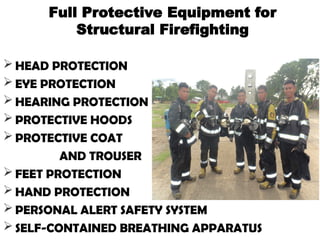
Full Protective Equipmentfor
Structural Firefighting
HEAD PROTECTION
EYE PROTECTION
HEARING PROTECTION
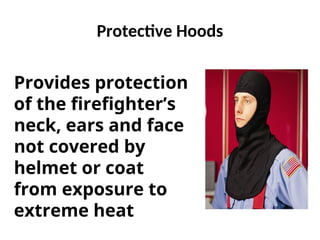
PROTECTIVE HOODS
PROTECTIVE COAT
AND TROUSER
FEET PROTECTION
HAND PROTECTION
PERSONAL ALERT SAFETY SYSTEM
SELF-CONTAINED BREATHING APPARATUS
4.
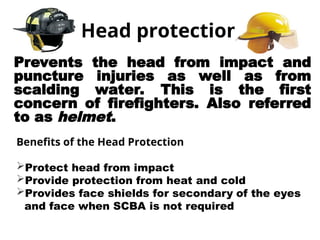
Head protection
Prevents thehead from impact and
puncture injuries as well as from
scalding water. This is the first
concern of firefighters. Also referred
to as helmet.
Benefits of the Head Protection
Protect head from impact
Provide protection from heat and cold
Provides face shields for secondary of the eyes
and face when SCBA is not required
5.
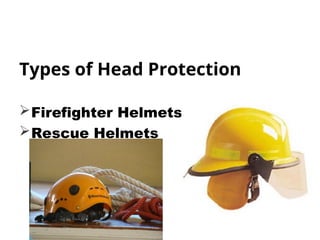
Types of HeadProtection
Firefighter Helmets
Rescue Helmets
6.
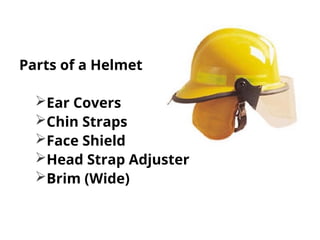
Parts of aHelmet
Ear Covers
Chin Straps
Face Shield
Head Strap Adjuster
Brim (Wide)
7.
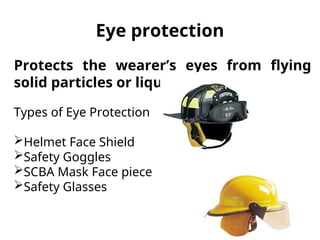
Eye protection
Protects thewearer’s eyes from flying
solid particles or liquids.
Types of Eye Protection
Helmet Face Shield
Safety Goggles
SCBA Mask Face piece
Safety Glasses
8.
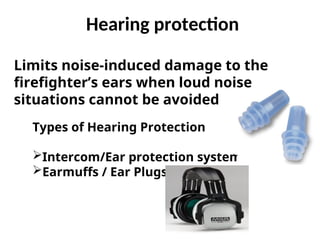
Hearing protection
Limits noise-induceddamage to the
firefighter’s ears when loud noise
situations cannot be avoided
Types of Hearing Protection
Intercom/Ear protection systems
Earmuffs / Ear Plugs
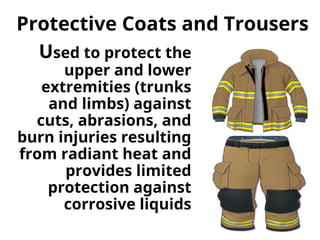
Protective Coats andTrousers
Used to protect the
upper and lower
extremities (trunks
and limbs) against
cuts, abrasions, and
burn injuries resulting
from radiant heat and
provides limited
protection against
corrosive liquids
11.
There are nodifference to both
components for protection
except that the protective
coats are for upper extremities
and protective trousers are for
lower extremities.
Components of a Protective Coat and Trousers
Outer Shell
Moisture Barrier
Thermal Barrier
12.
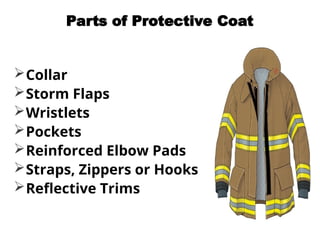
Parts of ProtectiveCoat
Collar
Storm Flaps
Wristlets
Pockets
Reinforced Elbow Pads
Straps, Zippers or Hooks
Reflective Trims
13.
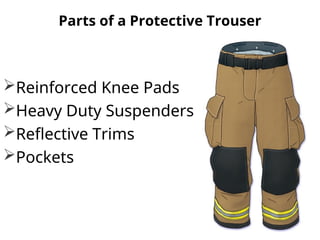
Parts of aProtective Trouser
Reinforced Knee Pads
Heavy Duty Suspenders
Reflective Trims
Pockets
14.
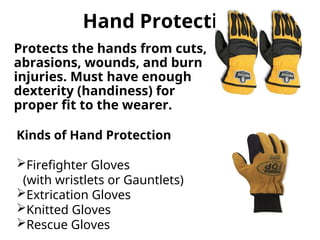
Hand Protection
Protects thehands from cuts,
abrasions, wounds, and burn
injuries. Must have enough
dexterity (handiness) for
proper fit to the wearer.
Kinds of Hand Protection
Firefighter Gloves
(with wristlets or Gauntlets)
Extrication Gloves
Knitted Gloves
Rescue Gloves
15.
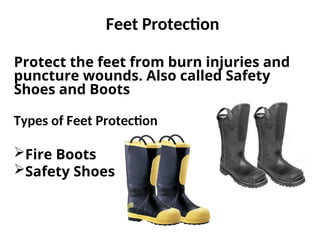
Feet Protection
Protect thefeet from burn injuries and
puncture wounds. Also called Safety
Shoes and Boots
Types of Feet Protection
Fire Boots
Safety Shoes
16.
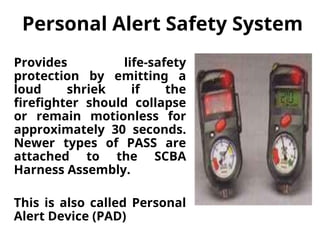
Personal Alert SafetySystem
Provides life-safety
protection by emitting a
loud shriek if the
firefighter should collapse
or remain motionless for
approximately 30 seconds.
Newer types of PASS are
attached to the SCBA
Harness Assembly.
This is also called Personal
Alert Device (PAD)
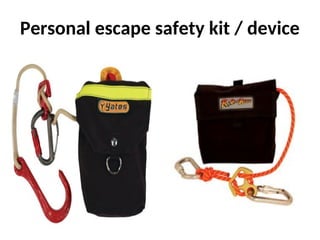
•Provides life-safety protection
forthe firefighter for fast,
reliable means of egress from
a burning multi storey
structure. A firefighter
equipped with the system can
quickly anchor the heat & cut
resistant rope with the hook
anchoring device and more
rapidly towards the exit point.
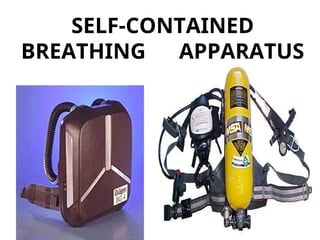
SELF-CONTAINED BREATHING
APPARATUS
Why RespiratoryProtection is Important?
Health Hazards in the workplace are a major
concern for both employers and employees. It is
important, though, to remember that hazardous
materials only present a health hazard when they
come into contact with your body.
Hazardous materials can enter your
body in three ways:
Ingestion
Skin Absorption
Inhalation
21.
Inhalation
Of the threeways that hazardous materials can enter your
body, inhalation is the most common route of exposure for
most materials which are health hazards. This includes
breathing in dust, fumes, oil mist, and vapors from solvents
and various gases.
Inhaling hazardous materials damages the delicate
structure of your lungs. Lungs that have been
damaged are more susceptible to respiratory diseases.
These diseases often cannot be cured, and eventually
lead to death. In short, respiratory protection is
serious business.
22.
22
Four common hazardous
atmospheresassociated with or
other related emergencies
Oxygen Deficiency
Elevated Temperatures
Smoke
Toxic Atmospheres
23.
Oxygen Deficiency
Occurs whenthe combustion process
consumes oxygen while producing toxic
gases that either physically displace
oxygen or dilutes its concentration. When
below 18 percent, the human body
responds by increasing its respiratory
rate. Oxygen deficiency occurs in below-
grade locations, chemical storage tanks,
grain bins, silos and other confined
spaces. Another is total-flooding carbon
dioxide extinguishing system after
24.
SCBA – RESPIRATORYHAZARDS
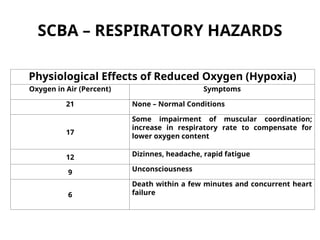
Physiological Effects of Reduced Oxygen (Hypoxia)
Oxygen in Air (Percent) Symptoms
21 None – Normal Conditions
17
Some impairment of muscular coordination;
increase in respiratory rate to compensate for
lower oxygen content
12 Dizinnes, headache, rapid fatigue
9 Unconsciousness
6
Death within a few minutes and concurrent heart
failure
25.
Elevated Temperatures
Are causedby exposure to heated air can
damage the respiratory tract, and if air is
moist, the damage can be much worse.
Excessive heat taken quickly into the lungs
can cause decrease in blood pressure and
circulatory system failure. Inhaling heated
gases can cause pulmonary edema
(accumulation of fluids in the lungs and
associated swelling) can cause death by
asphyxiation
26.
Smoke
Is the suspensionof small
particles of carbon, tar, and dust
floating in the combination of heated
gases. Some of the suspended
particles are irritating, but others may
be lethal. The darker the smoke, the
higher carbon monoxide level.
27.
Toxic Atmospheres Associatedwith Fires
Occurs during the combustion process,
exposure to combination of irritants and
toxicants whose toxicity cannot be predicted
accurately
The particular toxic gases given off at a fire
vary according to four factors:
Nature of the Combustible
Rate of Heating
Temperature of the evolved gases
Oxygen concentration in the air
28.
SCBA – RESPIRATORYHAZARDS
Toxic Atmospheres Not Associated with Fires
Are most likely can be found at highly
industrialized processes that uses
extremely dangerous chemicals. This
does not necessarily mean only at those
areas but another from leakage upon /
during transportation of highly
dangerous/hazardous chemicals
29.
SCBA protects theface and lungs
from toxic smoke and gases, and
other products of combustion
Protective breathing apparatus is extremely crucial
to the well-being of a firefighter. Failure to use this
equipment could lead to failed rescue attempts,
firefighter injuries, or worst – fatalities.
A well trained firefighter should be knowledgeable
of respiratory hazards, the requirements for wearing
protective breathing apparatus, the procedures for
donning or doffing the apparatus, and the proper care
and maintenance of the equipment. The basic
misconception of the SCBA is that its content is not
oxygen but compressed air (open-circuit) or liquid
oxygen (closed-circuit)
30.
Basic Components ofthe SCBA
Backpack and Harness Assembly – holds the air
cylinder on the firefighter’s back and provides stability
Air Cylinder Assembly – Includes cylinder, valve, and
pressure gauge
Regulator Assembly – includes high pressure hose
and low pressure hose
Face Piece Assembly – includes face piece lens,
exhalation valve, low-pressure hose, face piece straps
31.
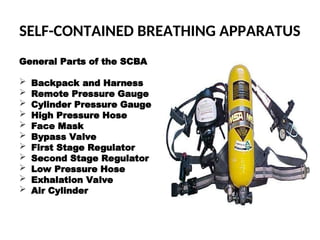
SELF-CONTAINED BREATHING APPARATUS
GeneralParts of the SCBA
Backpack and Harness
Remote Pressure Gauge
Cylinder Pressure Gauge
High Pressure Hose
Face Mask
Bypass Valve
First Stage Regulator
Second Stage Regulator
Low Pressure Hose
Exhalation Valve
Air Cylinder
32.
Protective Breathing Apparatus
Limitations
Inorder to operate effectively, the
firefighter must be aware of the three (3)
limitations of SCBA, namely:
Limitations of Wearer
Limitations of Equipment
Limitations of Air Supply
33.
Limitations of Wearer
Severalfactors affect the firefighter’s ability to use SCBA
effectively. These factors include physical, medical and
mental limitations.
PHYSICAL
Physical condition – the wearer must be in sound physical
condition in order to maximize the work that can be performed
and to stretch the air supply as far as possible.
Agility – Wearing a protective breathing apparatus restricts
the wearer’s movements and its affects his balance. Good agility
will help overcome these obstacles.
Facial Features – the shape and contour of the face affects
the wearer’s ability to get a good facepiece-to-face seal.
34.
Medical
Neurological Functioning– good motor coordination is
necessary for operating in protective breathing
equipment. The wearer must be of a sound mind to handle
emergency situations that may arise.
Muscular/Skeletal Condition – must have physical
strength and size to wear the size required to perform
the mandated tasks.
Cardiovascular Conditioning – poor cardiovascular
conditioning can result to heart attacks, strokes or other
related problems during strenuous activity.
Respiratory Functioning – proper respiratory
functioning can and will maximize the wearer’s
operation time in a self-contained breathing apparatus.
35.
Mental
Adequate trainingin equipment use
– the wearer must be knowledgeable
in every aspect of the breathing
apparatus use.
Self-confidence – the firefighter’s belief
in his ability will have an extremely
positive overall effect on the actions
performed.
Emotional Stability – the ability to
maintain control in an excited or high
stress environment will reduce the
chances of a serious mistake being made.
36.
Limitations of Equipment
Limited visibility – due to the facepiece,
reduces peripheral vision and facepiece
fogging can reduce overall vision.
Decreased ability to communicate –
facepiece hinders voice communication.
Increased Weight – adds 25 to 35 pounds of
the weight of the firefighter, depending on
the model.
Decreased Mobility – due to the increased
weight factor of the SCBA and the splinting
effect of the harness straps, reduces firefighter’s
mobility.
37.
Limitations of AirSupply
Physical Condition of User – firefighter’s poor
physical condition generally expends air supply faster.
Degree of Physical Exertion – the higher the physical
exertion, the faster the air supply expended
Emotional Stability of the User – the higher the
wearer become excited or stressed, uses air supply
faster than the calm firefighter.
Condition of Apparatus – minor leaks and poor
adjustment of regulators results in excessive air loss
Cylinder pressure before use – if the cylinder is not
filled to capacity, the amount of working time is
reduced proportionately
Training and user experience – properly trained and
highly experienced personnel are able to draw the
maximum air supply from a cylinder.
38.
Types of BreathingApparatus
•
Open-Circuit – most frequently used SCBA in the
fire service. This uses compressed air. The exhaled
SCBA air is vented to the outside atmosphere.
Closed-Circuit - mostly used in long
operations and hazardous materials incidents. It
can last for four (4) long hours before
replacement and weighs less than the open-
circuit because of the smaller cylinder and uses
pure liquid oxygen. It is also called Rebreather
Apparatus.
39.
Donning of SCBA– refers to the proper
wearing of the SCBA
Donning from a storage case
Over-the-Head Method
Backpack Method
Donning from a Seat Mount
40.
DOFFING of SCBA– refers to the
proper removal of the SCBA
Doffing Procedures:
Make sure that you are out of the contaminated area and
SCBA is no longer required.
Discontinue the flow of air from the regulator to the
facepiece
Disconnect low pressure hose from the regulator from the
facepiece, depending upon type of SCBA
Remove the facepiece
Remove the backpack assembly while protecting the
regulator
Close cylinder valve
Relieve pressure from the regulator
Extend all straps
Refill and replace the SCBA
Clean and disinfect the facepiece
41.
CARE AND MAINTENANCEOF PPE
Upon return to the station, check all
worn and used PPE for any damages
or contamination
Clean/Wash all those used in the
operations before storing
If contaminated and cannot be
disinfected, properly dispose the
equipment
Follow the necessary procedures for
cleaning and maintaining equipments
based on the manufacturer’s
instructions.



![Air and Breathing [OCCUPATIONAL SAFETY AND HEALTH (OSHA)]](https://cdn.slidesharecdn.com/ss_thumbnails/air-and-breathinglastedited-150520021830-lva1-app6891-thumbnail.jpg?width=640&height=640&fit=bounds)


