Chapter 3
Math Toolkit
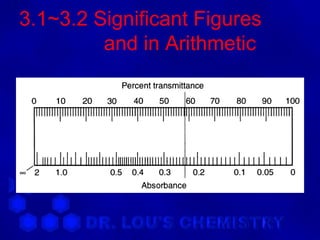
3.1~3.2 Significant Figures
         and in Arithmetic
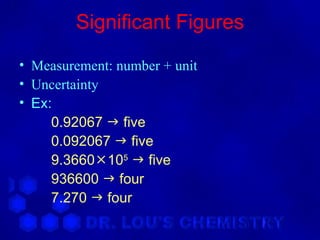
Significant Figures
• Measurement: number + unit
• Uncertainty
• Ex:
     0.92067  five
     0.092067  five
     9.3660105  five
     936600  four
     7.270  four
Significant Figures
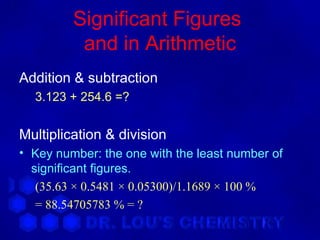
          and in Arithmetic
Addition & subtraction
  3.123 + 254.6 =?


Multiplication & division
• Key number: the one with the least number of
  significant figures.
   (35.63 × 0.5481 × 0.05300)/1.1689 × 100 %
   = 88.54705783 % = ?
Significant Figures
         and in Arithmetic
Logarithms & antilog, see p54-55
     [H+]=2.010-3
     pH=-log(2.010-3) = -(-3+0.30)=2.70
     antilogarithm of 0.072 ⇒ 1.18
     logarithm of 12.1 ⇒ 1.083
    log 339 = 2.5301997… = 2.530
    antilog (-3.42)    = 10-3.42 = 0.0003802
                       = 3.8x10⁻⁴
3.3 Types of Errors

  Every measurement has some
   uncertainty ⇒ experimental error.

  Maximum error v.s. time required
3.3 Types of Errors
•       Systematic error
        = Determinate error = consistent error

    -     Errors arise: instrument, method, & person
    -     Can be discovered & corrected
    -     Is from fixed cause, & is either high (+) or
          low (-) every time.
    -     Ways to detect systematic error:
            examples (a) pH meter (b) buret
3.3 Types of Errors
•  Random error = Indeterminate error
   Is always present & cannot be corrected
   Has an equal chance of being (+) or (-).
   From (a) people reading the scale
           (b) random electrical noise in an
                instrument.
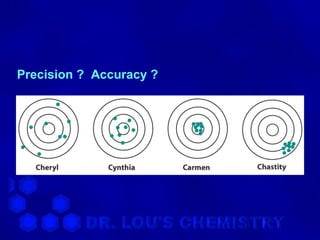
5) Precision & Accuracy
     reproducibility
     confidence of nearness to the truth
Precision ? Accuracy ?
3.3 Types of Errors
1) Absolute & Relative uncertainty
   a) Absolute : the margin of uncertainty
      ± 0.02(the measured value - the true value)

  b). Relative =     absolute uncertainty
                   magnitude of measurement

      (ex) 12.35 ± 0.02 mL
               0.02
           ⇒         = 0.002 = 0.2%
              12.35
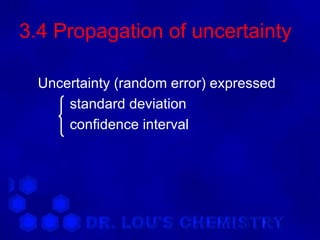
3.4 Propagation of uncertainty

  Uncertainty (random error) expressed
      standard deviation
      confidence interval
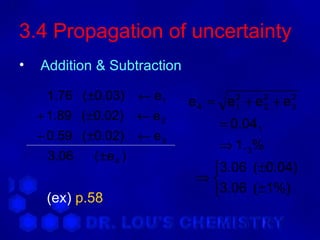
3.4 Propagation of uncertainty
•   Addition & Subtraction

     1.76 ( ±0.03)      ← e1   e 4 = e1 + e 2 + e 3
                                      2           2
                                            2
    + 1.89 ( ±0.02)     ← e2
                                    = 0.04 1
    − 0.59 ( ±0.02)     ← e3
                                    ⇒ 1.3 %
     3.06    ( ±e 4 )
                                 3.06 ( ±0.04)
                                ⇒
     (ex) p.58                   3.06 ( ±1%)
3.4 Propagation of uncertainty
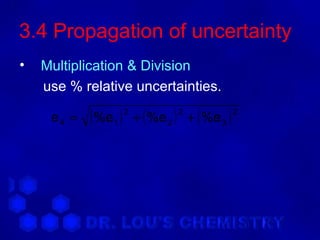
•   Multiplication & Division
    use % relative uncertainties.

     e4 =   ( %e1 )   2
                          + ( %e 2 ) + ( %e 3 )
                                   2              2
3.4 Propagation of uncertainty
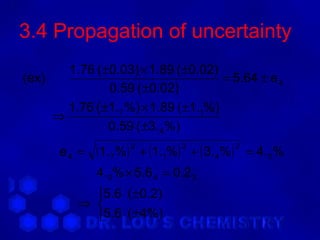
       1.76 ( ±0.03) × 1.89 ( ±0.02)
(ex)                                  = 5.64 ± e 4
               0.59 ( ±0.02)
       1.76 ( ±1.7 %) × 1.89 ( ±1.1%)
     ⇒
               0.59 ( ±3. 4 %)
       e4 =   (1.7%)   2
                           + (1.1%) + ( 3. 4 %) = 4.0 %
                                   2         2


              4.0 % × 5.6 4 = 0.2 3
            5.6 ( ±0.2)
          ⇒ 
            5.6 ( ±4%)
3.4 Propagation of uncertainty
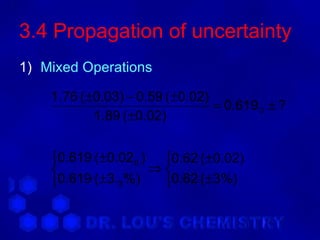
1) Mixed Operations

    1.76 ( ±0.03) − 0.59 ( ±0.02)
                                  = 0.619 0 ± ?
            1.89 ( ±0.02)


    0.619 ( ±0.02 0 ) 0.62 ( ±0.02)
                     ⇒
    0.619 ( ±3.3 %)   0.62 ( ±3%)
3.4 Propagation of uncertainty
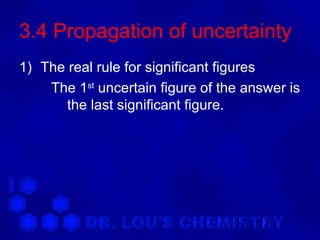
1) The real rule for significant figures
    The 1st uncertain figure of the answer is
       the last significant figure.
3.4 Propagation of uncertainty

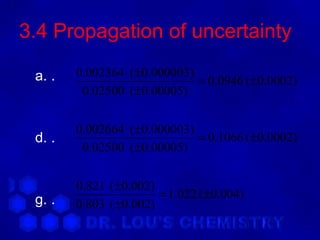
 a. .   0.002364 (±0.000003)
                             = 0.0946 (±0.0002)
         0.02500 (±0.00005)

        0.002664 (±0.000003)
 d. .                        = 0.1066 (±0.0002)
         0.02500 (±0.00005)

        0.821 (±0.002)
 g. .                  = 1.022 (±0.004)
        0.803 (±0.002)

Chapter 03

  • 1.
  • 2.
  • 3.
    Significant Figures • Measurement:number + unit • Uncertainty • Ex: 0.92067  five 0.092067  five 9.3660105  five 936600  four 7.270  four
  • 4.
    Significant Figures and in Arithmetic Addition & subtraction 3.123 + 254.6 =? Multiplication & division • Key number: the one with the least number of significant figures. (35.63 × 0.5481 × 0.05300)/1.1689 × 100 % = 88.54705783 % = ?
  • 5.
    Significant Figures and in Arithmetic Logarithms & antilog, see p54-55 [H+]=2.010-3 pH=-log(2.010-3) = -(-3+0.30)=2.70 antilogarithm of 0.072 ⇒ 1.18 logarithm of 12.1 ⇒ 1.083 log 339 = 2.5301997… = 2.530 antilog (-3.42) = 10-3.42 = 0.0003802 = 3.8x10⁻⁴
  • 6.
    3.3 Types ofErrors Every measurement has some uncertainty ⇒ experimental error. Maximum error v.s. time required
  • 7.
    3.3 Types ofErrors • Systematic error = Determinate error = consistent error - Errors arise: instrument, method, & person - Can be discovered & corrected - Is from fixed cause, & is either high (+) or low (-) every time. - Ways to detect systematic error: examples (a) pH meter (b) buret
  • 8.
    3.3 Types ofErrors • Random error = Indeterminate error Is always present & cannot be corrected Has an equal chance of being (+) or (-). From (a) people reading the scale (b) random electrical noise in an instrument. 5) Precision & Accuracy reproducibility confidence of nearness to the truth
  • 9.
  • 10.
    3.3 Types ofErrors 1) Absolute & Relative uncertainty a) Absolute : the margin of uncertainty ± 0.02(the measured value - the true value) b). Relative = absolute uncertainty magnitude of measurement (ex) 12.35 ± 0.02 mL 0.02 ⇒ = 0.002 = 0.2% 12.35
  • 11.
    3.4 Propagation ofuncertainty Uncertainty (random error) expressed standard deviation confidence interval
  • 12.
    3.4 Propagation ofuncertainty • Addition & Subtraction 1.76 ( ±0.03) ← e1 e 4 = e1 + e 2 + e 3 2 2 2 + 1.89 ( ±0.02) ← e2 = 0.04 1 − 0.59 ( ±0.02) ← e3 ⇒ 1.3 % 3.06 ( ±e 4 ) 3.06 ( ±0.04) ⇒ (ex) p.58 3.06 ( ±1%)
  • 13.
    3.4 Propagation ofuncertainty • Multiplication & Division use % relative uncertainties. e4 = ( %e1 ) 2 + ( %e 2 ) + ( %e 3 ) 2 2
  • 14.
    3.4 Propagation ofuncertainty 1.76 ( ±0.03) × 1.89 ( ±0.02) (ex) = 5.64 ± e 4 0.59 ( ±0.02) 1.76 ( ±1.7 %) × 1.89 ( ±1.1%) ⇒ 0.59 ( ±3. 4 %) e4 = (1.7%) 2 + (1.1%) + ( 3. 4 %) = 4.0 % 2 2 4.0 % × 5.6 4 = 0.2 3 5.6 ( ±0.2) ⇒  5.6 ( ±4%)
  • 15.
    3.4 Propagation ofuncertainty 1) Mixed Operations 1.76 ( ±0.03) − 0.59 ( ±0.02) = 0.619 0 ± ? 1.89 ( ±0.02) 0.619 ( ±0.02 0 ) 0.62 ( ±0.02)  ⇒ 0.619 ( ±3.3 %) 0.62 ( ±3%)
  • 16.
    3.4 Propagation ofuncertainty 1) The real rule for significant figures The 1st uncertain figure of the answer is the last significant figure.
  • 17.
    3.4 Propagation ofuncertainty a. . 0.002364 (±0.000003) = 0.0946 (±0.0002) 0.02500 (±0.00005) 0.002664 (±0.000003) d. . = 0.1066 (±0.0002) 0.02500 (±0.00005) 0.821 (±0.002) g. . = 1.022 (±0.004) 0.803 (±0.002)