Requirements Management
Requirements managementThe process of managing change to the requirements for a systemThe principal concerns of requirements management are:Managing changes to agreed requirementsManaging the relationships between requirementsManaging the dependencies between the requirements document and other documents produced in the systems engineering processRequirements cannot be managed effectively without requirements traceability. A requirement is traceable if you can discover who suggested the requirement, why the requirement exists, what requirements are related to it and how that requirement relates to other information such as systems designs, implementations and user documentation.
CASE tools for requirements managementRequirements management involves the collection, storage and maintenance of large amounts of informationThere are now a number of CASE tools available which are specifically designed to support requirements managementOther CASE tools such as configuration management systems may be adapted for requirements engineering
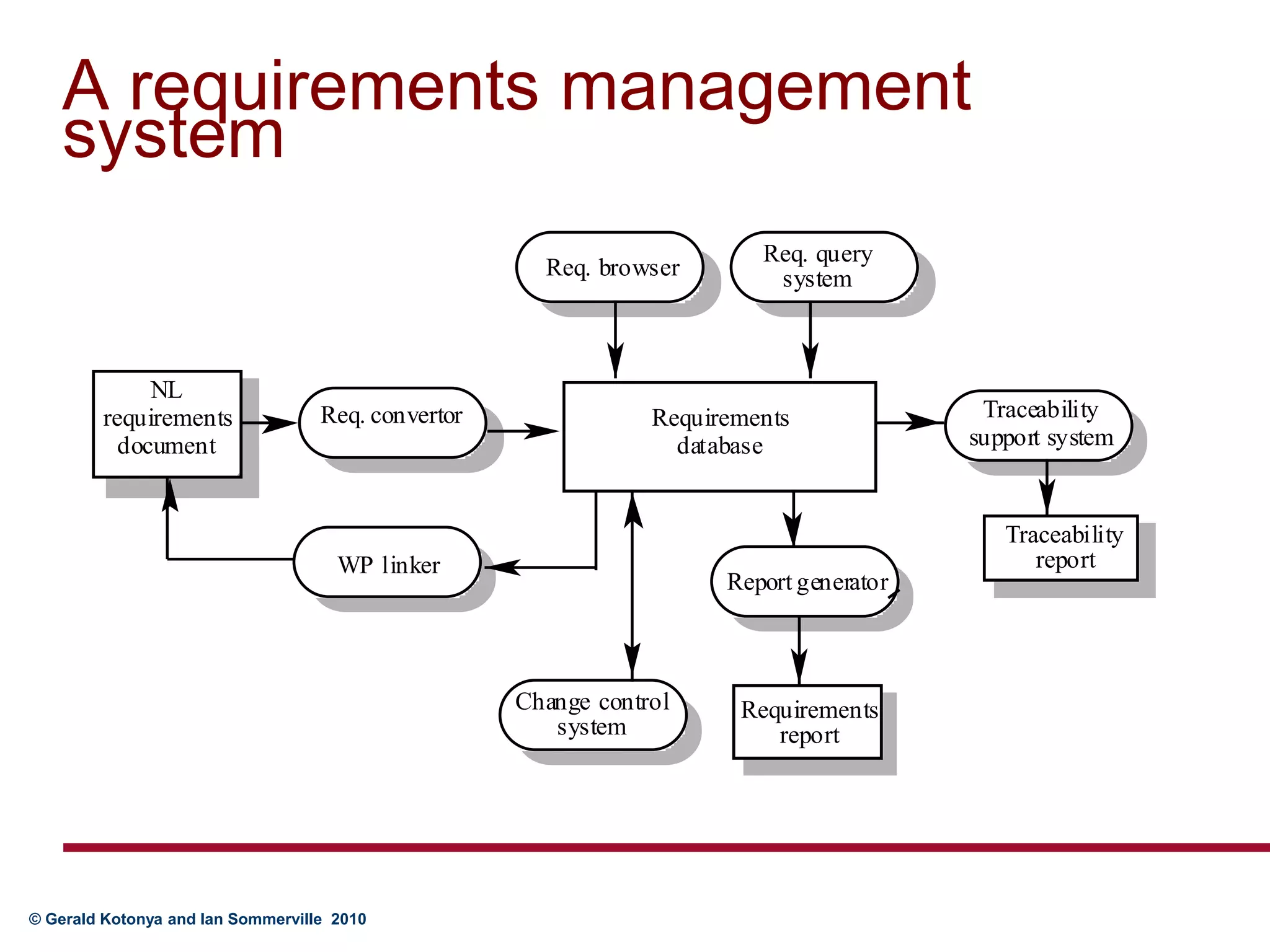
Requirements management tool supportA database system for storing requirements.Document analysis and generation facilities to help construct a requirements database and to help create requirements documents.Change management facilities which help ensure that changes are properly assessed and costed.Traceability facilities which help requirements engineers find dependencies between system requirements.
A requirements management system
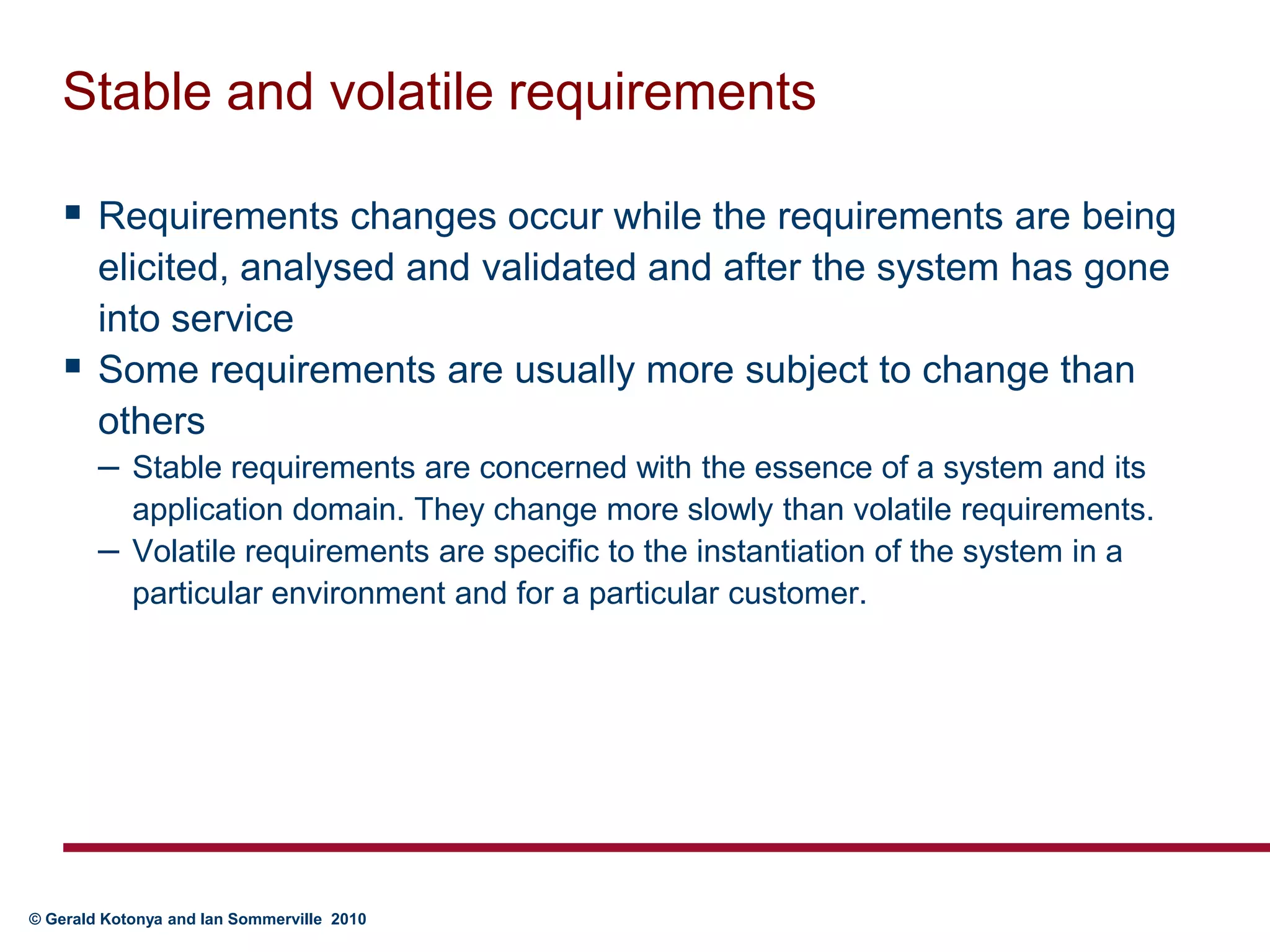
Stable and volatile requirementsRequirements changes occur while the requirements are being elicited, analysed and validated and after the system has gone into serviceSome requirements are usually more subject to change than othersStable requirements are concerned with the essence of a system and its application domain. They change more slowly than volatile requirements. Volatile requirements are specific to the instantiation of the system in a particular environment and for a particular customer.
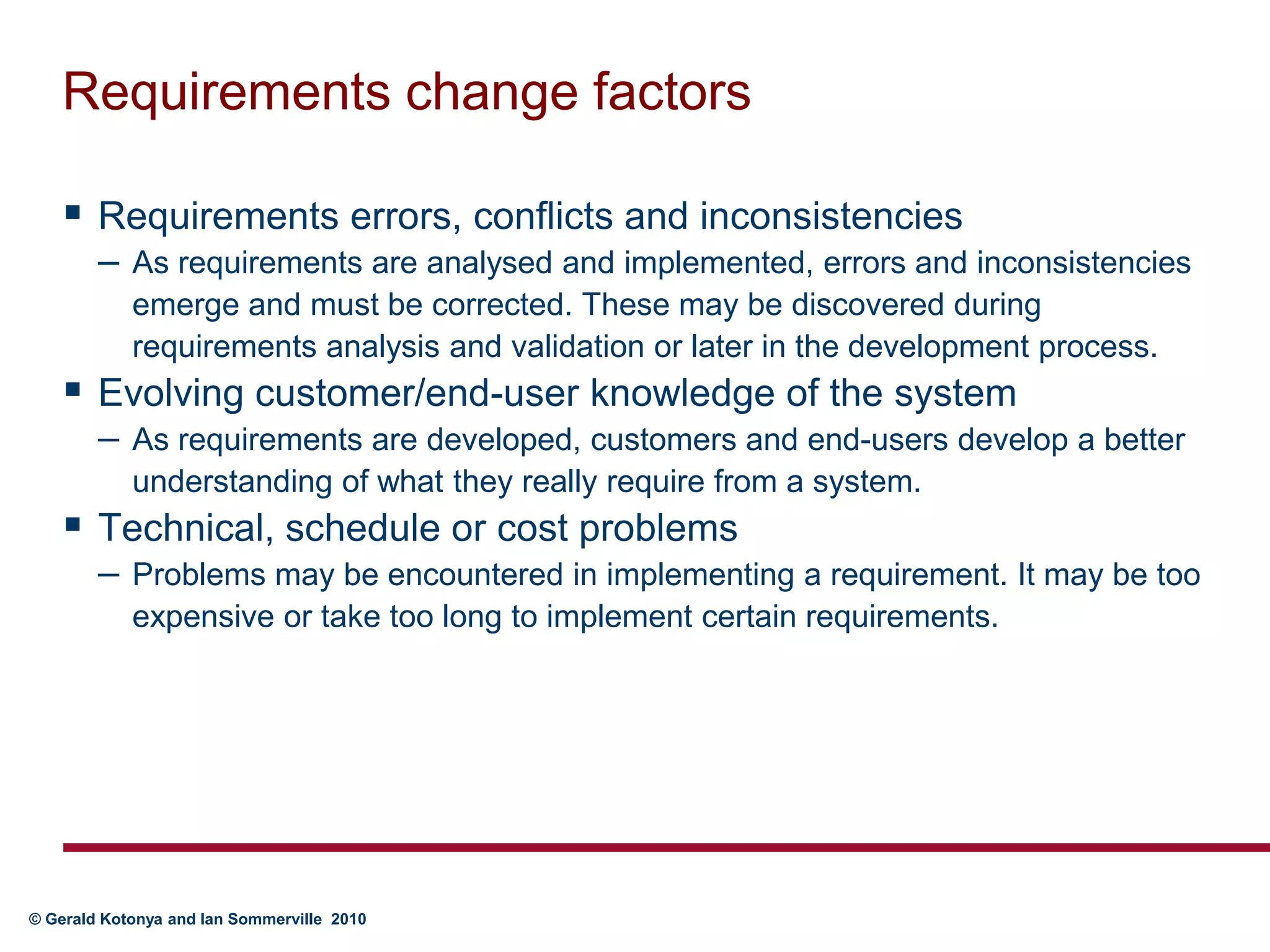
Requirements change factorsRequirements errors, conflicts and inconsistenciesAs requirements are analysed and implemented, errors and inconsistencies emerge and must be corrected. These may be discovered during requirements analysis and validation or later in the development process.Evolving customer/end-user knowledge of the systemAs requirements are developed, customers and end-users develop a better understanding of what they really require from a system.Technical, schedule or cost problems	Problems may be encountered in implementing a requirement. It may be too expensive or take too long to implement certain requirements.
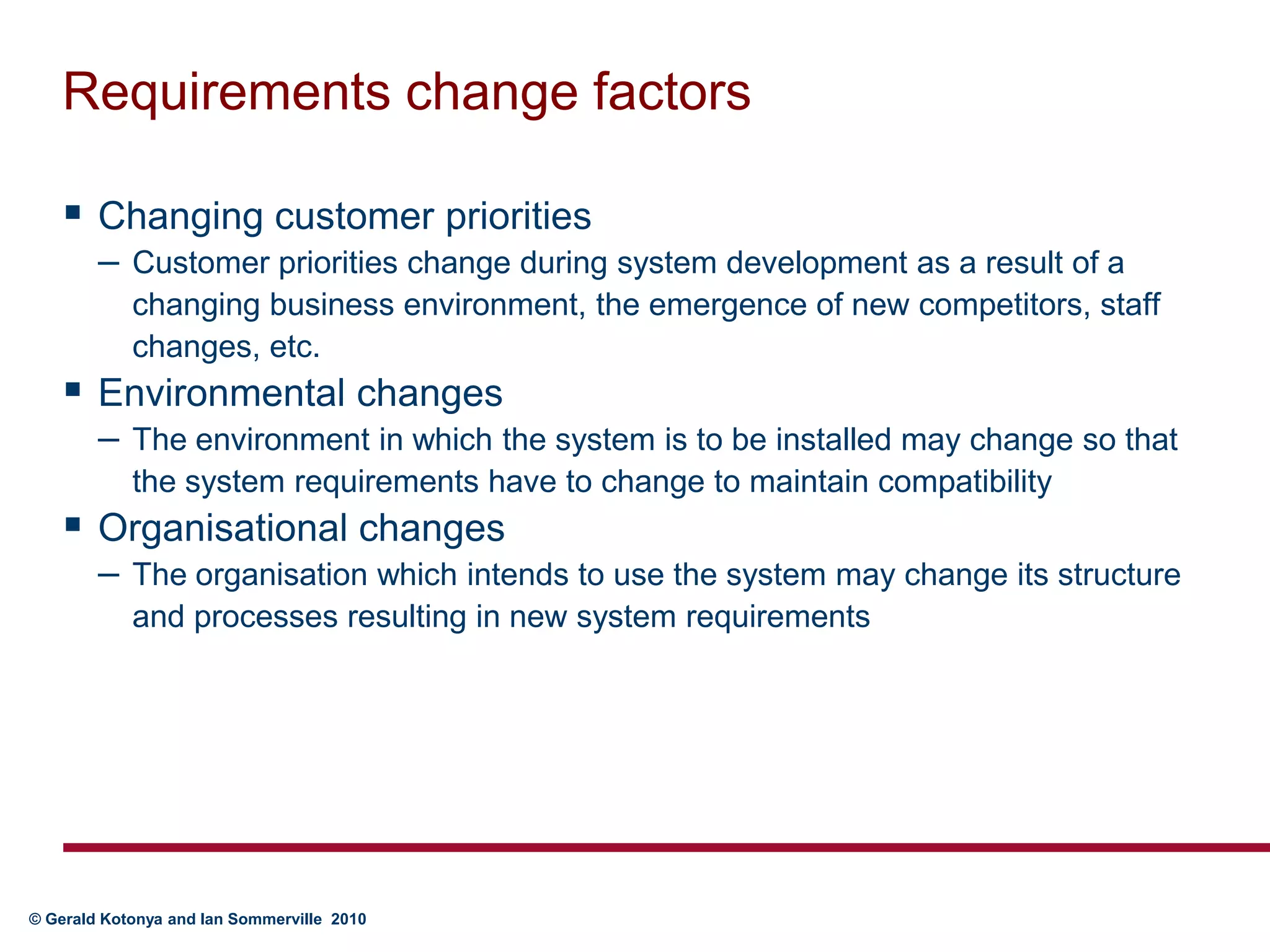
Requirements change factorsChanging customer priorities	Customer priorities change during system development as a result of a changing business environment, the emergence of new competitors, staff changes, etc.Environmental changes	The environment in which the system is to be installed may change so that the system requirements have to change to maintain compatibilityOrganisational changes	The organisation which intends to use the system may change its structure and processes resulting in new system requirements
Types of volatile requirementMutable requirements These are requirements which change because of changes to the environment in which the system is operatingEmergent requirements These are requirements which cannot be completely defined when the system is specified but which emerge as the system is designed and implementedConsequential requirements These are requirements which are based on assumptions about how the system will be used. When the system is put into use, some of these assumptions will be wrong.Compatibility requirements These are requirements which depend on other equipment or processes.
Requirements identificationIt is essential for requirements management that every requirement should have a unique identificationThe most common approach is requirements numbering based on chapter/section in the requirements documentProblems with this are:Numbers cannot be unambiguously assigned until the document is completeAssigning chapter/section numbers is an implicit classification of the requirement. This can mislead readers of the document into thinking that the most important relationships are with requirements in the same section
Requirements identification techniquesDynamic renumberingSome word processing systems allow for automatic renumbering of paragraphs and the inclusion of cross-references. As you re-organise your document and add new requirements, the system keeps track of the cross-reference and automatically renumbers your requirement depending on its chapter, section and position within the sectionDatabase record identificationWhen a requirement is identified it is entered in a requirements database and a database record identifier is assigned. This database identifier is used in all subsequent references to the requirementSymbolic identificationRequirements can be identified by giving them a symbolic name which is associated with the requirement itself. For example, EFF-1, EFF-2, EFF-3 may be used for requirements which relate to system efficiency
Storing requirementsRequirements have to be stored in such a way that they can be accessed easily and related to other system requirementsPossible storage techniques areIn one or more word processor files - requirements are stored in the requirements documentIn a specially designed requirements database
Word processor documentsAdvantagesRequirements are all stored in the same placeRequirements may be accessed by anyone with the right word processorIt is easy to produce the final requirements documentDisadvantagesRequirements dependencies must be externally maintainedSearch facilities are limitedNot possible to link requirements with proposed requirements changesNot possible to have version control on individual requirementsNo automated navigation from one requirement to another
Requirements databaseEach requirement is represented as one or more database entitiesDatabase query language is used to access requirementsAdvantagesGood query and navigation facilitiesSupport for change and version managementDisadvantagesReaders may not have the software/skills to access the requirements databaseThe link between the database and the requirements document must be maintained
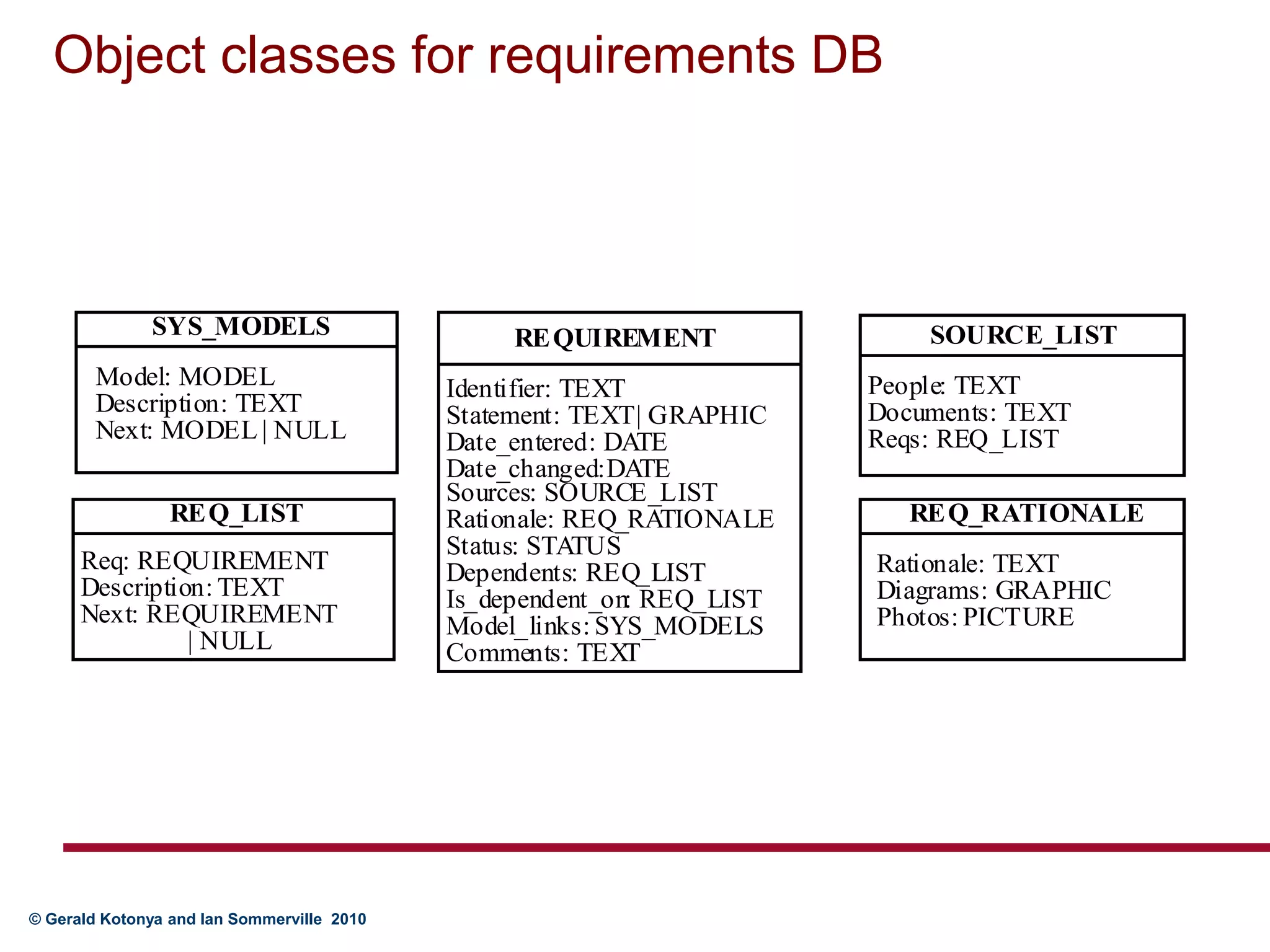
Object classes for requirements DB
Requirements DB - choice factorsThe statement of requirementsIf there is a need to store more than just simple text,  a database with multimedia capabilities may have to be used.The number of requirementsLarger systems usually need a database which is designed to manage a very large volume of data running on a specialised database server.Teamwork, team distribution and computer supportIf the requirements are developed by a distributed team of people, perhaps from different organisations, you need a database which provides for remote, multi-site access.
Database choice factorsCASE tool useThe database should be the same as or compatible with CASE tool databases. However, this can be a problem with some CASE tools which use their own proprietary databaseExisting database usageIf a database for software engineering support is already in use, this should be used for requirements management.
Change managementChange management is concerned with the procedures, processes and standards which are used to manage changes to system requirementsChange management policies may cover:The change request process and the information required to process each change requestThe process used to analyse the impact and costs of change and the associated traceability informationThe membership of the body which formally considers change requests4. The software support (if any) for the change control process
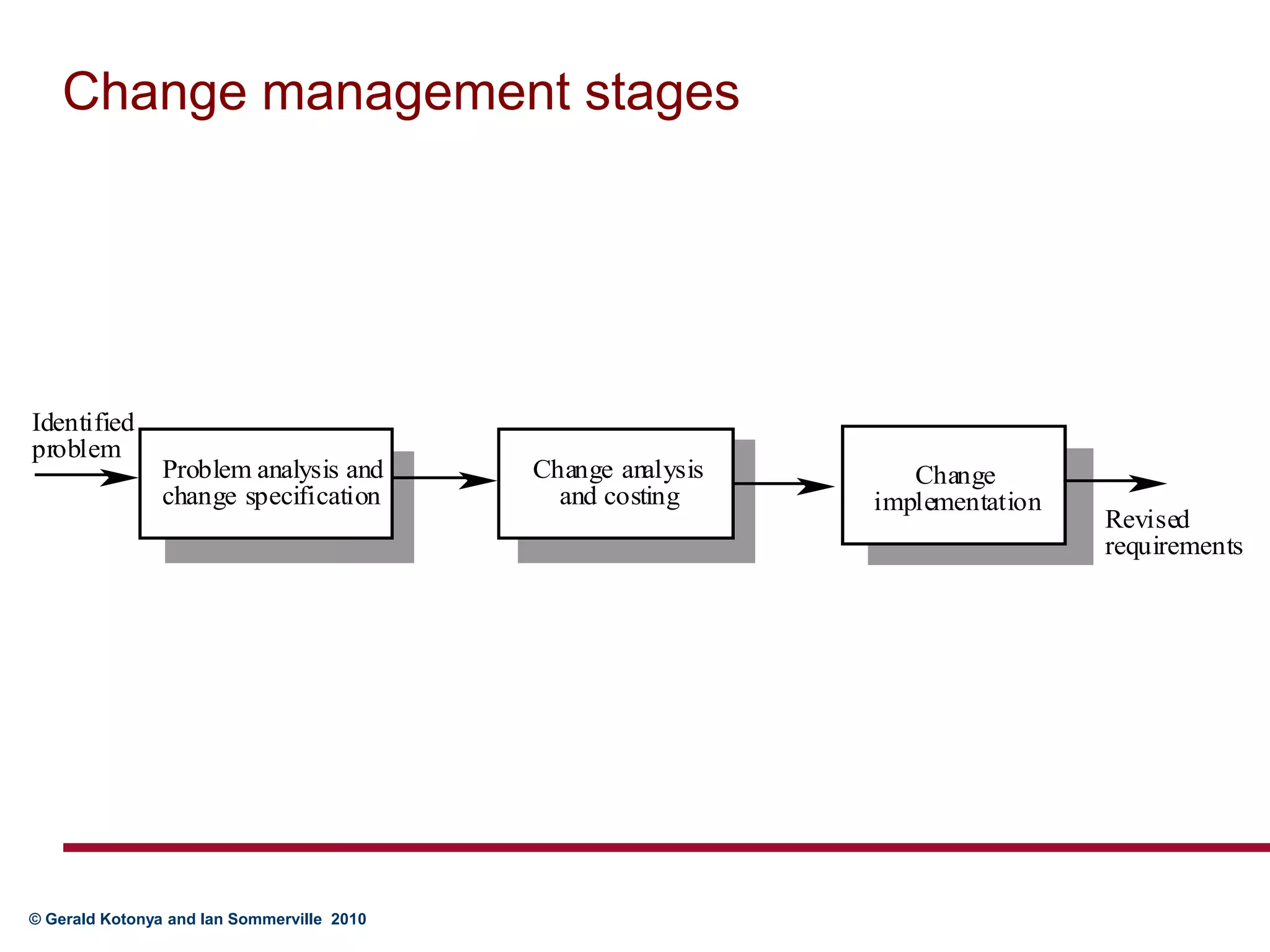
The change management processSome requirements problem is identified. This could come from an analysis of the requirements, new customer needs, or operational problems with the system. The requirements are analysed using problem information and requirements changes are proposed.The proposed changes are analysed This checks how many requirements (and, if necessary, system components) are affected by the change and roughly how much it would cost, in both time and money, to make the change.The change is implemented. A set of amendments to the requirements document or a new document version is produced.  This should, of course, be validated using whatever normal quality checking procedures are used.
Change management stages
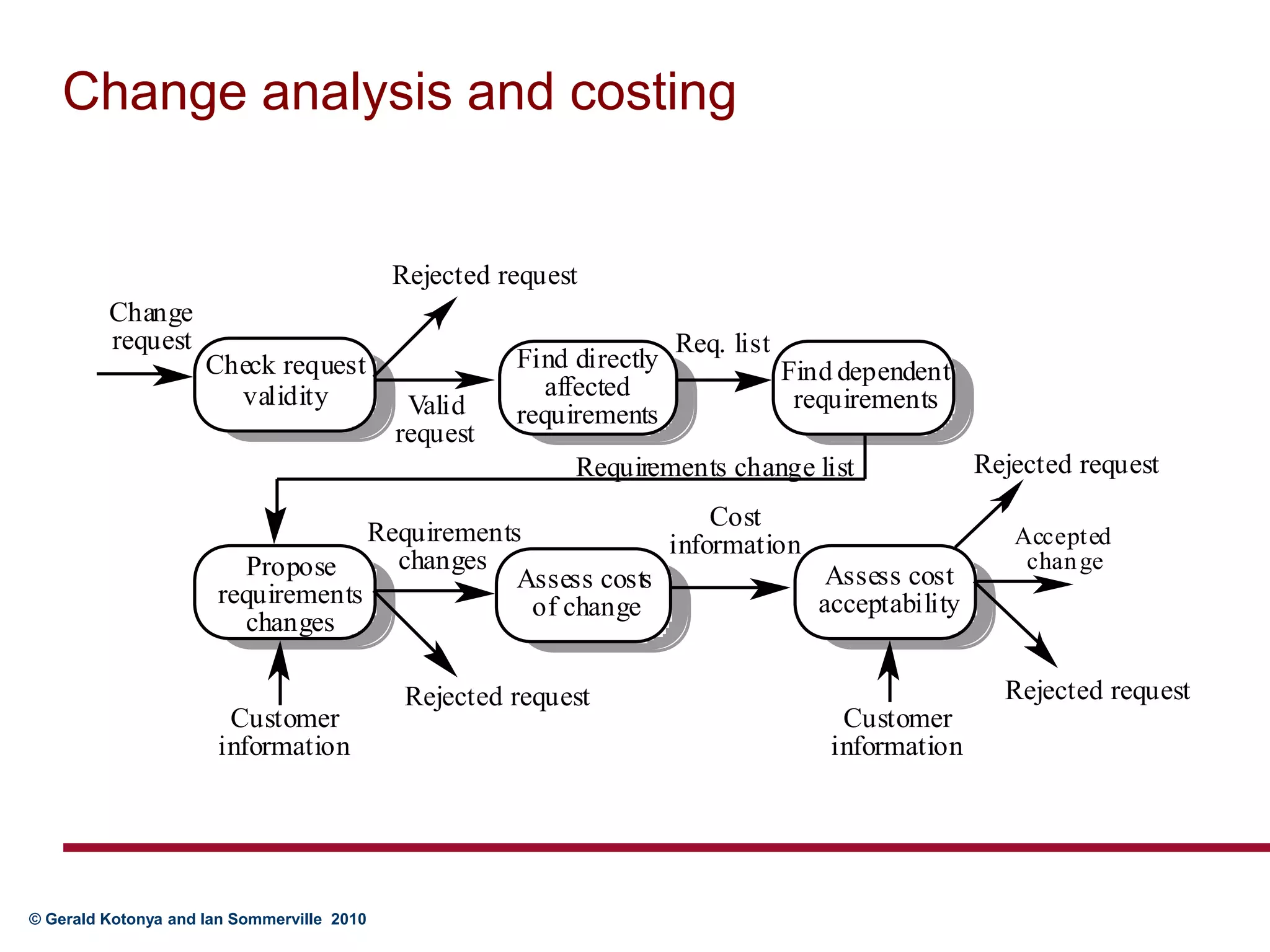
Change analysis and costing
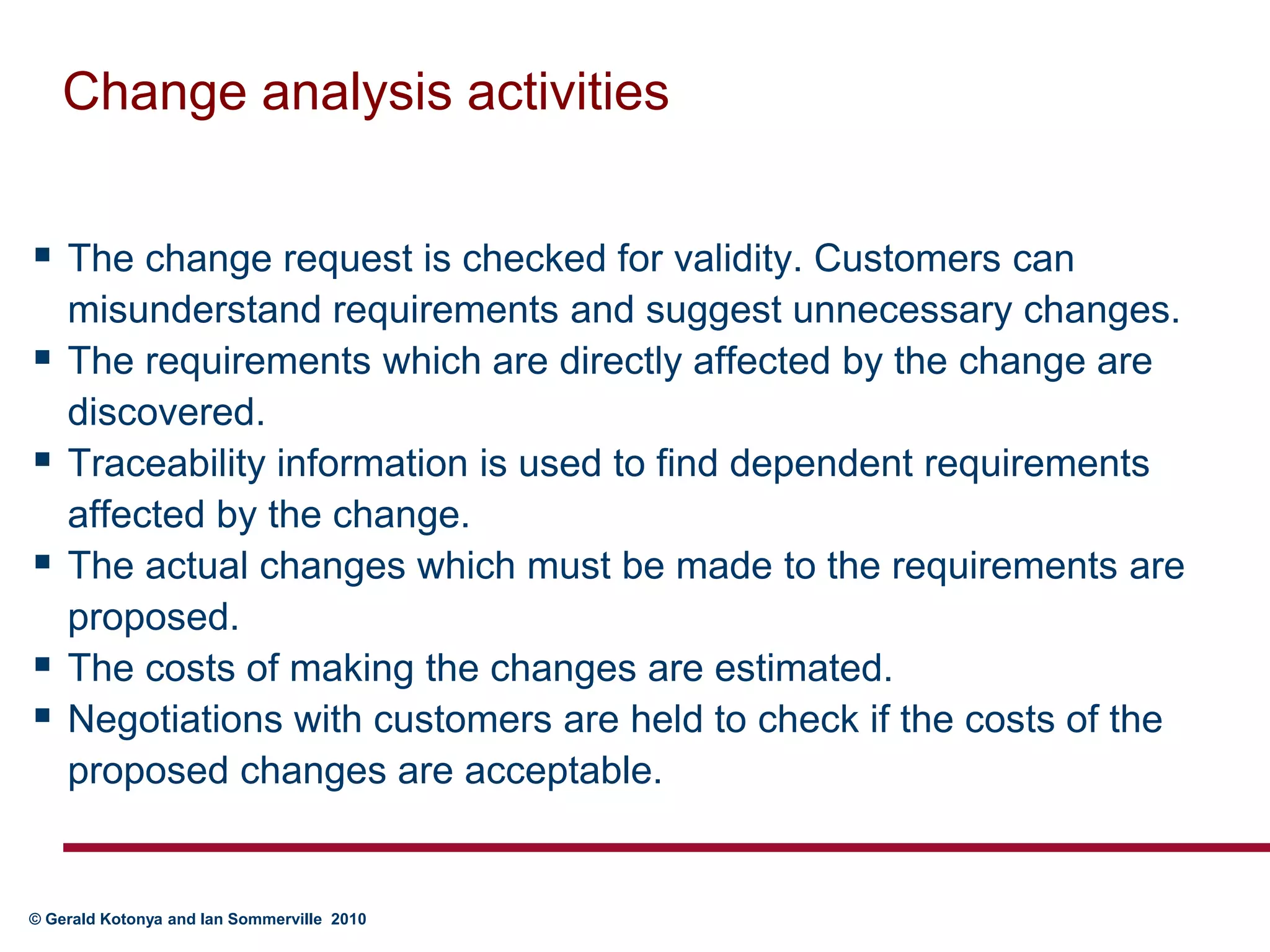
Change analysis activitiesThe change request is checked for validity. Customers can misunderstand requirements and suggest unnecessary changes.The requirements which are directly affected by the change are discovered.Traceability information is used to find dependent requirements affected by the change.The actual changes which must be made to the requirements are proposed. The costs of making the changes are estimated. Negotiations with customers are held to check if the costs of the proposed changes are acceptable.
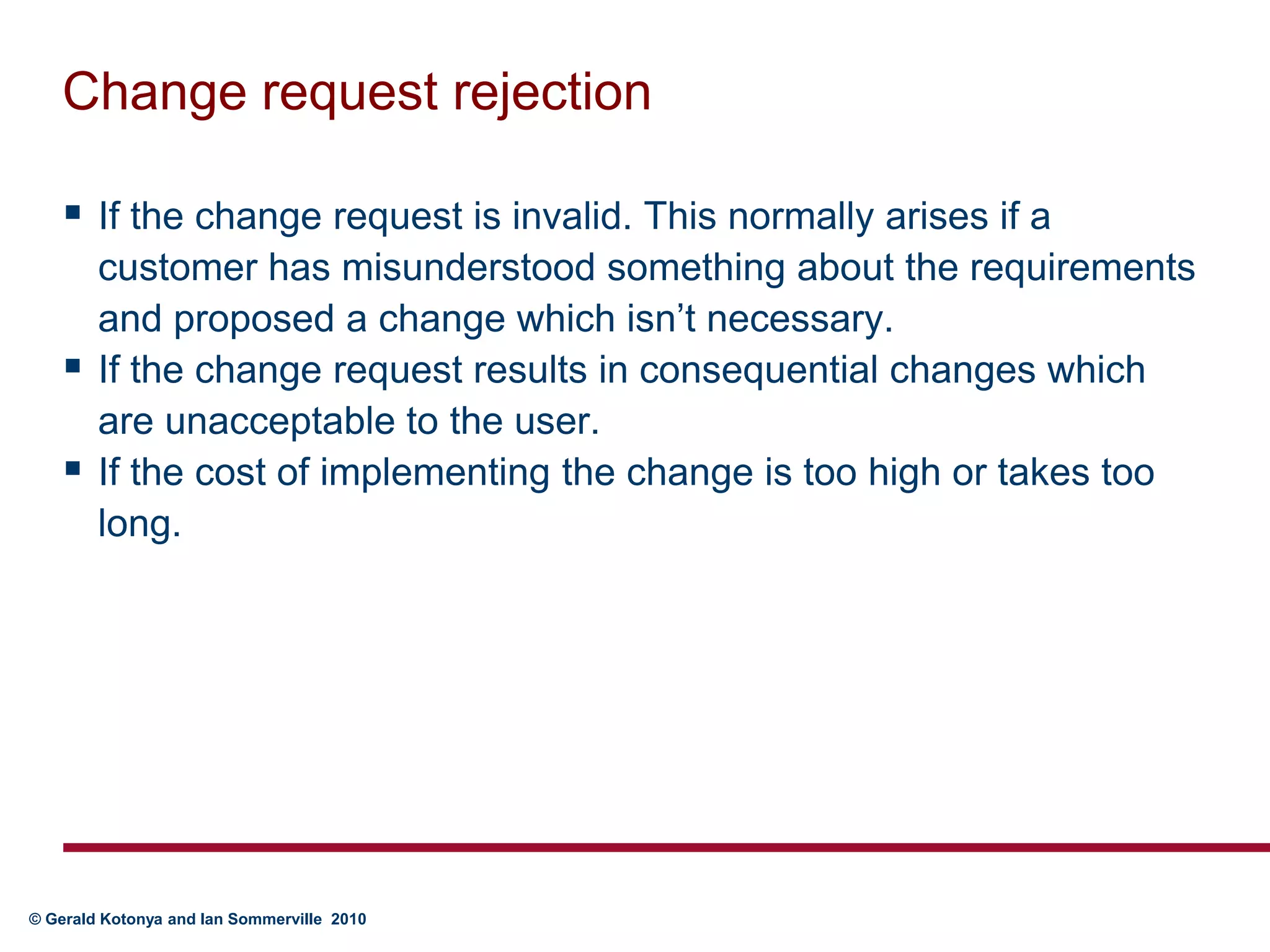
Change request rejectionIf the change request is invalid. This normally arises if a customer has misunderstood something about the requirements and proposed a change which isn’t necessary.If the change request results in consequential changes which are unacceptable to the user. If the cost of implementing the change is too high or takes too long.
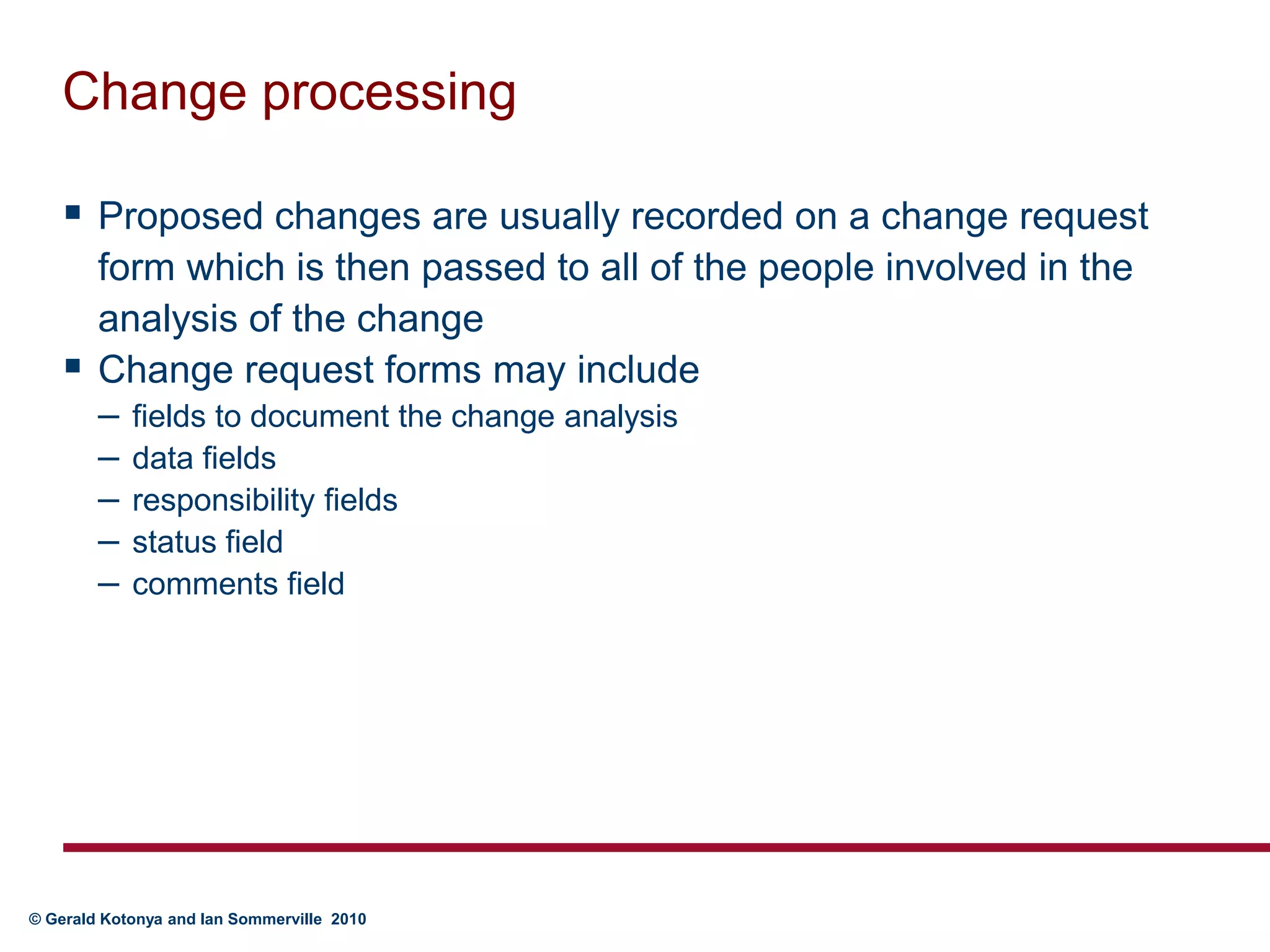
Change processingProposed changes are usually recorded on a change request form which is then passed to all of the people involved in the analysis of the changeChange request forms may includefields to document the change analysisdata fields responsibility fieldsstatus fieldcomments field
Tool support for change managementMay be provided through requirements management tools or through configuration management toolsTool facilities may includeElectronic change request forms which are filled in by different participants in the process.A database to store and manage these forms.A change model which may be instantiated so that people responsible for one stage of the process know who is responsible for the next process activity.Electronic transfer of forms between people with different responsibilities and electronic mail notification when activities have been completed.In some cases, direct links to a requirements database.
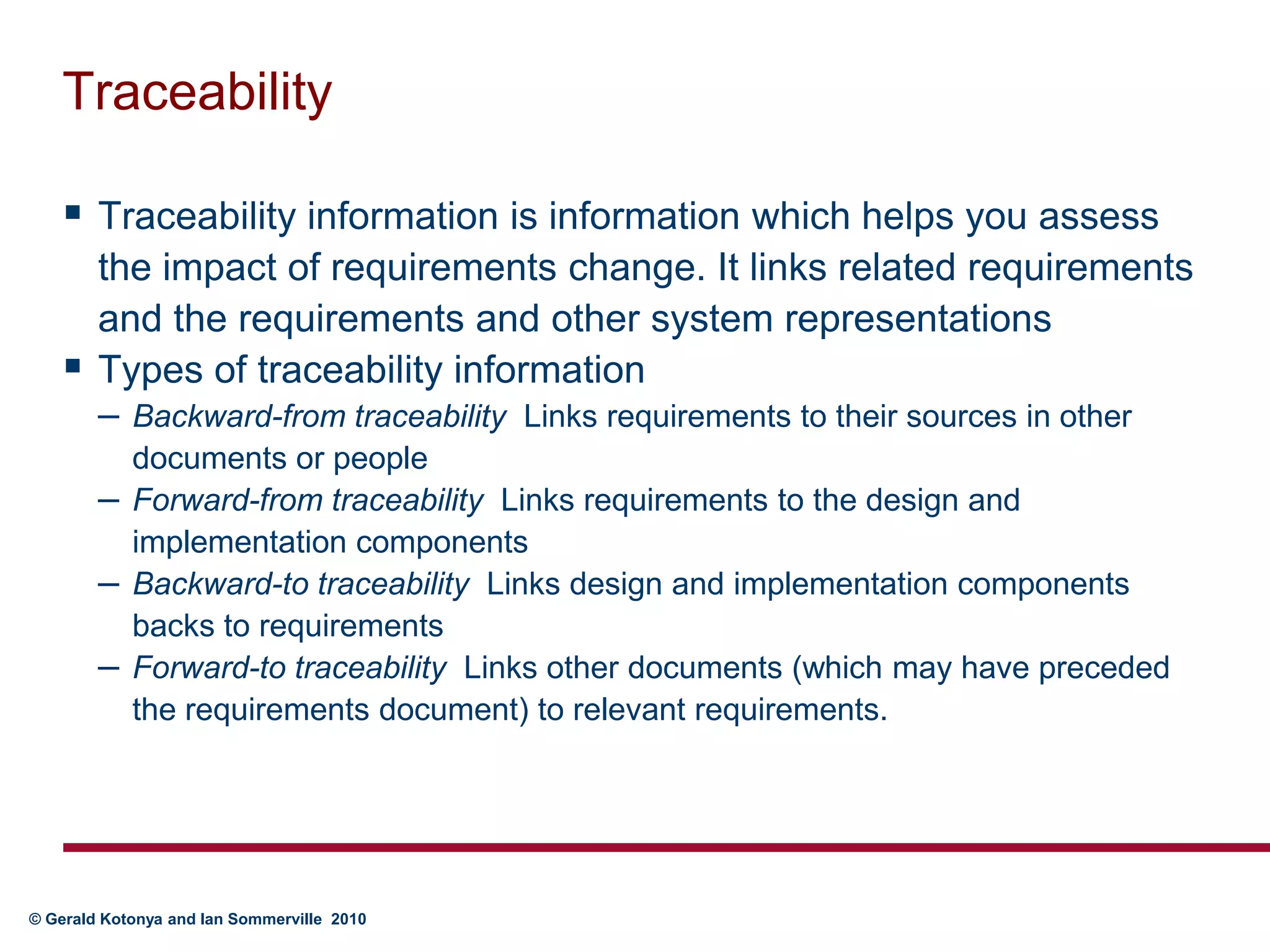
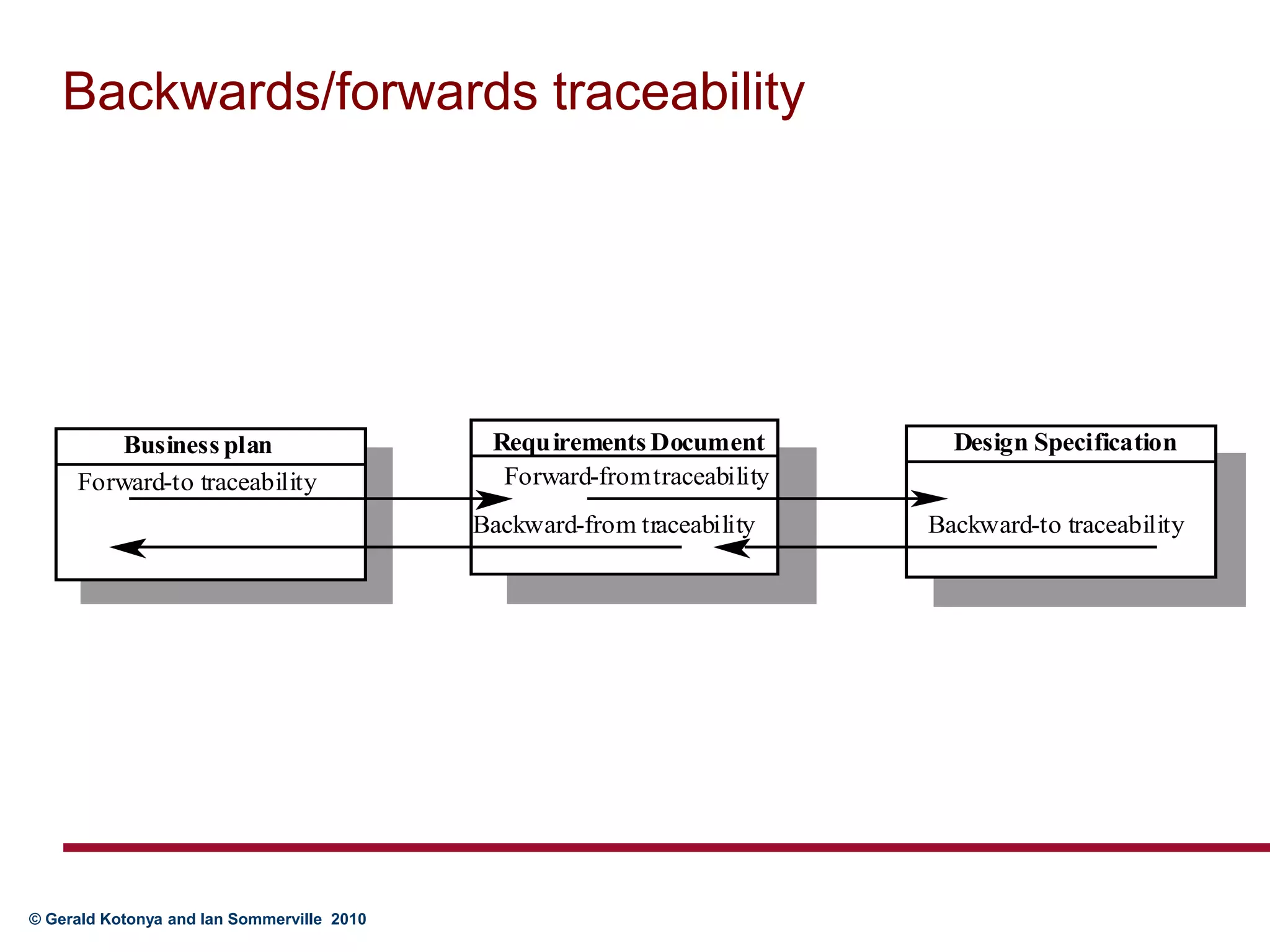
TraceabilityTraceability information is information which helps you assess the impact of requirements change. It links related requirements and the requirements and other system representationsTypes of traceability informationBackward-from traceability  Links requirements to their sources in other documents or peopleForward-from traceability  Links requirements to the design and implementation componentsBackward-to traceability  Links design and implementation components backs to requirementsForward-to traceability  Links other documents (which may have preceded the requirements document) to relevant requirements.
Backwards/forwards traceability
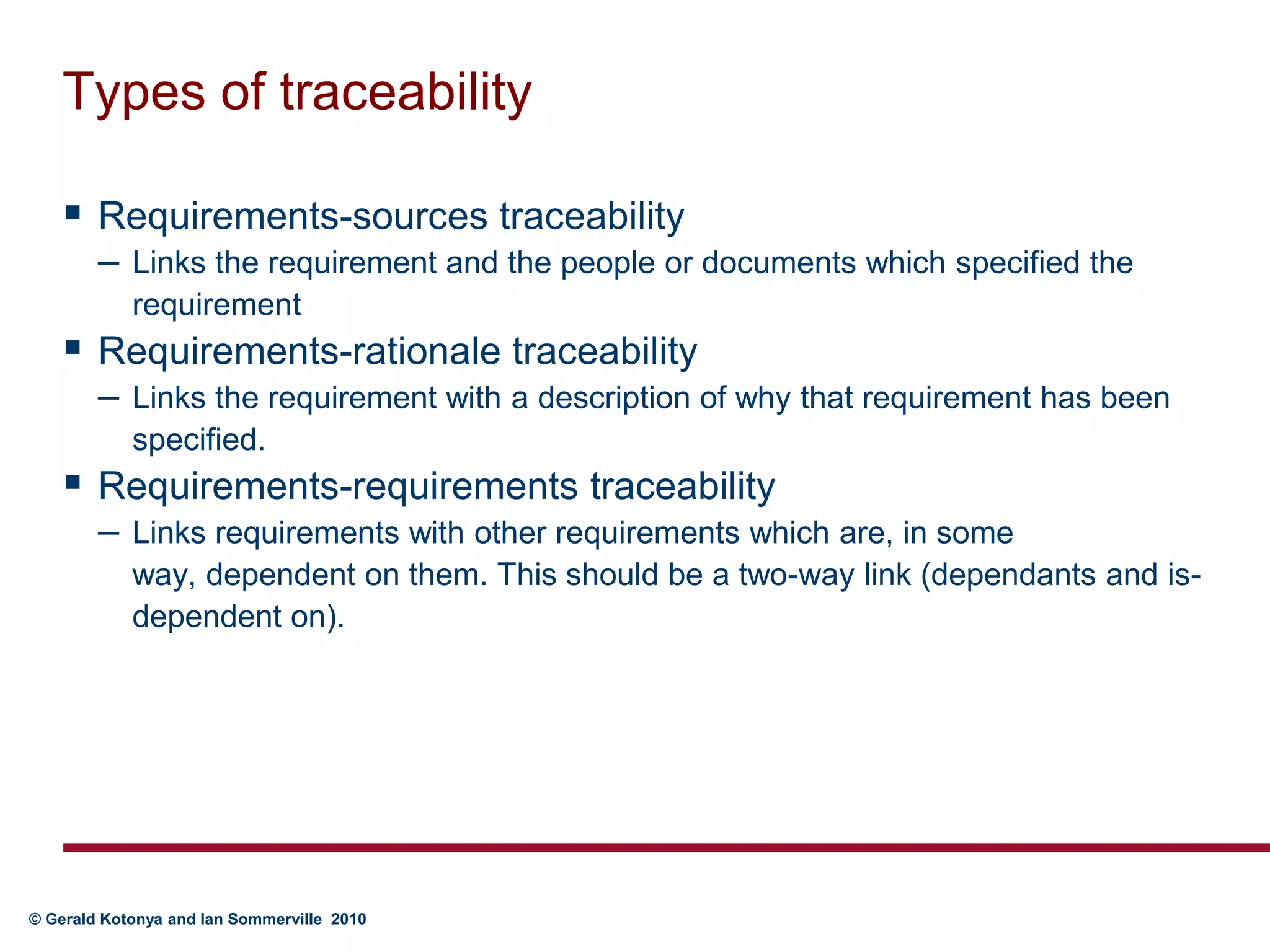
Types of traceabilityRequirements-sources traceabilityLinks the requirement and the people or documents which specified the requirementRequirements-rationale traceabilityLinks the requirement with a description of why that requirement has been specified.Requirements-requirements traceabilityLinks requirements with other requirements which are, in some way, dependent on them. This should be a two-way link (dependants and is-dependent on).
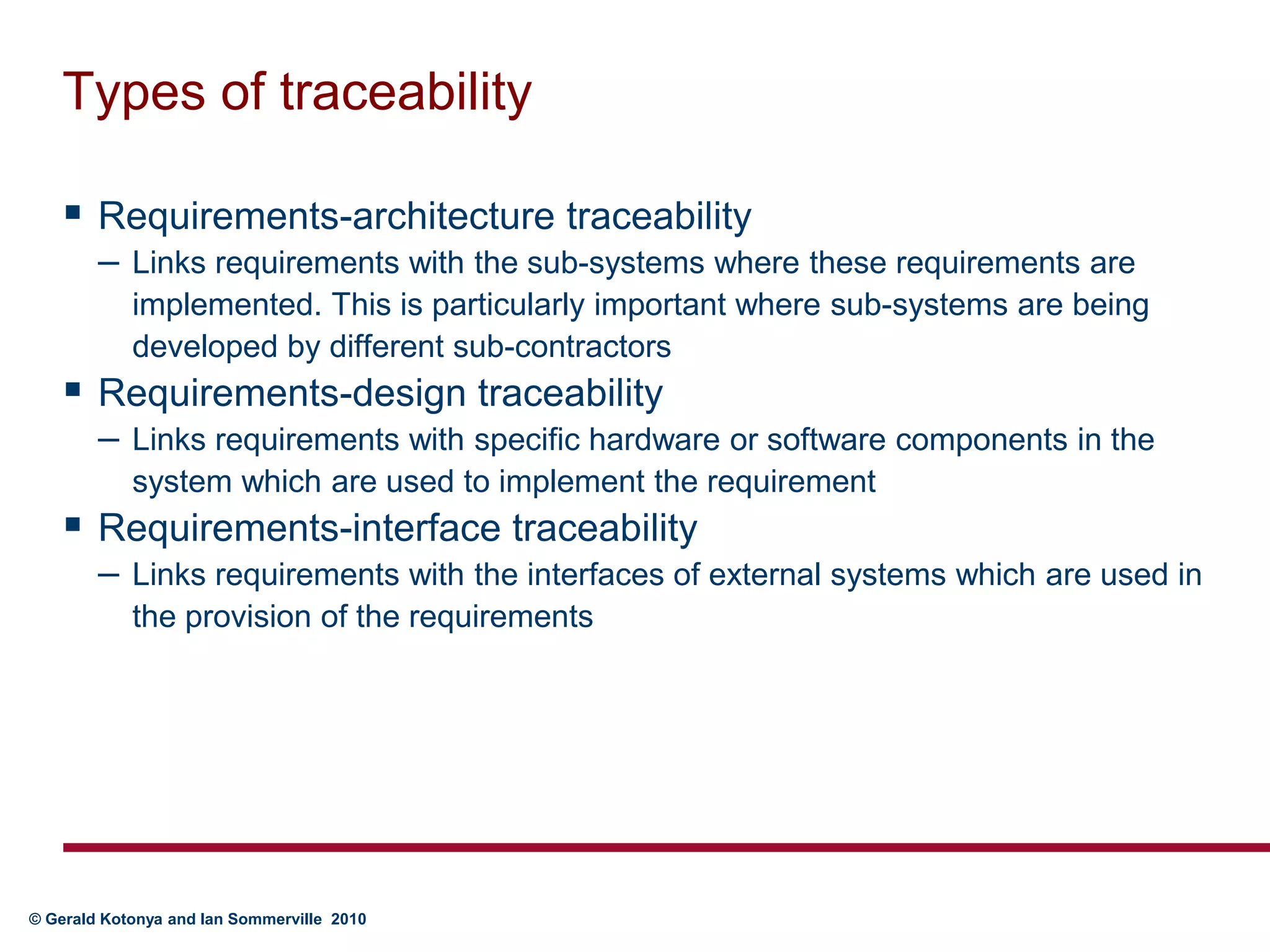
Types of traceabilityRequirements-architecture traceabilityLinks requirements with the sub-systems where these requirements are implemented. This is particularly important where sub-systems are being developed by different sub-contractorsRequirements-design traceabilityLinks requirements with specific hardware or software components in the system which are used to implement the requirementRequirements-interface traceabilityLinks requirements with the interfaces of external systems which are used in the provision of the requirements
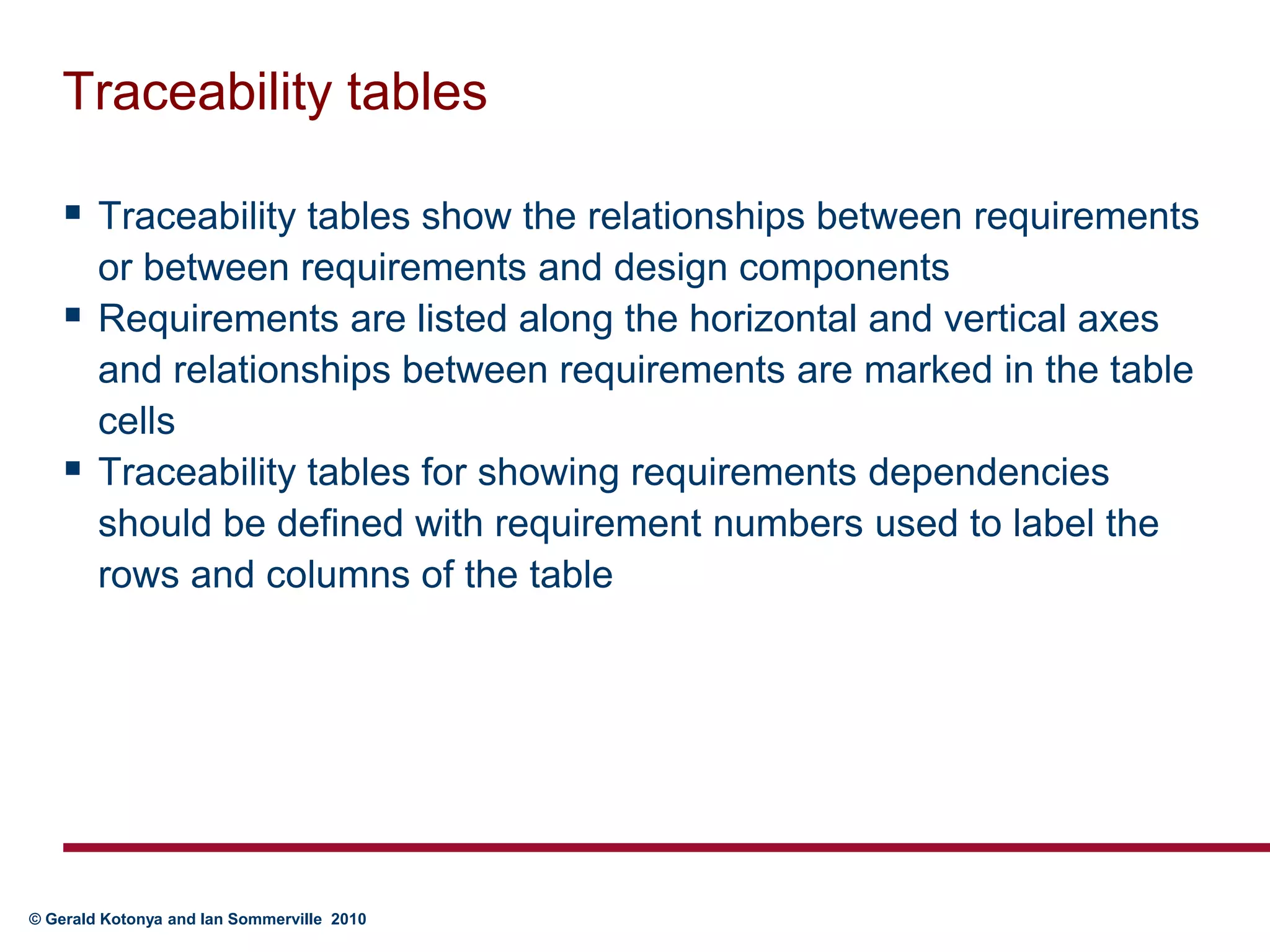
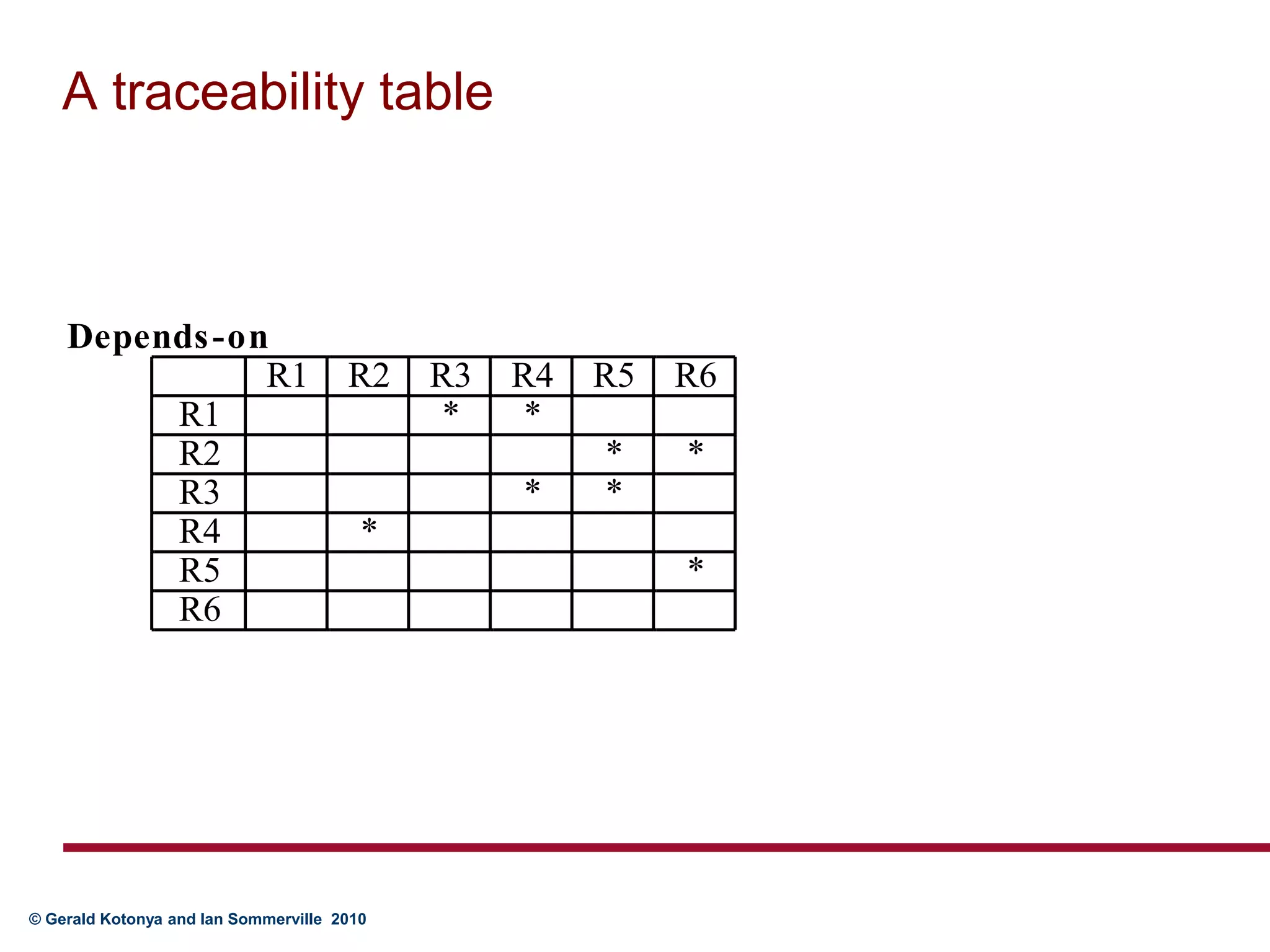
Traceability tablesTraceability tables show the relationships between requirements or between requirements and design componentsRequirements are listed along the horizontal and vertical axes and relationships between requirements are marked in the table cellsTraceability tables for showing requirements dependencies should be defined with requirement numbers used to label the rows and columns of the table
A traceability table
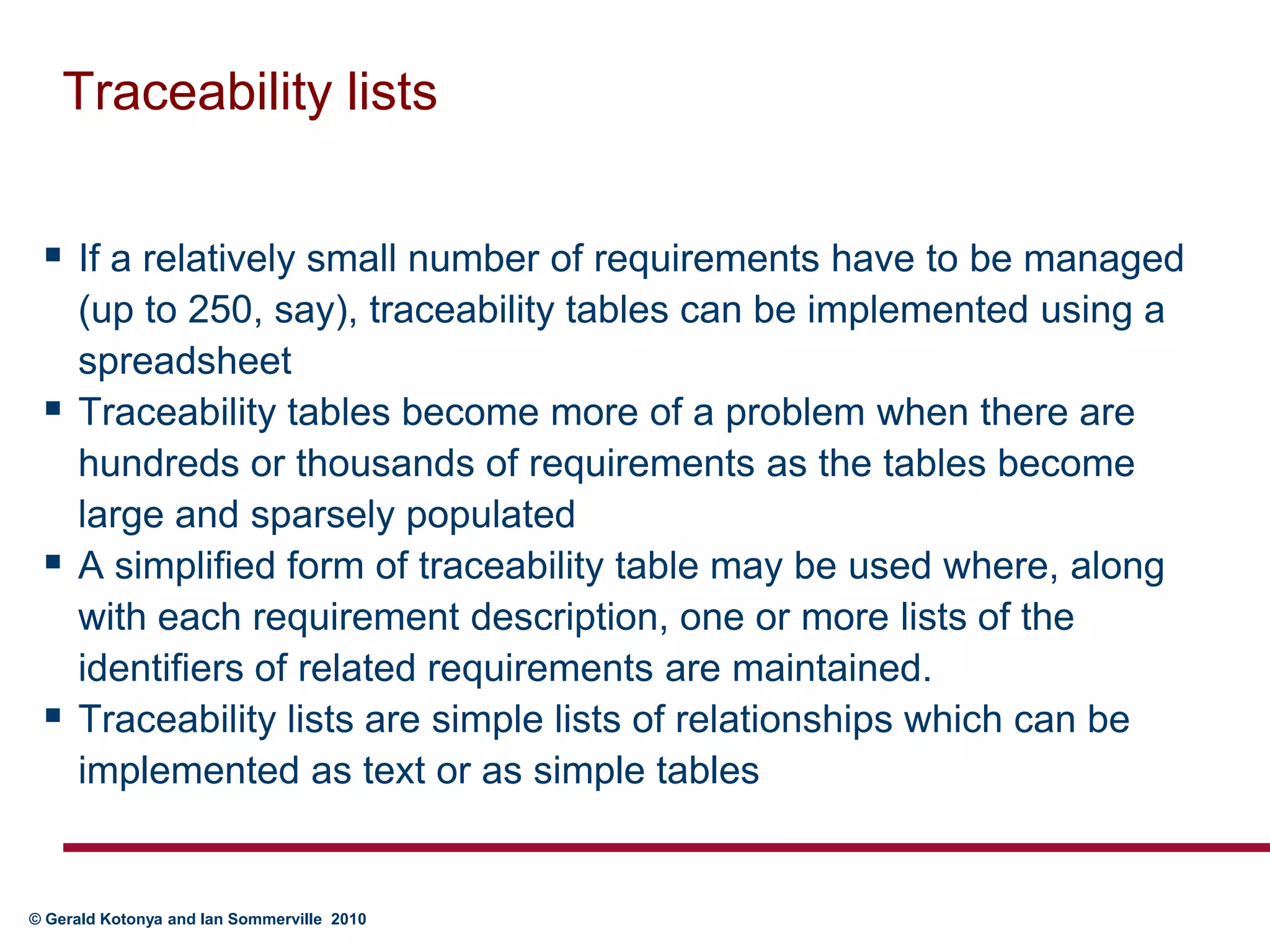
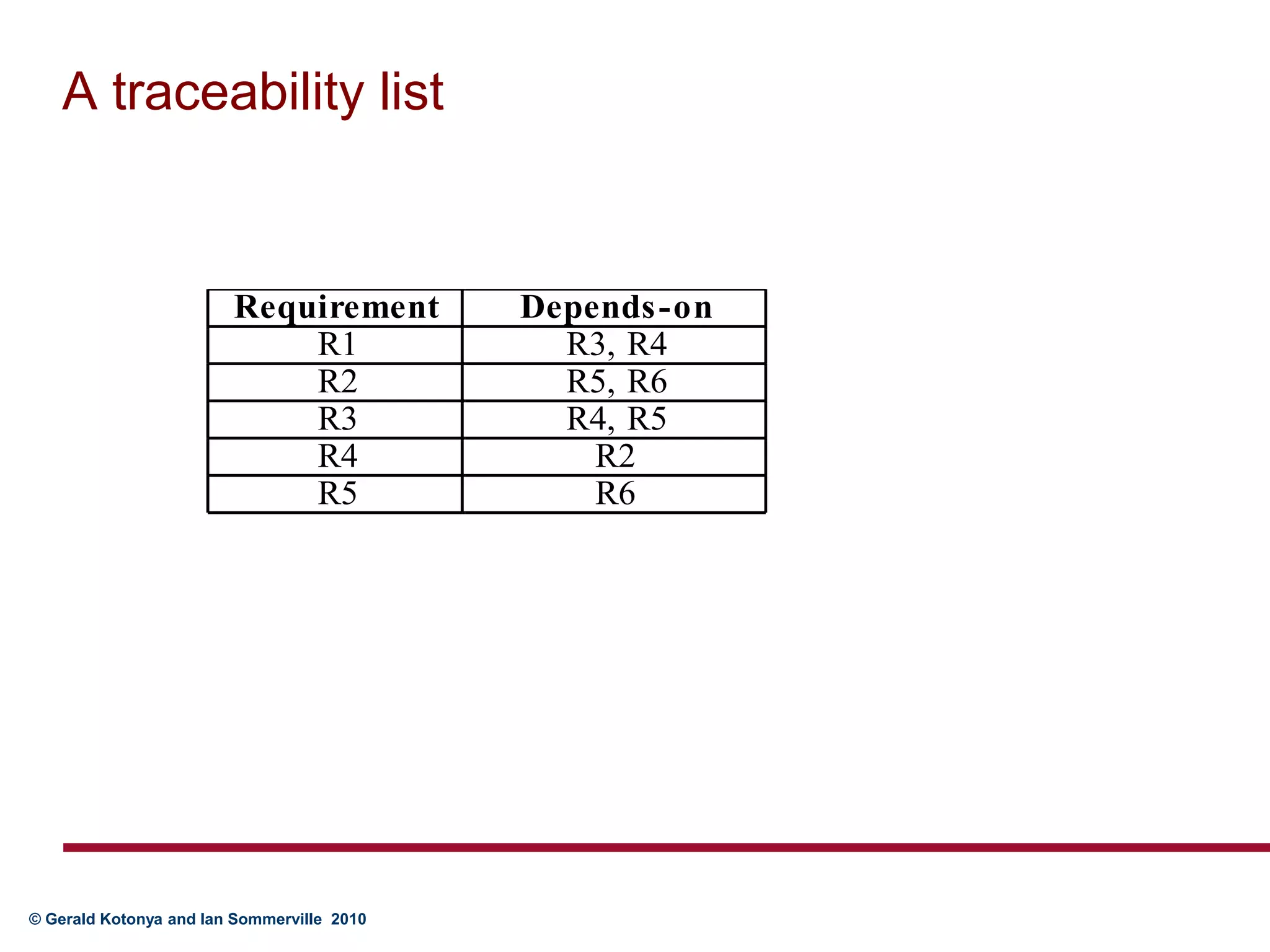
Traceability listsIf a relatively small number of requirements have to be managed (up to 250, say), traceability tables can be implemented using a spreadsheetTraceability tables become more of a problem when there are hundreds or thousands of requirements as the tables become large and sparsely populatedA simplified form of traceability table may be used where, along with each requirement description, one or more lists of the identifiers of related requirements are maintained. Traceability lists are simple lists of relationships which can be implemented as text or as simple tables
A traceability list
Traceability policiesTraceability policies define what and how traceability information should be maintained. Traceability policies may includeThe traceability information which should be maintained.    Techniques, such as traceability matrices, which should be used for maintaining traceability. A description of when the traceability information should be collected during the requirements engineering and system development processes. The roles of the people, such as the traceability manager, who are responsible for maintaining the traceability information should also be defined.A description of how to handle and document policy exceptionsThe process of managing traceability information
Factors influencing traceability policiesNumber of requirements The greater the number of requirements, the more the need for formal traceability policies.Estimated system lifetimeMore comprehensive traceability policies should be defined for systems which have a long lifetime.Level of organisational maturityDetailed traceability policies are most likely to be cost-effective in organisations which have a higher level of process maturity
Factors influencing traceability policiesProject team size and composition With a small team, it may be possible to assess the impact of proposed informally without structured traceability information. With larger teams, however, you need more formal traceability policies.Type of systemCritical systems such as hard real-time control systems or safety-critical systems need more comprehensive traceability policies than non-critical systems. Specific customer requirementsSome customers may specify that specific traceability information should be delivered as part of the system documentation.
Key pointsRequirements change is inevitable as customers develop a better understanding of their real needs and as the political, organisational and technical environment in which a system is to be installed changes.Requirements which are concerned with the essence of a system are more likely to be stable than requirements which are more concerned with how the system is implemented in a particular environment. Types of volatile requirement include mutable requirements, emergent requirements, consequential requirements and compatibility requirements.Requirements management requires that each requirement should be uniquely identified. If a large number of requirements have to be managed, the requirements should be stored in a database and links between related requirements should be maintained.
Key pointsChange management policies should define the processes used for change management and the information which should be associated with each change request. They should also define who is responsible for doing what in the change management process.Some automated support for change management should be provided. This may come through specialised requirements management tools or by configuring existing tools to support change managementTraceability information records the dependencies between requirements and the sources of these requirements, dependencies between requirements and dependencies between the requirements and the system implementation.  Traceability matrices may be used to record traceability information.Collecting and maintaining traceability information is expensive. To help control these costs, organisations should define a set of traceability policies which set out what information is to be collected and how it is to be maintained.

Chap5 RE management

  • 1.
  • 2.
    Requirements managementThe processof managing change to the requirements for a systemThe principal concerns of requirements management are:Managing changes to agreed requirementsManaging the relationships between requirementsManaging the dependencies between the requirements document and other documents produced in the systems engineering processRequirements cannot be managed effectively without requirements traceability. A requirement is traceable if you can discover who suggested the requirement, why the requirement exists, what requirements are related to it and how that requirement relates to other information such as systems designs, implementations and user documentation.
  • 3.
    CASE tools forrequirements managementRequirements management involves the collection, storage and maintenance of large amounts of informationThere are now a number of CASE tools available which are specifically designed to support requirements managementOther CASE tools such as configuration management systems may be adapted for requirements engineering
  • 4.
    Requirements management toolsupportA database system for storing requirements.Document analysis and generation facilities to help construct a requirements database and to help create requirements documents.Change management facilities which help ensure that changes are properly assessed and costed.Traceability facilities which help requirements engineers find dependencies between system requirements.
  • 5.
  • 6.
    Stable and volatilerequirementsRequirements changes occur while the requirements are being elicited, analysed and validated and after the system has gone into serviceSome requirements are usually more subject to change than othersStable requirements are concerned with the essence of a system and its application domain. They change more slowly than volatile requirements. Volatile requirements are specific to the instantiation of the system in a particular environment and for a particular customer.
  • 7.
    Requirements change factorsRequirementserrors, conflicts and inconsistenciesAs requirements are analysed and implemented, errors and inconsistencies emerge and must be corrected. These may be discovered during requirements analysis and validation or later in the development process.Evolving customer/end-user knowledge of the systemAs requirements are developed, customers and end-users develop a better understanding of what they really require from a system.Technical, schedule or cost problems Problems may be encountered in implementing a requirement. It may be too expensive or take too long to implement certain requirements.
  • 8.
    Requirements change factorsChangingcustomer priorities Customer priorities change during system development as a result of a changing business environment, the emergence of new competitors, staff changes, etc.Environmental changes The environment in which the system is to be installed may change so that the system requirements have to change to maintain compatibilityOrganisational changes The organisation which intends to use the system may change its structure and processes resulting in new system requirements
  • 9.
    Types of volatilerequirementMutable requirements These are requirements which change because of changes to the environment in which the system is operatingEmergent requirements These are requirements which cannot be completely defined when the system is specified but which emerge as the system is designed and implementedConsequential requirements These are requirements which are based on assumptions about how the system will be used. When the system is put into use, some of these assumptions will be wrong.Compatibility requirements These are requirements which depend on other equipment or processes.
  • 10.
    Requirements identificationIt isessential for requirements management that every requirement should have a unique identificationThe most common approach is requirements numbering based on chapter/section in the requirements documentProblems with this are:Numbers cannot be unambiguously assigned until the document is completeAssigning chapter/section numbers is an implicit classification of the requirement. This can mislead readers of the document into thinking that the most important relationships are with requirements in the same section
  • 11.
    Requirements identification techniquesDynamicrenumberingSome word processing systems allow for automatic renumbering of paragraphs and the inclusion of cross-references. As you re-organise your document and add new requirements, the system keeps track of the cross-reference and automatically renumbers your requirement depending on its chapter, section and position within the sectionDatabase record identificationWhen a requirement is identified it is entered in a requirements database and a database record identifier is assigned. This database identifier is used in all subsequent references to the requirementSymbolic identificationRequirements can be identified by giving them a symbolic name which is associated with the requirement itself. For example, EFF-1, EFF-2, EFF-3 may be used for requirements which relate to system efficiency
  • 12.
    Storing requirementsRequirements haveto be stored in such a way that they can be accessed easily and related to other system requirementsPossible storage techniques areIn one or more word processor files - requirements are stored in the requirements documentIn a specially designed requirements database
  • 13.
    Word processor documentsAdvantagesRequirementsare all stored in the same placeRequirements may be accessed by anyone with the right word processorIt is easy to produce the final requirements documentDisadvantagesRequirements dependencies must be externally maintainedSearch facilities are limitedNot possible to link requirements with proposed requirements changesNot possible to have version control on individual requirementsNo automated navigation from one requirement to another
  • 14.
    Requirements databaseEach requirementis represented as one or more database entitiesDatabase query language is used to access requirementsAdvantagesGood query and navigation facilitiesSupport for change and version managementDisadvantagesReaders may not have the software/skills to access the requirements databaseThe link between the database and the requirements document must be maintained
  • 15.
    Object classes forrequirements DB
  • 16.
    Requirements DB -choice factorsThe statement of requirementsIf there is a need to store more than just simple text, a database with multimedia capabilities may have to be used.The number of requirementsLarger systems usually need a database which is designed to manage a very large volume of data running on a specialised database server.Teamwork, team distribution and computer supportIf the requirements are developed by a distributed team of people, perhaps from different organisations, you need a database which provides for remote, multi-site access.
  • 17.
    Database choice factorsCASEtool useThe database should be the same as or compatible with CASE tool databases. However, this can be a problem with some CASE tools which use their own proprietary databaseExisting database usageIf a database for software engineering support is already in use, this should be used for requirements management.
  • 18.
    Change managementChange managementis concerned with the procedures, processes and standards which are used to manage changes to system requirementsChange management policies may cover:The change request process and the information required to process each change requestThe process used to analyse the impact and costs of change and the associated traceability informationThe membership of the body which formally considers change requests4. The software support (if any) for the change control process
  • 19.
    The change managementprocessSome requirements problem is identified. This could come from an analysis of the requirements, new customer needs, or operational problems with the system. The requirements are analysed using problem information and requirements changes are proposed.The proposed changes are analysed This checks how many requirements (and, if necessary, system components) are affected by the change and roughly how much it would cost, in both time and money, to make the change.The change is implemented. A set of amendments to the requirements document or a new document version is produced. This should, of course, be validated using whatever normal quality checking procedures are used.
  • 20.
  • 21.
  • 22.
    Change analysis activitiesThechange request is checked for validity. Customers can misunderstand requirements and suggest unnecessary changes.The requirements which are directly affected by the change are discovered.Traceability information is used to find dependent requirements affected by the change.The actual changes which must be made to the requirements are proposed. The costs of making the changes are estimated. Negotiations with customers are held to check if the costs of the proposed changes are acceptable.
  • 23.
    Change request rejectionIfthe change request is invalid. This normally arises if a customer has misunderstood something about the requirements and proposed a change which isn’t necessary.If the change request results in consequential changes which are unacceptable to the user. If the cost of implementing the change is too high or takes too long.
  • 24.
    Change processingProposed changesare usually recorded on a change request form which is then passed to all of the people involved in the analysis of the changeChange request forms may includefields to document the change analysisdata fields responsibility fieldsstatus fieldcomments field
  • 25.
    Tool support forchange managementMay be provided through requirements management tools or through configuration management toolsTool facilities may includeElectronic change request forms which are filled in by different participants in the process.A database to store and manage these forms.A change model which may be instantiated so that people responsible for one stage of the process know who is responsible for the next process activity.Electronic transfer of forms between people with different responsibilities and electronic mail notification when activities have been completed.In some cases, direct links to a requirements database.
  • 26.
    TraceabilityTraceability information isinformation which helps you assess the impact of requirements change. It links related requirements and the requirements and other system representationsTypes of traceability informationBackward-from traceability Links requirements to their sources in other documents or peopleForward-from traceability Links requirements to the design and implementation componentsBackward-to traceability Links design and implementation components backs to requirementsForward-to traceability Links other documents (which may have preceded the requirements document) to relevant requirements.
  • 27.
  • 28.
    Types of traceabilityRequirements-sourcestraceabilityLinks the requirement and the people or documents which specified the requirementRequirements-rationale traceabilityLinks the requirement with a description of why that requirement has been specified.Requirements-requirements traceabilityLinks requirements with other requirements which are, in some way, dependent on them. This should be a two-way link (dependants and is-dependent on).
  • 29.
    Types of traceabilityRequirements-architecturetraceabilityLinks requirements with the sub-systems where these requirements are implemented. This is particularly important where sub-systems are being developed by different sub-contractorsRequirements-design traceabilityLinks requirements with specific hardware or software components in the system which are used to implement the requirementRequirements-interface traceabilityLinks requirements with the interfaces of external systems which are used in the provision of the requirements
  • 30.
    Traceability tablesTraceability tablesshow the relationships between requirements or between requirements and design componentsRequirements are listed along the horizontal and vertical axes and relationships between requirements are marked in the table cellsTraceability tables for showing requirements dependencies should be defined with requirement numbers used to label the rows and columns of the table
  • 31.
  • 32.
    Traceability listsIf arelatively small number of requirements have to be managed (up to 250, say), traceability tables can be implemented using a spreadsheetTraceability tables become more of a problem when there are hundreds or thousands of requirements as the tables become large and sparsely populatedA simplified form of traceability table may be used where, along with each requirement description, one or more lists of the identifiers of related requirements are maintained. Traceability lists are simple lists of relationships which can be implemented as text or as simple tables
  • 33.
  • 34.
    Traceability policiesTraceability policiesdefine what and how traceability information should be maintained. Traceability policies may includeThe traceability information which should be maintained. Techniques, such as traceability matrices, which should be used for maintaining traceability. A description of when the traceability information should be collected during the requirements engineering and system development processes. The roles of the people, such as the traceability manager, who are responsible for maintaining the traceability information should also be defined.A description of how to handle and document policy exceptionsThe process of managing traceability information
  • 35.
    Factors influencing traceabilitypoliciesNumber of requirements The greater the number of requirements, the more the need for formal traceability policies.Estimated system lifetimeMore comprehensive traceability policies should be defined for systems which have a long lifetime.Level of organisational maturityDetailed traceability policies are most likely to be cost-effective in organisations which have a higher level of process maturity
  • 36.
    Factors influencing traceabilitypoliciesProject team size and composition With a small team, it may be possible to assess the impact of proposed informally without structured traceability information. With larger teams, however, you need more formal traceability policies.Type of systemCritical systems such as hard real-time control systems or safety-critical systems need more comprehensive traceability policies than non-critical systems. Specific customer requirementsSome customers may specify that specific traceability information should be delivered as part of the system documentation.
  • 37.
    Key pointsRequirements changeis inevitable as customers develop a better understanding of their real needs and as the political, organisational and technical environment in which a system is to be installed changes.Requirements which are concerned with the essence of a system are more likely to be stable than requirements which are more concerned with how the system is implemented in a particular environment. Types of volatile requirement include mutable requirements, emergent requirements, consequential requirements and compatibility requirements.Requirements management requires that each requirement should be uniquely identified. If a large number of requirements have to be managed, the requirements should be stored in a database and links between related requirements should be maintained.
  • 38.
    Key pointsChange managementpolicies should define the processes used for change management and the information which should be associated with each change request. They should also define who is responsible for doing what in the change management process.Some automated support for change management should be provided. This may come through specialised requirements management tools or by configuring existing tools to support change managementTraceability information records the dependencies between requirements and the sources of these requirements, dependencies between requirements and dependencies between the requirements and the system implementation. Traceability matrices may be used to record traceability information.Collecting and maintaining traceability information is expensive. To help control these costs, organisations should define a set of traceability policies which set out what information is to be collected and how it is to be maintained.