Requirements Engineering Processes
Objectives	To introduce the notion of processes and process models for requirements engineeringTo explain the critical role of people in requirements engineering processesTo explain why process improvements is important and to suggest a process improvement model for requirements engineering
ProcessesA process is an organised set of activities which transforms inputs to outputsProcess descriptions encapsulate knowledge and allow it to be reusedExamples of process descriptionsInstruction manual for a dishwasherCookery bookProcedures manual for a bankQuality manual for software development
Design processesProcesses which involve creativity, interactions between a wide range of different people, engineering judgement and background knowledge and experienceExamples of design processesWriting a bookOrganising a conferenceDesigning a processor chipRequirements engineering
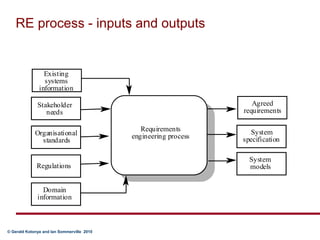
RE process - inputs and outputs
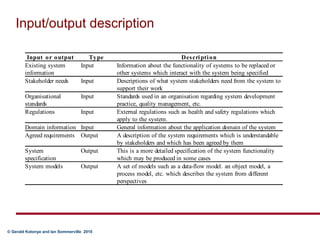
Input/output description
RE process variabilityRE processes  vary radically from one organisation to anotherFactors contributing to this variability includeTechnical maturityDisciplinary involvementOrganisational cultureApplication domainThere is therefore no ‘ideal’ requirements engineering process
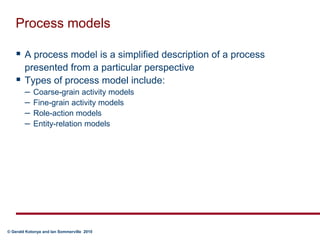
Process modelsA process model is a simplified description of a process presented from a particular perspectiveTypes of process model include:Coarse-grain activity modelsFine-grain activity modelsRole-action modelsEntity-relation models
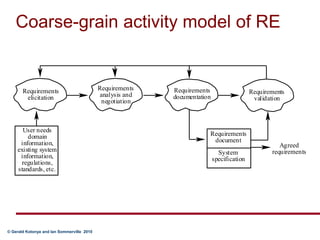
Coarse-grain activity model of RE
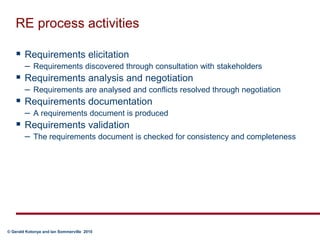
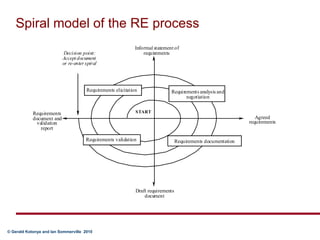
RE process activitiesRequirements elicitationRequirements discovered through consultation with stakeholdersRequirements analysis and negotiationRequirements are analysed and conflicts resolved through negotiationRequirements documentationA requirements document is producedRequirements validationThe requirements document is checked for consistency and completeness
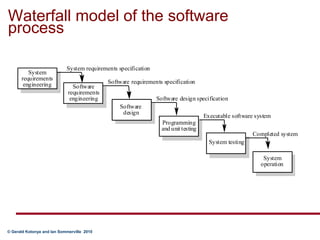
Waterfall model of the software process
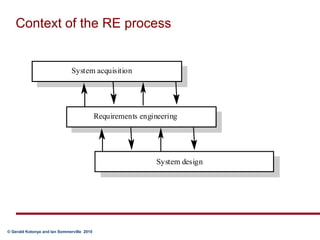
Context of the RE process
Spiral model of the RE process
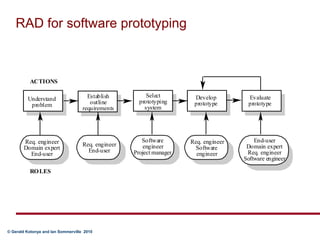
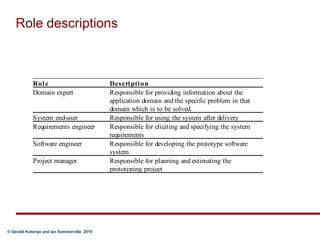
Actors in the RE processActors in a process are the people involved in the execution of that processActors are normally identified by their roles rather than individuallyRequirements engineering involves actors who are primarily interested in the problem to be solved (end-users, etc) as well actors interested in the solution (system designers, etc.)Role-action diagrams document which actors are involved in different activities
RAD for software prototyping
Role descriptions
Human and social factorsRequirements engineering processes are dominated by human, social and organisational factors because they always involve a range of stakeholders from different backgrounds and with different individual and organisational goals.System stakeholders may come from a range of technical and non-technical background and from different disciplines
Types of stakeholderSoftware engineers responsible for system developmentSystem end-users who will use the system after it has been deliveredManagers of system end-users who are responsible for their workExternal regulators who check that the system meets its legal requirementsDomain experts who give essential background information about the system application domain
Factors influencing requirementsPersonality and status of stakeholdersThe personal goals of individuals within an organisationThe degree of political influence of stakeholders within an organisation
Process supportCASE tools provide automated support for software engineering processesThe most mature CASE tools support well-understood activities such as programming and testing and the use of structured methodsSupport for requirements engineering is still limited because of the informality and the variability of the process
CASE tools for REModelling and validation  tools support the development of system models which can be used to specify the system and the checking of these models for completeness and consistency. The tool package which supports this book includes this type of tool.Management tools help manage a database of requirements and support the management of changes to these requirements.
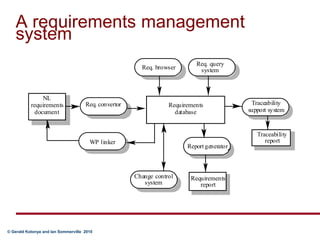
A requirements management system
Requirements management toolsRequirements browserRequirements query systemTraceability support systemReport generatorRequirements converter and word processor linkerChange control system
Process improvementProcess improvement is concerned with modifying processes in order to meet some improvement objectivesImprovement objectivesQuality improvementSchedule reductionResource reduction
Planning process improvementWhat are the problems with current processes?What are the improvement goals?How can process improvement be introduced to achieve these goals?How should process improvements be controlled and managed?
RE process problemsLack of stakeholder involvementBusiness needs not consideredLack of requirements managementLack of defined responsibilitiesStakeholder communication problemsOver-long schedules and poor quality requirements documents
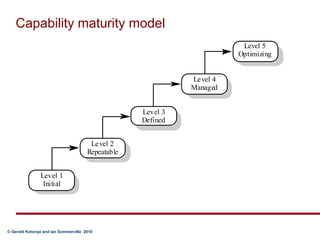
Process maturityProcess maturity can be thought of as the extent that an organisation has defined its processes, actively controls these processes and provides systematic human and computer-based support for them.The SEI’s Capability Maturity Model is a framework for assessing software process maturity in development organisations
Capability maturity model
Maturity levelsInitial level Organisations have an undisciplined process and it is left to individuals how to manage the process and which development techniques to use.Repeatable level Organisations have basic cost and schedule management procedures in place. They are likely to be able to make consistent budget and schedule predictions for projects in the same application area.Defined level The software process for both management and engineering activities is documented, standardized and integrated into a standard software process for the organisation.
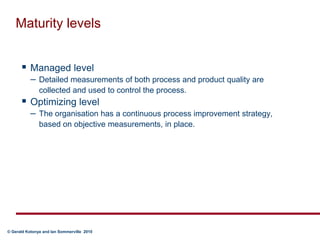
Maturity levelsManaged level Detailed measurements of both process and product quality are collected and used to control the process.Optimizing level The organisation has a continuous process improvement strategy, based on objective measurements, in place.
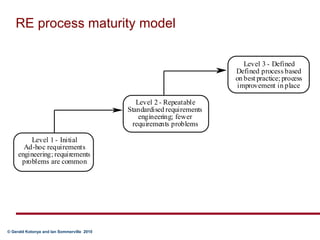
RE process maturity model
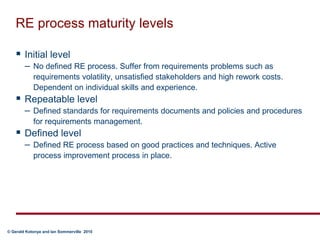
RE process maturity levelsInitial levelNo defined RE process. Suffer from requirements problems such as requirements volatility, unsatisfied stakeholders and high rework costs. Dependent on individual skills and experience.Repeatable levelDefined standards for requirements documents and policies and procedures for requirements management.Defined levelDefined RE process based on good practices and techniques. Active process improvement process in place.
Good practice for RE process improvementRE processes can be improved by the systematic introduction of good requirements engineering practiceEach improvement cycle identifies good practice guidelines and works to introduce them in an organisation
Examples of good practice guidelinesDefine a standard document structureUniquely identify each requirementDefine policies for requirements managementUse checklists for requirements analysisUse scenarios to elicit requirementsSpecify requirements quantitativelyUse prototyping to animate requirementsReuse requirements
Key pointsThe requirements engineering process is a structured set of activities which lead to the production of a requirements document.Inputs to the requirements engineering process are information about existing systems, stakeholder needs, organisational standards, regulations and domain information.Requirements engineering processes vary radically from one organisation to another. Most processes include requirements elicitation, requirements analysis and negotiation and requirements validation.
Key pointsRequirements engineering process models are simplified process description which are presented from a particular perspective.  Human, social and organisational factors are important influences on requirements engineering processes. Requirements engineering process improvement is difficult and is best tackled in an incremental way. Requirements engineering processes can be classified according to their degree of maturity.
Chap2 RE processes

  • 1.
  • 2.
    Objectives To introduce thenotion of processes and process models for requirements engineeringTo explain the critical role of people in requirements engineering processesTo explain why process improvements is important and to suggest a process improvement model for requirements engineering
  • 3.
    ProcessesA process isan organised set of activities which transforms inputs to outputsProcess descriptions encapsulate knowledge and allow it to be reusedExamples of process descriptionsInstruction manual for a dishwasherCookery bookProcedures manual for a bankQuality manual for software development
  • 4.
    Design processesProcesses whichinvolve creativity, interactions between a wide range of different people, engineering judgement and background knowledge and experienceExamples of design processesWriting a bookOrganising a conferenceDesigning a processor chipRequirements engineering
  • 5.
    RE process -inputs and outputs
  • 6.
  • 7.
    RE process variabilityREprocesses vary radically from one organisation to anotherFactors contributing to this variability includeTechnical maturityDisciplinary involvementOrganisational cultureApplication domainThere is therefore no ‘ideal’ requirements engineering process
  • 8.
    Process modelsA processmodel is a simplified description of a process presented from a particular perspectiveTypes of process model include:Coarse-grain activity modelsFine-grain activity modelsRole-action modelsEntity-relation models
  • 9.
  • 10.
    RE process activitiesRequirementselicitationRequirements discovered through consultation with stakeholdersRequirements analysis and negotiationRequirements are analysed and conflicts resolved through negotiationRequirements documentationA requirements document is producedRequirements validationThe requirements document is checked for consistency and completeness
  • 11.
    Waterfall model ofthe software process
  • 12.
    Context of theRE process
  • 13.
    Spiral model ofthe RE process
  • 14.
    Actors in theRE processActors in a process are the people involved in the execution of that processActors are normally identified by their roles rather than individuallyRequirements engineering involves actors who are primarily interested in the problem to be solved (end-users, etc) as well actors interested in the solution (system designers, etc.)Role-action diagrams document which actors are involved in different activities
  • 15.
    RAD for softwareprototyping
  • 16.
  • 17.
    Human and socialfactorsRequirements engineering processes are dominated by human, social and organisational factors because they always involve a range of stakeholders from different backgrounds and with different individual and organisational goals.System stakeholders may come from a range of technical and non-technical background and from different disciplines
  • 18.
    Types of stakeholderSoftwareengineers responsible for system developmentSystem end-users who will use the system after it has been deliveredManagers of system end-users who are responsible for their workExternal regulators who check that the system meets its legal requirementsDomain experts who give essential background information about the system application domain
  • 19.
    Factors influencing requirementsPersonalityand status of stakeholdersThe personal goals of individuals within an organisationThe degree of political influence of stakeholders within an organisation
  • 20.
    Process supportCASE toolsprovide automated support for software engineering processesThe most mature CASE tools support well-understood activities such as programming and testing and the use of structured methodsSupport for requirements engineering is still limited because of the informality and the variability of the process
  • 21.
    CASE tools forREModelling and validation tools support the development of system models which can be used to specify the system and the checking of these models for completeness and consistency. The tool package which supports this book includes this type of tool.Management tools help manage a database of requirements and support the management of changes to these requirements.
  • 22.
  • 23.
    Requirements management toolsRequirementsbrowserRequirements query systemTraceability support systemReport generatorRequirements converter and word processor linkerChange control system
  • 24.
    Process improvementProcess improvementis concerned with modifying processes in order to meet some improvement objectivesImprovement objectivesQuality improvementSchedule reductionResource reduction
  • 25.
    Planning process improvementWhatare the problems with current processes?What are the improvement goals?How can process improvement be introduced to achieve these goals?How should process improvements be controlled and managed?
  • 26.
    RE process problemsLackof stakeholder involvementBusiness needs not consideredLack of requirements managementLack of defined responsibilitiesStakeholder communication problemsOver-long schedules and poor quality requirements documents
  • 27.
    Process maturityProcess maturitycan be thought of as the extent that an organisation has defined its processes, actively controls these processes and provides systematic human and computer-based support for them.The SEI’s Capability Maturity Model is a framework for assessing software process maturity in development organisations
  • 28.
  • 29.
    Maturity levelsInitial levelOrganisations have an undisciplined process and it is left to individuals how to manage the process and which development techniques to use.Repeatable level Organisations have basic cost and schedule management procedures in place. They are likely to be able to make consistent budget and schedule predictions for projects in the same application area.Defined level The software process for both management and engineering activities is documented, standardized and integrated into a standard software process for the organisation.
  • 30.
    Maturity levelsManaged levelDetailed measurements of both process and product quality are collected and used to control the process.Optimizing level The organisation has a continuous process improvement strategy, based on objective measurements, in place.
  • 31.
  • 32.
    RE process maturitylevelsInitial levelNo defined RE process. Suffer from requirements problems such as requirements volatility, unsatisfied stakeholders and high rework costs. Dependent on individual skills and experience.Repeatable levelDefined standards for requirements documents and policies and procedures for requirements management.Defined levelDefined RE process based on good practices and techniques. Active process improvement process in place.
  • 33.
    Good practice forRE process improvementRE processes can be improved by the systematic introduction of good requirements engineering practiceEach improvement cycle identifies good practice guidelines and works to introduce them in an organisation
  • 34.
    Examples of goodpractice guidelinesDefine a standard document structureUniquely identify each requirementDefine policies for requirements managementUse checklists for requirements analysisUse scenarios to elicit requirementsSpecify requirements quantitativelyUse prototyping to animate requirementsReuse requirements
  • 35.
    Key pointsThe requirementsengineering process is a structured set of activities which lead to the production of a requirements document.Inputs to the requirements engineering process are information about existing systems, stakeholder needs, organisational standards, regulations and domain information.Requirements engineering processes vary radically from one organisation to another. Most processes include requirements elicitation, requirements analysis and negotiation and requirements validation.
  • 36.
    Key pointsRequirements engineeringprocess models are simplified process description which are presented from a particular perspective. Human, social and organisational factors are important influences on requirements engineering processes. Requirements engineering process improvement is difficult and is best tackled in an incremental way. Requirements engineering processes can be classified according to their degree of maturity.