Chapter 17 Component-based software engineeringLecture 11Chapter 17 Software reuse
Topics coveredComponents and component models CBSE processesComponent composition2Chapter 17 Software reuse
Component-based developmentComponent-based software engineering (CBSE) is an approach to software development that relies on the reuse of entities called ‘software components’.It emerged from the failure of object-oriented development to support effective reuse. Single object classes are too detailed and specific.Components are more abstract than object classes and can be considered to be stand-alone service providers. They can exist as stand-alone entities.3Chapter 17 Software reuse
CBSE essentialsIndependent components specified by their interfaces.Component standards to facilitate component integration.Middleware that provides support for component inter-operability.A development process that is geared to reuse.4Chapter 17 Software reuse
CBSE and design principlesApart from the benefits of reuse, CBSE is based on sound software engineering design principles:Components are independent so do not interfere with each other;Component implementations are hidden;Communication is through well-defined interfaces;Component platforms are shared and reduce development costs.5Chapter 17 Software reuse
Component standardsStandards need to be established so that components can communicate with each other and inter-operate.Unfortunately, several competing component standards were established:Sun’s Enterprise Java BeansMicrosoft’s COM and .NETCORBA’s CCMIn practice, these multiple standards have hindered the uptake of CBSE. It is impossible for components developed using different approaches to work together. 6Chapter 17 Software reuse
CBSE problemsComponent trustworthiness - how can a component with no available source code be trusted?Component certification - who will certify the quality of components?Emergent property prediction - how can the emergent properties of component compositions be predicted?Requirements trade-offs - how do we do trade-off analysis between the features of one component and another?7Chapter 17 Software reuse
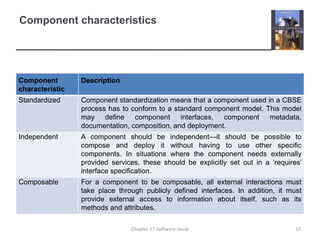
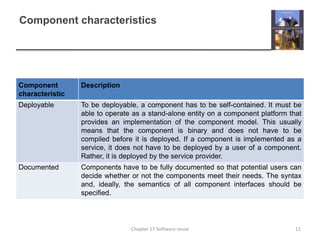
ComponentsComponents provide a service without regard to where the component is executing or its programming languageA component is an independent executable entity that can be made up of one or more executable objects;The component interface is published and all interactions are through the published interface;8Chapter 17 Software reuse
Component definitionsCouncill and Heinmann:A software component is a software element that conforms to a component model and can be independently deployed and composed without modification according to a composition standard.Szyperski:A software component is a unit of composition with contractually specified interfaces and explicit context dependencies only. A software component can be deployed independently and is subject to composition by third-parties.9Chapter 17 Software reuse
Component characteristics10Chapter 17 Software reuse
Component characteristics11Chapter 17 Software reuse
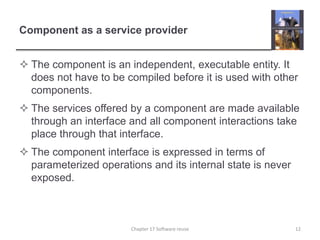
Component as a service providerThe component is an independent, executable entity. It does not have to be compiled before it is used with other components.The services offered by a component are made available through an interface and all component interactions take place through that interface.The component interface is expressed in terms of parameterized operations and its internal state is never exposed. 12Chapter 17 Software reuse
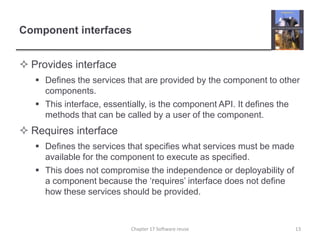
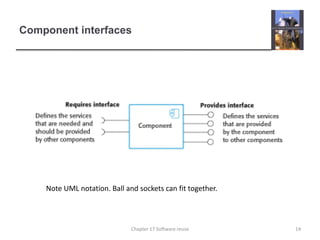
Component interfacesProvides interfaceDefines the services that are provided by the component to other components.This interface, essentially, is the component API. It defines the methods that can be called by a user of the component. Requires interfaceDefines the services that specifies what services must be made available for the component to execute as specified.This does not compromise the independence or deployability of a component because the ‘requires’ interface does not define how these services should be provided. 13Chapter 17 Software reuse
Component interfacesNote UML notation. Ball and sockets can fit together.14Chapter 17 Software reuse
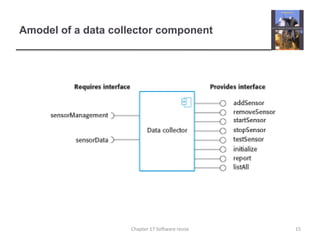
Amodel of a data collector component15Chapter 17 Software reuse
Component modelsA component model is a definition of standards for component implementation, documentation and deployment.Examples of component modelsEJB model (Enterprise Java Beans)COM+ model (.NET model)Corba Component ModelThe component model specifies how interfaces should be defined and the elements that should be included in an interface definition.16Chapter 17 Software reuse
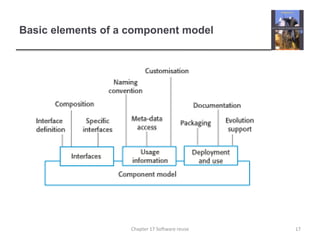
Basic elements of a component model17Chapter 17 Software reuse
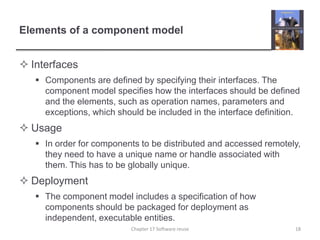
Elements of a component modelInterfacesComponents are defined by specifying their interfaces. The component model specifies how the interfaces should be defined and the elements, such as operation names, parameters and exceptions, which should be included in the interface definition.UsageIn order for components to be distributed and accessed remotely, they need to have a unique name or handle associated with them. This has to be globally unique.DeploymentThe component model includes a specification of how components should be packaged for deployment as independent, executable entities. 18Chapter 17 Software reuse
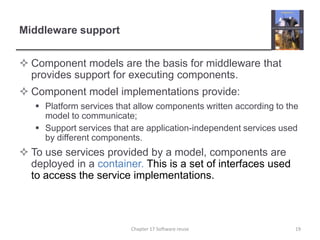
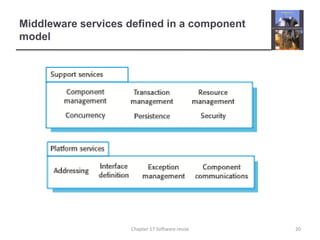
Middleware supportComponent models are the basis for middleware that provides support for executing components.Component model implementations provide:Platform services that allow components written according to the model to communicate;Support services that are application-independent services used by different components.To use services provided by a model, components are deployed in a container. This is a set of interfaces used to access the service implementations.19Chapter 17 Software reuse
Middleware services defined in a component model20Chapter 17 Software reuse
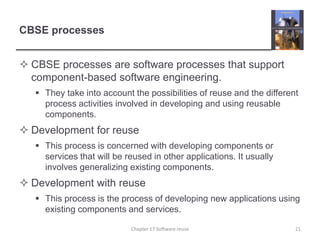
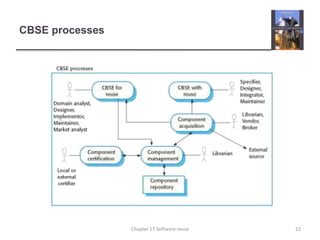
CBSE processesCBSE processes are software processes that support component-based software engineering.They take into account the possibilities of reuse and the different process activities involved in developing and using reusable components.Development for reuseThis process is concerned with developing components or services that will be reused in other applications. It usually involves generalizing existing components.Development with reuseThis process is the process of developing new applications using existing components and services.21Chapter 17 Software reuse
CBSE processes22Chapter 17 Software reuse
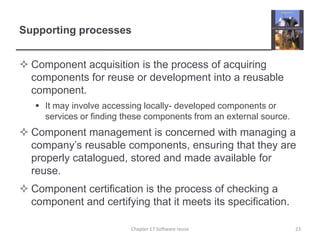
Supporting processesComponent acquisition is the process of acquiring components for reuse or development into a reusable component.It may involve accessing locally- developed components or services or finding these components from an external source.Component management is concerned with managing a company’s reusable components, ensuring that they are properly catalogued, stored and made available for reuse.Component certification is the process of checking a component and certifying that it meets its specification.Chapter 17 Software reuse23
Key pointsCBSE is a reuse-based approach to defining and implementing loosely coupled components into systems.A component is a software unit whose functionality and dependencies are completely defined by its interfaces.A component model defines a set of standards that component providers and composers should follow.The key CBSE processes are CBSE for reuse and CBSE with reuse.24Chapter 17 Software reuse
Chapter 17 Component-based software engineeringLecture 225Chapter 17 Software reuse
CBSE for reuseCBSE for reuse focuses on component development.Components developed for a specific application usually have to be generalised to make them reusable.A component is most likely to be reusable if it associated with a stable domain abstraction (business object). For example, in a hospital stable domain abstractions are associated with the fundamental purpose - nurses, patients, treatments, etc.26Chapter 17 Software reuse
Component development for reuseComponents for reuse may be specially constructed by generalising existing components.Component reusabilityShould reflect stable domain abstractions;Should hide state representation;Should be as independent as possible;Should publish exceptions through the component interface.There is a trade-off between reusability and usabilityThe more general the interface, the greater the reusability but it is then more complex and hence less usable.27Chapter 17 Software reuse
Changes for reusabilityRemove application-specific methods.Change names to make them general.Add methods to broaden coverage.Make exception handling consistent.Add a configuration interface for component adaptation.Integrate required components to reduce dependencies.28Chapter 17 Software reuse
Exception handlingComponents should not handle exceptions themselves, because each application will have its own requirements for exception handling.Rather, the component should define what exceptions can arise and should publish these as part of the interface.In practice, however, there are two problems with this:Publishing all exceptions leads to bloated interfaces that are harder to understand. This may put off potential users of the component.The operation of the component may depend on local exception handling, and changing this may have serious implications for the functionality of the component.Chapter 17 Software reuse29
Legacy system componentsExisting legacy systems that fulfil a useful business function can be re-packaged as components for reuse.This involves writing a wrapper component that implements provides and requires interfaces then accesses the legacy system.Although costly, this can be much less expensive than rewriting the legacy system.30Chapter 17 Software reuse
Reusable componentsThe development cost of reusable components may be higher than the cost of specific equivalents. This extra reusability enhancement cost should be an organization rather than a project cost.Generic components may be less space-efficient and may have longer execution times than their specific equivalents.31Chapter 17 Software reuse
Component managementComponent management involves deciding how to classify the component so that it can be discovered, making the component available either in a repository or as a service, maintaining information about the use of the component and keeping track of different component versions.A company with a reuse program may carry out some form of component certification before the component is made available for reuse.Certification means that someone apart from the developer checks the quality of the component. Chapter 17 Software reuse32
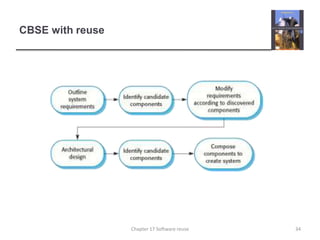
CBSE with reuseCBSE with reuse process has to find and integrate reusable components.When reusing components, it is essential to make trade-offs between ideal requirements and the services actually provided by available components.This involves:Developing outline requirements;Searching for components then modifying requirements according to available functionality.Searching again to find if there are better components that meet the revised requirements.Composing components to create the system.33Chapter 17 Software reuse
CBSE with reuse34Chapter 17 Software reuse
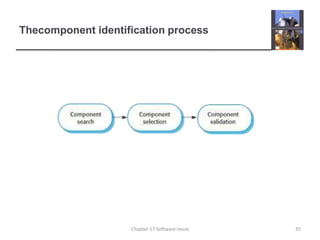
Thecomponent identification process35Chapter 17 Software reuse
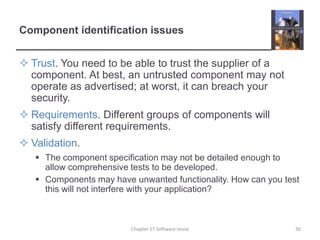
Component identification issuesTrust. You need to be able to trust the supplier of a component. At best, an untrusted component may not operate as advertised; at worst, it can breach your security.Requirements. Different groups of components will satisfy different requirements.Validation. The component specification may not be detailed enough to allow comprehensive tests to be developed.Components may have unwanted functionality. How can you test this will not interfere with your application?36Chapter 17 Software reuse
Component validation Component validation involves developing a set of test cases for a component (or, possibly, extending test cases supplied with that component) and developing a test harness to run component tests.The major problem with component validation is that the component specification may not be sufficiently detailed to allow you to develop a complete set of component tests.As well as testing that a component for reuse does what you require, you may also have to check that the component does not include any malicious code or functionality that you don’t need. Chapter 17 Software reuse37
Ariane launcher failure – validation failure?In 1996, the 1st test flight of the Ariane 5 rocket ended in disaster when the launcher went out of control 37 seconds after take off.The problem was due to a reused component from a previous version of the launcher (the Inertial Navigation System) that failed because assumptions made when that component was developed did not hold for Ariane 5.The functionality that failed in this component was not required in Ariane 5.38Chapter 17 Software reuse
Component compositionThe process of assembling components to create a system.Composition involves integrating components with each other and with the component infrastructure.Normally you have to write ‘glue code’ to integrate components.39Chapter 17 Software reuse
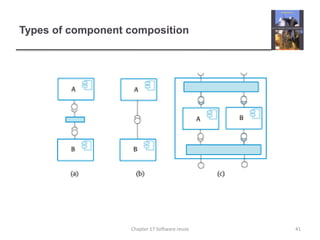
Types of compositionSequential composition where the composed components are executed in sequence. This involves composing the provides interfaces of each component.Hierarchical composition where one component calls on the services of another. The provides interface of one component is composed with the requires interface of another.Additive composition where the interfaces of two components are put together to create a new component. Provides and requires interfaces of integrated component is a combination of interfaces of constituent components.40Chapter 17 Software reuse
Types of component composition41Chapter 17 Software reuse
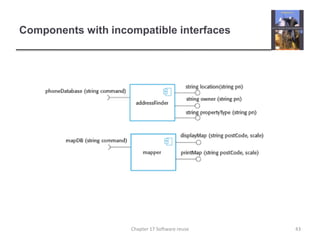
Interface incompatibilityParameter incompatibility where operations have the same name but are of different types.Operation incompatibility where the names of operations in the composed interfaces are different.Operation incompleteness where the provides interface of one component is a subset of the requires interface of another.42Chapter 17 Software reuse
Components with incompatible interfaces43Chapter 17 Software reuse
Adaptor componentsAddress the problem of component incompatibility by reconciling the interfaces of the components that are composed.Different types of adaptor are required depending on the type of composition.An addressFinder and a mapper component may be composed through an adaptor that strips the postal code from an address and passes this to the mapper component.44Chapter 17 Software reuse
Composition through an adaptorThe component postCodeStripper is the adaptor that facilitates the sequential composition of addressFinder and mapper components.45Chapter 17 Software reuse
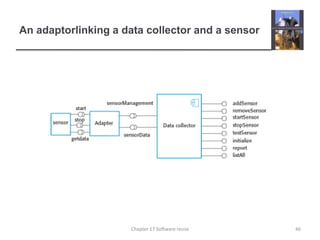
An adaptorlinking a data collector and a sensor 46Chapter 17 Software reuse
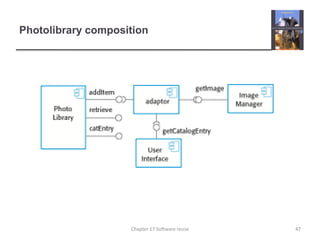
Photolibrary composition47Chapter 17 Software reuse
Interface semanticsYou have to rely on component documentation to decide if interfaces that are syntactically compatible are actually compatible.Consider an interface for a PhotoLibrary component:48Chapter 17 Software reuse
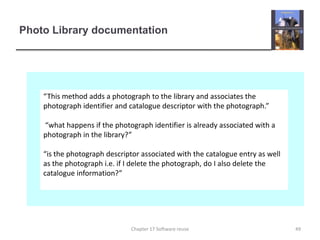
Photo Library documentation“This method adds a photograph to the library and associates the photograph identifier and catalogue descriptor with the photograph.” “what happens if the photograph identifier is already associated with a photograph in the library?”“is the photograph descriptor associated with the catalogue entry as well as the photograph i.e. if I delete the photograph, do I also delete the catalogue information?”49Chapter 17 Software reuse
The Object Constraint LanguageThe Object Constraint Language (OCL) has been designed to define constraints that are associated with UML models.It is based around the notion of pre and post condition specification – common to many formal methods.50Chapter 17 Software reuse
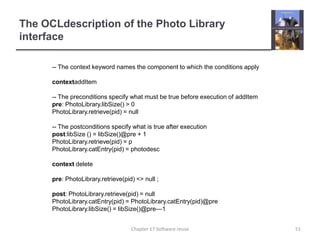
The OCLdescription of the Photo Library interface-- The context keyword names the component to which the conditions applycontextaddItem-- The preconditions specify what must be true before execution of addItempre: PhotoLibrary.libSize() > 0PhotoLibrary.retrieve(pid) = null-- The postconditions specify what is true after executionpost:libSize () = libSize()@pre + 1PhotoLibrary.retrieve(pid) = pPhotoLibrary.catEntry(pid) = photodesccontext deletepre: PhotoLibrary.retrieve(pid) <> null ;post: PhotoLibrary.retrieve(pid) = nullPhotoLibrary.catEntry(pid) = PhotoLibrary.catEntry(pid)@prePhotoLibrary.libSize() = libSize()@pre—151Chapter 17 Software reuse
Photo library conditionsAs specified, the OCL associated with the Photo Library component states that:There must not be a photograph in the library with the same identifier as the photograph to be entered;The library must exist - assume that creating a library adds a single item to it;Each new entry increases the size of the library by 1;If you retrieve using the same identifier then you get back the photo that you added;If you look up the catalogue using that identifier, then you get back the catalogue entry that you made.52Chapter 17 Software reuse
Composition trade-offsWhen composing components, you may find conflicts between functional and non-functional requirements, and conflicts between the need for rapid delivery and system evolution.You need to make decisions such as:What composition of components is effective for delivering the functional requirements?What composition of components allows for future change?What will be the emergent properties of the composed system?53Chapter 17 Software reuse
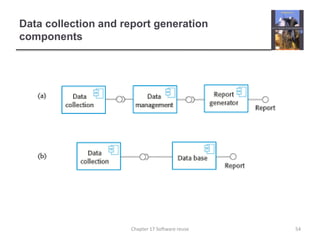
Data collection and report generation components54Chapter 17 Software reuse
Key pointsDuring the CBSE process, the processes of requirements engineering and system design are interleaved.Component composition is the process of ‘wiring’ components together to create a system.When composing reusable components, you normally have to write adaptors to reconcile different component interfaces.When choosing compositions, you have to consider required functionality, non-functional requirements and system evolution.55Chapter 17 Software reuse

Ch17-Software Engineering 9

  • 1.
    Chapter 17 Component-basedsoftware engineeringLecture 11Chapter 17 Software reuse
  • 2.
    Topics coveredComponents andcomponent models CBSE processesComponent composition2Chapter 17 Software reuse
  • 3.
    Component-based developmentComponent-based softwareengineering (CBSE) is an approach to software development that relies on the reuse of entities called ‘software components’.It emerged from the failure of object-oriented development to support effective reuse. Single object classes are too detailed and specific.Components are more abstract than object classes and can be considered to be stand-alone service providers. They can exist as stand-alone entities.3Chapter 17 Software reuse
  • 4.
    CBSE essentialsIndependent componentsspecified by their interfaces.Component standards to facilitate component integration.Middleware that provides support for component inter-operability.A development process that is geared to reuse.4Chapter 17 Software reuse
  • 5.
    CBSE and designprinciplesApart from the benefits of reuse, CBSE is based on sound software engineering design principles:Components are independent so do not interfere with each other;Component implementations are hidden;Communication is through well-defined interfaces;Component platforms are shared and reduce development costs.5Chapter 17 Software reuse
  • 6.
    Component standardsStandards needto be established so that components can communicate with each other and inter-operate.Unfortunately, several competing component standards were established:Sun’s Enterprise Java BeansMicrosoft’s COM and .NETCORBA’s CCMIn practice, these multiple standards have hindered the uptake of CBSE. It is impossible for components developed using different approaches to work together. 6Chapter 17 Software reuse
  • 7.
    CBSE problemsComponent trustworthiness- how can a component with no available source code be trusted?Component certification - who will certify the quality of components?Emergent property prediction - how can the emergent properties of component compositions be predicted?Requirements trade-offs - how do we do trade-off analysis between the features of one component and another?7Chapter 17 Software reuse
  • 8.
    ComponentsComponents provide aservice without regard to where the component is executing or its programming languageA component is an independent executable entity that can be made up of one or more executable objects;The component interface is published and all interactions are through the published interface;8Chapter 17 Software reuse
  • 9.
    Component definitionsCouncill andHeinmann:A software component is a software element that conforms to a component model and can be independently deployed and composed without modification according to a composition standard.Szyperski:A software component is a unit of composition with contractually specified interfaces and explicit context dependencies only. A software component can be deployed independently and is subject to composition by third-parties.9Chapter 17 Software reuse
  • 10.
  • 11.
  • 12.
    Component as aservice providerThe component is an independent, executable entity. It does not have to be compiled before it is used with other components.The services offered by a component are made available through an interface and all component interactions take place through that interface.The component interface is expressed in terms of parameterized operations and its internal state is never exposed. 12Chapter 17 Software reuse
  • 13.
    Component interfacesProvides interfaceDefinesthe services that are provided by the component to other components.This interface, essentially, is the component API. It defines the methods that can be called by a user of the component. Requires interfaceDefines the services that specifies what services must be made available for the component to execute as specified.This does not compromise the independence or deployability of a component because the ‘requires’ interface does not define how these services should be provided. 13Chapter 17 Software reuse
  • 14.
    Component interfacesNote UMLnotation. Ball and sockets can fit together.14Chapter 17 Software reuse
  • 15.
    Amodel of adata collector component15Chapter 17 Software reuse
  • 16.
    Component modelsA componentmodel is a definition of standards for component implementation, documentation and deployment.Examples of component modelsEJB model (Enterprise Java Beans)COM+ model (.NET model)Corba Component ModelThe component model specifies how interfaces should be defined and the elements that should be included in an interface definition.16Chapter 17 Software reuse
  • 17.
    Basic elements ofa component model17Chapter 17 Software reuse
  • 18.
    Elements of acomponent modelInterfacesComponents are defined by specifying their interfaces. The component model specifies how the interfaces should be defined and the elements, such as operation names, parameters and exceptions, which should be included in the interface definition.UsageIn order for components to be distributed and accessed remotely, they need to have a unique name or handle associated with them. This has to be globally unique.DeploymentThe component model includes a specification of how components should be packaged for deployment as independent, executable entities. 18Chapter 17 Software reuse
  • 19.
    Middleware supportComponent modelsare the basis for middleware that provides support for executing components.Component model implementations provide:Platform services that allow components written according to the model to communicate;Support services that are application-independent services used by different components.To use services provided by a model, components are deployed in a container. This is a set of interfaces used to access the service implementations.19Chapter 17 Software reuse
  • 20.
    Middleware services definedin a component model20Chapter 17 Software reuse
  • 21.
    CBSE processesCBSE processesare software processes that support component-based software engineering.They take into account the possibilities of reuse and the different process activities involved in developing and using reusable components.Development for reuseThis process is concerned with developing components or services that will be reused in other applications. It usually involves generalizing existing components.Development with reuseThis process is the process of developing new applications using existing components and services.21Chapter 17 Software reuse
  • 22.
  • 23.
    Supporting processesComponent acquisitionis the process of acquiring components for reuse or development into a reusable component.It may involve accessing locally- developed components or services or finding these components from an external source.Component management is concerned with managing a company’s reusable components, ensuring that they are properly catalogued, stored and made available for reuse.Component certification is the process of checking a component and certifying that it meets its specification.Chapter 17 Software reuse23
  • 24.
    Key pointsCBSE isa reuse-based approach to defining and implementing loosely coupled components into systems.A component is a software unit whose functionality and dependencies are completely defined by its interfaces.A component model defines a set of standards that component providers and composers should follow.The key CBSE processes are CBSE for reuse and CBSE with reuse.24Chapter 17 Software reuse
  • 25.
    Chapter 17 Component-basedsoftware engineeringLecture 225Chapter 17 Software reuse
  • 26.
    CBSE for reuseCBSEfor reuse focuses on component development.Components developed for a specific application usually have to be generalised to make them reusable.A component is most likely to be reusable if it associated with a stable domain abstraction (business object). For example, in a hospital stable domain abstractions are associated with the fundamental purpose - nurses, patients, treatments, etc.26Chapter 17 Software reuse
  • 27.
    Component development forreuseComponents for reuse may be specially constructed by generalising existing components.Component reusabilityShould reflect stable domain abstractions;Should hide state representation;Should be as independent as possible;Should publish exceptions through the component interface.There is a trade-off between reusability and usabilityThe more general the interface, the greater the reusability but it is then more complex and hence less usable.27Chapter 17 Software reuse
  • 28.
    Changes for reusabilityRemoveapplication-specific methods.Change names to make them general.Add methods to broaden coverage.Make exception handling consistent.Add a configuration interface for component adaptation.Integrate required components to reduce dependencies.28Chapter 17 Software reuse
  • 29.
    Exception handlingComponents shouldnot handle exceptions themselves, because each application will have its own requirements for exception handling.Rather, the component should define what exceptions can arise and should publish these as part of the interface.In practice, however, there are two problems with this:Publishing all exceptions leads to bloated interfaces that are harder to understand. This may put off potential users of the component.The operation of the component may depend on local exception handling, and changing this may have serious implications for the functionality of the component.Chapter 17 Software reuse29
  • 30.
    Legacy system componentsExistinglegacy systems that fulfil a useful business function can be re-packaged as components for reuse.This involves writing a wrapper component that implements provides and requires interfaces then accesses the legacy system.Although costly, this can be much less expensive than rewriting the legacy system.30Chapter 17 Software reuse
  • 31.
    Reusable componentsThe developmentcost of reusable components may be higher than the cost of specific equivalents. This extra reusability enhancement cost should be an organization rather than a project cost.Generic components may be less space-efficient and may have longer execution times than their specific equivalents.31Chapter 17 Software reuse
  • 32.
    Component managementComponent managementinvolves deciding how to classify the component so that it can be discovered, making the component available either in a repository or as a service, maintaining information about the use of the component and keeping track of different component versions.A company with a reuse program may carry out some form of component certification before the component is made available for reuse.Certification means that someone apart from the developer checks the quality of the component. Chapter 17 Software reuse32
  • 33.
    CBSE with reuseCBSEwith reuse process has to find and integrate reusable components.When reusing components, it is essential to make trade-offs between ideal requirements and the services actually provided by available components.This involves:Developing outline requirements;Searching for components then modifying requirements according to available functionality.Searching again to find if there are better components that meet the revised requirements.Composing components to create the system.33Chapter 17 Software reuse
  • 34.
    CBSE with reuse34Chapter17 Software reuse
  • 35.
  • 36.
    Component identification issuesTrust.You need to be able to trust the supplier of a component. At best, an untrusted component may not operate as advertised; at worst, it can breach your security.Requirements. Different groups of components will satisfy different requirements.Validation. The component specification may not be detailed enough to allow comprehensive tests to be developed.Components may have unwanted functionality. How can you test this will not interfere with your application?36Chapter 17 Software reuse
  • 37.
    Component validation Componentvalidation involves developing a set of test cases for a component (or, possibly, extending test cases supplied with that component) and developing a test harness to run component tests.The major problem with component validation is that the component specification may not be sufficiently detailed to allow you to develop a complete set of component tests.As well as testing that a component for reuse does what you require, you may also have to check that the component does not include any malicious code or functionality that you don’t need. Chapter 17 Software reuse37
  • 38.
    Ariane launcher failure– validation failure?In 1996, the 1st test flight of the Ariane 5 rocket ended in disaster when the launcher went out of control 37 seconds after take off.The problem was due to a reused component from a previous version of the launcher (the Inertial Navigation System) that failed because assumptions made when that component was developed did not hold for Ariane 5.The functionality that failed in this component was not required in Ariane 5.38Chapter 17 Software reuse
  • 39.
    Component compositionThe processof assembling components to create a system.Composition involves integrating components with each other and with the component infrastructure.Normally you have to write ‘glue code’ to integrate components.39Chapter 17 Software reuse
  • 40.
    Types of compositionSequentialcomposition where the composed components are executed in sequence. This involves composing the provides interfaces of each component.Hierarchical composition where one component calls on the services of another. The provides interface of one component is composed with the requires interface of another.Additive composition where the interfaces of two components are put together to create a new component. Provides and requires interfaces of integrated component is a combination of interfaces of constituent components.40Chapter 17 Software reuse
  • 41.
    Types of componentcomposition41Chapter 17 Software reuse
  • 42.
    Interface incompatibilityParameter incompatibilitywhere operations have the same name but are of different types.Operation incompatibility where the names of operations in the composed interfaces are different.Operation incompleteness where the provides interface of one component is a subset of the requires interface of another.42Chapter 17 Software reuse
  • 43.
    Components with incompatibleinterfaces43Chapter 17 Software reuse
  • 44.
    Adaptor componentsAddress theproblem of component incompatibility by reconciling the interfaces of the components that are composed.Different types of adaptor are required depending on the type of composition.An addressFinder and a mapper component may be composed through an adaptor that strips the postal code from an address and passes this to the mapper component.44Chapter 17 Software reuse
  • 45.
    Composition through anadaptorThe component postCodeStripper is the adaptor that facilitates the sequential composition of addressFinder and mapper components.45Chapter 17 Software reuse
  • 46.
    An adaptorlinking adata collector and a sensor 46Chapter 17 Software reuse
  • 47.
  • 48.
    Interface semanticsYou haveto rely on component documentation to decide if interfaces that are syntactically compatible are actually compatible.Consider an interface for a PhotoLibrary component:48Chapter 17 Software reuse
  • 49.
    Photo Library documentation“Thismethod adds a photograph to the library and associates the photograph identifier and catalogue descriptor with the photograph.” “what happens if the photograph identifier is already associated with a photograph in the library?”“is the photograph descriptor associated with the catalogue entry as well as the photograph i.e. if I delete the photograph, do I also delete the catalogue information?”49Chapter 17 Software reuse
  • 50.
    The Object ConstraintLanguageThe Object Constraint Language (OCL) has been designed to define constraints that are associated with UML models.It is based around the notion of pre and post condition specification – common to many formal methods.50Chapter 17 Software reuse
  • 51.
    The OCLdescription ofthe Photo Library interface-- The context keyword names the component to which the conditions applycontextaddItem-- The preconditions specify what must be true before execution of addItempre: PhotoLibrary.libSize() > 0PhotoLibrary.retrieve(pid) = null-- The postconditions specify what is true after executionpost:libSize () = libSize()@pre + 1PhotoLibrary.retrieve(pid) = pPhotoLibrary.catEntry(pid) = photodesccontext deletepre: PhotoLibrary.retrieve(pid) <> null ;post: PhotoLibrary.retrieve(pid) = nullPhotoLibrary.catEntry(pid) = PhotoLibrary.catEntry(pid)@prePhotoLibrary.libSize() = libSize()@pre—151Chapter 17 Software reuse
  • 52.
    Photo library conditionsAsspecified, the OCL associated with the Photo Library component states that:There must not be a photograph in the library with the same identifier as the photograph to be entered;The library must exist - assume that creating a library adds a single item to it;Each new entry increases the size of the library by 1;If you retrieve using the same identifier then you get back the photo that you added;If you look up the catalogue using that identifier, then you get back the catalogue entry that you made.52Chapter 17 Software reuse
  • 53.
    Composition trade-offsWhen composingcomponents, you may find conflicts between functional and non-functional requirements, and conflicts between the need for rapid delivery and system evolution.You need to make decisions such as:What composition of components is effective for delivering the functional requirements?What composition of components allows for future change?What will be the emergent properties of the composed system?53Chapter 17 Software reuse
  • 54.
    Data collection andreport generation components54Chapter 17 Software reuse
  • 55.
    Key pointsDuring theCBSE process, the processes of requirements engineering and system design are interleaved.Component composition is the process of ‘wiring’ components together to create a system.When composing reusable components, you normally have to write adaptors to reconcile different component interfaces.When choosing compositions, you have to consider required functionality, non-functional requirements and system evolution.55Chapter 17 Software reuse