12 - 1

Chapter

12

Special Challenges in Career
Management

Copyright © 2002 by The McGraw-Hill Companies, Inc. All rights reserved.
Objectives

12 - 2

After reading this chapter, you should be able to:
1.
2.
3.
4.

Design an effective socialization program for
employees.
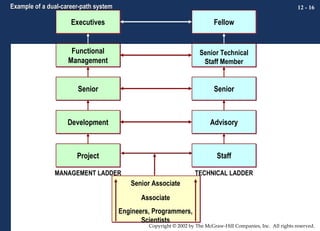
Discuss why a dual-career path is necessary for
professional and managerial employees.
Provide advice on how to help a plateaued
employee.
Develop policies to help employees and the
company avoid technical obsolescence.
Copyright © 2002 by The McGraw-Hill Companies, Inc. All rights reserved.
12 - 3

Objectives (continued)
5.
6.

7.

Develop policies to help employees deal with
work-and-life conflict.
Select and design outplacement strategies that
minimize the negative effects on displaced
employees and “survivors.”
Explain why retirees may be valuable as parttime employees.

Copyright © 2002 by The McGraw-Hill Companies, Inc. All rights reserved.
12 - 4

Introduction
Many companies in Silicon Valley face serious
career management challenges.
 These companies are now paying more attention to
career management issues because their work
force is starting to age and pay more attention to
work-life balance.
 Many employees face long commutes because
they can not afford to live close to where they
work.


Copyright © 2002 by The McGraw-Hill Companies, Inc. All rights reserved.
12 - 5

Introduction (continued)

If companies do not help their
employees with their personal
lives, they may leave for jobs
with other companies in other
areas that do.
Copyright © 2002 by The McGraw-Hill Companies, Inc. All rights reserved.
12 - 6

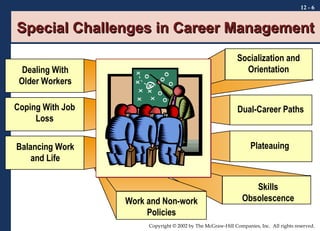
Special Challenges in Career Management
Socialization and
Orientation

Dealing With
Older Workers
Coping With Job
Loss

Dual-Career Paths

Balancing Work
and Life

Plateauing

Work and Non-work
Policies

Skills
Obsolescence

Copyright © 2002 by The McGraw-Hill Companies, Inc. All rights reserved.
12 - 7

Socialization and Orientation
 Organizational

socialization is the process by
which new employees are transformed into
effective members of the company.

 The

purpose of orientation is to:

 Prepare

employees to perform their jobs effectively
 Learn about the organization
 Establish work relationships
Copyright © 2002 by The McGraw-Hill Companies, Inc. All rights reserved.
12 - 8

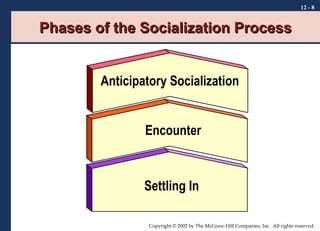
Phases of the Socialization Process
Anticipatory Socialization
Encounter

Settling In
Copyright © 2002 by The McGraw-Hill Companies, Inc. All rights reserved.
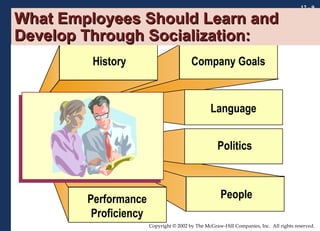
What Employees Should Learn and
Develop Through Socialization:
History

12 - 9

Company Goals

Language
Politics

Performance
Proficiency

People
Copyright © 2002 by The McGraw-Hill Companies, Inc. All rights reserved.
12 - 10

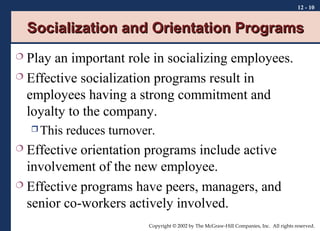
Socialization and Orientation Programs
Play an important role in socializing employees.
 Effective socialization programs result in
employees having a strong commitment and
loyalty to the company.


 This

reduces turnover.

Effective orientation programs include active
involvement of the new employee.
 Effective programs have peers, managers, and
senior co-workers actively involved.


Copyright © 2002 by The McGraw-Hill Companies, Inc. All rights reserved.
12 - 11

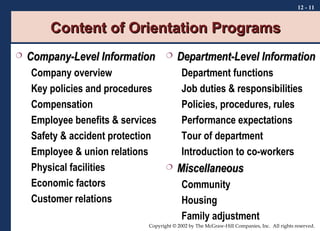
Content of Orientation Programs


Company-Level Information
Company overview
Key policies and procedures
Compensation
Employee benefits & services
Safety & accident protection
Employee & union relations
Physical facilities
Economic factors
Customer relations



Department-Level Information
Department functions
Job duties & responsibilities
Policies, procedures, rules
Performance expectations
Tour of department
Introduction to co-workers



Miscellaneous
Community
Housing
Family adjustment

Copyright © 2002 by The McGraw-Hill Companies, Inc. All rights reserved.
12 - 12

Characteristics of Effective Orientation Programs
Employees are encouraged to ask questions.
 Program includes information on both technical and
social aspects of the job.
 Orientation is the responsibility of the new employee’s
manager.
 Debasing and embarrassing new employees is avoided.
 Formal and informal interactions with managers and
peers occur.
 Programs involve relocation assistance.
 Employees receive information about the company’s
products, services, and customers.


Copyright © 2002 by The McGraw-Hill Companies, Inc. All rights reserved.
12 - 13

Dual-Career Paths
A career path is a sequence of job positions
involving similar types of work and skills that
employees move through in the company.
 For companies with professional employees, a key
issue is how to ensure that they feel they are
valued.
 The traditional career path model has limited
advancement opportunities for those in the
technical career path.


Copyright © 2002 by The McGraw-Hill Companies, Inc. All rights reserved.
12 - 14

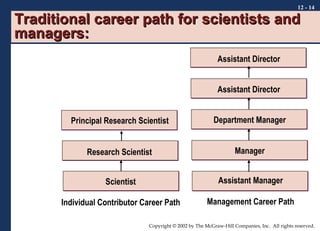
Traditional career path for scientists and
managers:
Assistant Director
Assistant Director
Principal Research Scientist

Department Manager

Research Scientist

Manager

Scientist

Assistant Manager

Individual Contributor Career Path

Management Career Path

Copyright © 2002 by The McGraw-Hill Companies, Inc. All rights reserved.
12 - 15

A dual-career-path
system enables
employees to remain in a
technical career path or
move into a management
career path.

Copyright © 2002 by The McGraw-Hill Companies, Inc. All rights reserved.
Example of a dual-career-path system

12 - 16

Executives

Fellow

Functional
Management

Senior Technical
Staff Member

Senior

Senior

Development

Advisory

Project

Staff

MANAGEMENT LADDER

TECHNICAL LADDER

Senior Associate
Associate
Engineers, Programmers,
Scientists

Copyright © 2002 by The McGraw-Hill Companies, Inc. All rights reserved.
12 - 17

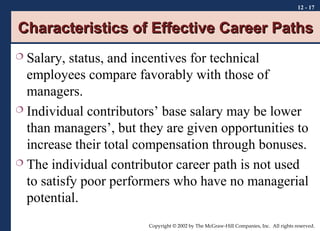
Characteristics of Effective Career Paths
Salary, status, and incentives for technical
employees compare favorably with those of
managers.
 Individual contributors’ base salary may be lower
than managers’, but they are given opportunities to
increase their total compensation through bonuses.
 The individual contributor career path is not used
to satisfy poor performers who have no managerial
potential.


Copyright © 2002 by The McGraw-Hill Companies, Inc. All rights reserved.
12 - 18

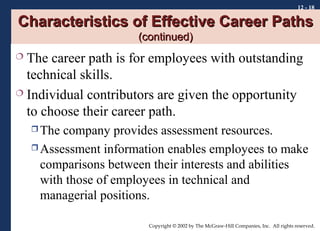
Characteristics of Effective Career Paths
(continued)

The career path is for employees with outstanding
technical skills.
 Individual contributors are given the opportunity
to choose their career path.


 The

company provides assessment resources.
 Assessment information enables employees to make
comparisons between their interests and abilities
with those of employees in technical and
managerial positions.
Copyright © 2002 by The McGraw-Hill Companies, Inc. All rights reserved.
12 - 19

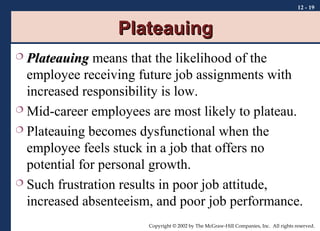
Plateauing
Plateauing means that the likelihood of the
employee receiving future job assignments with
increased responsibility is low.
 Mid-career employees are most likely to plateau.
 Plateauing becomes dysfunctional when the
employee feels stuck in a job that offers no
potential for personal growth.
 Such frustration results in poor job attitude,
increased absenteeism, and poor job performance.


Copyright © 2002 by The McGraw-Hill Companies, Inc. All rights reserved.
12 - 20

Reasons Employees Can Plateau
Discrimination based on age, gender, or race.
 Lack of ability.
 Lack of training.
 Low need for achievement.
 Unfair pay decisions or dissatisfaction with pay
raises.
 Confusion about job responsibilities.
 Slow company growth resulting in reduced
development opportunities.


Copyright © 2002 by The McGraw-Hill Companies, Inc. All rights reserved.
12 - 21

Possible Remedies for Plateaued Employees


Employee understands the reasons for plateau.



Employee is encouraged to participate in
development activities.



Employee is encouraged to seek career counseling.



Employee reality-tests his solutions.
Copyright © 2002 by The McGraw-Hill Companies, Inc. All rights reserved.
12 - 22

Skills Obsolescence
Obsolescence – a reduction in an employee’s
competence resulting from a lack of knowledge of
new work processes, techniques, and technologies
that have developed since the employee completed
her education.
 Not just a concern of technical and professional
occupations. All employees are at risk.
 Obsolescence needs to be avoided if companies
are trying to become learning organizations.


Copyright © 2002 by The McGraw-Hill Companies, Inc. All rights reserved.
12 - 23

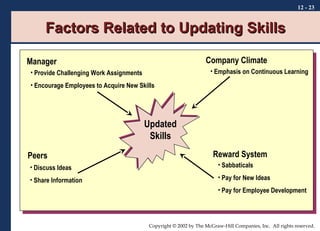
Factors Related to Updating Skills
Company Climate

Manager

• Emphasis on Continuous Learning

• Provide Challenging Work Assignments
• Encourage Employees to Acquire New Skills

Updated
Skills
Peers

Reward System

• Discuss Ideas

• Sabbaticals

• Share Information

• Pay for New Ideas
• Pay for Employee Development

Copyright © 2002 by The McGraw-Hill Companies, Inc. All rights reserved.
12 - 24

Balancing Work and Life
Families with a working husband, homemaker
wife, and two or more children account for only 7
percent of American families.
 The increasing number of two-career couples and
single heads of households creates a challenge for
companies.
 Companies have to carefully consider how to
manage employees who are simultaneously
meeting the needs of both work and family.


Copyright © 2002 by The McGraw-Hill Companies, Inc. All rights reserved.
12 - 25

Balancing Work and Life (continued)
 There

are two roles that training can play in
balancing work and non-work.
 Trainers

and managers may be responsible
for developing policies and procedures.
 Trainers may be responsible for developing
training programs to teach managers their
role in administering and overseeing the use
of work-life policies.
Copyright © 2002 by The McGraw-Hill Companies, Inc. All rights reserved.
12 - 26

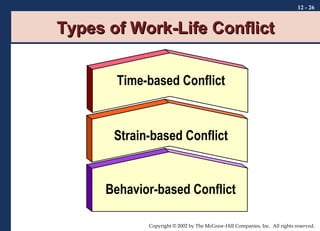
Types of Work-Life Conflict
Time-based Conflict

Strain-based Conflict

Behavior-based Conflict
Copyright © 2002 by The McGraw-Hill Companies, Inc. All rights reserved.
12 - 27

Company Policies to Accommodate
Work and Non-work:
 Communicating information about work
and non-work policies and job demands.
 Flexibility in work arrangements and work
schedules.
 Redesigning jobs.
 Support Services.

Copyright © 2002 by The McGraw-Hill Companies, Inc. All rights reserved.
12 - 28

For job sharing to be effective:











The impact of job sharing on clients and customers must
be determined.
The employee interested in job sharing must find another
employee performing the same job who wants reduced
work hours.
The two people sharing the job need to have similar work
values and motivations.
The manager must actively communicate with the jobsharing employees.
All schedules and work assignments need coordination.
Performance measurement should be both team and
individual.
Copyright © 2002 by The McGraw-Hill Companies, Inc. All rights reserved.
12 - 29

Coping With Job Loss
Important career management issue because of the
increased use of downsizing to deal with excess
employees resulting from corporate restructuring,
mergers, acquisitions, and takeovers.
 Companies that lay off employees can experience
lowered job commitment, distrust of management,
and difficulties recruiting new employees.
 Job loss causes stress and disrupts the personal
lives of laid-off employees.


Copyright © 2002 by The McGraw-Hill Companies, Inc. All rights reserved.
12 - 30

Coping With Job Loss (continued)
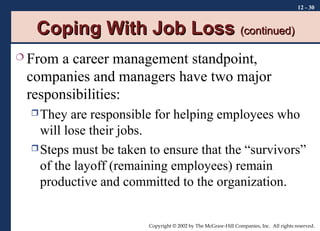
 From

a career management standpoint,
companies and managers have two major
responsibilities:
 They

are responsible for helping employees who
will lose their jobs.
 Steps must be taken to ensure that the “survivors”
of the layoff (remaining employees) remain
productive and committed to the organization.

Copyright © 2002 by The McGraw-Hill Companies, Inc. All rights reserved.
12 - 31

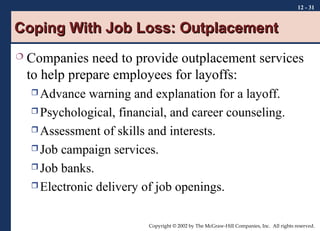
Coping With Job Loss: Outplacement


Companies need to provide outplacement services
to help prepare employees for layoffs:
 Advance

warning and explanation for a layoff.
 Psychological, financial, and career counseling.
 Assessment of skills and interests.
 Job campaign services.
 Job banks.
 Electronic delivery of job openings.
Copyright © 2002 by The McGraw-Hill Companies, Inc. All rights reserved.
12 - 32

Dealing With Older Workers
 Meeting

the needs of older workers.

 Pre-retirement

socialization.

 Retirement.
 Early

retirement programs.

Copyright © 2002 by The McGraw-Hill Companies, Inc. All rights reserved.
12 - 33

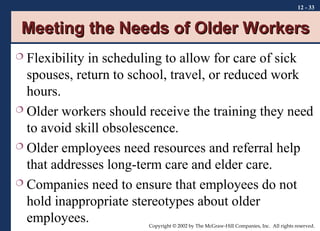
Meeting the Needs of Older Workers
Flexibility in scheduling to allow for care of sick
spouses, return to school, travel, or reduced work
hours.
 Older workers should receive the training they need
to avoid skill obsolescence.
 Older employees need resources and referral help
that addresses long-term care and elder care.
 Companies need to ensure that employees do not
hold inappropriate stereotypes about older
employees.


Copyright © 2002 by The McGraw-Hill Companies, Inc. All rights reserved.

Chap12

  • 1.
    12 - 1 Chapter 12 SpecialChallenges in Career Management Copyright © 2002 by The McGraw-Hill Companies, Inc. All rights reserved.
  • 2.
    Objectives 12 - 2 Afterreading this chapter, you should be able to: 1. 2. 3. 4. Design an effective socialization program for employees. Discuss why a dual-career path is necessary for professional and managerial employees. Provide advice on how to help a plateaued employee. Develop policies to help employees and the company avoid technical obsolescence. Copyright © 2002 by The McGraw-Hill Companies, Inc. All rights reserved.
  • 3.
    12 - 3 Objectives(continued) 5. 6. 7. Develop policies to help employees deal with work-and-life conflict. Select and design outplacement strategies that minimize the negative effects on displaced employees and “survivors.” Explain why retirees may be valuable as parttime employees. Copyright © 2002 by The McGraw-Hill Companies, Inc. All rights reserved.
  • 4.
    12 - 4 Introduction Manycompanies in Silicon Valley face serious career management challenges.  These companies are now paying more attention to career management issues because their work force is starting to age and pay more attention to work-life balance.  Many employees face long commutes because they can not afford to live close to where they work.  Copyright © 2002 by The McGraw-Hill Companies, Inc. All rights reserved.
  • 5.
    12 - 5 Introduction(continued) If companies do not help their employees with their personal lives, they may leave for jobs with other companies in other areas that do. Copyright © 2002 by The McGraw-Hill Companies, Inc. All rights reserved.
  • 6.
    12 - 6 SpecialChallenges in Career Management Socialization and Orientation Dealing With Older Workers Coping With Job Loss Dual-Career Paths Balancing Work and Life Plateauing Work and Non-work Policies Skills Obsolescence Copyright © 2002 by The McGraw-Hill Companies, Inc. All rights reserved.
  • 7.
    12 - 7 Socializationand Orientation  Organizational socialization is the process by which new employees are transformed into effective members of the company.  The purpose of orientation is to:  Prepare employees to perform their jobs effectively  Learn about the organization  Establish work relationships Copyright © 2002 by The McGraw-Hill Companies, Inc. All rights reserved.
  • 8.
    12 - 8 Phasesof the Socialization Process Anticipatory Socialization Encounter Settling In Copyright © 2002 by The McGraw-Hill Companies, Inc. All rights reserved.
  • 9.
    What Employees ShouldLearn and Develop Through Socialization: History 12 - 9 Company Goals Language Politics Performance Proficiency People Copyright © 2002 by The McGraw-Hill Companies, Inc. All rights reserved.
  • 10.
    12 - 10 Socializationand Orientation Programs Play an important role in socializing employees.  Effective socialization programs result in employees having a strong commitment and loyalty to the company.   This reduces turnover. Effective orientation programs include active involvement of the new employee.  Effective programs have peers, managers, and senior co-workers actively involved.  Copyright © 2002 by The McGraw-Hill Companies, Inc. All rights reserved.
  • 11.
    12 - 11 Contentof Orientation Programs  Company-Level Information Company overview Key policies and procedures Compensation Employee benefits & services Safety & accident protection Employee & union relations Physical facilities Economic factors Customer relations  Department-Level Information Department functions Job duties & responsibilities Policies, procedures, rules Performance expectations Tour of department Introduction to co-workers  Miscellaneous Community Housing Family adjustment Copyright © 2002 by The McGraw-Hill Companies, Inc. All rights reserved.
  • 12.
    12 - 12 Characteristicsof Effective Orientation Programs Employees are encouraged to ask questions.  Program includes information on both technical and social aspects of the job.  Orientation is the responsibility of the new employee’s manager.  Debasing and embarrassing new employees is avoided.  Formal and informal interactions with managers and peers occur.  Programs involve relocation assistance.  Employees receive information about the company’s products, services, and customers.  Copyright © 2002 by The McGraw-Hill Companies, Inc. All rights reserved.
  • 13.
    12 - 13 Dual-CareerPaths A career path is a sequence of job positions involving similar types of work and skills that employees move through in the company.  For companies with professional employees, a key issue is how to ensure that they feel they are valued.  The traditional career path model has limited advancement opportunities for those in the technical career path.  Copyright © 2002 by The McGraw-Hill Companies, Inc. All rights reserved.
  • 14.
    12 - 14 Traditionalcareer path for scientists and managers: Assistant Director Assistant Director Principal Research Scientist Department Manager Research Scientist Manager Scientist Assistant Manager Individual Contributor Career Path Management Career Path Copyright © 2002 by The McGraw-Hill Companies, Inc. All rights reserved.
  • 15.
    12 - 15 Adual-career-path system enables employees to remain in a technical career path or move into a management career path. Copyright © 2002 by The McGraw-Hill Companies, Inc. All rights reserved.
  • 16.
    Example of adual-career-path system 12 - 16 Executives Fellow Functional Management Senior Technical Staff Member Senior Senior Development Advisory Project Staff MANAGEMENT LADDER TECHNICAL LADDER Senior Associate Associate Engineers, Programmers, Scientists Copyright © 2002 by The McGraw-Hill Companies, Inc. All rights reserved.
  • 17.
    12 - 17 Characteristicsof Effective Career Paths Salary, status, and incentives for technical employees compare favorably with those of managers.  Individual contributors’ base salary may be lower than managers’, but they are given opportunities to increase their total compensation through bonuses.  The individual contributor career path is not used to satisfy poor performers who have no managerial potential.  Copyright © 2002 by The McGraw-Hill Companies, Inc. All rights reserved.
  • 18.
    12 - 18 Characteristicsof Effective Career Paths (continued) The career path is for employees with outstanding technical skills.  Individual contributors are given the opportunity to choose their career path.   The company provides assessment resources.  Assessment information enables employees to make comparisons between their interests and abilities with those of employees in technical and managerial positions. Copyright © 2002 by The McGraw-Hill Companies, Inc. All rights reserved.
  • 19.
    12 - 19 Plateauing Plateauingmeans that the likelihood of the employee receiving future job assignments with increased responsibility is low.  Mid-career employees are most likely to plateau.  Plateauing becomes dysfunctional when the employee feels stuck in a job that offers no potential for personal growth.  Such frustration results in poor job attitude, increased absenteeism, and poor job performance.  Copyright © 2002 by The McGraw-Hill Companies, Inc. All rights reserved.
  • 20.
    12 - 20 ReasonsEmployees Can Plateau Discrimination based on age, gender, or race.  Lack of ability.  Lack of training.  Low need for achievement.  Unfair pay decisions or dissatisfaction with pay raises.  Confusion about job responsibilities.  Slow company growth resulting in reduced development opportunities.  Copyright © 2002 by The McGraw-Hill Companies, Inc. All rights reserved.
  • 21.
    12 - 21 PossibleRemedies for Plateaued Employees  Employee understands the reasons for plateau.  Employee is encouraged to participate in development activities.  Employee is encouraged to seek career counseling.  Employee reality-tests his solutions. Copyright © 2002 by The McGraw-Hill Companies, Inc. All rights reserved.
  • 22.
    12 - 22 SkillsObsolescence Obsolescence – a reduction in an employee’s competence resulting from a lack of knowledge of new work processes, techniques, and technologies that have developed since the employee completed her education.  Not just a concern of technical and professional occupations. All employees are at risk.  Obsolescence needs to be avoided if companies are trying to become learning organizations.  Copyright © 2002 by The McGraw-Hill Companies, Inc. All rights reserved.
  • 23.
    12 - 23 FactorsRelated to Updating Skills Company Climate Manager • Emphasis on Continuous Learning • Provide Challenging Work Assignments • Encourage Employees to Acquire New Skills Updated Skills Peers Reward System • Discuss Ideas • Sabbaticals • Share Information • Pay for New Ideas • Pay for Employee Development Copyright © 2002 by The McGraw-Hill Companies, Inc. All rights reserved.
  • 24.
    12 - 24 BalancingWork and Life Families with a working husband, homemaker wife, and two or more children account for only 7 percent of American families.  The increasing number of two-career couples and single heads of households creates a challenge for companies.  Companies have to carefully consider how to manage employees who are simultaneously meeting the needs of both work and family.  Copyright © 2002 by The McGraw-Hill Companies, Inc. All rights reserved.
  • 25.
    12 - 25 BalancingWork and Life (continued)  There are two roles that training can play in balancing work and non-work.  Trainers and managers may be responsible for developing policies and procedures.  Trainers may be responsible for developing training programs to teach managers their role in administering and overseeing the use of work-life policies. Copyright © 2002 by The McGraw-Hill Companies, Inc. All rights reserved.
  • 26.
    12 - 26 Typesof Work-Life Conflict Time-based Conflict Strain-based Conflict Behavior-based Conflict Copyright © 2002 by The McGraw-Hill Companies, Inc. All rights reserved.
  • 27.
    12 - 27 CompanyPolicies to Accommodate Work and Non-work:  Communicating information about work and non-work policies and job demands.  Flexibility in work arrangements and work schedules.  Redesigning jobs.  Support Services. Copyright © 2002 by The McGraw-Hill Companies, Inc. All rights reserved.
  • 28.
    12 - 28 Forjob sharing to be effective:       The impact of job sharing on clients and customers must be determined. The employee interested in job sharing must find another employee performing the same job who wants reduced work hours. The two people sharing the job need to have similar work values and motivations. The manager must actively communicate with the jobsharing employees. All schedules and work assignments need coordination. Performance measurement should be both team and individual. Copyright © 2002 by The McGraw-Hill Companies, Inc. All rights reserved.
  • 29.
    12 - 29 CopingWith Job Loss Important career management issue because of the increased use of downsizing to deal with excess employees resulting from corporate restructuring, mergers, acquisitions, and takeovers.  Companies that lay off employees can experience lowered job commitment, distrust of management, and difficulties recruiting new employees.  Job loss causes stress and disrupts the personal lives of laid-off employees.  Copyright © 2002 by The McGraw-Hill Companies, Inc. All rights reserved.
  • 30.
    12 - 30 CopingWith Job Loss (continued)  From a career management standpoint, companies and managers have two major responsibilities:  They are responsible for helping employees who will lose their jobs.  Steps must be taken to ensure that the “survivors” of the layoff (remaining employees) remain productive and committed to the organization. Copyright © 2002 by The McGraw-Hill Companies, Inc. All rights reserved.
  • 31.
    12 - 31 CopingWith Job Loss: Outplacement  Companies need to provide outplacement services to help prepare employees for layoffs:  Advance warning and explanation for a layoff.  Psychological, financial, and career counseling.  Assessment of skills and interests.  Job campaign services.  Job banks.  Electronic delivery of job openings. Copyright © 2002 by The McGraw-Hill Companies, Inc. All rights reserved.
  • 32.
    12 - 32 DealingWith Older Workers  Meeting the needs of older workers.  Pre-retirement socialization.  Retirement.  Early retirement programs. Copyright © 2002 by The McGraw-Hill Companies, Inc. All rights reserved.
  • 33.
    12 - 33 Meetingthe Needs of Older Workers Flexibility in scheduling to allow for care of sick spouses, return to school, travel, or reduced work hours.  Older workers should receive the training they need to avoid skill obsolescence.  Older employees need resources and referral help that addresses long-term care and elder care.  Companies need to ensure that employees do not hold inappropriate stereotypes about older employees.  Copyright © 2002 by The McGraw-Hill Companies, Inc. All rights reserved.

Editor's Notes

  • #17 See Exhibit 14.8, page 504