Chapter 4 Computer
Software
James A. O'Brien, and George Marakas.
Management Information Systems with MISource
2007, 8th
ed. Boston, MA: McGraw-Hill, Inc.,
2007. ISBN: 13 9780073323091
Chapter 4 Computer Software 2
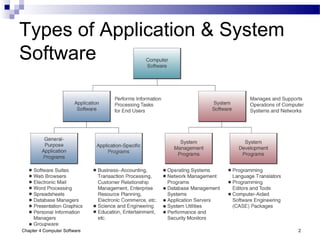
Types of Application & System
Software
Chapter 4 Computer Software 3
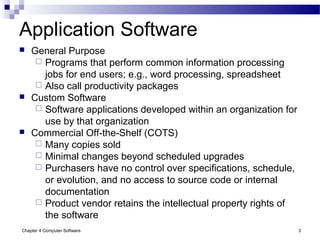
Application Software
๏ฎ General Purpose
๏‚จ Programs that perform common information processing
jobs for end users; e.g., word processing, spreadsheet
๏‚จ Also call productivity packages
๏ฎ Custom Software
๏‚จ Software applications developed within an organization for
use by that organization
๏ฎ Commercial Off-the-Shelf (COTS)
๏‚จ Many copies sold
๏‚จ Minimal changes beyond scheduled upgrades
๏‚จ Purchasers have no control over specifications, schedule,
or evolution, and no access to source code or internal
documentation
๏‚จ Product vendor retains the intellectual property rights of
the software
Chapter 4 Computer Software 4
Application Software
๏ฎ Open-source Software
๏‚จ Developers collaborate on the development of an
application using programming standards which allow
anyone to contribute to the software
๏‚จ As each developer completes a project, the application
code becomes available and free to anyone who wants it
Chapter 4 Computer Software 5
Business Application Software
๏ฎ Function-Specific Application Software
๏‚จThousands of these packages support
specific applications of end users
๏‚จExamples: customer relationship
management, enterprise resource planning,
supply chain management, Web-enabled
electronic commerce
Chapter 4 Computer Software 6
Software Suites, Integrated
Packages
๏ฎ Most widely used productivity packages are
bundled together as software suites
๏ฎ Advantages
๏‚จCost less than buying individual packages
๏‚จAll have similar GUI
๏‚จWork well together
๏ฎ Disadvantages
๏‚จAll features not used
๏‚จTakes a lot of disk space (bloatware)
Chapter 4 Computer Software 7
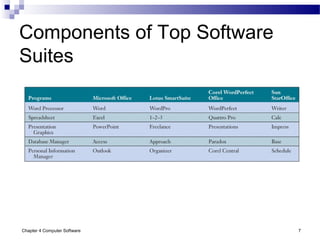
Components of Top Software
Suites
Chapter 4 Computer Software 8
Integrated Packages
๏ฎ Integrated packages combine the functions of
several programs into one package
๏‚จE.g., Microsoft Works, AppleWorks
๏ฎ Advantages
๏‚จMany functions for lower price
๏‚จUses less disk space
๏‚จFrequently pre-installed on microcomputers
๏ฎ Disadvantages
๏‚จLimited functionality
Chapter 4 Computer Software 9
Web Browsers
๏ฎ Software applications that support navigation
through the point-and-click hyper-linked
resources of the Web
๏ฎ Becoming the universal platform from which end
users launchโ€ฆ
๏‚จInformation searches
๏‚จE-mail
๏‚จMultimedia file transfer
๏‚จDiscussion groups
๏‚จOther Internet-based applications
Chapter 4 Computer Software 10
Search Engines
๏ฎ Browsers are used to gain access to Internet
search engines
๏‚จGoogle, Ask Jeeves, Look Smart, Lycos,
Overture, Yahoo!
๏ฎ Using search engines to find information has
become an indispensable part of Internet,
intranet, and extranet applications
Chapter 4 Computer Software 11
E-mail, Instant Messaging, and
Weblogs
๏ฎ E-mail
๏‚จSoftware to communicate by sending and
receiving messages and attachments via the
Internet, intranet, or extranet
๏ฎ Instant messaging (IM)
๏‚จReceive electronic messages instantly
๏ฎ Weblog or blog
๏‚จA personal website in dated log format
๏‚จUpdated with new information about a subject
or range of subjects
Chapter 4 Computer Software 12
Word Processing/Desktop
Publishing
๏ฎ Word Processing
๏‚จCreate, edit, revise, and print documents
๏‚จExample: Microsoft Word, Lotus WordPro,
Corel WordPerfect
๏ฎ Desktop Publishing
๏‚จProduce printed materials that look
professionally published
๏‚จExample: Adobe PageMaker, Microsoft
Publisher, QuarkXPress
Chapter 4 Computer Software 13
Electronic Spreadsheets
๏ฎ Used by virtually every business forโ€ฆ
๏‚จAnalysis, planning, modeling
๏ฎ Electronic Spreadsheet
๏‚จWorksheet of rows and columns
๏‚จCan be stored on local computer or on
network
๏‚จRequires designing format and developing the
relationships (formulas)
๏‚จMost help you develop charts and graphic
displays of spreadsheet results
๏‚จSupports what-if questions
Chapter 4 Computer Software 14
Presentation Graphics
๏ฎ Common presentation graphics packagesโ€ฆ
๏‚จConverts numeric data into graphics displays
๏‚จUsed to create multimedia presentations of
graphics, photos, animation, and video clips
๏‚จE.g., Microsoft PowerPoint, Lotus Freelance,
Corel Presentations
๏‚จTop packages can tailor files for transfer in
HTML format to websites
Chapter 4 Computer Software 15
Personal Information Managers
๏ฎ Software for end user productivity and
collaboration
๏‚จStores information about clients
๏‚จManages schedules, appointments, tasks
๏‚จMost include ability to access the Web and
provide e-mail capabilities
๏‚จSome support team collaboration by sharing
information with other PIM users
๏‚จExample: Lotus Organizer, Microsoft Outlook
Chapter 4 Computer Software 16
Groupware
๏ฎ Software that helps workgroups collaborate on
group assignments
๏‚จE-mail, discussion groups, databases, video
conferencing
๏‚จExample: Lotus Notes, Novell GroupWise,
Microsoft Exchange
๏‚จWindows SharePoint Services and
WebSphere both allow teams to create
websites for information sharing and
document collaboration
Chapter 4 Computer Software 17
Software Alternatives
๏ฎ Outsourcing development and maintenance of
software
๏ฎ Application service providers (ASPs)
๏‚จCompanies that own, operate, and maintain
application software and computer system
resources
๏‚จUse the application for a fee over the Internet
๏‚จPay-as-you-go
๏‚จUse expected to accelerate in the coming
years
Chapter 4 Computer Software 18
Software Licensing
๏ฎ All COTS and ASP software is licensed
๏‚จInvolves the underlying..
๏ฎ Intellectual property rights
๏ฎ Copyright
๏ฎ Trademark
๏ฎ Trade secrets
๏‚จAlso involves traditional contract law, including
Uniform Commercial Code (UCC)
๏ฎ You donโ€™t buy software
๏‚จYou buy a license to use the software
๏‚จLicensed to protect the vendorโ€™s property rights
Chapter 4 Computer Software 19
Categories of Group Software
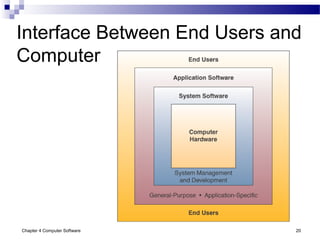
๏ฎ System Management Programs
๏‚จManages the hardware, software, network,
and data resources of computer systems
๏‚จExample: operating systems, network manage-
ment programs, database management
systems, system utilities
๏ฎ System Development Programs
๏‚จHelps users develop IS programs and
procedures and then prepare them for
processing
๏‚จIncludes language translators and editors,
CASE and programming tools
Chapter 4 Computer Software 20
Interface Between End Users and
Computer
Chapter 4 Computer Software 21
Operating Systems
๏ฎ Integrated system of programs thatโ€ฆ
๏‚จManages the operations of the CPU
๏‚จControls the input/output, storage resources,
and activities of the computer system
๏‚จProvides support services as the computer
executes application programs
๏ฎ The operating system must be loaded and
activated before other tasks can be
accomplished
Chapter 4 Computer Software 22
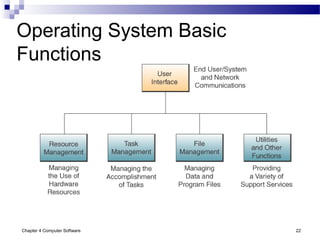
Operating System Basic
Functions
Chapter 4 Computer Software 23
User Interface
๏ฎ The part of the operating system that allows you
to communicate with it
๏ฎ Three main typesโ€ฆ
๏‚จCommand-driven
๏‚จMenu-driven
๏‚จGraphical user interfaces (GUI)
Chapter 4 Computer Software 24
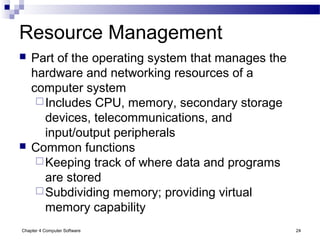
Resource Management
๏ฎ Part of the operating system that manages the
hardware and networking resources of a
computer system
๏‚จIncludes CPU, memory, secondary storage
devices, telecommunications, and
input/output peripherals
๏ฎ Common functions
๏‚จKeeping track of where data and programs
are stored
๏‚จSubdividing memory; providing virtual
memory capability
Chapter 4 Computer Software 25
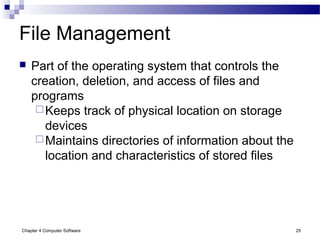
File Management
๏ฎ Part of the operating system that controls the
creation, deletion, and access of files and
programs
๏‚จKeeps track of physical location on storage
devices
๏‚จMaintains directories of information about the
location and characteristics of stored files
Chapter 4 Computer Software 26
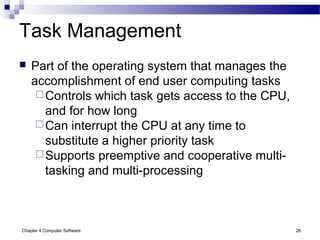
Task Management
๏ฎ Part of the operating system that manages the
accomplishment of end user computing tasks
๏‚จControls which task gets access to the CPU,
and for how long
๏‚จCan interrupt the CPU at any time to
substitute a higher priority task
๏‚จSupports preemptive and cooperative multi-
tasking and multi-processing
Chapter 4 Computer Software 27
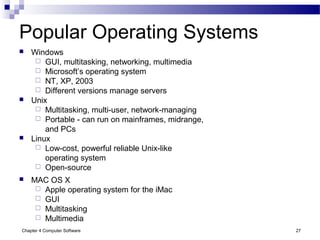
Popular Operating Systems
๏ฎ Windows
๏‚จ GUI, multitasking, networking, multimedia
๏‚จ Microsoftโ€™s operating system
๏‚จ NT, XP, 2003
๏‚จ Different versions manage servers
๏ฎ Unix
๏‚จ Multitasking, multi-user, network-managing
๏‚จ Portable - can run on mainframes, midrange,
and PCs
๏ฎ Linux
๏‚จ Low-cost, powerful reliable Unix-like
operating system
๏‚จ Open-source
๏ฎ MAC OS X
๏‚จ Apple operating system for the iMac
๏‚จ GUI
๏‚จ Multitasking
๏‚จ Multimedia
Chapter 4 Computer Software 28
Open-Source Licensing
Characteristics
๏ฎ The Program
๏‚จ Must include source code and allow distribution in
source code as well as compiled form
๏ฎ The License
๏‚จ Shall not restrict any party from selling or giving
away the software as a component of an
aggregate software distribution containing
programs from several sources
๏‚จ Must allow modifications and derived works, and
must allow them to be distributed under the same
terms as the license of the original software
Chapter 4 Computer Software 29
Open-Source Licensing
Characteristics
๏ฎ The License (contโ€™d)
๏‚จ Must allow modifications and derived works and
allow them to be distributed under the same
terms as the license of the original software
๏‚จ May restrict source code from being distributed in
modified form only if the license allows the
distribution of patch files with the source code
for the purpose of modifying the program at build
time
๏‚จ Must not discriminate against any person or any
group of persons
Chapter 4 Computer Software 30
Open-Source Licensing
Characteristics
๏ฎ The License (contโ€™d)
๏‚จ Must not restrict anyone from making use of the
program in a specific field of endeavor
๏‚จ The rights attached to the program must apply to
all to whom the program is redistributed, without
the need for execution of an additional license
๏‚จ Must not be specific to a product
๏‚จ Must not contaminate other software by placing
restrictions on any software distributed along with
the licensed software
Chapter 4 Computer Software 31
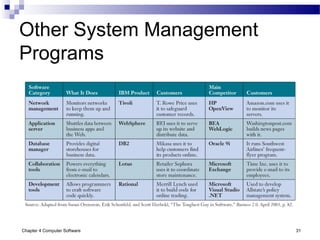
Other System Management
Programs
Chapter 4 Computer Software 32
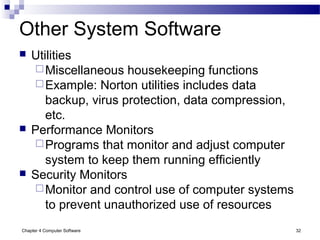
Other System Software
๏ฎ Utilities
๏‚จMiscellaneous housekeeping functions
๏‚จExample: Norton utilities includes data
backup, virus protection, data compression,
etc.
๏ฎ Performance Monitors
๏‚จPrograms that monitor and adjust computer
system to keep them running efficiently
๏ฎ Security Monitors
๏‚จMonitor and control use of computer systems
to prevent unauthorized use of resources
Chapter 4 Computer Software 33
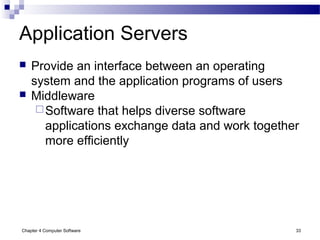
Application Servers
๏ฎ Provide an interface between an operating
system and the application programs of users
๏ฎ Middleware
๏‚จSoftware that helps diverse software
applications exchange data and work together
more efficiently
Chapter 4 Computer Software 34
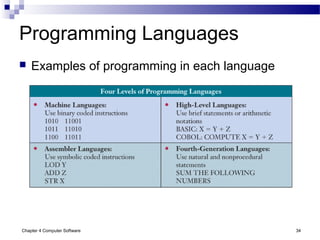
Programming Languages
๏ฎ Examples of programming in each language
Chapter 4 Computer Software 35
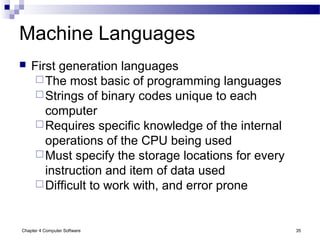
Machine Languages
๏ฎ First generation languages
๏‚จThe most basic of programming languages
๏‚จStrings of binary codes unique to each
computer
๏‚จRequires specific knowledge of the internal
operations of the CPU being used
๏‚จMust specify the storage locations for every
instruction and item of data used
๏‚จDifficult to work with, and error prone
Chapter 4 Computer Software 36
Assembler Languages
๏ฎ Second generation languages
๏‚จDeveloped to reduce difficulties in writing
machine language programs
๏‚จUses assemblers to convert the programs into
machine instructions
๏‚จSymbols are used to represent operation
codes and storage locations
๏‚จAlphabetic abbreviations call mnemonics and
other symbols represent operation codes,
storage locations, and data elements
Chapter 4 Computer Software 37
High-Level Languages
๏ฎ Third generation languages
๏‚จUses brief statements or arithmetic
expressions
๏‚จStatements translated into machine language
by compilers or interpreters
๏‚จLess efficient than assembler languages and
requires greater translation time
๏‚จMachine independent
๏‚จExample: BASIC, COBOL, and FORTRAN
Chapter 4 Computer Software 38
Fourth-Generation Languages
๏ฎ Variety of programming languages that are
nonprocedural and conversational
๏‚จEncourages programmers to specify the results
wanted; the computer determines the sequence
of instructions that accomplishes the results
๏‚จSimplified the programming process
๏ฎ Natural languages
๏‚จVery close to English or other human language
๏‚จSometimes called fifth-generation (5GLs)
๏‚จNo longer a trade-off between ease of use and
flexibility
Chapter 4 Computer Software 39
Object-Oriented Languages
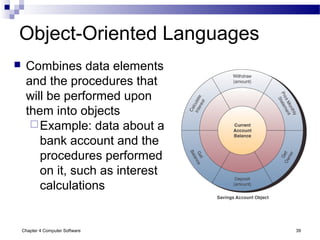
๏ฎ Combines data elements
and the procedures that
will be performed upon
them into objects
๏‚จExample: data about a
bank account and the
procedures performed
on it, such as interest
calculations
Chapter 4 Computer Software 40
Object-Oriented Languages
๏ฎ Most widely used software development
languages
๏‚จEasier to use and more efficient for graphics-
oriented user interfaces
๏‚จReusable: can use an object from one
application in another application
๏‚จExample: Visual Basic, C++, Java
๏‚จMost object-oriented languages provide a GUI
that supports visual programming
Chapter 4 Computer Software 41
Web Languages
๏ฎ HTML
๏‚จA page description language that creates
hypertext documents for the Web
๏ฎ XML
๏‚จDescribes Web page content by applying
identifying tags or contextual labels to the data
๏ฎ Java
๏‚จObject-oriented programming language that is
simple, secure, and platform independent
๏‚จJava applets can be executed on any computer
Chapter 4 Computer Software 42
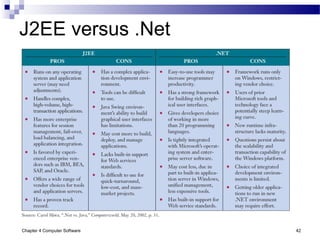
J2EE versus .Net
Chapter 4 Computer Software 43
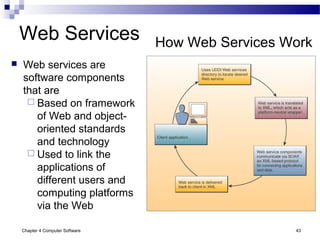
Web Services
๏ฎ Web services are
software components
that are
๏‚จ Based on framework
of Web and object-
oriented standards
and technology
๏‚จ Used to link the
applications of
different users and
computing platforms
via the Web
How Web Services Work
Chapter 4 Computer Software 44
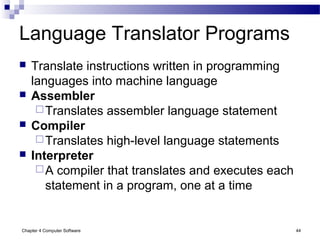
Language Translator Programs
๏ฎ Translate instructions written in programming
languages into machine language
๏ฎ Assembler
๏‚จTranslates assembler language statement
๏ฎ Compiler
๏‚จTranslates high-level language statements
๏ฎ Interpreter
๏‚จA compiler that translates and executes each
statement in a program, one at a time
Chapter 4 Computer Software 45
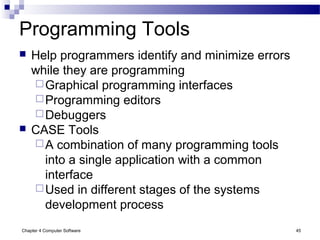
Programming Tools
๏ฎ Help programmers identify and minimize errors
while they are programming
๏‚จGraphical programming interfaces
๏‚จProgramming editors
๏‚จDebuggers
๏ฎ CASE Tools
๏‚จA combination of many programming tools
into a single application with a common
interface
๏‚จUsed in different stages of the systems
development process

Chap04 Computer Software

  • 1.
    Chapter 4 Computer Software JamesA. O'Brien, and George Marakas. Management Information Systems with MISource 2007, 8th ed. Boston, MA: McGraw-Hill, Inc., 2007. ISBN: 13 9780073323091
  • 2.
    Chapter 4 ComputerSoftware 2 Types of Application & System Software
  • 3.
    Chapter 4 ComputerSoftware 3 Application Software ๏ฎ General Purpose ๏‚จ Programs that perform common information processing jobs for end users; e.g., word processing, spreadsheet ๏‚จ Also call productivity packages ๏ฎ Custom Software ๏‚จ Software applications developed within an organization for use by that organization ๏ฎ Commercial Off-the-Shelf (COTS) ๏‚จ Many copies sold ๏‚จ Minimal changes beyond scheduled upgrades ๏‚จ Purchasers have no control over specifications, schedule, or evolution, and no access to source code or internal documentation ๏‚จ Product vendor retains the intellectual property rights of the software
  • 4.
    Chapter 4 ComputerSoftware 4 Application Software ๏ฎ Open-source Software ๏‚จ Developers collaborate on the development of an application using programming standards which allow anyone to contribute to the software ๏‚จ As each developer completes a project, the application code becomes available and free to anyone who wants it
  • 5.
    Chapter 4 ComputerSoftware 5 Business Application Software ๏ฎ Function-Specific Application Software ๏‚จThousands of these packages support specific applications of end users ๏‚จExamples: customer relationship management, enterprise resource planning, supply chain management, Web-enabled electronic commerce
  • 6.
    Chapter 4 ComputerSoftware 6 Software Suites, Integrated Packages ๏ฎ Most widely used productivity packages are bundled together as software suites ๏ฎ Advantages ๏‚จCost less than buying individual packages ๏‚จAll have similar GUI ๏‚จWork well together ๏ฎ Disadvantages ๏‚จAll features not used ๏‚จTakes a lot of disk space (bloatware)
  • 7.
    Chapter 4 ComputerSoftware 7 Components of Top Software Suites
  • 8.
    Chapter 4 ComputerSoftware 8 Integrated Packages ๏ฎ Integrated packages combine the functions of several programs into one package ๏‚จE.g., Microsoft Works, AppleWorks ๏ฎ Advantages ๏‚จMany functions for lower price ๏‚จUses less disk space ๏‚จFrequently pre-installed on microcomputers ๏ฎ Disadvantages ๏‚จLimited functionality
  • 9.
    Chapter 4 ComputerSoftware 9 Web Browsers ๏ฎ Software applications that support navigation through the point-and-click hyper-linked resources of the Web ๏ฎ Becoming the universal platform from which end users launchโ€ฆ ๏‚จInformation searches ๏‚จE-mail ๏‚จMultimedia file transfer ๏‚จDiscussion groups ๏‚จOther Internet-based applications
  • 10.
    Chapter 4 ComputerSoftware 10 Search Engines ๏ฎ Browsers are used to gain access to Internet search engines ๏‚จGoogle, Ask Jeeves, Look Smart, Lycos, Overture, Yahoo! ๏ฎ Using search engines to find information has become an indispensable part of Internet, intranet, and extranet applications
  • 11.
    Chapter 4 ComputerSoftware 11 E-mail, Instant Messaging, and Weblogs ๏ฎ E-mail ๏‚จSoftware to communicate by sending and receiving messages and attachments via the Internet, intranet, or extranet ๏ฎ Instant messaging (IM) ๏‚จReceive electronic messages instantly ๏ฎ Weblog or blog ๏‚จA personal website in dated log format ๏‚จUpdated with new information about a subject or range of subjects
  • 12.
    Chapter 4 ComputerSoftware 12 Word Processing/Desktop Publishing ๏ฎ Word Processing ๏‚จCreate, edit, revise, and print documents ๏‚จExample: Microsoft Word, Lotus WordPro, Corel WordPerfect ๏ฎ Desktop Publishing ๏‚จProduce printed materials that look professionally published ๏‚จExample: Adobe PageMaker, Microsoft Publisher, QuarkXPress
  • 13.
    Chapter 4 ComputerSoftware 13 Electronic Spreadsheets ๏ฎ Used by virtually every business forโ€ฆ ๏‚จAnalysis, planning, modeling ๏ฎ Electronic Spreadsheet ๏‚จWorksheet of rows and columns ๏‚จCan be stored on local computer or on network ๏‚จRequires designing format and developing the relationships (formulas) ๏‚จMost help you develop charts and graphic displays of spreadsheet results ๏‚จSupports what-if questions
  • 14.
    Chapter 4 ComputerSoftware 14 Presentation Graphics ๏ฎ Common presentation graphics packagesโ€ฆ ๏‚จConverts numeric data into graphics displays ๏‚จUsed to create multimedia presentations of graphics, photos, animation, and video clips ๏‚จE.g., Microsoft PowerPoint, Lotus Freelance, Corel Presentations ๏‚จTop packages can tailor files for transfer in HTML format to websites
  • 15.
    Chapter 4 ComputerSoftware 15 Personal Information Managers ๏ฎ Software for end user productivity and collaboration ๏‚จStores information about clients ๏‚จManages schedules, appointments, tasks ๏‚จMost include ability to access the Web and provide e-mail capabilities ๏‚จSome support team collaboration by sharing information with other PIM users ๏‚จExample: Lotus Organizer, Microsoft Outlook
  • 16.
    Chapter 4 ComputerSoftware 16 Groupware ๏ฎ Software that helps workgroups collaborate on group assignments ๏‚จE-mail, discussion groups, databases, video conferencing ๏‚จExample: Lotus Notes, Novell GroupWise, Microsoft Exchange ๏‚จWindows SharePoint Services and WebSphere both allow teams to create websites for information sharing and document collaboration
  • 17.
    Chapter 4 ComputerSoftware 17 Software Alternatives ๏ฎ Outsourcing development and maintenance of software ๏ฎ Application service providers (ASPs) ๏‚จCompanies that own, operate, and maintain application software and computer system resources ๏‚จUse the application for a fee over the Internet ๏‚จPay-as-you-go ๏‚จUse expected to accelerate in the coming years
  • 18.
    Chapter 4 ComputerSoftware 18 Software Licensing ๏ฎ All COTS and ASP software is licensed ๏‚จInvolves the underlying.. ๏ฎ Intellectual property rights ๏ฎ Copyright ๏ฎ Trademark ๏ฎ Trade secrets ๏‚จAlso involves traditional contract law, including Uniform Commercial Code (UCC) ๏ฎ You donโ€™t buy software ๏‚จYou buy a license to use the software ๏‚จLicensed to protect the vendorโ€™s property rights
  • 19.
    Chapter 4 ComputerSoftware 19 Categories of Group Software ๏ฎ System Management Programs ๏‚จManages the hardware, software, network, and data resources of computer systems ๏‚จExample: operating systems, network manage- ment programs, database management systems, system utilities ๏ฎ System Development Programs ๏‚จHelps users develop IS programs and procedures and then prepare them for processing ๏‚จIncludes language translators and editors, CASE and programming tools
  • 20.
    Chapter 4 ComputerSoftware 20 Interface Between End Users and Computer
  • 21.
    Chapter 4 ComputerSoftware 21 Operating Systems ๏ฎ Integrated system of programs thatโ€ฆ ๏‚จManages the operations of the CPU ๏‚จControls the input/output, storage resources, and activities of the computer system ๏‚จProvides support services as the computer executes application programs ๏ฎ The operating system must be loaded and activated before other tasks can be accomplished
  • 22.
    Chapter 4 ComputerSoftware 22 Operating System Basic Functions
  • 23.
    Chapter 4 ComputerSoftware 23 User Interface ๏ฎ The part of the operating system that allows you to communicate with it ๏ฎ Three main typesโ€ฆ ๏‚จCommand-driven ๏‚จMenu-driven ๏‚จGraphical user interfaces (GUI)
  • 24.
    Chapter 4 ComputerSoftware 24 Resource Management ๏ฎ Part of the operating system that manages the hardware and networking resources of a computer system ๏‚จIncludes CPU, memory, secondary storage devices, telecommunications, and input/output peripherals ๏ฎ Common functions ๏‚จKeeping track of where data and programs are stored ๏‚จSubdividing memory; providing virtual memory capability
  • 25.
    Chapter 4 ComputerSoftware 25 File Management ๏ฎ Part of the operating system that controls the creation, deletion, and access of files and programs ๏‚จKeeps track of physical location on storage devices ๏‚จMaintains directories of information about the location and characteristics of stored files
  • 26.
    Chapter 4 ComputerSoftware 26 Task Management ๏ฎ Part of the operating system that manages the accomplishment of end user computing tasks ๏‚จControls which task gets access to the CPU, and for how long ๏‚จCan interrupt the CPU at any time to substitute a higher priority task ๏‚จSupports preemptive and cooperative multi- tasking and multi-processing
  • 27.
    Chapter 4 ComputerSoftware 27 Popular Operating Systems ๏ฎ Windows ๏‚จ GUI, multitasking, networking, multimedia ๏‚จ Microsoftโ€™s operating system ๏‚จ NT, XP, 2003 ๏‚จ Different versions manage servers ๏ฎ Unix ๏‚จ Multitasking, multi-user, network-managing ๏‚จ Portable - can run on mainframes, midrange, and PCs ๏ฎ Linux ๏‚จ Low-cost, powerful reliable Unix-like operating system ๏‚จ Open-source ๏ฎ MAC OS X ๏‚จ Apple operating system for the iMac ๏‚จ GUI ๏‚จ Multitasking ๏‚จ Multimedia
  • 28.
    Chapter 4 ComputerSoftware 28 Open-Source Licensing Characteristics ๏ฎ The Program ๏‚จ Must include source code and allow distribution in source code as well as compiled form ๏ฎ The License ๏‚จ Shall not restrict any party from selling or giving away the software as a component of an aggregate software distribution containing programs from several sources ๏‚จ Must allow modifications and derived works, and must allow them to be distributed under the same terms as the license of the original software
  • 29.
    Chapter 4 ComputerSoftware 29 Open-Source Licensing Characteristics ๏ฎ The License (contโ€™d) ๏‚จ Must allow modifications and derived works and allow them to be distributed under the same terms as the license of the original software ๏‚จ May restrict source code from being distributed in modified form only if the license allows the distribution of patch files with the source code for the purpose of modifying the program at build time ๏‚จ Must not discriminate against any person or any group of persons
  • 30.
    Chapter 4 ComputerSoftware 30 Open-Source Licensing Characteristics ๏ฎ The License (contโ€™d) ๏‚จ Must not restrict anyone from making use of the program in a specific field of endeavor ๏‚จ The rights attached to the program must apply to all to whom the program is redistributed, without the need for execution of an additional license ๏‚จ Must not be specific to a product ๏‚จ Must not contaminate other software by placing restrictions on any software distributed along with the licensed software
  • 31.
    Chapter 4 ComputerSoftware 31 Other System Management Programs
  • 32.
    Chapter 4 ComputerSoftware 32 Other System Software ๏ฎ Utilities ๏‚จMiscellaneous housekeeping functions ๏‚จExample: Norton utilities includes data backup, virus protection, data compression, etc. ๏ฎ Performance Monitors ๏‚จPrograms that monitor and adjust computer system to keep them running efficiently ๏ฎ Security Monitors ๏‚จMonitor and control use of computer systems to prevent unauthorized use of resources
  • 33.
    Chapter 4 ComputerSoftware 33 Application Servers ๏ฎ Provide an interface between an operating system and the application programs of users ๏ฎ Middleware ๏‚จSoftware that helps diverse software applications exchange data and work together more efficiently
  • 34.
    Chapter 4 ComputerSoftware 34 Programming Languages ๏ฎ Examples of programming in each language
  • 35.
    Chapter 4 ComputerSoftware 35 Machine Languages ๏ฎ First generation languages ๏‚จThe most basic of programming languages ๏‚จStrings of binary codes unique to each computer ๏‚จRequires specific knowledge of the internal operations of the CPU being used ๏‚จMust specify the storage locations for every instruction and item of data used ๏‚จDifficult to work with, and error prone
  • 36.
    Chapter 4 ComputerSoftware 36 Assembler Languages ๏ฎ Second generation languages ๏‚จDeveloped to reduce difficulties in writing machine language programs ๏‚จUses assemblers to convert the programs into machine instructions ๏‚จSymbols are used to represent operation codes and storage locations ๏‚จAlphabetic abbreviations call mnemonics and other symbols represent operation codes, storage locations, and data elements
  • 37.
    Chapter 4 ComputerSoftware 37 High-Level Languages ๏ฎ Third generation languages ๏‚จUses brief statements or arithmetic expressions ๏‚จStatements translated into machine language by compilers or interpreters ๏‚จLess efficient than assembler languages and requires greater translation time ๏‚จMachine independent ๏‚จExample: BASIC, COBOL, and FORTRAN
  • 38.
    Chapter 4 ComputerSoftware 38 Fourth-Generation Languages ๏ฎ Variety of programming languages that are nonprocedural and conversational ๏‚จEncourages programmers to specify the results wanted; the computer determines the sequence of instructions that accomplishes the results ๏‚จSimplified the programming process ๏ฎ Natural languages ๏‚จVery close to English or other human language ๏‚จSometimes called fifth-generation (5GLs) ๏‚จNo longer a trade-off between ease of use and flexibility
  • 39.
    Chapter 4 ComputerSoftware 39 Object-Oriented Languages ๏ฎ Combines data elements and the procedures that will be performed upon them into objects ๏‚จExample: data about a bank account and the procedures performed on it, such as interest calculations
  • 40.
    Chapter 4 ComputerSoftware 40 Object-Oriented Languages ๏ฎ Most widely used software development languages ๏‚จEasier to use and more efficient for graphics- oriented user interfaces ๏‚จReusable: can use an object from one application in another application ๏‚จExample: Visual Basic, C++, Java ๏‚จMost object-oriented languages provide a GUI that supports visual programming
  • 41.
    Chapter 4 ComputerSoftware 41 Web Languages ๏ฎ HTML ๏‚จA page description language that creates hypertext documents for the Web ๏ฎ XML ๏‚จDescribes Web page content by applying identifying tags or contextual labels to the data ๏ฎ Java ๏‚จObject-oriented programming language that is simple, secure, and platform independent ๏‚จJava applets can be executed on any computer
  • 42.
    Chapter 4 ComputerSoftware 42 J2EE versus .Net
  • 43.
    Chapter 4 ComputerSoftware 43 Web Services ๏ฎ Web services are software components that are ๏‚จ Based on framework of Web and object- oriented standards and technology ๏‚จ Used to link the applications of different users and computing platforms via the Web How Web Services Work
  • 44.
    Chapter 4 ComputerSoftware 44 Language Translator Programs ๏ฎ Translate instructions written in programming languages into machine language ๏ฎ Assembler ๏‚จTranslates assembler language statement ๏ฎ Compiler ๏‚จTranslates high-level language statements ๏ฎ Interpreter ๏‚จA compiler that translates and executes each statement in a program, one at a time
  • 45.
    Chapter 4 ComputerSoftware 45 Programming Tools ๏ฎ Help programmers identify and minimize errors while they are programming ๏‚จGraphical programming interfaces ๏‚จProgramming editors ๏‚จDebuggers ๏ฎ CASE Tools ๏‚จA combination of many programming tools into a single application with a common interface ๏‚จUsed in different stages of the systems development process