MSB204-1 22V
CBL PROJECT REPORT
IVAR IKS
Digitalisation and sustainability
GROUP 5:
Syed Aqib Ali 268248
Leomar Jose Heredia Gomez 246122
Sushant Hada 268255
Nina Magda Kowalska 269398
S M Nayem Abdullah 261919
Table of Contents
Stage 1: Engaging Phase..........................................................................................................3
About IVAR IKS ..............................................................................................................................3
Why IVAR?.......................................................................................................................................4
Big idea ..............................................................................................................................................4
Essential questions............................................................................................................................5
Challenge...........................................................................................................................................5
Stage 2– Investigating Phase....................................................................................................6
Guiding questions and informative discussion with IVAR...........................................................6
Stage 3 – Acting Phase............................................................................................................10
Background of the solution............................................................................................................10
Why we need to find a solution for digitalization of data and information...............................11
Real-Time data (Future prediction and seasonal trends).............................................................................11
Research purposes and UN goal #12...........................................................................................................12
Control of production (Effectiveness and efficiency) .................................................................................12
Proceeding to Solution....................................................................................................................13
Two Dimensions..............................................................................................................................13
Supply of wastage ...........................................................................................................................14
Optimizing food waste through digital application .....................................................................14
Group reflection..............................................................................................................................16
References: ......................................................................................................................................17
Stage 1: Engaging Phase
IVAR IKS
About IVAR IKS
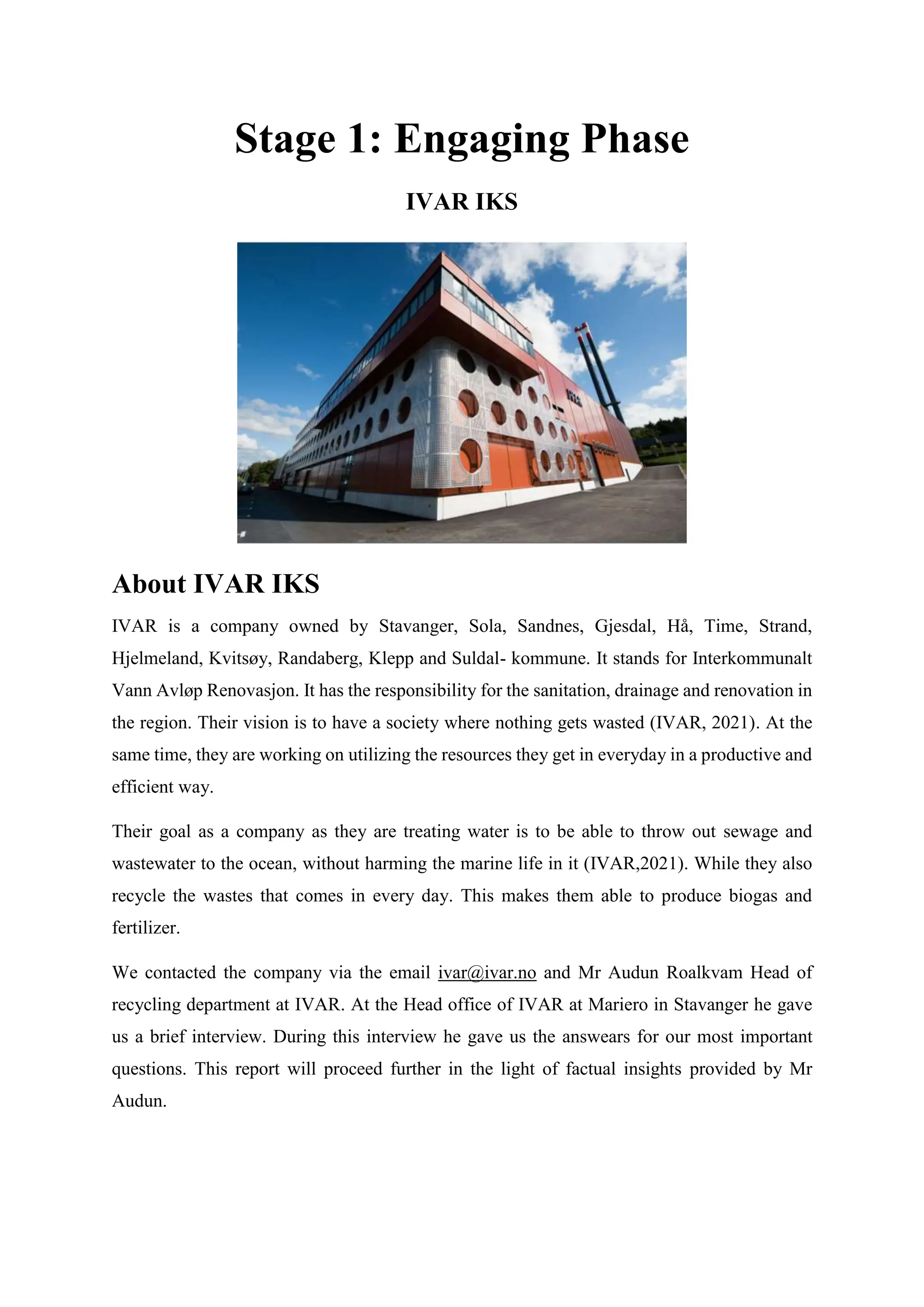
IVAR is a company owned by Stavanger, Sola, Sandnes, Gjesdal, Hå, Time, Strand,
Hjelmeland, Kvitsøy, Randaberg, Klepp and Suldal- kommune. It stands for Interkommunalt
Vann Avløp Renovasjon. It has the responsibility for the sanitation, drainage and renovation in
the region. Their vision is to have a society where nothing gets wasted (IVAR, 2021). At the
same time, they are working on utilizing the resources they get in everyday in a productive and
efficient way.
Their goal as a company as they are treating water is to be able to throw out sewage and
wastewater to the ocean, without harming the marine life in it (IVAR,2021). While they also
recycle the wastes that comes in every day. This makes them able to produce biogas and
fertilizer.
We contacted the company via the email ivar@ivar.no and Mr Audun Roalkvam Head of
recycling department at IVAR. At the Head office of IVAR at Mariero in Stavanger he gave
us a brief interview. During this interview he gave us the answears for our most important
questions. This report will proceed further in the light of factual insights provided by Mr
Audun.
Why IVAR?
There was a bit confusion to select in between various restaurants, mega grocery stores or
wastage management companies. After some initial discussion with the team, we decided to
form a list of different interrelated questions regarding food wastage and we went to Rema
1000, Coop Mega, and Kiwi on the first outdoor visit and they gave us some emails to contact
to right person in the company. We sent them emails with our questions but still could not get
the answers. However, meanwhile we decided to finalize the one restaurant which may be
popular and having a good traffic of customers as the food wastage could be a mandatory
problem for them. Hence, we explored Villa 22, Olivia Torget, Egon Stavanger and Harry
Pepper. After few hours of Intractive interview sessions with the staff and concerned person,
we ended up concluding that they were doing their best to minimize food wastage. We came
to know that it is a legal practice to throw the partially eaten or even the untouched food coming
from the customer’s table so we can't do much about that, and regarding the food which is left
behind is the refrigerator and can get expired within few days, they answered that our
professional chefs are intelligent enough hence they know how precisely they can get the most
out of it before it gets expired. Conversely, we were not satisfied on this response because it is
nearly impossible to have a that precise check and balance in the inventory which is fragile as
we also found a verbal evidence from other restaurants that they said we encourage our working
staff to take that food which is going get expired within few days and it is not required anymore.
That was where we ended up concluding that our first question is not worth anymore to work
on it so it led us to reconsider our second question on how to improve the food waste more
efficiently with digitalization, which we then considered IVAR as a good choice to answer this
big and interesting challenge.
As Food is one of basic need of human, and it’s the most important resource on planet earth
and it is one of the biggest challenges for humanity to save the extra food and find the best
efficient ways for it to serve it to those need it.
Big idea
The big idea of this report can be summarised as following:
“Digitalization and Sustainability”
Essential questions
1. What do you do with the food waste?
2. What kind of food is being wasted?
3. Where does the food waste come from?
4. What's the most normal kind of waste? process of food waste, possibility of making
waste to something valuable?
5. What are you doing in terms of preventing food waste?
6. What are the high seasons of food wastage during the year?
7. What are you doing to recycle/transform it more efficiently?
8. Are you utilizing food waste other than producing biogas?
9. What tool/software you use to have good coordination between the suppliers of (Food)
wastage and the utilizers of (food) wastage in terms of weekly demand and supply. Do
you face any problems executing this coordination?
Challenge
As per our findings, we faced many challenges during the collections of data from several
stores, restaurant and the waste management companies. One of the major issues with the waste
management is that the stores and restaurants are unable to separate the food waste from their
side as they are keeping the cooked foods or the raw foods in same garbage bin. They are
unable to separate these waste as they keep all the biodegradable wastages in one single trash
bin which includes cooked food, raw foods, papers and all. This is the main reason that
challenged us as these kinds of waste cannot be used to feed the animals in the animal shelter
or the pigs in the farms.
Beside this, we could not find proper answers to our findings as they were unable to provide
us with the proper answers to our questions. They could not cooperate with all sorts of questions
we had which challenged us which left us with only little information.
Manage and minimize food wastage efficiently with digital tools in IVAR.
Stage 2– Investigating Phase
Mr Audun Roalkvam Head of recycling department at IVAR has given us a brief interview
of almost 40 minutes in the Head office of IVAR at Mariero Stavanger and this report will
proceed further in the light of factual insights provide by Mr Audun.
Guiding questions and informative discussion with IVAR
CBL Group 5 went to IVAR Head Quarters at Mariero since Mr. Audun Roalkvam gave the
appointment for this discussion of Food waste and Digitalization and after 40 minutes of one-
to-one productive interview with the head of recycling department Mr. Audun the discussion
concluded in the following paragraphs in the forms of guiding questions and IVAR response.
These are the main questions we focused on when we had the interview with Audun and the
response of Audun has been summarized in the following paragraphs:
1. How do you describe the supply chain of food waste?
a. We treat waste, do not collect it. Private and Industrial. IVAR gets the waste
from the Stavanger kommune. Make biogas and fertilizer. The rest biomass left
has a lot of nutrients and is shipped to the rest of Norway to the life stocks.
2. Is it possible to produce biogas from every food waste?
a. Some more than others, it depends on how much fiber the food waste has. The
more fiber means the more difficulty may be faced during decomposition
(Weiland, 2010).
3. How is the demand for biogas?
a. The gas is produced by letting the food rotten and heat it a little bit and
decompose the food, it treated a little bit, and this gas is then collected, and
ready to be sold. It is sold as fuel for transport and as heating fuel for homes,
green house etc (mostly sold as this). We can also make electricity out of it. The
production of biogas is less than the demand, and lyse wants IVAR to produce
more biogas, so it can be sold as electricity.
(Biogas may be utilized as a fuel source as well as a source of energy. Methane is the primary
component of biogas. Biogas contains chemical energy; therefore, electricity is generated by
turning this chemical energy to mechanical energy, which is then converted to electricity. This
is achieved by converting energy from one form to another using transducers such as generators
and turbines. Because it may be produced on a small or big scale, this power can be utilized
both home and commercially (Salvador et al., 2019).)
4. What do you do with the leftovers of biomass waste?
a. The biomass waste is sent to other parts of Norway where there is demand for
that (Grønnvekst AS, 2008), because here in Jæren there is more than enough
of supply with so many cows etc that there is in the area.
5. Could these leftovers be given to animals as nutrients?
a. Also, it is given to larvas so they can eat it. And you can make bread out of
larvas because of their high nutritions in proteins.
Digestate, the waste product of digestion, can be utilized or sold as fertilizer, eliminating the
demand for artificial fertilizers. Digestate can also be marketed as animal bedding or soil
amendments to generate extra cash (Tanigawa, 2017).
6. Who transports the Biomass from your side?
a. It is the company named Grønnvekst. Biomass waste is an issue because it costs
transport, it would be better if it could be used locally (Grønnvekst, 2008).
7. What type of data do you use to predict the supply and demand?
a. We are relying on historical data as we get tons and tons of food wastage
because it varies in months or seasons. We also get a lot of other garbage with
the food wastages, so we use historical data on a large scale to plan our
productions. There is no live data analysis but trying to implement the best route
as far as possible.
8. How is digitalization implemented in the company?
a. We are using excel sheets, reports and information through emails and we are
coordinating with our stakeholders from top to bottom by using internet and
phone calls. We do not have the perfect digitalization system right now.
9. Are there any kind of reward or subsidies for IVAR?
a. Not in Norway, it is regulated since this is funded by the taxes when the people
pay for the public services. Although we try to make it as cheap as possible. But
in other countries I know that there is a maximum of how much the companies
can charge, and the rest is subsidized by taxes.
10. How long geographically can IVAR expand?
a. The west coast in Norway is quite difficult to handle because of its geography
with the fjords etc. Probably the southeast part of Norway, in between Stavanger
and Bergen.
11. What are the future expansion plans for IVAR?
a. With Bergen we are getting their waste at the moment (IVAR, 2022). In the
Future we hope that they will see that since it is already in Stavanger, they
should leave it there since we have the capacity for handling it. But we know
that they have plans to make their own fabrics in the future. However, we are
aiming for the space between Kristiansand and Bergen.
12. What are IVAR’s competitors?
a. There are biogas plants specially in the eastern parts of Norway. In the south
there are some composting plants. Drammen would be the closest competitor,
probably (Lindum AS, 2012).
13. Are there any kinds of challenges that IVAR is facing and is looking for solutions?
a. The company wants to get more waste in our plants. The problem is that in
Norway, not everybody collects the food waste. Most of them do but not
everybody does it. Some of the food waste in from Norway is exported to
Denmark as they also have the biogas production. They had started the
production earlier than Norway which is why we want to get more food
wastages in our company. As per the current scenario, about 55% of the food
wastage is owned by the Municipalities. Companies like us must go on public
tenders to stay on the competition.
14. Do the government give you some rewards because you are doing some really
decent work? Managing food waste, stuff that is good for social ethics?
a. No, we do not get rewarded from the government. Everything here in Norway
is regulated. The household must have contracts with municipalities for waste
collection and they must pay whatever the cost is. Also, we try to make it as
cheap as possible so there is no need of any subsidies from the government as
here in Norway, we charge 3,000 kr per year for the household wastages. This
cost includes the taxes.
15. Do government pay IVAR?
a. Yes, the municipality delivers about 10,000 tons of food waste in our company
and they pay us in the calculation of per tons where the municipalities charge
the households for the waste collection. And right now, we have plants that can
handle more wastage than we have right now. So, we have a surplus of food
waste.
16. How is the data helping the company and the stakeholders around IVAR?
a. We have a data project that is going to collect all the production data of IVAR,
this includes delivered and received waste, delivered water to the municipalities,
and received sewer to our treatment plants.
17. Does this type of data gets sent to the Norwegian Environment Agency and
forward it to the UN for example?
a. This is useful data to monitor material recycling, water consumption in each
household etc. These are statistics that our owner municipalities and residents
will benefit from. We forward data to Statistics Norway and the State
Administrator, so that automatic collection and collection of data will be useful.
Stage 3 – Acting Phase
Background of the solution
As we went to IVAR’s headquarters and got to know the company and how they operated, we
noticed that their process of digitalization and efficiency of the company was until a certain
degree (old fashioned) as they were contacting each other and getting all the information
through mails, telephone and excel sheets. This is not a wrong way of handling food waste, but
it creates an opportunity for less control and effectiveness, something we want to change for
the better of the company. IVAR could improve and have more control of their food waste with
this platform, alike idea that we want to introduce to you. Something like the platform order,
but more personalized to IVAR’s needs. This new platform is heavily based on data analytics
which look for similar patterns and changes in specific given periods. This may even help to
understand better the supply chain, as a lot of the analytics is done in Supply Chain analytics
(Quantzig, 2022). Strategic Information System Planning identifies the company’s business
model in several approaches depending on which kind of business model they have. According
to SISP it is noticeably clear that organizational approach is best for understanding this solution
model. To rectify the problem in Ivar we can seek informative assistance from this approach,
which is based on IT architecture, executes through a strategy, and supported by the objectives
to commence organizational change. (Galliers et al., 2020)
To be more precise, IVAR could implement one or both digital strategies i.e., customer
engagement and digitized solutions. Customer engagement provides smooth analytics on the
customer data and their demand. It does improve the communication channel with the
customers whether it is a small or a large company (Sebastian et al., 2020, p.134). Whereas the
Digitized solution provides deep insight into products, services, and the data of the
organization. This strategy is linked with the R&D that is necessary for the organization
(Sebastian et al., 2020, p.135). As IVAR is already a technology-based company, it is fully
enabled with assets like operational backbone and digital service platforms which enables its
operational process efficient supports digital tools and innovation growth. All it is left is the
proper implementation of the ERP software which will provide efficiency, reliability, and
quality in its overall operations (Sebastian et al., 2020, p.137). This will keep track of all the
IVAR data and provide precise information about the whole operational process and all the
incoming and outgoing processes.
Why we need to find a solution for digitalization of data and
information
When a company undergoes a digital transformation, by using digital technologies such as
social media, mobile phones, embedded devices then it must focus on streamlining major
business executions such as customer experience, smoothening the process flow of business
models. The word “transformation” explains the comprehensiveness of actions and tasks that
need to be taken when a company goes through adapting these new technologies. Hence, a
digital transformation typically includes a company-wide digital strategy which comprehends
the in-depth execution plan of transforming old traditions processes into modern automation
systems. (Galliers et al., 2020 p. 202).
In this solution we are going from a macro supply chain perspective to a micro perspective,
focusing on how this will benefit IVAR, which will naturally also benefit some other
stakeholders in the supply chain, but focusing on IVAR. By creating value and need in the
company with this solution, it gives IVAR the opportunity to look different at its supply chain
and practices to improve themselves as a company (Galliers et al., 2020, p.160). In addition, as
the future looks for food waste in Norway and even globally spoken, the food waste industry
is getting bigger, and with this along comes also more information to handle (Elks, 2018). Our
solution is created to handle the amount of big data that there is now, but also the data there is
to come in future.
Data analytics software can be used to effectively manage food waste commercially with
companies like IVAR (Quantzig, 2020), which may include:
1. Real-Time data (Future prediction and seasonal trends)
2. Rational decision making (Prediction of production of Biogas)
3. Reseach Purpose and UN goal #12
4. Control of production (Effective and efficiency)
Real-Time data (Future prediction and seasonal trends)
Real Time Data provides a very efficient way to use the information that is digitally stored as
this data can be accessed very quickly. Future predictions for the incoming food waste can be
monitored more efficiently and the amount of waste that is received on a seasonal basis can
also be analyzed after easily retrieving the data from the database. Even the whole operational
process can be efficiently organized. With the help of extracting live data, we can predict the
near future of the incoming food waste in the plant, amount of waste to distribute for different
purposes which will help the company to stay ahead in the competitive market. It is also one
of the feasible ways to modernize business.
Research purposes and UN goal #12
Having live data will provide more accurate data about the consumption and waste of the
population in the 12 municipalities where IVAR operates. This data will then be sent to SSB
(Norwegian public statistic organization) which handles this data. In addition, this data can also
be used for human developing index purposes, to compare countries and their development
process. Where the one that supplies the data is the Norwegian Environment Agency, which
gets the data from SSB (Avfall Norge, 2018). Nevertheless, it is also important to mention the
contribution this makes as it makes it clear and effective in order to follow the UN goals.
Especially the #12 Responsible consumption and production (UNO, 2022), where this data
contributes to measure this type of development and can tell where we are most likely as a part
of society are heading and contributing to.
UNO mentioned on their webpage that every year, an approximately 1/3 of all food produced,
which is almost equivalent to 1.3 billion tones, having the worth around $1 trillion, ends up
rotting in the bins of consumers and retailers, or spoiling due to poor transportation and
harvesting practices (UNO, 2022).
Control of production (Effectiveness and efficiency)
As real-time data will provide information about how much waste has been collected, the
information will be available as soon as the waste arrives in the warehouse. So, Ivar can take
necessary steps regarding how much waste they are receiving. According to the data, Ivar can
estimate how much biogas they will be going to produce, and they can inform their buyers.
According to the understanding, Ivar can effectively and efficiently manage waste and produce
biogas. It is always easy to manage the cost and time when data and information are available,
so the importance of real-time data is obvious.
Proceeding to Solution
After asking these questions we are clearer in what areas the company is struggling the most,
and in this way, we can try to help them to develop the company and help them to have more
control of the food waste that comes inside in their plants which they process, in order to have
a more efficient use of the biogas that they produce (IVAR, 2018).
The stance of IVAR regarding transforming and managing data insights about food wastage is
surely disappointing because they are still using conventional and old data management tools
like excel files and emails. Which tells us that there´s no proper way of organizing data hence
our solution for the digitalization part comes in.
Two Dimensions
From this point onward we are having two pathways to proceed to, first one is to search for the
solution in terms of data management and digitalization at the last integration part of energy
demanding companies like to provide them concrete evidence about the previous production
and records. Moving to the other perspective, which is more complex, IVAR mentioned after
our interview while talking the contradiction between the interests of collecting more food
waste to produce more biogas and achieving the Sustainability goals of 2030 to decrease
food waste. This can also be confirmed by SSB and where they get part of their data from, for
example food waste in this case from government owned companies from each county in the
region (Avfall Norge, 2019).
Pointing towards this conflict of wants and needs, it is clear that; transformation of
digitalization, and its outcomes will not affect the ‘greed’ of IVAR to collect more wastage but
instead digitalization will help the company to identify the weak spots in the supply chain
which are causing ‘wastage’ of the food waste.
In addition, live database could help for maximizing their profit with other companies selling
their gas and fertilizers, see the needs and study them more of the market. More control, better
predictions (Surie & Wagner, 2005). Also, for their company image, they have more time to
spend on customer relations and what really matters to the company.
Such data storage and control would also benefit the inhabitants in the area for research
purposes as this data would be open and easy to access as it's from a public owned company.
Supply of wastage
The implementation of digitalization in the supply chain can help various stores that deliver
products to different cities in Norway. Depending on which region of Norway you are in,
people have different food needs. People living in the Northern part of the Country will have
different eating habits and needs than the people living in Western part like Stavanger. This
diversity causes products to be thrown away because these are not what people buy there. Chain
stores bring the same products to their outlets no matter where they are because the assortment
must be the same everywhere.
Information on products that are not bought in each region could help to stop food waste by
changing the supply of products that are not bought in each area in favor of increasing the
supply of products that are popular in that area.
Suppliers will not lose money by discontinuing the supply of certain products, because it will
increase the supply of other products that are bought in massive amounts, and the amount of
waste food will decrease. The implementation of digitalization in the form of monitoring of
discarded food by outlets in towns throughout Norway will help to collect data on specific
products that are wasted to a considerable extent.
Optimizing food waste through digital application
The loss of important data which could have been stored and monitored is important to combat
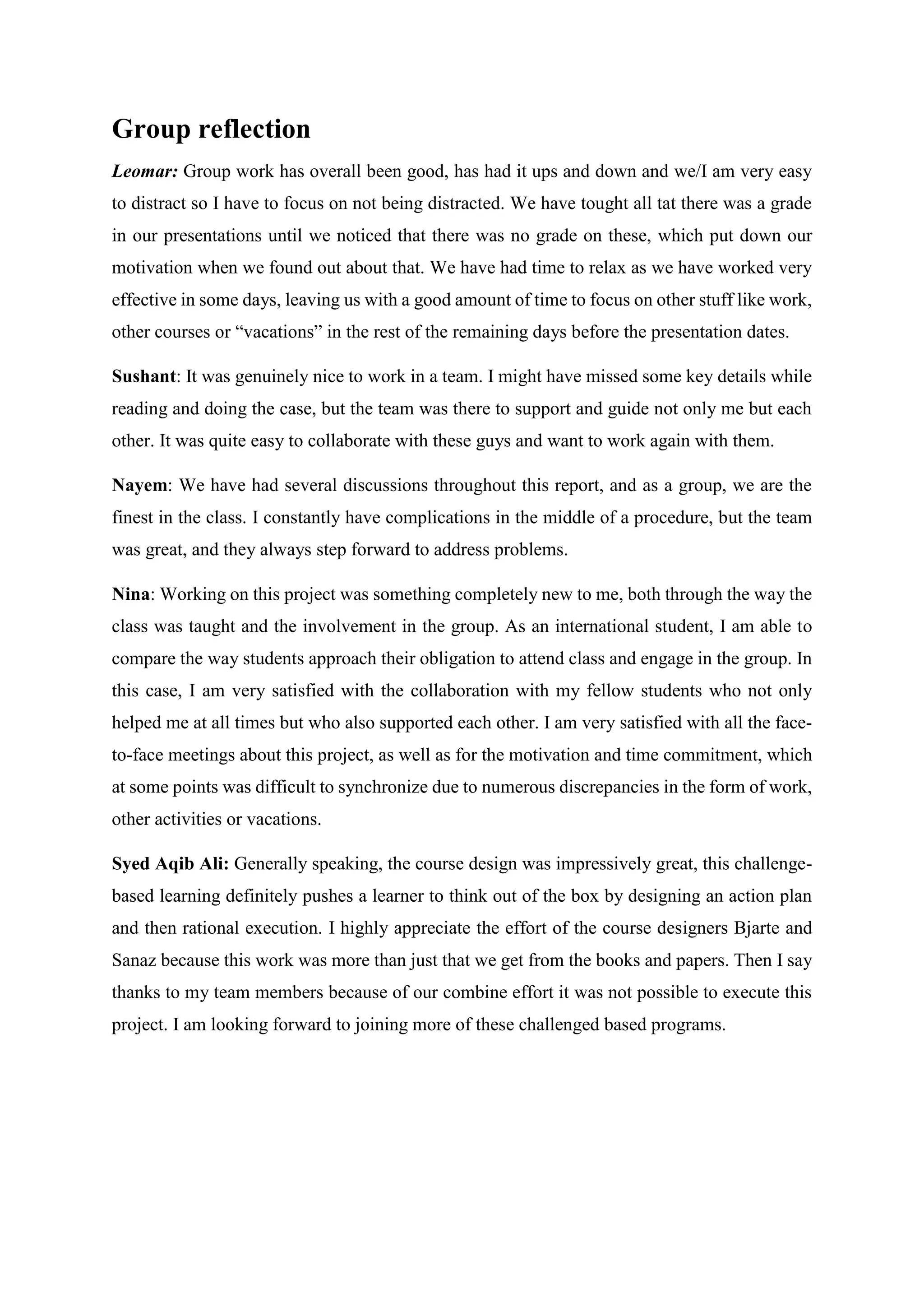
the food waste problem. Hereby, we are introducing you to a digital application, called
“DigiGreen”. This application will consist primarily of recording the information about food
waste, which is being stored in warehouses, for example. here in this application, we will be
able to monitor the figures and stats through several channels in supply chain and we would be
easily predicting the seasonal trends, download the weekly/monthly reports, and many other
KPIs reports. Since this application will be backup by online cloud-based system so every
employee of the company would be able to access it but with the limitations set by the
administrator. Like for example, an employee working in waste collecting plant may have the
application window of inserting the exact numbers of weight, category of wastage, date and
time of arrival and departure etc. Meanwhile a data analyst sitting in the office can get live
insights from it and can prepare himself for the meeting with biogas producing companies to
depict the updated trends. Rather than just converting formerly analog products and services to the
digital world, many businesses want or need to take use of digital technology's capabilities and expand
into new markets (Hess et al., 2016). Where a digital customer interface is really important. To make
communication smoother, Ivar needs to formulate its website more digital where they will keep track
of their food wastes, biogas, fertilizer, biowaste and everything.
Since, this idea is not new, and many companies are already using these kind of softwares such
as esmiley and IKEA providing this tool online as a B2B seller to companies who wants to
manage their waste.
Group reflection
Leomar: Group work has overall been good, has had it ups and down and we/I am very easy
to distract so I have to focus on not being distracted. We have tought all tat there was a grade
in our presentations until we noticed that there was no grade on these, which put down our
motivation when we found out about that. We have had time to relax as we have worked very
effective in some days, leaving us with a good amount of time to focus on other stuff like work,
other courses or “vacations” in the rest of the remaining days before the presentation dates.
Sushant: It was genuinely nice to work in a team. I might have missed some key details while
reading and doing the case, but the team was there to support and guide not only me but each
other. It was quite easy to collaborate with these guys and want to work again with them.
Nayem: We have had several discussions throughout this report, and as a group, we are the
finest in the class. I constantly have complications in the middle of a procedure, but the team
was great, and they always step forward to address problems.
Nina: Working on this project was something completely new to me, both through the way the
class was taught and the involvement in the group. As an international student, I am able to
compare the way students approach their obligation to attend class and engage in the group. In
this case, I am very satisfied with the collaboration with my fellow students who not only
helped me at all times but who also supported each other. I am very satisfied with all the face-
to-face meetings about this project, as well as for the motivation and time commitment, which
at some points was difficult to synchronize due to numerous discrepancies in the form of work,
other activities or vacations.
Syed Aqib Ali: Generally speaking, the course design was impressively great, this challenge-
based learning definitely pushes a learner to think out of the box by designing an action plan
and then rational execution. I highly appreciate the effort of the course designers Bjarte and
Sanaz because this work was more than just that we get from the books and papers. Then I say
thanks to my team members because of our combine effort it was not possible to execute this
project. I am looking forward to joining more of these challenged based programs.
References:
Bjørnerud,S., Syversen, F., Dalen, A. (2019). Avfallsmengder fram mot 2035.
Avfall Norge. https://avfallnorge.ams3.digitaloceanspaces.com/avfall-norge-
no/dokumenter/Avfallsmengder-frem-mot-2035_AN-7-
2019.pdf?mtime=20200401153242&focal=none
Elks, Sonia. (2018, 22. August). By 2030 we could throw away more than 2 billion
tonnes of food. World Economic Forum. Retrived 25. April 2022:
https://www.weforum.org/agenda/2018/08/global-food-waste-could-rise-by-a-third-by-
2030-study
Hess, T., Benlian, A., Matt, C., & Wiesböck, F. (2016). Digital Transformation is
a High-Priority Management Challenge1. MIS Quarterly Executive, 15(123), 163.
Galliers, R., Leidner, D. E., & Simeonova, B. (2020). In Strategic Information
Management: Theory and Practice (5th edition, pp. 12–13). essay, Routledge.
Grønnvekst AS. (2008). Landbruk. Retrived 14.April 2022:
https://www.gronnvekst.no/landbruk
IVAR IKS. (2022, 04.February). IVAR vil nå motta matavfall fra Bergensområdet.
Retrived 14.April 2022:
https://www.ivar.no/aktuelt/ivar-vil-na-motta-matavfall-fra-bergensomradet-
article7568-805.html
IVAR IKS. (2022). About IVAR. Retrived 15.April 2022:
https://www.ivar.no/forus/
IVAR IKS. (2021, 12.November). IVAR Gjenvinningsstasjon Forus. Retrived
15.April 2022: https://www.ivar.no/english/
IVAR IKS. (2018, 09.October). Vi lager biogass. Retrived 14.April 2022:
https://www.ivar.no/biogass/
Lindum AS. (2012). BIOGASSANNELEGGET. Retrived 21.April 2022:
https://lindum.no/biogassanlegget/
Salvador, R., Barros, M. V., Rosário, J. G. D. P. D., Piekarski, C. M., da Luz, L.
M., & de Francisco, A. C. (2019). Life cycle assessment of electricity from biogas: A
systematic literature review. Environmental Progress & Sustainable Energy. 38(4):
13133.
Size, F. & WIRE, B., 2020. Using Data Analytics for Effective Food Waste
Management | Analytics Experts at Quantzig Offer Unprecedented Insights. Retrived 22.
March 2022: https://www.businesswire.com/news/home/20200528005053/en/Using-
Data-Analytics-for-Effective-Food-Waste-Management-Analytics-Experts-at-
Quantzig-Offer-Unprecedented-Insights
Sürie, C., & Wagner, M. (2005). Supply chain analysis. In Supply chain
management and advanced planning. 37-63. Springer, Berlin, Heidelberg.
Syversen,F.,Hanssen,O.,Bratland,H. (2018,31.January). Nasjonal beregning av
Mengde matsvinn på Forbrukerleddet. Avfall Norge.
https://www.miljodirektoratet.no/globalassets/publikasjoner/M1016/M1016.pdf
United Nations. (n.d.). Sustainable consumption and production. United Nations.
Retrieved 15.April, 2022: https://www.un.org/sustainabledevelopment/sustainable-
consumption-production/
Weiland, P. (2010). Biogas production: current state and perspectives. Applied
microbiology and biotechnology. 85(4): 849-860.
Sebastian, I. M., Ross, J. W., Beath, C., Mocker, M., Moloney, K. G., & Fonstad,
N. O. (2020). How Big Old Companies Navigate Digital Transformation. Strategic
Information Management, 133–150. https://doi.org/10.4324/9780429286797-6

Challenged-Based Learning Project on IVAR IKS (Digitalisation and sustainability)

  • 1.
    MSB204-1 22V CBL PROJECTREPORT IVAR IKS Digitalisation and sustainability GROUP 5: Syed Aqib Ali 268248 Leomar Jose Heredia Gomez 246122 Sushant Hada 268255 Nina Magda Kowalska 269398 S M Nayem Abdullah 261919
  • 2.
    Table of Contents Stage1: Engaging Phase..........................................................................................................3 About IVAR IKS ..............................................................................................................................3 Why IVAR?.......................................................................................................................................4 Big idea ..............................................................................................................................................4 Essential questions............................................................................................................................5 Challenge...........................................................................................................................................5 Stage 2– Investigating Phase....................................................................................................6 Guiding questions and informative discussion with IVAR...........................................................6 Stage 3 – Acting Phase............................................................................................................10 Background of the solution............................................................................................................10 Why we need to find a solution for digitalization of data and information...............................11 Real-Time data (Future prediction and seasonal trends).............................................................................11 Research purposes and UN goal #12...........................................................................................................12 Control of production (Effectiveness and efficiency) .................................................................................12 Proceeding to Solution....................................................................................................................13 Two Dimensions..............................................................................................................................13 Supply of wastage ...........................................................................................................................14 Optimizing food waste through digital application .....................................................................14 Group reflection..............................................................................................................................16 References: ......................................................................................................................................17
  • 3.
    Stage 1: EngagingPhase IVAR IKS About IVAR IKS IVAR is a company owned by Stavanger, Sola, Sandnes, Gjesdal, Hå, Time, Strand, Hjelmeland, Kvitsøy, Randaberg, Klepp and Suldal- kommune. It stands for Interkommunalt Vann Avløp Renovasjon. It has the responsibility for the sanitation, drainage and renovation in the region. Their vision is to have a society where nothing gets wasted (IVAR, 2021). At the same time, they are working on utilizing the resources they get in everyday in a productive and efficient way. Their goal as a company as they are treating water is to be able to throw out sewage and wastewater to the ocean, without harming the marine life in it (IVAR,2021). While they also recycle the wastes that comes in every day. This makes them able to produce biogas and fertilizer. We contacted the company via the email ivar@ivar.no and Mr Audun Roalkvam Head of recycling department at IVAR. At the Head office of IVAR at Mariero in Stavanger he gave us a brief interview. During this interview he gave us the answears for our most important questions. This report will proceed further in the light of factual insights provided by Mr Audun.
  • 4.
    Why IVAR? There wasa bit confusion to select in between various restaurants, mega grocery stores or wastage management companies. After some initial discussion with the team, we decided to form a list of different interrelated questions regarding food wastage and we went to Rema 1000, Coop Mega, and Kiwi on the first outdoor visit and they gave us some emails to contact to right person in the company. We sent them emails with our questions but still could not get the answers. However, meanwhile we decided to finalize the one restaurant which may be popular and having a good traffic of customers as the food wastage could be a mandatory problem for them. Hence, we explored Villa 22, Olivia Torget, Egon Stavanger and Harry Pepper. After few hours of Intractive interview sessions with the staff and concerned person, we ended up concluding that they were doing their best to minimize food wastage. We came to know that it is a legal practice to throw the partially eaten or even the untouched food coming from the customer’s table so we can't do much about that, and regarding the food which is left behind is the refrigerator and can get expired within few days, they answered that our professional chefs are intelligent enough hence they know how precisely they can get the most out of it before it gets expired. Conversely, we were not satisfied on this response because it is nearly impossible to have a that precise check and balance in the inventory which is fragile as we also found a verbal evidence from other restaurants that they said we encourage our working staff to take that food which is going get expired within few days and it is not required anymore. That was where we ended up concluding that our first question is not worth anymore to work on it so it led us to reconsider our second question on how to improve the food waste more efficiently with digitalization, which we then considered IVAR as a good choice to answer this big and interesting challenge. As Food is one of basic need of human, and it’s the most important resource on planet earth and it is one of the biggest challenges for humanity to save the extra food and find the best efficient ways for it to serve it to those need it. Big idea The big idea of this report can be summarised as following: “Digitalization and Sustainability”
  • 5.
    Essential questions 1. Whatdo you do with the food waste? 2. What kind of food is being wasted? 3. Where does the food waste come from? 4. What's the most normal kind of waste? process of food waste, possibility of making waste to something valuable? 5. What are you doing in terms of preventing food waste? 6. What are the high seasons of food wastage during the year? 7. What are you doing to recycle/transform it more efficiently? 8. Are you utilizing food waste other than producing biogas? 9. What tool/software you use to have good coordination between the suppliers of (Food) wastage and the utilizers of (food) wastage in terms of weekly demand and supply. Do you face any problems executing this coordination? Challenge As per our findings, we faced many challenges during the collections of data from several stores, restaurant and the waste management companies. One of the major issues with the waste management is that the stores and restaurants are unable to separate the food waste from their side as they are keeping the cooked foods or the raw foods in same garbage bin. They are unable to separate these waste as they keep all the biodegradable wastages in one single trash bin which includes cooked food, raw foods, papers and all. This is the main reason that challenged us as these kinds of waste cannot be used to feed the animals in the animal shelter or the pigs in the farms. Beside this, we could not find proper answers to our findings as they were unable to provide us with the proper answers to our questions. They could not cooperate with all sorts of questions we had which challenged us which left us with only little information. Manage and minimize food wastage efficiently with digital tools in IVAR.
  • 6.
    Stage 2– InvestigatingPhase Mr Audun Roalkvam Head of recycling department at IVAR has given us a brief interview of almost 40 minutes in the Head office of IVAR at Mariero Stavanger and this report will proceed further in the light of factual insights provide by Mr Audun. Guiding questions and informative discussion with IVAR CBL Group 5 went to IVAR Head Quarters at Mariero since Mr. Audun Roalkvam gave the appointment for this discussion of Food waste and Digitalization and after 40 minutes of one- to-one productive interview with the head of recycling department Mr. Audun the discussion concluded in the following paragraphs in the forms of guiding questions and IVAR response. These are the main questions we focused on when we had the interview with Audun and the response of Audun has been summarized in the following paragraphs: 1. How do you describe the supply chain of food waste? a. We treat waste, do not collect it. Private and Industrial. IVAR gets the waste from the Stavanger kommune. Make biogas and fertilizer. The rest biomass left has a lot of nutrients and is shipped to the rest of Norway to the life stocks. 2. Is it possible to produce biogas from every food waste? a. Some more than others, it depends on how much fiber the food waste has. The more fiber means the more difficulty may be faced during decomposition (Weiland, 2010). 3. How is the demand for biogas? a. The gas is produced by letting the food rotten and heat it a little bit and decompose the food, it treated a little bit, and this gas is then collected, and ready to be sold. It is sold as fuel for transport and as heating fuel for homes, green house etc (mostly sold as this). We can also make electricity out of it. The production of biogas is less than the demand, and lyse wants IVAR to produce more biogas, so it can be sold as electricity. (Biogas may be utilized as a fuel source as well as a source of energy. Methane is the primary component of biogas. Biogas contains chemical energy; therefore, electricity is generated by turning this chemical energy to mechanical energy, which is then converted to electricity. This is achieved by converting energy from one form to another using transducers such as generators
  • 7.
    and turbines. Becauseit may be produced on a small or big scale, this power can be utilized both home and commercially (Salvador et al., 2019).) 4. What do you do with the leftovers of biomass waste? a. The biomass waste is sent to other parts of Norway where there is demand for that (Grønnvekst AS, 2008), because here in Jæren there is more than enough of supply with so many cows etc that there is in the area. 5. Could these leftovers be given to animals as nutrients? a. Also, it is given to larvas so they can eat it. And you can make bread out of larvas because of their high nutritions in proteins. Digestate, the waste product of digestion, can be utilized or sold as fertilizer, eliminating the demand for artificial fertilizers. Digestate can also be marketed as animal bedding or soil amendments to generate extra cash (Tanigawa, 2017). 6. Who transports the Biomass from your side? a. It is the company named Grønnvekst. Biomass waste is an issue because it costs transport, it would be better if it could be used locally (Grønnvekst, 2008). 7. What type of data do you use to predict the supply and demand? a. We are relying on historical data as we get tons and tons of food wastage because it varies in months or seasons. We also get a lot of other garbage with the food wastages, so we use historical data on a large scale to plan our productions. There is no live data analysis but trying to implement the best route as far as possible. 8. How is digitalization implemented in the company? a. We are using excel sheets, reports and information through emails and we are coordinating with our stakeholders from top to bottom by using internet and phone calls. We do not have the perfect digitalization system right now. 9. Are there any kind of reward or subsidies for IVAR? a. Not in Norway, it is regulated since this is funded by the taxes when the people pay for the public services. Although we try to make it as cheap as possible. But in other countries I know that there is a maximum of how much the companies can charge, and the rest is subsidized by taxes.
  • 8.
    10. How longgeographically can IVAR expand? a. The west coast in Norway is quite difficult to handle because of its geography with the fjords etc. Probably the southeast part of Norway, in between Stavanger and Bergen. 11. What are the future expansion plans for IVAR? a. With Bergen we are getting their waste at the moment (IVAR, 2022). In the Future we hope that they will see that since it is already in Stavanger, they should leave it there since we have the capacity for handling it. But we know that they have plans to make their own fabrics in the future. However, we are aiming for the space between Kristiansand and Bergen. 12. What are IVAR’s competitors? a. There are biogas plants specially in the eastern parts of Norway. In the south there are some composting plants. Drammen would be the closest competitor, probably (Lindum AS, 2012). 13. Are there any kinds of challenges that IVAR is facing and is looking for solutions? a. The company wants to get more waste in our plants. The problem is that in Norway, not everybody collects the food waste. Most of them do but not everybody does it. Some of the food waste in from Norway is exported to Denmark as they also have the biogas production. They had started the production earlier than Norway which is why we want to get more food wastages in our company. As per the current scenario, about 55% of the food wastage is owned by the Municipalities. Companies like us must go on public tenders to stay on the competition. 14. Do the government give you some rewards because you are doing some really decent work? Managing food waste, stuff that is good for social ethics? a. No, we do not get rewarded from the government. Everything here in Norway is regulated. The household must have contracts with municipalities for waste collection and they must pay whatever the cost is. Also, we try to make it as cheap as possible so there is no need of any subsidies from the government as here in Norway, we charge 3,000 kr per year for the household wastages. This cost includes the taxes. 15. Do government pay IVAR? a. Yes, the municipality delivers about 10,000 tons of food waste in our company and they pay us in the calculation of per tons where the municipalities charge
  • 9.
    the households forthe waste collection. And right now, we have plants that can handle more wastage than we have right now. So, we have a surplus of food waste. 16. How is the data helping the company and the stakeholders around IVAR? a. We have a data project that is going to collect all the production data of IVAR, this includes delivered and received waste, delivered water to the municipalities, and received sewer to our treatment plants. 17. Does this type of data gets sent to the Norwegian Environment Agency and forward it to the UN for example? a. This is useful data to monitor material recycling, water consumption in each household etc. These are statistics that our owner municipalities and residents will benefit from. We forward data to Statistics Norway and the State Administrator, so that automatic collection and collection of data will be useful.
  • 10.
    Stage 3 –Acting Phase Background of the solution As we went to IVAR’s headquarters and got to know the company and how they operated, we noticed that their process of digitalization and efficiency of the company was until a certain degree (old fashioned) as they were contacting each other and getting all the information through mails, telephone and excel sheets. This is not a wrong way of handling food waste, but it creates an opportunity for less control and effectiveness, something we want to change for the better of the company. IVAR could improve and have more control of their food waste with this platform, alike idea that we want to introduce to you. Something like the platform order, but more personalized to IVAR’s needs. This new platform is heavily based on data analytics which look for similar patterns and changes in specific given periods. This may even help to understand better the supply chain, as a lot of the analytics is done in Supply Chain analytics (Quantzig, 2022). Strategic Information System Planning identifies the company’s business model in several approaches depending on which kind of business model they have. According to SISP it is noticeably clear that organizational approach is best for understanding this solution model. To rectify the problem in Ivar we can seek informative assistance from this approach, which is based on IT architecture, executes through a strategy, and supported by the objectives to commence organizational change. (Galliers et al., 2020) To be more precise, IVAR could implement one or both digital strategies i.e., customer engagement and digitized solutions. Customer engagement provides smooth analytics on the customer data and their demand. It does improve the communication channel with the customers whether it is a small or a large company (Sebastian et al., 2020, p.134). Whereas the Digitized solution provides deep insight into products, services, and the data of the organization. This strategy is linked with the R&D that is necessary for the organization (Sebastian et al., 2020, p.135). As IVAR is already a technology-based company, it is fully enabled with assets like operational backbone and digital service platforms which enables its operational process efficient supports digital tools and innovation growth. All it is left is the proper implementation of the ERP software which will provide efficiency, reliability, and quality in its overall operations (Sebastian et al., 2020, p.137). This will keep track of all the IVAR data and provide precise information about the whole operational process and all the incoming and outgoing processes.
  • 11.
    Why we needto find a solution for digitalization of data and information When a company undergoes a digital transformation, by using digital technologies such as social media, mobile phones, embedded devices then it must focus on streamlining major business executions such as customer experience, smoothening the process flow of business models. The word “transformation” explains the comprehensiveness of actions and tasks that need to be taken when a company goes through adapting these new technologies. Hence, a digital transformation typically includes a company-wide digital strategy which comprehends the in-depth execution plan of transforming old traditions processes into modern automation systems. (Galliers et al., 2020 p. 202). In this solution we are going from a macro supply chain perspective to a micro perspective, focusing on how this will benefit IVAR, which will naturally also benefit some other stakeholders in the supply chain, but focusing on IVAR. By creating value and need in the company with this solution, it gives IVAR the opportunity to look different at its supply chain and practices to improve themselves as a company (Galliers et al., 2020, p.160). In addition, as the future looks for food waste in Norway and even globally spoken, the food waste industry is getting bigger, and with this along comes also more information to handle (Elks, 2018). Our solution is created to handle the amount of big data that there is now, but also the data there is to come in future. Data analytics software can be used to effectively manage food waste commercially with companies like IVAR (Quantzig, 2020), which may include: 1. Real-Time data (Future prediction and seasonal trends) 2. Rational decision making (Prediction of production of Biogas) 3. Reseach Purpose and UN goal #12 4. Control of production (Effective and efficiency) Real-Time data (Future prediction and seasonal trends) Real Time Data provides a very efficient way to use the information that is digitally stored as this data can be accessed very quickly. Future predictions for the incoming food waste can be monitored more efficiently and the amount of waste that is received on a seasonal basis can
  • 12.
    also be analyzedafter easily retrieving the data from the database. Even the whole operational process can be efficiently organized. With the help of extracting live data, we can predict the near future of the incoming food waste in the plant, amount of waste to distribute for different purposes which will help the company to stay ahead in the competitive market. It is also one of the feasible ways to modernize business. Research purposes and UN goal #12 Having live data will provide more accurate data about the consumption and waste of the population in the 12 municipalities where IVAR operates. This data will then be sent to SSB (Norwegian public statistic organization) which handles this data. In addition, this data can also be used for human developing index purposes, to compare countries and their development process. Where the one that supplies the data is the Norwegian Environment Agency, which gets the data from SSB (Avfall Norge, 2018). Nevertheless, it is also important to mention the contribution this makes as it makes it clear and effective in order to follow the UN goals. Especially the #12 Responsible consumption and production (UNO, 2022), where this data contributes to measure this type of development and can tell where we are most likely as a part of society are heading and contributing to. UNO mentioned on their webpage that every year, an approximately 1/3 of all food produced, which is almost equivalent to 1.3 billion tones, having the worth around $1 trillion, ends up rotting in the bins of consumers and retailers, or spoiling due to poor transportation and harvesting practices (UNO, 2022). Control of production (Effectiveness and efficiency) As real-time data will provide information about how much waste has been collected, the information will be available as soon as the waste arrives in the warehouse. So, Ivar can take necessary steps regarding how much waste they are receiving. According to the data, Ivar can estimate how much biogas they will be going to produce, and they can inform their buyers. According to the understanding, Ivar can effectively and efficiently manage waste and produce biogas. It is always easy to manage the cost and time when data and information are available, so the importance of real-time data is obvious.
  • 13.
    Proceeding to Solution Afterasking these questions we are clearer in what areas the company is struggling the most, and in this way, we can try to help them to develop the company and help them to have more control of the food waste that comes inside in their plants which they process, in order to have a more efficient use of the biogas that they produce (IVAR, 2018). The stance of IVAR regarding transforming and managing data insights about food wastage is surely disappointing because they are still using conventional and old data management tools like excel files and emails. Which tells us that there´s no proper way of organizing data hence our solution for the digitalization part comes in. Two Dimensions From this point onward we are having two pathways to proceed to, first one is to search for the solution in terms of data management and digitalization at the last integration part of energy demanding companies like to provide them concrete evidence about the previous production and records. Moving to the other perspective, which is more complex, IVAR mentioned after our interview while talking the contradiction between the interests of collecting more food waste to produce more biogas and achieving the Sustainability goals of 2030 to decrease food waste. This can also be confirmed by SSB and where they get part of their data from, for example food waste in this case from government owned companies from each county in the region (Avfall Norge, 2019). Pointing towards this conflict of wants and needs, it is clear that; transformation of digitalization, and its outcomes will not affect the ‘greed’ of IVAR to collect more wastage but instead digitalization will help the company to identify the weak spots in the supply chain which are causing ‘wastage’ of the food waste. In addition, live database could help for maximizing their profit with other companies selling their gas and fertilizers, see the needs and study them more of the market. More control, better predictions (Surie & Wagner, 2005). Also, for their company image, they have more time to spend on customer relations and what really matters to the company. Such data storage and control would also benefit the inhabitants in the area for research purposes as this data would be open and easy to access as it's from a public owned company.
  • 14.
    Supply of wastage Theimplementation of digitalization in the supply chain can help various stores that deliver products to different cities in Norway. Depending on which region of Norway you are in, people have different food needs. People living in the Northern part of the Country will have different eating habits and needs than the people living in Western part like Stavanger. This diversity causes products to be thrown away because these are not what people buy there. Chain stores bring the same products to their outlets no matter where they are because the assortment must be the same everywhere. Information on products that are not bought in each region could help to stop food waste by changing the supply of products that are not bought in each area in favor of increasing the supply of products that are popular in that area. Suppliers will not lose money by discontinuing the supply of certain products, because it will increase the supply of other products that are bought in massive amounts, and the amount of waste food will decrease. The implementation of digitalization in the form of monitoring of discarded food by outlets in towns throughout Norway will help to collect data on specific products that are wasted to a considerable extent. Optimizing food waste through digital application The loss of important data which could have been stored and monitored is important to combat the food waste problem. Hereby, we are introducing you to a digital application, called “DigiGreen”. This application will consist primarily of recording the information about food waste, which is being stored in warehouses, for example. here in this application, we will be able to monitor the figures and stats through several channels in supply chain and we would be easily predicting the seasonal trends, download the weekly/monthly reports, and many other KPIs reports. Since this application will be backup by online cloud-based system so every employee of the company would be able to access it but with the limitations set by the administrator. Like for example, an employee working in waste collecting plant may have the application window of inserting the exact numbers of weight, category of wastage, date and time of arrival and departure etc. Meanwhile a data analyst sitting in the office can get live insights from it and can prepare himself for the meeting with biogas producing companies to depict the updated trends. Rather than just converting formerly analog products and services to the digital world, many businesses want or need to take use of digital technology's capabilities and expand
  • 15.
    into new markets(Hess et al., 2016). Where a digital customer interface is really important. To make communication smoother, Ivar needs to formulate its website more digital where they will keep track of their food wastes, biogas, fertilizer, biowaste and everything. Since, this idea is not new, and many companies are already using these kind of softwares such as esmiley and IKEA providing this tool online as a B2B seller to companies who wants to manage their waste.
  • 16.
    Group reflection Leomar: Groupwork has overall been good, has had it ups and down and we/I am very easy to distract so I have to focus on not being distracted. We have tought all tat there was a grade in our presentations until we noticed that there was no grade on these, which put down our motivation when we found out about that. We have had time to relax as we have worked very effective in some days, leaving us with a good amount of time to focus on other stuff like work, other courses or “vacations” in the rest of the remaining days before the presentation dates. Sushant: It was genuinely nice to work in a team. I might have missed some key details while reading and doing the case, but the team was there to support and guide not only me but each other. It was quite easy to collaborate with these guys and want to work again with them. Nayem: We have had several discussions throughout this report, and as a group, we are the finest in the class. I constantly have complications in the middle of a procedure, but the team was great, and they always step forward to address problems. Nina: Working on this project was something completely new to me, both through the way the class was taught and the involvement in the group. As an international student, I am able to compare the way students approach their obligation to attend class and engage in the group. In this case, I am very satisfied with the collaboration with my fellow students who not only helped me at all times but who also supported each other. I am very satisfied with all the face- to-face meetings about this project, as well as for the motivation and time commitment, which at some points was difficult to synchronize due to numerous discrepancies in the form of work, other activities or vacations. Syed Aqib Ali: Generally speaking, the course design was impressively great, this challenge- based learning definitely pushes a learner to think out of the box by designing an action plan and then rational execution. I highly appreciate the effort of the course designers Bjarte and Sanaz because this work was more than just that we get from the books and papers. Then I say thanks to my team members because of our combine effort it was not possible to execute this project. I am looking forward to joining more of these challenged based programs.
  • 17.
    References: Bjørnerud,S., Syversen, F.,Dalen, A. (2019). Avfallsmengder fram mot 2035. Avfall Norge. https://avfallnorge.ams3.digitaloceanspaces.com/avfall-norge- no/dokumenter/Avfallsmengder-frem-mot-2035_AN-7- 2019.pdf?mtime=20200401153242&focal=none Elks, Sonia. (2018, 22. August). By 2030 we could throw away more than 2 billion tonnes of food. World Economic Forum. Retrived 25. April 2022: https://www.weforum.org/agenda/2018/08/global-food-waste-could-rise-by-a-third-by- 2030-study Hess, T., Benlian, A., Matt, C., & Wiesböck, F. (2016). Digital Transformation is a High-Priority Management Challenge1. MIS Quarterly Executive, 15(123), 163. Galliers, R., Leidner, D. E., & Simeonova, B. (2020). In Strategic Information Management: Theory and Practice (5th edition, pp. 12–13). essay, Routledge. Grønnvekst AS. (2008). Landbruk. Retrived 14.April 2022: https://www.gronnvekst.no/landbruk IVAR IKS. (2022, 04.February). IVAR vil nå motta matavfall fra Bergensområdet. Retrived 14.April 2022: https://www.ivar.no/aktuelt/ivar-vil-na-motta-matavfall-fra-bergensomradet- article7568-805.html IVAR IKS. (2022). About IVAR. Retrived 15.April 2022: https://www.ivar.no/forus/ IVAR IKS. (2021, 12.November). IVAR Gjenvinningsstasjon Forus. Retrived 15.April 2022: https://www.ivar.no/english/ IVAR IKS. (2018, 09.October). Vi lager biogass. Retrived 14.April 2022: https://www.ivar.no/biogass/ Lindum AS. (2012). BIOGASSANNELEGGET. Retrived 21.April 2022: https://lindum.no/biogassanlegget/ Salvador, R., Barros, M. V., Rosário, J. G. D. P. D., Piekarski, C. M., da Luz, L. M., & de Francisco, A. C. (2019). Life cycle assessment of electricity from biogas: A systematic literature review. Environmental Progress & Sustainable Energy. 38(4): 13133. Size, F. & WIRE, B., 2020. Using Data Analytics for Effective Food Waste Management | Analytics Experts at Quantzig Offer Unprecedented Insights. Retrived 22. March 2022: https://www.businesswire.com/news/home/20200528005053/en/Using- Data-Analytics-for-Effective-Food-Waste-Management-Analytics-Experts-at- Quantzig-Offer-Unprecedented-Insights Sürie, C., & Wagner, M. (2005). Supply chain analysis. In Supply chain management and advanced planning. 37-63. Springer, Berlin, Heidelberg. Syversen,F.,Hanssen,O.,Bratland,H. (2018,31.January). Nasjonal beregning av Mengde matsvinn på Forbrukerleddet. Avfall Norge. https://www.miljodirektoratet.no/globalassets/publikasjoner/M1016/M1016.pdf
  • 18.
    United Nations. (n.d.).Sustainable consumption and production. United Nations. Retrieved 15.April, 2022: https://www.un.org/sustainabledevelopment/sustainable- consumption-production/ Weiland, P. (2010). Biogas production: current state and perspectives. Applied microbiology and biotechnology. 85(4): 849-860. Sebastian, I. M., Ross, J. W., Beath, C., Mocker, M., Moloney, K. G., & Fonstad, N. O. (2020). How Big Old Companies Navigate Digital Transformation. Strategic Information Management, 133–150. https://doi.org/10.4324/9780429286797-6