1

POLYMORPISM
BY
IMTIAZ HUSSAIN
What is Meant By Polymorphism?


It is a Greek word.



Poly mean many.



Morphism mean forms.



In programing Polymorphism is the ability for objects of different
classes related by inheritance to response differently to the same
function call.

2
What is Polymorphism in OOP?


After the inheritance it is another most important feature of OOP.



In polymorphism, the member functions with same name are define
in base class and also in each derived class.



Polymorphism is use to keep the interface of base class to its derived
classes.



Polymorphism can be achieved by mean of virtual functions.



In polymorphism one pointer to a base class object may also point
any object of its derived class.

3
How can we access the member
of class?


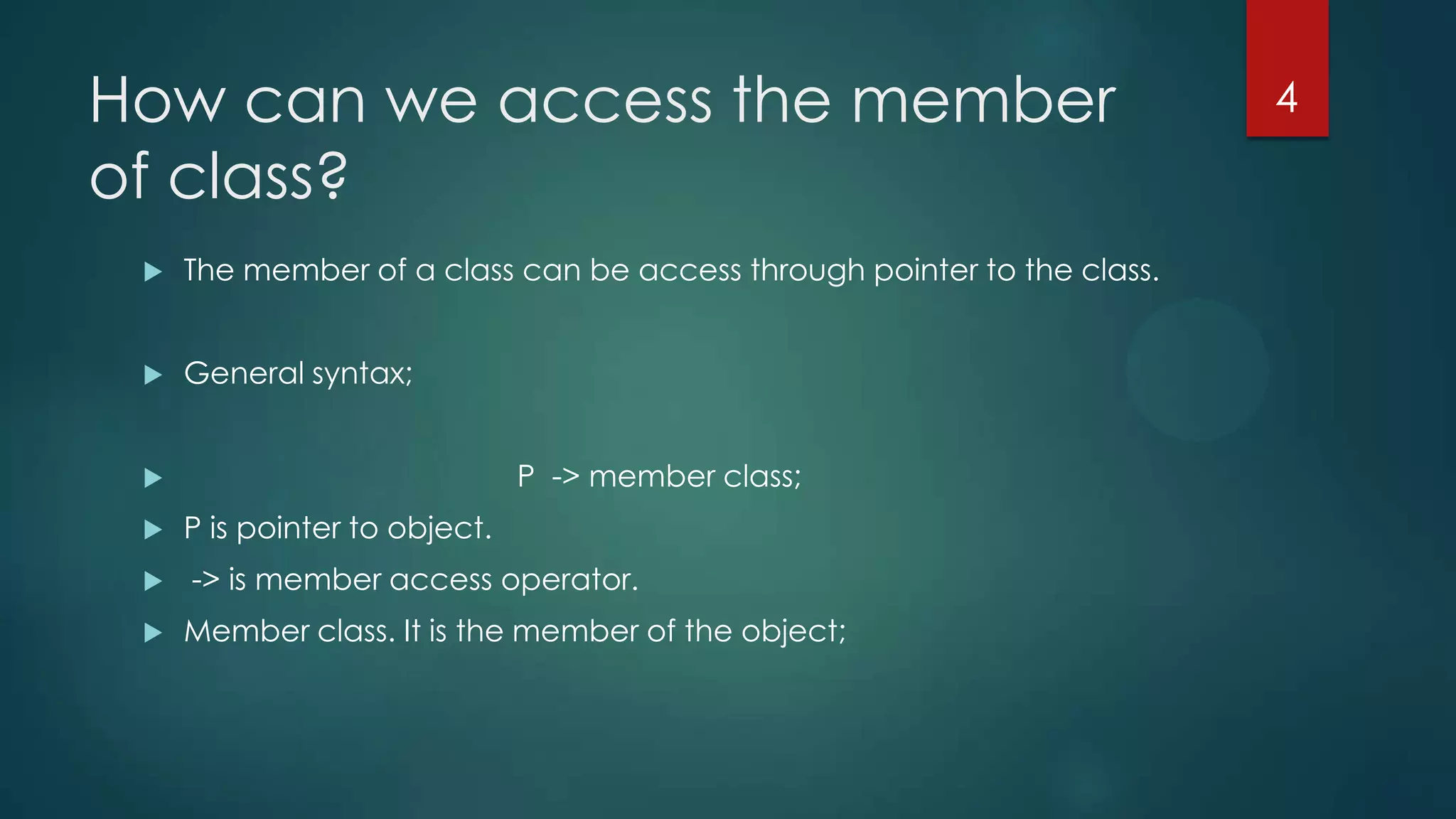
The member of a class can be access through pointer to the class.



General syntax;
P -> member class;






P is pointer to object.
-> is member access operator.
Member class. It is the member of the object;

4
Simple program to access member
of class;
void show()


{



#include<iostream.h>





#include<conio.h>



cout<<"Your name is "<<name;



class data



cout<<"Your age is "<<age;



}



{



private:





};



main()

char name[12];



{



int age;





public:



void input(){





cout<<"Entr your name“;
cin>>name;
cout<<"Enter your age"; cin>>age;}

data obj,*j;
j=&obj;
j->input();



j->show();



getch();



}

5
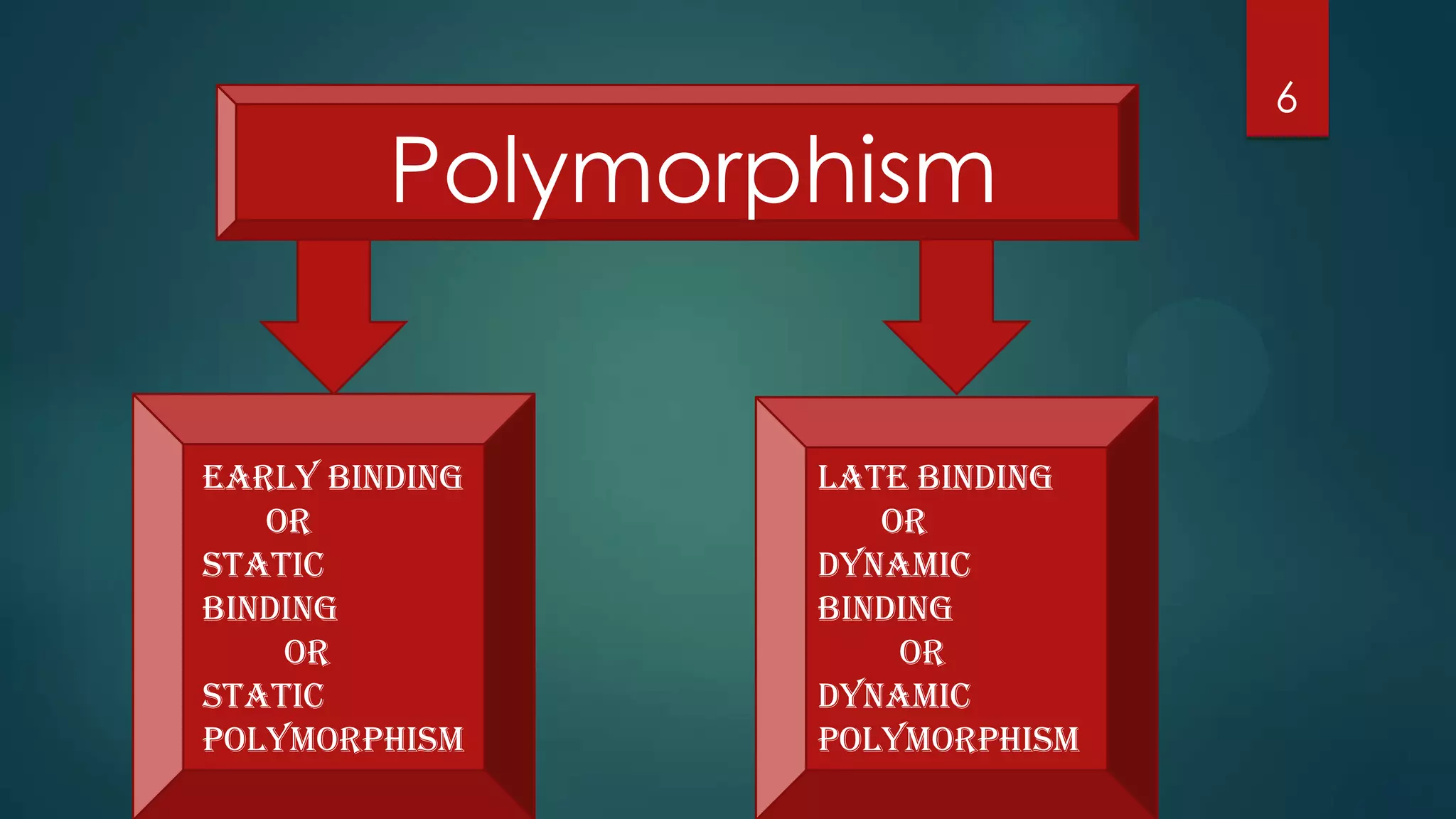
Polymorphism

Early Binding
OR
Static
Binding
OR
Static
Polymorphism

LATE Binding
OR
DYNAMIC
Binding
OR
dynamic
Polymorphism

6
Early Binding



The Events That Takes Place At Compile Time Is Called Early Binding.



Also Called Static Binding.



Information Required To Call A Function Is Known At Compile Time.

7
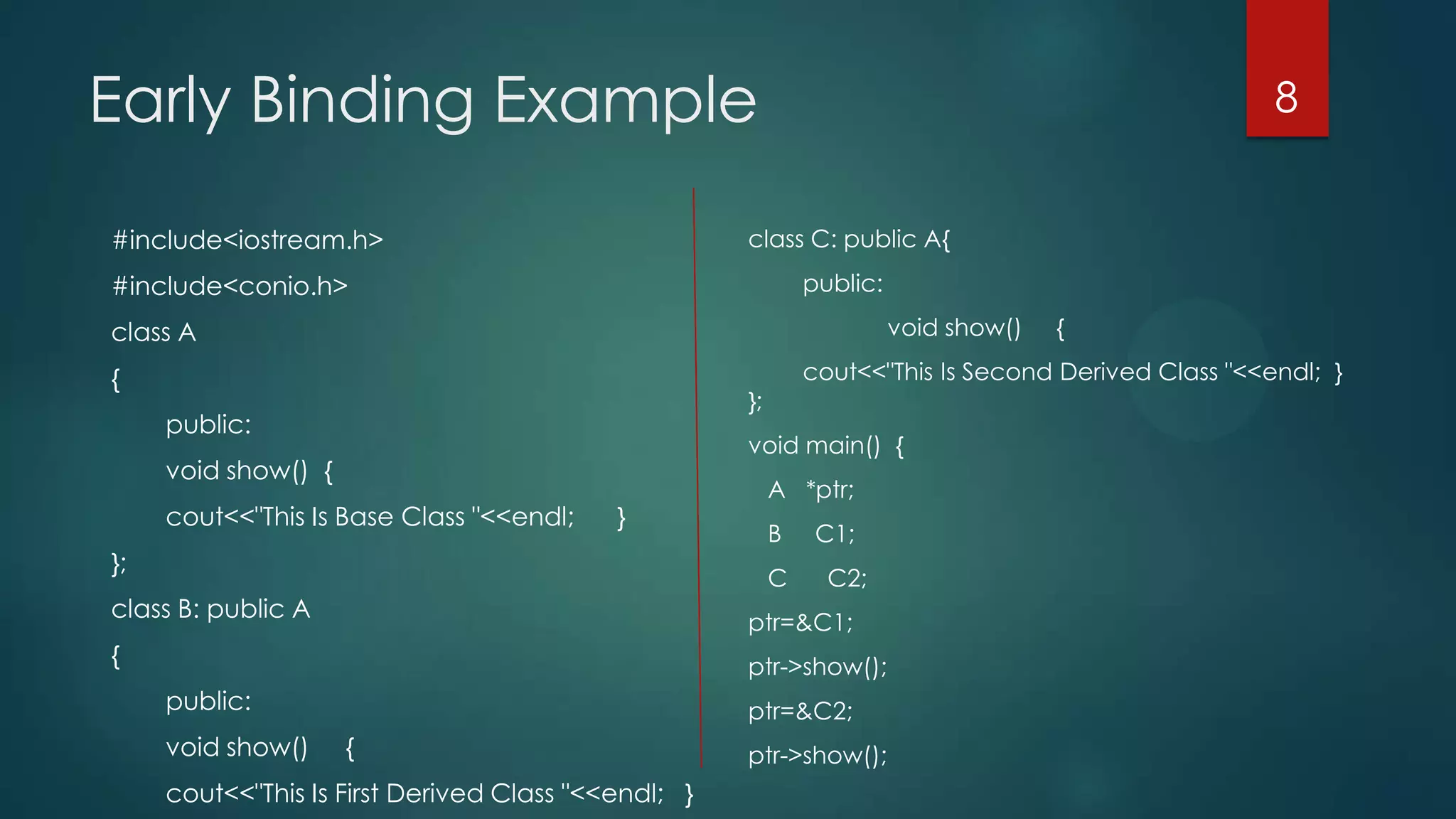
Early Binding Example
#include<iostream.h>

8

class C: public A{
public:

#include<conio.h>

void show()

class A

{

cout<<"This Is Second Derived Class "<<endl; }

};

public:

void main() {

void show() {
cout<<"This Is Base Class "<<endl;

}

};

A *ptr;
B
C

class B: public A

C1;
C2;

ptr=&C1;

{

ptr->show();

public:

void show()

ptr=&C2;

{

cout<<"This Is First Derived Class "<<endl; }

{

ptr->show();
Virtual Function


Special Type Function.



Can Be Define In Both Derived And Base Class.



Its Name Will Be Same In Every Class.



Definition May Be Different.



In Derived Classes It Will Be Executed Through Pointer Of Its Base
Class.



It is Declared By Keyword Virtual.



A Redefined Function Is Said To Override The Base Class Function.

9
Late Binding



The Events That Takes Place In Execution Time Is Called Late Binding.



In Late Binding At The Compile Time Compiler Does Not Know Which
Message Should Compiler Will Respond Because The Type Of Pointer
Is Unknown At Compile Time.



It Depending Upon The Contents In Pointer During Execution Time Of
Program.

10
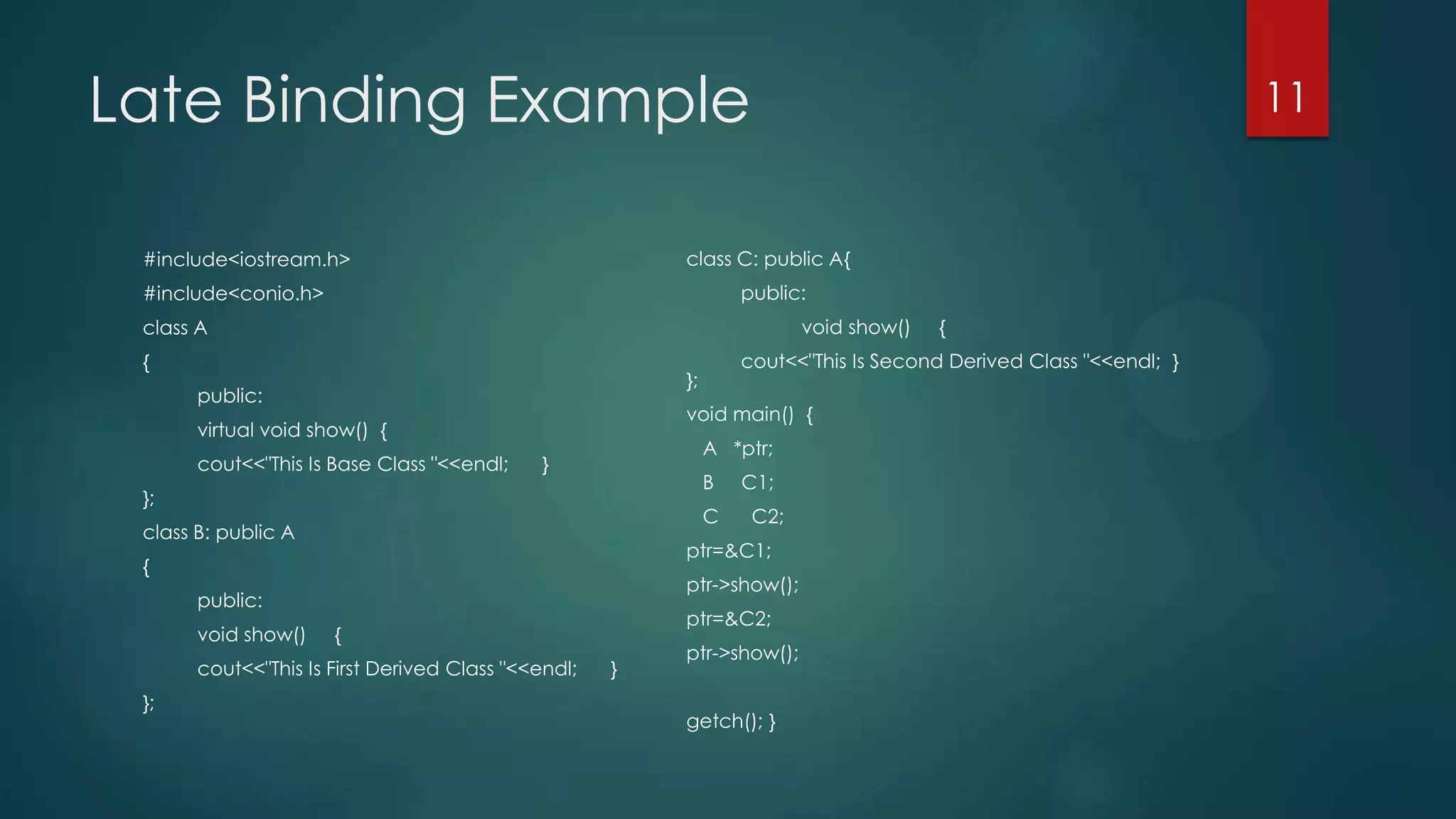
Late Binding Example

11

class C: public A{

#include<iostream.h>

public:

#include<conio.h>

void show()

class A
{

void main() {

virtual void show() {
cout<<"This Is Base Class "<<endl;

A *ptr;

}

B

};

C

class B: public A

C2;

ptr->show();

public:

ptr=&C2;

{

cout<<"This Is First Derived Class "<<endl;
};

C1;

ptr=&C1;

{
void show()

cout<<"This Is Second Derived Class "<<endl; }

};

public:

}

{

ptr->show();

getch(); }
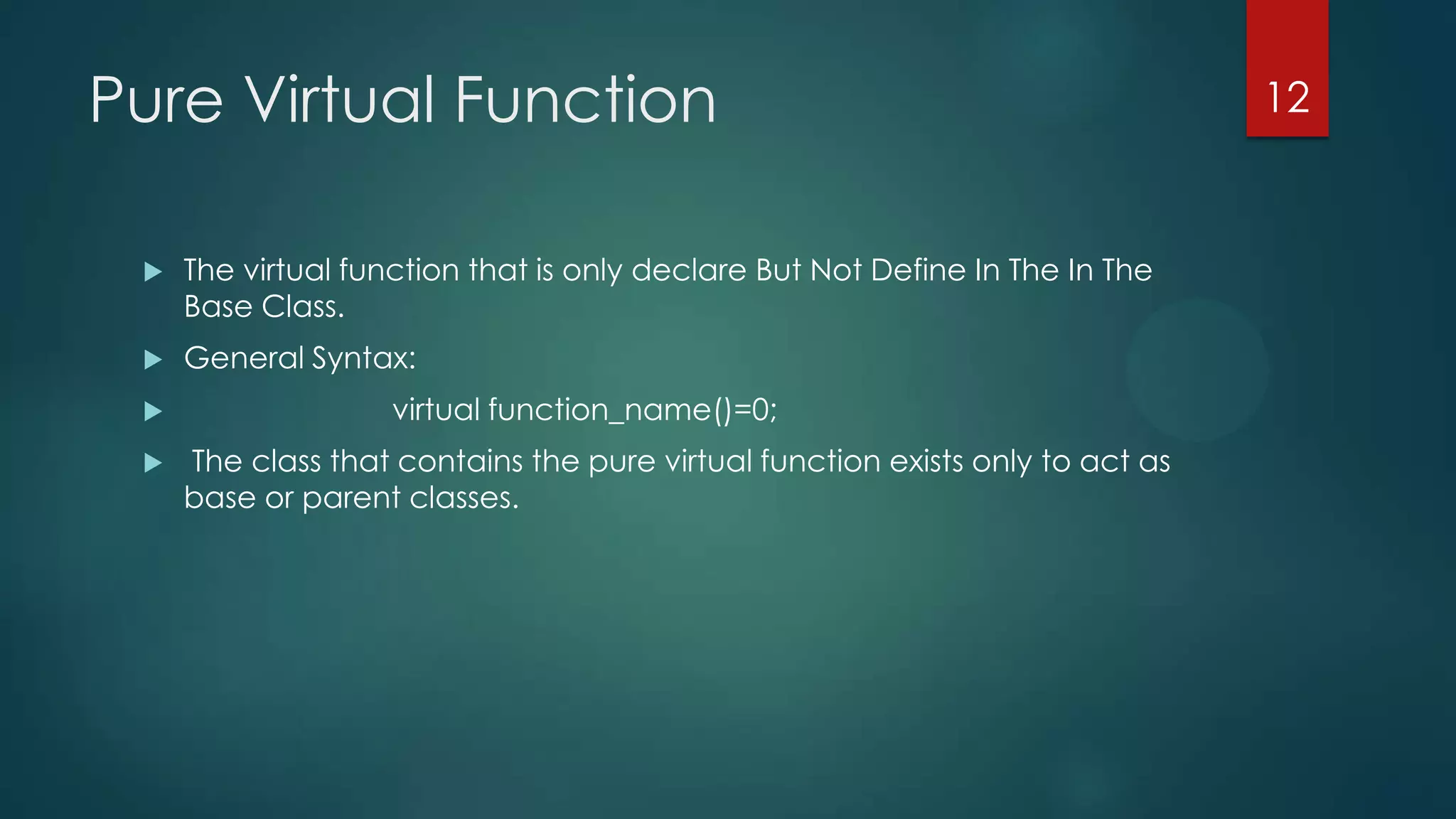
Pure Virtual Function


The virtual function that is only declare But Not Define In The In The
Base Class.



General Syntax:




virtual function_name()=0;
The class that contains the pure virtual function exists only to act as
base or parent classes.

12
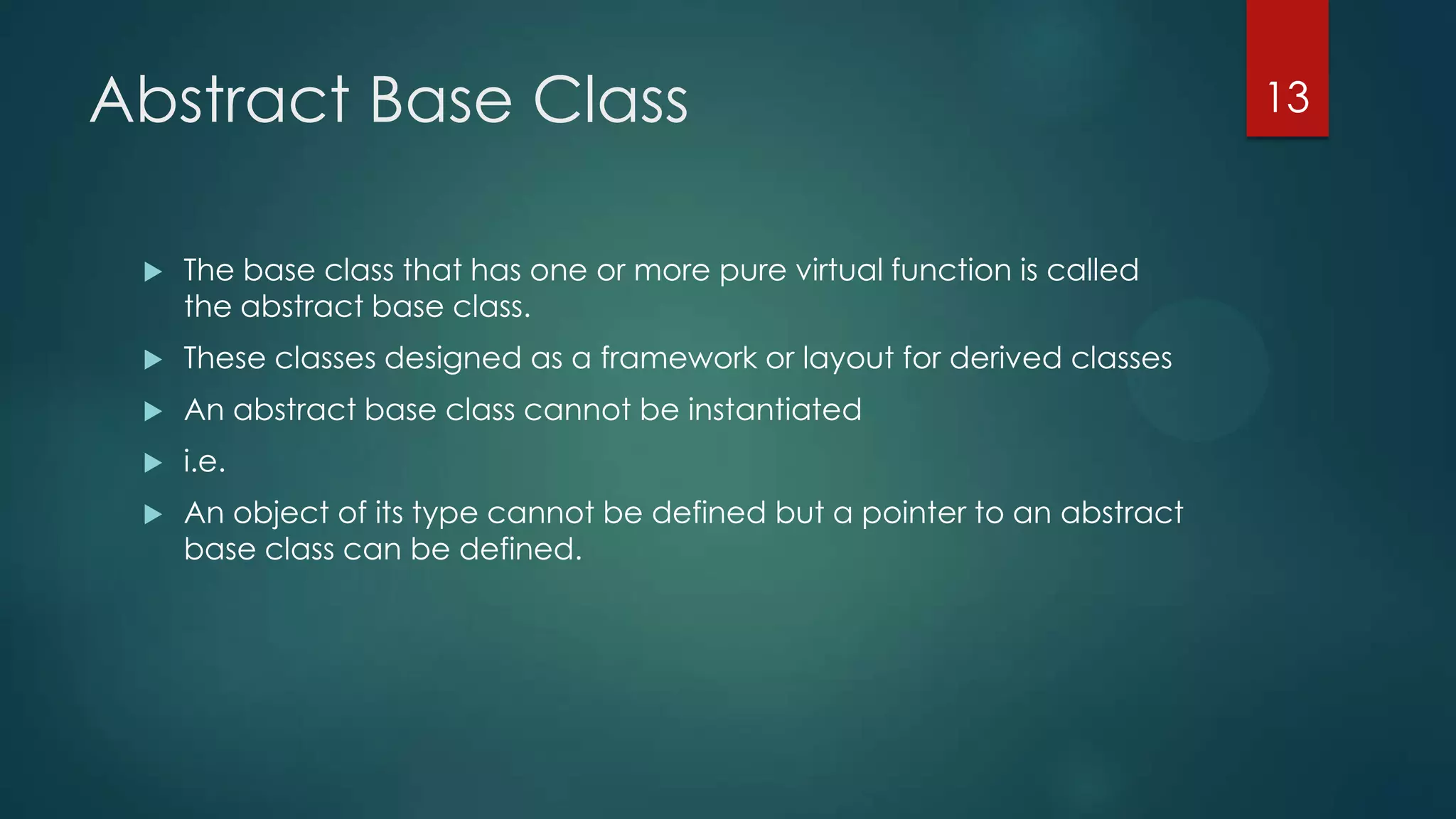
Abstract Base Class


The base class that has one or more pure virtual function is called
the abstract base class.



These classes designed as a framework or layout for derived classes



An abstract base class cannot be instantiated



i.e.



An object of its type cannot be defined but a pointer to an abstract
base class can be defined.

13
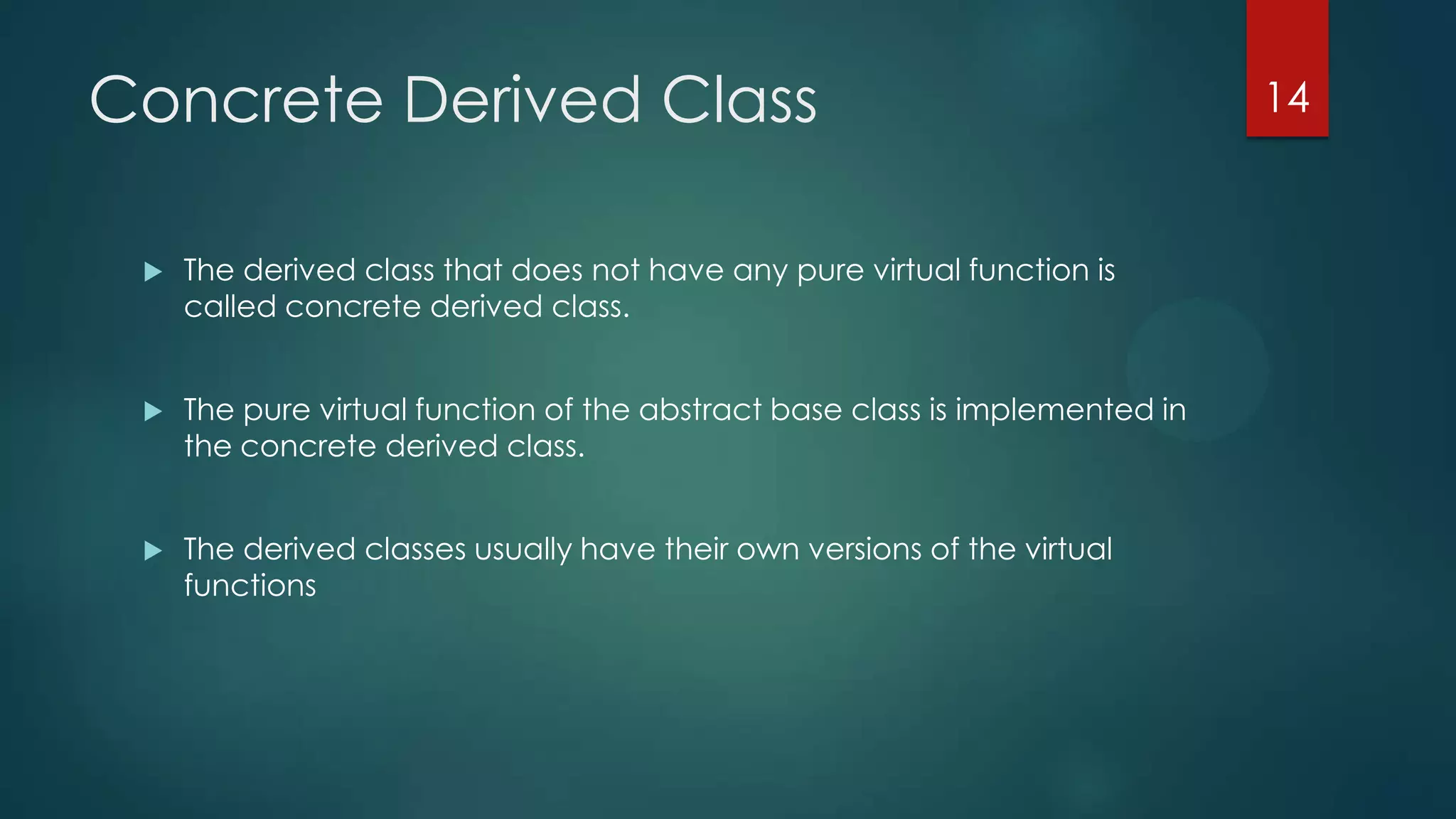
Concrete Derived Class


The derived class that does not have any pure virtual function is
called concrete derived class.



The pure virtual function of the abstract base class is implemented in
the concrete derived class.



The derived classes usually have their own versions of the virtual
functions

14
15

THANKs

Good
Luck

polymorphism

  • 1.
  • 2.
    What is MeantBy Polymorphism?  It is a Greek word.  Poly mean many.  Morphism mean forms.  In programing Polymorphism is the ability for objects of different classes related by inheritance to response differently to the same function call. 2
  • 3.
    What is Polymorphismin OOP?  After the inheritance it is another most important feature of OOP.  In polymorphism, the member functions with same name are define in base class and also in each derived class.  Polymorphism is use to keep the interface of base class to its derived classes.  Polymorphism can be achieved by mean of virtual functions.  In polymorphism one pointer to a base class object may also point any object of its derived class. 3
  • 4.
    How can weaccess the member of class?  The member of a class can be access through pointer to the class.  General syntax; P -> member class;     P is pointer to object. -> is member access operator. Member class. It is the member of the object; 4
  • 5.
    Simple program toaccess member of class; void show()  {  #include<iostream.h>   #include<conio.h>  cout<<"Your name is "<<name;  class data  cout<<"Your age is "<<age;  }  {  private:   };  main() char name[12];  {  int age;   public:  void input(){   cout<<"Entr your name“; cin>>name; cout<<"Enter your age"; cin>>age;} data obj,*j; j=&obj; j->input();  j->show();  getch();  } 5
  • 6.
  • 7.
    Early Binding  The EventsThat Takes Place At Compile Time Is Called Early Binding.  Also Called Static Binding.  Information Required To Call A Function Is Known At Compile Time. 7
  • 8.
    Early Binding Example #include<iostream.h> 8 classC: public A{ public: #include<conio.h> void show() class A { cout<<"This Is Second Derived Class "<<endl; } }; public: void main() { void show() { cout<<"This Is Base Class "<<endl; } }; A *ptr; B C class B: public A C1; C2; ptr=&C1; { ptr->show(); public: void show() ptr=&C2; { cout<<"This Is First Derived Class "<<endl; } { ptr->show();
  • 9.
    Virtual Function  Special TypeFunction.  Can Be Define In Both Derived And Base Class.  Its Name Will Be Same In Every Class.  Definition May Be Different.  In Derived Classes It Will Be Executed Through Pointer Of Its Base Class.  It is Declared By Keyword Virtual.  A Redefined Function Is Said To Override The Base Class Function. 9
  • 10.
    Late Binding  The EventsThat Takes Place In Execution Time Is Called Late Binding.  In Late Binding At The Compile Time Compiler Does Not Know Which Message Should Compiler Will Respond Because The Type Of Pointer Is Unknown At Compile Time.  It Depending Upon The Contents In Pointer During Execution Time Of Program. 10
  • 11.
    Late Binding Example 11 classC: public A{ #include<iostream.h> public: #include<conio.h> void show() class A { void main() { virtual void show() { cout<<"This Is Base Class "<<endl; A *ptr; } B }; C class B: public A C2; ptr->show(); public: ptr=&C2; { cout<<"This Is First Derived Class "<<endl; }; C1; ptr=&C1; { void show() cout<<"This Is Second Derived Class "<<endl; } }; public: } { ptr->show(); getch(); }
  • 12.
    Pure Virtual Function  Thevirtual function that is only declare But Not Define In The In The Base Class.  General Syntax:   virtual function_name()=0; The class that contains the pure virtual function exists only to act as base or parent classes. 12
  • 13.
    Abstract Base Class  Thebase class that has one or more pure virtual function is called the abstract base class.  These classes designed as a framework or layout for derived classes  An abstract base class cannot be instantiated  i.e.  An object of its type cannot be defined but a pointer to an abstract base class can be defined. 13
  • 14.
    Concrete Derived Class  Thederived class that does not have any pure virtual function is called concrete derived class.  The pure virtual function of the abstract base class is implemented in the concrete derived class.  The derived classes usually have their own versions of the virtual functions 14
  • 15.