McGraw-Hill/Irwin Copyright © 2012 by The McGraw-Hill Companies, Inc. All rights reserved.
3- 
2 
Corporate Performance
3- 
3 
Corporate Performance Measured
3- 
4 
Market Value Added 
What is it? 
Why is it useful? 
Defined: 
Book Value Market Value Added [Share Price = ´ Shares Outstanding] - Equity
Book Value Market Value Added [Share Price Shares Outstanding] = ´ - Equity 
3- 
5 
MVA: Discussion 
Consider AT&T and Home Depot 
Similar MVA, Different Market-to-Book Ratio 
Why? 
TABLE 4.3
3- 
6 
Economic Value Added 
What is it? 
Why is it important? 
Why is it called residual income? 
Defined: 
Economic Value Added Operating Income* - [Cost of Capital = ´Total Capitalization]
Economic Value Added Operating Income - [Cost of Capital = ´Total Capitalization] 
3- 
7 
EVA: Discussion 
Consider Coca-Cola and Google 
Similar EVA, Different Return on Capital 
Why? 
TABLE 4.4 
* Operating Income = Net Income + After-tax Interest; ROC = Return on Capital
3- 
8 
Book Rates of Return* 
What do they measure? 
Return on Capital: 
Return on Assets: 
Return on Equity: 
*Book Rates of Return are also referred to as Accounting rates of Return
3- 
9 
Calculating Return on Capital 
Assets 2009 2008 
Current assets: 
Cash and cash equivalents $ 632 245 
Short-term investments 425 416 
Merchandise inventory - net 8,249 8,209 
Deferred income taxes - net 208 105 
Other current assets 218 215 
Total current assets 9,732 9,190 
Property less acc. depreciation 22,499 22,722 
Long-term investments 277 253 
Other assets 497 460 
Total assets $ 33,005 32,625 
Liabilities and Shareholders' Equity 2009 2008 
Current liabilities: 
Short-term borrowings $ - 987 
Current maturities of long-term debt 552 34 
Accounts payable 4,287 4,109 
Accrued comp./employee benefits 577 434 
Deferred revenue 683 674 
Other current liabilities 1,256 1,322 
Total current liabilities 7,355 7,560 
Long-term debt, excl. current maturities 4,528 5,039 
Deferred income taxes - net 598 599 
Other liabilities 1,455 1,372 
Total liabilities 13,936 14,570 
Shareholders' equity: - - 
Common stock - $.50 par value 729 735 
Capital in excess of par value 6 277 
Retained earnings 18,307 17,049 
Acc. other comprehensive income 27 (6) 
Total shareholders' equity 19,069 18,055 
Lowe’s Return on Capital 
After Tax Operating Income = Net Income + After-Tax Interest 
= 1,783 + 181 = 1,964 
Average Total Capitalization = Average Long-Term Debt + Equity 
= + = 
(23,597 23,094) 23,345.5 
ROC = After-Tax Operating Income = 1,964 = 
8.4% 
Average Total Capitalization 23,345.5 
Lowe’s Balance Sheet (in $m) Total liabilities and shareholders' equity $ 33,005 32,625 
Lowe's Income Statement 2009 
Net sales 47,220 
Cost of sales 30,757 
Gross margin 16,463 
Expenses: 
Selling, general and administrative 11,688 
Store opening costs 49 
Depreciation 1,614 
Interest - net 287 
Total expenses 13,638 
Pre-tax earnings 2,825 
Income tax provision 1,042 
Net earnings 1,783 
2
3- 
10 
Calculating Return on Assets 
Lowe’s Return on Assets Lowe’s Balance Sheet (in $m) 
Assets 2009 2008 
Current assets: 
Cash and cash equivalents $ 632 245 
Short-term investments 425 416 
Merchandise inventory - net 8,249 8,209 
Deferred income taxes - net 208 105 
Other current assets 218 215 
Total current assets 9,732 9,190 
Property less acc. depreciation 22,499 22,722 
Long-term investments 277 253 
Other assets 497 460 
Total assets $ 33,005 32,625 
Liabilities and Shareholders' Equity 2009 2008 
Current liabilities: 
Short-term borrowings $ - 987 
Current maturities of long-term debt 552 34 
Accounts payable 4,287 4,109 
Accrued comp./employee benefits 577 434 
Deferred revenue 683 674 
Other current liabilities 1,256 1,322 
Total current liabilities 7,355 7,560 
Long-term debt, excl. current maturities 4,528 5,039 
Deferred income taxes - net 598 599 
Other liabilities 1,455 1,372 
Total liabilities 13,936 14,570 
Shareholders' equity: - - 
Common stock - $.50 par value 729 735 
Capital in excess of par value 6 277 
Retained earnings 18,307 17,049 
Acc. other comprehensive income 27 (6) 
Total shareholders' equity 19,069 18,055 
Total liabilities and shareholders' equity $ 33,005 32,625 
After Tax Operating Income = Net Income + After-Tax Interest 
= 1,783 + 181 = 1,964 
Average Total Assets = (33,005 32,625) 
ROA After-Tax Operating Income 1,964 6.0% 
Average Total Assets 32,815 
ROA = After-Tax Operating Income 1,964 6.0% 
Total Assets 32,625 Year Beginning 
or 
= = = 
= = 
Lowe's Income Statement 2009 
Net sales 47,220 
Cost of sales 30,757 
Gross margin 16,463 
Expenses: 
Selling, general and administrative 11,688 
Store opening costs 49 
Depreciation 1,614 
Interest - net 287 
Total expenses 13,638 
Pre-tax earnings 2,825 
Income tax provision 1,042 
Net earnings 1,783 
2 
32,815 
+ 
=
3- 
11 
Calculating Return on Equity 
Lowe’s Balance Sheet (in $m) Lowe’s Return on Equity 
Assets 2009 2008 
Current assets: 
Cash and cash equivalents $ 632 245 
Short-term investments 425 416 
Merchandise inventory - net 8,249 8,209 
Deferred income taxes - net 208 105 
Other current assets 218 215 
Total current assets 9,732 9,190 
Property less acc. depreciation 22,499 22,722 
Long-term investments 277 253 
Other assets 497 460 
Total assets $ 33,005 32,625 
Liabilities and Shareholders' Equity 2009 2008 
Current liabilities: 
Short-term borrowings $ - 987 
Current maturities of long-term debt 552 34 
Accounts payable 4,287 4,109 
Accrued comp./employee benefits 577 434 
Deferred revenue 683 674 
Other current liabilities 1,256 1,322 
Total current liabilities 7,355 7,560 
Long-term debt, excl. current maturities 4,528 5,039 
Deferred income taxes - net 598 599 
Other liabilities 1,455 1,372 
Total liabilities 13,936 14,570 
Shareholders' equity: - - 
Common stock - $.50 par value 729 735 
Capital in excess of par value 6 277 
Retained earnings 18,307 17,049 
Acc. other comprehensive income 27 (6) 
Total shareholders' equity 19,069 18,055 
Total liabilities and shareholders' equity $ 33,005 32,625 
Average Total Equity = (19,069 18,055) 
ROE Net Income 1,783 9.6% 
Average Total Equity 18,562 
ROE = Net Income 1,783 9.9% 
Equity 18,055 Year Beginning 
or 
= = = 
= = 
Lowe's Income Statement 2009 
Net sales 47,220 
Cost of sales 30,757 
Gross margin 16,463 
Expenses: 
Selling, general and administrative 11,688 
Store opening costs 49 
Depreciation 1,614 
Interest - net 287 
Total expenses 13,638 
Pre-tax earnings 2,825 
Income tax provision 1,042 
Net earnings 1,783 
2 
18,562 
+ 
=
3- 
12 
Financial Ratios and Shareholder Value 
Shareholder value depends on good investment and financing decisions. 
Financial Ratios help measure the success and soundness of these decisions.
3- 
13 
Efficiency Ratios 
Asset turnover ratio = Sales 
Total AssetsYear Beginning 
OR* Average Total Assets 
How does this ratio measure efficiency? 
Receivables Turnover= Sales 
= Sales 
ReceivablesYear Beginning 
How does this ratio measure efficiency? 
* Either equation is a legitimate way to calculate the asset turnover ratio
3- 
14 
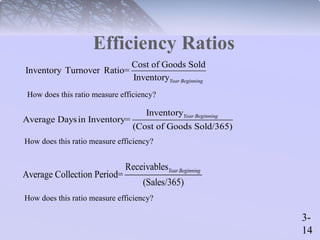
Efficiency Ratios 
Inventory Turnover Ratio= Cost of Goods Sold 
InventoryYear Beginning 
How does this ratio measure efficiency? 
Inventory 
Average Days in Inventory= 
Year Beginning 
(Cost of Goods Sold/365) 
How does this ratio measure efficiency? 
Receivables 
Average Collection Period= 
Year Beginning 
(Sales/365) 
How does this ratio measure efficiency?
3- 
15 
Calculating an Efficiency Ratio 
Lowe’s Balance Sheet (in $m) 
Assets 2009 2008 
Current assets: 
Cash and cash equivalents $ 632 245 
Short-term investments 425 416 
Merchandise inventory - net 8,249 8,209 
Deferred income taxes - net 208 105 
Other current assets 218 215 
Total current assets 9,732 9,190 
Property less acc. depreciation 22,499 22,722 
Long-term investments 277 253 
Other assets 497 460 
Total assets $ 33,005 32,625 
Liabilities and Shareholders' Equity 2009 2008 
Current liabilities: 
Short-term borrowings $ - 987 
Current maturities of long-term debt 552 34 
Accounts payable 4,287 4,109 
Accrued comp./employee benefits 577 434 
Deferred revenue 683 674 
Other current liabilities 1,256 1,322 
Total current liabilities 7,355 7,560 
Long-term debt, excl. current maturities 4,528 5,039 
Deferred income taxes - net 598 599 
Other liabilities 1,455 1,372 
Total liabilities 13,936 14,570 
Shareholders' equity: - - 
Common stock - $.50 par value 729 735 
Capital in excess of par value 6 277 
Retained earnings 18,307 17,049 
Acc. other comprehensive income 27 (6) 
Total shareholders' equity 19,069 18,055 
Total liabilities and shareholders' equity $ 33,005 32,625 
Lowe’s Asset Turnover Ratio 
+ 
Average Total Assets = (33,005 32,625) 
2 
32,815 
= 
Asset Turnover Ratio = Sales = 47,220 = 
1.4 
Average Total Assets 32,815 
Lowe's Income Statement 2009 
Net sales 47,220 
Cost of sales 30,757 
Gross margin 16,463 
Expenses: 
Selling, general and administrative 11,688 
Store opening costs 49 
Depreciation 1,614 
Interest - net 287 
Total expenses 13,638 
Pre-tax earnings 2,825 
Income tax provision 1,042 
Net earnings 1,783
+ 
Profit Margin= Net Income 
Sales 
Net Income Operating Profit Margin= After-Tax Interest 
3- 
16 
Profitability Ratios 
How does this ratio measure the firm’s profitability? 
Sales 
When is this ratio potentially more useful than just profit margin? 
Note: ROC, ROA, ROE and EVA are also typically considered profitability ratios.
3- 
17 
Calculating a Profitability Ratio 
Lowe’s Balance Sheet (in $m) 
Assets 2009 2008 
Current assets: 
Cash and cash equivalents $ 632 245 
Short-term investments 425 416 
Merchandise inventory - net 8,249 8,209 
Deferred income taxes - net 208 105 
Other current assets 218 215 
Total current assets 9,732 9,190 
Property less acc. depreciation 22,499 22,722 
Long-term investments 277 253 
Other assets 497 460 
Total assets $ 33,005 32,625 
Liabilities and Shareholders' Equity 2009 2008 
Current liabilities: 
Short-term borrowings $ - 987 
Current maturities of long-term debt 552 34 
Accounts payable 4,287 4,109 
Accrued comp./employee benefits 577 434 
Deferred revenue 683 674 
Other current liabilities 1,256 1,322 
Total current liabilities 7,355 7,560 
Long-term debt, excl. current maturities 4,528 5,039 
Deferred income taxes - net 598 599 
Other liabilities 1,455 1,372 
Total liabilities 13,936 14,570 
Shareholders' equity: - - 
Common stock - $.50 par value 729 735 
Capital in excess of par value 6 277 
Retained earnings 18,307 17,049 
Acc. other comprehensive income 27 (6) 
Total shareholders' equity 19,069 18,055 
Total liabilities and shareholders' equity $ 33,005 32,625 
Lowe’s Operating Profit Margin 
= = + = 
OPM Net Income + After-Tax Interest 1,783 181 4.2% 
Sales 47,220 
Lowe's Income Statement 2009 
Net sales 47,220 
Cost of sales 30,757 
Gross margin 16,463 
Expenses: 
Selling, general and administrative 11,688 
Store opening costs 49 
Depreciation 1,614 
Interest - net 287 
Total expenses 13,638 
Pre-tax earnings 2,825 
Income tax provision 1,042 
Net earnings 1,783
3- 
18 
Leverage Ratios 
Long term debt ratio= Long Term Debt 
Long Term Debt+Equity 
How does this ratio measure leverage? 
Long-term Debt Equity Ratio= Long-Term Debt 
Equity 
How does this ratio measure leverage?
3- 
19 
Measuring Leverage 
Total Debt Ratio= Total Liabilities 
Total Assets 
How does this ratio measure leverage? 
Times Interest Earned= EBIT 
Interest Payments 
How does this ratio measure leverage? 
Cash Coverage Ratio= EBIT+Depreciation 
Interest Payments 
How does this ratio measure leverage?
3- 
20 
Calculating a Leverage Ratio 
Lowe’s Balance Sheet (in $m) 
Assets 2009 2008 
Current assets: 
Cash and cash equivalents $ 632 245 
Short-term investments 425 416 
Merchandise inventory - net 8,249 8,209 
Deferred income taxes - net 208 105 
Other current assets 218 215 
Total current assets 9,732 9,190 
Property less acc. depreciation 22,499 22,722 
Long-term investments 277 253 
Other assets 497 460 
Total assets $ 33,005 32,625 
Liabilities and Shareholders' Equity 2009 2008 
Current liabilities: 
Short-term borrowings $ - 987 
Current maturities of long-term debt 552 34 
Accounts payable 4,287 4,109 
Accrued comp./employee benefits 577 434 
Deferred revenue 683 674 
Other current liabilities 1,256 1,322 
Total current liabilities 7,355 7,560 
Long-term debt, excl. current maturities 4,528 5,039 
Deferred income taxes - net 598 599 
Other liabilities 1,455 1,372 
Total liabilities 13,936 14,570 
Shareholders' equity: - - 
Common stock - $.50 par value 729 735 
Capital in excess of par value 6 277 
Retained earnings 18,307 17,049 
Acc. other comprehensive income 27 (6) 
Total shareholders' equity 19,069 18,055 
Total liabilities and shareholders' equity $ 33,005 32,625 
Lowe’s Times Interest Earned 
Ratio 
EBIT = Sales - COGS - Expenses - Depreciation 
= 47, 220 -30,757 -11,737 -1,614 = 3,112 
Times Interest Earned = EBIT = 3,112 = 
10.8 
Interest 287 
Lowe's Income Statement 2009 
Net sales 47,220 
Cost of sales 30,757 
Gross margin 16,463 
Expenses: 
Selling, general and administrative 11,688 
Store opening costs 49 
Depreciation 1,614 
Interest - net 287 
Total expenses 13,638 
Pre-tax earnings 2,825 
Income tax provision 1,042 
Net earnings 1,783
3- 
21 
Measuring Liquidity 
NWC to Total Assets Ratio = Net Working Capital 
Total Assets 
How does this ratio measure liquidity? 
Current Ratio= Current Assets 
Current Liabilities 
How does this ratio measure liquidity?
3- 
22 
Liquidity Ratios 
Cash + Marketable Securities Quick ratio= + Receivables 
Current Liabilities 
How does this ratio differ form the current ratio? Why might a financial manager prefer it? 
Cash Ratio= Cash + Marketable Securities 
Current Liabilities 
How does this ratio differ from the current ratio? Why might a financial manager prefer it?
3- 
23 
Calculating a Liquidity Ratio 
Lowe’s Balance Sheet (in $m) 
Assets 2009 2008 
Current assets: 
Cash and cash equivalents $ 632 245 
Short-term investments 425 416 
Merchandise inventory - net 8,249 8,209 
Deferred income taxes - net 208 105 
Other current assets 218 215 
Total current assets 9,732 9,190 
Property less acc. depreciation 22,499 22,722 
Long-term investments 277 253 
Other assets 497 460 
Total assets $ 33,005 32,625 
Liabilities and Shareholders' Equity 2009 2008 
Current liabilities: 
Short-term borrowings $ - 987 
Current maturities of long-term debt 552 34 
Accounts payable 4,287 4,109 
Accrued comp./employee benefits 577 434 
Deferred revenue 683 674 
Other current liabilities 1,256 1,322 
Total current liabilities 7,355 7,560 
Long-term debt, excl. current maturities 4,528 5,039 
Deferred income taxes - net 598 599 
Other liabilities 1,455 1,372 
Total liabilities 13,936 14,570 
Shareholders' equity: - - 
Common stock - $.50 par value 729 735 
Capital in excess of par value 6 277 
Retained earnings 18,307 17,049 
Acc. other comprehensive income 27 (6) 
Total shareholders' equity 19,069 18,055 
Total liabilities and shareholders' equity $ 33,005 32,625 
Lowe’s NWC to Total Assets Ratio 
Net Working Capital = 9,732-7,355 = 2,377 
NWC to Total Assets = NWC = 2,377 = 
7.2% 
Total Assets 33,005 
Lowe's Income Statement 2009 
Net sales 47,220 
Cost of sales 30,757 
Gross margin 16,463 
Expenses: 
Selling, general and administrative 11,688 
Store opening costs 49 
Depreciation 1,614 
Interest - net 287 
Total expenses 13,638 
Pre-tax earnings 2,825 
Income tax provision 1,042 
Net earnings 1,783
3- 
24 
The DuPont System 
What is it, and what is it used for?
3- 
25 
The DuPont System: ROA 
+ 
ROA= Net Income Interest 
+ 
Assets 
Sales ROA= x Net Income Interest 
Assets Sales 
Asset 
Turnover 
Operating Profit 
Margin
3- 
26 
ROA Decomposition by Industry
3- 
27 
The DuPont System: ROE 
+ 
Assets Sales Net Income ROE= x x Interest x Net Income 
+ 
Equity Assets Sales Net Income Interest 
Leverage 
Ratio Asset 
Turnover 
Operating 
Profit 
Margin 
Debt 
Burden 
ROE= Net Income 
Equity
3- 
28 
Sustainable Growth 
Plowback Ratio= Earnings-Dividends 
Earnings 
Payout Ratio= Dividends 
Earnings 
´ 
Growth in equity from plowback = Plowback Ratio ROE 
Earnings - Dividends Earnings 
= ´ 
Earnings Equity 
= Earnings-Dividends 
Equity
3- 
29 
The Role of Financial Ratios 
Table 4.8
3- 
30 
The Role of Financial Ratios
3- 
31 
Appendix A: Average Ratios, by Industry 
Table 4.7
3- 
32 
Appendix B: Financial Ratios and Default Risk 
Table 4.9

Chap004

  • 1.
    McGraw-Hill/Irwin Copyright ©2012 by The McGraw-Hill Companies, Inc. All rights reserved.
  • 2.
    3- 2 CorporatePerformance
  • 3.
    3- 3 CorporatePerformance Measured
  • 4.
    3- 4 MarketValue Added What is it? Why is it useful? Defined: Book Value Market Value Added [Share Price = ´ Shares Outstanding] - Equity
  • 5.
    Book Value MarketValue Added [Share Price Shares Outstanding] = ´ - Equity 3- 5 MVA: Discussion Consider AT&T and Home Depot Similar MVA, Different Market-to-Book Ratio Why? TABLE 4.3
  • 6.
    3- 6 EconomicValue Added What is it? Why is it important? Why is it called residual income? Defined: Economic Value Added Operating Income* - [Cost of Capital = ´Total Capitalization]
  • 7.
    Economic Value AddedOperating Income - [Cost of Capital = ´Total Capitalization] 3- 7 EVA: Discussion Consider Coca-Cola and Google Similar EVA, Different Return on Capital Why? TABLE 4.4 * Operating Income = Net Income + After-tax Interest; ROC = Return on Capital
  • 8.
    3- 8 BookRates of Return* What do they measure? Return on Capital: Return on Assets: Return on Equity: *Book Rates of Return are also referred to as Accounting rates of Return
  • 9.
    3- 9 CalculatingReturn on Capital Assets 2009 2008 Current assets: Cash and cash equivalents $ 632 245 Short-term investments 425 416 Merchandise inventory - net 8,249 8,209 Deferred income taxes - net 208 105 Other current assets 218 215 Total current assets 9,732 9,190 Property less acc. depreciation 22,499 22,722 Long-term investments 277 253 Other assets 497 460 Total assets $ 33,005 32,625 Liabilities and Shareholders' Equity 2009 2008 Current liabilities: Short-term borrowings $ - 987 Current maturities of long-term debt 552 34 Accounts payable 4,287 4,109 Accrued comp./employee benefits 577 434 Deferred revenue 683 674 Other current liabilities 1,256 1,322 Total current liabilities 7,355 7,560 Long-term debt, excl. current maturities 4,528 5,039 Deferred income taxes - net 598 599 Other liabilities 1,455 1,372 Total liabilities 13,936 14,570 Shareholders' equity: - - Common stock - $.50 par value 729 735 Capital in excess of par value 6 277 Retained earnings 18,307 17,049 Acc. other comprehensive income 27 (6) Total shareholders' equity 19,069 18,055 Lowe’s Return on Capital After Tax Operating Income = Net Income + After-Tax Interest = 1,783 + 181 = 1,964 Average Total Capitalization = Average Long-Term Debt + Equity = + = (23,597 23,094) 23,345.5 ROC = After-Tax Operating Income = 1,964 = 8.4% Average Total Capitalization 23,345.5 Lowe’s Balance Sheet (in $m) Total liabilities and shareholders' equity $ 33,005 32,625 Lowe's Income Statement 2009 Net sales 47,220 Cost of sales 30,757 Gross margin 16,463 Expenses: Selling, general and administrative 11,688 Store opening costs 49 Depreciation 1,614 Interest - net 287 Total expenses 13,638 Pre-tax earnings 2,825 Income tax provision 1,042 Net earnings 1,783 2
  • 10.
    3- 10 CalculatingReturn on Assets Lowe’s Return on Assets Lowe’s Balance Sheet (in $m) Assets 2009 2008 Current assets: Cash and cash equivalents $ 632 245 Short-term investments 425 416 Merchandise inventory - net 8,249 8,209 Deferred income taxes - net 208 105 Other current assets 218 215 Total current assets 9,732 9,190 Property less acc. depreciation 22,499 22,722 Long-term investments 277 253 Other assets 497 460 Total assets $ 33,005 32,625 Liabilities and Shareholders' Equity 2009 2008 Current liabilities: Short-term borrowings $ - 987 Current maturities of long-term debt 552 34 Accounts payable 4,287 4,109 Accrued comp./employee benefits 577 434 Deferred revenue 683 674 Other current liabilities 1,256 1,322 Total current liabilities 7,355 7,560 Long-term debt, excl. current maturities 4,528 5,039 Deferred income taxes - net 598 599 Other liabilities 1,455 1,372 Total liabilities 13,936 14,570 Shareholders' equity: - - Common stock - $.50 par value 729 735 Capital in excess of par value 6 277 Retained earnings 18,307 17,049 Acc. other comprehensive income 27 (6) Total shareholders' equity 19,069 18,055 Total liabilities and shareholders' equity $ 33,005 32,625 After Tax Operating Income = Net Income + After-Tax Interest = 1,783 + 181 = 1,964 Average Total Assets = (33,005 32,625) ROA After-Tax Operating Income 1,964 6.0% Average Total Assets 32,815 ROA = After-Tax Operating Income 1,964 6.0% Total Assets 32,625 Year Beginning or = = = = = Lowe's Income Statement 2009 Net sales 47,220 Cost of sales 30,757 Gross margin 16,463 Expenses: Selling, general and administrative 11,688 Store opening costs 49 Depreciation 1,614 Interest - net 287 Total expenses 13,638 Pre-tax earnings 2,825 Income tax provision 1,042 Net earnings 1,783 2 32,815 + =
  • 11.
    3- 11 CalculatingReturn on Equity Lowe’s Balance Sheet (in $m) Lowe’s Return on Equity Assets 2009 2008 Current assets: Cash and cash equivalents $ 632 245 Short-term investments 425 416 Merchandise inventory - net 8,249 8,209 Deferred income taxes - net 208 105 Other current assets 218 215 Total current assets 9,732 9,190 Property less acc. depreciation 22,499 22,722 Long-term investments 277 253 Other assets 497 460 Total assets $ 33,005 32,625 Liabilities and Shareholders' Equity 2009 2008 Current liabilities: Short-term borrowings $ - 987 Current maturities of long-term debt 552 34 Accounts payable 4,287 4,109 Accrued comp./employee benefits 577 434 Deferred revenue 683 674 Other current liabilities 1,256 1,322 Total current liabilities 7,355 7,560 Long-term debt, excl. current maturities 4,528 5,039 Deferred income taxes - net 598 599 Other liabilities 1,455 1,372 Total liabilities 13,936 14,570 Shareholders' equity: - - Common stock - $.50 par value 729 735 Capital in excess of par value 6 277 Retained earnings 18,307 17,049 Acc. other comprehensive income 27 (6) Total shareholders' equity 19,069 18,055 Total liabilities and shareholders' equity $ 33,005 32,625 Average Total Equity = (19,069 18,055) ROE Net Income 1,783 9.6% Average Total Equity 18,562 ROE = Net Income 1,783 9.9% Equity 18,055 Year Beginning or = = = = = Lowe's Income Statement 2009 Net sales 47,220 Cost of sales 30,757 Gross margin 16,463 Expenses: Selling, general and administrative 11,688 Store opening costs 49 Depreciation 1,614 Interest - net 287 Total expenses 13,638 Pre-tax earnings 2,825 Income tax provision 1,042 Net earnings 1,783 2 18,562 + =
  • 12.
    3- 12 FinancialRatios and Shareholder Value Shareholder value depends on good investment and financing decisions. Financial Ratios help measure the success and soundness of these decisions.
  • 13.
    3- 13 EfficiencyRatios Asset turnover ratio = Sales Total AssetsYear Beginning OR* Average Total Assets How does this ratio measure efficiency? Receivables Turnover= Sales = Sales ReceivablesYear Beginning How does this ratio measure efficiency? * Either equation is a legitimate way to calculate the asset turnover ratio
  • 14.
    3- 14 EfficiencyRatios Inventory Turnover Ratio= Cost of Goods Sold InventoryYear Beginning How does this ratio measure efficiency? Inventory Average Days in Inventory= Year Beginning (Cost of Goods Sold/365) How does this ratio measure efficiency? Receivables Average Collection Period= Year Beginning (Sales/365) How does this ratio measure efficiency?
  • 15.
    3- 15 Calculatingan Efficiency Ratio Lowe’s Balance Sheet (in $m) Assets 2009 2008 Current assets: Cash and cash equivalents $ 632 245 Short-term investments 425 416 Merchandise inventory - net 8,249 8,209 Deferred income taxes - net 208 105 Other current assets 218 215 Total current assets 9,732 9,190 Property less acc. depreciation 22,499 22,722 Long-term investments 277 253 Other assets 497 460 Total assets $ 33,005 32,625 Liabilities and Shareholders' Equity 2009 2008 Current liabilities: Short-term borrowings $ - 987 Current maturities of long-term debt 552 34 Accounts payable 4,287 4,109 Accrued comp./employee benefits 577 434 Deferred revenue 683 674 Other current liabilities 1,256 1,322 Total current liabilities 7,355 7,560 Long-term debt, excl. current maturities 4,528 5,039 Deferred income taxes - net 598 599 Other liabilities 1,455 1,372 Total liabilities 13,936 14,570 Shareholders' equity: - - Common stock - $.50 par value 729 735 Capital in excess of par value 6 277 Retained earnings 18,307 17,049 Acc. other comprehensive income 27 (6) Total shareholders' equity 19,069 18,055 Total liabilities and shareholders' equity $ 33,005 32,625 Lowe’s Asset Turnover Ratio + Average Total Assets = (33,005 32,625) 2 32,815 = Asset Turnover Ratio = Sales = 47,220 = 1.4 Average Total Assets 32,815 Lowe's Income Statement 2009 Net sales 47,220 Cost of sales 30,757 Gross margin 16,463 Expenses: Selling, general and administrative 11,688 Store opening costs 49 Depreciation 1,614 Interest - net 287 Total expenses 13,638 Pre-tax earnings 2,825 Income tax provision 1,042 Net earnings 1,783
  • 16.
    + Profit Margin=Net Income Sales Net Income Operating Profit Margin= After-Tax Interest 3- 16 Profitability Ratios How does this ratio measure the firm’s profitability? Sales When is this ratio potentially more useful than just profit margin? Note: ROC, ROA, ROE and EVA are also typically considered profitability ratios.
  • 17.
    3- 17 Calculatinga Profitability Ratio Lowe’s Balance Sheet (in $m) Assets 2009 2008 Current assets: Cash and cash equivalents $ 632 245 Short-term investments 425 416 Merchandise inventory - net 8,249 8,209 Deferred income taxes - net 208 105 Other current assets 218 215 Total current assets 9,732 9,190 Property less acc. depreciation 22,499 22,722 Long-term investments 277 253 Other assets 497 460 Total assets $ 33,005 32,625 Liabilities and Shareholders' Equity 2009 2008 Current liabilities: Short-term borrowings $ - 987 Current maturities of long-term debt 552 34 Accounts payable 4,287 4,109 Accrued comp./employee benefits 577 434 Deferred revenue 683 674 Other current liabilities 1,256 1,322 Total current liabilities 7,355 7,560 Long-term debt, excl. current maturities 4,528 5,039 Deferred income taxes - net 598 599 Other liabilities 1,455 1,372 Total liabilities 13,936 14,570 Shareholders' equity: - - Common stock - $.50 par value 729 735 Capital in excess of par value 6 277 Retained earnings 18,307 17,049 Acc. other comprehensive income 27 (6) Total shareholders' equity 19,069 18,055 Total liabilities and shareholders' equity $ 33,005 32,625 Lowe’s Operating Profit Margin = = + = OPM Net Income + After-Tax Interest 1,783 181 4.2% Sales 47,220 Lowe's Income Statement 2009 Net sales 47,220 Cost of sales 30,757 Gross margin 16,463 Expenses: Selling, general and administrative 11,688 Store opening costs 49 Depreciation 1,614 Interest - net 287 Total expenses 13,638 Pre-tax earnings 2,825 Income tax provision 1,042 Net earnings 1,783
  • 18.
    3- 18 LeverageRatios Long term debt ratio= Long Term Debt Long Term Debt+Equity How does this ratio measure leverage? Long-term Debt Equity Ratio= Long-Term Debt Equity How does this ratio measure leverage?
  • 19.
    3- 19 MeasuringLeverage Total Debt Ratio= Total Liabilities Total Assets How does this ratio measure leverage? Times Interest Earned= EBIT Interest Payments How does this ratio measure leverage? Cash Coverage Ratio= EBIT+Depreciation Interest Payments How does this ratio measure leverage?
  • 20.
    3- 20 Calculatinga Leverage Ratio Lowe’s Balance Sheet (in $m) Assets 2009 2008 Current assets: Cash and cash equivalents $ 632 245 Short-term investments 425 416 Merchandise inventory - net 8,249 8,209 Deferred income taxes - net 208 105 Other current assets 218 215 Total current assets 9,732 9,190 Property less acc. depreciation 22,499 22,722 Long-term investments 277 253 Other assets 497 460 Total assets $ 33,005 32,625 Liabilities and Shareholders' Equity 2009 2008 Current liabilities: Short-term borrowings $ - 987 Current maturities of long-term debt 552 34 Accounts payable 4,287 4,109 Accrued comp./employee benefits 577 434 Deferred revenue 683 674 Other current liabilities 1,256 1,322 Total current liabilities 7,355 7,560 Long-term debt, excl. current maturities 4,528 5,039 Deferred income taxes - net 598 599 Other liabilities 1,455 1,372 Total liabilities 13,936 14,570 Shareholders' equity: - - Common stock - $.50 par value 729 735 Capital in excess of par value 6 277 Retained earnings 18,307 17,049 Acc. other comprehensive income 27 (6) Total shareholders' equity 19,069 18,055 Total liabilities and shareholders' equity $ 33,005 32,625 Lowe’s Times Interest Earned Ratio EBIT = Sales - COGS - Expenses - Depreciation = 47, 220 -30,757 -11,737 -1,614 = 3,112 Times Interest Earned = EBIT = 3,112 = 10.8 Interest 287 Lowe's Income Statement 2009 Net sales 47,220 Cost of sales 30,757 Gross margin 16,463 Expenses: Selling, general and administrative 11,688 Store opening costs 49 Depreciation 1,614 Interest - net 287 Total expenses 13,638 Pre-tax earnings 2,825 Income tax provision 1,042 Net earnings 1,783
  • 21.
    3- 21 MeasuringLiquidity NWC to Total Assets Ratio = Net Working Capital Total Assets How does this ratio measure liquidity? Current Ratio= Current Assets Current Liabilities How does this ratio measure liquidity?
  • 22.
    3- 22 LiquidityRatios Cash + Marketable Securities Quick ratio= + Receivables Current Liabilities How does this ratio differ form the current ratio? Why might a financial manager prefer it? Cash Ratio= Cash + Marketable Securities Current Liabilities How does this ratio differ from the current ratio? Why might a financial manager prefer it?
  • 23.
    3- 23 Calculatinga Liquidity Ratio Lowe’s Balance Sheet (in $m) Assets 2009 2008 Current assets: Cash and cash equivalents $ 632 245 Short-term investments 425 416 Merchandise inventory - net 8,249 8,209 Deferred income taxes - net 208 105 Other current assets 218 215 Total current assets 9,732 9,190 Property less acc. depreciation 22,499 22,722 Long-term investments 277 253 Other assets 497 460 Total assets $ 33,005 32,625 Liabilities and Shareholders' Equity 2009 2008 Current liabilities: Short-term borrowings $ - 987 Current maturities of long-term debt 552 34 Accounts payable 4,287 4,109 Accrued comp./employee benefits 577 434 Deferred revenue 683 674 Other current liabilities 1,256 1,322 Total current liabilities 7,355 7,560 Long-term debt, excl. current maturities 4,528 5,039 Deferred income taxes - net 598 599 Other liabilities 1,455 1,372 Total liabilities 13,936 14,570 Shareholders' equity: - - Common stock - $.50 par value 729 735 Capital in excess of par value 6 277 Retained earnings 18,307 17,049 Acc. other comprehensive income 27 (6) Total shareholders' equity 19,069 18,055 Total liabilities and shareholders' equity $ 33,005 32,625 Lowe’s NWC to Total Assets Ratio Net Working Capital = 9,732-7,355 = 2,377 NWC to Total Assets = NWC = 2,377 = 7.2% Total Assets 33,005 Lowe's Income Statement 2009 Net sales 47,220 Cost of sales 30,757 Gross margin 16,463 Expenses: Selling, general and administrative 11,688 Store opening costs 49 Depreciation 1,614 Interest - net 287 Total expenses 13,638 Pre-tax earnings 2,825 Income tax provision 1,042 Net earnings 1,783
  • 24.
    3- 24 TheDuPont System What is it, and what is it used for?
  • 25.
    3- 25 TheDuPont System: ROA + ROA= Net Income Interest + Assets Sales ROA= x Net Income Interest Assets Sales Asset Turnover Operating Profit Margin
  • 26.
    3- 26 ROADecomposition by Industry
  • 27.
    3- 27 TheDuPont System: ROE + Assets Sales Net Income ROE= x x Interest x Net Income + Equity Assets Sales Net Income Interest Leverage Ratio Asset Turnover Operating Profit Margin Debt Burden ROE= Net Income Equity
  • 28.
    3- 28 SustainableGrowth Plowback Ratio= Earnings-Dividends Earnings Payout Ratio= Dividends Earnings ´ Growth in equity from plowback = Plowback Ratio ROE Earnings - Dividends Earnings = ´ Earnings Equity = Earnings-Dividends Equity
  • 29.
    3- 29 TheRole of Financial Ratios Table 4.8
  • 30.
    3- 30 TheRole of Financial Ratios
  • 31.
    3- 31 AppendixA: Average Ratios, by Industry Table 4.7
  • 32.
    3- 32 AppendixB: Financial Ratios and Default Risk Table 4.9

Editor's Notes

  • #2 Chapter 4 Learning Objectives 1 Calculate and interpret the market value and market value added of a public corporation. 2 Calculate and interpret key measures of financial performance, including economic value added (EVA) and rates of return on capital, assets, and equity. 3 Calculate and interpret key measures of operating efficiency, leverage, and liquidity. 4 Show how profitability depends on the efficient use of assets and on profits as a fraction of sales. 5 Understand how a company’s sustainable growth depends on both its payout policy and its return to equity. 6 Compare a company’s financial standing with its competitors and its own position in previous years.
  • #3 Chapter 4 Outline Corporate Performance Measured Market Value Added Economic Value Added Book Rates of Return: Return on Capital, Return on Assets, Return on Equity Financial Ratios Assessing the Investment Decisions: Measuring Efficiency, Measuring Profitability Assessing the Financing Decisions: Measuring Leverage, Measuring Liquidity The Du Pont System Calculating Sustainable Growth The Role of Financial Ratios and Transparency Basic idea of this chapter: The financials (balance sheet, income statement) and market values act as the foundation. Financial ratios are the building block that help diagnose corporate performance.
  • #4 Three Primary Ways to Measure Corporate Performance: Market Value Add: Market capitalization minus book value of equity. Economic Value Add: Operating income minus a charge for the cost of capital employed. Also called residual income. Book Rates of Return: Measure the firm’s profits per dollar of assets. Also known as accounting rates of return because they are based on accounting information (specifically company financials). Three common measures are the return on capital (ROC), the return on equity (ROE), and the return on assets (ROA).
  • #5 Definitions: Market Capitalization —Total market value of equity, equal to share price times the number of shares outstanding Market Value Added —Market Capitalization – Book Value of Equity
  • #6 Market Capitalization = Total market value of equity, equal to share price times the number of shares outstanding Market Value Added = Market Capitalization – Book Value of Equity (i.e. does the market believe the firm’s value exceeds its book value) Market-to-Book Ratio = (Market Value of Equity)/(Book Value of Equity) Limitations of MVA: 1. Market value reflects investors’ expectations about future performance, complete with the imprecisions that come with all forecasting. 2. Market value fluctuates frequently due to reasons outside of the financial managers control. 3. Privately owned corporations do not have a public market value.
  • #7 Economic Value Added = Operating Income minus the product of cost of capital and total capitalization Operating Income = Net Income + After-tax Interest Cost of Capital = The minimum acceptable rate of return on capital investment Total Capitalization = Total Long-term Capital = Equity + Bonds + other Long-term capital [all capital committed by debt and equity investors]
  • #8 Economic Value Added = Operating Income minus the product of cost of capital and total capitalization Operating Income = Net Income + After-tax Interest Cost of Capital = The minimum acceptable rate of return on capital investment Total Capitalization = Total long-term capital = Equity + Bonds + Other Long-term Capital [all capital committed by debt and equity investors] Return on Capital = (Operating Income)/(Total Capitalization)
  • #9 Book Rates of Return = Accounting Rates of Return = Measures of the firm’s profits per dollar of assets. Return on Capital = (after-tax operating income)/(total capitalization) Return on Assets = (after-tax operating income)/(average total assets) or = (after-tax operating income)/(start of year total assets) Return on Equity = (net income)/(average equity) or = (net income)/(start of year equity) Average Assets = (end of period assets + beginning of period assets)/2 Average Equity = (end of period equity + beginning of period equity)/2
  • #10 Return on Capital = Net income plus after tax interest (this sum is known as operating income) as a percentage of long-term capital (known as total capitalization) Average Total Capitalization = The average of the beginning and end of year value of equity and long-term debt
  • #11 Return on Assets = Net income plus after-tax interest (this sum is known as operating income) as a percentage of (average) total assets
  • #12 Return on Equity = Net income as a percentage of average total equity
  • #13 Investment Decision – The allocation of limited resources among competing opportunities (projects) through the capital budgeting process. Financing Decision — The form and amount of financing of a firm’s investments.
  • #14 Efficiency Ratios – Ratios which measure how efficiently a firm uses its assets.
  • #15 Efficiency Ratios – Ratios which measure how efficiently a firm uses its assets.
  • #17 Profitability Ratio — Measures the profits generated from sales. Note: ROC, ROA, ROA and EVA are also typically considered profitability ratios.
  • #19 Leverage Ratios – Measures the extent to which a firm is funded by debt
  • #21 Note: COGS stands for Cost of Goods Sold. Expenses include selling, general and administrative costs (and “store operating costs” in this example).
  • #22 Liquidity Ratios– Ratios which measure the extent to which the firm has sufficient liquidity in the coming year. Net Working Capital = Current Assets – Current Liabilities
  • #23 The Quick Ratio is sometimes referred to as the Acid-Test Ratio
  • #25 DuPont System: A breakdown of ROE and ROA into component ratios
  • #27 Discussion: For a given level of ROA, which firms have returns driven by turnover? By margin?
  • #28 The last ratio in the DuPont breakdown of ROE is a measure of the firm’s debt burden. The denominator represents free cash flow (Cash available for distribution to investors after the company has paid for any new capital investment or additions to working capital.). If the ratio is close to zero, the firm has a heavy debt burden—much of its free cash flow goes to interest payments.
  • #29 Definitions: Growth in Equity from Plowback = Sustainable Growth = Growth that relies only on internal financing, keeping the long-term debt ratio constant. Plowback Ratio + Payout Ratio = 1 (always) Payout Ratio– The percent of each dollar earned that is paid to shareholders. Plowback Ratio– The percent of each dollar earned that is retained by the corporation.
  • #30 Discussion: after we have made all of these calculations, how do we know if the results are good or bad? Financial ratios can be used for: 1. Self comparison (or trend analysis)-- is the company improving over its past performance? 2. Peer group comparison -- how is the company doing compared to peer companies? (in this case, Home Depot vs. Lowe’s) 3. Best practice -- how does the company compare to "best of breed" companies regardless of industry? The most important role that ratio analysis plays is diagnostic. Ratio analysis points out areas of strengths and weaknesses in corporate performance. When an organization has an intense understanding of the operating processes that contribute to financial statement numbers, corrective action can be identified and hopefully implemented in a fairly short time frame. This is much like the medical doctor interpreting the results from a series of lab reports and recommending a course of action to correct the medical problem. Notes: Discrepancies between calculations here and in previous slides are from rounding. Some measures can be calculated using average values or year beginning values.