EQUITY THEORY
&
ORGANISATIONAL
JUSTICE
By Group10
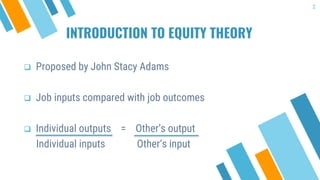
INTRODUCTION TO EQUITY THEORY
 Proposed by John Stacy Adams
 Job inputs compared with job outcomes
 Individual outputs = Other’s output
Individual inputs Other’s input
2
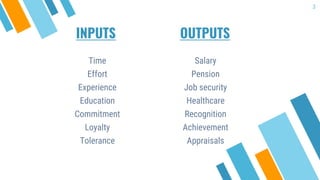
INPUTS OUTPUTS
Time
Effort
Experience
Education
Commitment
Loyalty
Tolerance
Salary
Pension
Job security
Healthcare
Recognition
Achievement
Appraisals
3
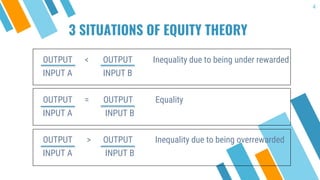
3 SITUATIONS OF EQUITY THEORY
OUTPUT < OUTPUT Inequality due to being under rewarded
INPUT A INPUT B
OUTPUT = OUTPUT Equality
INPUT A INPUT B
OUTPUT > OUTPUT Inequality due to being overrewarded
INPUT A INPUT B
4
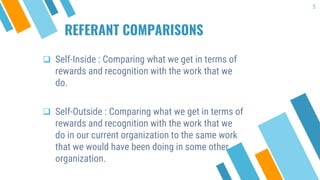
REFERANT COMPARISONS
 Self-Inside : Comparing what we get in terms of
rewards and recognition with the work that we
do.
 Self-Outside : Comparing what we get in terms of
rewards and recognition with the work that we
do in our current organization to the same work
that we would have been doing in some other
organization.
5
6
 Other-Inside : Comparison with the work that we do with
colleagues in our organization and the remuneration and
the rewards and the outcomes we get with the rewards,
remuneration and outcomes of other people in our
organization.
 Other-Outside : Comparison with the work that we are
doing and the outcomes that we are getting within our
organization to the work that our friends are doing and
the outcomes that they are getting within different
organization.
PROS OF EQUITY THEORY
 Source of motivation
 Helps in reducing employee exploitation
 Better relation between workers
 Employee retention
 Cost cutting
7
CONS OF EQUITY THEORY
 Difference of perception
 Exact comparison is difficult
 All other factors are ignored
8
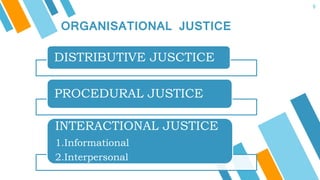
ORGANISATIONAL JUSTICE
9
DISTRIBUTIVE JUSCTICE
PROCEDURAL JUSTICE
INTERACTIONAL JUSTICE
1.Informational
2.Interpersonal
DISTRIBUTIVE JUSTICE
 Perceive fairness of the outcomes
 Direct relation between employees efforts
and the incentives given to them.
 Part of every kind of industry which is not
only beneficial for organizational growth but
also for employee’s loyalty towards their
work.
10
PROCEDURAL JUSTICE
 Employees who are not satisfied with the
fairness of the outcome, must be given a
chance to communicate with managers to
know about what kind of process is followed
while evaluation .
 Important for every kind of industry to involve
employees in decision making process .
11
INFORMATIONAL JUSTICE
 Interaction between the manager and employees
where manager provides their employee the key
decisions and keep them informed about the
important organizational issues.
 Specially for informing any bad news to the
employee, which is not comfortable for manager to
deliver and not comfortable for employee receiving
it.
12
INTERPERSONAL JUSTICE
 Reflects the day to day relation between managers
and employees, whether the employee is treated
with dignity and respect by the managers.
13
THANK YOU
14

Equity theory

  • 1.
  • 2.
    INTRODUCTION TO EQUITYTHEORY  Proposed by John Stacy Adams  Job inputs compared with job outcomes  Individual outputs = Other’s output Individual inputs Other’s input 2
  • 3.
  • 4.
    3 SITUATIONS OFEQUITY THEORY OUTPUT < OUTPUT Inequality due to being under rewarded INPUT A INPUT B OUTPUT = OUTPUT Equality INPUT A INPUT B OUTPUT > OUTPUT Inequality due to being overrewarded INPUT A INPUT B 4
  • 5.
    REFERANT COMPARISONS  Self-Inside: Comparing what we get in terms of rewards and recognition with the work that we do.  Self-Outside : Comparing what we get in terms of rewards and recognition with the work that we do in our current organization to the same work that we would have been doing in some other organization. 5
  • 6.
    6  Other-Inside :Comparison with the work that we do with colleagues in our organization and the remuneration and the rewards and the outcomes we get with the rewards, remuneration and outcomes of other people in our organization.  Other-Outside : Comparison with the work that we are doing and the outcomes that we are getting within our organization to the work that our friends are doing and the outcomes that they are getting within different organization.
  • 7.
    PROS OF EQUITYTHEORY  Source of motivation  Helps in reducing employee exploitation  Better relation between workers  Employee retention  Cost cutting 7
  • 8.
    CONS OF EQUITYTHEORY  Difference of perception  Exact comparison is difficult  All other factors are ignored 8
  • 9.
    ORGANISATIONAL JUSTICE 9 DISTRIBUTIVE JUSCTICE PROCEDURALJUSTICE INTERACTIONAL JUSTICE 1.Informational 2.Interpersonal
  • 10.
    DISTRIBUTIVE JUSTICE  Perceivefairness of the outcomes  Direct relation between employees efforts and the incentives given to them.  Part of every kind of industry which is not only beneficial for organizational growth but also for employee’s loyalty towards their work. 10
  • 11.
    PROCEDURAL JUSTICE  Employeeswho are not satisfied with the fairness of the outcome, must be given a chance to communicate with managers to know about what kind of process is followed while evaluation .  Important for every kind of industry to involve employees in decision making process . 11
  • 12.
    INFORMATIONAL JUSTICE  Interactionbetween the manager and employees where manager provides their employee the key decisions and keep them informed about the important organizational issues.  Specially for informing any bad news to the employee, which is not comfortable for manager to deliver and not comfortable for employee receiving it. 12
  • 13.
    INTERPERSONAL JUSTICE  Reflectsthe day to day relation between managers and employees, whether the employee is treated with dignity and respect by the managers. 13
  • 14.