


Risk Analysis, Real Options, and Capital Budgeting
Chapter Outline 8.1 Sensitivity Analysis, Scenario Analysis, and Break-Even Analysis 8.2 Monte Carlo Simulation 8.3 Real Options 8.4 Decision Trees
8.1 Sensitivity, Scenario, and Break-Even Each allows us to look behind the NPV number to see  how stable  our  estimates  are.
Sensitivity, Scenario, and Break-Even The  projected cash flow  often  goes unmet  in practice, and the firm ends up with a money loser.
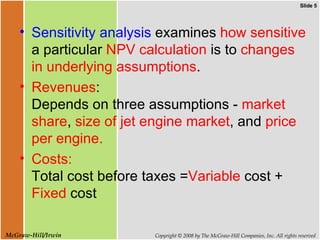
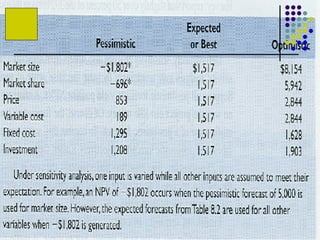
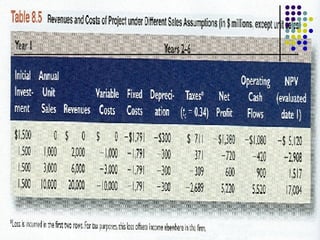
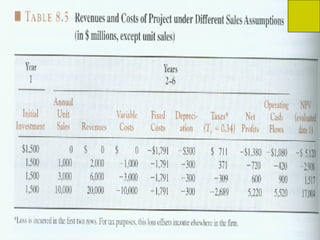
Sensitivity analysis  examines  how sensitive  a particular  NPV calculation  is to  changes in underlying assumptions .  Revenues :  Depends on three assumptions -  market share ,  size of jet engine market , and  price per engine. Costs:  Total cost before taxes = Variable  cost +  Fixed  cost
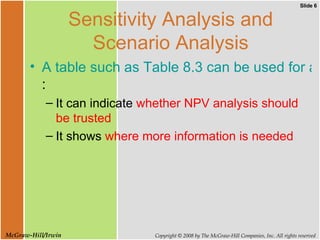
Sensitivity Analysis and Scenario Analysis A table such as Table 8.3 can be used for a number of purposes : It can indicate  whether NPV analysis   should be trusted   It shows  where more information is needed
Sensitivity Analysis and Scenario Analysis The effect of incorrect estimates on  revenues  is so much greater than the effect of incorrect estimates on costs,  more information  on the  factors determining  revenues  might be needed.
Sensitivity Analysis and Scenario Analysis However, sensitivity analysis suffers from some drawbacks: It may  unwittingly  increase  the  false sense of security  among managers; it treats each variable in isolation.  Managers frequently perform scenario analysis to minimize this problem.
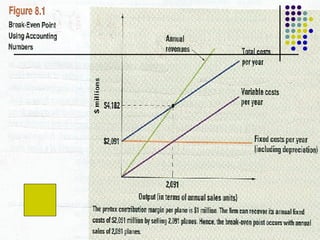
Break-Even Analysis This approach determines the  sales  needed to  break even . It is a useful complement to sensitivity analysis, because it also sheds light on the  severity of incorrect forecasts .
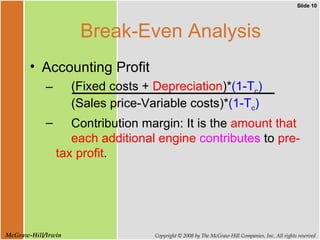
Break-Even Analysis Accounting Profit    (Fixed costs +  Depreciation )* (1-T c )   (Sales price-Variable costs)* (1-T c )   Contribution margin: It is the  amount that    each additional engine   contributes  to  pre-tax profit .
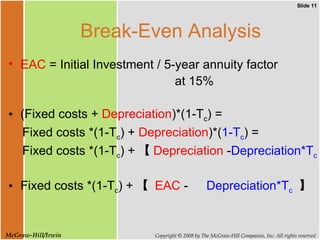
Break-Even Analysis EAC  = Initial Investment / 5-year annuity factor at 15%  (Fixed costs +  Depreciation )*(1-T c ) = Fixed costs *(1-T c ) +  Depreciation )*( 1-T c ) = Fixed costs *(1-T c ) + 【 Depreciation  - Depreciation*T c 】 Fixed costs *(1-T c ) + 【  EAC  -   Depreciation*T c   】
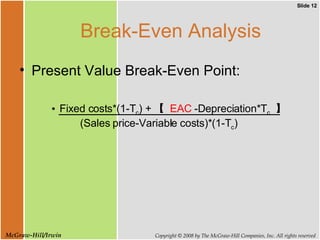
Break-Even Analysis Present Value Break-Even Point:  Fixed costs*(1-T c ) + 【  EAC  -Depreciation*T c   】   (Sales price-Variable costs)*(1-T c )
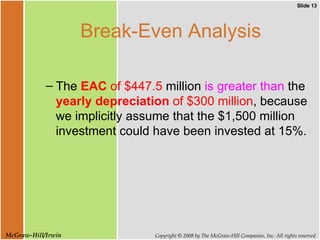
Break-Even Analysis The   EAC  of $447.5  million  is greater than  the  yearly depreciation  of $300 million , because we implicitly assume that the $1,500 million investment could have been invested at 15%.
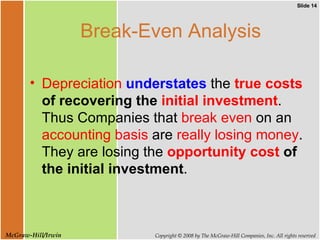
Break-Even Analysis Depreciation   understates  the  true costs  of recovering the  initial investment . Thus Companies that  break even  on an  accounting basis  are  really losing money . They are losing the  opportunity cost  of the initial investment .
8.3 Real Options NPV analysis ignores the  adjustments  that a firm can make after a project is accepted. These adjustments are called  real options . Thus,  NPV   underestimates  the true value of a project.
One of the fundamental insights of modern finance theory is that  options have value .  Because corporations make decisions in a  dynamic environment , they have  options  that should be considered in  project valuation .
Options The Option to  Expand Has value if demand turns out to be higher than expected.
The Option to  Abandon Managers also have the option to abandon existing projects.  Abandonment  can often  save  companies  a great of money .Thus, the  option to abandon   increases the value  of any potential project. Abandonment options are pervasive in the real world.
Timing  Options  They have value if the underlying variables are changing with a favorable trend.
Discounted CF and Options We can calculate the  market value of a project  as the sum of the  NPV of the project without options  and the  value of the managerial options  implicit in the project. M  =  NPV  +  Opt A good example would be comparing the desirability of a  specialized  machine versus a more  versatile  machine. If they both cost about the same and last the same amount of time, the more versatile machine is more valuable because it comes with options.
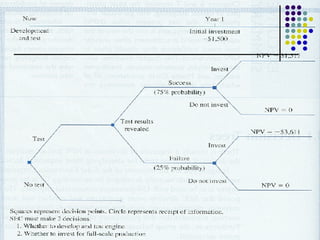
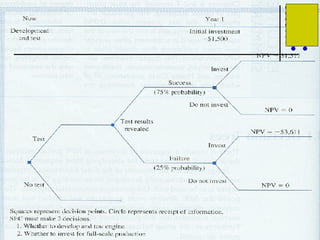
8.4 Decision Trees Two decisions: Whether to  develop  and  test  the solar-powered jet engine. Whether to  invest  for  full-scale production  following the results of the test.
A fundamental problem in NPV analysis is dealing with  uncertain  future outcomes.  Warning : Perhaps a higher discount rate should have been used for the initial test-marketing decision.


Chap008

  • 1.
    Risk Analysis, RealOptions, and Capital Budgeting
  • 2.
    Chapter Outline 8.1Sensitivity Analysis, Scenario Analysis, and Break-Even Analysis 8.2 Monte Carlo Simulation 8.3 Real Options 8.4 Decision Trees
  • 3.
    8.1 Sensitivity, Scenario,and Break-Even Each allows us to look behind the NPV number to see how stable our estimates are.
  • 4.
    Sensitivity, Scenario, andBreak-Even The projected cash flow often goes unmet in practice, and the firm ends up with a money loser.
  • 5.
    Sensitivity analysis examines how sensitive a particular NPV calculation is to changes in underlying assumptions . Revenues : Depends on three assumptions - market share , size of jet engine market , and price per engine. Costs: Total cost before taxes = Variable cost + Fixed cost
  • 6.
    Sensitivity Analysis andScenario Analysis A table such as Table 8.3 can be used for a number of purposes : It can indicate whether NPV analysis should be trusted It shows where more information is needed
  • 7.
    Sensitivity Analysis andScenario Analysis The effect of incorrect estimates on revenues is so much greater than the effect of incorrect estimates on costs, more information on the factors determining revenues might be needed.
  • 8.
    Sensitivity Analysis andScenario Analysis However, sensitivity analysis suffers from some drawbacks: It may unwittingly increase the false sense of security among managers; it treats each variable in isolation. Managers frequently perform scenario analysis to minimize this problem.
  • 9.
    Break-Even Analysis Thisapproach determines the sales needed to break even . It is a useful complement to sensitivity analysis, because it also sheds light on the severity of incorrect forecasts .
  • 10.
    Break-Even Analysis AccountingProfit   (Fixed costs + Depreciation )* (1-T c )   (Sales price-Variable costs)* (1-T c )   Contribution margin: It is the amount that   each additional engine contributes to pre-tax profit .
  • 11.
    Break-Even Analysis EAC = Initial Investment / 5-year annuity factor at 15% (Fixed costs + Depreciation )*(1-T c ) = Fixed costs *(1-T c ) + Depreciation )*( 1-T c ) = Fixed costs *(1-T c ) + 【 Depreciation - Depreciation*T c 】 Fixed costs *(1-T c ) + 【 EAC -   Depreciation*T c 】
  • 12.
    Break-Even Analysis PresentValue Break-Even Point: Fixed costs*(1-T c ) + 【 EAC -Depreciation*T c 】 (Sales price-Variable costs)*(1-T c )
  • 13.
    Break-Even Analysis The EAC of $447.5 million is greater than the yearly depreciation of $300 million , because we implicitly assume that the $1,500 million investment could have been invested at 15%.
  • 14.
    Break-Even Analysis Depreciation understates the true costs of recovering the initial investment . Thus Companies that break even on an accounting basis are really losing money . They are losing the opportunity cost of the initial investment .
  • 15.
    8.3 Real OptionsNPV analysis ignores the adjustments that a firm can make after a project is accepted. These adjustments are called real options . Thus, NPV underestimates the true value of a project.
  • 16.
    One of thefundamental insights of modern finance theory is that options have value . Because corporations make decisions in a dynamic environment , they have options that should be considered in project valuation .
  • 17.
    Options The Optionto Expand Has value if demand turns out to be higher than expected.
  • 18.
    The Option to Abandon Managers also have the option to abandon existing projects. Abandonment can often save companies a great of money .Thus, the option to abandon increases the value of any potential project. Abandonment options are pervasive in the real world.
  • 19.
    Timing Options They have value if the underlying variables are changing with a favorable trend.
  • 20.
    Discounted CF andOptions We can calculate the market value of a project as the sum of the NPV of the project without options and the value of the managerial options implicit in the project. M = NPV + Opt A good example would be comparing the desirability of a specialized machine versus a more versatile machine. If they both cost about the same and last the same amount of time, the more versatile machine is more valuable because it comes with options.
  • 21.
    8.4 Decision TreesTwo decisions: Whether to develop and test the solar-powered jet engine. Whether to invest for full-scale production following the results of the test.
  • 22.
    A fundamental problemin NPV analysis is dealing with uncertain future outcomes. Warning : Perhaps a higher discount rate should have been used for the initial test-marketing decision.
  • 23.
  • 24.
  • 25.
  • 26.
  • 27.
  • 28.