FORWARD CURVES and
FORECASTS
Bobby Adjemian
Director, Market Analysis
Presented at:
EPIS Conference
Skamania Lodge, WA
September 26, 2003
2
The Holy Grail of the market analyst:
• “Predict spot prices”
• Available options are:
Forward price curves (market)
Forecast prices (models)
Proposition:
Neither option consistently provides acceptable spot
price predictability
3
First some definitions:
• Forward price curves are prices which are set today for
future delivery
• Spot prices are prices at delivery
• Forecast prices or Expected spot are prices which are
calculated using a simulation model usually driven by
market fundamentals
4
Why do we want good predictors of spot prices?
• Some reasons:
Reliable valuations
Improves plant management
Create trading opportunities
5
What is the theoretical perspective?
Analysis:
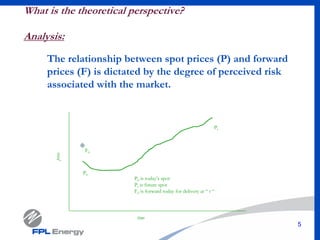
The relationship between spot prices (P) and forward
prices (F) is dictated by the degree of perceived risk
associated with the market.
price
time
P0
Pt
P0 is today’s spot
Pt is future spot
F0 is forward today for delivery at “ t “
F0
6
What is the theoretical perspective?
Analysis:
P0 =
Pt
1 + k
n
P0 =
F0
1 + rf
n
F0 = Pt *
1 + rf
1 + k
n
Where:
k = discount rate
n = # of periods between “0” and “t”
rf = Risk free rate of return
If k >rf then F0 < Pt
7
What is the empirical perspective?
Analysis:
price
2002
price
2002
ERCOT
SP 15
Forward
Actual
Forward
Actual
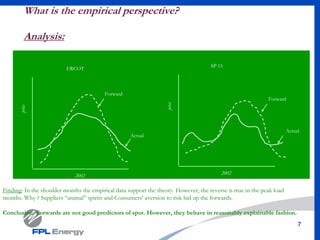
Finding: In the shoulder months the empirical data support the theory. However, the reverse is true in the peak load
months. Why ? Suppliers “animal” spirits and Consumers’ aversion to risk bid up the forwards.
Conclusion: Forwards are not good predictors of spot. However, they behave in reasonably explainable fashion.
8
Forecast of spot prices
The other option to predict spot prices are forecast models which
are generally fundamentals driven
They rely on significant volume of input data and utilize tools
and algorithms that attempt to approximate real world market
operations
Generally, their solution logic is designed to satisfy a multiple
constraint (economic and operational) objective of meeting the
energy demand.
9
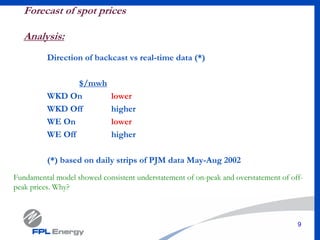
Forecast of spot prices
Analysis:
Direction of backcast vs real-time data (*)
$/mwh
WKD On lower
WKD Off higher
WE On lower
WE Off higher
(*) based on daily strips of PJM data May-Aug 2002
Fundamental model showed consistent understatement of on-peak and overstatement of off-
peak prices. Why?
10
Biases in simulation models
• Factors contributing to a downward bias on-peak
Emphasis on single point vs stochastic simulations
Failure to fully capture bidding strategies by generators
Lack of ancillary service modeling
Lack of full simulation of operating constraints
The assumption of perfect market efficiency
Other?
• Factors contributing to an upward bias off-peak
Failure to fully capture bidding strategies by generators
Other?
Conclusion: Generally, fundamental models are not good predictors of spot prices. Out of the box production
models have built in biases and limitations that only approximate market operations
11
Key Points
• Our ability to accurately predict spot prices is not
good.
• On the one hand forwards prove to be a poor predictor
because the relationship of the forwards to the spot
price is biased and is dictated by the largely illiquid
current nature of the electricity markets.
• On the other hand, fundamental models miss out on
the operating complexities of real-time markets and as
such can not accurately predict spot prices.
• A market analyst must be cognizant of these factors as
they attempt to use either: the market data or the
forecast data.
12
Recommendation
• Until spot markets become more liquid and
popular the simulation model, when used with
appropriate adjustments to account for its
biases, represents the best alternative for
producing reliable results.

Day-Ahead LMP Forecasting with AURORAxmp

  • 1.
    FORWARD CURVES and FORECASTS BobbyAdjemian Director, Market Analysis Presented at: EPIS Conference Skamania Lodge, WA September 26, 2003
  • 2.
    2 The Holy Grailof the market analyst: • “Predict spot prices” • Available options are: Forward price curves (market) Forecast prices (models) Proposition: Neither option consistently provides acceptable spot price predictability
  • 3.
    3 First some definitions: •Forward price curves are prices which are set today for future delivery • Spot prices are prices at delivery • Forecast prices or Expected spot are prices which are calculated using a simulation model usually driven by market fundamentals
  • 4.
    4 Why do wewant good predictors of spot prices? • Some reasons: Reliable valuations Improves plant management Create trading opportunities
  • 5.
    5 What is thetheoretical perspective? Analysis: The relationship between spot prices (P) and forward prices (F) is dictated by the degree of perceived risk associated with the market. price time P0 Pt P0 is today’s spot Pt is future spot F0 is forward today for delivery at “ t “ F0
  • 6.
    6 What is thetheoretical perspective? Analysis: P0 = Pt 1 + k n P0 = F0 1 + rf n F0 = Pt * 1 + rf 1 + k n Where: k = discount rate n = # of periods between “0” and “t” rf = Risk free rate of return If k >rf then F0 < Pt
  • 7.
    7 What is theempirical perspective? Analysis: price 2002 price 2002 ERCOT SP 15 Forward Actual Forward Actual Finding: In the shoulder months the empirical data support the theory. However, the reverse is true in the peak load months. Why ? Suppliers “animal” spirits and Consumers’ aversion to risk bid up the forwards. Conclusion: Forwards are not good predictors of spot. However, they behave in reasonably explainable fashion.
  • 8.
    8 Forecast of spotprices The other option to predict spot prices are forecast models which are generally fundamentals driven They rely on significant volume of input data and utilize tools and algorithms that attempt to approximate real world market operations Generally, their solution logic is designed to satisfy a multiple constraint (economic and operational) objective of meeting the energy demand.
  • 9.
    9 Forecast of spotprices Analysis: Direction of backcast vs real-time data (*) $/mwh WKD On lower WKD Off higher WE On lower WE Off higher (*) based on daily strips of PJM data May-Aug 2002 Fundamental model showed consistent understatement of on-peak and overstatement of off- peak prices. Why?
  • 10.
    10 Biases in simulationmodels • Factors contributing to a downward bias on-peak Emphasis on single point vs stochastic simulations Failure to fully capture bidding strategies by generators Lack of ancillary service modeling Lack of full simulation of operating constraints The assumption of perfect market efficiency Other? • Factors contributing to an upward bias off-peak Failure to fully capture bidding strategies by generators Other? Conclusion: Generally, fundamental models are not good predictors of spot prices. Out of the box production models have built in biases and limitations that only approximate market operations
  • 11.
    11 Key Points • Ourability to accurately predict spot prices is not good. • On the one hand forwards prove to be a poor predictor because the relationship of the forwards to the spot price is biased and is dictated by the largely illiquid current nature of the electricity markets. • On the other hand, fundamental models miss out on the operating complexities of real-time markets and as such can not accurately predict spot prices. • A market analyst must be cognizant of these factors as they attempt to use either: the market data or the forecast data.
  • 12.
    12 Recommendation • Until spotmarkets become more liquid and popular the simulation model, when used with appropriate adjustments to account for its biases, represents the best alternative for producing reliable results.