IST 617                      Assignment 4 – Student Choice #2                      Nov 29, 2010
                Choice #1: Research Paper – Rewards for Information Workers


  Building Intrinsic Motivation Using Personal Learning Plans for High
                          Technology Workers


                                        Leo de Sousa


                                         Abstract
This paper explores an approach to build intrinsic motivation in High Technology Workers

which motivates them to work on their personal learning plans to earn rewards in their personal,

educational and career objectives in a work environment governed by a Collective Bargaining

Agreement. Topics covered are (a) Definition of Key Terms, (b), Background, (c) An Approach

for Motivating Unionized Employees, (d) Review of Supporting Motivational Theories and (e)

Conclusions. After reading this paper, the reader should have a clear understanding of the key

terms, background, discussion of motivational theories and an approach to develop intrinsic

motivation for employees to work towards rewards in their personal, educational and career

objectives.


Leo de Sousa                                                                              Page 1
IST 617                       Assignment 4 – Student Choice #2                      Nov 29, 2010
                 Choice #1: Research Paper – Rewards for Information Workers

                                        Definitions
Collective Bargaining Agreement (CBA): A written contract between an employer and a labor

union, for a definitive period of time, spelling out conditions of employment, wages, hours of

work, rights of employees and the union, and procedures to be followed in settling disputes.

Personal Learning Plan (PLP): A structured and collaborative process between an employee and

their manager with goal of creating a plan for the employee’s personal, educational and career

development.

SMART Objectives: A mnemonic used in performance management to describe the goals and

targets set for employees. SMART stands for : Specific, Measurable, Achievable, Relevant, and

Time Bound.

Total Compensation: A Human Resources term used to describe the complete compensation an

employer provides to employee including salary, benefits, pension, health care and government

benefits.


                                       Background
I lead a team of 22 unionized, Systems Analysts in the Information Technology Services

department at the British Columbia Institute of Technology (BCIT) (www.bcit.ca). BCIT is a

provincially chartered and publically funded higher education institution. My team has

responsibility for all the applications delivered centrally to our community. My team members’

total compensation is governed by the Collective Bargaining Agreement (CBA) between the

BCIT Faculty and Staff Association (FSA) (www.bcitfsa.ca) and BCIT. The CBA (BCIT FSA,

2007) prescribes the specifics of the employee compensation items:

   •   Holidays, Vacations and Leaves


Leo de Sousa                                                                               Page 2
IST 617                       Assignment 4 – Student Choice #2                        Nov 29, 2010
                 Choice #1: Research Paper – Rewards for Information Workers
   •   Professional Development

   •   Placement and Advancement

   •   Salary, Hourly Rates and Allowances

   •   Insurance/Benefit Plans

   •   Administrative Allowances

The CBA does not have any provisions for bonuses or rewards for FSA union members,

although BCIT does run an annual Employee Excellence recognition program. The CBA

specifies three job descriptions - Junior Systems Analyst (JSA), Intermediate Systems Analyst

(ISA) and Senior Systems Analyst (SSA); each with nine pay steps. The job descriptions are

generic and specific duties are defined within work teams. Staff members are automatically

granted the next salary pay step annually until they reach the top, ninth step. Staff members can

follow a process to apply for reclassification from JSA to ISA and ISA to SSA. Finally, the

CBA describes a Performance Management process but the outcomes of the performance review

can not be used for discipline or reward purposes.


This constrained environment is a significant challenge for managers. It is particularly difficult

to find ways to motivate our staff members with rewards. Managers have some discretion in

assigning work to team members and allowing flexible work hours but the unionized culture

forces a manager to work to the lowest common denominator when considering reward

opportunities. Should a manager appear to break the rules in the CBA, there is a grievance

process that a staff member can engage to address their issues. The final background factor to be

considered is that nature of the work environment of high technology workers. High technology


Leo de Sousa                                                                                Page 3
IST 617                       Assignment 4 – Student Choice #2                      Nov 29, 2010
                 Choice #1: Research Paper – Rewards for Information Workers
workers are constantly faced with changes in their profession and there are significant challenges

for them to stay current while also doing their daily work.


        An Approach for Motivating Unionized Employees
An approach I have implemented to motivate my team is the Personal Learning Plan (PLP).

Swinton recommends “Although you may have little scope to change pay policies and make

substantial changes to what people earn, there is plenty you can do. Making sure you hold

regular one to one meetings to discuss goals and personal development is a valuable investment

in time. Set goals for your team and help them to create their own personal development plan.”

(Swinton, 2006) I meet regularly with my team members to collaboratively build a personal

learning plan. This approach has been successful in the workplace and motivates staff members

to advance their personal, educational and career objectives. Developing PLPs with your staff

provides multiple motivational and rewarding impacts:


   •   Reinforces the shared responsibility of the employer/manager and the employee to career

       development benefiting the employee and the company

   •   Allows employees at lower positions to build skills and competencies so they can apply

       to reclassify to higher level positions

   •   Allows employees to build skills and competencies so they can apply for different jobs

       and roles in the organization

   •   Keeps job skills current in a rapidly changing high technology work environment


Personal Learning Plans are “living” documents that require an investment of time by the

employee and manager to build plans that are realistic and achievable. A key to this requirement


Leo de Sousa                                                                                Page 4
in the process is ensuring the individual learning items to “SMART objectives”. A sample
IST 617                       Assignment 4 – Student Choice #2                         Nov 29, 2010
                 Choice #1: Research Paper – Rewards for Information Workers
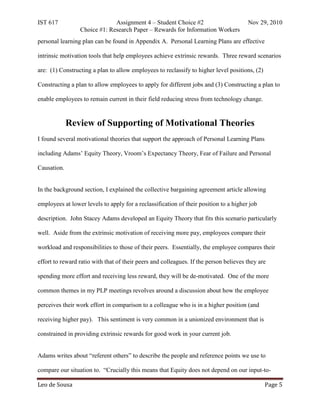
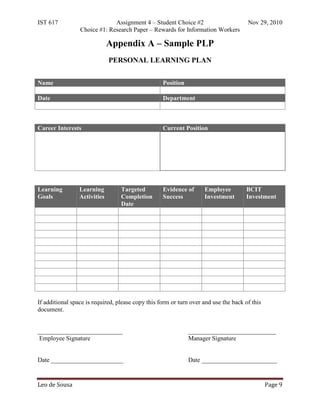
personal learning plan can be found in Appendix A. Personal Learning Plans are effective

intrinsic motivation tools that help employees achieve extrinsic rewards. Three reward scenarios

are: (1) Constructing a plan to allow employees to reclassify to higher level positions, (2)

Constructing a plan to allow employees to apply for different jobs and (3) Constructing a plan to

enable employees to remain current in their field reducing stress from technology change.


             Review of Supporting of Motivational Theories
I found several motivational theories that support the approach of Personal Learning Plans

including Adams’ Equity Theory, Vroom’s Expectancy Theory, Fear of Failure and Personal

Causation.


In the background section, I explained the collective bargaining agreement article allowing

employees at lower levels to apply for a reclassification of their position to a higher job

description. John Stacey Adams developed an Equity Theory that fits this scenario particularly

well. Aside from the extrinsic motivation of receiving more pay, employees compare their

workload and responsibilities to those of their peers. Essentially, the employee compares their

effort to reward ratio with that of their peers and colleagues. If the person believes they are

spending more effort and receiving less reward, they will be de-motivated. One of the more

common themes in my PLP meetings revolves around a discussion about how the employee

perceives their work effort in comparison to a colleague who is in a higher position (and

receiving higher pay). This sentiment is very common in a unionized environment that is

constrained in providing extrinsic rewards for good work in your current job.


Adams writes about “referent others” to describe the people and reference points we use to


Leo de Sousa                                                                                   Page 5
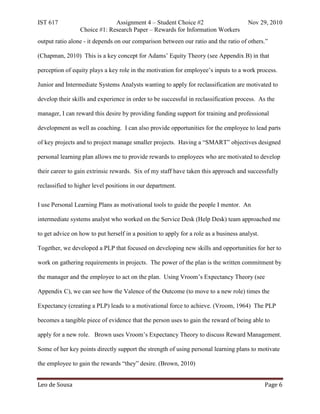
compare our situation to. “Crucially this means that Equity does not depend on our input-to-
IST 617                       Assignment 4 – Student Choice #2                         Nov 29, 2010
                 Choice #1: Research Paper – Rewards for Information Workers
output ratio alone - it depends on our comparison between our ratio and the ratio of others.”

(Chapman, 2010) This is a key concept for Adams’ Equity Theory (see Appendix B) in that

perception of equity plays a key role in the motivation for employee’s inputs to a work process.

Junior and Intermediate Systems Analysts wanting to apply for reclassification are motivated to

develop their skills and experience in order to be successful in reclassification process. As the

manager, I can reward this desire by providing funding support for training and professional

development as well as coaching. I can also provide opportunities for the employee to lead parts

of key projects and to project manage smaller projects. Having a “SMART” objectives designed

personal learning plan allows me to provide rewards to employees who are motivated to develop

their career to gain extrinsic rewards. Six of my staff have taken this approach and successfully

reclassified to higher level positions in our department.


I use Personal Learning Plans as motivational tools to guide the people I mentor. An

intermediate systems analyst who worked on the Service Desk (Help Desk) team approached me

to get advice on how to put herself in a position to apply for a role as a business analyst.

Together, we developed a PLP that focused on developing new skills and opportunities for her to

work on gathering requirements in projects. The power of the plan is the written commitment by

the manager and the employee to act on the plan. Using Vroom’s Expectancy Theory (see

Appendix C), we can see how the Valence of the Outcome (to move to a new role) times the

Expectancy (creating a PLP) leads to a motivational force to achieve. (Vroom, 1964) The PLP

becomes a tangible piece of evidence that the person uses to gain the reward of being able to

apply for a new role. Brown uses Vroom’s Expectancy Theory to discuss Reward Management.

Some of her key points directly support the strength of using personal learning plans to motivate

the employee to gain the rewards “they” desire. (Brown, 2010)


Leo de Sousa                                                                                   Page 6
IST 617                         Assignment 4 – Student Choice #2                     Nov 29, 2010
                   Choice #1: Research Paper – Rewards for Information Workers
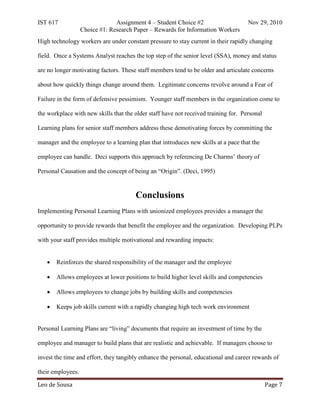
High technology workers are under constant pressure to stay current in their rapidly changing

field. Once a Systems Analyst reaches the top step of the senior level (SSA), money and status

are no longer motivating factors. These staff members tend to be older and articulate concerns

about how quickly things change around them. Legitimate concerns revolve around a Fear of

Failure in the form of defensive pessimism. Younger staff members in the organization come to

the workplace with new skills that the older staff have not received training for. Personal

Learning plans for senior staff members address these demotivating forces by committing the

manager and the employee to a learning plan that introduces new skills at a pace that the

employee can handle. Deci supports this approach by referencing De Charms’ theory of

Personal Causation and the concept of being an “Origin”. (Deci, 1995)


                                       Conclusions
Implementing Personal Learning Plans with unionized employees provides a manager the

opportunity to provide rewards that benefit the employee and the organization. Developing PLPs

with your staff provides multiple motivational and rewarding impacts:


   •   Reinforces the shared responsibility of the manager and the employee

   •   Allows employees at lower positions to build higher level skills and competencies

   •   Allows employees to change jobs by building skills and competencies

   •   Keeps job skills current with a rapidly changing high tech work environment


Personal Learning Plans are “living” documents that require an investment of time by the

employee and manager to build plans that are realistic and achievable. If managers choose to

invest the time and effort, they tangibly enhance the personal, educational and career rewards of


Leo de Sousa                                                                                  Page 7
their employees.
IST 617                     Assignment 4 – Student Choice #2                    Nov 29, 2010
               Choice #1: Research Paper – Rewards for Information Workers

                                     References
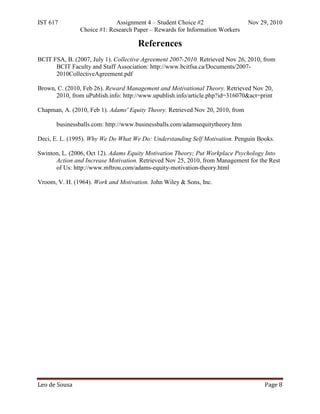
BCIT FSA, B. (2007, July 1). Collective Agreement 2007-2010. Retrieved Nov 26, 2010, from
      BCIT Faculty and Staff Association: http://www.bcitfsa.ca/Documents/2007-
      2010CollectiveAgreement.pdf

Brown, C. (2010, Feb 26). Reward Management and Motivational Theory. Retrieved Nov 20,
      2010, from uPublish.info: http://www.upublish.info/article.php?id=316070&act=print

Chapman, A. (2010, Feb 1). Adams' Equity Theory. Retrieved Nov 20, 2010, from

       businessballs.com: http://www.businessballs.com/adamsequitytheory.htm

Deci, E. L. (1995). Why We Do What We Do: Understanding Self Motivation. Penguin Books.

Swinton, L. (2006, Oct 12). Adams Equity Motivation Theory; Put Workplace Psychology Into
      Action and Increase Motivation. Retrieved Nov 25, 2010, from Management for the Rest
      of Us: http://www.mftrou.com/adams-equity-motivation-theory.html

Vroom, V. H. (1964). Work and Motivation. John Wiley & Sons, Inc.


Leo de Sousa                                                                         Page 8
IST 617                       Assignment 4 – Student Choice #2                        Nov 29, 2010
                 Choice #1: Research Paper – Rewards for Information Workers

                              Appendix A – Sample PLP
                              PERSONAL LEARNING PLAN


Name                                               Position

Date                                               Department


Career Interests                                   Current Position


Learning         Learning         Targeted         Evidence of      Employee         BCIT
Goals            Activities       Completion       Success          Investment       Investment
                                  Date


If additional space is required, please copy this form or turn over and use the back of this
document.


___________________________                                   ____________________________
 Employee Signature                                           Manager Signature


Date _______________________                                  Date ________________________


Leo de Sousa                                                                                   Page 9
IST 617                       Assignment 4 – Student Choice #2                       Nov 29, 2010
                 Choice #1: Research Paper – Rewards for Information Workers

                     Appendix B – Adams’ Equity Theory
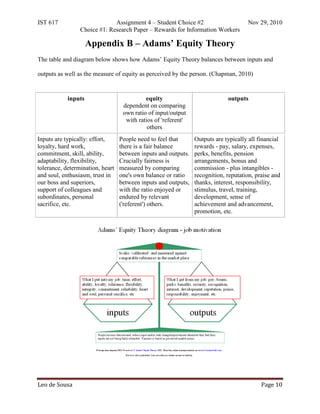
The table and diagram below shows how Adams’ Equity Theory balances between inputs and

outputs as well as the measure of equity as perceived by the person. (Chapman, 2010)


            inputs                          equity                           outputs
                                   dependent on comparing
                                   own ratio of input/output
                                    with ratios of 'referent'
                                             others
Inputs are typically: effort,     People need to feel that      Outputs are typically all financial
loyalty, hard work,               there is a fair balance       rewards - pay, salary, expenses,
commitment, skill, ability,       between inputs and outputs.   perks, benefits, pension
adaptability, flexibility,        Crucially fairness is         arrangements, bonus and
tolerance, determination, heart   measured by comparing         commission - plus intangibles -
and soul, enthusiasm, trust in    one's own balance or ratio    recognition, reputation, praise and
our boss and superiors,           between inputs and outputs,   thanks, interest, responsibility,
support of colleagues and         with the ratio enjoyed or     stimulus, travel, training,
subordinates, personal            endured by relevant           development, sense of
sacrifice, etc.                   ('referent') others.          achievement and advancement,
                                                                promotion, etc.


Leo de Sousa                                                                               Page 10
IST 617                        Assignment 4 – Student Choice #2                         Nov 29, 2010
                  Choice #1: Research Paper – Rewards for Information Workers

                Appendix C – Vroom’s Expectancy Theory
Expectancy Theory is based on an employee’s beliefs:

   •    Valence - refers to emotional orientations which people hold with respect to outcomes

        (rewards) – the value the person attaches to first and second order outcomes

   •    Expectancy – refers to employees’ different expectations and levels of confidence about

        what they are capable of doing – the belief that effort will lead to first order outcomes

   •      Instrumentality – refers to the perception of employees whether they will actually

        receive what they desire, even if it has been promised by a manager – the perceived link

        between first order and second order outcomes


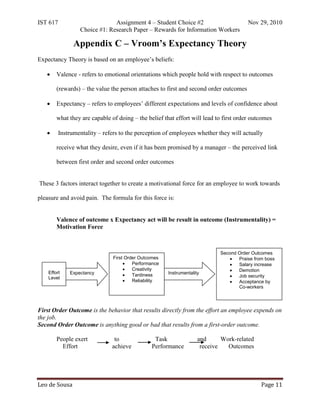
These 3 factors interact together to create a motivational force for an employee to work towards

pleasure and avoid pain. The formula for this force is:


        Valence of outcome x Expectancy act will be result in outcome (Instrumentality) =
        Motivation Force


                                                                             Second Order Outcomes
                                First Order Outcomes                            •   Praise from boss
                                     •   Performance                            •   Salary increase
                                     •   Creativity                             •   Demotion
    Effort    Expectancy                               Instrumentality
                                     •   Tardiness                              •   Job security
    Level
                                     •   Reliability                            •   Acceptance by
                                                                                    Co-workers


First Order Outcome is the behavior that results directly from the effort an employee expends on
the job.
Second Order Outcome is anything good or bad that results from a first-order outcome.

        People exert            to               Task                and      Work-related
          Effort               achieve          Performance           receive   Outcomes


Leo de Sousa                                                                                  Page 11

Rewards for Information Workers

  • 1.
    IST 617 Assignment 4 – Student Choice #2 Nov 29, 2010 Choice #1: Research Paper – Rewards for Information Workers Building Intrinsic Motivation Using Personal Learning Plans for High Technology Workers Leo de Sousa Abstract This paper explores an approach to build intrinsic motivation in High Technology Workers which motivates them to work on their personal learning plans to earn rewards in their personal, educational and career objectives in a work environment governed by a Collective Bargaining Agreement. Topics covered are (a) Definition of Key Terms, (b), Background, (c) An Approach for Motivating Unionized Employees, (d) Review of Supporting Motivational Theories and (e) Conclusions. After reading this paper, the reader should have a clear understanding of the key terms, background, discussion of motivational theories and an approach to develop intrinsic motivation for employees to work towards rewards in their personal, educational and career objectives. Leo de Sousa Page 1
  • 2.
    IST 617 Assignment 4 – Student Choice #2 Nov 29, 2010 Choice #1: Research Paper – Rewards for Information Workers Definitions Collective Bargaining Agreement (CBA): A written contract between an employer and a labor union, for a definitive period of time, spelling out conditions of employment, wages, hours of work, rights of employees and the union, and procedures to be followed in settling disputes. Personal Learning Plan (PLP): A structured and collaborative process between an employee and their manager with goal of creating a plan for the employee’s personal, educational and career development. SMART Objectives: A mnemonic used in performance management to describe the goals and targets set for employees. SMART stands for : Specific, Measurable, Achievable, Relevant, and Time Bound. Total Compensation: A Human Resources term used to describe the complete compensation an employer provides to employee including salary, benefits, pension, health care and government benefits. Background I lead a team of 22 unionized, Systems Analysts in the Information Technology Services department at the British Columbia Institute of Technology (BCIT) (www.bcit.ca). BCIT is a provincially chartered and publically funded higher education institution. My team has responsibility for all the applications delivered centrally to our community. My team members’ total compensation is governed by the Collective Bargaining Agreement (CBA) between the BCIT Faculty and Staff Association (FSA) (www.bcitfsa.ca) and BCIT. The CBA (BCIT FSA, 2007) prescribes the specifics of the employee compensation items: • Holidays, Vacations and Leaves Leo de Sousa Page 2
  • 3.
    IST 617 Assignment 4 – Student Choice #2 Nov 29, 2010 Choice #1: Research Paper – Rewards for Information Workers • Professional Development • Placement and Advancement • Salary, Hourly Rates and Allowances • Insurance/Benefit Plans • Administrative Allowances The CBA does not have any provisions for bonuses or rewards for FSA union members, although BCIT does run an annual Employee Excellence recognition program. The CBA specifies three job descriptions - Junior Systems Analyst (JSA), Intermediate Systems Analyst (ISA) and Senior Systems Analyst (SSA); each with nine pay steps. The job descriptions are generic and specific duties are defined within work teams. Staff members are automatically granted the next salary pay step annually until they reach the top, ninth step. Staff members can follow a process to apply for reclassification from JSA to ISA and ISA to SSA. Finally, the CBA describes a Performance Management process but the outcomes of the performance review can not be used for discipline or reward purposes. This constrained environment is a significant challenge for managers. It is particularly difficult to find ways to motivate our staff members with rewards. Managers have some discretion in assigning work to team members and allowing flexible work hours but the unionized culture forces a manager to work to the lowest common denominator when considering reward opportunities. Should a manager appear to break the rules in the CBA, there is a grievance process that a staff member can engage to address their issues. The final background factor to be considered is that nature of the work environment of high technology workers. High technology Leo de Sousa Page 3
  • 4.
    IST 617 Assignment 4 – Student Choice #2 Nov 29, 2010 Choice #1: Research Paper – Rewards for Information Workers workers are constantly faced with changes in their profession and there are significant challenges for them to stay current while also doing their daily work. An Approach for Motivating Unionized Employees An approach I have implemented to motivate my team is the Personal Learning Plan (PLP). Swinton recommends “Although you may have little scope to change pay policies and make substantial changes to what people earn, there is plenty you can do. Making sure you hold regular one to one meetings to discuss goals and personal development is a valuable investment in time. Set goals for your team and help them to create their own personal development plan.” (Swinton, 2006) I meet regularly with my team members to collaboratively build a personal learning plan. This approach has been successful in the workplace and motivates staff members to advance their personal, educational and career objectives. Developing PLPs with your staff provides multiple motivational and rewarding impacts: • Reinforces the shared responsibility of the employer/manager and the employee to career development benefiting the employee and the company • Allows employees at lower positions to build skills and competencies so they can apply to reclassify to higher level positions • Allows employees to build skills and competencies so they can apply for different jobs and roles in the organization • Keeps job skills current in a rapidly changing high technology work environment Personal Learning Plans are “living” documents that require an investment of time by the employee and manager to build plans that are realistic and achievable. A key to this requirement Leo de Sousa Page 4 in the process is ensuring the individual learning items to “SMART objectives”. A sample
  • 5.
    IST 617 Assignment 4 – Student Choice #2 Nov 29, 2010 Choice #1: Research Paper – Rewards for Information Workers personal learning plan can be found in Appendix A. Personal Learning Plans are effective intrinsic motivation tools that help employees achieve extrinsic rewards. Three reward scenarios are: (1) Constructing a plan to allow employees to reclassify to higher level positions, (2) Constructing a plan to allow employees to apply for different jobs and (3) Constructing a plan to enable employees to remain current in their field reducing stress from technology change. Review of Supporting of Motivational Theories I found several motivational theories that support the approach of Personal Learning Plans including Adams’ Equity Theory, Vroom’s Expectancy Theory, Fear of Failure and Personal Causation. In the background section, I explained the collective bargaining agreement article allowing employees at lower levels to apply for a reclassification of their position to a higher job description. John Stacey Adams developed an Equity Theory that fits this scenario particularly well. Aside from the extrinsic motivation of receiving more pay, employees compare their workload and responsibilities to those of their peers. Essentially, the employee compares their effort to reward ratio with that of their peers and colleagues. If the person believes they are spending more effort and receiving less reward, they will be de-motivated. One of the more common themes in my PLP meetings revolves around a discussion about how the employee perceives their work effort in comparison to a colleague who is in a higher position (and receiving higher pay). This sentiment is very common in a unionized environment that is constrained in providing extrinsic rewards for good work in your current job. Adams writes about “referent others” to describe the people and reference points we use to Leo de Sousa Page 5 compare our situation to. “Crucially this means that Equity does not depend on our input-to-
  • 6.
    IST 617 Assignment 4 – Student Choice #2 Nov 29, 2010 Choice #1: Research Paper – Rewards for Information Workers output ratio alone - it depends on our comparison between our ratio and the ratio of others.” (Chapman, 2010) This is a key concept for Adams’ Equity Theory (see Appendix B) in that perception of equity plays a key role in the motivation for employee’s inputs to a work process. Junior and Intermediate Systems Analysts wanting to apply for reclassification are motivated to develop their skills and experience in order to be successful in reclassification process. As the manager, I can reward this desire by providing funding support for training and professional development as well as coaching. I can also provide opportunities for the employee to lead parts of key projects and to project manage smaller projects. Having a “SMART” objectives designed personal learning plan allows me to provide rewards to employees who are motivated to develop their career to gain extrinsic rewards. Six of my staff have taken this approach and successfully reclassified to higher level positions in our department. I use Personal Learning Plans as motivational tools to guide the people I mentor. An intermediate systems analyst who worked on the Service Desk (Help Desk) team approached me to get advice on how to put herself in a position to apply for a role as a business analyst. Together, we developed a PLP that focused on developing new skills and opportunities for her to work on gathering requirements in projects. The power of the plan is the written commitment by the manager and the employee to act on the plan. Using Vroom’s Expectancy Theory (see Appendix C), we can see how the Valence of the Outcome (to move to a new role) times the Expectancy (creating a PLP) leads to a motivational force to achieve. (Vroom, 1964) The PLP becomes a tangible piece of evidence that the person uses to gain the reward of being able to apply for a new role. Brown uses Vroom’s Expectancy Theory to discuss Reward Management. Some of her key points directly support the strength of using personal learning plans to motivate the employee to gain the rewards “they” desire. (Brown, 2010) Leo de Sousa Page 6
  • 7.
    IST 617 Assignment 4 – Student Choice #2 Nov 29, 2010 Choice #1: Research Paper – Rewards for Information Workers High technology workers are under constant pressure to stay current in their rapidly changing field. Once a Systems Analyst reaches the top step of the senior level (SSA), money and status are no longer motivating factors. These staff members tend to be older and articulate concerns about how quickly things change around them. Legitimate concerns revolve around a Fear of Failure in the form of defensive pessimism. Younger staff members in the organization come to the workplace with new skills that the older staff have not received training for. Personal Learning plans for senior staff members address these demotivating forces by committing the manager and the employee to a learning plan that introduces new skills at a pace that the employee can handle. Deci supports this approach by referencing De Charms’ theory of Personal Causation and the concept of being an “Origin”. (Deci, 1995) Conclusions Implementing Personal Learning Plans with unionized employees provides a manager the opportunity to provide rewards that benefit the employee and the organization. Developing PLPs with your staff provides multiple motivational and rewarding impacts: • Reinforces the shared responsibility of the manager and the employee • Allows employees at lower positions to build higher level skills and competencies • Allows employees to change jobs by building skills and competencies • Keeps job skills current with a rapidly changing high tech work environment Personal Learning Plans are “living” documents that require an investment of time by the employee and manager to build plans that are realistic and achievable. If managers choose to invest the time and effort, they tangibly enhance the personal, educational and career rewards of Leo de Sousa Page 7 their employees.
  • 8.
    IST 617 Assignment 4 – Student Choice #2 Nov 29, 2010 Choice #1: Research Paper – Rewards for Information Workers References BCIT FSA, B. (2007, July 1). Collective Agreement 2007-2010. Retrieved Nov 26, 2010, from BCIT Faculty and Staff Association: http://www.bcitfsa.ca/Documents/2007- 2010CollectiveAgreement.pdf Brown, C. (2010, Feb 26). Reward Management and Motivational Theory. Retrieved Nov 20, 2010, from uPublish.info: http://www.upublish.info/article.php?id=316070&act=print Chapman, A. (2010, Feb 1). Adams' Equity Theory. Retrieved Nov 20, 2010, from businessballs.com: http://www.businessballs.com/adamsequitytheory.htm Deci, E. L. (1995). Why We Do What We Do: Understanding Self Motivation. Penguin Books. Swinton, L. (2006, Oct 12). Adams Equity Motivation Theory; Put Workplace Psychology Into Action and Increase Motivation. Retrieved Nov 25, 2010, from Management for the Rest of Us: http://www.mftrou.com/adams-equity-motivation-theory.html Vroom, V. H. (1964). Work and Motivation. John Wiley & Sons, Inc. Leo de Sousa Page 8
  • 9.
    IST 617 Assignment 4 – Student Choice #2 Nov 29, 2010 Choice #1: Research Paper – Rewards for Information Workers Appendix A – Sample PLP PERSONAL LEARNING PLAN Name Position Date Department Career Interests Current Position Learning Learning Targeted Evidence of Employee BCIT Goals Activities Completion Success Investment Investment Date If additional space is required, please copy this form or turn over and use the back of this document. ___________________________ ____________________________ Employee Signature Manager Signature Date _______________________ Date ________________________ Leo de Sousa Page 9
  • 10.
    IST 617 Assignment 4 – Student Choice #2 Nov 29, 2010 Choice #1: Research Paper – Rewards for Information Workers Appendix B – Adams’ Equity Theory The table and diagram below shows how Adams’ Equity Theory balances between inputs and outputs as well as the measure of equity as perceived by the person. (Chapman, 2010) inputs equity outputs dependent on comparing own ratio of input/output with ratios of 'referent' others Inputs are typically: effort, People need to feel that Outputs are typically all financial loyalty, hard work, there is a fair balance rewards - pay, salary, expenses, commitment, skill, ability, between inputs and outputs. perks, benefits, pension adaptability, flexibility, Crucially fairness is arrangements, bonus and tolerance, determination, heart measured by comparing commission - plus intangibles - and soul, enthusiasm, trust in one's own balance or ratio recognition, reputation, praise and our boss and superiors, between inputs and outputs, thanks, interest, responsibility, support of colleagues and with the ratio enjoyed or stimulus, travel, training, subordinates, personal endured by relevant development, sense of sacrifice, etc. ('referent') others. achievement and advancement, promotion, etc. Leo de Sousa Page 10
  • 11.
    IST 617 Assignment 4 – Student Choice #2 Nov 29, 2010 Choice #1: Research Paper – Rewards for Information Workers Appendix C – Vroom’s Expectancy Theory Expectancy Theory is based on an employee’s beliefs: • Valence - refers to emotional orientations which people hold with respect to outcomes (rewards) – the value the person attaches to first and second order outcomes • Expectancy – refers to employees’ different expectations and levels of confidence about what they are capable of doing – the belief that effort will lead to first order outcomes • Instrumentality – refers to the perception of employees whether they will actually receive what they desire, even if it has been promised by a manager – the perceived link between first order and second order outcomes These 3 factors interact together to create a motivational force for an employee to work towards pleasure and avoid pain. The formula for this force is: Valence of outcome x Expectancy act will be result in outcome (Instrumentality) = Motivation Force Second Order Outcomes First Order Outcomes • Praise from boss • Performance • Salary increase • Creativity • Demotion Effort Expectancy Instrumentality • Tardiness • Job security Level • Reliability • Acceptance by Co-workers First Order Outcome is the behavior that results directly from the effort an employee expends on the job. Second Order Outcome is anything good or bad that results from a first-order outcome. People exert to Task and Work-related Effort achieve Performance receive Outcomes Leo de Sousa Page 11