Source, Message and
Channel Factors
6
McGraw-Hill/Irwin © 2004 The McGraw-Hill Companies, Inc., All Rights Reserved.
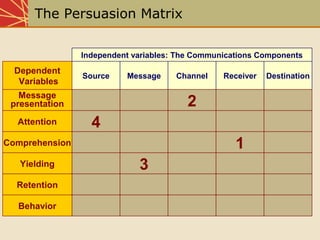
The Persuasion Matrix
Independent variables: The Communications Components
Source Message Channel Receiver Destination
4
3
2
1
Message
presentation
Attention
Comprehension
Yielding
Retention
Behavior
Dependent
Variables
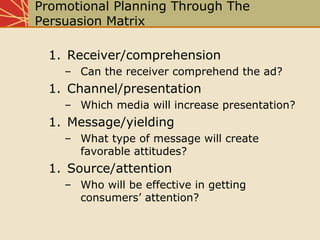
Promotional Planning Through The
Persuasion Matrix
1. Receiver/comprehension
– Can the receiver comprehend the ad?
1. Channel/presentation
– Which media will increase presentation?
1. Message/yielding
– What type of message will create
favorable attitudes?
1. Source/attention
– Who will be effective in getting
consumers’ attention?
Source Attributes and
Receiver Processing Modes
Source attribute Process
CompliancePower
IdentificationAttractiveness
InternalizationCredibility
Source Credibility
• The extend to which the source is seen as
having:
– Knowledge
– Skill
– Expertise
• And the source is perceived as being:
– Trustworthy
– Unbiased
– Objective
Dell Computer uses its founder and CEO as
an advertising spokespeson
Source Attractiveness
• Similarity
– Resemblance between the source
and recipient of the message
• Familiarity
– Knowledge of the source through
repeated
• Likeability
– Affection for the source resulting
from physical appearance,
behavior, or other personal traits
The Use of Celebrities
• Endorsements
– The celebrity, whether an expert or not,
merely agrees to the use of his or her name
and image in the promotion of the product.
• Testimonials
– The celebrity, usually an expert with
experience with the product, attests to its
value and worth.
• Dramatizations
– Celebrity actors or models portray the brand
in use during dramatic enactments designed
to show the goods.
Pepsi used pop star Brittany Spears as an
endorser for several years
Risks of Using Celebrities
• The celebrity may overshadow the product
• The celebrity may be overexposed which
reduces his or her credibility
• The target audience may not be receptive
to celebrity endorsers
• The celebrity’s behavior may pose a risk to
the company
Lance Armstrong’s image diluted in positive doping
test, diluted image also of endorsed brands
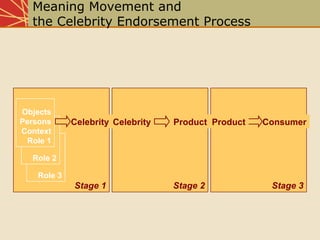
Meaning Movement and
the Celebrity Endorsement Process
Stage 1
Role 3
Role 2
Objects
Persons
Context
Role 1
Celebrity
Stage 2
ProductCelebrity
Stage 3
ConsumerProduct
Lance Armstrong’s image helps assign
meaning to Power Bar
Message Factors
Message Structure
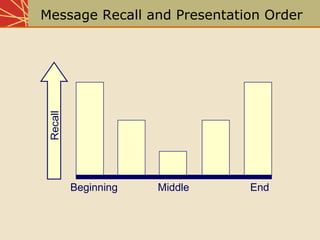
• Order of presentation (primacy vs.
recency)
• Conclusion Drawing (open vs. closed end)
• Message sidedness (one vs. two-sided)
• Refutation
• Verbal vs. visual
Message Recall and Presentation Order
Recall
Beginning Middle End
The visual image supports the verbal appeal
in this ad
Message Factors
Message Appeals
 The most important creative strategy decisions involves
the choice of an appropriate appeal.
 Some ads are designed to appeal to the rational, logical
aspects of the consumer’s decision making process.
 Others appeal to feelings in an attempt to evoke some
emotional reaction.
 Types of appeal includes:
• Comparative Advertising
• Fear Appeals
• Humor Appeals
Message Factors
 Comparative Advertising
 Either taking directly or indirectly taking a name of
competitors in ad and comparing one or more specific
attributes.
 Brand recall is higher in such advertisements.
 Most suitable for new brands, it allows to create new
position itself to promote its distinctive advantages.
 They often compare themselves with market leader,
on the other hand market leader often hesitate to use
comparison ads, as most believe they have little to
gain by featuring competitors products in their
advertisements.
 Political advertisements are often uses comparative
advertisements.
Sorrell Ridge uses a comparative ad
Message Factors
 Fear Appeals
 Fear is an emotional responses to a threat that
expresses some sort of danger.
 Ads sometimes use fear appeals to evoke this
emotional response and arouse individuals to take
steps to remove the threat.
 How fear operates?
 The relationship between fear and persuasion can be
explained by the fact that fear appeals have both
facilitating and inhibiting effects.
Fear Appeals and Message Acceptance
Rejection
Inhibiting effects
Resultant
nonmonotonic curve
Facilitating effects
Level of fear
Acceptance
Message Factors
 Humor Appeals
 Humorous adds are successful in bringing attracting and
holding attention.
 They enhance effectiveness by putting consumers in a
positive mood, increasing their liking of the ad itself and
their feeling towards the product or service.
 Humor can distract the receiver from counter arguing
against the message.
 Critics says that funny ads draw people to the humorous
situation but distract them from the brand and its
attributes.
 Humorous ads may wear out faster than serious appeals.
 Wearout refers to the tendency of a television or radio
commercial to lose its effectiveness when it seen/heard
repeatedly.
Pros and Cons of Using Humor
Advantages
• Aids attention and
awareness
• May aid retention of the
message
• Creates a positive mood
and enhances persuasion
• May aid name and simple
copy registration
• May serve as a distracter
and reduce the level of
counter arguing
Disadvantages
• Does not aid persuasion
in general
• May harm recall and
comprehension
• May harm complex copy
registration
• Does not aid source
credibility
• Is not effective in bringing
about sales
• May wear out faster
UNFAVORABLE TOWARD
HUMOR
• Research directors
• Direct mail, newspapers
• Corporate advertising
• Industrial products
• Goods or services of a
sensitive nature
• Audiences that are:
– Older
– Less educated
– Down-scale
– Female
– Semi- or Unskilled
FAVORABLE TOWARD
HUMOR
• Creative personnel
• Radio and television
• Consumer non-durables
• Business services
• Products related to the
humorous ploy
• Audiences that are:
– Younger
– Better educated
– Up-scale
– Male
– Professional
Use of Humor
Payday uses a humorous print ad
Channel Factors
• Personal versus nonpersonal channels
• Effects of alternative mass media
– Externally paced media (broadcast)
– Internally paced media (print, direct mail,
Internet)
• Effects of Context and Environment
– Qualitative media effect
– Media environment (mood states)
• Clutter

Chap006 imc mba

  • 1.
    Source, Message and ChannelFactors 6 McGraw-Hill/Irwin © 2004 The McGraw-Hill Companies, Inc., All Rights Reserved.
  • 2.
    The Persuasion Matrix Independentvariables: The Communications Components Source Message Channel Receiver Destination 4 3 2 1 Message presentation Attention Comprehension Yielding Retention Behavior Dependent Variables
  • 3.
    Promotional Planning ThroughThe Persuasion Matrix 1. Receiver/comprehension – Can the receiver comprehend the ad? 1. Channel/presentation – Which media will increase presentation? 1. Message/yielding – What type of message will create favorable attitudes? 1. Source/attention – Who will be effective in getting consumers’ attention?
  • 4.
    Source Attributes and ReceiverProcessing Modes Source attribute Process CompliancePower IdentificationAttractiveness InternalizationCredibility
  • 5.
    Source Credibility • Theextend to which the source is seen as having: – Knowledge – Skill – Expertise • And the source is perceived as being: – Trustworthy – Unbiased – Objective
  • 6.
    Dell Computer usesits founder and CEO as an advertising spokespeson
  • 7.
    Source Attractiveness • Similarity –Resemblance between the source and recipient of the message • Familiarity – Knowledge of the source through repeated • Likeability – Affection for the source resulting from physical appearance, behavior, or other personal traits
  • 8.
    The Use ofCelebrities • Endorsements – The celebrity, whether an expert or not, merely agrees to the use of his or her name and image in the promotion of the product. • Testimonials – The celebrity, usually an expert with experience with the product, attests to its value and worth. • Dramatizations – Celebrity actors or models portray the brand in use during dramatic enactments designed to show the goods.
  • 9.
    Pepsi used popstar Brittany Spears as an endorser for several years
  • 10.
    Risks of UsingCelebrities • The celebrity may overshadow the product • The celebrity may be overexposed which reduces his or her credibility • The target audience may not be receptive to celebrity endorsers • The celebrity’s behavior may pose a risk to the company
  • 11.
    Lance Armstrong’s imagediluted in positive doping test, diluted image also of endorsed brands
  • 12.
    Meaning Movement and theCelebrity Endorsement Process Stage 1 Role 3 Role 2 Objects Persons Context Role 1 Celebrity Stage 2 ProductCelebrity Stage 3 ConsumerProduct
  • 13.
    Lance Armstrong’s imagehelps assign meaning to Power Bar
  • 14.
    Message Factors Message Structure •Order of presentation (primacy vs. recency) • Conclusion Drawing (open vs. closed end) • Message sidedness (one vs. two-sided) • Refutation • Verbal vs. visual
  • 15.
    Message Recall andPresentation Order Recall Beginning Middle End
  • 16.
    The visual imagesupports the verbal appeal in this ad
  • 17.
    Message Factors Message Appeals The most important creative strategy decisions involves the choice of an appropriate appeal.  Some ads are designed to appeal to the rational, logical aspects of the consumer’s decision making process.  Others appeal to feelings in an attempt to evoke some emotional reaction.  Types of appeal includes: • Comparative Advertising • Fear Appeals • Humor Appeals
  • 18.
    Message Factors  ComparativeAdvertising  Either taking directly or indirectly taking a name of competitors in ad and comparing one or more specific attributes.  Brand recall is higher in such advertisements.  Most suitable for new brands, it allows to create new position itself to promote its distinctive advantages.  They often compare themselves with market leader, on the other hand market leader often hesitate to use comparison ads, as most believe they have little to gain by featuring competitors products in their advertisements.  Political advertisements are often uses comparative advertisements.
  • 19.
    Sorrell Ridge usesa comparative ad
  • 20.
    Message Factors  FearAppeals  Fear is an emotional responses to a threat that expresses some sort of danger.  Ads sometimes use fear appeals to evoke this emotional response and arouse individuals to take steps to remove the threat.  How fear operates?  The relationship between fear and persuasion can be explained by the fact that fear appeals have both facilitating and inhibiting effects.
  • 21.
    Fear Appeals andMessage Acceptance Rejection Inhibiting effects Resultant nonmonotonic curve Facilitating effects Level of fear Acceptance
  • 22.
    Message Factors  HumorAppeals  Humorous adds are successful in bringing attracting and holding attention.  They enhance effectiveness by putting consumers in a positive mood, increasing their liking of the ad itself and their feeling towards the product or service.  Humor can distract the receiver from counter arguing against the message.  Critics says that funny ads draw people to the humorous situation but distract them from the brand and its attributes.  Humorous ads may wear out faster than serious appeals.  Wearout refers to the tendency of a television or radio commercial to lose its effectiveness when it seen/heard repeatedly.
  • 23.
    Pros and Consof Using Humor Advantages • Aids attention and awareness • May aid retention of the message • Creates a positive mood and enhances persuasion • May aid name and simple copy registration • May serve as a distracter and reduce the level of counter arguing Disadvantages • Does not aid persuasion in general • May harm recall and comprehension • May harm complex copy registration • Does not aid source credibility • Is not effective in bringing about sales • May wear out faster
  • 24.
    UNFAVORABLE TOWARD HUMOR • Researchdirectors • Direct mail, newspapers • Corporate advertising • Industrial products • Goods or services of a sensitive nature • Audiences that are: – Older – Less educated – Down-scale – Female – Semi- or Unskilled FAVORABLE TOWARD HUMOR • Creative personnel • Radio and television • Consumer non-durables • Business services • Products related to the humorous ploy • Audiences that are: – Younger – Better educated – Up-scale – Male – Professional Use of Humor
  • 25.
    Payday uses ahumorous print ad
  • 26.
    Channel Factors • Personalversus nonpersonal channels • Effects of alternative mass media – Externally paced media (broadcast) – Internally paced media (print, direct mail, Internet) • Effects of Context and Environment – Qualitative media effect – Media environment (mood states) • Clutter