Direct Marketing to Boost
Revenue
What is Direct Marketing?
Direct Marketing is both marketing and sales.
Direct Marketing is the translation of one-on-one, face-
to-face selling into broad reach media.
Definition: Any advertising activity which creates and
exploits a direct relationship between you and your
prospect or customer as an individual.
Difference from other activities?
 General advertising speaks to people en masse. It does
not try to isolate them as individuals. Nor does it
normally demand immediate action.
 Sales promotion is designed to achieve an immediate
effect on sales. It does not build relationship.
 Public relations employs media controlled by others.
 Packaging is again devoid of any relationships.
Direct Marketing is always selling
 Product / Service / Next Step
 Response
 Continued Engagement
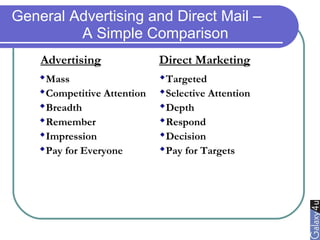
Mass Targeted
Competitive Attention Selective Attention
Breadth Depth
Remember Respond
Impression Decision
Pay for Everyone Pay for Targets
General Advertising and Direct Mail –
A Simple Comparison
Advertising Direct Marketing
Two Important Factors in DM
 Pre-selection
Refining the target based on pre-existing
level of interest
 The Offer
What does it take to provoke response?
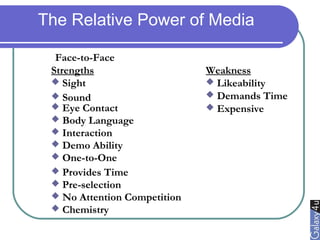
The Relative Power of Media
 Likeability
 Demands Time
 Expensive
Weakness
Face-to-Face
Strengths
 Sight
 Sound
 Eye Contact
 Body Language
 Interaction
 Demo Ability
 One-to-One
 Provides Time
 Pre-selection
 No Attention Competition
 Chemistry
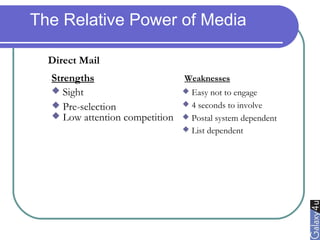
 Sight
 Pre-selection
 Low attention competition
Strengths
Direct Mail
 Easy not to engage
 4 seconds to involve
 Postal system dependent
Weaknesses
 List dependent
The Relative Power of Media
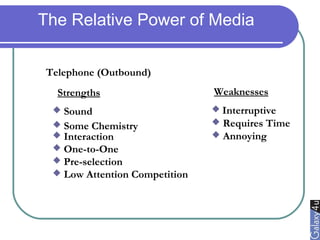
 Sound
 Some Chemistry
 Interaction
 One-to-One
 Pre-selection
 Low Attention Competition
Strengths
 Interruptive
 Requires Time
 Annoying
Weaknesses
Telephone (Outbound)
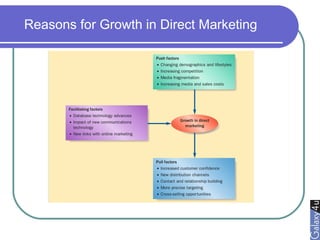
Reasons for Growth in Direct Marketing
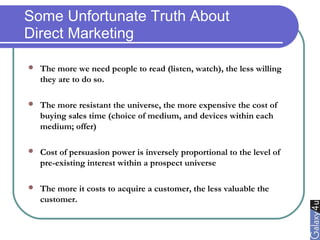
Some Unfortunate Truth About
Direct Marketing
 The more we need people to read (listen, watch), the less willing
they are to do so.
 The more resistant the universe, the more expensive the cost of
buying sales time (choice of medium, and devices within each
medium; offer)
 Cost of persuasion power is inversely proportional to the level of
pre-existing interest within a prospect universe
 The more it costs to acquire a customer, the less valuable the
customer.
Sales Support – The Sales Sequence
 The sales sequence is the set of decision steps
necessary to close a sale matched with a set of
communications designed to provoke each step.
 Direct Marketing tools are typically used to narrow
the universe to “qualified prospects” .
 DM sells the next step in the sequence.
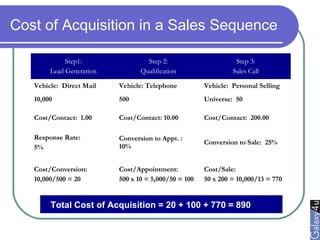
 The cost of acquisition is the total cost of all the
contacts at each step necessary to provoke a single
decision to the next step.
Cost of Acquisition in a Sales Sequence
Step1:
Lead Generation
Step 2:
Qualification
Step 3:
Sales Call
Vehicle: Direct Mail Vehicle: Telephone Vehicle: Personal Selling
10,000 500 Universe: 50
Cost/Contact: 1.00 Cost/Contact: 10.00 Cost/Contact: 200.00
Response Rate:
5%
Conversion to Appt. :
10%
Conversion to Sale: 25%
Cost/Conversion:
10,000/500 = 20
Cost/Appointment:
500 x 10 = 5,000/50 = 100
Cost/Sale:
50 x 200 = 10,000/13 = 770
Total Cost of Acquisition = 20 + 100 + 770 = 890
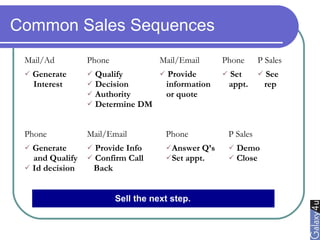
Common Sales Sequences
Mail/Ad Phone Mail/Email Phone P Sales
 Generate
Interest
 Qualify
 Decision
 Authority
 Determine DM
 Provide
information
or quote
 Set
appt.
 See
rep
Phone Mail/Email Phone P Sales
 Generate
and Qualify
 Id decision
 Provide Info
 Confirm Call
Back
Answer Q’s
Set appt.
 Demo
 Close
Sell the next step.
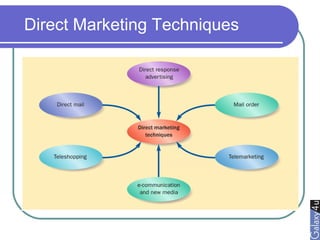
Direct Marketing Techniques
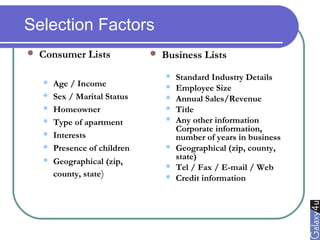
Selection Factors
 Consumer Lists
 Age / Income
 Sex / Marital Status
 Homeowner
 Type of apartment
 Interests
 Presence of children
 Geographical (zip,
county, state)
 Business Lists
 Standard Industry Details
 Employee Size
 Annual Sales/Revenue
 Title
 Any other information
Corporate information,
number of years in business
 Geographical (zip, county,
state)
 Tel / Fax / E-mail / Web
 Credit information
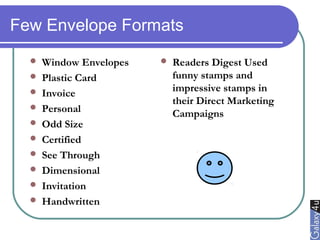
Few Envelope Formats
 Window Envelopes
 Plastic Card
 Invoice
 Personal
 Odd Size
 Certified
 See Through
 Dimensional
 Invitation
 Handwritten
 Readers Digest Used
funny stamps and
impressive stamps in
their Direct Marketing
Campaigns
Letter Planning and Structure
 The Opening
 The Body
 The Close
 The Signature
 The P.S.
Writing Leads for Letters – How to Start
 A strong, startling fact, research result, something true of
their industry
 Establish a connection
 referral
 similar occupation
 status as a customer, etc.
 recognition of status as a donor/contributor
 Tell a story
 A quote
 Reference a competitor
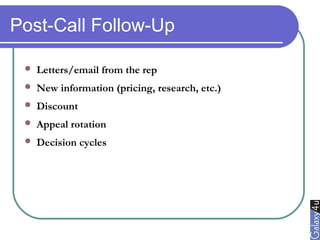
Post-Call Follow-Up
 Letters/email from the rep
 New information (pricing, research, etc.)
 Discount
 Appeal rotation
 Decision cycles
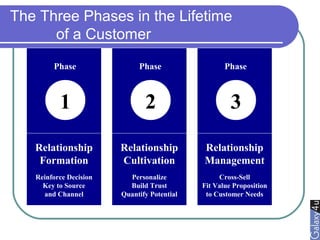
The Three Phases in the Lifetime
of a Customer
1
Phase
2
Phase
3
Phase
Relationship
Formation
Reinforce Decision
Key to Source
and Channel
Relationship
Cultivation
Personalize
Build Trust
Quantify Potential
Relationship
Management
Cross-Sell
Fit Value Proposition
to Customer Needs
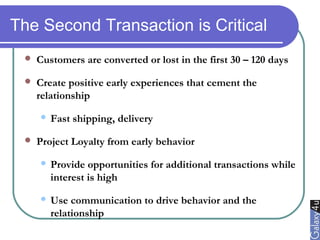
The Second Transaction is Critical
 Customers are converted or lost in the first 30 – 120 days
 Create positive early experiences that cement the
relationship
 Fast shipping, delivery
 Project Loyalty from early behavior
 Provide opportunities for additional transactions while
interest is high
 Use communication to drive behavior and the
relationship
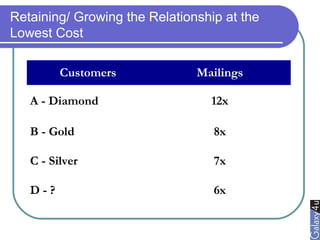
Retaining/ Growing the Relationship at the
Lowest Cost
Customers Mailings
A - Diamond 12x
B - Gold 8x
C - Silver 7x
D - ? 6x
Recipients of Direct Mail
 Customers
 Have pre-existing interest, Will read more copy
 Require less costly mail
 Mailing to customers generates $ and improves retention
 Prospects
 Pre-existing interest is “likely”
 Requires more expensive mail to buy readership
 Resistant to reading (looking for a reason to stop)
 Relevance is key
 Influencers
Unfortunate Truths - Direct Mail
 People read direct mail, looking for a reason to stop
 The margin of error on direct mail is greater than in any other
medium.
 Special interest offerings tend to do best in direct mail, but the
more specialized the interest, the more limited the growth potential
(requires product proliferation – old/new/same).
 There is an inverse relationship between degree of pre-existing
interest and cost per response.
 There is a direct relationship between readership and response.
 People are not dying to hear from you.
 Very little body copy is ever actually re-read.
Formulate your strategy
 What is your overall business activity
 What is your positioning?
 What current marketing activities do you conduct?
 What is the state of your database?
 Have you sold the concept of Direct Marketing within your
organization?
 Where exactly Direct Marketing should fit in your organization
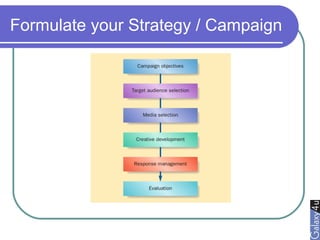
Formulate your Strategy / Campaign
Various Mediums available
 Direct mail
 Door to door drop
 Newspapers
 Magazines
 Broadcasters: TV, Radio.
 Telephone, Fax
 Posters
 Newsletters
 Web as powerful medium………….Video mailers / Pod cast
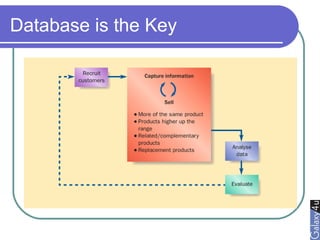
Database is the Key
Successful Direct Marketers
 American Express
 Readers Digest
 Eureka Forbes, Amway, etc.
 Banks: HDFC, ICICI, Barclays and many others
 Insurance companies: LIC, TATA AIG, MAX
 Book Publishers: Sage Publications, etc
 Magazines: India Today, Money Life, Business Today
 Advertisements: Times of India, Sakal, etc.
The Last Premise
Focus on Them
“You can make more friends in 2 months
by becoming interested in other people
than you can in 2 years by trying to get
people interested in you.”
Dale Carnegie
References
Commonsense Direct Marketing
David Ogilvy
And others
Q&A - Contact
Avinash MurkuteAvinash Murkute
Mobile: +91-9822698070
E-mail: avinash@galaxy4u.in
Web: www.galaxy4u.in
--------------------------------------------------------
Doubt is the key to knowledge.

DIRECT MARKETING

  • 1.
    Direct Marketing toBoost Revenue
  • 2.
    What is DirectMarketing? Direct Marketing is both marketing and sales. Direct Marketing is the translation of one-on-one, face- to-face selling into broad reach media. Definition: Any advertising activity which creates and exploits a direct relationship between you and your prospect or customer as an individual.
  • 3.
    Difference from otheractivities?  General advertising speaks to people en masse. It does not try to isolate them as individuals. Nor does it normally demand immediate action.  Sales promotion is designed to achieve an immediate effect on sales. It does not build relationship.  Public relations employs media controlled by others.  Packaging is again devoid of any relationships.
  • 4.
    Direct Marketing isalways selling  Product / Service / Next Step  Response  Continued Engagement
  • 5.
    Mass Targeted Competitive AttentionSelective Attention Breadth Depth Remember Respond Impression Decision Pay for Everyone Pay for Targets General Advertising and Direct Mail – A Simple Comparison Advertising Direct Marketing
  • 6.
    Two Important Factorsin DM  Pre-selection Refining the target based on pre-existing level of interest  The Offer What does it take to provoke response?
  • 7.
    The Relative Powerof Media  Likeability  Demands Time  Expensive Weakness Face-to-Face Strengths  Sight  Sound  Eye Contact  Body Language  Interaction  Demo Ability  One-to-One  Provides Time  Pre-selection  No Attention Competition  Chemistry
  • 8.
     Sight  Pre-selection Low attention competition Strengths Direct Mail  Easy not to engage  4 seconds to involve  Postal system dependent Weaknesses  List dependent The Relative Power of Media
  • 9.
    The Relative Powerof Media  Sound  Some Chemistry  Interaction  One-to-One  Pre-selection  Low Attention Competition Strengths  Interruptive  Requires Time  Annoying Weaknesses Telephone (Outbound)
  • 10.
    Reasons for Growthin Direct Marketing
  • 11.
    Some Unfortunate TruthAbout Direct Marketing  The more we need people to read (listen, watch), the less willing they are to do so.  The more resistant the universe, the more expensive the cost of buying sales time (choice of medium, and devices within each medium; offer)  Cost of persuasion power is inversely proportional to the level of pre-existing interest within a prospect universe  The more it costs to acquire a customer, the less valuable the customer.
  • 12.
    Sales Support –The Sales Sequence  The sales sequence is the set of decision steps necessary to close a sale matched with a set of communications designed to provoke each step.  Direct Marketing tools are typically used to narrow the universe to “qualified prospects” .  DM sells the next step in the sequence.  The cost of acquisition is the total cost of all the contacts at each step necessary to provoke a single decision to the next step.
  • 13.
    Cost of Acquisitionin a Sales Sequence Step1: Lead Generation Step 2: Qualification Step 3: Sales Call Vehicle: Direct Mail Vehicle: Telephone Vehicle: Personal Selling 10,000 500 Universe: 50 Cost/Contact: 1.00 Cost/Contact: 10.00 Cost/Contact: 200.00 Response Rate: 5% Conversion to Appt. : 10% Conversion to Sale: 25% Cost/Conversion: 10,000/500 = 20 Cost/Appointment: 500 x 10 = 5,000/50 = 100 Cost/Sale: 50 x 200 = 10,000/13 = 770 Total Cost of Acquisition = 20 + 100 + 770 = 890
  • 14.
    Common Sales Sequences Mail/AdPhone Mail/Email Phone P Sales  Generate Interest  Qualify  Decision  Authority  Determine DM  Provide information or quote  Set appt.  See rep Phone Mail/Email Phone P Sales  Generate and Qualify  Id decision  Provide Info  Confirm Call Back Answer Q’s Set appt.  Demo  Close Sell the next step.
  • 15.
  • 16.
    Selection Factors  ConsumerLists  Age / Income  Sex / Marital Status  Homeowner  Type of apartment  Interests  Presence of children  Geographical (zip, county, state)  Business Lists  Standard Industry Details  Employee Size  Annual Sales/Revenue  Title  Any other information Corporate information, number of years in business  Geographical (zip, county, state)  Tel / Fax / E-mail / Web  Credit information
  • 17.
    Few Envelope Formats Window Envelopes  Plastic Card  Invoice  Personal  Odd Size  Certified  See Through  Dimensional  Invitation  Handwritten  Readers Digest Used funny stamps and impressive stamps in their Direct Marketing Campaigns
  • 18.
    Letter Planning andStructure  The Opening  The Body  The Close  The Signature  The P.S.
  • 19.
    Writing Leads forLetters – How to Start  A strong, startling fact, research result, something true of their industry  Establish a connection  referral  similar occupation  status as a customer, etc.  recognition of status as a donor/contributor  Tell a story  A quote  Reference a competitor
  • 20.
    Post-Call Follow-Up  Letters/emailfrom the rep  New information (pricing, research, etc.)  Discount  Appeal rotation  Decision cycles
  • 21.
    The Three Phasesin the Lifetime of a Customer 1 Phase 2 Phase 3 Phase Relationship Formation Reinforce Decision Key to Source and Channel Relationship Cultivation Personalize Build Trust Quantify Potential Relationship Management Cross-Sell Fit Value Proposition to Customer Needs
  • 22.
    The Second Transactionis Critical  Customers are converted or lost in the first 30 – 120 days  Create positive early experiences that cement the relationship  Fast shipping, delivery  Project Loyalty from early behavior  Provide opportunities for additional transactions while interest is high  Use communication to drive behavior and the relationship
  • 23.
    Retaining/ Growing theRelationship at the Lowest Cost Customers Mailings A - Diamond 12x B - Gold 8x C - Silver 7x D - ? 6x
  • 24.
    Recipients of DirectMail  Customers  Have pre-existing interest, Will read more copy  Require less costly mail  Mailing to customers generates $ and improves retention  Prospects  Pre-existing interest is “likely”  Requires more expensive mail to buy readership  Resistant to reading (looking for a reason to stop)  Relevance is key  Influencers
  • 25.
    Unfortunate Truths -Direct Mail  People read direct mail, looking for a reason to stop  The margin of error on direct mail is greater than in any other medium.  Special interest offerings tend to do best in direct mail, but the more specialized the interest, the more limited the growth potential (requires product proliferation – old/new/same).  There is an inverse relationship between degree of pre-existing interest and cost per response.  There is a direct relationship between readership and response.  People are not dying to hear from you.  Very little body copy is ever actually re-read.
  • 26.
    Formulate your strategy What is your overall business activity  What is your positioning?  What current marketing activities do you conduct?  What is the state of your database?  Have you sold the concept of Direct Marketing within your organization?  Where exactly Direct Marketing should fit in your organization
  • 27.
  • 28.
    Various Mediums available Direct mail  Door to door drop  Newspapers  Magazines  Broadcasters: TV, Radio.  Telephone, Fax  Posters  Newsletters  Web as powerful medium………….Video mailers / Pod cast
  • 29.
  • 30.
    Successful Direct Marketers American Express  Readers Digest  Eureka Forbes, Amway, etc.  Banks: HDFC, ICICI, Barclays and many others  Insurance companies: LIC, TATA AIG, MAX  Book Publishers: Sage Publications, etc  Magazines: India Today, Money Life, Business Today  Advertisements: Times of India, Sakal, etc.
  • 31.
    The Last Premise Focuson Them “You can make more friends in 2 months by becoming interested in other people than you can in 2 years by trying to get people interested in you.” Dale Carnegie
  • 32.
  • 33.
    Q&A - Contact AvinashMurkuteAvinash Murkute Mobile: +91-9822698070 E-mail: avinash@galaxy4u.in Web: www.galaxy4u.in -------------------------------------------------------- Doubt is the key to knowledge.

Editor's Notes

  • #8 I can get you interested. I only need to know you have a need – that’s why qualified leads are based on need and where ________________? not interested 30 minutes
  • #9 With 4 seconds distraction, etc. is is virtually impossible to get people interested – the key is to find people who have an interest and reinforce it. No matter how targeted the message, if we can’t find the __________ we can’t use the medium.
  • #13 1. And, really, they’re at different points in the dereg process…awareness, visibility of choice, as well as interest in/willingness to switch varies as well. 2. This means some people will be left out,and we have to find a way to play that to our advantage. 3. But I want you to think about the word promise. Because what there does not seem to be a lot of in the energy market is promising. And it represents an ownable point of difference for New Power.
  • #23 1. And, really, they’re at different points in the dereg process…awareness, visibility of choice, as well as interest in/willingness to switch varies as well. 2. This means some people will be left out,and we have to find a way to play that to our advantage. 3. But I want you to think about the word promise. Because what there does not seem to be a lot of in the energy market is promising. And it represents an ownable point of difference for New Power.