Integrated Advertising, Promotion, and
Marketing Communications
Ninth Edition, Global Edition
Chapter 6
Advertising Design
Copyright © 2022, 2018, 2016 Pearson Education, Ltd. All Rights Reserved
Chapter Objectives
6.1 How do marketers use message strategies to design
effective advertisements?
6.2 What are the seven main types of advertising appeals?
6.3 What role does the executional framework play in
advertising design?
6.4 How are sources and spokespersons featured in
advertising designs?
6.5 What kinds of adjustments are necessary when
undertaking advertising design in international settings?
Copyright © 2022, 2018, 2016 Pearson Education, Ltd. All Rights Reserved
Chapter Overview
• Message strategies
• Advertising appeals
• Executional frameworks
• Sources and spokespersons
• International settings
Copyright © 2022, 2018, 2016 Pearson Education, Ltd. All Rights Reserved
Adweek Media and Harris Interactive
Survey
• Ads somewhat or very interesting (55%)
• Ads not interesting at all (13%)
• Ads very influential in purchase decisions (6%)
• Ads somewhat influential in purchase decisions (29%)
• Nearly half of 18-34 year-olds influenced by advertising
• 37% of 35-44 year-olds influenced by advertising
• 28% of individuals 45+ influenced by advertising
Copyright © 2022, 2018, 2016 Pearson Education, Ltd. All Rights Reserved
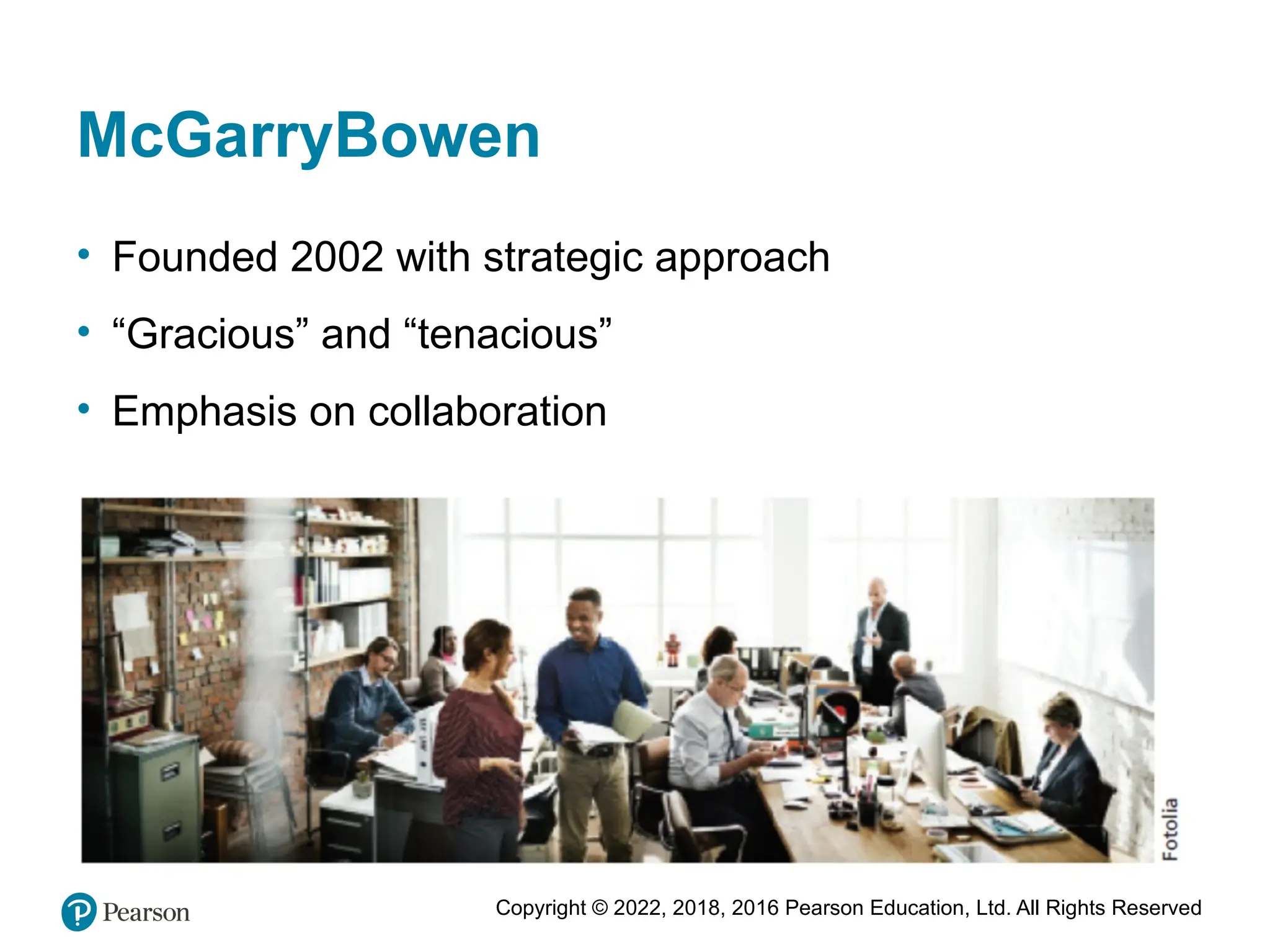
McGarryBowen
• Founded 2002 with strategic approach
• “Gracious” and “tenacious”
• Emphasis on collaboration
Copyright © 2022, 2018, 2016 Pearson Education, Ltd. All Rights Reserved
Figure 6.1: Message Strategies
• Cognitive
– Generic
– Unique selling proposition
– Hyperbole
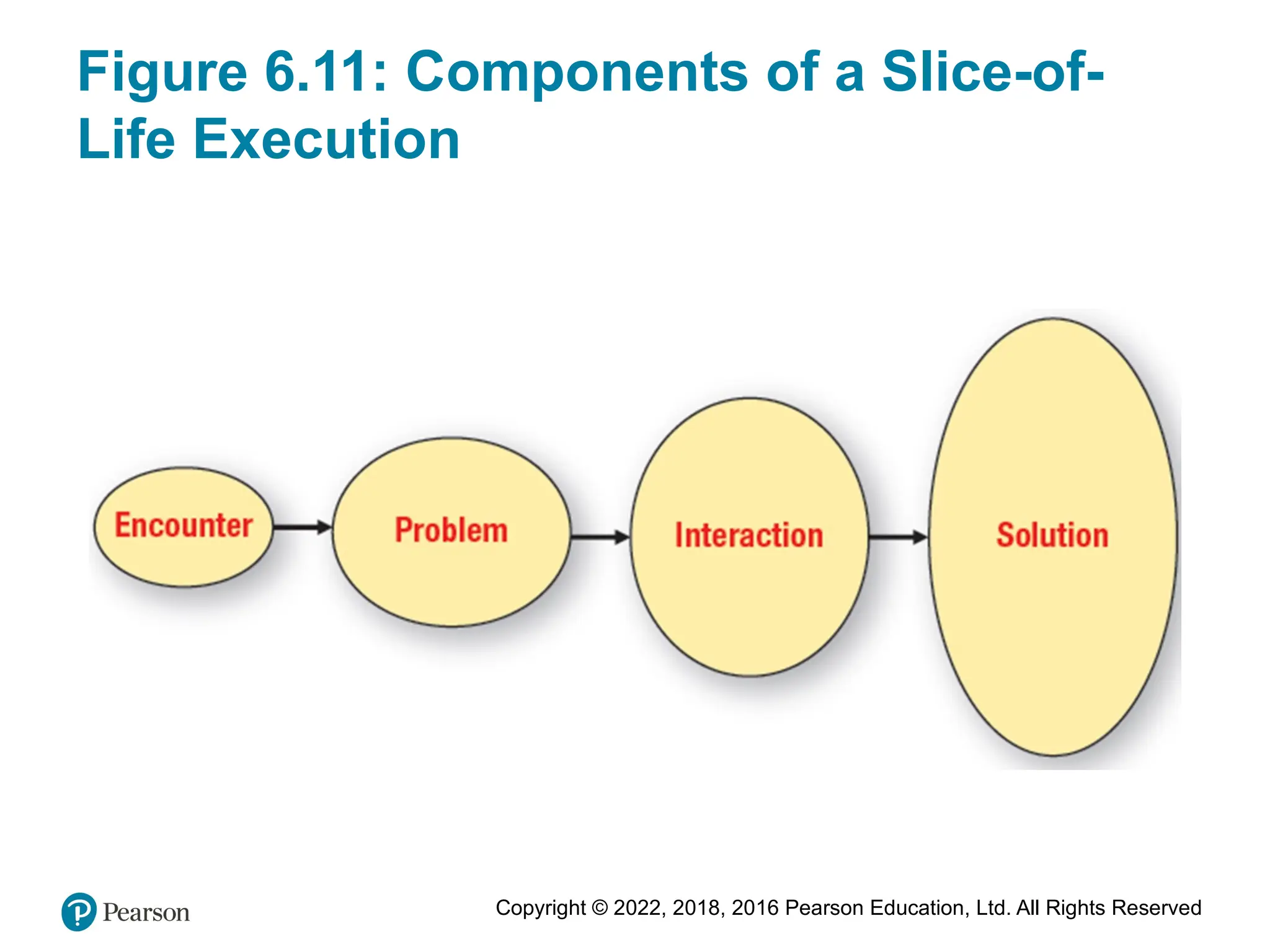
– Comparative
• Affective
– Resonance
– Emotional
• Conative
Copyright © 2022, 2018, 2016 Pearson Education, Ltd. All Rights Reserved
Message Strategies (1 of 3)
Cognitive
• Generic
• Preemptive
• Unique selling proposition
• Hyperbole
• Comparative
Copyright © 2022, 2018, 2016 Pearson Education, Ltd. All Rights Reserved
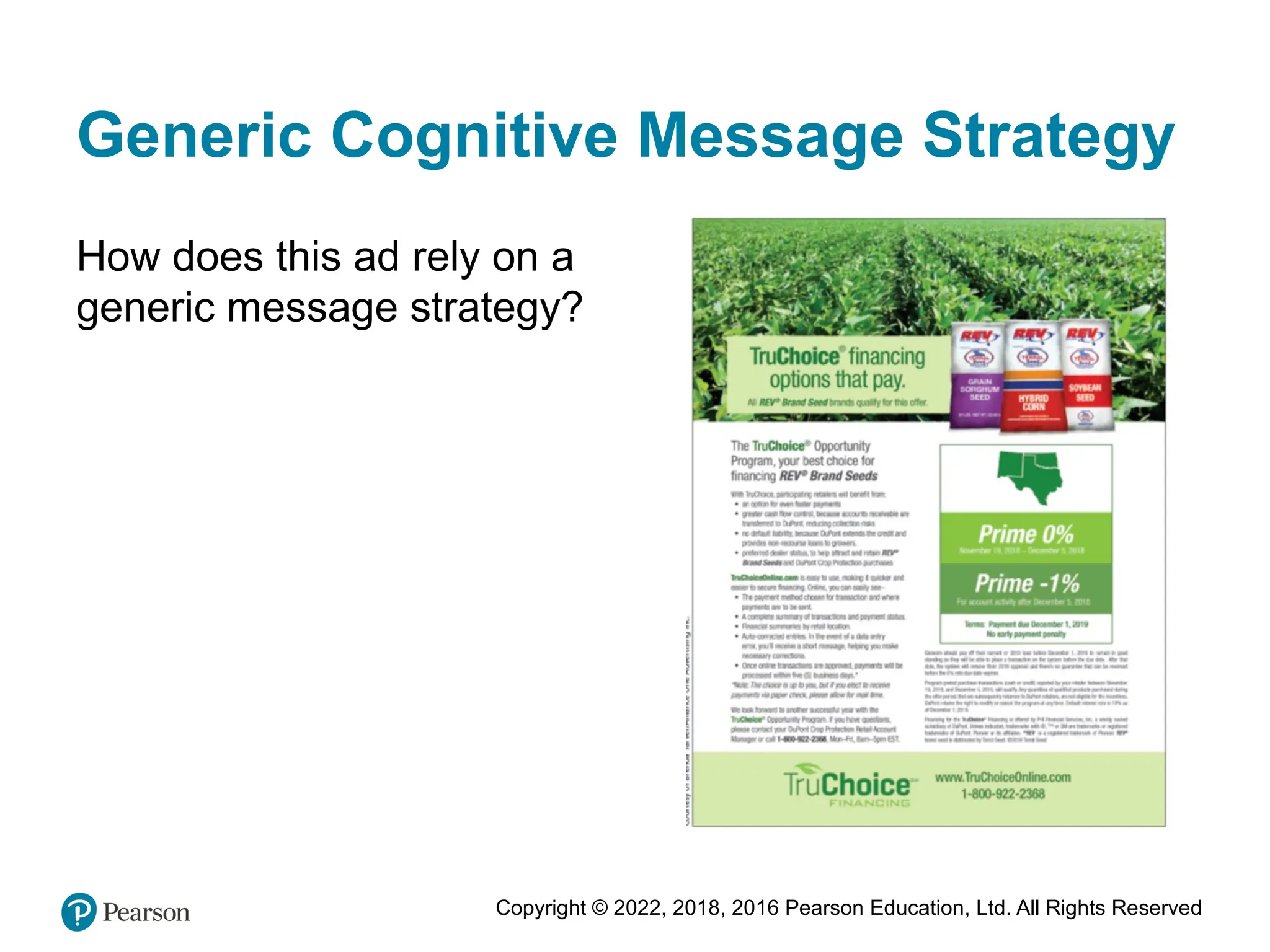
Generic Cognitive Message Strategy
How does this ad rely on a
generic message strategy?
Copyright © 2022, 2018, 2016 Pearson Education, Ltd. All Rights Reserved
Preemptive Cognitive Message Strategy
• Claim of superiority based on attribute or benefit
• Prevent competition from making same claim
• First to state advantage
Copyright © 2022, 2018, 2016 Pearson Education, Ltd. All Rights Reserved
Unique Selling Proposition Cognitive
Message Strategy
• Focuses on a testable claim of:
– Uniqueness
– Superiority
• Can be supported in some manner
• Example: HelloFresh offers the fastest delivery times
Copyright © 2022, 2018, 2016 Pearson Education, Ltd. All Rights Reserved
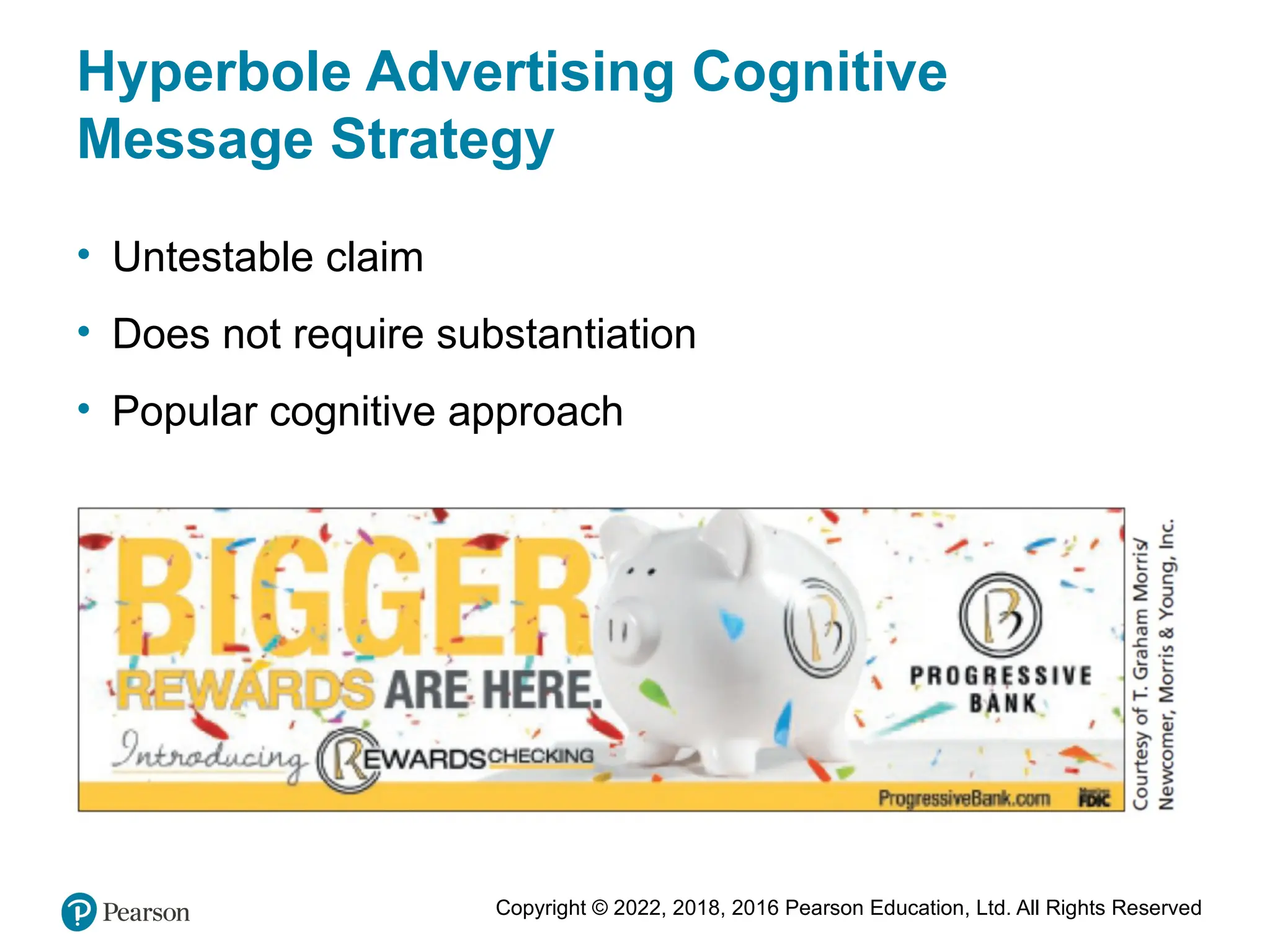
Hyperbole Advertising Cognitive
Message Strategy
• Untestable claim
• Does not require substantiation
• Popular cognitive approach
Copyright © 2022, 2018, 2016 Pearson Education, Ltd. All Rights Reserved
Comparative Advertising Cognitive
Message Strategy
• Direct or indirect comparisons
• Real or fictitious competitor
• Advantage – captures attention
– Brand awareness increases
– Message awareness increases
• Negative – less believable, negative attitude
– Negative comparative ad
– Spontaneous trait transference
• Choose comparisons carefully
Copyright © 2022, 2018, 2016 Pearson Education, Ltd. All Rights Reserved
Message Strategies (2 of 3)
Affective
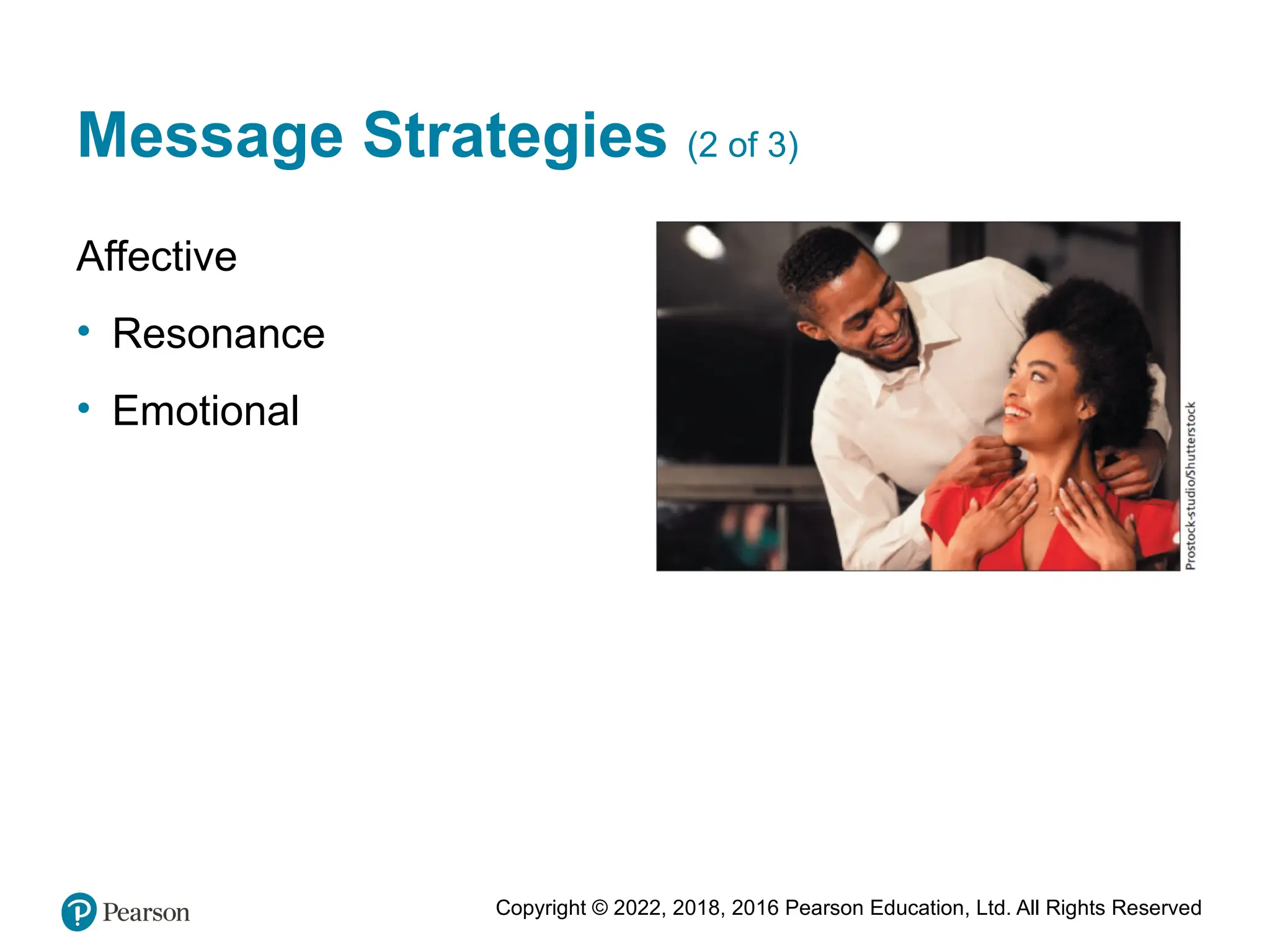
• Resonance
• Emotional
Copyright © 2022, 2018, 2016 Pearson Education, Ltd. All Rights Reserved
Affective Message Strategy (1 of 2)
• Invokes feelings or emotions
• Attempts to enhance likeability
• Resonance Advertising
– Connects with consumer experiences
– Comfort marketing
• Emotional Advertising
– Emotions lead to recall and choice
– Consumer and b-to-b markets
– Leads to positive feelings
Copyright © 2022, 2018, 2016 Pearson Education, Ltd. All Rights Reserved
Affective Message Strategy (2 of 2)
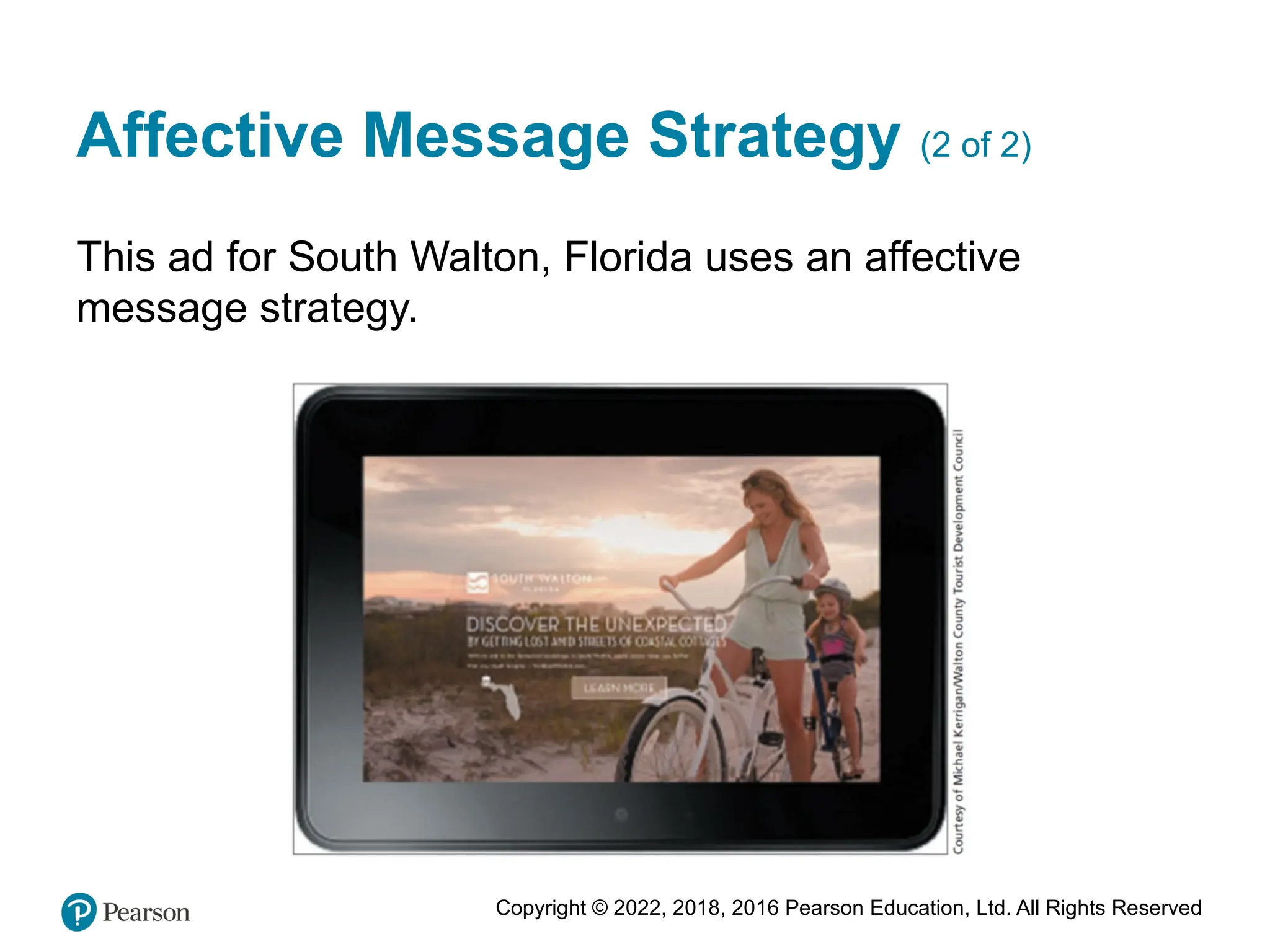
This ad for South Walton, Florida uses an affective
message strategy.
Copyright © 2022, 2018, 2016 Pearson Education, Ltd. All Rights Reserved
Message Strategies (3 of 3)
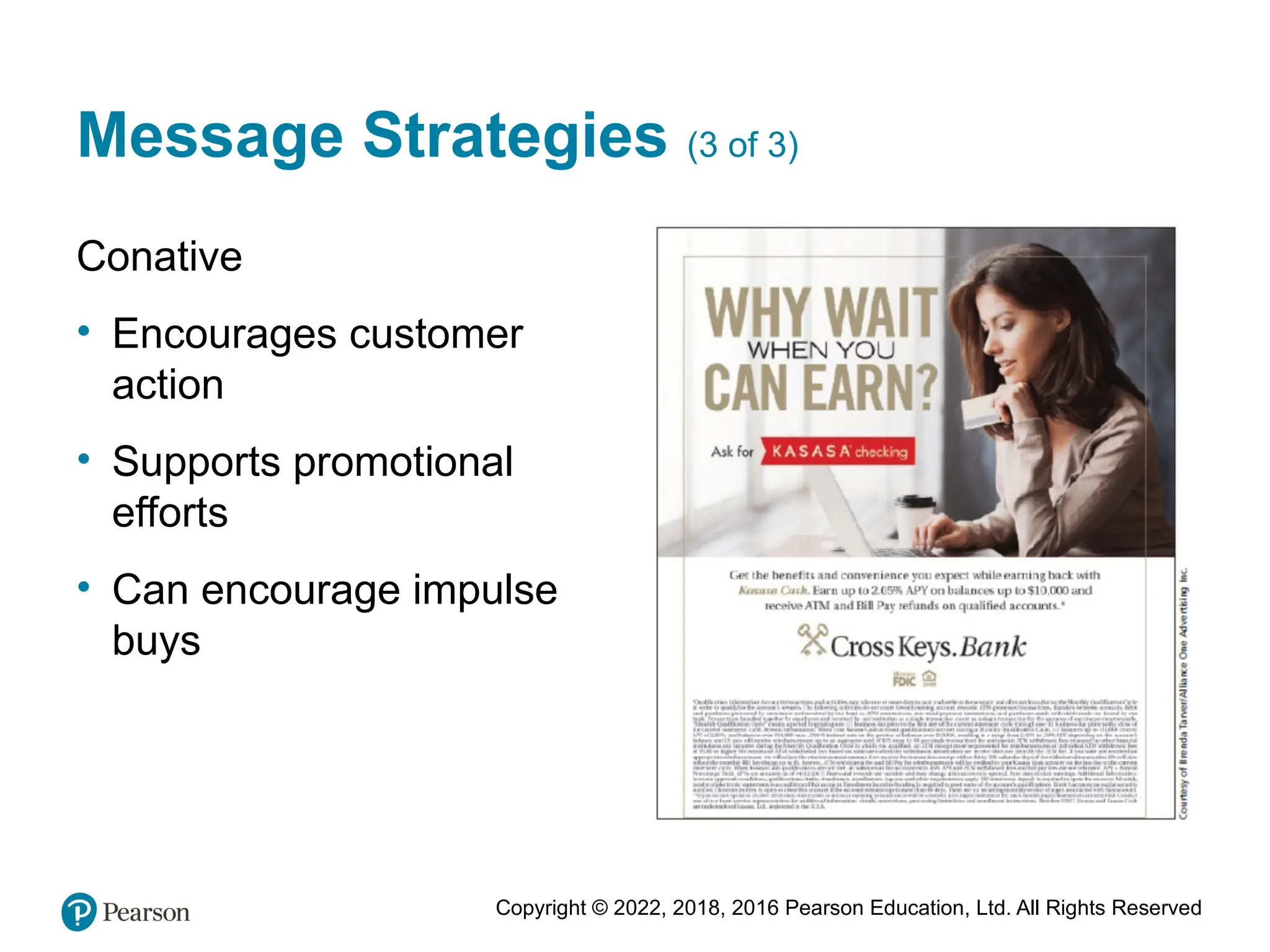
Conative
• Encourages customer
action
• Supports promotional
efforts
• Can encourage impulse
buys
Copyright © 2022, 2018, 2016 Pearson Education, Ltd. All Rights Reserved
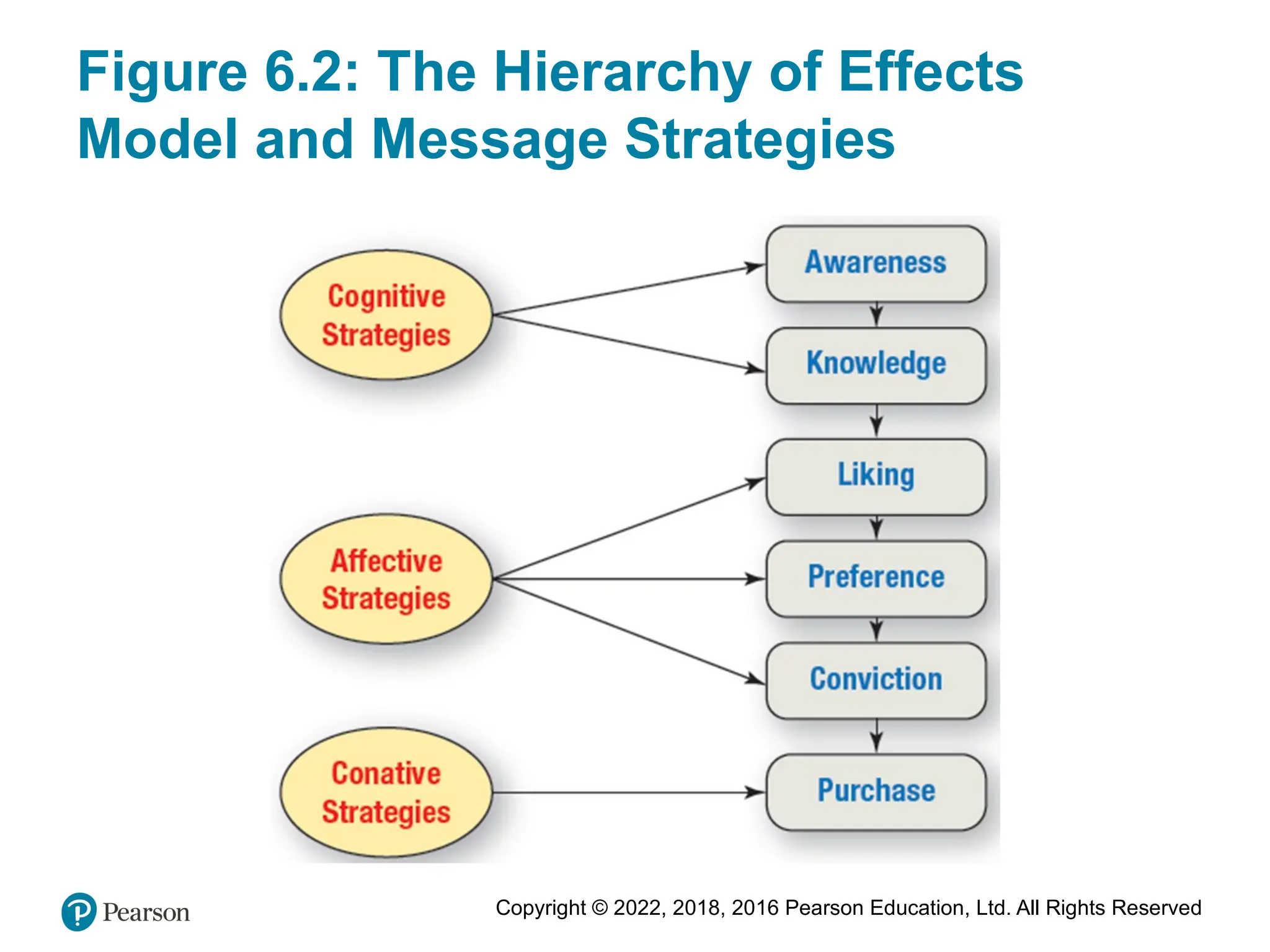
Figure 6.2: The Hierarchy of Effects
Model and Message Strategies
Copyright © 2022, 2018, 2016 Pearson Education, Ltd. All Rights Reserved
Questions to Consider (1 of 2)
• Think about the message strategies we have just
discussed:
– Cognitive
– Affective
– Conative
• What examples of effective advertising can you think of in
each of these categories?
• Did the ads stimulate you to buy something? If so, what
made it work for you?
Copyright © 2022, 2018, 2016 Pearson Education, Ltd. All Rights Reserved
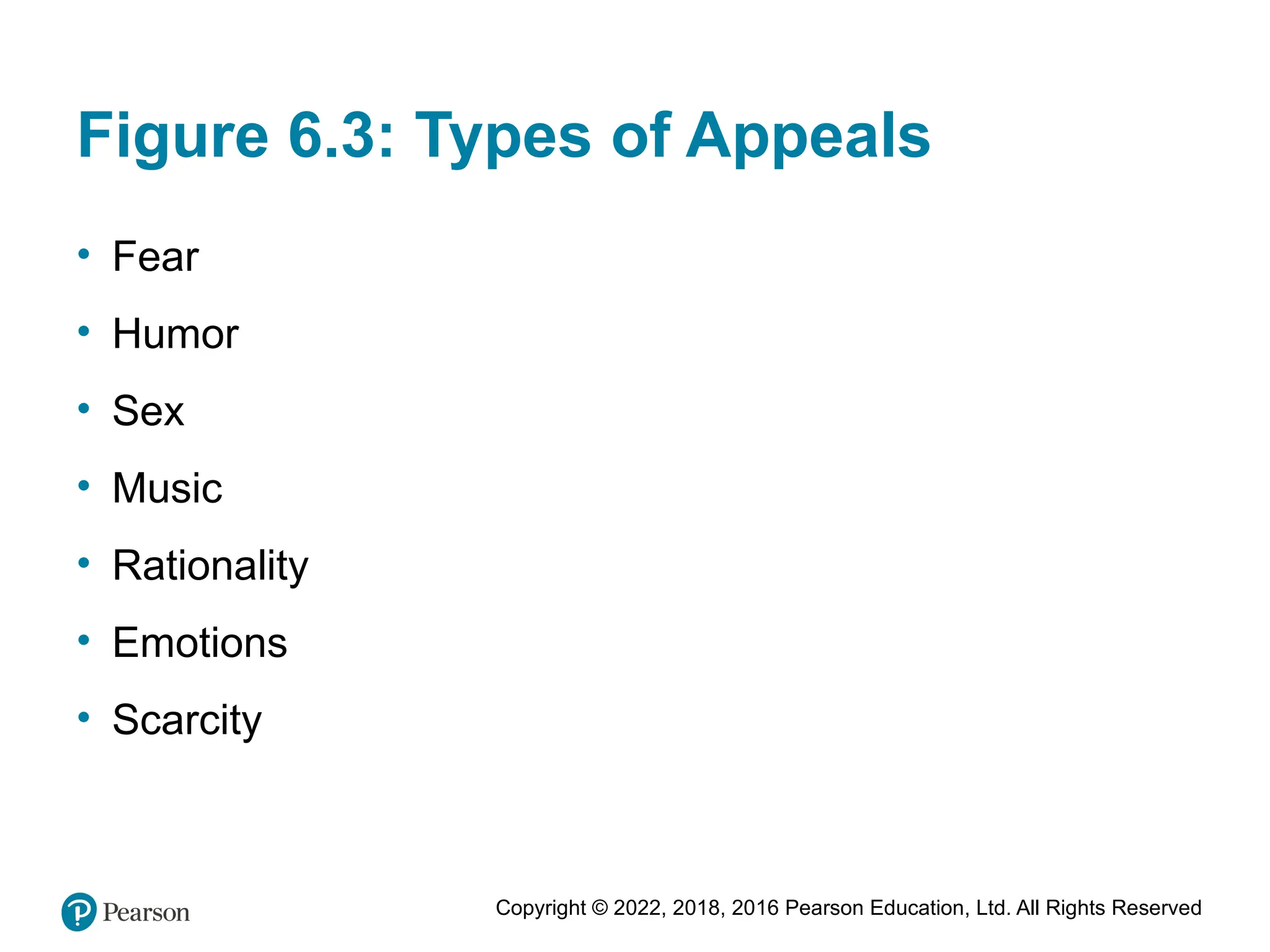
Figure 6.3: Types of Appeals
• Fear
• Humor
• Sex
• Music
• Rationality
• Emotions
• Scarcity
Copyright © 2022, 2018, 2016 Pearson Education, Ltd. All Rights Reserved
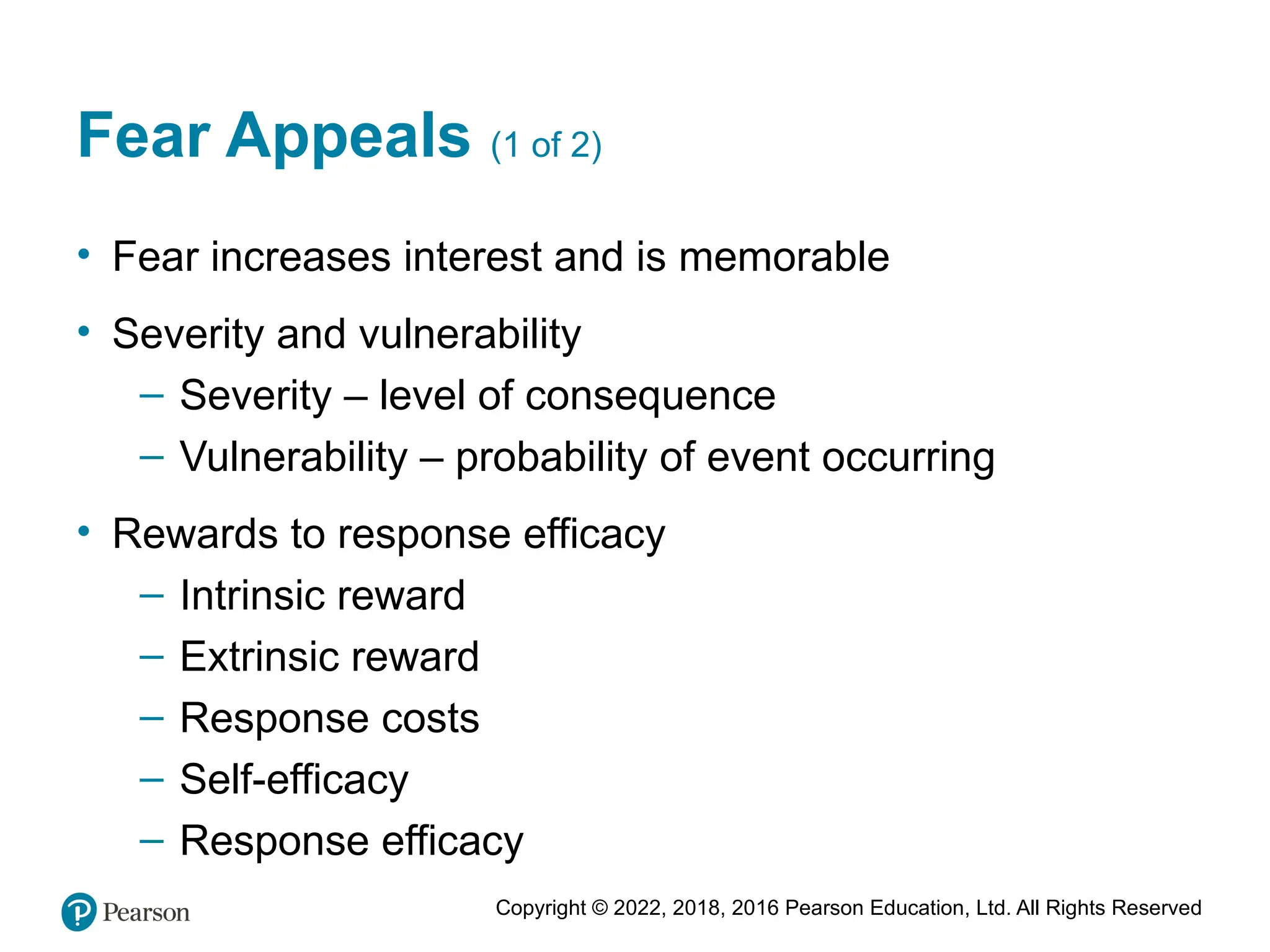
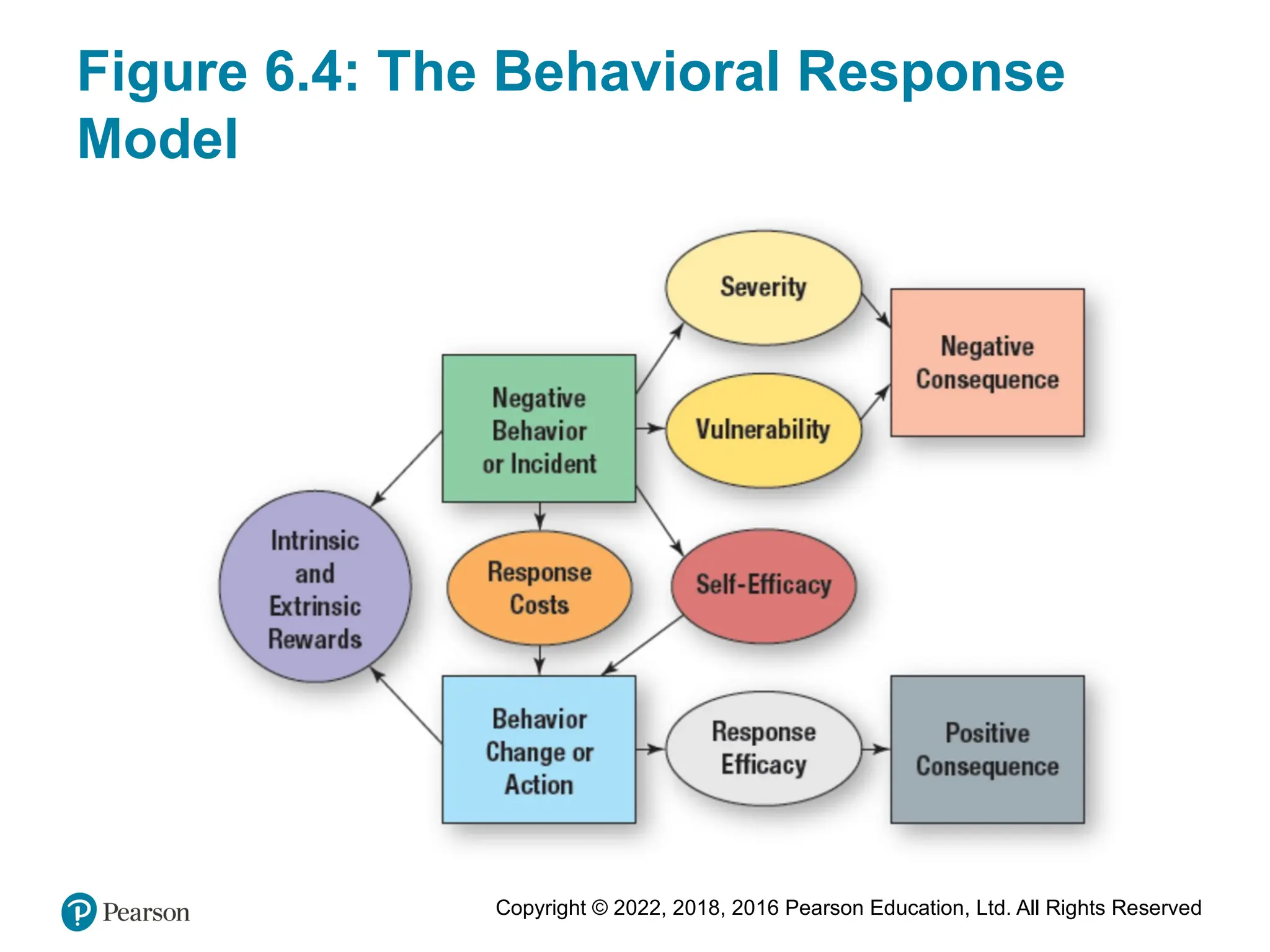
Fear Appeals (1 of 2)
• Fear increases interest and is memorable
• Severity and vulnerability
– Severity – level of consequence
– Vulnerability – probability of event occurring
• Rewards to response efficacy
– Intrinsic reward
– Extrinsic reward
– Response costs
– Self-efficacy
– Response efficacy
Copyright © 2022, 2018, 2016 Pearson Education, Ltd. All Rights Reserved
Figure 6.4: The Behavioral Response
Model
Copyright © 2022, 2018, 2016 Pearson Education, Ltd. All Rights Reserved
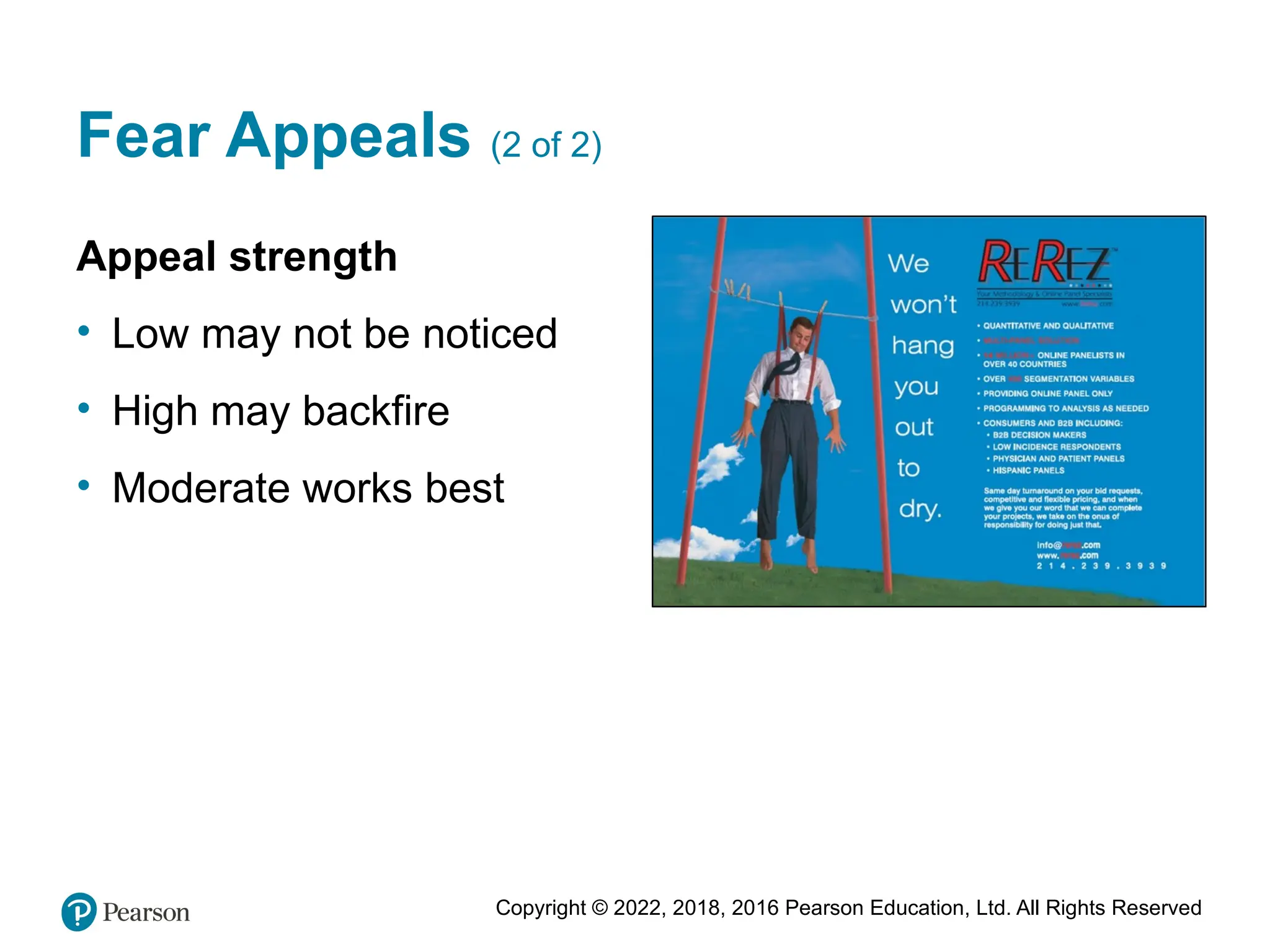
Fear Appeals (2 of 2)
Appeal strength
• Low may not be noticed
• High may backfire
• Moderate works best
Copyright © 2022, 2018, 2016 Pearson Education, Ltd. All Rights Reserved
Humor Appeals (1 of 2)
• Cuts through advertising clutter
• Good at grabbing and keeping attention
• Offers intrusive value, attracts attention
• Causes consumers to
– Watch
– Laugh
– Remember
Copyright © 2022, 2018, 2016 Pearson Education, Ltd. All Rights Reserved
Humor Appeals (2 of 2)
• Advantages of humor
– Piques interest
– Increases recall and comprehension
• Problems with humor
– Can be offensive
– Can overpower message
• Humor should focus on product
• International usage
– Humor is rooted in culture
– Humor varies across countries
Copyright © 2022, 2018, 2016 Pearson Education, Ltd. All Rights Reserved
Figure 6.5: Reasons for Using Humor in
Ads
• Captures attention
• Holds attention
• Often wins creative awards
• High recall scores
• Consumers enjoy ads that make them laugh
• Evaluated by consumers as likeable ads
Copyright © 2022, 2018, 2016 Pearson Education, Ltd. All Rights Reserved
Sex Appeals
• Break through clutter
• Use has increased
• Effectiveness has
declined
• Advertisers shifting to
more subtle sexual cues
Copyright © 2022, 2018, 2016 Pearson Education, Ltd. All Rights Reserved
Figure 6.6: Sexuality Approaches Used in
Advertising
• Subliminal techniques
• Sensuality
• Sexual suggestiveness
• Nudity or partial nudity
• Overt sexuality
Copyright © 2022, 2018, 2016 Pearson Education, Ltd. All Rights Reserved
Sex Appeal Approaches (1 of 2)
• Subliminal approach
– Places cues or icons in ads
– Not effective
• Sensuality
– Women respond more favourably
– More sophisticated
– Relies on imagination
• Sexual suggestiveness
– Hints about sex
– Sexual theme
Copyright © 2022, 2018, 2016 Pearson Education, Ltd. All Rights Reserved
Sex Appeal Approaches (2 of 2)
• Nudity or partial nudity
– Used for wide variety of products
– Attract attention
– Not always designed to elicit sexual response
– Underwear commercials
• Overt sexuality
– Acceptable for sexually-oriented products
– Used to break through ad clutter
– Often used for a shock effect
– Danger of being offensive
Copyright © 2022, 2018, 2016 Pearson Education, Ltd. All Rights Reserved
Figure 6.7: Factors to Consider Before
Using Decorative Models
• Improve ad recognition but not brand recognition
• Influence emotional and objective evaluations
• Attractive models produce a higher level of attention than
less attractive models
• Produce higher purchase intentions when product is
sexually relevant
Copyright © 2022, 2018, 2016 Pearson Education, Ltd. All Rights Reserved
Effectiveness of Sex Appeals
• Increase attention
– Brand recall lower
• Physiological arousal
• Cognitive impressions
– Like versus dislike
• Consider societal trends
Copyright © 2022, 2018, 2016 Pearson Education, Ltd. All Rights Reserved
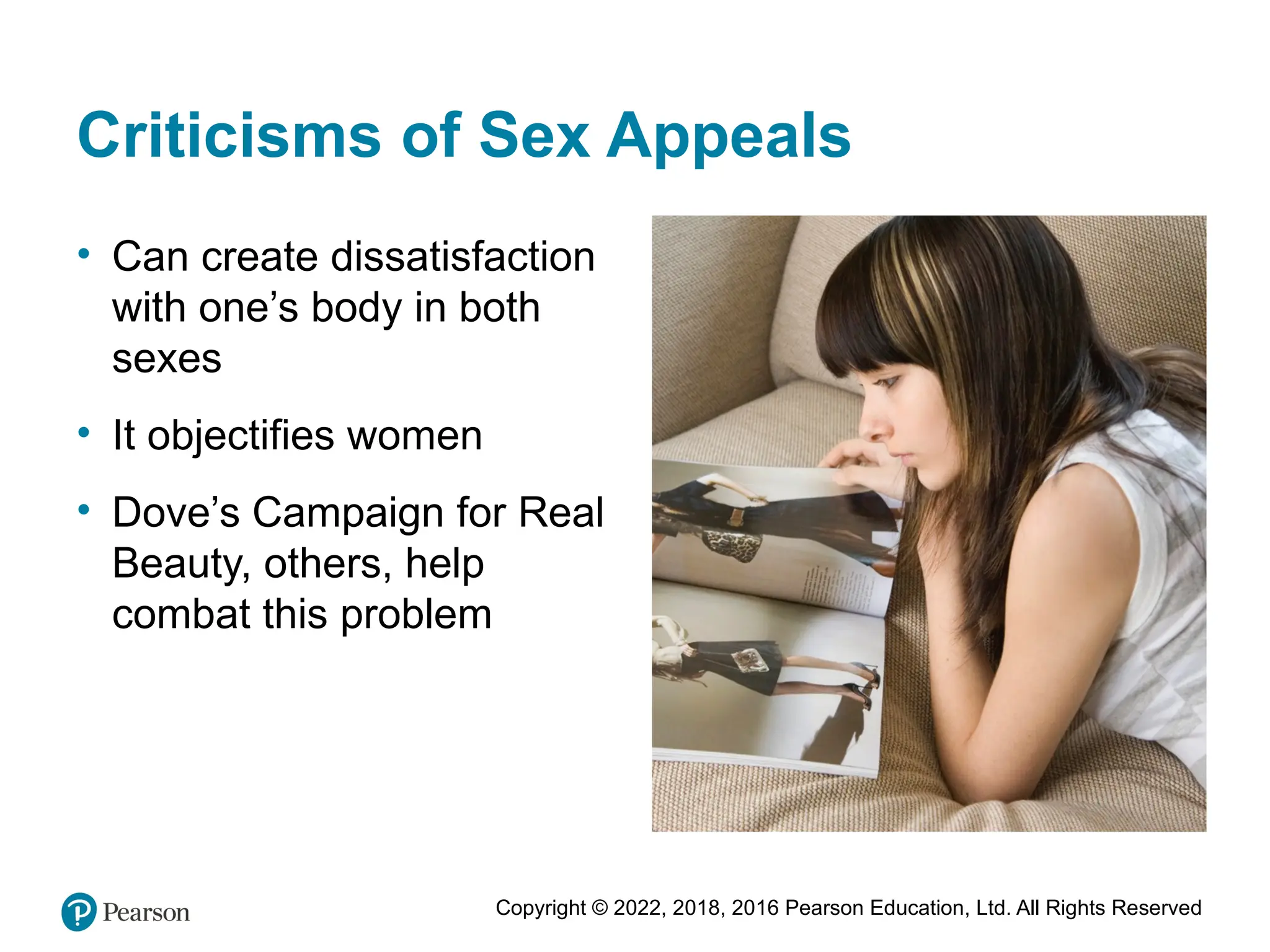
Criticisms of Sex Appeals
• Can create dissatisfaction
with one’s body in both
sexes
• It objectifies women
• Dove’s Campaign for Real
Beauty, others, help
combat this problem
Copyright © 2022, 2018, 2016 Pearson Education, Ltd. All Rights Reserved
Music Appeals (1 of 3)
• Connects with emotions and memories
• Has intrusive value
• Gains attention
• Increases the retention of visual information
• Improves recall
• Can increase persuasiveness
Copyright © 2022, 2018, 2016 Pearson Education, Ltd. All Rights Reserved
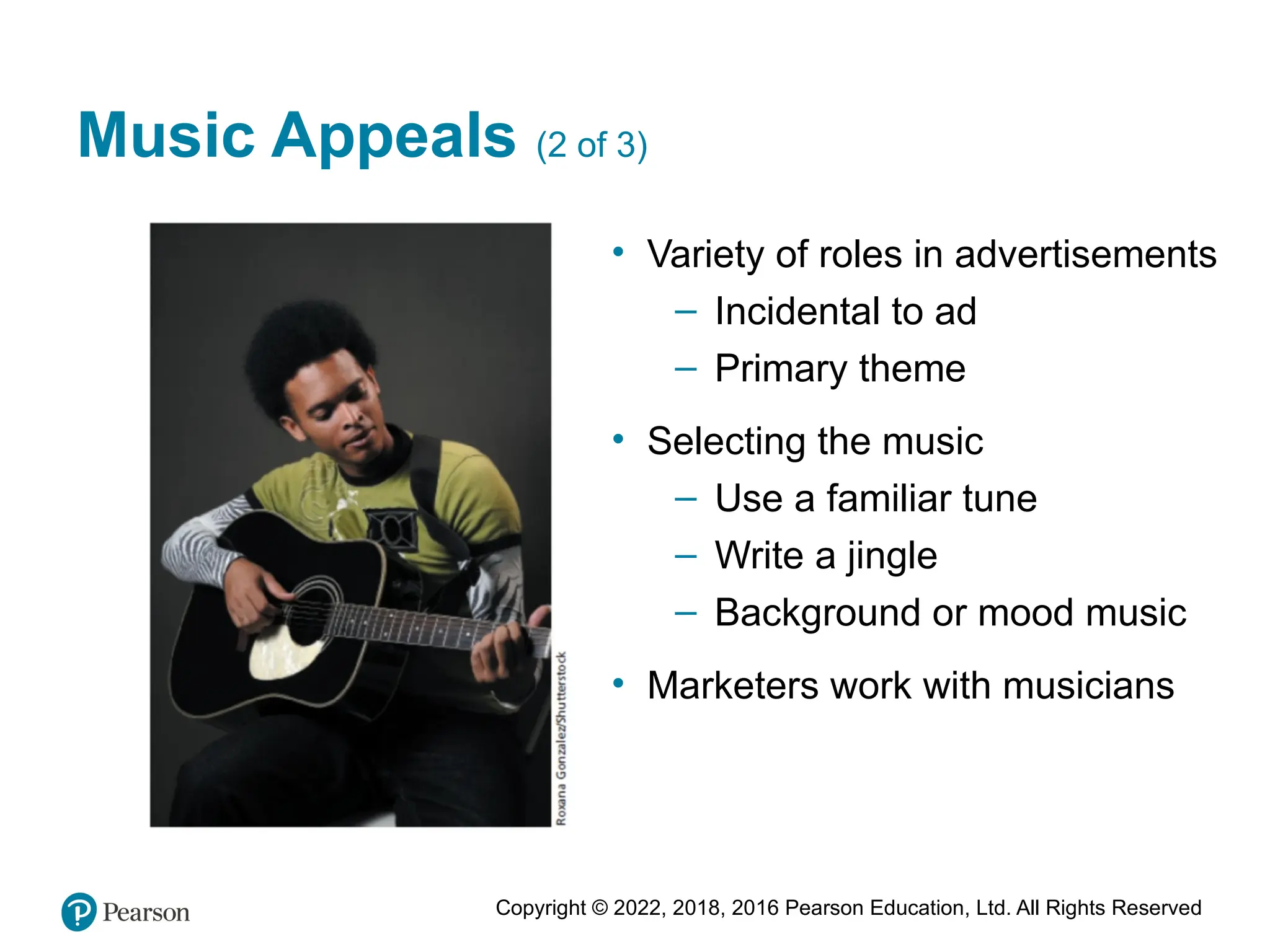
Music Appeals (2 of 3)
• Variety of roles in advertisements
– Incidental to ad
– Primary theme
• Selecting the music
– Use a familiar tune
– Write a jingle
– Background or mood music
• Marketers work with musicians
Copyright © 2022, 2018, 2016 Pearson Education, Ltd. All Rights Reserved
Music Appeals (3 of 3)
• Advantages of music appeals
– Consumers have affinity with existing songs
– Brand awareness, brand equity, and brand loyalty
become easier
– Emotional affinity transference to brand
– Popular songs expensive
• Alternative methods
– Musicians see ad songs as way to be heard
– Songs posted on YouTube and other sites
– Occasionally full song becomes popular
Copyright © 2022, 2018, 2016 Pearson Education, Ltd. All Rights Reserved
Rational Appeals
• Based on hierarchy of effects model
• Active processing of information
• Media outlets
– Print media and internet best mediums
• Business-to-business
– Print media, trade publications
– Information search by buying center members
• Product attributes
– Complex and high involvement products
– If processed, excellent at changing attitudes
Copyright © 2022, 2018, 2016 Pearson Education, Ltd. All Rights Reserved
Emotional Appeals
• Brand loyalty
– Key to developing brand loyalty
– Creates bond with brand
• Business-to-Business
– Used more frequently (25%)
– Emotions important in business decisions
• Media outlets
– Television best medium
– Internet
– Work well when tied with other appeals
Copyright © 2022, 2018, 2016 Pearson Education, Ltd. All Rights Reserved
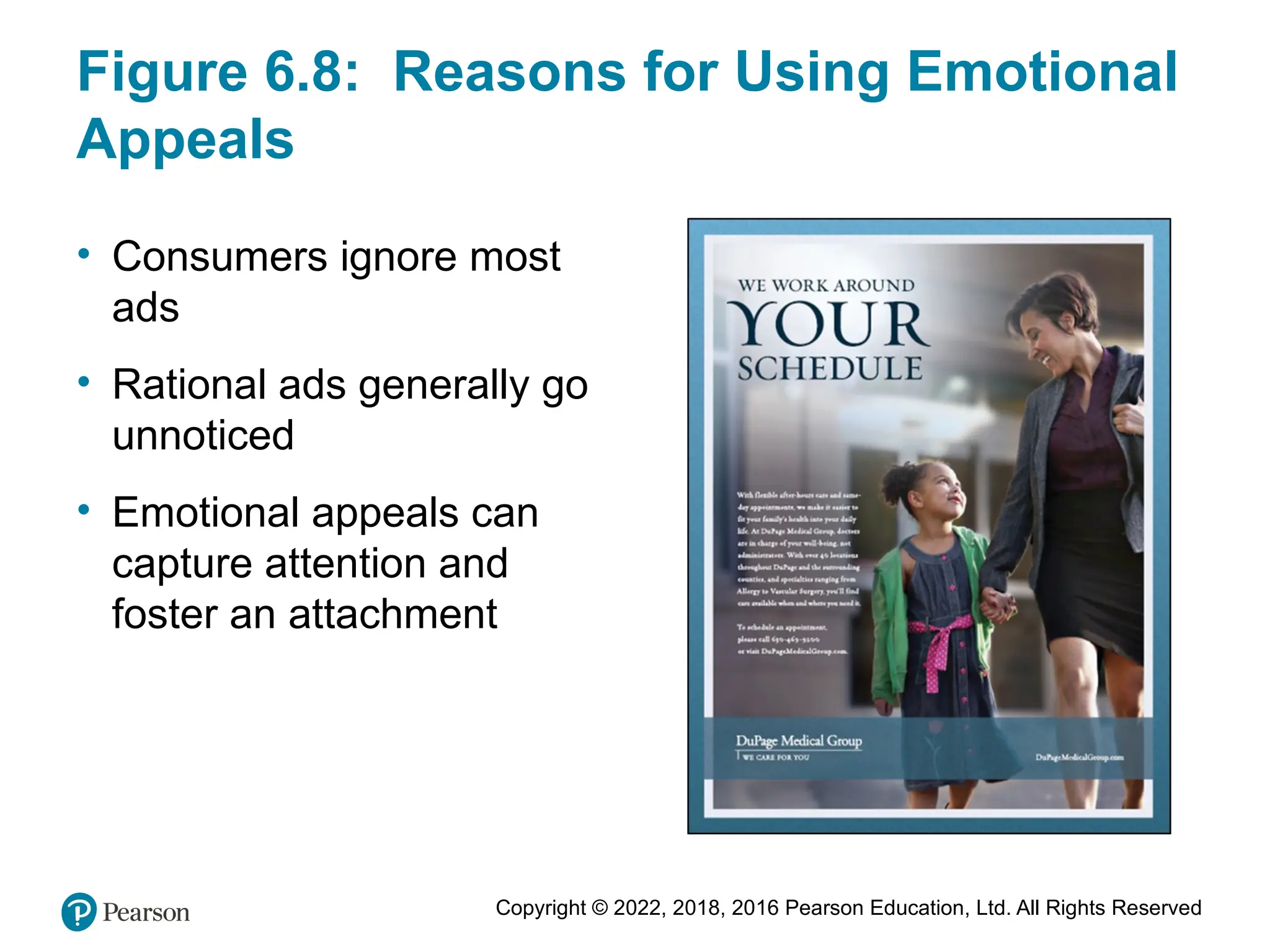
Figure 6.8: Reasons for Using Emotional
Appeals
• Consumers ignore most
ads
• Rational ads generally go
unnoticed
• Emotional appeals can
capture attention and
foster an attachment
Copyright © 2022, 2018, 2016 Pearson Education, Ltd. All Rights Reserved
Figure 6.9: Emotions Featured in
Advertising
• Trust
• Reliability
• Friendship
• Happiness
• Security
• Glamour-luxury
• Serenity
• Anger
• Protecting loved ones
• Romance
• Passion
• Family bonds
– with parents
– with siblings
– with children
– with extended family
members
Copyright © 2022, 2018, 2016 Pearson Education, Ltd. All Rights Reserved
Questions to Consider (2 of 2)
• As a consumer, do you think you are driven more by
rational or emotional advertising appeals?
• Which factors seem to determine the appeals that work
for you? Consider:
– Type of product or service
– Your brand loyalties
– Your past experiences
• Is it possible you think you are being rational when in fact
you are responding to emotional appeals?
Copyright © 2022, 2018, 2016 Pearson Education, Ltd. All Rights Reserved
Scarcity Appeals
• Based on limited supply
• Based on limited time to purchase
• Often tied with promotion tools such as contests,
sweepstakes, and coupons
• Encourage customers to take action
Copyright © 2022, 2018, 2016 Pearson Education, Ltd. All Rights Reserved
Figure 6.10: Executional Frameworks
• Animation
• Slice-of-life
• Storytelling
• Testimonial
• Authoritative
• Demonstration
• Fantasy
• Informative
Copyright © 2022, 2018, 2016 Pearson Education, Ltd. All Rights Reserved
Animation Executions
• Usage has increased dramatically
• Enhanced graphics technology
• Rotoscoping
• Costs coming down
• Business-to-business use
Copyright © 2022, 2018, 2016 Pearson Education, Ltd. All Rights Reserved
Figure 6.11: Components of a Slice-of-
Life Execution
Copyright © 2022, 2018, 2016 Pearson Education, Ltd. All Rights Reserved
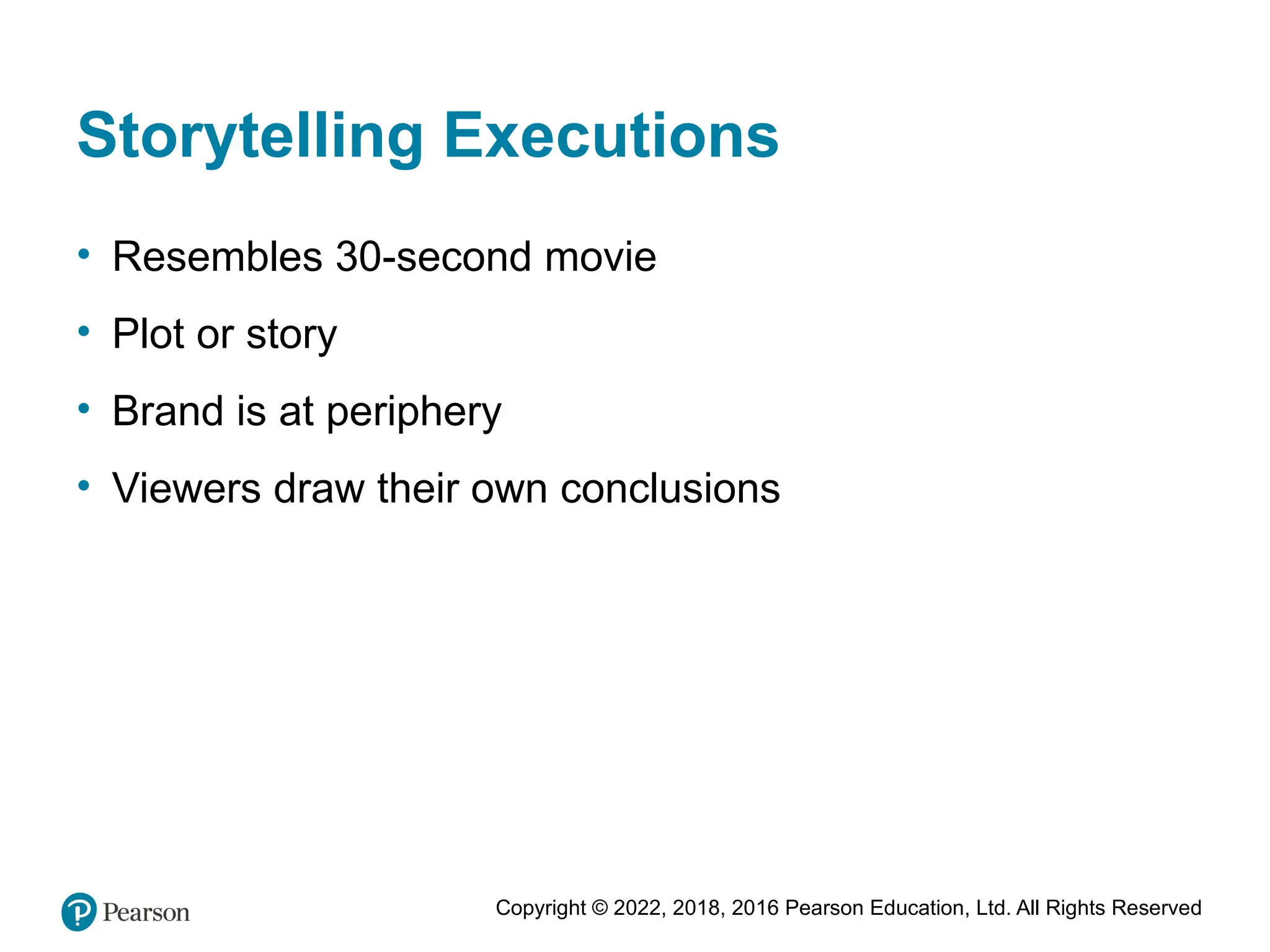
Storytelling Executions
• Resembles 30-second movie
• Plot or story
• Brand is at periphery
• Viewers draw their own conclusions
Copyright © 2022, 2018, 2016 Pearson Education, Ltd. All Rights Reserved
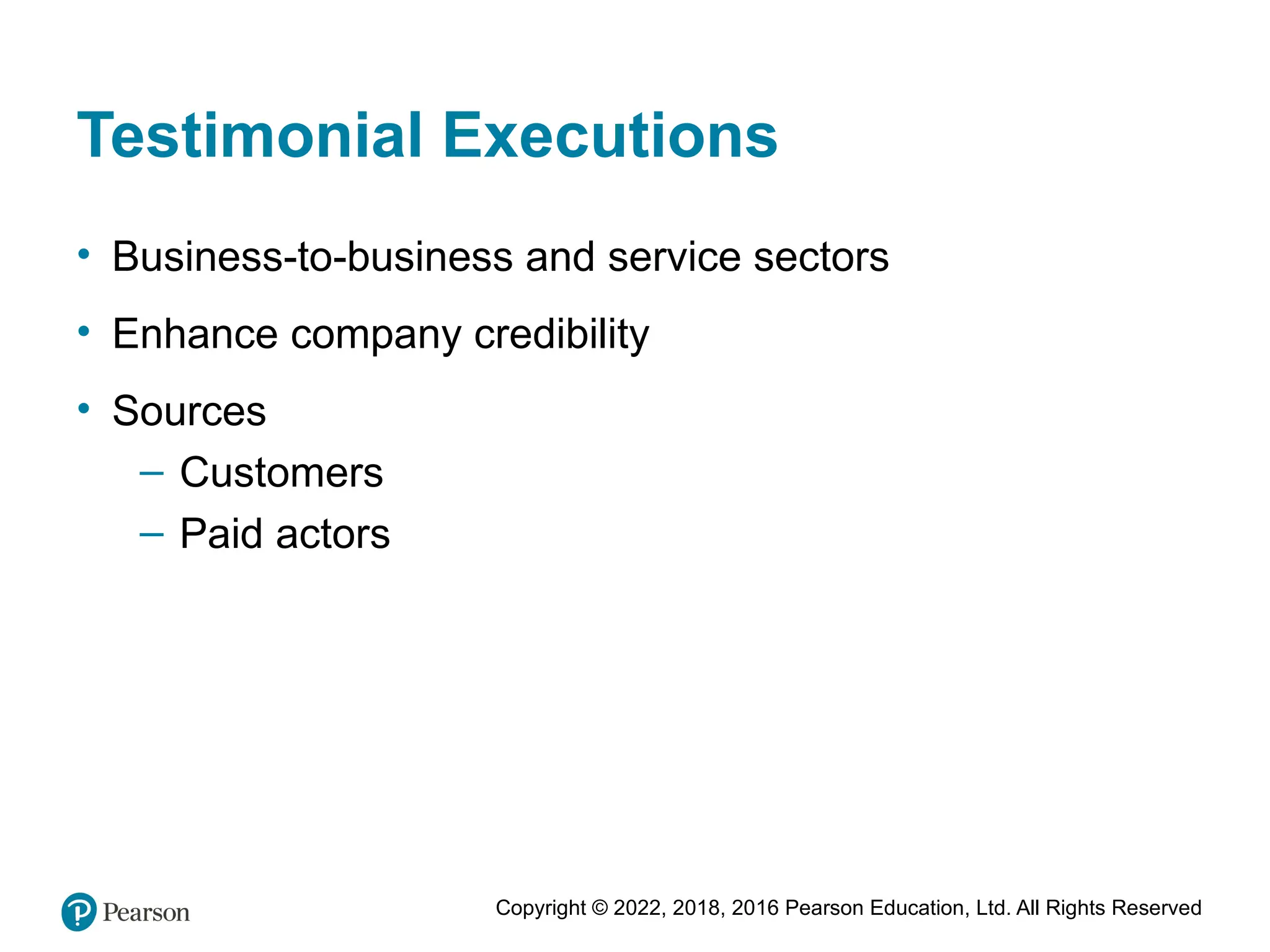
Testimonial Executions
• Business-to-business and service sectors
• Enhance company credibility
• Sources
– Customers
– Paid actors
Copyright © 2022, 2018, 2016 Pearson Education, Ltd. All Rights Reserved
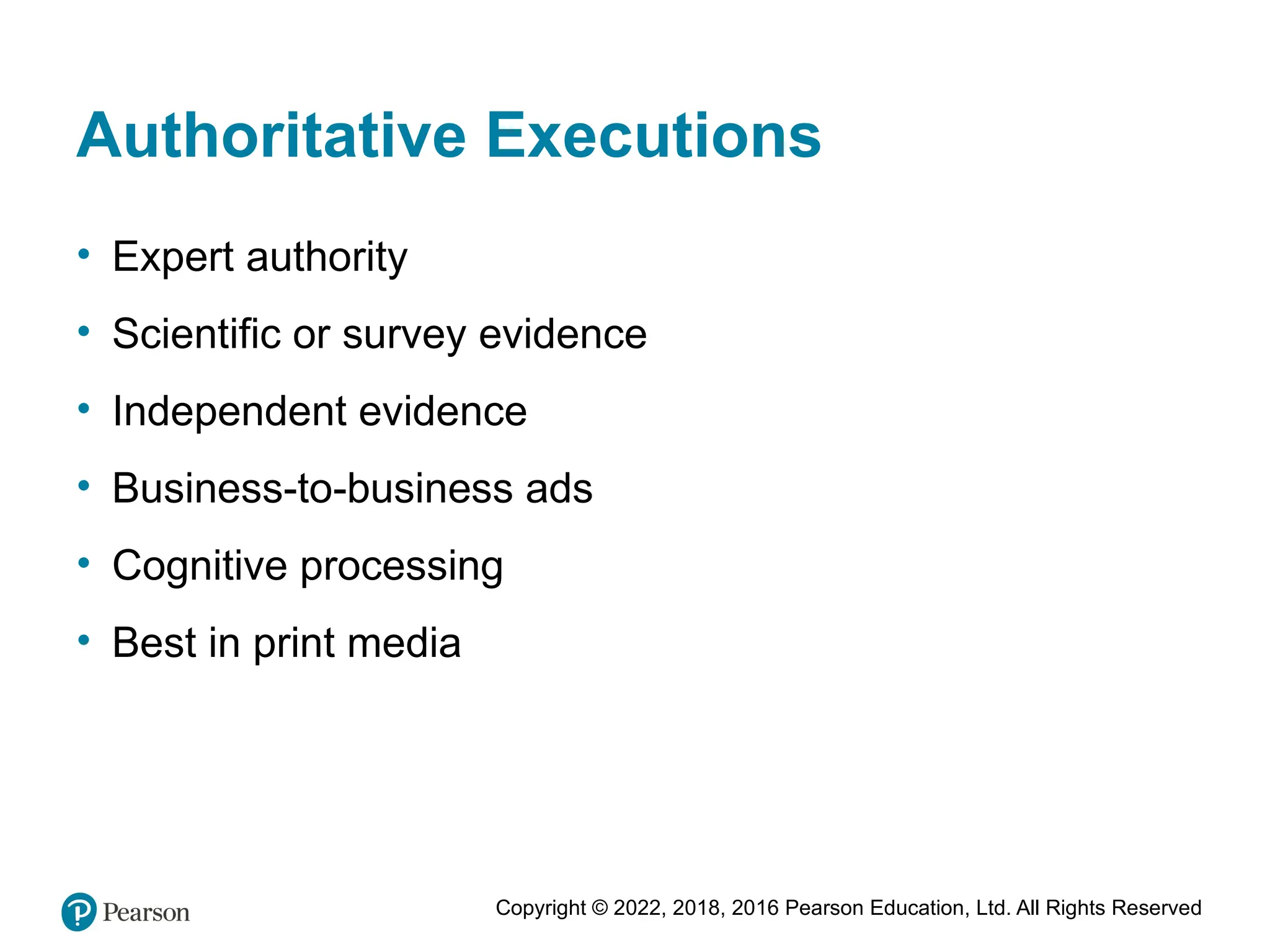
Authoritative Executions
• Expert authority
• Scientific or survey evidence
• Independent evidence
• Business-to-business ads
• Cognitive processing
• Best in print media
Copyright © 2022, 2018, 2016 Pearson Education, Ltd. All Rights Reserved
Demonstration Executions
• Shows product being used
• Business-to-business sector
• Works best for television and internet
Copyright © 2022, 2018, 2016 Pearson Education, Ltd. All Rights Reserved
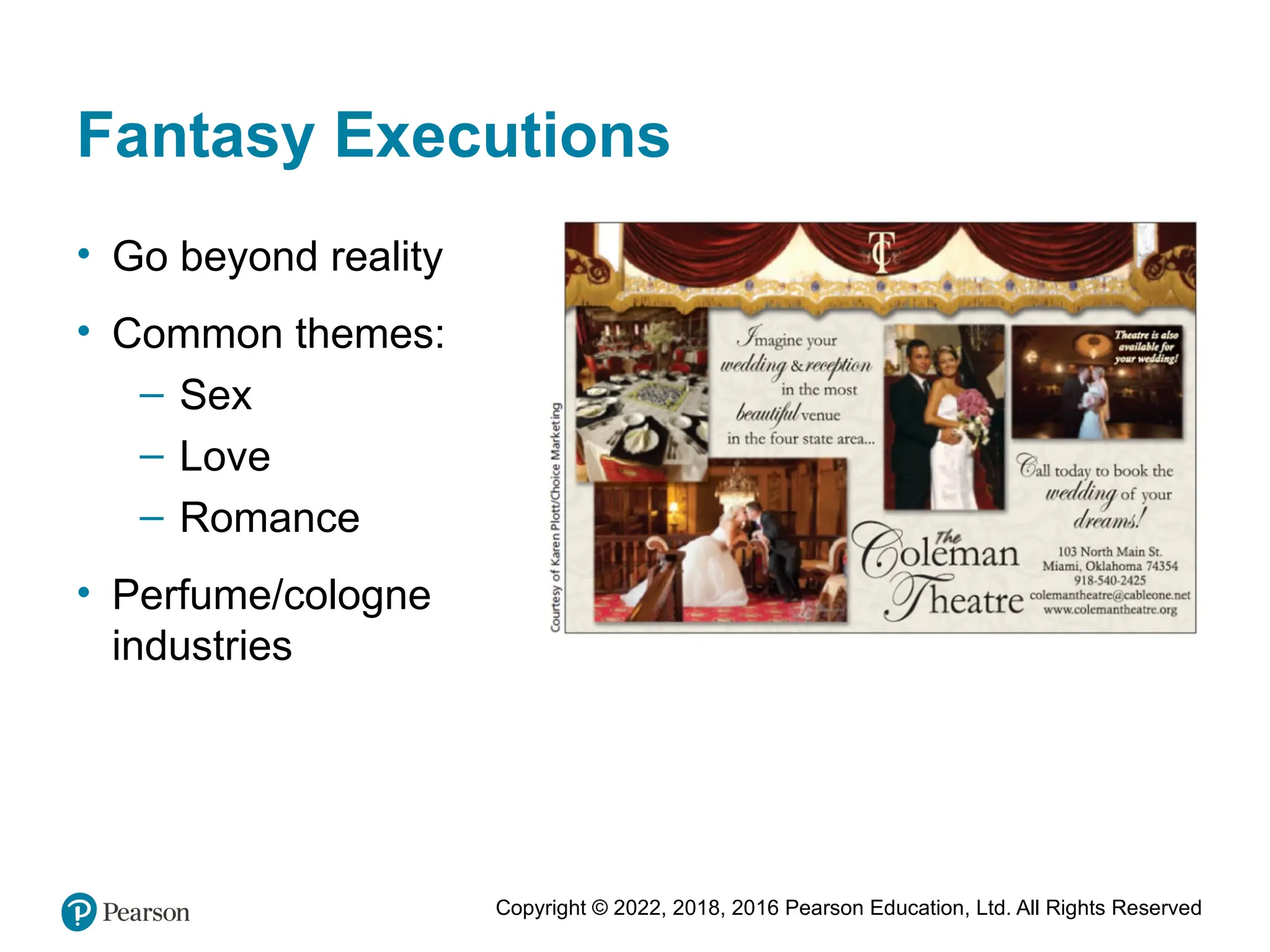
Fantasy Executions
• Go beyond reality
• Common themes:
– Sex
– Love
– Romance
• Perfume/cologne
industries
Copyright © 2022, 2018, 2016 Pearson Education, Ltd. All Rights Reserved
Informative Executions
• Used extensively in radio
• Business-to-business
• Best for high-involvement purchases
• Correct placement vital
Copyright © 2022, 2018, 2016 Pearson Education, Ltd. All Rights Reserved
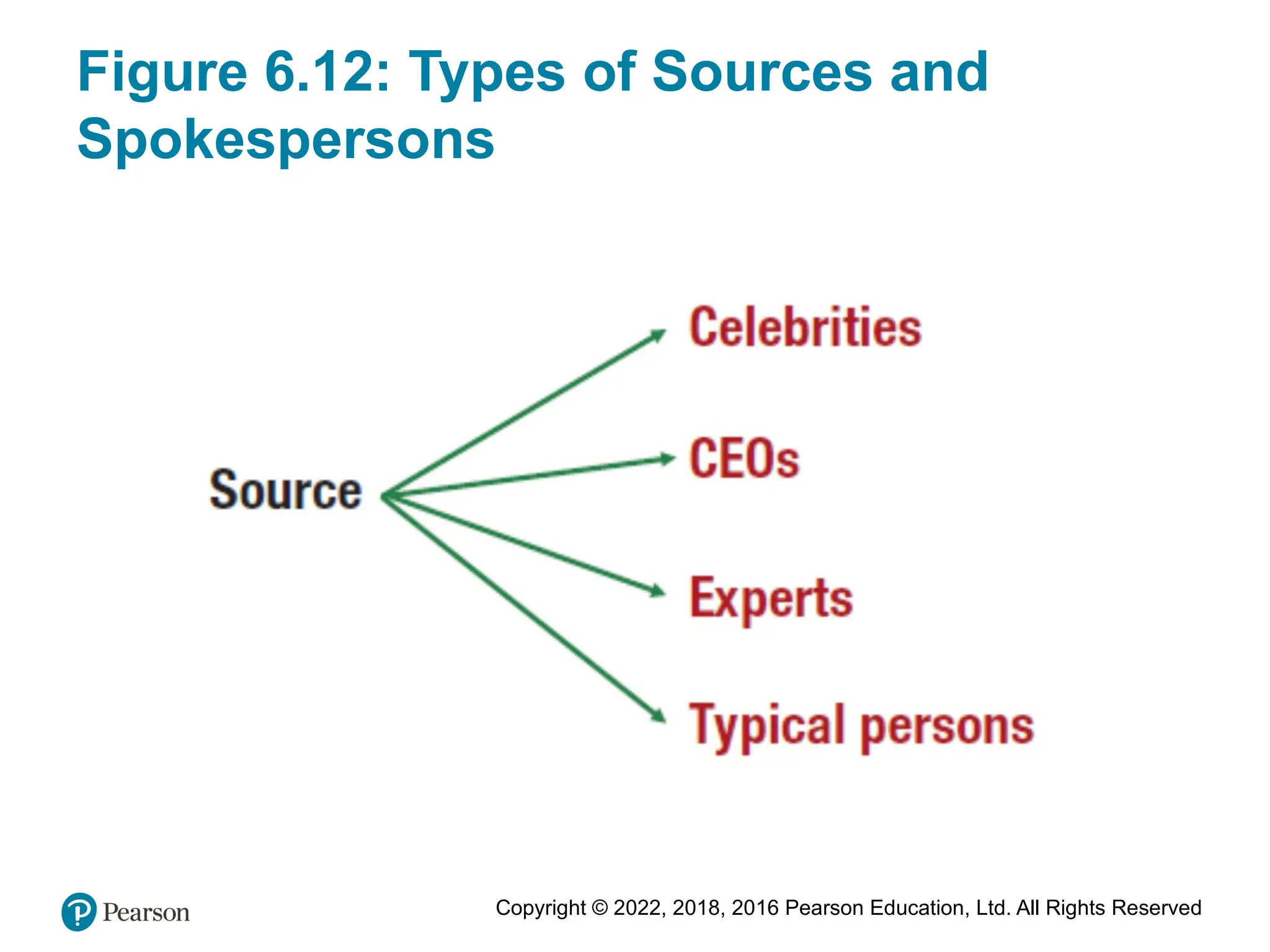
Figure 6.12: Types of Sources and
Spokespersons
Copyright © 2022, 2018, 2016 Pearson Education, Ltd. All Rights Reserved
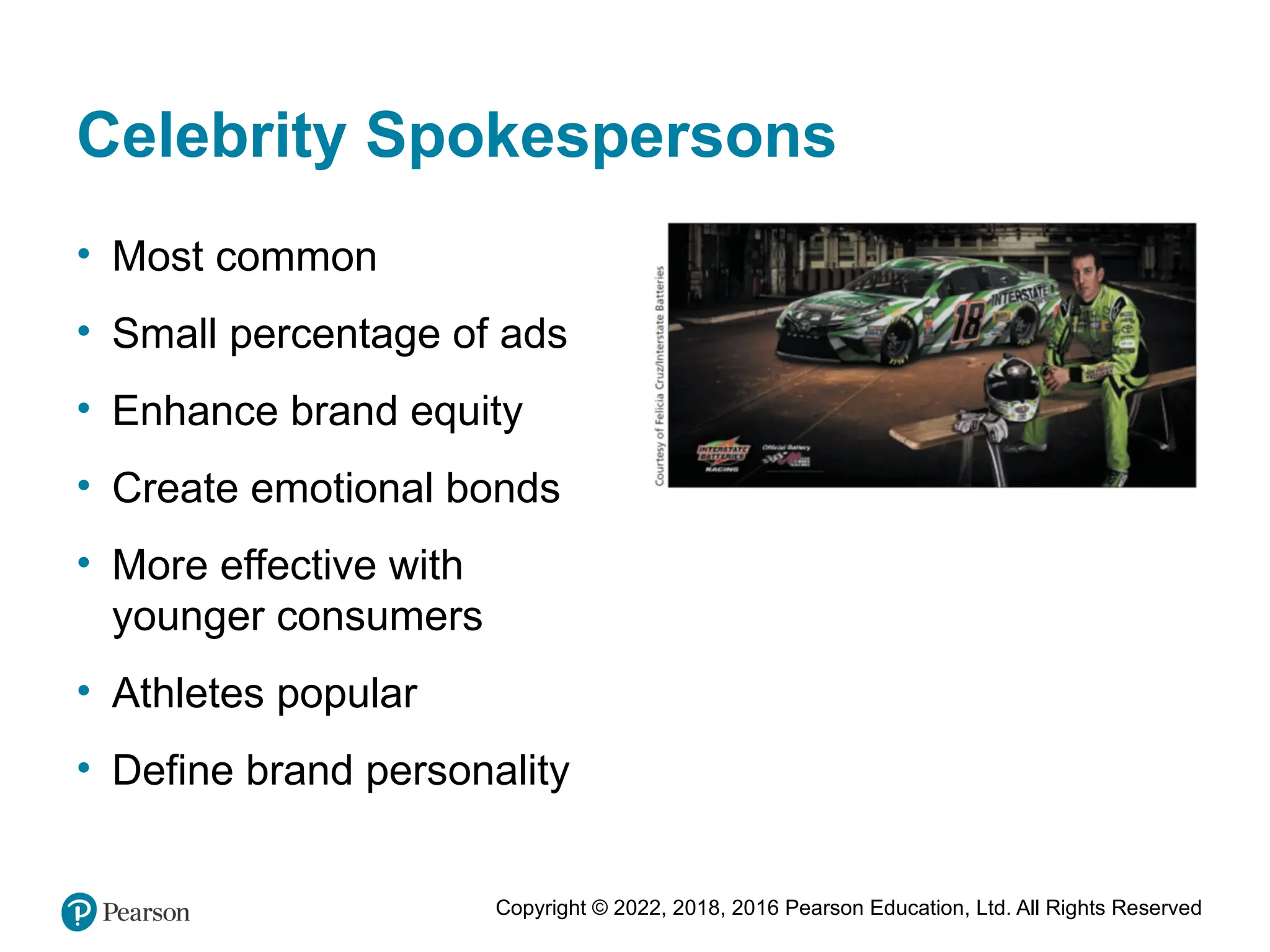
Celebrity Spokespersons
• Most common
• Small percentage of ads
• Enhance brand equity
• Create emotional bonds
• More effective with
younger consumers
• Athletes popular
• Define brand personality
Copyright © 2022, 2018, 2016 Pearson Education, Ltd. All Rights Reserved
Additional Celebrity Endorsements
• Celebrity voice-overs
– Quality voice
– Voice recognition
– Can be distraction
• Dead person endorsements
– Somewhat controversial
– Becoming more common
• Social media endorsements
– Paid to endorse products
– Paid to post tweets, comments
Copyright © 2022, 2018, 2016 Pearson Education, Ltd. All Rights Reserved
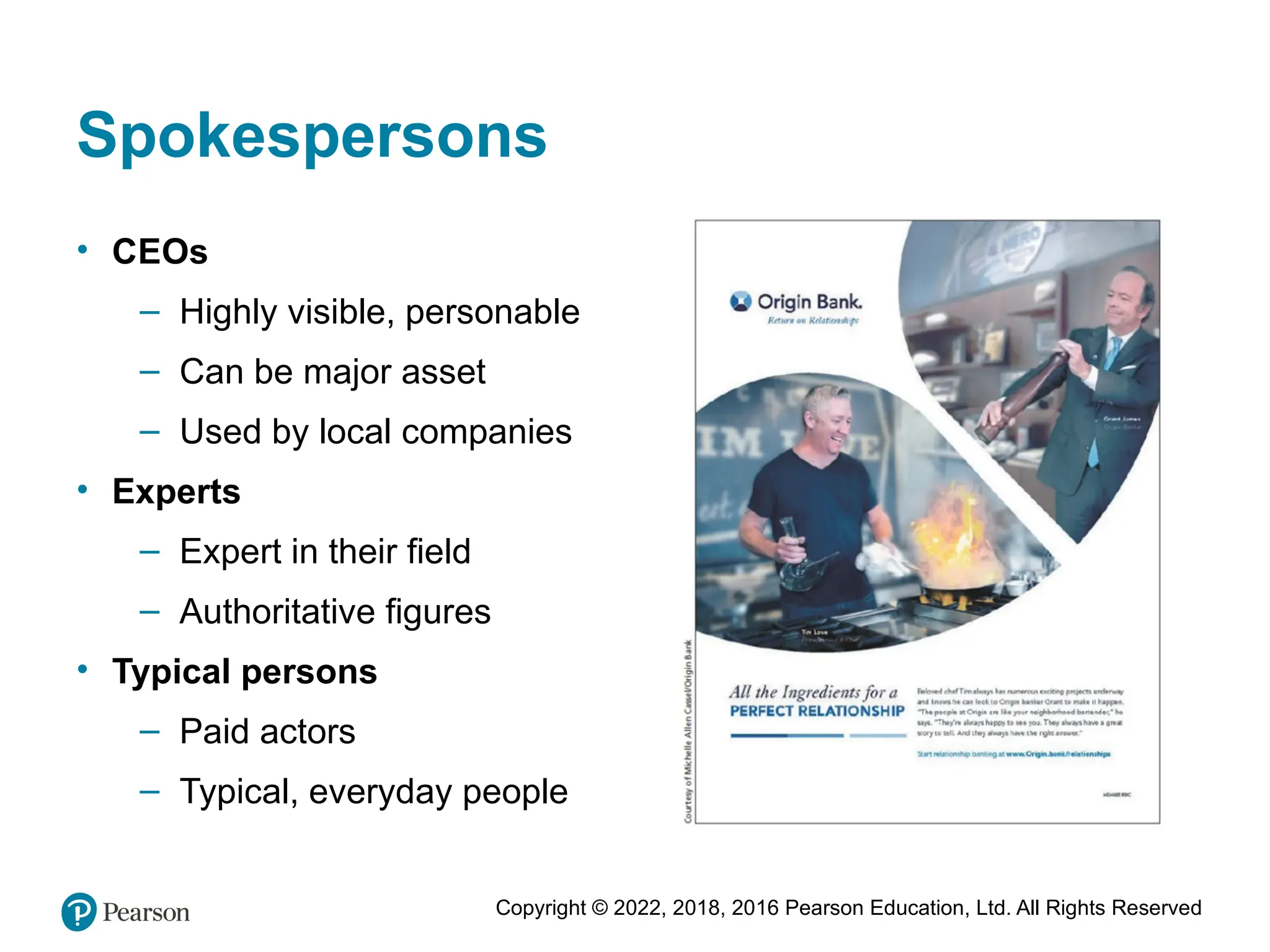
Spokespersons
• CEOs
– Highly visible, personable
– Can be major asset
– Used by local companies
• Experts
– Expert in their field
– Authoritative figures
• Typical persons
– Paid actors
– Typical, everyday people
Copyright © 2022, 2018, 2016 Pearson Education, Ltd. All Rights Reserved
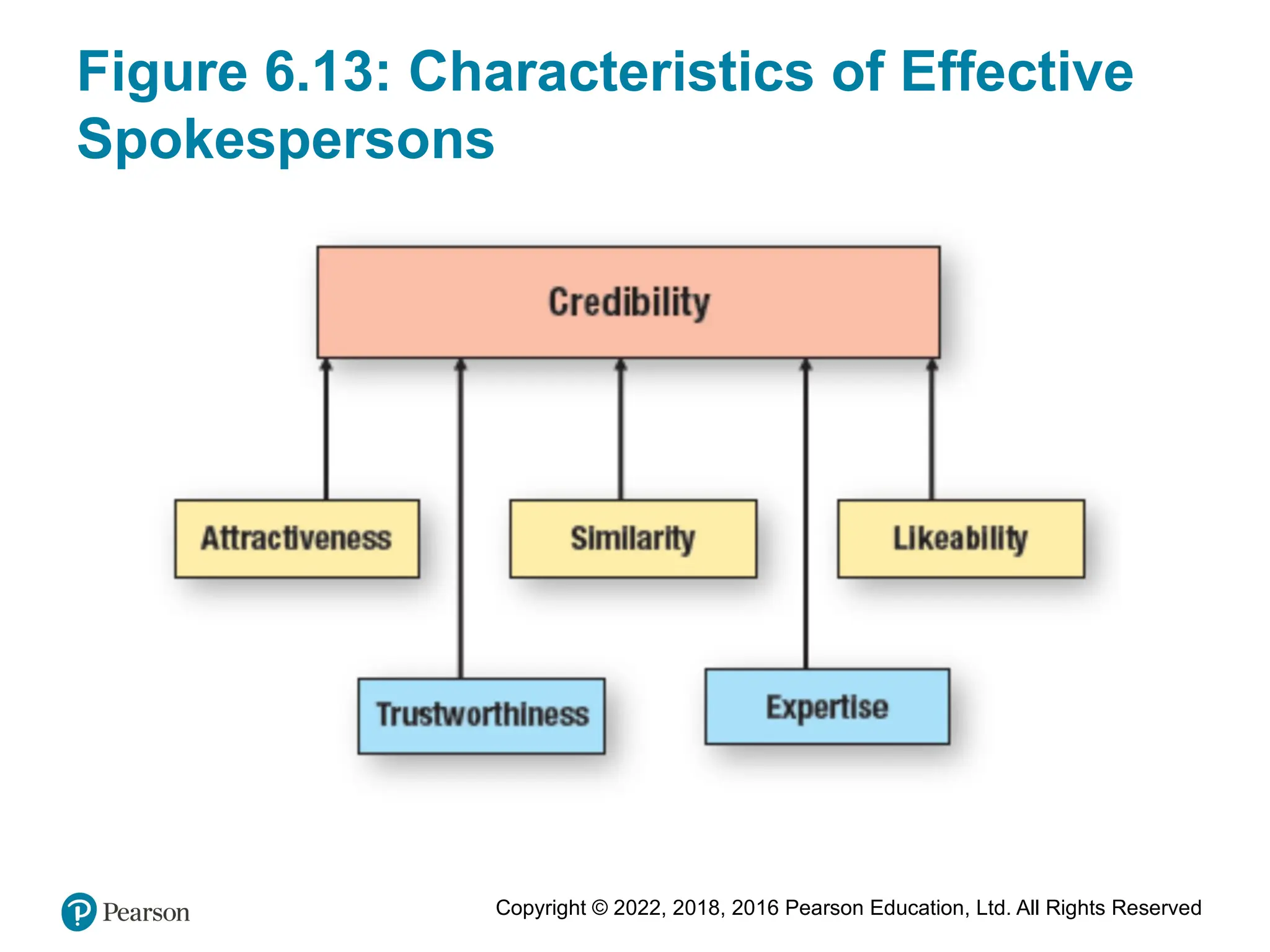
Figure 6.13: Characteristics of Effective
Spokespersons
Copyright © 2022, 2018, 2016 Pearson Education, Ltd. All Rights Reserved
Credibility Source Characteristics
• Derived from five characteristics
• Acceptance of individual and message
• Believable
• Most sources do not score high in all characteristics
• Celebrities most likely to possess all characteristics
Copyright © 2022, 2018, 2016 Pearson Education, Ltd. All Rights Reserved
Attractiveness Source Characteristics
• Physical attractiveness
• Personality attractiveness
Copyright © 2022, 2018, 2016 Pearson Education, Ltd. All Rights Reserved
Similarity Source Characteristics
• Closely related to attractiveness
• Allows for identification
• Source has similar beliefs or attitudes
• Preferences or behaviors similar
• Aspiration similarity
Copyright © 2022, 2018, 2016 Pearson Education, Ltd. All Rights Reserved
Likeability Source Characteristics
• Consumers respond to
sources they like
• May like role an actor
plays
• May like an athlete
because on favorite team
• May like source because
supports favorite cause
• Transfer of dislike to
brand being endorsed
Copyright © 2022, 2018, 2016 Pearson Education, Ltd. All Rights Reserved
Trustworthiness Source Characteristics
• Not all spokespersons are viewed as trustworthy
• Degree of confidence or acceptance
• Helps consumers believe message
• Likeability and trustworthiness related
Copyright © 2022, 2018, 2016 Pearson Education, Ltd. All Rights Reserved
Expertise Source Characteristics
• Sources with higher expertise more believable
• Results in higher credibility
• Can work to change opinions or attitudes
Copyright © 2022, 2018, 2016 Pearson Education, Ltd. All Rights Reserved
Matching Source Types and
Characteristics
• Celebrities
• CEO
• Expert
• Typical person
Copyright © 2022, 2018, 2016 Pearson Education, Ltd. All Rights Reserved
International Implications
• Adapt to cultural differences
• Be careful with language and translation
• Adjust message strategy, appeal, execution
Copyright © 2022, 2018, 2016 Pearson Education, Ltd. All Rights Reserved
Your Career: Resume and Application
Letter Design
• Design resume and application letter carefully
• Consider cognitive message strategies from this chapter
• List references with credibility and expertise
• Spend time with supervisors and coworkers so they can
provide positive future references
Copyright © 2022, 2018, 2016 Pearson Education, Ltd. All Rights Reserved
Blog Exercises
• Hepatitis C Ads
• New Coke Flavor
• Steak and Shake
• Television Ads

clow_IAPMC9_ppt_06.imhhhhhv fffv pp tx

  • 1.
    Integrated Advertising, Promotion,and Marketing Communications Ninth Edition, Global Edition Chapter 6 Advertising Design Copyright © 2022, 2018, 2016 Pearson Education, Ltd. All Rights Reserved
  • 2.
    Copyright © 2022,2018, 2016 Pearson Education, Ltd. All Rights Reserved Chapter Objectives 6.1 How do marketers use message strategies to design effective advertisements? 6.2 What are the seven main types of advertising appeals? 6.3 What role does the executional framework play in advertising design? 6.4 How are sources and spokespersons featured in advertising designs? 6.5 What kinds of adjustments are necessary when undertaking advertising design in international settings?
  • 3.
    Copyright © 2022,2018, 2016 Pearson Education, Ltd. All Rights Reserved Chapter Overview • Message strategies • Advertising appeals • Executional frameworks • Sources and spokespersons • International settings
  • 4.
    Copyright © 2022,2018, 2016 Pearson Education, Ltd. All Rights Reserved Adweek Media and Harris Interactive Survey • Ads somewhat or very interesting (55%) • Ads not interesting at all (13%) • Ads very influential in purchase decisions (6%) • Ads somewhat influential in purchase decisions (29%) • Nearly half of 18-34 year-olds influenced by advertising • 37% of 35-44 year-olds influenced by advertising • 28% of individuals 45+ influenced by advertising
  • 5.
    Copyright © 2022,2018, 2016 Pearson Education, Ltd. All Rights Reserved McGarryBowen • Founded 2002 with strategic approach • “Gracious” and “tenacious” • Emphasis on collaboration
  • 6.
    Copyright © 2022,2018, 2016 Pearson Education, Ltd. All Rights Reserved Figure 6.1: Message Strategies • Cognitive – Generic – Unique selling proposition – Hyperbole – Comparative • Affective – Resonance – Emotional • Conative
  • 7.
    Copyright © 2022,2018, 2016 Pearson Education, Ltd. All Rights Reserved Message Strategies (1 of 3) Cognitive • Generic • Preemptive • Unique selling proposition • Hyperbole • Comparative
  • 8.
    Copyright © 2022,2018, 2016 Pearson Education, Ltd. All Rights Reserved Generic Cognitive Message Strategy How does this ad rely on a generic message strategy?
  • 9.
    Copyright © 2022,2018, 2016 Pearson Education, Ltd. All Rights Reserved Preemptive Cognitive Message Strategy • Claim of superiority based on attribute or benefit • Prevent competition from making same claim • First to state advantage
  • 10.
    Copyright © 2022,2018, 2016 Pearson Education, Ltd. All Rights Reserved Unique Selling Proposition Cognitive Message Strategy • Focuses on a testable claim of: – Uniqueness – Superiority • Can be supported in some manner • Example: HelloFresh offers the fastest delivery times
  • 11.
    Copyright © 2022,2018, 2016 Pearson Education, Ltd. All Rights Reserved Hyperbole Advertising Cognitive Message Strategy • Untestable claim • Does not require substantiation • Popular cognitive approach
  • 12.
    Copyright © 2022,2018, 2016 Pearson Education, Ltd. All Rights Reserved Comparative Advertising Cognitive Message Strategy • Direct or indirect comparisons • Real or fictitious competitor • Advantage – captures attention – Brand awareness increases – Message awareness increases • Negative – less believable, negative attitude – Negative comparative ad – Spontaneous trait transference • Choose comparisons carefully
  • 13.
    Copyright © 2022,2018, 2016 Pearson Education, Ltd. All Rights Reserved Message Strategies (2 of 3) Affective • Resonance • Emotional
  • 14.
    Copyright © 2022,2018, 2016 Pearson Education, Ltd. All Rights Reserved Affective Message Strategy (1 of 2) • Invokes feelings or emotions • Attempts to enhance likeability • Resonance Advertising – Connects with consumer experiences – Comfort marketing • Emotional Advertising – Emotions lead to recall and choice – Consumer and b-to-b markets – Leads to positive feelings
  • 15.
    Copyright © 2022,2018, 2016 Pearson Education, Ltd. All Rights Reserved Affective Message Strategy (2 of 2) This ad for South Walton, Florida uses an affective message strategy.
  • 16.
    Copyright © 2022,2018, 2016 Pearson Education, Ltd. All Rights Reserved Message Strategies (3 of 3) Conative • Encourages customer action • Supports promotional efforts • Can encourage impulse buys
  • 17.
    Copyright © 2022,2018, 2016 Pearson Education, Ltd. All Rights Reserved Figure 6.2: The Hierarchy of Effects Model and Message Strategies
  • 18.
    Copyright © 2022,2018, 2016 Pearson Education, Ltd. All Rights Reserved Questions to Consider (1 of 2) • Think about the message strategies we have just discussed: – Cognitive – Affective – Conative • What examples of effective advertising can you think of in each of these categories? • Did the ads stimulate you to buy something? If so, what made it work for you?
  • 19.
    Copyright © 2022,2018, 2016 Pearson Education, Ltd. All Rights Reserved Figure 6.3: Types of Appeals • Fear • Humor • Sex • Music • Rationality • Emotions • Scarcity
  • 20.
    Copyright © 2022,2018, 2016 Pearson Education, Ltd. All Rights Reserved Fear Appeals (1 of 2) • Fear increases interest and is memorable • Severity and vulnerability – Severity – level of consequence – Vulnerability – probability of event occurring • Rewards to response efficacy – Intrinsic reward – Extrinsic reward – Response costs – Self-efficacy – Response efficacy
  • 21.
    Copyright © 2022,2018, 2016 Pearson Education, Ltd. All Rights Reserved Figure 6.4: The Behavioral Response Model
  • 22.
    Copyright © 2022,2018, 2016 Pearson Education, Ltd. All Rights Reserved Fear Appeals (2 of 2) Appeal strength • Low may not be noticed • High may backfire • Moderate works best
  • 23.
    Copyright © 2022,2018, 2016 Pearson Education, Ltd. All Rights Reserved Humor Appeals (1 of 2) • Cuts through advertising clutter • Good at grabbing and keeping attention • Offers intrusive value, attracts attention • Causes consumers to – Watch – Laugh – Remember
  • 24.
    Copyright © 2022,2018, 2016 Pearson Education, Ltd. All Rights Reserved Humor Appeals (2 of 2) • Advantages of humor – Piques interest – Increases recall and comprehension • Problems with humor – Can be offensive – Can overpower message • Humor should focus on product • International usage – Humor is rooted in culture – Humor varies across countries
  • 25.
    Copyright © 2022,2018, 2016 Pearson Education, Ltd. All Rights Reserved Figure 6.5: Reasons for Using Humor in Ads • Captures attention • Holds attention • Often wins creative awards • High recall scores • Consumers enjoy ads that make them laugh • Evaluated by consumers as likeable ads
  • 26.
    Copyright © 2022,2018, 2016 Pearson Education, Ltd. All Rights Reserved Sex Appeals • Break through clutter • Use has increased • Effectiveness has declined • Advertisers shifting to more subtle sexual cues
  • 27.
    Copyright © 2022,2018, 2016 Pearson Education, Ltd. All Rights Reserved Figure 6.6: Sexuality Approaches Used in Advertising • Subliminal techniques • Sensuality • Sexual suggestiveness • Nudity or partial nudity • Overt sexuality
  • 28.
    Copyright © 2022,2018, 2016 Pearson Education, Ltd. All Rights Reserved Sex Appeal Approaches (1 of 2) • Subliminal approach – Places cues or icons in ads – Not effective • Sensuality – Women respond more favourably – More sophisticated – Relies on imagination • Sexual suggestiveness – Hints about sex – Sexual theme
  • 29.
    Copyright © 2022,2018, 2016 Pearson Education, Ltd. All Rights Reserved Sex Appeal Approaches (2 of 2) • Nudity or partial nudity – Used for wide variety of products – Attract attention – Not always designed to elicit sexual response – Underwear commercials • Overt sexuality – Acceptable for sexually-oriented products – Used to break through ad clutter – Often used for a shock effect – Danger of being offensive
  • 30.
    Copyright © 2022,2018, 2016 Pearson Education, Ltd. All Rights Reserved Figure 6.7: Factors to Consider Before Using Decorative Models • Improve ad recognition but not brand recognition • Influence emotional and objective evaluations • Attractive models produce a higher level of attention than less attractive models • Produce higher purchase intentions when product is sexually relevant
  • 31.
    Copyright © 2022,2018, 2016 Pearson Education, Ltd. All Rights Reserved Effectiveness of Sex Appeals • Increase attention – Brand recall lower • Physiological arousal • Cognitive impressions – Like versus dislike • Consider societal trends
  • 32.
    Copyright © 2022,2018, 2016 Pearson Education, Ltd. All Rights Reserved Criticisms of Sex Appeals • Can create dissatisfaction with one’s body in both sexes • It objectifies women • Dove’s Campaign for Real Beauty, others, help combat this problem
  • 33.
    Copyright © 2022,2018, 2016 Pearson Education, Ltd. All Rights Reserved Music Appeals (1 of 3) • Connects with emotions and memories • Has intrusive value • Gains attention • Increases the retention of visual information • Improves recall • Can increase persuasiveness
  • 34.
    Copyright © 2022,2018, 2016 Pearson Education, Ltd. All Rights Reserved Music Appeals (2 of 3) • Variety of roles in advertisements – Incidental to ad – Primary theme • Selecting the music – Use a familiar tune – Write a jingle – Background or mood music • Marketers work with musicians
  • 35.
    Copyright © 2022,2018, 2016 Pearson Education, Ltd. All Rights Reserved Music Appeals (3 of 3) • Advantages of music appeals – Consumers have affinity with existing songs – Brand awareness, brand equity, and brand loyalty become easier – Emotional affinity transference to brand – Popular songs expensive • Alternative methods – Musicians see ad songs as way to be heard – Songs posted on YouTube and other sites – Occasionally full song becomes popular
  • 36.
    Copyright © 2022,2018, 2016 Pearson Education, Ltd. All Rights Reserved Rational Appeals • Based on hierarchy of effects model • Active processing of information • Media outlets – Print media and internet best mediums • Business-to-business – Print media, trade publications – Information search by buying center members • Product attributes – Complex and high involvement products – If processed, excellent at changing attitudes
  • 37.
    Copyright © 2022,2018, 2016 Pearson Education, Ltd. All Rights Reserved Emotional Appeals • Brand loyalty – Key to developing brand loyalty – Creates bond with brand • Business-to-Business – Used more frequently (25%) – Emotions important in business decisions • Media outlets – Television best medium – Internet – Work well when tied with other appeals
  • 38.
    Copyright © 2022,2018, 2016 Pearson Education, Ltd. All Rights Reserved Figure 6.8: Reasons for Using Emotional Appeals • Consumers ignore most ads • Rational ads generally go unnoticed • Emotional appeals can capture attention and foster an attachment
  • 39.
    Copyright © 2022,2018, 2016 Pearson Education, Ltd. All Rights Reserved Figure 6.9: Emotions Featured in Advertising • Trust • Reliability • Friendship • Happiness • Security • Glamour-luxury • Serenity • Anger • Protecting loved ones • Romance • Passion • Family bonds – with parents – with siblings – with children – with extended family members
  • 40.
    Copyright © 2022,2018, 2016 Pearson Education, Ltd. All Rights Reserved Questions to Consider (2 of 2) • As a consumer, do you think you are driven more by rational or emotional advertising appeals? • Which factors seem to determine the appeals that work for you? Consider: – Type of product or service – Your brand loyalties – Your past experiences • Is it possible you think you are being rational when in fact you are responding to emotional appeals?
  • 41.
    Copyright © 2022,2018, 2016 Pearson Education, Ltd. All Rights Reserved Scarcity Appeals • Based on limited supply • Based on limited time to purchase • Often tied with promotion tools such as contests, sweepstakes, and coupons • Encourage customers to take action
  • 42.
    Copyright © 2022,2018, 2016 Pearson Education, Ltd. All Rights Reserved Figure 6.10: Executional Frameworks • Animation • Slice-of-life • Storytelling • Testimonial • Authoritative • Demonstration • Fantasy • Informative
  • 43.
    Copyright © 2022,2018, 2016 Pearson Education, Ltd. All Rights Reserved Animation Executions • Usage has increased dramatically • Enhanced graphics technology • Rotoscoping • Costs coming down • Business-to-business use
  • 44.
    Copyright © 2022,2018, 2016 Pearson Education, Ltd. All Rights Reserved Figure 6.11: Components of a Slice-of- Life Execution
  • 45.
    Copyright © 2022,2018, 2016 Pearson Education, Ltd. All Rights Reserved Storytelling Executions • Resembles 30-second movie • Plot or story • Brand is at periphery • Viewers draw their own conclusions
  • 46.
    Copyright © 2022,2018, 2016 Pearson Education, Ltd. All Rights Reserved Testimonial Executions • Business-to-business and service sectors • Enhance company credibility • Sources – Customers – Paid actors
  • 47.
    Copyright © 2022,2018, 2016 Pearson Education, Ltd. All Rights Reserved Authoritative Executions • Expert authority • Scientific or survey evidence • Independent evidence • Business-to-business ads • Cognitive processing • Best in print media
  • 48.
    Copyright © 2022,2018, 2016 Pearson Education, Ltd. All Rights Reserved Demonstration Executions • Shows product being used • Business-to-business sector • Works best for television and internet
  • 49.
    Copyright © 2022,2018, 2016 Pearson Education, Ltd. All Rights Reserved Fantasy Executions • Go beyond reality • Common themes: – Sex – Love – Romance • Perfume/cologne industries
  • 50.
    Copyright © 2022,2018, 2016 Pearson Education, Ltd. All Rights Reserved Informative Executions • Used extensively in radio • Business-to-business • Best for high-involvement purchases • Correct placement vital
  • 51.
    Copyright © 2022,2018, 2016 Pearson Education, Ltd. All Rights Reserved Figure 6.12: Types of Sources and Spokespersons
  • 52.
    Copyright © 2022,2018, 2016 Pearson Education, Ltd. All Rights Reserved Celebrity Spokespersons • Most common • Small percentage of ads • Enhance brand equity • Create emotional bonds • More effective with younger consumers • Athletes popular • Define brand personality
  • 53.
    Copyright © 2022,2018, 2016 Pearson Education, Ltd. All Rights Reserved Additional Celebrity Endorsements • Celebrity voice-overs – Quality voice – Voice recognition – Can be distraction • Dead person endorsements – Somewhat controversial – Becoming more common • Social media endorsements – Paid to endorse products – Paid to post tweets, comments
  • 54.
    Copyright © 2022,2018, 2016 Pearson Education, Ltd. All Rights Reserved Spokespersons • CEOs – Highly visible, personable – Can be major asset – Used by local companies • Experts – Expert in their field – Authoritative figures • Typical persons – Paid actors – Typical, everyday people
  • 55.
    Copyright © 2022,2018, 2016 Pearson Education, Ltd. All Rights Reserved Figure 6.13: Characteristics of Effective Spokespersons
  • 56.
    Copyright © 2022,2018, 2016 Pearson Education, Ltd. All Rights Reserved Credibility Source Characteristics • Derived from five characteristics • Acceptance of individual and message • Believable • Most sources do not score high in all characteristics • Celebrities most likely to possess all characteristics
  • 57.
    Copyright © 2022,2018, 2016 Pearson Education, Ltd. All Rights Reserved Attractiveness Source Characteristics • Physical attractiveness • Personality attractiveness
  • 58.
    Copyright © 2022,2018, 2016 Pearson Education, Ltd. All Rights Reserved Similarity Source Characteristics • Closely related to attractiveness • Allows for identification • Source has similar beliefs or attitudes • Preferences or behaviors similar • Aspiration similarity
  • 59.
    Copyright © 2022,2018, 2016 Pearson Education, Ltd. All Rights Reserved Likeability Source Characteristics • Consumers respond to sources they like • May like role an actor plays • May like an athlete because on favorite team • May like source because supports favorite cause • Transfer of dislike to brand being endorsed
  • 60.
    Copyright © 2022,2018, 2016 Pearson Education, Ltd. All Rights Reserved Trustworthiness Source Characteristics • Not all spokespersons are viewed as trustworthy • Degree of confidence or acceptance • Helps consumers believe message • Likeability and trustworthiness related
  • 61.
    Copyright © 2022,2018, 2016 Pearson Education, Ltd. All Rights Reserved Expertise Source Characteristics • Sources with higher expertise more believable • Results in higher credibility • Can work to change opinions or attitudes
  • 62.
    Copyright © 2022,2018, 2016 Pearson Education, Ltd. All Rights Reserved Matching Source Types and Characteristics • Celebrities • CEO • Expert • Typical person
  • 63.
    Copyright © 2022,2018, 2016 Pearson Education, Ltd. All Rights Reserved International Implications • Adapt to cultural differences • Be careful with language and translation • Adjust message strategy, appeal, execution
  • 64.
    Copyright © 2022,2018, 2016 Pearson Education, Ltd. All Rights Reserved Your Career: Resume and Application Letter Design • Design resume and application letter carefully • Consider cognitive message strategies from this chapter • List references with credibility and expertise • Spend time with supervisors and coworkers so they can provide positive future references
  • 65.
    Copyright © 2022,2018, 2016 Pearson Education, Ltd. All Rights Reserved Blog Exercises • Hepatitis C Ads • New Coke Flavor • Steak and Shake • Television Ads

Editor's Notes

  • #1 If this PowerPoint presentation contains mathematical equations, you may need to check that your computer has the following installed: 1) MathType Plugin 2) Math Player (free versions available) 3) NVDA Reader (free versions available)
  • #2 These are the objectives for Chapter 6.
  • #3 Chapter 6 presents information on advertising design. It focuses on types of message strategies, appeals, and ad executions. This chapter examines three primary advertising design issues – message strategies, appeals, and executional frameworks. While discussed separately, decisions about ad design incorporate all three elements. Finally, the chapter discusses characteristics of strong sources and spokespersons, along with adjustments that must be made when designing advertising in international settings.
  • #4 Adweek Media and Harris Interactive conducted a survey of consumers about their attitudes toward advertising. 55% said ads were somewhat or very interesting compared to only 13% who said advertising was not interesting at all. About 6% said ads were very influential in the purchase decisions they made, and 29% said ads were somewhat influential in purchase decisions. About half of the survey respondents in the 18- to 34-year-old age bracket were influenced by advertising. The percentage dropped to 37% for individuals 35 to 44 and 28% for individuals 45 and older.
  • #5 The mcgarrybowen advertising agency was founded in 2002 with the design to be both “gracious” and “tenacious.” Over the past decade, it has picked up an impressive list of clients such as Chevron, Canon, Disney, JP Morgan, Kraft, Oscar Mayer, and Pfizer. This full-service agency believes in people and emphasizes collaboration among employees and with clients. To achieve marketing goals, the creative staff utilizes a storytelling approach and strategic planning. Rather than integration, the goal is unification.
  • #6 The message theme outlines the key ideas in an advertisement. It is a central part of the creative brief. The message then can be created using a number of different message strategies, the primary tactic or approach used to deliver the message theme. Message strategies can be divided into three main categories that correspond with the three components of attitude – cognitive, affective, and conative. Let’s take a closer look at these…
  • #7 A cognitive message strategy presents rational arguments or pieces of information to consumers. Cognitive message strategies are designed to influence the cognitive component of attitude, which deals with beliefs and knowledge. Cognitive message strategies can be divided into five types – generic, preemptive, unique selling proposition, hyperbole, and comparative.
  • #8 A generic cognitive message strategy promotes a brand’s attributes or benefits without any claim of superiority. This TruChoice advertisement concentrates on the cognitive aspects of purchasing and financing seeds for a farming enterprise.
  • #9 A preemptive cognitive message strategy makes a claim of superiority based on a product’s specific attribute or benefit with the intent of preventing the competition from making the same claim.
  • #10 A unique selling proposition message strategy focuses on a testable claim of uniqueness or superiority.
  • #11 A hyperbole cognitive message strategy is an untestable claim based on some attribute or benefit. It does not require substantiation, which makes it a popular cognitive strategy approach. Notice this ad uses hyperbole with the statement, “Bigger rewards are here.”
  • #12 A comparative cognitive message strategy focuses on a direct or indirect comparison to a competing brand. The brand can be real, mentioned, or fictitious. The advantage of comparative ads is that they tend to capture attention. Brand awareness and message awareness tend to be higher. The negative aspect is that they can be less believable and can create a negative attitude. This is most likely to occur when a negative comparison approach is used in the ad, downgrading the competing brand. If the consumer does not believe the ad, then spontaneous trait transference can occur, which is placing the negative trait on the advertised brand instead of the competitor. It is important to choose competitors wisely in making comparisons.
  • #13 Advertisements that invoke feelings or emotions are affective message strategies. These messages attempt to enhance the likeability of a product, recall of the message, and comprehension of the message. The two types of affective message strategies are resonance and emotional. Resonance advertising connects a product with a consumer’s experiences from the past in order to develop a bond with the brand. Often, advertisers will use music from that generation to create an emotional bond. Emotional messages attempt to elicit emotions that will lead to product recall and choice. Many different emotions can be connected with a product. Emotional messages are used in both consumer and business-to-business advertising. Affective message strategies help develop brand equity by creating an emotional bond with the brand. As shown in this advertisement, many ads for jewelry seek to elicit a strong emotional response designed to enhance and increase brand awareness.
  • #14 Affective message strategies invoke feelings or emotions with the goal of enhancing likeability, recall, and comprehension. Affective strategies can be resonance or emotional. Resonance advertising connects a brand with a consumer’s experience. A new form of resonance advertising is comfort marketing. This encourages consumers to purchase a brand rather than a generic product because brands have stood the test of time, and consumers can take comfort in them. Emotional advertising elicits powerful emotions that lead to recall and choice.
  • #15 Can you identify the emotional affective message strategy in this ad? What is it?
  • #16 Conative message strategies are designed to lead directly to some type of action or response. The strategy encourages consumers (or businesses) to act in some way, to do something like make an inquiry or access a website for more information. It can be tied with some type of promotion like a coupon, contest, or sweepstakes. This conative advertisement for Cross Keys Bank seeks to move consumers to open accounts but also avoids the assertive advertising approach.
  • #17 Because message strategies correspond to the components of attitude, they can be matched with the different stages of the Hierarchy of Effects Model. Cognitive strategies deal with awareness and knowledge. Affective strategies deal with emotions and the stages of liking, preference, and conviction. Conative strategies encourage action and match the purchase phase of the model. The diagram is structured into topics and subtopics as follows. Cognitive strategies Awareness Knowledge Affective strategies Liking Preference Conviction Conative strategies Purchase   Each topic flows into its subtopics from left to right, and each subtopic flows into the next subtopic from top to bottom.
  • #18 For these questions, encourage students to think about advertising examples from their own lives and from brands they like. What kinds of purchases did they make as a result?
  • #19 Advertisers have seven different types of appeals they can use. The type of appeal chosen should be based on the creative brief and the objectives of the ad campaign. If a means-end chain has been developed, then ideas on which appeal would work the best can be generated. While almost any appeal can work in any situation, some appeals would be more appropriate than others. In some cases, a particular appeal may be unacceptable to the target audience or to the client.
  • #20 Fear appeals are common and are used for products ranging from insurance, to home security systems, to deodorant. Fear appeals increase interest and are remembered by individuals. Severity is the level of consequence that will occur, and vulnerability is the probability of the event happening. Response efficacy is the likelihood that a change in behavior or actions will result in a desirable positive consequence. Intrinsic reward is the internal satisfaction, and extrinsic reward is the value of the event or reward received. Response cost is the cost or sacrifice the person will need to make to obtain the reward. Self-efficacy is the confidence a person has in his/her own ability to engage in the action, or to stop an undesirable behavior. All of these factors influence the effectiveness of an ad using a fear appeal.
  • #21 The behavioral response model explains how fear appeals work. For a product such as a home security system, an ad can focus on severity, what happens when a home is broken into, or vulnerability, the probability of it actually occurring. The ad can show the negative consequences of such an event. An ad can show the intrinsic and extrinsic rewards from installing a security system. Response efficacy can be illustrated by the alarm going off when a burglar tries to enter, and the police are called. Peace of mind and security are then shown as the positive consequence. The diagram flows as follows. Negative behavior or incident flows to Severity which flows to Negative consequence Vulnerability which flows to Negative consequence Self efficacy flows to Behavior change or action which flows to Response efficacy which flows to Positive consequence Negative behavior or incident flows to   Response costs which flow to Behavior change or action   Negative behavior or incident and Behavior change or action flow to intrinsic and extrinsic rewards.
  • #22 This business-to-business ad uses a fear appeal with the headline “We won’t hang you out to dry.” The copy then explains what ReRez can do for a business that wants marketing research. The fear appeal is strong enough to get attention, especially the visual, but not so strong that it is ignored.
  • #23 Humor is an excellent appeal for cutting through advertising clutter, and grabbing and keeping someone’s attention. Humor causes individuals to stop what they are doing, watch, laugh at, and then remember the ad. In recall tests, consumers most often remembered humorous ads over ads with other types of appeals. The best results occur when the humor is connected naturally with the product.
  • #24 Humor appeals offer a number of advantages. Humor piques consumer interest. Humor increases recall and comprehension of ads. Humor elevates people’s moods, and if people feel good about an ad, they tend to think positively about the brand being advertised. Problems occur when the humor is offensive or overpowers the message. At times, people can recall an ad and describe it in detail, but not remember the brand being promoted. When that occurs, the ad has failed. To prevent the humor from overpowering the message, the humor should focus on the product and not stand alone. Humor is rooted in culture, so what is funny in one country is not likely to be funny in another. Good humor that is remembered and that is connected with the brand is difficult to achieve.
  • #25 Advertisers use humor because it works. It captures attention. It holds people’s attention. Humor often wins creative awards at competitions. Humor produces a high level of recall on recall tests. People enjoy humor; they like to laugh. When comparing ads, most people evaluate humorous ads as ones they like best.
  • #26 Sex appeals are often used to break advertising clutter. The use of sex appeals has increased in the United States and in many other countries. The problem is that sex appeals may not carry the impact they used to because children are growing up exposed to sexual themes all around them. As a result, many advertisers are moving to more subtle sexual clues and a softer sexual approach. This advertisement for milk features a mild sex appeal.
  • #27 Advertisers have five different approaches they can use with sex appeals. They range from very subliminal messages to overt sexuality.
  • #28 The subliminal approach places sexual cues or icons in an advertisement with the idea of affecting the subconscious is subliminal advertising. Research has shown that subliminal advertising does not work. It is not effective. Ad clutter requires stronger ads that get attention. The sensuality approach conveys sex, but in a loving, romantic way. Women respond more favorably to a sensuous approach. It is viewed as more sophisticated and relies on a person’s imagination. Because it relies on imagination, the viewer can put their own positive spin on what they think will occur. Images of romance and love can be more enticing to viewers of an ad than raw sexuality. Sexual suggestiveness is a stronger hint about having sex, or a sexual theme. Recent ads have focused on women watching men who were shirtless or nearly nude, suggesting sexual fantasies that could occur with the man.
  • #29 Nudity or partial nudity is used in advertising for a variety of reasons and for a wide variety of products. Some products are related to sex, others have nothing at all to do with sex. One primary reason nudity or partial nudity is used in ads is to attract attention. It is not always designed to elicit a sexual response. For instance, underwear commercials may be just promoting garments, not trying to convey the idea that the underwear is sexy. Overt sexuality in ads is acceptable for sexually-oriented products. It can be used to break through ad clutter. It is often used for shock value, to get people’s attention. The major danger of an overt sexual approach is that it can offend people. When that occurs, it creates a negative image and attitude toward the brand.
  • #30 Before using a decorative model, companies should consider several factors. First, using decorative models does improve ad recognition, but it does not improve brand recognition. Recalling the ad but not the brand is not good. Second, decorative models influence emotional and objective evaluations of the product for both male and female audiences. Third, attractive models produce higher levels of attention than less attractive models for both males and females. Fourth, decorative models produce higher purchase intentions when the product is sexually relevant.
  • #31 Are sex appeals effective? Ads with sexual themes do attract attention. However, brand recall may be lower. Overt sexual ads, overt sexual cues, and nudity will increase physiological arousal. The cognitive impressions made in ads with sex appeals vary depending on the viewer. If the person likes the ad, then a positive cognitive impression is made of the brand. If they dislike the ad, then a negative cognitive impression is made of the brand. Societal trends also impact the use of sex appeals, especially in global markets.
  • #32 Sexual appeals in advertising are not all positive. A number of disadvantages are present. Using sex in advertising today has less influence because sex is common on television and in movies. Sexual themes interfere with brand recall and affect ad comprehension. A negative societal consequence is that such appeals may cause a greater dissatisfaction with the viewer’s own body. Females feel they are too fat. Males feel they are not strong or muscular enough. Sex appeals have also led to the objectifying of women. Dove’s Campaign for Real Beauty and others like it have worked to combat this problem.
  • #33 Music is an important part of advertising. It connects with emotions and generates memories. It has intrusive value and gets attention. Music increases the retention of visual information. It produces higher recall scores and can increase persuasiveness. Consumers often tie particular music to a specific brand of product.
  • #34 Music can play a variety of roles in ads. It can be incidental to the ad, hardly noticed by viewers, or it can be the central theme of the ad. The role it will assume impacts the type of music that will be selected. Advertisers can use a familiar tune, or they can write a jingle or new song. Music can be for background purposes or to create a certain mood as the ad progresses. In recent years, advertisers have worked more with musicians to create original new music for advertisements.
  • #35 Music appeals offer a number of advantages. Consumers have an affinity with existing songs, so when an existing song is used, consumers have already heard it and most have developed emotions with it. Brand awareness, brand equity, and brand loyalty become easier with music appeals. Even for new songs, consumers transfer affinity and positive feelings from the song to the brand. Musicians have become more open to writing and performing songs for ads. It gives them a way to be heard. Songs are often posted on YouTube and other sites. Occasionally, the full song version of a tune written for an ad will become popular and move to other music outlets.
  • #36 Rational appeals are based on the hierarchy of effects model and the sequence of steps outlined in the model. It implies active processing of information. Rational appeals work best for print ads where longer copy can be inserted and online where there is very little limit to what copy can be inserted. Rational appeals are common in business-to-business ads, again in print media, especially trade publications. When members of the buying center are searching for information, ads using rational appeals can be effective. Rational appeals work well for complex and high involvement products. If a person processes the information in a rational ad, it is excellent at changing attitudes. The question is, will consumers stop and look or listen to the ad and process the information?
  • #37 Most advertising creatives believe that emotions are the key to developing brand loyalty. Emotions and feelings will create bonds with a brand. Emotional appeals are becoming more common in B-to-B advertising and are now used in about 25% of all business ads. The rationale is that business buyers are people also, and even in business decisions, emotions are an important component. Emotional appeals work really well for television, where people can see and hear the emotions. They also work well on the internet. Emotional appeals work well with other types of appeals and are often combined with other appeals like humor.
  • #38 Emotional appeals are often used because consumers tend to ignore ads, and emotional themes tend to be noticed more. Rational appeals, especially, are often ignored unless the person is in the market for that particular product. This advertisement for DuPage Medical Group utilizes an emotional appeal.
  • #40 For these questions, encourage students to think about advertising appeals they have encountered in their own lives. Which appeals stimulated a purchase for them, and what kind of product or service was it?
  • #41 Scarcity appeals urge consumers to make a purchase now because of some type of limitation. Often that limitation is a limited supply, which means products must be purchased before they are all gone. It can be based on limited time. You only have 5 days or one week, or just one hour. Scarcity appeals are often tied to other promotions such as contests, sweepstakes, and coupons. The concept is to encourage customers to take action immediately, or it will be too late.
  • #42 An executional framework signifies the manner in which an advertising appeal will be presented. It should be chosen in conjunction with an advertising appeal and a message strategy. There are eight different executions that can be used. While almost any execution can be used with any appeal and message strategy, there are logical combinations, and there are some combinations that do not work well together. For instance, a common combination would be emotional appeal, affective message strategy, and slice-of-life execution. A combination that would be difficult to pull off would be rational appeal, affective message strategy, and demonstration execution.
  • #43 Animation usage has increased dramatically, and is often now a chosen method of advertising. The skill and quality of animation has improved greatly in the last 20 years. One technique, known as rotoscoping, involves drawing animated characters into scenes with live characters. Rotoscoping also can be used to merge live video scenes to make it look like it really happened or all occurred at the same time. The costs of animation have come down in recent years, which makes it more appealing to advertisers. Animation is now used even for B-to-B advertising.
  • #44 The slice-of-life execution was made popular by Procter & Gamble in the 1950s. The basic premise is the introduction of a problem that a product solves. Slice-of-life has four components. It opens with an encounter between people or with a situation. A problem occurs. Then there is interaction, which can be a voice-over or conversation between two people. Then comes the P & G product that solves the problem. The typical detergent scenario is of a child’s uniform getting dirty and now it is not available for the championship game. The mother interacts with a neighbor who recommends Tide or Cheer, and the uniform is clean. Everyone is happy as the child runs out onto the field in a clean uniform. The diagram flows as follows. Encounter Problem Interaction Solution
  • #45 Storytelling is similar to the slice-of-life execution, but does not include an encounter where the brand solves the problem. Storytelling resembles a 30-second movie, with a plot. The brand is more at the periphery of the ad, not its central focus. Rather than tell a brand’s benefits or attributes, the ad leaves the audience to draw their own conclusions.
  • #46 Testimonials are used in the business-to-business sector and the service sector. Testimonials involve customers giving testimonies about a product or service. Testimonies can enhance the credibility of a product. The testimonies can be given by real customers or by paid actors. Real customers are more believable, but lack polish for a TV ad. Paid actors sometimes look like paid actors, and the testimony benefits are lost.
  • #47 When using the authoritative execution, advertisers seek to convince consumers of the product’s superiority. The most common approach is to use some type of expert authority, such as a doctor, dentist, lawyer, or electrician. Scientific evidence or even survey evidence can be used to support the claim. It works best if the evidence is independent, such as Consumer Reports. The authoritative approach is used in business-to-business ads, especially in trade journals. Authoritative executions rely on cognitive processing of the information, so they work best with print media where copy can be supplied.
  • #48 A demonstration execution shows how a product works. A demonstration is an effective way to communicate the benefits of a product to viewers. It is used in business-to-business advertising to show how a product can meet the needs of a business. It works best for television and the internet.
  • #49 Fantasy executions lift the audience beyond reality to a world of make-believe. Some are meant to be realistic, but most are fantasies that are irrational and would never really happen. The most common themes for fantasy executions are sex, love, and romance. As a result, fantasy executions work well for perfume and cologne. They also work well for clothing and vacation destinations. A few business-to-business ads have featured fantasies, but the danger is that customers will not take the business seriously. This Coleman Theatre ad utilizes a fantasy approach designed for brides-to-be.
  • #50 Informative executions present information to the audience in a straightforward manner. They are used extensively in radio, often by DJs. Informative ads are less common in television and in print. Informative ads are common with business-to-business. The key to whether individuals pay attention is the buying situation. If someone is looking for a particular product, then they may notice the informative ad. Level of involvement is important. Consumers and business buyers have to be involved at the time to notice informative ads. Placement is also important. Ads placed next to an article on the topic are more likely to be noticed.
  • #51 Selecting the right source and spokesperson for an advertisement is a critical decision. Advertisers have four choices – celebrities, CEOs of companies, experts from various fields, and typical persons. The diagram is structured as follows. Source splits into four subtopics of celebrities, C E Os, experts, typical persons
  • #52 The most common type of spokesperson is the celebrity. They are featured in a small percentage of all ads. A celebrity can enhance brand equity and create emotional bonds with the brand. Celebrities are more effective with younger consumers than with older individuals. Athletes are a popular category of spokespersons. Celebrity spokespersons can be used to establish a brand’s personality.
  • #53 Three additional categories of celebrity endorsements are: celebrity voice-overs, dead-person endorsements, and social media endorsements. Celebrity voice-overs are used because of the quality of their voice. Sometimes it is because the voice can be recognized and will influence consumers. At other times, the voice-over is a distraction because consumers pay too much attention to the voice and don’t hear the brand message. Another category, dead celebrities, is somewhat controversial. It is becoming more common because they can’t bring negative publicity to themselves or the brand. The newest form of celebrity endorsements is with social media. Celebrities are paid to post positive comments about a brand on social media, such as Twitter.
  • #54 CEOs can be used as spokespersons. They work well if they are highly visible and personable. They can be a major asset to a company. They work especially well for local companies where consumers in that area know them personally, or at least have met them. Expert spokespersons should be experts in their fields. They then serve as authoritative figures and can provide expert opinions. The last category is typical persons. They can be either paid actors who portray a typical person, or everyday, ordinary people. This advertisement for Origin Bank features typical people.
  • #55 In evaluating sources, companies and ad agencies consider several characteristics. The effectiveness of the spokesperson depends on his/her degree of credibility. The level of credibility is determined by five factors – attractiveness, trustworthiness, similarity, expertise, and likeability. The diagram shows credibility to be composed of attractiveness, trustworthiness, similarity, expertise, likeability.
  • #56 Source credibility is derived from five characteristics: attractiveness, trustworthiness, similarity, expertise, and likability. Credibility determines the level of acceptance of the individual and his/her message. Credibility translates into the spokesperson being believable. Most sources do not score high on all of the dimensions. Celebrities are the most likely to possess all of the characteristics, at least to some degree.
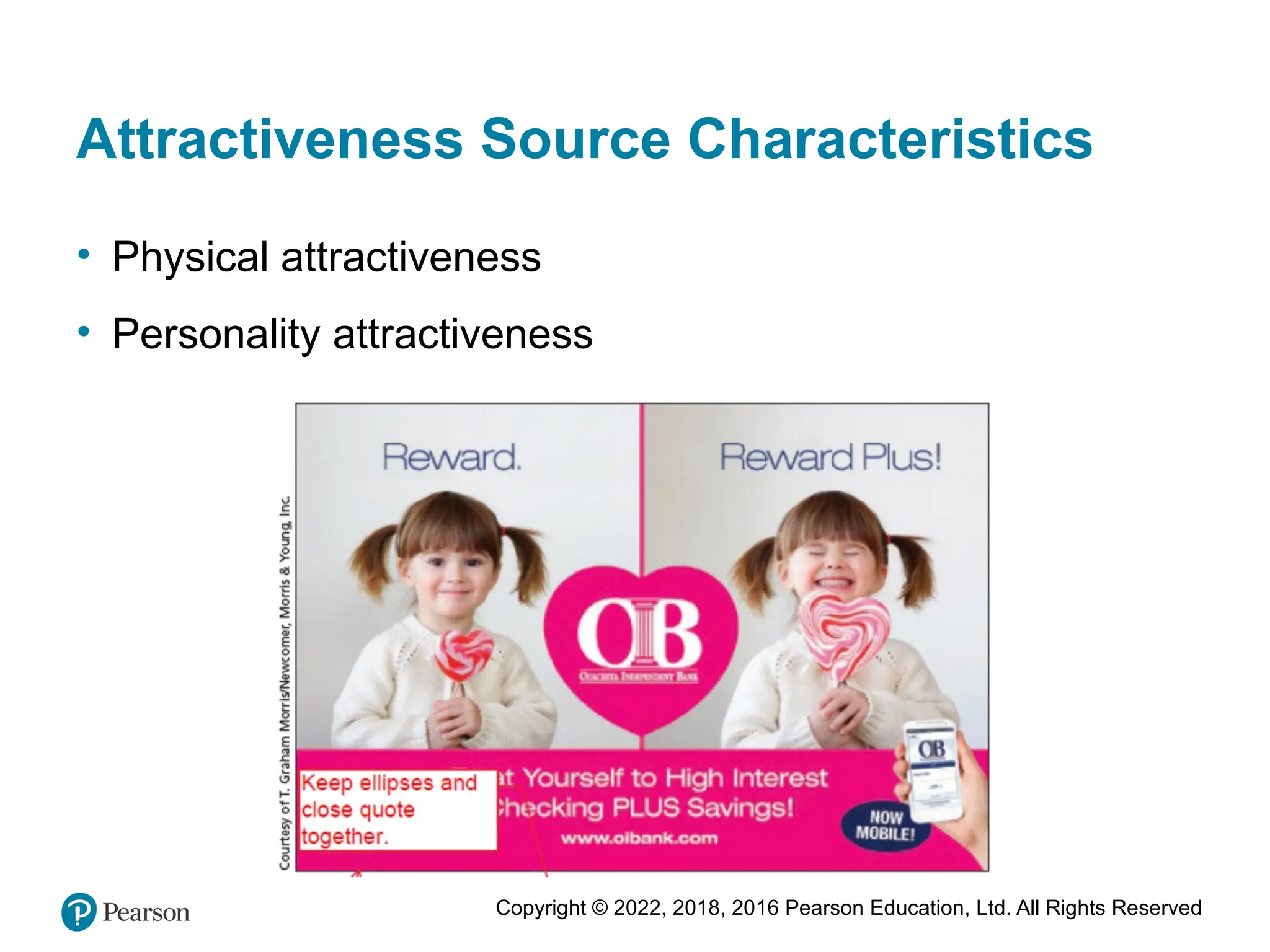
  • #57 Attractiveness deals with both physical attractiveness and personality attractiveness. To be attractive, the spokesperson needs both. Someone who is physically attractive but has a rotten personality will not be a good spokesperson. Individuals who are physically attractive will be seen as more credible than less attractive people. A happy child improves the attractiveness of this ad for Ouachita Independent Bank. The text at the bottom of the ad reads treat yourself to high interest checking plus savings.
  • #58 Similarity is important and closely related to attractiveness. Similarity allows for identification with the spokesperson. Identification can come from having similar beliefs, attitudes, preferences, or behaviors. Sometimes it comes from aspirations, something a consumer wants to be or has dreamed of being.
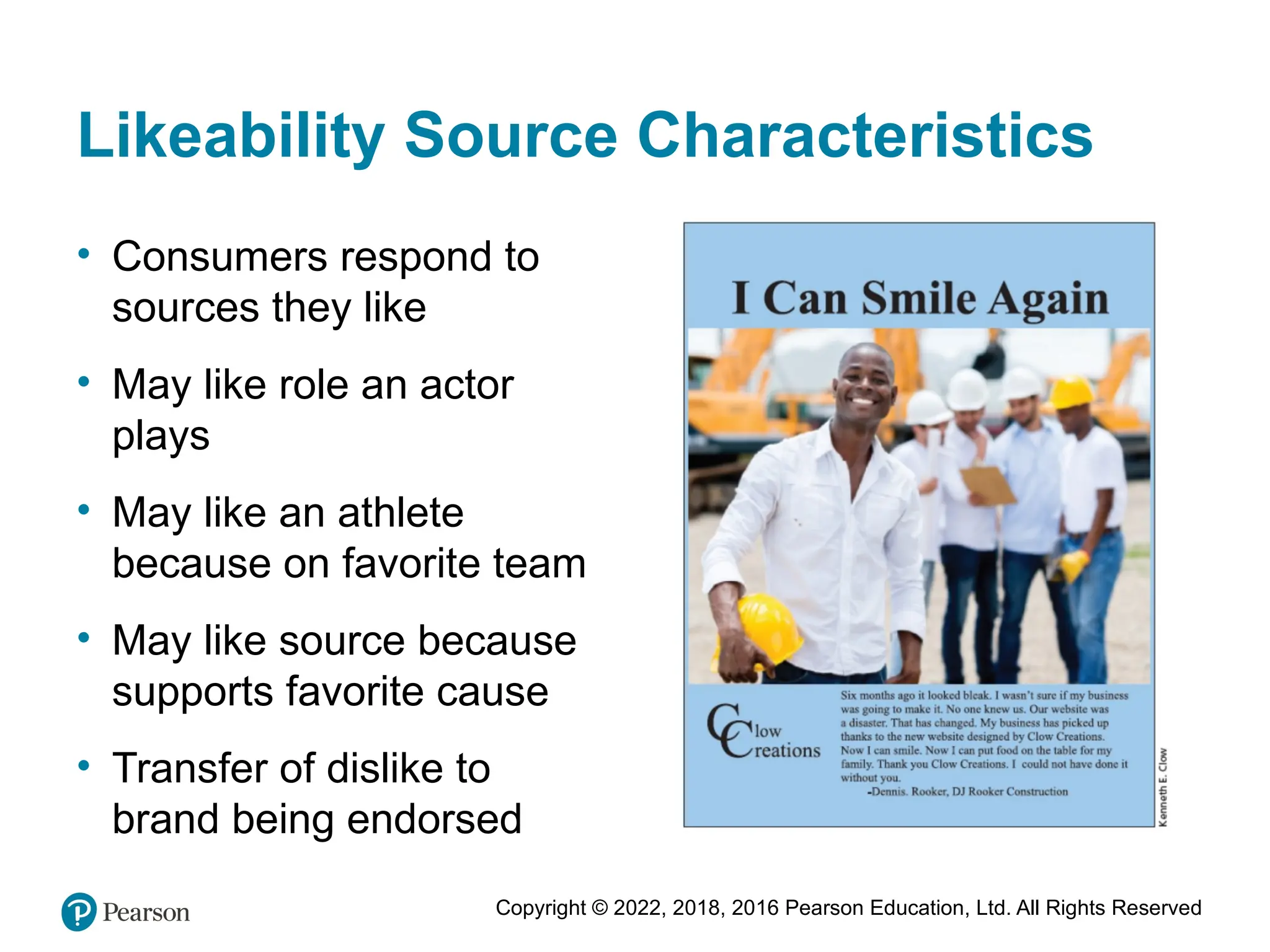
  • #59 Closely related to attractiveness and similarity is likeability. Consumers respond to sources they like. That likeability can be derived in a number of different ways. An actor may be likeable because of a role he/she plays in a TV show or movie. If it is an athlete, the source may be a favorite player or on a favorite team. It may be that the source supports the consumer’s favorite charity. If someone likes the source, then that liking will usually transfer to the brand being endorsed. But, if for some reason an individual does not like a spokesperson, then that dislike will transfer to the brand also.
  • #60 Not all celebrities or spokespersons are viewed as trustworthy. Trustworthiness is the consumer’s degree of confidence in or acceptance of a spokesperson. Trustworthiness enhances the ability for a consumer to believe the message. Likeability and trustworthiness are closely related.
  • #61 Spokespersons with higher levels of expertise are viewed as being more credible. Expertise is often connected to a person’s livelihood or occupation. Expertise can be valuable in persuasive advertisements designed to change opinions or attitudes.
  • #62 In choosing a spokesperson, it is important to match source types with characteristics. Celebrities tend to score high in credibility because they often score high on the other five dimensions. The risk is negative publicity and the endorsement of too many products, which lessen credibility. CEOs are typically seen as having high levels of trustworthiness, expertise, and credibility. But, not all are good on camera, so an agency must exercise care when selecting CEOs. For experts, seek those who are attractive, likeable, and trustworthy. Valid credentials are important. For typical persons, using multiple typical persons in an ad increases credibility. Using three customers to discuss a product may be better than using just one. Real people can be useful, but may not be effective on television, resulting in an ad that comes across poorly. Using actors helps because they are skilled at acting and learning lines. However, they may not appear to be real.
  • #63 In global markets, it is necessary to adapt message strategies, appeals, and execution to cultural differences. Companies need to be careful with translations and language.
  • #64 Due to the level of competition you will face in seeking a job after graduation, the manner in which a resume and application letter are designed becomes vital. It will have an impact on whether you get an interview or are placed in the reject pile. The cognitive message strategies explained in this chapter will help determine the best approach to take.
  • #65 Access the authors’ blog for Chapter 6 at the URLs provided to complete these exercises. Answer the questions that are posed on the blog.