CHAPTER 9
McGraw-Hill/Irwin Copyright © 2003 by The McGraw-Hill Companies, Inc. All rights reserved.
STRATEGIC MANAGEMENT  Gregory G. Dess and G. T. Lumpkin
Chapter
Nine
Implementing Strategy:
Achieving Effective
Strategic Control
Dr.PHEA V.,2010
Strategic control
Organizational control
CHAPTER 9
McGraw-Hill/Irwin Copyright © 2003 by The McGraw-Hill Companies, Inc. All rights reserved.
STRATEGIC MANAGEMENT  Gregory G. Dess and G. T. Lumpkin
After studying this chapter, you should have
a good understanding of:
• The value of effective strategic control systems in strategy
implementation
• The key difference between “traditional” and “contemporary”
control systems
• The imperative for “contemporary” control systems in today’s
complex and rapidly changing competitive and general
environments
• The benefits of having the proper balance among the three
levers of behavioral control _ culture, rewards and
incentives/boundaries
• How a strong and positive culture and reward system can lessen
the need for boundaries
• Why there is no “one best way” to design strategic control
systems and the important contingent roles of business- and
corporate-level strategies
Learning
Objectives
TRANSPARENCY-76
Dr.PHEA V.,2012
Strategic control: overview
• Making necessary changes in firm activities
according to the strategic plan
Focused on entire organization or major
departments(e.g. commence value chance : PA&SA)
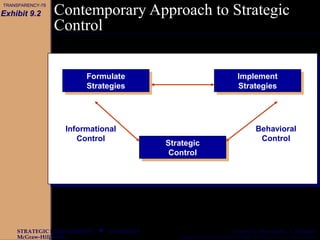
Informational control(The key difference between
“traditional” and “contemporary” control systems)
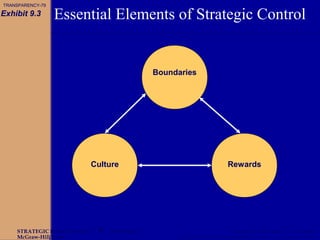
Behavioral control_ method of organizational control in which
a firm influences the actions of employee through Culture, rewards,
and boundaries(The benefits of having the proper balance among
the three levers) :
Dr.PHEA V.,2012
Strategic control: overview
Informational control:
– Monitoring External and Internal environments
and “fit” between the two {for trends & events that
signal the need to make modifications(change) to
a firm’s strategies , goals, and objectives}.
– Ability to respond effectively to environmental
change(based on Act fast and the ability to adapt to changing demands in
accordance with customer needs and other outside pressures(Uncertainty).
Adding source: Responsive Organization, ch.9 of PM, Batman.. )
Two broad types :Traditional practice contrasts
with contemporary approach
Dr.PHEA V.,2012
IC: Traditional(Mechanism)
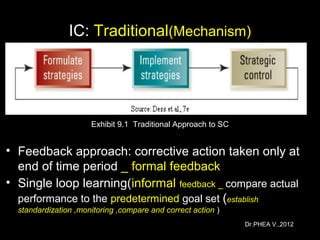
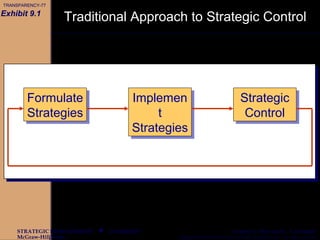
• Feedback approach: corrective action taken only at
end of time period _ formal feedback
• Single loop learning(informal feedback _ compare actual
performance to the predetermined goal set (establish
standardization ,monitoring ,compare and correct action )
Exhibit 9.1 Traditional Approach to SC
Dr.PHEA V.,2010
IC: Traditional (cont.): Advantage
Lengthy time lags(interval) with rather rigid
planning and goal-setting processes(clarity of steps _
BC principles): Achievement organization’s Vision
Most appropriate in stable, simple
environments where goal attainment is
measured with relative certainty and simplicity
(programming decision)
Dr.PHEA V.,2010
IC: contemporary
• More realistic view of environment(I&E) and
organizations(organization’s goals(OG) and strategies(S)
still fit with current strategic environment? Consistently F&I):
Continual monitoring of external and internal
characteristics for need to adjust plans (to obtain the best
fit between OG&S)_ S. formulation
Continual check for “fit” of organizational plans with
current strategic environment_ S. imple-tion
• “Are we doing the right thing?”
Dr.PHEA V.,2010
IC: contemporary
• Two key activities(Methodological Preliminary
Assessment):
– Scanning and monitoring external environment(ch.2)
– Scanning and monitoring internal changes(ch.3)
Forecasting issue will be changing in the
future(Manager gain information)
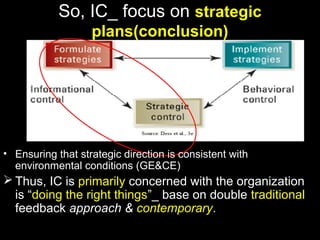
So, IC_ focus on strategic
plans(conclusion)
• Ensuring that strategic direction is consistent with
environmental conditions (GE&CE)
 Thus, IC is primarily concerned with the organization
is “doing the right things”_ base on double traditional
feedback approach & contemporary.
Dr.PHEA V.,2010
Strategic control: overview
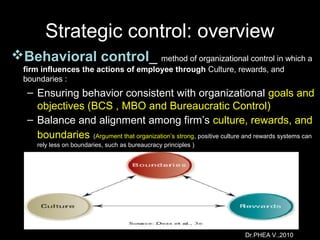
Behavioral control_ method of organizational control in which a
firm influences the actions of employee through Culture, rewards, and
boundaries :
– Ensuring behavior consistent with organizational goals and
objectives (BCS , MBO and Bureaucratic Control)
– Balance and alignment among firm’s culture, rewards, and
boundaries (Argument that organization’s strong, positive culture and rewards systems can
rely less on boundaries, such as bureaucracy principles )
Behavioral control: focus on
strategic actions
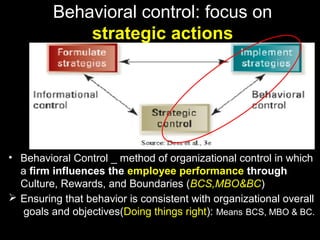
• Behavioral Control _ method of organizational control in which
a firm influences the employee performance through
Culture, Rewards, and Boundaries (BCS,MBO&BC)
 Ensuring that behavior is consistent with organizational overall
goals and objectives(Doing things right): Means BCS, MBO & BC.
Behavior Control Systems(BCS)
Managers must motivate and shape(form)
employee behavior to meet organizational goals
and objectives.
 Direct Supervision: managers who directly manage
workers and can teach, reward, and correct(base on
Informal feedback_ Major departments):
 Very expensive since only a few workers can be managed
by 1 manager.(-)
 Hard to do in complex job settings.(-)
 Can demotivator (negative influence to motivation)
workers who desire more autonomy.(+)
Management by Objectives(MBO)
 MBO_ Evaluates workers by attainment of specific
objectives: (Performance appraisal)
 Goals are set at each level of the firm.
 Goal setting is participatory with manager AND worker.
 Reviews held looking at progress toward goals ( cost
&benefit analyst):
 Pay raises and promotions are tied to goal attainment.
 Teams are also measured in this way with goals and
performance measured for the team.(Strategic Planning
had examined, but how a bout outcome? )
Bureaucratic Control(BC)
 Control through a system of rules and standard operating
procedures (SOPs) that shape the behavior of divisions,
functions, and individuals.(+)
 Rules and SOPs tell the worker what to do.
 Standardized actions so outcomes are predictable.
 Still need output control to correct mistakes.(Policy)
 Problems of Bureaucratic Control: (-)
 Rules easier to make than delete. Leads to “red tape”
 Firm can become too standardized and not flexible.
 Best used for routine problems (certainty),but uncertainty
lead to fail.
Dr.PHEA V.,2010
Emphasis on culture(C) and
rewards(R)
• Increasing organic nature of organizations means
strict rules, policies, and regulations are ineffective
(uncertainty : CE.).So use R&C to align individual &
OG becomes increasingly important.
• Decreased commitment between organizations and
members means culture is the only real “glue” that
binds members to an organization
 Strength of culture reduces costs of monitoring
behavior
Culture & Managerial Action:
Consider the four functions of management:
 Planning: in innovative firms, the culture will encourage all
managers to participate.
 Slow moving firms focus on the formal process rather than the
decision.
 Organizing: Creative firms will have organic, flexible
structures.
 Probably very flat decisions with delegated authority.
 Leading: encourage leading by example.
 Top managers take risks and trust lower managers.
 Controlling: innovative firms choose controls that match the
structure.
Dr.PHEA V.,2010
Recap
• Culture provides implicit proscriptions on
behavior
• Boundaries provide explicit proscriptions
on behavior
• Rewards designed to align behavior with
organizational goals
Dr.PHEA V.,2010
Growing from boundaries to
rewards and culture
• Recruiting, hiring, training, and retention
• Managerial role models
• Clear alignment of rewards with goals and
objectives
Dr.PHEA V.,2010
Corporate governance: overview
• Alignment(regulation) of managerial(board of
directors) and shareholder interests ( the balance of control
between the stakeholders and managersstakeholders and managers or directors of an organization).
Internal corporate governance “mechanisms”
– Board of directors: represents shareholders’
interests( by shareholders)
– Activist shareholders(owners): actively pursue
maximization of value( shareholders' purpose)
– Managerial rewards and incentives: alignment with
goals of shareholders
Dr.PHEA V.,2010
Corporate governance: overview
External corporate governance“mechanisms”
– Market for corporate control(capital market)
– Banks and analysts
– Media
– Public activists
– Auditors
Dr.PHEA V.,2010
Corporate governance as
strategic control
• Modern corporation characterized by
separation of ownership and control
• Corporate governance
– Internal and external arrangements to align
managers’ and shareholders’ interests
– Primary participants: shareholders, managers,
board of directors
Dr.PHEA V.,2010
Major parties to a corporation
• Shareholders – principals
– Contribute capital and risk in exchange for
participation in profits
– No direct responsibility or involvement in
operations and with limited liability
– Elect directors to act with fiduciary care to
protect their interests
Dr.PHEA V.,2010
Major parties to a corporation
• Managers control the firm without providing
capital investment but risk their continued
employment and income
• Act as agents of the principals
(shareholders)
Dr.PHEA V.,2010
Agency relationship in modern
corporation
• Goals of principals and agents may conflict
– Principals (shareholders) want return on
investment
– Agents (managers) want to maintain income
Shareholders cannot easily monitor
managers’ actions (imperfect information)
“When the cat’s away, the mice may play.”
Dr.PHEA V.,2010
Distribution of risk in modern
corporation
• Shareholders
– Bear residual risk (what’s remaining after
liquidation)
– Desire high firm risk while reducing portfolio
risk through stock portfolio diversification
• Managers
– Bear employment risk: only one source of
income
– Desire reduced firm risk: risk averse
– May diversify firm to reduce employment risk
Dr.PHEA V.,2010
Resolving potential conflicts of
interest
• Governance mechanisms: arrangements
to align interests of shareholders and
managers
– Board of directors
– Active shareholders
– Executive compensation (rewards and
incentives)
Dr.PHEA V.,2010
Board of directors
• Represents shareholders
– Fiduciary: one entrusted with property for
benefit of another
– Oversees management of firm through CEO
oversight
• Hire, compensate, evaluate, fire CEO
• Ratify and monitor CEO’s strategies
• Provide advice and counsel to CEO
Dr.PHEA V.,2010
Board of directors
• 10-12 members often with firm-relevant
experience
• Considerable work experience (30-40
years)
• 2-3 CEOs from other firms
• 2-3 insiders (firm managers/officers)
• Directors hold 2-3 other directorships,
have served roughly 11 years, and are
close to 60 years old
•Dr.PHEA V.,2010
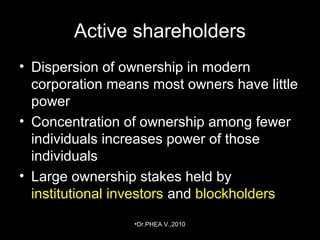
Active shareholders
• Dispersion of ownership in modern
corporation means most owners have little
power
• Concentration of ownership among fewer
individuals increases power of those
individuals
• Large ownership stakes held by
institutional investors and blockholders
Dr.PHEA V.,2010
Institutional investors
• Mutual funds (e.g., T. Rowe Price, Fidelity
Investments)
• Pension funds (CalPERS, TIAA-CREF)
• Insurance companies
• University endowments
• Bank trusts(доверительные операции банков)
Dr.PHEA V.,2010
Institutional investors and
blockholders
• Institutional investors own 50% of Fortune
500 and nearly 70% of Fortune 100
• Potentially exert considerable influence on
corporate strategy and policies
Dr.PHEA V.,2010
Executive compensation
• Aligning executive rewards and incentives
with shareholders’ interests
• Salary – non-contingent pay
• Bonus, stock options – contingent pay
– Pay for performance
– Often results in pay without performance
Dr.PHEA V.,2010
Executive compensation
• Effective executive compensation difficult
to design and administer
– Long time lag between decisions and results
– Cause and effect relationships unclear
Dr.PHEA V.,2010
Corporate governance
mechanisms
• Attempt to align managerial actions with
interests of shareholders
– Board of directors: monitors CEO
– Large, active shareholders monitor CEO
– Executive compensation seeks to align
managerial rewards and incentives with
shareholders’ interests
• Primarily internal governance mechanisms
Dr.PHEA V.,2010
External governance
mechanisms
• Market for corporate control
• Auditors
• Regulatory bodies
• Banks and analysts
• Public activists
Dr.PHEA V.,2010
Market for corporate control
• Purchase and sale of public corporations
on open market through purchase of stock
• Operates when actors in financial markets
sense that management and board are
“asleep at the wheel”
Dr.PHEA V.,2010
Market for corporate control
• Reacts to managerial opportunistic
behavior
– Shirking: ineffective performance
– On the job consumption: lavish spending,
company jets, expensive parties
– Excessive product market diversification
• Increases firm size thereby increasing
compensation
Dr.PHEA V.,2010
Market for corporate control
• Market for corporate control may constrain
opportunistic behavior
• Managers may initiate anti-takeover
tactics to deter outside takeover
– Poison pills/shark repellent: reduce firm net
worth
– Greenmail: buying off potential acquirer
– Golden parachutes: generous severance
packages for departing managers
Dr.PHEA V.,2010
Auditors
• External accountants who verify financial
records
• Independent of management
• Certified by other profession accountants
• May not maintain full independence
Dr.PHEA V.,2010
Banks and analysts
• Banks
– Commercial and investment banks carrying
debt of focal firm
• Stock analysts
– Research firms and industries
– Recommend to buy, sell, or hold
– Not always unbiased in recommendations
Dr.PHEA V.,2010
Regulation
• Securities and Exchange Commission
• Sarbanes-Oxley: rules regarding financial
reporting and external auditing
• Stock exchanges: NYSE, NASDAQ/AmEx
Dr.PHEA V.,2010
Media and public activists
• Business press
• Public activists (e.g., Ralph Nader, Erin
Brokovich)
Dr.PHEA V.,2010
Recap
• Corporate governance
– Internal and external arrangements to align
managers’ and shareholders’ interests
• Potentially conflicting goals
– Internal arrangements
• Board of directors
• Active, large shareholders
• Executive compensation
– External arrangements: market for corporate
control, auditors, etc.
Dr.PHEA V.,2010
Summary
• Strategic control: Control of firm direction
consistent with external conditions
– Informational control: ongoing monitoring of
external and internal conditions and of
strategy formulation
– Behavioral control
• Ensuring behavior of organizational members is
consistent with goals and objectives
• Culture, rewards, boundaries
Dr.PHEA V.,2010
Corporate governance
• Control of firm direction by owners, their
representatives, and interested publics
– Separation of ownership and control creates
potential for conflict between owners and
managers
• Board and large shareholders oversee
management; compensation creates
rewards and incentives
• External parties also monitor management
CHAPTER 9
McGraw-Hill/Irwin Copyright © 2003 by The McGraw-Hill Companies, Inc. All rights reserved.
STRATEGIC MANAGEMENT  Gregory G. Dess and G. T. Lumpkin
Formulate
Strategies
Formulate
Strategies
Implemen
t
Strategies
Implemen
t
Strategies
Strategic
Control
Strategic
Control
Exhibit 9.1
Traditional Approach to Strategic Control
TRANSPARENCY-77
CHAPTER 9
McGraw-Hill/Irwin Copyright © 2003 by The McGraw-Hill Companies, Inc. All rights reserved.
STRATEGIC MANAGEMENT  Gregory G. Dess and G. T. Lumpkin
Contemporary Approach to Strategic
Control
Exhibit 9.2
TRANSPARENCY-78
Implement
Strategies
Implement
Strategies
Informational
Control
Behavioral
Control
Formulate
Strategies
Formulate
Strategies
Strategic
Control
Strategic
Control
CHAPTER 9
McGraw-Hill/Irwin Copyright © 2003 by The McGraw-Hill Companies, Inc. All rights reserved.
STRATEGIC MANAGEMENT  Gregory G. Dess and G. T. Lumpkin
Essential Elements of Strategic Control
Boundaries
Culture Rewards
Exhibit 9.3
TRANSPARENCY-79
CHAPTER 9
McGraw-Hill/Irwin Copyright © 2003 by The McGraw-Hill Companies, Inc. All rights reserved.
STRATEGIC MANAGEMENT  Gregory G. Dess and G. T. Lumpkin
Action Plan for Objective #3
Description
Primary
Responsibility Target Date
1. Develop and implement 2002 marketing plan, including specific
plans
for addressing Falcon 20 retrofit programs, and expanded sales of
cabin shells.
R.H. Plenge
(V.P. Marketing)
December 15, 2001
2. Negotiate new supplier agreement with Gulfstream Aerospace. M. Spraggins
(President)
March 1, 2002
3. Continue and complete the development of the UltraSlim window and
have a fully tested and documented design ready for production at a
manufacturing cost of less than $900 per unit.
D.R. Pearson
(V.P. Operations)
June 15, 2002
4. Develop a window design suitable for L-1011 and similar wide-body
aircraft and have a fully tested and documented design ready for
production at a manufacturing cost comparable to the current Boeing
window.
D.R. Pearson
(V.P. Operations)
September 15, 2002
Exhibit 9.4
TRANSPARENCY-80
CHAPTER 9
McGraw-Hill/Irwin Copyright © 2003 by The McGraw-Hill Companies, Inc. All rights reserved.
STRATEGIC MANAGEMENT  Gregory G. Dess and G. T. Lumpkin
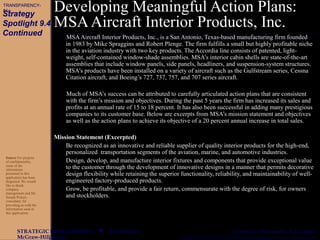
Developing Meaningful Action Plans:
MSAAircraft Interior Products, Inc.
MSAAircraft Interior Products, Inc., is a San Antonio, Texas-based manufacturing firm founded
in 1983 by Mike Spraggins and Robert Plenge. The firm fulfills a small but highly profitable niche
in the aviation industry with two key products. The Accordia line consists of patented, light-
weight, self-contained window-shade assemblies. MSA’s interior cabin shells are state-of-the-art
assemblies that include window panels, side panels, headliners, and suspension-system structures.
MSA’s products have been installed on a variety of aircraft such as the Gulfstream series, Cessna
Citation aircraft, and Boeing’s 727, 737, 757, and 707 series aircraft.
Much of MSA’s success can be attributed to carefully articulated action plans that are consistent
with the firm’s mission and objectives. During the past 5 years the firm has increased its sales and
profits at an annual rate of 15 to 18 percent. It has also been successful in adding many prestigious
companies to its customer base. Below are excerpts from MSA’s mission statement and objectives
as well as the action plans to achieve its objective of a 20 percent annual increase in total sales.
Mission Statement (Excerpted)
• Be recognized as an innovative and reliable supplier of quality interior products for the high-end,
personalized transportation segments of the aviation, marine, and automotive industries.
• Design, develop, and manufacture interior fixtures and components that provide exceptional value
to the customer through the development of innovative designs in a manner that permits decorative
design flexibility while retaining the superior functionality, reliability, and maintainability of well-
engineered factory-produced products.
• Grow, be profitable, and provide a fair return, commensurate with the degree of risk, for owners
and stockholders.
Source For purpose
of confidentiality,
some of the
information
presented in this
application has been
disguised. We would
like to thank
company
management and Mr.
Joseph Picken,
consultant, for
providing us with the
information used in
this application.
Strategy
Spotlight 9.4
Continued
TRANSPARENCY-
81a
CHAPTER 9
McGraw-Hill/Irwin Copyright © 2003 by The McGraw-Hill Companies, Inc. All rights reserved.
STRATEGIC MANAGEMENT  Gregory G. Dess and G. T. Lumpkin
Developing Meaningful Action Plans: MSA
Aircraft Interior Products, Inc.
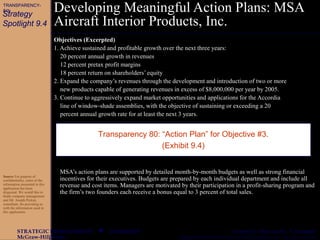
Objectives (Excerpted)
1. Achieve sustained and profitable growth over the next three years:
20 percent annual growth in revenues
12 percent pretax profit margins
18 percent return on shareholders’ equity
2. Expand the company’s revenues through the development and introduction of two or more
new products capable of generating revenues in excess of $8,000,000 per year by 2005.
3. Continue to aggressively expand market opportunities and applications for the Accordia
line of window-shade assemblies, with the objective of sustaining or exceeding a 20
percent annual growth rate for at least the next 3 years.
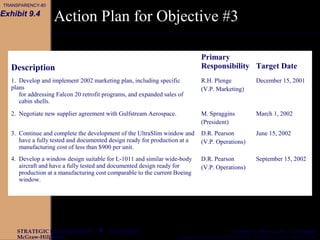
MSA’s action plans are supported by detailed month-by-month budgets as well as strong financial
incentives for their executives. Budgets are prepared by each individual department and include all
revenue and cost items. Managers are motivated by their participation in a profit-sharing program and
the firm’s two founders each receive a bonus equal to 3 percent of total sales.
Source For purpose of
confidentiality, some of the
information presented in this
application has been
disguised. We would like to
thank company management
and Mr. Joseph Picken,
consultant, for providing us
with the information used in
this application.
Strategy
Spotlight 9.4
Transparency 80: “Action Plan” for Objective #3.
(Exhibit 9.4)
TRANSPARENCY-
81b
CHAPTER 9
McGraw-Hill/Irwin Copyright © 2003 by The McGraw-Hill Companies, Inc. All rights reserved.
STRATEGIC MANAGEMENT  Gregory G. Dess and G. T. Lumpkin
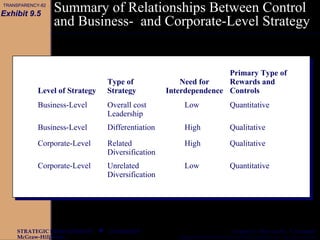
Summary of Relationships Between Control
and Business- and Corporate-Level Strategy
Level of Strategy
Type of
Strategy
Need for
Interdependence
Primary Type of
Rewards and
Controls
Business-Level Overall cost
Leadership
Low Quantitative
Business-Level Differentiation High Qualitative
Corporate-Level Related
Diversification
High Qualitative
Corporate-Level Unrelated
Diversification
Low Quantitative
Exhibit 9.5
TRANSPARENCY-82

Phea ch.09

  • 1.
    CHAPTER 9 McGraw-Hill/Irwin Copyright© 2003 by The McGraw-Hill Companies, Inc. All rights reserved. STRATEGIC MANAGEMENT  Gregory G. Dess and G. T. Lumpkin Chapter Nine Implementing Strategy: Achieving Effective Strategic Control
  • 2.
  • 3.
    CHAPTER 9 McGraw-Hill/Irwin Copyright© 2003 by The McGraw-Hill Companies, Inc. All rights reserved. STRATEGIC MANAGEMENT  Gregory G. Dess and G. T. Lumpkin After studying this chapter, you should have a good understanding of: • The value of effective strategic control systems in strategy implementation • The key difference between “traditional” and “contemporary” control systems • The imperative for “contemporary” control systems in today’s complex and rapidly changing competitive and general environments • The benefits of having the proper balance among the three levers of behavioral control _ culture, rewards and incentives/boundaries • How a strong and positive culture and reward system can lessen the need for boundaries • Why there is no “one best way” to design strategic control systems and the important contingent roles of business- and corporate-level strategies Learning Objectives TRANSPARENCY-76
  • 4.
    Dr.PHEA V.,2012 Strategic control:overview • Making necessary changes in firm activities according to the strategic plan Focused on entire organization or major departments(e.g. commence value chance : PA&SA) Informational control(The key difference between “traditional” and “contemporary” control systems) Behavioral control_ method of organizational control in which a firm influences the actions of employee through Culture, rewards, and boundaries(The benefits of having the proper balance among the three levers) :
  • 5.
    Dr.PHEA V.,2012 Strategic control:overview Informational control: – Monitoring External and Internal environments and “fit” between the two {for trends & events that signal the need to make modifications(change) to a firm’s strategies , goals, and objectives}. – Ability to respond effectively to environmental change(based on Act fast and the ability to adapt to changing demands in accordance with customer needs and other outside pressures(Uncertainty). Adding source: Responsive Organization, ch.9 of PM, Batman.. ) Two broad types :Traditional practice contrasts with contemporary approach
  • 6.
    Dr.PHEA V.,2012 IC: Traditional(Mechanism) •Feedback approach: corrective action taken only at end of time period _ formal feedback • Single loop learning(informal feedback _ compare actual performance to the predetermined goal set (establish standardization ,monitoring ,compare and correct action ) Exhibit 9.1 Traditional Approach to SC
  • 7.
    Dr.PHEA V.,2010 IC: Traditional(cont.): Advantage Lengthy time lags(interval) with rather rigid planning and goal-setting processes(clarity of steps _ BC principles): Achievement organization’s Vision Most appropriate in stable, simple environments where goal attainment is measured with relative certainty and simplicity (programming decision)
  • 8.
    Dr.PHEA V.,2010 IC: contemporary •More realistic view of environment(I&E) and organizations(organization’s goals(OG) and strategies(S) still fit with current strategic environment? Consistently F&I): Continual monitoring of external and internal characteristics for need to adjust plans (to obtain the best fit between OG&S)_ S. formulation Continual check for “fit” of organizational plans with current strategic environment_ S. imple-tion • “Are we doing the right thing?”
  • 9.
    Dr.PHEA V.,2010 IC: contemporary •Two key activities(Methodological Preliminary Assessment): – Scanning and monitoring external environment(ch.2) – Scanning and monitoring internal changes(ch.3) Forecasting issue will be changing in the future(Manager gain information)
  • 10.
    So, IC_ focuson strategic plans(conclusion) • Ensuring that strategic direction is consistent with environmental conditions (GE&CE)  Thus, IC is primarily concerned with the organization is “doing the right things”_ base on double traditional feedback approach & contemporary.
  • 11.
    Dr.PHEA V.,2010 Strategic control:overview Behavioral control_ method of organizational control in which a firm influences the actions of employee through Culture, rewards, and boundaries : – Ensuring behavior consistent with organizational goals and objectives (BCS , MBO and Bureaucratic Control) – Balance and alignment among firm’s culture, rewards, and boundaries (Argument that organization’s strong, positive culture and rewards systems can rely less on boundaries, such as bureaucracy principles )
  • 12.
    Behavioral control: focuson strategic actions • Behavioral Control _ method of organizational control in which a firm influences the employee performance through Culture, Rewards, and Boundaries (BCS,MBO&BC)  Ensuring that behavior is consistent with organizational overall goals and objectives(Doing things right): Means BCS, MBO & BC.
  • 13.
    Behavior Control Systems(BCS) Managersmust motivate and shape(form) employee behavior to meet organizational goals and objectives.  Direct Supervision: managers who directly manage workers and can teach, reward, and correct(base on Informal feedback_ Major departments):  Very expensive since only a few workers can be managed by 1 manager.(-)  Hard to do in complex job settings.(-)  Can demotivator (negative influence to motivation) workers who desire more autonomy.(+)
  • 14.
    Management by Objectives(MBO) MBO_ Evaluates workers by attainment of specific objectives: (Performance appraisal)  Goals are set at each level of the firm.  Goal setting is participatory with manager AND worker.  Reviews held looking at progress toward goals ( cost &benefit analyst):  Pay raises and promotions are tied to goal attainment.  Teams are also measured in this way with goals and performance measured for the team.(Strategic Planning had examined, but how a bout outcome? )
  • 15.
    Bureaucratic Control(BC)  Controlthrough a system of rules and standard operating procedures (SOPs) that shape the behavior of divisions, functions, and individuals.(+)  Rules and SOPs tell the worker what to do.  Standardized actions so outcomes are predictable.  Still need output control to correct mistakes.(Policy)  Problems of Bureaucratic Control: (-)  Rules easier to make than delete. Leads to “red tape”  Firm can become too standardized and not flexible.  Best used for routine problems (certainty),but uncertainty lead to fail.
  • 16.
    Dr.PHEA V.,2010 Emphasis onculture(C) and rewards(R) • Increasing organic nature of organizations means strict rules, policies, and regulations are ineffective (uncertainty : CE.).So use R&C to align individual & OG becomes increasingly important. • Decreased commitment between organizations and members means culture is the only real “glue” that binds members to an organization  Strength of culture reduces costs of monitoring behavior
  • 17.
    Culture & ManagerialAction: Consider the four functions of management:  Planning: in innovative firms, the culture will encourage all managers to participate.  Slow moving firms focus on the formal process rather than the decision.  Organizing: Creative firms will have organic, flexible structures.  Probably very flat decisions with delegated authority.  Leading: encourage leading by example.  Top managers take risks and trust lower managers.  Controlling: innovative firms choose controls that match the structure.
  • 18.
    Dr.PHEA V.,2010 Recap • Cultureprovides implicit proscriptions on behavior • Boundaries provide explicit proscriptions on behavior • Rewards designed to align behavior with organizational goals
  • 19.
    Dr.PHEA V.,2010 Growing fromboundaries to rewards and culture • Recruiting, hiring, training, and retention • Managerial role models • Clear alignment of rewards with goals and objectives
  • 20.
    Dr.PHEA V.,2010 Corporate governance:overview • Alignment(regulation) of managerial(board of directors) and shareholder interests ( the balance of control between the stakeholders and managersstakeholders and managers or directors of an organization). Internal corporate governance “mechanisms” – Board of directors: represents shareholders’ interests( by shareholders) – Activist shareholders(owners): actively pursue maximization of value( shareholders' purpose) – Managerial rewards and incentives: alignment with goals of shareholders
  • 21.
    Dr.PHEA V.,2010 Corporate governance:overview External corporate governance“mechanisms” – Market for corporate control(capital market) – Banks and analysts – Media – Public activists – Auditors
  • 22.
    Dr.PHEA V.,2010 Corporate governanceas strategic control • Modern corporation characterized by separation of ownership and control • Corporate governance – Internal and external arrangements to align managers’ and shareholders’ interests – Primary participants: shareholders, managers, board of directors
  • 23.
    Dr.PHEA V.,2010 Major partiesto a corporation • Shareholders – principals – Contribute capital and risk in exchange for participation in profits – No direct responsibility or involvement in operations and with limited liability – Elect directors to act with fiduciary care to protect their interests
  • 24.
    Dr.PHEA V.,2010 Major partiesto a corporation • Managers control the firm without providing capital investment but risk their continued employment and income • Act as agents of the principals (shareholders)
  • 25.
    Dr.PHEA V.,2010 Agency relationshipin modern corporation • Goals of principals and agents may conflict – Principals (shareholders) want return on investment – Agents (managers) want to maintain income Shareholders cannot easily monitor managers’ actions (imperfect information) “When the cat’s away, the mice may play.”
  • 26.
    Dr.PHEA V.,2010 Distribution ofrisk in modern corporation • Shareholders – Bear residual risk (what’s remaining after liquidation) – Desire high firm risk while reducing portfolio risk through stock portfolio diversification • Managers – Bear employment risk: only one source of income – Desire reduced firm risk: risk averse – May diversify firm to reduce employment risk
  • 27.
    Dr.PHEA V.,2010 Resolving potentialconflicts of interest • Governance mechanisms: arrangements to align interests of shareholders and managers – Board of directors – Active shareholders – Executive compensation (rewards and incentives)
  • 28.
    Dr.PHEA V.,2010 Board ofdirectors • Represents shareholders – Fiduciary: one entrusted with property for benefit of another – Oversees management of firm through CEO oversight • Hire, compensate, evaluate, fire CEO • Ratify and monitor CEO’s strategies • Provide advice and counsel to CEO
  • 29.
    Dr.PHEA V.,2010 Board ofdirectors • 10-12 members often with firm-relevant experience • Considerable work experience (30-40 years) • 2-3 CEOs from other firms • 2-3 insiders (firm managers/officers) • Directors hold 2-3 other directorships, have served roughly 11 years, and are close to 60 years old
  • 30.
    •Dr.PHEA V.,2010 Active shareholders •Dispersion of ownership in modern corporation means most owners have little power • Concentration of ownership among fewer individuals increases power of those individuals • Large ownership stakes held by institutional investors and blockholders
  • 31.
    Dr.PHEA V.,2010 Institutional investors •Mutual funds (e.g., T. Rowe Price, Fidelity Investments) • Pension funds (CalPERS, TIAA-CREF) • Insurance companies • University endowments • Bank trusts(доверительные операции банков)
  • 32.
    Dr.PHEA V.,2010 Institutional investorsand blockholders • Institutional investors own 50% of Fortune 500 and nearly 70% of Fortune 100 • Potentially exert considerable influence on corporate strategy and policies
  • 33.
    Dr.PHEA V.,2010 Executive compensation •Aligning executive rewards and incentives with shareholders’ interests • Salary – non-contingent pay • Bonus, stock options – contingent pay – Pay for performance – Often results in pay without performance
  • 34.
    Dr.PHEA V.,2010 Executive compensation •Effective executive compensation difficult to design and administer – Long time lag between decisions and results – Cause and effect relationships unclear
  • 35.
    Dr.PHEA V.,2010 Corporate governance mechanisms •Attempt to align managerial actions with interests of shareholders – Board of directors: monitors CEO – Large, active shareholders monitor CEO – Executive compensation seeks to align managerial rewards and incentives with shareholders’ interests • Primarily internal governance mechanisms
  • 36.
    Dr.PHEA V.,2010 External governance mechanisms •Market for corporate control • Auditors • Regulatory bodies • Banks and analysts • Public activists
  • 37.
    Dr.PHEA V.,2010 Market forcorporate control • Purchase and sale of public corporations on open market through purchase of stock • Operates when actors in financial markets sense that management and board are “asleep at the wheel”
  • 38.
    Dr.PHEA V.,2010 Market forcorporate control • Reacts to managerial opportunistic behavior – Shirking: ineffective performance – On the job consumption: lavish spending, company jets, expensive parties – Excessive product market diversification • Increases firm size thereby increasing compensation
  • 39.
    Dr.PHEA V.,2010 Market forcorporate control • Market for corporate control may constrain opportunistic behavior • Managers may initiate anti-takeover tactics to deter outside takeover – Poison pills/shark repellent: reduce firm net worth – Greenmail: buying off potential acquirer – Golden parachutes: generous severance packages for departing managers
  • 40.
    Dr.PHEA V.,2010 Auditors • Externalaccountants who verify financial records • Independent of management • Certified by other profession accountants • May not maintain full independence
  • 41.
    Dr.PHEA V.,2010 Banks andanalysts • Banks – Commercial and investment banks carrying debt of focal firm • Stock analysts – Research firms and industries – Recommend to buy, sell, or hold – Not always unbiased in recommendations
  • 42.
    Dr.PHEA V.,2010 Regulation • Securitiesand Exchange Commission • Sarbanes-Oxley: rules regarding financial reporting and external auditing • Stock exchanges: NYSE, NASDAQ/AmEx
  • 43.
    Dr.PHEA V.,2010 Media andpublic activists • Business press • Public activists (e.g., Ralph Nader, Erin Brokovich)
  • 44.
    Dr.PHEA V.,2010 Recap • Corporategovernance – Internal and external arrangements to align managers’ and shareholders’ interests • Potentially conflicting goals – Internal arrangements • Board of directors • Active, large shareholders • Executive compensation – External arrangements: market for corporate control, auditors, etc.
  • 45.
    Dr.PHEA V.,2010 Summary • Strategiccontrol: Control of firm direction consistent with external conditions – Informational control: ongoing monitoring of external and internal conditions and of strategy formulation – Behavioral control • Ensuring behavior of organizational members is consistent with goals and objectives • Culture, rewards, boundaries
  • 46.
    Dr.PHEA V.,2010 Corporate governance •Control of firm direction by owners, their representatives, and interested publics – Separation of ownership and control creates potential for conflict between owners and managers • Board and large shareholders oversee management; compensation creates rewards and incentives • External parties also monitor management
  • 47.
    CHAPTER 9 McGraw-Hill/Irwin Copyright© 2003 by The McGraw-Hill Companies, Inc. All rights reserved. STRATEGIC MANAGEMENT  Gregory G. Dess and G. T. Lumpkin Formulate Strategies Formulate Strategies Implemen t Strategies Implemen t Strategies Strategic Control Strategic Control Exhibit 9.1 Traditional Approach to Strategic Control TRANSPARENCY-77
  • 48.
    CHAPTER 9 McGraw-Hill/Irwin Copyright© 2003 by The McGraw-Hill Companies, Inc. All rights reserved. STRATEGIC MANAGEMENT  Gregory G. Dess and G. T. Lumpkin Contemporary Approach to Strategic Control Exhibit 9.2 TRANSPARENCY-78 Implement Strategies Implement Strategies Informational Control Behavioral Control Formulate Strategies Formulate Strategies Strategic Control Strategic Control
  • 49.
    CHAPTER 9 McGraw-Hill/Irwin Copyright© 2003 by The McGraw-Hill Companies, Inc. All rights reserved. STRATEGIC MANAGEMENT  Gregory G. Dess and G. T. Lumpkin Essential Elements of Strategic Control Boundaries Culture Rewards Exhibit 9.3 TRANSPARENCY-79
  • 50.
    CHAPTER 9 McGraw-Hill/Irwin Copyright© 2003 by The McGraw-Hill Companies, Inc. All rights reserved. STRATEGIC MANAGEMENT  Gregory G. Dess and G. T. Lumpkin Action Plan for Objective #3 Description Primary Responsibility Target Date 1. Develop and implement 2002 marketing plan, including specific plans for addressing Falcon 20 retrofit programs, and expanded sales of cabin shells. R.H. Plenge (V.P. Marketing) December 15, 2001 2. Negotiate new supplier agreement with Gulfstream Aerospace. M. Spraggins (President) March 1, 2002 3. Continue and complete the development of the UltraSlim window and have a fully tested and documented design ready for production at a manufacturing cost of less than $900 per unit. D.R. Pearson (V.P. Operations) June 15, 2002 4. Develop a window design suitable for L-1011 and similar wide-body aircraft and have a fully tested and documented design ready for production at a manufacturing cost comparable to the current Boeing window. D.R. Pearson (V.P. Operations) September 15, 2002 Exhibit 9.4 TRANSPARENCY-80
  • 51.
    CHAPTER 9 McGraw-Hill/Irwin Copyright© 2003 by The McGraw-Hill Companies, Inc. All rights reserved. STRATEGIC MANAGEMENT  Gregory G. Dess and G. T. Lumpkin Developing Meaningful Action Plans: MSAAircraft Interior Products, Inc. MSAAircraft Interior Products, Inc., is a San Antonio, Texas-based manufacturing firm founded in 1983 by Mike Spraggins and Robert Plenge. The firm fulfills a small but highly profitable niche in the aviation industry with two key products. The Accordia line consists of patented, light- weight, self-contained window-shade assemblies. MSA’s interior cabin shells are state-of-the-art assemblies that include window panels, side panels, headliners, and suspension-system structures. MSA’s products have been installed on a variety of aircraft such as the Gulfstream series, Cessna Citation aircraft, and Boeing’s 727, 737, 757, and 707 series aircraft. Much of MSA’s success can be attributed to carefully articulated action plans that are consistent with the firm’s mission and objectives. During the past 5 years the firm has increased its sales and profits at an annual rate of 15 to 18 percent. It has also been successful in adding many prestigious companies to its customer base. Below are excerpts from MSA’s mission statement and objectives as well as the action plans to achieve its objective of a 20 percent annual increase in total sales. Mission Statement (Excerpted) • Be recognized as an innovative and reliable supplier of quality interior products for the high-end, personalized transportation segments of the aviation, marine, and automotive industries. • Design, develop, and manufacture interior fixtures and components that provide exceptional value to the customer through the development of innovative designs in a manner that permits decorative design flexibility while retaining the superior functionality, reliability, and maintainability of well- engineered factory-produced products. • Grow, be profitable, and provide a fair return, commensurate with the degree of risk, for owners and stockholders. Source For purpose of confidentiality, some of the information presented in this application has been disguised. We would like to thank company management and Mr. Joseph Picken, consultant, for providing us with the information used in this application. Strategy Spotlight 9.4 Continued TRANSPARENCY- 81a
  • 52.
    CHAPTER 9 McGraw-Hill/Irwin Copyright© 2003 by The McGraw-Hill Companies, Inc. All rights reserved. STRATEGIC MANAGEMENT  Gregory G. Dess and G. T. Lumpkin Developing Meaningful Action Plans: MSA Aircraft Interior Products, Inc. Objectives (Excerpted) 1. Achieve sustained and profitable growth over the next three years: 20 percent annual growth in revenues 12 percent pretax profit margins 18 percent return on shareholders’ equity 2. Expand the company’s revenues through the development and introduction of two or more new products capable of generating revenues in excess of $8,000,000 per year by 2005. 3. Continue to aggressively expand market opportunities and applications for the Accordia line of window-shade assemblies, with the objective of sustaining or exceeding a 20 percent annual growth rate for at least the next 3 years. MSA’s action plans are supported by detailed month-by-month budgets as well as strong financial incentives for their executives. Budgets are prepared by each individual department and include all revenue and cost items. Managers are motivated by their participation in a profit-sharing program and the firm’s two founders each receive a bonus equal to 3 percent of total sales. Source For purpose of confidentiality, some of the information presented in this application has been disguised. We would like to thank company management and Mr. Joseph Picken, consultant, for providing us with the information used in this application. Strategy Spotlight 9.4 Transparency 80: “Action Plan” for Objective #3. (Exhibit 9.4) TRANSPARENCY- 81b
  • 53.
    CHAPTER 9 McGraw-Hill/Irwin Copyright© 2003 by The McGraw-Hill Companies, Inc. All rights reserved. STRATEGIC MANAGEMENT  Gregory G. Dess and G. T. Lumpkin Summary of Relationships Between Control and Business- and Corporate-Level Strategy Level of Strategy Type of Strategy Need for Interdependence Primary Type of Rewards and Controls Business-Level Overall cost Leadership Low Quantitative Business-Level Differentiation High Qualitative Corporate-Level Related Diversification High Qualitative Corporate-Level Unrelated Diversification Low Quantitative Exhibit 9.5 TRANSPARENCY-82

Editor's Notes

  • #4 Proper_б) специфический, характерный
  • #5 Entire _ а) полный, целый, весь
  • #6 Fit . 1) приспосабливать 2) соответствовать 3. consistent , equal , appropriate Responsive organization based on Act fast (quickness) and the ability to adapt to changing demands in accordance with customer needs and other outside pressures(Uncertainty). Modification 1) изменение 2) модификация; вариант 3) видоизменение
  • #8 Approach_ подход (к решению проблемы, задачи и т. п.) ; метод (решения проблемы и т. п.) Loop _ замкнутая система (автоматического регулирования или управления) Predetermined _ с предварительной установкой; заранее установленный
  • #9 Lengthy_ очень длинный, растянутый, многословны lag: interval
  • #10 Formulation& Implementation
  • #13 rely on_ надеяться(depend on) Argue_2) аргументировать, приводить доводы .e.g.,to argue logically — приводить логичные аргументы во время спора alignment [] регулировка.
  • #14 Behavioral Control _ method of organizational control in which a firm influences the actions of employee through Culture, rewards, and boundaries
  • #15 demotivator _демотиватор (фактор, оказывающий отрицательное воздействие на мотивацию)
  • #16 Attainment 1) достижение, приобретение (достижение какой-л. цели) 2) квалификация; подготовка (способность, качество, приобретенное вследствие обучения, тренировки и т. д.) cost analysis _анализ затрат (анализ величины, структуры и динамики затрат с целью выявления их возможного снижения и более эффективного использования имеющихся ресурсов)
  • #19 ineffective 1) безрезультатный, напрасный, бесполезный, неэффективный 2) недействительный glue [] 1. клей Bind_) вязать; связывать; завязывать
  • #20 encourage=Syn: favour promote, stimulate motive maintain foste match 1) согласовывать, приводить в соответствие flat decision _окончательное решение Tall structure ( организационная структура, которая характеризуется большим количеством уровней управления; при данной структуре у каждой мелкой группы сотрудников есть свой управляющий, который, в свою очередь, подчиняется вышестоящим управляющим ) Tall structures have many levels of authority relative to the organization’s size. As levels in the hierarchy increase, communication gets difficult. The extra levels result in more time being taken to implement decisions. Communications can also become garbled(falsify) as it is repeated through the firm. Flat structure ( организационная структура, которая характеризуется меньшим количеством уровней управления, чем в иерархии обычной организации; обычно предполагает меньшее количество промежуточных управляющих, т. е. все подчиненные подразделения или группы имеют одного главного управляющего ) Flat structures have few levels but wide spans of control. Results in quick communications but can lead to overworked managers.
  • #24 Implicity 1) косвенным образом, не прямо 2) по смыслу 3) полностью 4) безоговорочно explicit _ 1. 1) ясный, подробный; подробно разработанный; высказанный до конца; явный; определённый, точный Proscription_ проскрипция, запрещение, запрет; объявление вне закона; изгнание
  • #26 corporate governance_ the balance of control between the stakeholders, managers, and directors of an organization corporate governance_ корпоративное управление (распределение властных полномочий в корпорации, предже всего между менеджерами и акционерами) Alignment : adjustment , regulation_приспосабливание, адаптация
  • #28 separation _1) а) отделение, раздел, разделение, разъединение, отрыв Align_б) присоединяться к (какому-л. движению) , поддерживать (кого-л.)
  • #29 contribute 1) вносить вклад 2) содействовать 3) сотрудничать liabilities _ долги, денежные обязательства, задолженность Fiduciary_1) , основанный на доверии; фидуциарный, порученный, доверенный
  • #32 Bear _ 1) носить 2) перевозить 3) производить 4) выдерживать, выносить 5) терпеть, нести 6) подтверждать 7) играть на понижение Residual _остаток, разность (разница между доходом, получаемым от пула ипотек в основе обеспеченных или ипотечных облигаций, и доходом, выплачиваемым по этим облигациям)
  • #37 mutual fund_ взаимный фонд Портфель акций, тщательно отобранных и приобретенных профессиональными финансистами на вложения многих тысяч мелких вкладчиков. Стоимость акции фонда равна стоимости суммарных инвестиций фонда (за вычетом долга), деленных на число акций. Основное преимущество для вкладчиков - уменьшение риска, поскольку инвестиции распределены среди большого количества различных предприятий. endowment _дар, вклад - endowment contract(договор о материальном обеспечении)
  • #38 Exert _1) влиять 2) проявлять 3) оказывать (давление)