Interest Rate Derivatives:  HJM and LMM Chapter 29
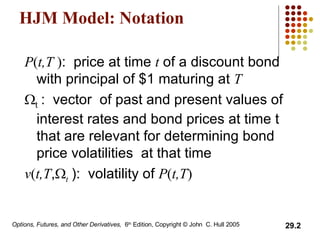
HJM Model: Notation P ( t,T  ) :  price at time  t  of a discount bond with principal of $1 maturing at  T ๏— t ๏€  :  vector  of past and present values of interest rates and bond prices at time t that are relevant for determining bond price volatilities  at that time v ( t,T , ๏— t ๏€  ):  volatility of  P ( t,T )
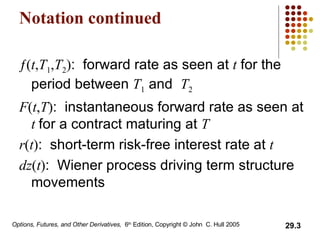
Notation continued ฦ’( t , T 1 , T 2 ) :  forward rate as seen at  t  for the period between  T 1  and  T 2 F ( t , T ) :  instantaneous forward rate as seen at  t  for a contract maturing at  T r ( t ) :  short-term risk-free interest rate at  t dz ( t ) :  Wiener process driving term structure movements
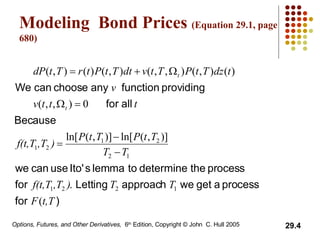
Modeling  Bond Prices  (Equation 29.1, page 680)
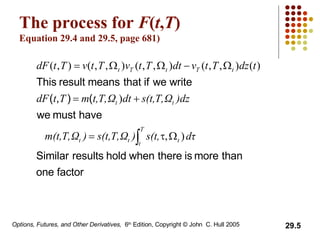
The process for  F ( t , T ) Equation 29.4 and 29.5, page 681)
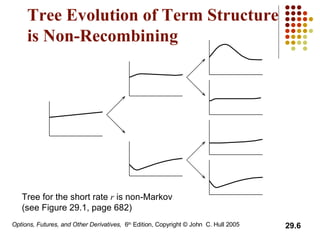
Tree Evolution of Term Structure is Non-Recombining Tree for the short rate  r  is non-Markov (see Figure 29.1, page 682)
The LIBOR Market Model The LIBOR market model is a model constructed in terms of the forward rates underlying caplet prices
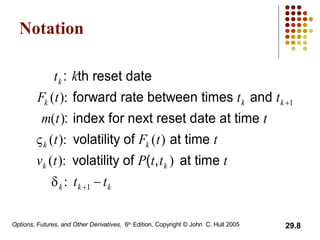
Notation
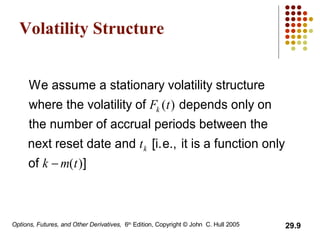
Volatility Structure
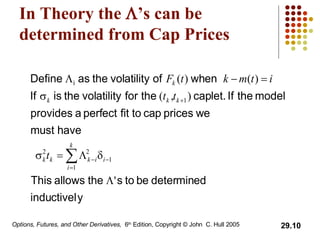
In Theory the  ๏Œ โ€™s can be determined from Cap Prices
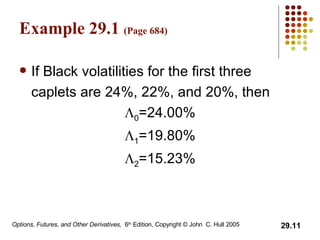
Example 29.1  (Page 684) If Black volatilities for the first three caplets are 24%, 22%, and 20%, then ๏Œ 0 =24.00% ๏Œ 1 =19.80% ๏Œ 2 =15.23%
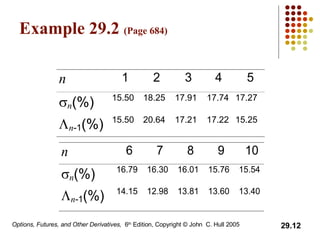
Example 29.2  (Page 684)
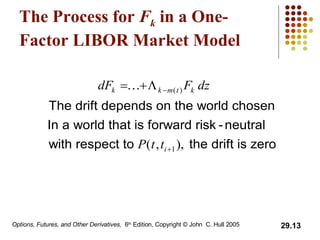
The Process for  F k  in a One-Factor LIBOR Market Model
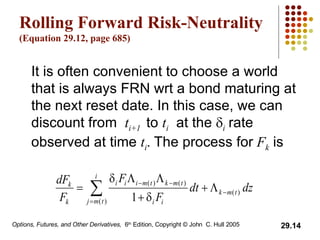
Rolling Forward Risk-Neutrality  (Equation 29.12, page 685) It is often convenient to choose a world that is always FRN wrt a bond maturing at the next reset date. In this case, we can discount from  t i+1  to  t i   at the  ๏ค i   rate observed at time  t i .  The process for   F k   is
The LIBOR Market Model  and HJM In the limit as the time between resets tends to zero, the LIBOR market model with rolling forward risk neutrality becomes the HJM model in the traditional risk-neutral world
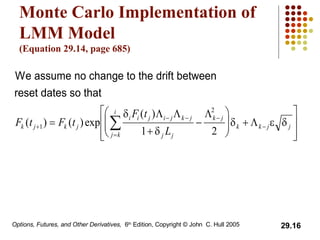
Monte Carlo Implementation of LMM Model  (Equation 29.14, page 685)
Multifactor Versions of LMM LMM can be extended so that there are several components to the volatility A factor analysis can be used to determine how the volatility of  F k  is split into components
Ratchet Caps, Sticky Caps, and Flexi Caps A plain vanilla cap depends only on one forward rate. Its price is not dependent on the number of factors. Ratchet caps, sticky caps, and flexi caps depend on the joint distribution of two or more forward rates. Their prices tend to increase with the number of factors
Valuing European Options in the LIBOR Market Model There is an analytic approximation that can be used to value European swap options in the LIBOR market model. See equations 29.18 and 29.19 on page 689
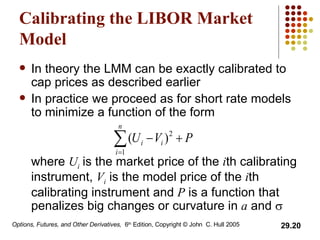
Calibrating the LIBOR Market Model In theory the LMM can be exactly calibrated to cap prices as described earlier In practice we proceed as for short rate models to minimize a function of the form where  U i   is the market price of the  i th calibrating instrument,  V i  is the model price of the  i th calibrating instrument and  P  is a function that penalizes big changes or curvature in  a  and  ๏ณ
Types of Mortgage-Backed Securities (MBSs) Pass-Through Collateralized Mortgage Obligation (CMO) Interest Only (IO) Principal Only (PO)
Option-Adjusted Spread (OAS) To calculate the OAS for an interest rate derivative we value it assuming  that the initial yield curve is the Treasury curve + a spread We use an iterative  procedure to calculate the spread  that makes the derivativeโ€™s model price = market  price. This is the OAS.

Chap 29

  • 1.
    Interest Rate Derivatives: HJM and LMM Chapter 29
  • 2.
    HJM Model: NotationP ( t,T ) : price at time t of a discount bond with principal of $1 maturing at T ๏— t ๏€  : vector of past and present values of interest rates and bond prices at time t that are relevant for determining bond price volatilities at that time v ( t,T , ๏— t ๏€  ): volatility of P ( t,T )
  • 3.
    Notation continued ฦ’(t , T 1 , T 2 ) : forward rate as seen at t for the period between T 1 and T 2 F ( t , T ) : instantaneous forward rate as seen at t for a contract maturing at T r ( t ) : short-term risk-free interest rate at t dz ( t ) : Wiener process driving term structure movements
  • 4.
    Modeling BondPrices (Equation 29.1, page 680)
  • 5.
    The process for F ( t , T ) Equation 29.4 and 29.5, page 681)
  • 6.
    Tree Evolution ofTerm Structure is Non-Recombining Tree for the short rate r is non-Markov (see Figure 29.1, page 682)
  • 7.
    The LIBOR MarketModel The LIBOR market model is a model constructed in terms of the forward rates underlying caplet prices
  • 8.
  • 9.
  • 10.
    In Theory the ๏Œ โ€™s can be determined from Cap Prices
  • 11.
    Example 29.1 (Page 684) If Black volatilities for the first three caplets are 24%, 22%, and 20%, then ๏Œ 0 =24.00% ๏Œ 1 =19.80% ๏Œ 2 =15.23%
  • 12.
    Example 29.2 (Page 684)
  • 13.
    The Process for F k in a One-Factor LIBOR Market Model
  • 14.
    Rolling Forward Risk-Neutrality (Equation 29.12, page 685) It is often convenient to choose a world that is always FRN wrt a bond maturing at the next reset date. In this case, we can discount from t i+1 to t i at the ๏ค i rate observed at time t i . The process for F k is
  • 15.
    The LIBOR MarketModel and HJM In the limit as the time between resets tends to zero, the LIBOR market model with rolling forward risk neutrality becomes the HJM model in the traditional risk-neutral world
  • 16.
    Monte Carlo Implementationof LMM Model (Equation 29.14, page 685)
  • 17.
    Multifactor Versions ofLMM LMM can be extended so that there are several components to the volatility A factor analysis can be used to determine how the volatility of F k is split into components
  • 18.
    Ratchet Caps, StickyCaps, and Flexi Caps A plain vanilla cap depends only on one forward rate. Its price is not dependent on the number of factors. Ratchet caps, sticky caps, and flexi caps depend on the joint distribution of two or more forward rates. Their prices tend to increase with the number of factors
  • 19.
    Valuing European Optionsin the LIBOR Market Model There is an analytic approximation that can be used to value European swap options in the LIBOR market model. See equations 29.18 and 29.19 on page 689
  • 20.
    Calibrating the LIBORMarket Model In theory the LMM can be exactly calibrated to cap prices as described earlier In practice we proceed as for short rate models to minimize a function of the form where U i is the market price of the i th calibrating instrument, V i is the model price of the i th calibrating instrument and P is a function that penalizes big changes or curvature in a and ๏ณ
  • 21.
    Types of Mortgage-BackedSecurities (MBSs) Pass-Through Collateralized Mortgage Obligation (CMO) Interest Only (IO) Principal Only (PO)
  • 22.
    Option-Adjusted Spread (OAS)To calculate the OAS for an interest rate derivative we value it assuming that the initial yield curve is the Treasury curve + a spread We use an iterative procedure to calculate the spread that makes the derivativeโ€™s model price = market price. This is the OAS.