Mortgage Backed Security
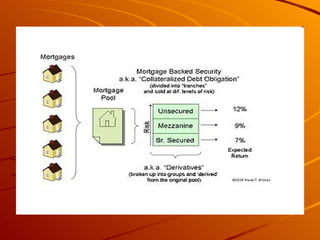
Structured Finance A sector of  finance  that was created to help transfer  risk  using complex legal and corporate entities  Ability to repackage risk and create safe assets from risky collaterals. Important Features – Securitization , Tranching  .
 
Securitization A  structured finance  process that distributes risk by aggregating debt instruments in a pool, then issues new securities backed by the pool. Steps Involved : a) Pooling and Transfer b) Issuance
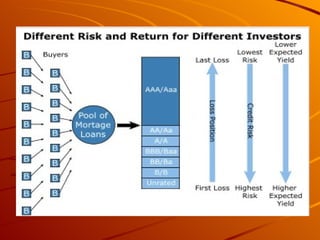
Tranching Individual securities are often split into  tranches  /classes. Each tranche has a different level of credit protection or risk exposure than another  Cash flow waterfall  arrangement Benefit  - Generates rated securities from a pool of unrated assets
 
 
Mortgage Backed Security An  asset-backed security  or debt obligation that represents a claim on the cash flows from mortgage loans.  Mostly issued by the Government National Mortgage Association ( Ginnie  Mae ) , the Federal National Mortgage Association ( Fannie Mae ) and the Federal Home Loan Mortgage Corporation ( Freddie Mac )
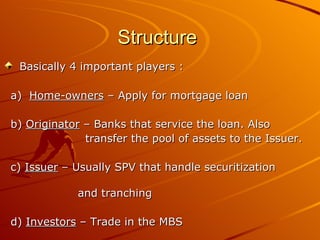
Structure  Basically 4 important players : a)  Home-owners  – Apply for mortgage loan b)  Originator  – Banks that service the loan. Also  transfer the pool of assets to the Issuer. c)  Issuer  – Usually SPV that handle securitization  and tranching d)  Investors  – Trade in the MBS
Features Weighted average maturity Weighted-average coupon Pass Through Rate
 
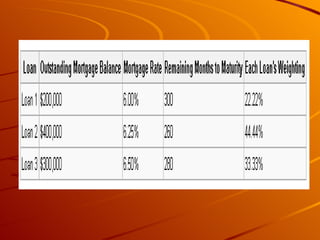
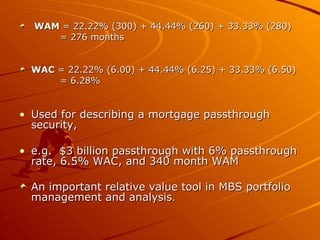
WAM  = 22.22% (300) + 44.44% (260) + 33.33% (280) = 276 months  WAC  = 22.22% (6.00) + 44.44% (6.25) + 33.33% (6.50)  = 6.28%  Used for describing a mortgage passthrough security,  e.g.  $3 billion passthrough with 6% passthrough rate, 6.5% WAC, and 340 month WAM  An important relative value tool in MBS portfolio management and analysis .
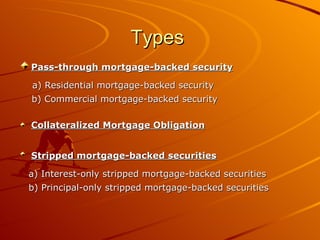
Types  Pass-through mortgage-backed security   a) Residential mortgage-backed security   b) Commercial mortgage-backed security  Collateralized Mortgage Obligation Stripped mortgage-backed securities   a) Interest-only stripped mortgage-backed securities   b) Principal-only stripped mortgage-backed securities
Risk Interest rate risk and Prepayment risk The number of homeowners in residential MBS securitizations who prepay goes up when interest rates go down .   Credit risk Depends on the likelihood of the borrower paying the promised cash flows (principal and interest) on time
Uses Transforms relatively  illiquid , individual financial assets into liquid and tradable capital market instruments.  Allow mortgage originators to replenish their funds, which can then be used for additional origination activities.  Frequently a more efficient and lower cost source of financing in comparison with other bank and capital markets financing alternatives
US MBS Market Total U.S. mortgage debt outstanding :  $ 1.54 trillion Total U.S. mortgage-related securities  :  $ 45 billion Reasons (other than investment or speculation) for entering the market include the desire to hedge against a drop in  prepayment  rates   Highly liquid securities
Reference www.wikipedia.org www.hbs.edu/research/pdf/09-060.pdf  www.federalreserve.gov  www.investopedia.com
THANK YOU

Mortgage Backed Security

  • 1.
  • 2.
    Structured Finance Asector of finance that was created to help transfer risk using complex legal and corporate entities Ability to repackage risk and create safe assets from risky collaterals. Important Features – Securitization , Tranching .
  • 3.
  • 4.
    Securitization A structured finance process that distributes risk by aggregating debt instruments in a pool, then issues new securities backed by the pool. Steps Involved : a) Pooling and Transfer b) Issuance
  • 5.
    Tranching Individual securitiesare often split into tranches /classes. Each tranche has a different level of credit protection or risk exposure than another Cash flow waterfall arrangement Benefit - Generates rated securities from a pool of unrated assets
  • 6.
  • 7.
  • 8.
    Mortgage Backed SecurityAn asset-backed security or debt obligation that represents a claim on the cash flows from mortgage loans. Mostly issued by the Government National Mortgage Association ( Ginnie Mae ) , the Federal National Mortgage Association ( Fannie Mae ) and the Federal Home Loan Mortgage Corporation ( Freddie Mac )
  • 9.
    Structure Basically4 important players : a) Home-owners – Apply for mortgage loan b) Originator – Banks that service the loan. Also transfer the pool of assets to the Issuer. c) Issuer – Usually SPV that handle securitization and tranching d) Investors – Trade in the MBS
  • 10.
    Features Weighted averagematurity Weighted-average coupon Pass Through Rate
  • 11.
  • 12.
    WAM =22.22% (300) + 44.44% (260) + 33.33% (280) = 276 months WAC = 22.22% (6.00) + 44.44% (6.25) + 33.33% (6.50) = 6.28% Used for describing a mortgage passthrough security, e.g. $3 billion passthrough with 6% passthrough rate, 6.5% WAC, and 340 month WAM An important relative value tool in MBS portfolio management and analysis .
  • 13.
    Types Pass-throughmortgage-backed security a) Residential mortgage-backed security b) Commercial mortgage-backed security Collateralized Mortgage Obligation Stripped mortgage-backed securities a) Interest-only stripped mortgage-backed securities b) Principal-only stripped mortgage-backed securities
  • 14.
    Risk Interest raterisk and Prepayment risk The number of homeowners in residential MBS securitizations who prepay goes up when interest rates go down . Credit risk Depends on the likelihood of the borrower paying the promised cash flows (principal and interest) on time
  • 15.
    Uses Transforms relatively illiquid , individual financial assets into liquid and tradable capital market instruments. Allow mortgage originators to replenish their funds, which can then be used for additional origination activities. Frequently a more efficient and lower cost source of financing in comparison with other bank and capital markets financing alternatives
  • 16.
    US MBS MarketTotal U.S. mortgage debt outstanding : $ 1.54 trillion Total U.S. mortgage-related securities : $ 45 billion Reasons (other than investment or speculation) for entering the market include the desire to hedge against a drop in prepayment rates Highly liquid securities
  • 17.
    Reference www.wikipedia.org www.hbs.edu/research/pdf/09-060.pdf www.federalreserve.gov www.investopedia.com
  • 18.