Ideas for DiscussionREV 2Channel Models For Cloud ComputingDanny GoodallLead Marketing Analystdannyg@lustratusrepama.comSeptember 2009
Channel Models for Cloud ComputingLustratus REPAMA is in the process of creating a market segmentation model for cloud computingThis should include the likely channel models that will be in place It is currently difficult to predict with any degree of certainty how the channel model for cloud market will develop over the coming yearsThis DRAFT document explores some ideas and is circulated for discussion and debateLater versions of this document will be released at http://www.lustratusrepama.com/repama-blog
Cloud ComputingDefinitions and technical capability segmentation
Cloud Computing Definitions“...a model for enabling convenient, on-demand network access to a shared pool of configurable computing resources (e.g., networks, servers, storage, applications, and services) that can be rapidly provisioned and released with minimal management effort or service provider interaction”Cloud Computing according to Source: NIST - http://csrc.nist.gov/groups/SNS/cloud-computing/index.html
Cloud Computing DefinitionsSource: NIST - http://csrc.nist.gov/groups/SNS/cloud-computing/index.html
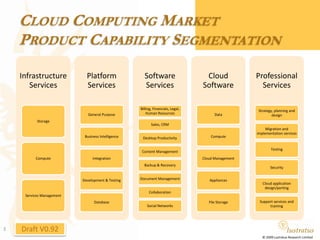
Cloud Computing Market Product Capability Segmentation* These services have been arbitrarily grouped for layout purposes. There is no particular significance to this grouping.
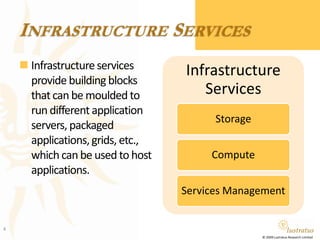
Infrastructure ServicesInfrastructure services provide building blocks that can be moulded to run different application servers, packaged applications, grids, etc., which can be used to host applications.
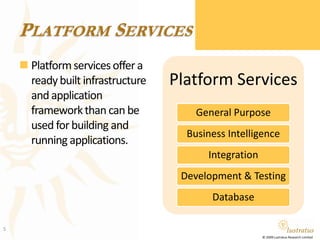
Platform ServicesPlatform services offer a ready built infrastructure and application framework that can be used for building and running applications.
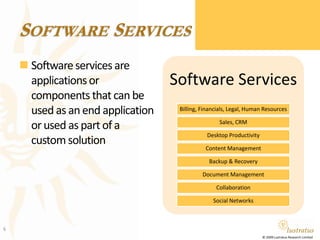
Software ServicesSoftware services are applications or components that can be used as an end application or used as part of a custom solution* These services have been arbitrarily grouped for layout purposes. There is no particular significance to this grouping.
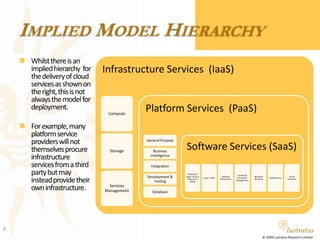
Implied Model HierarchyThere is an apparent implied hierarchy  for the delivery of cloud services as shown in the diagram below. However this is not always the model for deployment.For example, many platform service providers will not themselves procure infrastructure services from a third party but may instead provide their own infrastructure.
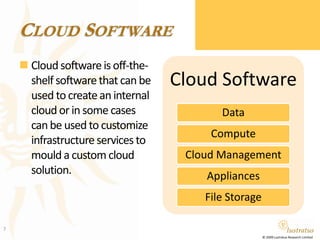
Cloud SoftwareCloud software is off-the-shelf software that can be used to create an internal cloud or in some cases can be used to customize infrastructure services to mould a custom cloud solution.
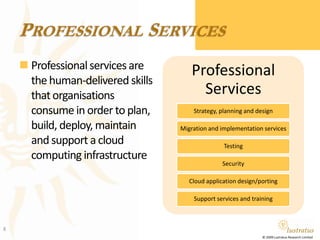
Professional ServicesProfessional services are the human-delivered skills that organisations consume in order to plan, build, deploy, maintain and support a cloud computing infrastructure
Cloud SoftwareChannel ModelSDRAFT channel model for the cloud software segment
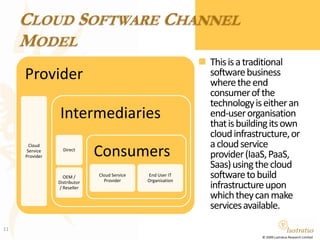
Cloud Software Channel ModelThis is a traditional software business where the end consumer of the technology is either an end-user organisation that is building its own cloud infrastructure, or a cloud service provider (IaaS, PaaS, Saas) using the cloud software to build infrastructure upon which they can make services available.
Software ServicesChannel ModelSDRAFT channel model for the software services segment
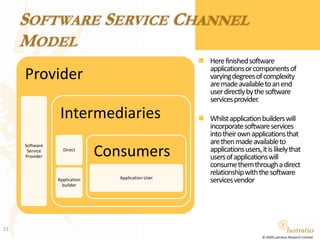
Software Service Channel ModelHere finished software applications or components of varying degrees of complexity are made available to an end user directly by the software services provider.Whilst application builders will incorporate software services into their own applications that are then made available to applications users, it is likely that users of applications will consume them through a direct relationship with the software services vendor
Platform ServicesChannel ModelSDRAFT channel model for the platform services segment
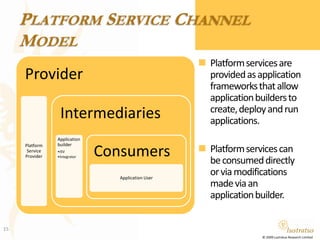
Platform Service Channel ModelPlatform services are provided as application frameworks that allow application builders to create, deploy and run applications.Platform services can be consumed directly or via modifications made via an application builder.
Infrastructure ServicesChannel ModelSDRAFT channel model for the infrastructure services segment
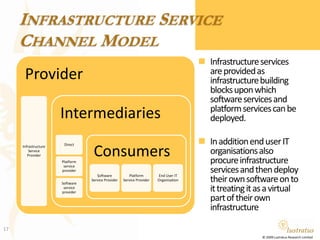
Infrastructure Service Channel ModelInfrastructure services are provided as infrastructure building blocks upon which software services and platform services can be deployed. In addition end user IT organisations also procure infrastructure services and then deploy their own software on to it treating it as a virtual part of their own infrastructure
AcknowledgementsLustratus REPAMA would like to acknowledge that much of the high-level work on market taxonomy is derived from work carried out by Brad Buck of OpenCrowd and Peter Laird of Tendril Inc.Working definitions for cloud computing come from the work of Peter Mell and Tim Grance of NIST.

Channel Models For Cloud Computing - REV 2 - (0.90))

  • 1.
    Ideas for DiscussionREV2Channel Models For Cloud ComputingDanny GoodallLead Marketing Analystdannyg@lustratusrepama.comSeptember 2009
  • 2.
    Channel Models forCloud ComputingLustratus REPAMA is in the process of creating a market segmentation model for cloud computingThis should include the likely channel models that will be in place It is currently difficult to predict with any degree of certainty how the channel model for cloud market will develop over the coming yearsThis DRAFT document explores some ideas and is circulated for discussion and debateLater versions of this document will be released at http://www.lustratusrepama.com/repama-blog
  • 3.
    Cloud ComputingDefinitions andtechnical capability segmentation
  • 4.
    Cloud Computing Definitions“...amodel for enabling convenient, on-demand network access to a shared pool of configurable computing resources (e.g., networks, servers, storage, applications, and services) that can be rapidly provisioned and released with minimal management effort or service provider interaction”Cloud Computing according to Source: NIST - http://csrc.nist.gov/groups/SNS/cloud-computing/index.html
  • 5.
    Cloud Computing DefinitionsSource:NIST - http://csrc.nist.gov/groups/SNS/cloud-computing/index.html
  • 6.
    Cloud Computing MarketProduct Capability Segmentation* These services have been arbitrarily grouped for layout purposes. There is no particular significance to this grouping.
  • 7.
    Infrastructure ServicesInfrastructure servicesprovide building blocks that can be moulded to run different application servers, packaged applications, grids, etc., which can be used to host applications.
  • 8.
    Platform ServicesPlatform servicesoffer a ready built infrastructure and application framework that can be used for building and running applications.
  • 9.
    Software ServicesSoftware servicesare applications or components that can be used as an end application or used as part of a custom solution* These services have been arbitrarily grouped for layout purposes. There is no particular significance to this grouping.
  • 10.
    Implied Model HierarchyThereis an apparent implied hierarchy for the delivery of cloud services as shown in the diagram below. However this is not always the model for deployment.For example, many platform service providers will not themselves procure infrastructure services from a third party but may instead provide their own infrastructure.
  • 11.
    Cloud SoftwareCloud softwareis off-the-shelf software that can be used to create an internal cloud or in some cases can be used to customize infrastructure services to mould a custom cloud solution.
  • 12.
    Professional ServicesProfessional servicesare the human-delivered skills that organisations consume in order to plan, build, deploy, maintain and support a cloud computing infrastructure
  • 13.
    Cloud SoftwareChannel ModelSDRAFTchannel model for the cloud software segment
  • 14.
    Cloud Software ChannelModelThis is a traditional software business where the end consumer of the technology is either an end-user organisation that is building its own cloud infrastructure, or a cloud service provider (IaaS, PaaS, Saas) using the cloud software to build infrastructure upon which they can make services available.
  • 15.
    Software ServicesChannel ModelSDRAFTchannel model for the software services segment
  • 16.
    Software Service ChannelModelHere finished software applications or components of varying degrees of complexity are made available to an end user directly by the software services provider.Whilst application builders will incorporate software services into their own applications that are then made available to applications users, it is likely that users of applications will consume them through a direct relationship with the software services vendor
  • 17.
    Platform ServicesChannel ModelSDRAFTchannel model for the platform services segment
  • 18.
    Platform Service ChannelModelPlatform services are provided as application frameworks that allow application builders to create, deploy and run applications.Platform services can be consumed directly or via modifications made via an application builder.
  • 19.
    Infrastructure ServicesChannel ModelSDRAFTchannel model for the infrastructure services segment
  • 20.
    Infrastructure Service ChannelModelInfrastructure services are provided as infrastructure building blocks upon which software services and platform services can be deployed. In addition end user IT organisations also procure infrastructure services and then deploy their own software on to it treating it as a virtual part of their own infrastructure
  • 21.
    AcknowledgementsLustratus REPAMA wouldlike to acknowledge that much of the high-level work on market taxonomy is derived from work carried out by Brad Buck of OpenCrowd and Peter Laird of Tendril Inc.Working definitions for cloud computing come from the work of Peter Mell and Tim Grance of NIST.

Editor's Notes

  • #6 Draft NIST Working Definition of Cloud ComputingAuthors: Peter Mell and Tim Grance8-21-09 National Institute of Standards and Technology, Information Technology Laboratory Note 1: Cloud computing is still an evolving paradigm. Its definitions, use cases, underlying technologies, issues, risks, and benefits will be refined in a spirited debate by the public and private sectors. These definitions, attributes, and characteristics will evolve and change over time. Note 2: The cloud computing industry represents a large ecosystem of many models, vendors, and market niches. This definition attempts to encompass all of the various cloud approaches.Definition of Cloud Computing: Cloud computing is a model for enabling convenient, on-demand network access to a shared pool of configurable computing resources (e.g., networks, servers, storage, applications, and services) that can be rapidly provisioned and released with minimal management effort or service provider interaction. This cloud model promotes availability and is composed of five essential characteristics, three service models, and four deployment models. Essential Characteristics:On-demand self-service. A consumer can unilaterally provision computing capabilities, such as server time and network storage, as needed automatically without requiring human interaction with each service’s provider. Broad network access. Capabilities are available over the network and accessed through standard mechanisms that promote use by heterogeneous thin or thick client platforms (e.g., mobile phones, laptops, and PDAs).Resource pooling. The provider’s computing resources are pooled to serve multiple consumers using a multi-tenant model, with different physical and virtual resources dynamically assigned and reassigned according to consumer demand. There is a sense of location independence in that the customer generally has no control or knowledge over the exact location of the provided resources but may be able to specify location at a higher level of abstraction (e.g., country, state, or datacenter). Examples of resources include storage, processing, memory, network bandwidth, and virtual machines.Rapid elasticity. Capabilities can be rapidly and elastically provisioned, in some cases automatically, to quickly scale out and rapidly released to quickly scale in. To the consumer, the capabilities available for provisioning often appear to be unlimited and can be purchased in any quantity at any time.Measured Service. Cloud systems automatically control and optimize resource use by leveraging a metering capability at some level of abstraction appropriate to the type of service (e.g., storage, processing, bandwidth, and active user accounts). Resource usage can be monitored, controlled, and reported providing transparency for both the provider and consumer of the utilized service. Service Models:Cloud Software as a Service (SaaS). The capability provided to the consumer is to use the provider’s applications running on a cloud infrastructure. The applications are accessible from various client devices through a thin client interface such as a web browser (e.g., web-based email). The consumer does not manage or control the underlying cloud infrastructure including network, servers, operating systems, storage, or even individual application capabilities, with the possible exception of limited user-specific application configuration settings.Cloud Platform as a Service (PaaS). The capability provided to the consumer is to deploy onto the cloud infrastructure consumer-created or acquired applications created using programming languages and tools supported by the provider. The consumer does not manage or control the underlying cloud infrastructure including network, servers, operating systems, or storage, but has control over the deployed applications and possibly application hosting environment configurations.Cloud Infrastructure as a Service (IaaS). The capability provided to the consumer is to provision processing, storage, networks, and other fundamental computing resources where the consumer is able to deploy and run arbitrary software, which can include operating systems and applications. The consumer does not manage or control the underlying cloud infrastructure but has control over operating systems, storage, deployed applications, and possibly limited control of select networking components (e.g., host firewalls). Deployment Models:Private cloud. The cloud infrastructure is operated solely for an organization. It may be managed by the organization or a third party and may exist on premise or off premise.Community cloud. The cloud infrastructure is shared by several organizations and supports a specific community that has shared concerns (e.g., mission, security requirements, policy, and compliance considerations). It may be managed by the organizations or a third party and may exist on premise or off premise.Public cloud. The cloud infrastructure is made available to the general public or a large industry group and is owned by an organization selling cloud services.Hybrid cloud. The cloud infrastructure is a composition of two or more clouds (private, community, or public) that remain unique entities but are bound together by standardized or proprietary technology that enables data and application portability (e.g., cloud bursting for load-balancing between clouds). Note: Cloud software takes full advantage of the cloud paradigm by being service oriented with a focus on statelessness, low coupling, modularity, and semantic interoperability.Below are the changes from draft version 14:1. Changed "Deliver Models" to "Service Models" to avoid confusion of terminology with the "Deployment Models"2. Removed location independence from the title of an essential characteristic and moved it within the description 3. Change reference to scaling within rapid elasticity section from "up" and "down" to "in and out"4. Removed "load balancers" list of example IaaS networking components over which a consumer might exert some control/customization5. Moved note on cloud software to end of definition