CloudComputing
and
ServicePlatforms
V i b h a w a N i r m a l W i j e r a t h n a
Agenda
Cloud Computing Definition
Other Definitions Cloud Computing
History of Cloud Computing
Why Cloud Computing
Why not Cloud Computing ?
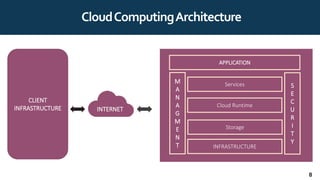
Cloud Computing Architecture
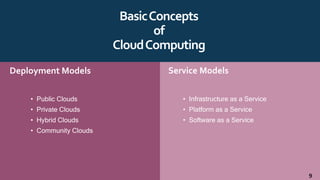
Basic Concepts of Cloud Computing
Cloud Deployment Models
Cloud Service Models
Cloud Service Platforms
Cisco HyperFlex
01
Pricing
Cloud Computing
Cloud Computing is the various services which
are provided by computer using through the
internet. Such as Software Development
platforms , Servers , Storage and networking etc.
02
Other
Definitions
“Digital transformation is helping companies rapidly
drive efficiency, agility, and connectivity as they use
technology to transform their business processes into
something easier, faster, and more secure, flexible
and profitable. Cloud computing technology is a
cornerstone to digital transformation.”
_CISCO
“Cloud computing is the delivery of computing
services—including servers, storage, databases,
networking, software, analytics, and intelligence—over
the Internet (“the cloud”) to offer faster innovation,
flexible resources, and economies of scale.”
_Microsoft
3
History of
Cloud Computing
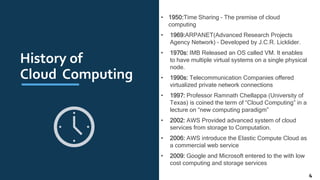
• 1950:Time Sharing – The premise of cloud
computing
• 1969:ARPANET(Advanced Research Projects
Agency Network) – Developed by J.C.R. Licklider.
• 1970s: IMB Released an OS called VM. It enables
to have multiple virtual systems on a single physical
node.
• 1990s: Telecommunication Companies offered
virtualized private network connections
• 1997: Professor Ramnath Chellappa (University of
Texas) is coined the term of “Cloud Computing” in a
lecture on “new computing paradigm”
• 2002: AWS Provided advanced system of cloud
services from storage to Computation.
• 2006: AWS introduce the Elastic Compute Cloud as
a commercial web service
• 2009: Google and Microsoft entered to the with low
cost computing and storage services
4
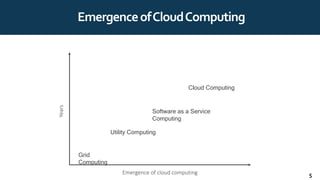
EmergenceofCloudComputing
Grid
Computing
Utility Computing
Software as a Service
Computing
Cloud Computing
Years
Emergence of cloud computing 5
Why
Cloud Computing ?
• High Speed
• Lower Cost for users (Infrastructure ,
maintenance)
• Flexibility
• Competitive Advantage for business
• Sporadic batch processing
• Back-up and restore data
6
Why Not
Cloud Computing ? • Risk of Vulnerability attacks
• Depend on Network connectivity
• Limited Control
7
CloudComputingArchitecture
CLIENT
INFRASTRUCTURE INTERNET
APPLICATION
M
A
N
A
G
M
E
N
T
S
E
C
U
R
I
T
Y
INFRASTRUCTURE
Services
Cloud Runtime
Storage
8
Deployment Models Service Models
• Public Clouds
• Private Clouds
• Hybrid Clouds
• Community Clouds
• Infrastructure as a Service
• Platform as a Service
• Software as a Service
BasicConcepts
of
CloudComputing
9
Cloud Deployment Models
10
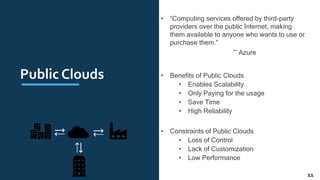
Public Clouds
• “Computing services offered by third-party
providers over the public Internet, making
them available to anyone who wants to use or
purchase them.”
~ Azure
• Benefits of Public Clouds
• Enables Scalability
• Only Paying for the usage
• Save Time
• High Reliability
• Constraints of Public Clouds
• Loss of Control
• Lack of Customization
• Low Performance
11
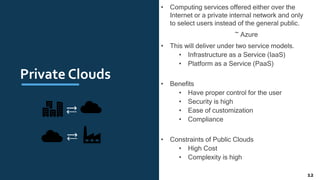
Private Clouds
• Computing services offered either over the
Internet or a private internal network and only
to select users instead of the general public..
~ Azure
• This will deliver under two service models.
• Infrastructure as a Service (IaaS)
• Platform as a Service (PaaS)
• Benefits
• Have proper control for the user
• Security is high
• Ease of customization
• Compliance
• Constraints of Public Clouds
• High Cost
• Complexity is high
12
Hybrid
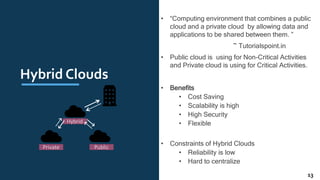
Hybrid Clouds
• “Computing environment that combines a public
cloud and a private cloud by allowing data and
applications to be shared between them. ”
~ Tutorialspoint.in
• Public cloud is using for Non-Critical Activities
and Private cloud is using for Critical Activities.
• Benefits
• Cost Saving
• Scalability is high
• High Security
• Flexible
• Constraints of Hybrid Clouds
• Reliability is low
• Hard to centralize
Private Public
13
Community Cloud
• Cloud computing solution to a limited number
of individuals or organizations that is
governed, managed and secured commonly
by all the participating organizations or a third-
party managed service provider.
• Benefits of Community Cloud
• Improved Service
• Scalability is high
• Availability
• Flexible
• Constraints of Community Clouds
• High Cost
14
CloudService Models
(X as a Service)
15
Infrastructure as a
Service
• IaaS is centered around a model of service
delivery that provisions a predefined,
standardized infrastructure specifically
optimized for the customer’s applications
• Customers maintain ownership and
management of their application(s) while the
transition, hosting operations and
infrastructure management to the IaaS
provider
• Examples
• DigitalOcean
• Linode
• Rackspace
• Amazon Web Services (AWS)
• Cisco Metapod 16
Infrastructure as a
Service
• Benefits
• Use of the latest technology for
infrastructure equipment.
• Reduced risk by having off-site
resources
• Reduced time, cost, and complexity in
adding new features or capabilities.
• Constrains
• Internet connection is a must.
• Depends on virtualization services.
• This service restricts user-privacy &
customization.
Benefits and Constrains
17
Platform as a
Service
• PaaS developers are concerned only with
web-based development and generally do not
care what operating system is used
• Facilitate to Workflow facilities for application
design
• Application development, testing, deployment,
and hosting
• Integration with web services and databases
• Support for Simple Object Access Protocol
(SOAP)
• Other interfaces allows PaaS offerings to
create combinations of web services
• Examples:
• AWS Elastic Beanstalk
• Windows Azure
• Google App Engine
• OpenShift 18
Platform as a
Service
• Benefits
• Scalability
• Simple and easy to use
• Low cost
• Reduced time, cost, and complexity in
adding new features or capabilities.
• Constrains
• Vendor migrations
• Mix-up local and connecting with other
clouds increase complexity
Benefits and Constrains
19
Software as a
Service
• Software distribution model in which
applications are hosted by a vendor or service
provider and made available to customers
over a network, typically the Internet
• Varieties of SaaS
• Vertical SaaS and Horizontal SaaS
• Software can use with SaaS model
• Accounting
• Customer relationship management
• Email software
• Human resources
• IT security
• IT service management
• Video conferencing
20
Software as a
Service
• Benefits
• Scalability
• Simple and easy to use
• Flexible
• Up to Date
• Constrains
• Connectivity is a must
• Performance
• Security
• Limited Vary of application
Benefits and Constrains
21
AvailableCloudService Platforms
22
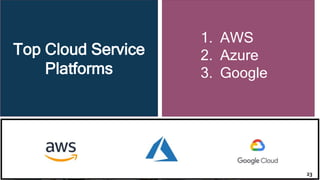
Top Cloud Service
Platforms
1. AWS
2. Azure
3. Google
Images
23
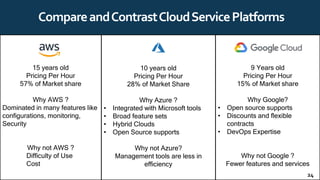
CompareandContrastCloudServicePlatforms
15 years old
Pricing Per Hour
57% of Market share
Why AWS ?
Dominated in many features like
configurations, monitoring,
Security
Why not AWS ?
Difficulty of Use
Cost
10 years old
Pricing Per Hour
28% of Market Share
Why Azure ?
• Integrated with Microsoft tools
• Broad feature sets
• Hybrid Clouds
• Open Source supports
Why not Azure?
Management tools are less in
efficiency
9 Years old
Pricing Per Hour
15% of Market share
Why Google?
• Open source supports
• Discounts and flexible
contracts
• DevOps Expertise
Why not Google ?
Fewer features and services
24
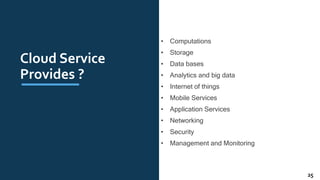
Cloud Service
Provides ?
• Computations
• Storage
• Data bases
• Analytics and big data
• Internet of things
• Mobile Services
• Application Services
• Networking
• Security
• Management and Monitoring
25
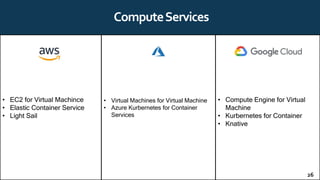
ComputeServices
• EC2 for Virtual Machince
• Elastic Container Service
• Light Sail
• Virtual Machines for Virtual Machine
• Azure Kurbernetes for Container
Services
• Compute Engine for Virtual
Machine
• Kurbernetes for Container
• Knative
26
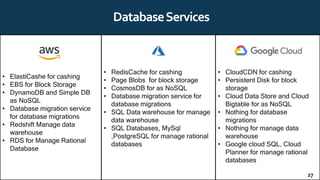
DatabaseServices
• ElastiCashe for cashing
• EBS for Block Storage
• DynamoDB and Simple DB
as NoSQL
• Database migration service
for database migrations
• Redshift Manage data
warehouse
• RDS for Manage Rational
Database
• RedisCache for cashing
• Page Blobs for block storage
• CosmosDB for as NoSQL
• Database migration service for
database migrations
• SQL Data warehouse for manage
data warehouse
• SQL Databases, MySql
,PostgreSQL for manage rational
databases
• CloudCDN for cashing
• Persistent Disk for block
storage
• Cloud Data Store and Cloud
Bigtable for as NoSQL
• Nothing for database
migrations
• Nothing for manage data
warehouse
• Google cloud SQL, Cloud
Planner for manage rational
databases
27
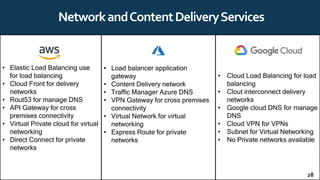
NetworkandContentDeliveryServices
• Elastic Load Balancing use
for load balancing
• Cloud Front for delivery
networks
• Rout53 for manage DNS
• API Gateway for cross
premises connectivity
• Virtual Private cloud for virtual
networking
• Direct Connect for private
networks
• Load balancer application
gateway
• Content Delivery network
• Traffic Manager Azure DNS
• VPN Gateway for cross premises
connectivity
• Virtual Network for virtual
networking
• Express Route for private
networks
• Cloud Load Balancing for load
balancing
• Clout interconnect delivery
networks
• Google cloud DNS for manage
DNS
• Cloud VPN for VPNs
• Subnet for Virtual Networking
• No Private networks available
28
CiscoHyperFlex
HyperFlex systems combine software defined storage and data services software with Cisco UCS (Unified
computing systems) a converged infrastructure system that integrates computing, networking and storage
resources to increase efficiency and enable centralized management.
29
Pricing ?
• AWS
https://calculator.aws/#/addService
• Azure
https://azure.microsoft.com/en-us/pricing/calculator/
• Google
https://cloud.google.com/products/calculator/
30
ThankYou
V i b h a w a N i r m a l W i j e r a t h n a

Cloud computing and Service Platforms

  • 1.
    CloudComputing and ServicePlatforms V i bh a w a N i r m a l W i j e r a t h n a
  • 2.
    Agenda Cloud Computing Definition OtherDefinitions Cloud Computing History of Cloud Computing Why Cloud Computing Why not Cloud Computing ? Cloud Computing Architecture Basic Concepts of Cloud Computing Cloud Deployment Models Cloud Service Models Cloud Service Platforms Cisco HyperFlex 01 Pricing
  • 3.
    Cloud Computing Cloud Computingis the various services which are provided by computer using through the internet. Such as Software Development platforms , Servers , Storage and networking etc. 02
  • 4.
    Other Definitions “Digital transformation ishelping companies rapidly drive efficiency, agility, and connectivity as they use technology to transform their business processes into something easier, faster, and more secure, flexible and profitable. Cloud computing technology is a cornerstone to digital transformation.” _CISCO “Cloud computing is the delivery of computing services—including servers, storage, databases, networking, software, analytics, and intelligence—over the Internet (“the cloud”) to offer faster innovation, flexible resources, and economies of scale.” _Microsoft 3
  • 5.
    History of Cloud Computing •1950:Time Sharing – The premise of cloud computing • 1969:ARPANET(Advanced Research Projects Agency Network) – Developed by J.C.R. Licklider. • 1970s: IMB Released an OS called VM. It enables to have multiple virtual systems on a single physical node. • 1990s: Telecommunication Companies offered virtualized private network connections • 1997: Professor Ramnath Chellappa (University of Texas) is coined the term of “Cloud Computing” in a lecture on “new computing paradigm” • 2002: AWS Provided advanced system of cloud services from storage to Computation. • 2006: AWS introduce the Elastic Compute Cloud as a commercial web service • 2009: Google and Microsoft entered to the with low cost computing and storage services 4
  • 6.
    EmergenceofCloudComputing Grid Computing Utility Computing Software asa Service Computing Cloud Computing Years Emergence of cloud computing 5
  • 7.
    Why Cloud Computing ? •High Speed • Lower Cost for users (Infrastructure , maintenance) • Flexibility • Competitive Advantage for business • Sporadic batch processing • Back-up and restore data 6
  • 8.
    Why Not Cloud Computing? • Risk of Vulnerability attacks • Depend on Network connectivity • Limited Control 7
  • 9.
  • 10.
    Deployment Models ServiceModels • Public Clouds • Private Clouds • Hybrid Clouds • Community Clouds • Infrastructure as a Service • Platform as a Service • Software as a Service BasicConcepts of CloudComputing 9
  • 11.
  • 12.
    Public Clouds • “Computingservices offered by third-party providers over the public Internet, making them available to anyone who wants to use or purchase them.” ~ Azure • Benefits of Public Clouds • Enables Scalability • Only Paying for the usage • Save Time • High Reliability • Constraints of Public Clouds • Loss of Control • Lack of Customization • Low Performance 11
  • 13.
    Private Clouds • Computingservices offered either over the Internet or a private internal network and only to select users instead of the general public.. ~ Azure • This will deliver under two service models. • Infrastructure as a Service (IaaS) • Platform as a Service (PaaS) • Benefits • Have proper control for the user • Security is high • Ease of customization • Compliance • Constraints of Public Clouds • High Cost • Complexity is high 12
  • 14.
    Hybrid Hybrid Clouds • “Computingenvironment that combines a public cloud and a private cloud by allowing data and applications to be shared between them. ” ~ Tutorialspoint.in • Public cloud is using for Non-Critical Activities and Private cloud is using for Critical Activities. • Benefits • Cost Saving • Scalability is high • High Security • Flexible • Constraints of Hybrid Clouds • Reliability is low • Hard to centralize Private Public 13
  • 15.
    Community Cloud • Cloudcomputing solution to a limited number of individuals or organizations that is governed, managed and secured commonly by all the participating organizations or a third- party managed service provider. • Benefits of Community Cloud • Improved Service • Scalability is high • Availability • Flexible • Constraints of Community Clouds • High Cost 14
  • 16.
  • 17.
    Infrastructure as a Service •IaaS is centered around a model of service delivery that provisions a predefined, standardized infrastructure specifically optimized for the customer’s applications • Customers maintain ownership and management of their application(s) while the transition, hosting operations and infrastructure management to the IaaS provider • Examples • DigitalOcean • Linode • Rackspace • Amazon Web Services (AWS) • Cisco Metapod 16
  • 18.
    Infrastructure as a Service •Benefits • Use of the latest technology for infrastructure equipment. • Reduced risk by having off-site resources • Reduced time, cost, and complexity in adding new features or capabilities. • Constrains • Internet connection is a must. • Depends on virtualization services. • This service restricts user-privacy & customization. Benefits and Constrains 17
  • 19.
    Platform as a Service •PaaS developers are concerned only with web-based development and generally do not care what operating system is used • Facilitate to Workflow facilities for application design • Application development, testing, deployment, and hosting • Integration with web services and databases • Support for Simple Object Access Protocol (SOAP) • Other interfaces allows PaaS offerings to create combinations of web services • Examples: • AWS Elastic Beanstalk • Windows Azure • Google App Engine • OpenShift 18
  • 20.
    Platform as a Service •Benefits • Scalability • Simple and easy to use • Low cost • Reduced time, cost, and complexity in adding new features or capabilities. • Constrains • Vendor migrations • Mix-up local and connecting with other clouds increase complexity Benefits and Constrains 19
  • 21.
    Software as a Service •Software distribution model in which applications are hosted by a vendor or service provider and made available to customers over a network, typically the Internet • Varieties of SaaS • Vertical SaaS and Horizontal SaaS • Software can use with SaaS model • Accounting • Customer relationship management • Email software • Human resources • IT security • IT service management • Video conferencing 20
  • 22.
    Software as a Service •Benefits • Scalability • Simple and easy to use • Flexible • Up to Date • Constrains • Connectivity is a must • Performance • Security • Limited Vary of application Benefits and Constrains 21
  • 23.
  • 24.
    Top Cloud Service Platforms 1.AWS 2. Azure 3. Google Images 23
  • 25.
    CompareandContrastCloudServicePlatforms 15 years old PricingPer Hour 57% of Market share Why AWS ? Dominated in many features like configurations, monitoring, Security Why not AWS ? Difficulty of Use Cost 10 years old Pricing Per Hour 28% of Market Share Why Azure ? • Integrated with Microsoft tools • Broad feature sets • Hybrid Clouds • Open Source supports Why not Azure? Management tools are less in efficiency 9 Years old Pricing Per Hour 15% of Market share Why Google? • Open source supports • Discounts and flexible contracts • DevOps Expertise Why not Google ? Fewer features and services 24
  • 26.
    Cloud Service Provides ? •Computations • Storage • Data bases • Analytics and big data • Internet of things • Mobile Services • Application Services • Networking • Security • Management and Monitoring 25
  • 27.
    ComputeServices • EC2 forVirtual Machince • Elastic Container Service • Light Sail • Virtual Machines for Virtual Machine • Azure Kurbernetes for Container Services • Compute Engine for Virtual Machine • Kurbernetes for Container • Knative 26
  • 28.
    DatabaseServices • ElastiCashe forcashing • EBS for Block Storage • DynamoDB and Simple DB as NoSQL • Database migration service for database migrations • Redshift Manage data warehouse • RDS for Manage Rational Database • RedisCache for cashing • Page Blobs for block storage • CosmosDB for as NoSQL • Database migration service for database migrations • SQL Data warehouse for manage data warehouse • SQL Databases, MySql ,PostgreSQL for manage rational databases • CloudCDN for cashing • Persistent Disk for block storage • Cloud Data Store and Cloud Bigtable for as NoSQL • Nothing for database migrations • Nothing for manage data warehouse • Google cloud SQL, Cloud Planner for manage rational databases 27
  • 29.
    NetworkandContentDeliveryServices • Elastic LoadBalancing use for load balancing • Cloud Front for delivery networks • Rout53 for manage DNS • API Gateway for cross premises connectivity • Virtual Private cloud for virtual networking • Direct Connect for private networks • Load balancer application gateway • Content Delivery network • Traffic Manager Azure DNS • VPN Gateway for cross premises connectivity • Virtual Network for virtual networking • Express Route for private networks • Cloud Load Balancing for load balancing • Clout interconnect delivery networks • Google cloud DNS for manage DNS • Cloud VPN for VPNs • Subnet for Virtual Networking • No Private networks available 28
  • 30.
    CiscoHyperFlex HyperFlex systems combinesoftware defined storage and data services software with Cisco UCS (Unified computing systems) a converged infrastructure system that integrates computing, networking and storage resources to increase efficiency and enable centralized management. 29
  • 31.
    Pricing ? • AWS https://calculator.aws/#/addService •Azure https://azure.microsoft.com/en-us/pricing/calculator/ • Google https://cloud.google.com/products/calculator/ 30
  • 32.
    ThankYou V i bh a w a N i r m a l W i j e r a t h n a