Technology,Tools andTrends
November 2015
Adapters & EAI
Agenda
Session 1:
Background on software integration
Background on adapters
Overview of adapter technology
Session 2:
Overview of trends in adapter technology
J2CA, Web Services, Semantic Adapters
Overview of adapter development tools
Background On Software Integration
Software integration is the #1 IT priority today
It is also the most complex and expensive problem to solve
About 30% - 40% of all IT costs are integration-related
Approximately 1/2 of all integration costs are adapter-related
Adapters represent the highest incremental cost of software
integration
Each software system that needs to be integrated requires an
adapter
Background On Software Integration
The primary focus of software integration is information
systems (or business applications)
The two main areas of software integration are:
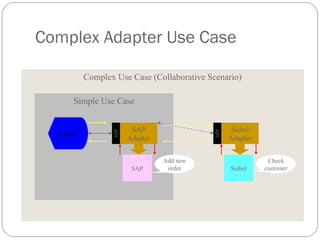
Data
Function (Web Services)
The two main types of software integration environments are:
Point to Point (Application Server based)
Brokered (Integration Platform based)
The extended focus of software integration is business
processes
Integrating information systems with business processes
Automating the integrated business processes
Background On Software Integration
Components of Software Integration Platform
Foundation components
Host (Application Server, Integration Server, others)
Messaging bus (JMS, others)
Object brokers (OMG)
Database engines (RDBMS, ODBMS, others)
Transaction engines (XA compliant, others)
Value add integration components
Transformer
Mapping, Object aggregation, Object decomposition
Broker
Routing, Filters
Adapters
Current Perspective on EAI
EAI is still a big, complex, expensive, tedious and repeating
problem faced universally by companies of all sizes
Approximately 1/3 of all IT costs are EAI related
Approximately 1/2 of all EAI costs are adapter-related
The definition of EAI is much broader today and includes software
systems within and outside the companies firewalls
 The term “EAI” has been changed and misunderstood with the continuing evolution
of EAI technologies
Current Perspective on EAI
EAI is an ongoing initiative and requires strategic thinking,
strong risk management, and realistic goal oriented
implementation plans
Industry studies have reported that the success rates of EAI
project is very low < 5%
Existing methodologies, project management practices &
processes are not enough to deal with the unique and specific
risk management requirements of EAI
Current Perspective on EAI
New tools have a strong commitment to solve one of the
toughest problems of EAI namely development of
custom/customized adapters and lowering the total cost of
ownership
The first step is to define EAI in a clear and simple form easy
to understand, comprehend, and implement
Definition of EAI
EAI is the process of integrating applications and database
systems into a unified software system capable of supporting:
On-demand data exchange
Collaboration of shared functions
Consolidation & Transformation of data into information
Automating data synchronization
Automating business process
EAI Domains
The EAI processes are grouped into a set of logical processes
(“Domains”) which simplifies the definition of specific EAI
processes
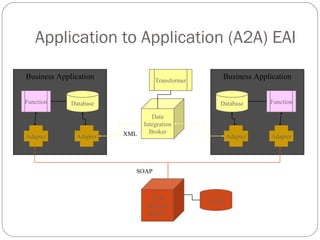
Application To Application Domain (A2A - Domain)
The process of integrating two or more business applications
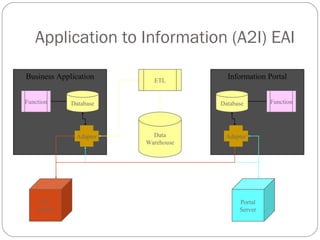
Application To Information Domain (A2I - Domain)
The process of integrating a business application with information
producers (data warehouses), information access portals, etc.
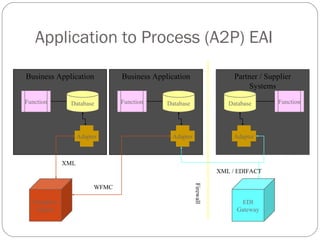
Application To Process Domain (A2P - Domain)
The process of integrating a business application with one or more work
flows, EDI gateways, supply chain automation networks, mobile
workforce networks
EAI Domain Reference Models
Every EAI Domain is supported by a context sensitive
reference model that can be used to define, design, deploy a
customized EAI solution
Each EAI domain reference model contains:
A logical architecture that defines the components and
relationships of the EAI process
A set of integration patterns that define the different behavior
and interactions of the EAI process
A technology stack containing layers of technologies and
standards that enable the EAI process
Business ApplicationBusiness Application
Application to Application (A2A) EAI
Database DatabaseFunction Function
Data
Integration
Broker
Adapter Adapter
Web
Services
Broker
Adapter Adapter
SOAP
XML
Transformer
UDDI
Information PortalBusiness Application
Application to Information (A2I) EAI
Database DatabaseFunction Function
Adapter
EII
Server
Adapter
ETL
Data
Warehouse
Portal
Server
Business Application Partner / Supplier
Systems
Business Application
Application to Process (A2P) EAI
Database DatabaseFunction Function
Adapter
Workflow
Engine
Adapter
EDI
Gateway
XML
DatabaseFunction
Adapter
XML / EDIFACT
Firewall
WFMC
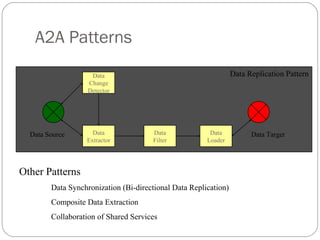
Data Replication Pattern
A2A Patterns
Data
Change
Detector
Data
Extractor
Data
Filter
Data Source Data TargetData
Loader
Other Patterns
Data Synchronization (Bi-directional Data Replication)
Composite Data Extraction
Collaboration of Shared Services
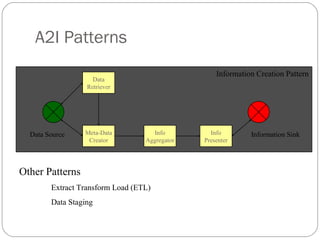
Information Creation Pattern
A2I Patterns
Data
Retriever
Meta-Data
Creator
Info
Aggregator
Data Source Information SinkInfo
Presenter
Other Patterns
Extract Transform Load (ETL)
Data Staging
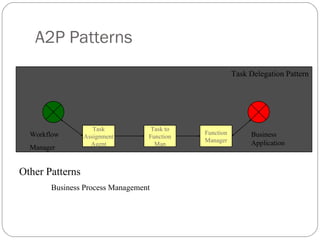
Task Delegation Pattern
A2P Patterns
Task
Assignment
Agent
Task to
Function
Map
Workflow
Manager
Business
Application
Function
Manager
Other Patterns
Business Process Management
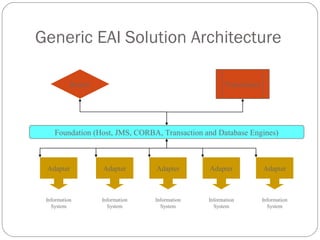
Generic EAI Solution Architecture
Foundation (Host, JMS, CORBA, Transaction and Database Engines)
Broker Transformer
Adapter
Information
System
Adapter
Information
System
Adapter
Information
System
Adapter
Information
System
Adapter
Information
System
Adapter Technology Status Quo
Adapters represent the highest incremental cost of
integration
Each applications that needs to be integrated requires a
minimum of one to three adapters (A2A, A2I, A2P)
The average Fortune 1000 company1
has 48 applications and
14 databases for a total of 62 potential adapters
There are few specific tools and platforms available for
development and maintenance of adapters
1
IDC
Definition of an Adapter
There is no Single Definition of an Adapter
But there is a common understanding of the adapters
behavior and role
Adapters, Connectors, Plug-ins, Web Services, Integration
Components and other proprietary terms are used in
different context to mean “Adapter Type Of Functionality”
Adapter definitions tend to be context sensitive
Generic Definition Of Adapter
An Adapter is a software component which integrates two
different instances of software systems
Typically the software systems integrated are business
applications (information systems)
In a brokered integration environment a business application is integrated
with the broker by using an adapter
Adapter facilitates integration between the integrated software
systems
Provide connectivity between the systems
Manage the interactions between the systems
Enforce transformation and other business rules
Background On Adapters
The concept of adapters was first introduced by the
Enterprise Application Integration (EAI) vendors in the later
half of 1990’s
Adapters have become the most important aspect of software
integration
Every software that needs to be integrated requires an adapter
The average Fortune 1000 company has 48 different business
applications and 14 different databases¹
Adapters represent the highest incremental cost of software
integration
¹ IDC
Background On Adapters
Until recently there were no standards for developing and
supporting adapters
J2EE:JCA is the first system level standard designed to support
adapters on the Java Application Server
Major vendors are now supporting J2EE:JCA in their Java application
servers
Adapters are becoming a commodity
System standards for adapters will result in more focus on
integration functionality
Multiple providers of the same adapter will give users
opportunity to compare adapter features
Background On Adapters
Generally adapters are custom developed from scratch
Most information systems are proprietary or heavily
customized
The average cost of developing and maintaining an adapter for
packaged applications like SAP, PeopleSoft, etc. over a five year
period is over U$ 1 Million
The adapter market has few tools available for developers
The biggest challenge in creating adapter tools is the expertise
and experience required to design, develop, and maintain
complex adapters
Adapter Interactions
An adapter use case defines a specific interaction between the
two software systems integrated by the adapter
An adapter use case is a sequence of one or more functional
steps
There are two types of steps in an adapter use case
Integration function (Connection, Parsing, Transformation, etc.)
Support function (System Logging, Error handling, Audit Trail, etc.)
Two types of use cases
Simple Use Case
Involves only one adapter (two software systems)
Complex Use Case
Involves two or more adapters (four or more software systems)
Adapter Scenarios
An adapter scenario is a specific instance of an adapter use
case and is bound to a specific runtime environment
Atomic Scenario (Derived from simple use case)
Collaborative Scenario (Derived from complex use case)
It is possible for adapter scenarios to change between atomic
and collaborative scenarios depending on the runtime
environment
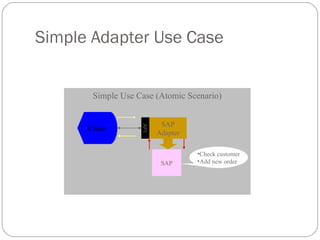
Simple Use Case (Atomic Scenario)
Simple Adapter Use Case
SAP
Adapter
SAP
API
Client
•Check customer
•Add new order
Complex Use Case (Collaborative Scenario)
Simple Use Case
Complex Adapter Use Case
SAP
Adapter
SAP
Siebel
Adapter
Siebel
API
API
Client
Add new
order
Check
customer
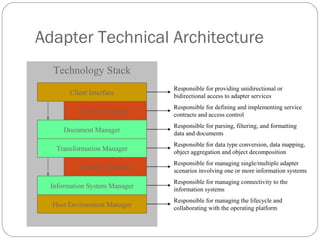
Adapter Technical Architecture
Technology Stack
Client Interface
Service Gateway
Document Manager
Transformation Manager
Scenario Manager
Information System Manager
Host Environment Manager
Responsible for providing unidirectional or
bidirectional access to adapter services
Responsible for parsing, filtering, and formatting
data and documents
Responsible for managing single/multiple adapter
scenarios involving one or more information systems
Responsible for defining and implementing service
contracts and access control
Responsible for data type conversion, data mapping,
object aggregation and object decomposition
Responsible for managing connectivity to the
information systems
Responsible for managing the lifecycle and
collaborating with the operating platform
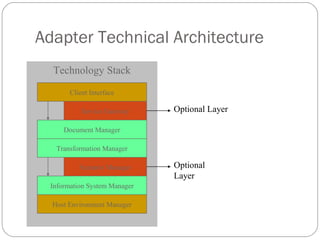
Adapter Technical Architecture
Technology Stack
Client Interface
Service Gateway
Document Manager
Transformation Manager
Scenario Manager
Information System Manager
Host Environment Manager
Optional Layer
Optional
Layer
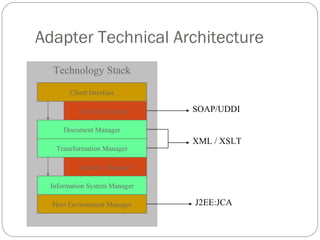
Adapter Technical Architecture
Technology Stack
Client Interface
Service Gateway
Document Manager
Transformation Manager
Scenario Manager
Information System Manager
Host Environment Manager
SOAP/UDDI
J2EE:JCA
XML / XSLT
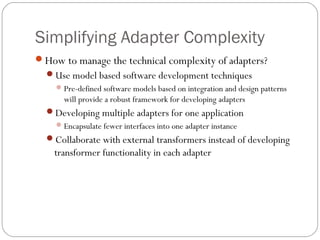
Simplifying Adapter Complexity
How to manage the technical complexity of adapters?
Use model based software development techniques
Pre-defined software models based on integration and design patterns
will provide a robust framework for developing adapters
Developing multiple adapters for one application
Encapsulate fewer interfaces into one adapter instance
Collaborate with external transformers instead of developing
transformer functionality in each adapter
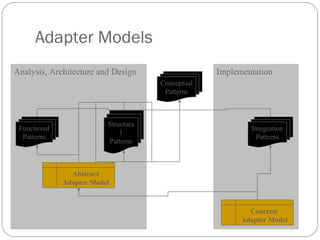
ImplementationAnalysis, Architecture and Design
Adapter Models
Abstract
Adapter Model
Structura
l
Patterns
Functional
Patterns
Conceptual
Patterns
Integration
Patterns
Concrete
Adapter Model
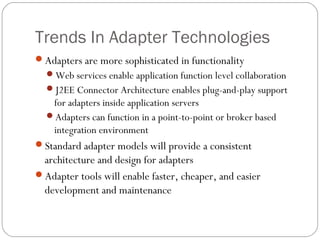
Trends In Adapter Technologies
Adapters are more sophisticated in functionality
Web services enable application function level collaboration
J2EE Connector Architecture enables plug-and-play support
for adapters inside application servers
Adapters can function in a point-to-point or broker based
integration environment
Standard adapter models will provide a consistent
architecture and design for adapters
Adapter tools will enable faster, cheaper, and easier
development and maintenance
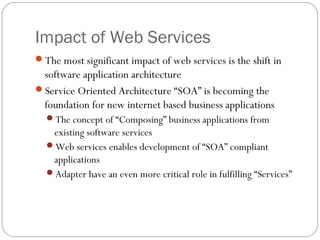
Impact of Web Services
The most significant impact of web services is the shift in
software application architecture
Service Oriented Architecture “SOA” is becoming the
foundation for new internet based business applications
The concept of “Composing” business applications from
existing software services
Web services enables development of “SOA” compliant
applications
Adapter have an even more critical role in fulfilling “Services”
Impact of Web Services
Where is the Synergy between adapters and web services?
Web services provide a standardized platform for defining,
locating, and invoking business services
WSDL, UDDI, SOAP
Adapter provide a standardized component mechanism for
fulfilling the web services by accessing external software
systems
J2CA
Both web services and adapters are moving towards a common
semantic environment enabling rapid “composition”
UDEF, RDF
What is J2EE Connector Architecture?
J2EE Connector Architecture (J2CA) is a sub-specification of
J2EE
J2CA is a system level interface for hosting and accessing
connectors to non-J2EE applications
J2CA connectors extend the J2EE servers ability to interface
with non-J2EE applications
Most J2EE servers support J2CA specification
IBM WebSphere, BEA WebLogic, Jboss, Oracle AS
J2CA compliant adapters for popular applications like SAP,
PeopleSoft, are now available in the market place
What is J2EE Connector Architecture?
J2CA Specification (Ver 1.5) defines system contracts for
managing security, transactions, and connections between
J2EE application components and legacy systems
Support meta-data interfaces and bi-directional access
between adapters and legacy systems
Message driven access to J2CA connectors is now possible
Moving Towards Semantic
Adapters
What is a Semantic Adapter?
A Semantic Adapter provides an interface to the semantics of
the adapter
Adapter Behavior (Services provided by the adapter)
Meta-data of the adapted systems data structures
Meta-data of the adapted systems service interfaces
Configuration properties of the adapters runtime environment
A Semantic Adapter uses an Ontology based approach to define
the semantics
This involves associating commonly understood meaning to the definition
of adapter properties, behavior, configuration, and associated meta-data
Adapter Development Tools
Fundamental Requirements
Enable just in time adapter development and maintenance
Customers do not purchase adapters ahead of requirement
End points (information systems) change and therefore pre-built adapters
need customization too
Extend the model based design (MBD) paradigm to adapters
Model based development significantly reduces development time and
cost, and increases adapter quality
Differentiate and support abstract adapter models and concrete
adapter models
Enables multiple implementations of a common abstract adapter
model
Adapter Development Tools
Fundamental Requirements
Enable adapter developers to focus on the business
requirements of integrating two software systems
Develop and maintain platform controllers which encapsulates the
operating platform system interfaces from adapter developers
Eliminates the burden of learning and programming system level
interfaces and standards
E.g: J2EE:JCA controller which encapsulates J2EE:JCA system
contracts from the adapter developer
Generate adapter framework and component shell from pre-defined
adapter models
Ensures design consistency, reduces bugs and enhances the quality of
adapters
Adapter Technology
Architecture:
Adapter architecture based on the concept of functional layers
Each layer encapsulates specific adapter functionality accessible as well
defined services
Each layer can be implemented as an isolated/distributed component of
the adapter
Architecture supports three types of interactions for an adapter
Synchronization
Keeping distributed data models in sync with each other
Collaboration
Enabling software systems to collaborate functions
Delegation
Enabling software systems to execute tasks on behalf of other systems
Adapter Technology
Adapter Model
Is a collection of one or more adapter patterns managed by the
E-Fusion framework Integrated Collaboration Environment
(ICE)
E-Fusion supports two types of Adapter Models
Abstract adapter model
Represents the architecture and design of an adapter
Adapters cannot be created directly from abstract adapter models as
there are no implementation details defined
Concrete adapter model
Represents the implementation reference model of an adapter
Includes one or more run-time scenarios
Adapters can be created from concrete adapter models
Adapter Development Environment
Adapter Development Environment (ADE) supports
developers throughout the full lifecycle of adapter
development and maintenance
From design to maintenance
Design, Develop, Assemble, Configure, Deploy, Maintain
Develop pre-built adapter models and support custom adapter models
Enable higher efficiencies in adapter development without
changing existing development workflow and processes
Define new adapter engineering and development methodologies which
can be applied with generic software development tools
Adapter Runtime Environment
Adapter Runtime Environment (ARE) supports distributed
and centralized adapter deployments across multiple
platforms
Support dynamic distribution of adapter components across the
platforms in the adapter runtime environment
Support centralized administration, monitoring, and debugging
of adapters at runtime
Support dynamic language (locale) translation for multi-lingual
runtime environments
Support dynamic component code download and side-by-side
runtime environments (production and QA)
Summary
Adapters are complex pieces of software performing critical
integration tasks
The definition of adapters continues to expand and support
new application architectures (“SOA”)
Adapter tools are now available for enabling rapid adapter
development and deployment
The trend is towards developing semantically and
functionally rich adapters will continue to strengthen the role
of adapters

Adapters and EAI

  • 1.
  • 2.
    Agenda Session 1: Background onsoftware integration Background on adapters Overview of adapter technology Session 2: Overview of trends in adapter technology J2CA, Web Services, Semantic Adapters Overview of adapter development tools
  • 3.
    Background On SoftwareIntegration Software integration is the #1 IT priority today It is also the most complex and expensive problem to solve About 30% - 40% of all IT costs are integration-related Approximately 1/2 of all integration costs are adapter-related Adapters represent the highest incremental cost of software integration Each software system that needs to be integrated requires an adapter
  • 4.
    Background On SoftwareIntegration The primary focus of software integration is information systems (or business applications) The two main areas of software integration are: Data Function (Web Services) The two main types of software integration environments are: Point to Point (Application Server based) Brokered (Integration Platform based) The extended focus of software integration is business processes Integrating information systems with business processes Automating the integrated business processes
  • 5.
    Background On SoftwareIntegration Components of Software Integration Platform Foundation components Host (Application Server, Integration Server, others) Messaging bus (JMS, others) Object brokers (OMG) Database engines (RDBMS, ODBMS, others) Transaction engines (XA compliant, others) Value add integration components Transformer Mapping, Object aggregation, Object decomposition Broker Routing, Filters Adapters
  • 6.
    Current Perspective onEAI EAI is still a big, complex, expensive, tedious and repeating problem faced universally by companies of all sizes Approximately 1/3 of all IT costs are EAI related Approximately 1/2 of all EAI costs are adapter-related The definition of EAI is much broader today and includes software systems within and outside the companies firewalls  The term “EAI” has been changed and misunderstood with the continuing evolution of EAI technologies
  • 7.
    Current Perspective onEAI EAI is an ongoing initiative and requires strategic thinking, strong risk management, and realistic goal oriented implementation plans Industry studies have reported that the success rates of EAI project is very low < 5% Existing methodologies, project management practices & processes are not enough to deal with the unique and specific risk management requirements of EAI
  • 8.
    Current Perspective onEAI New tools have a strong commitment to solve one of the toughest problems of EAI namely development of custom/customized adapters and lowering the total cost of ownership The first step is to define EAI in a clear and simple form easy to understand, comprehend, and implement
  • 9.
    Definition of EAI EAIis the process of integrating applications and database systems into a unified software system capable of supporting: On-demand data exchange Collaboration of shared functions Consolidation & Transformation of data into information Automating data synchronization Automating business process
  • 10.
    EAI Domains The EAIprocesses are grouped into a set of logical processes (“Domains”) which simplifies the definition of specific EAI processes Application To Application Domain (A2A - Domain) The process of integrating two or more business applications Application To Information Domain (A2I - Domain) The process of integrating a business application with information producers (data warehouses), information access portals, etc. Application To Process Domain (A2P - Domain) The process of integrating a business application with one or more work flows, EDI gateways, supply chain automation networks, mobile workforce networks
  • 11.
    EAI Domain ReferenceModels Every EAI Domain is supported by a context sensitive reference model that can be used to define, design, deploy a customized EAI solution Each EAI domain reference model contains: A logical architecture that defines the components and relationships of the EAI process A set of integration patterns that define the different behavior and interactions of the EAI process A technology stack containing layers of technologies and standards that enable the EAI process
  • 12.
    Business ApplicationBusiness Application Applicationto Application (A2A) EAI Database DatabaseFunction Function Data Integration Broker Adapter Adapter Web Services Broker Adapter Adapter SOAP XML Transformer UDDI
  • 13.
    Information PortalBusiness Application Applicationto Information (A2I) EAI Database DatabaseFunction Function Adapter EII Server Adapter ETL Data Warehouse Portal Server
  • 14.
    Business Application Partner/ Supplier Systems Business Application Application to Process (A2P) EAI Database DatabaseFunction Function Adapter Workflow Engine Adapter EDI Gateway XML DatabaseFunction Adapter XML / EDIFACT Firewall WFMC
  • 15.
    Data Replication Pattern A2APatterns Data Change Detector Data Extractor Data Filter Data Source Data TargetData Loader Other Patterns Data Synchronization (Bi-directional Data Replication) Composite Data Extraction Collaboration of Shared Services
  • 16.
    Information Creation Pattern A2IPatterns Data Retriever Meta-Data Creator Info Aggregator Data Source Information SinkInfo Presenter Other Patterns Extract Transform Load (ETL) Data Staging
  • 17.
    Task Delegation Pattern A2PPatterns Task Assignment Agent Task to Function Map Workflow Manager Business Application Function Manager Other Patterns Business Process Management
  • 18.
    Generic EAI SolutionArchitecture Foundation (Host, JMS, CORBA, Transaction and Database Engines) Broker Transformer Adapter Information System Adapter Information System Adapter Information System Adapter Information System Adapter Information System
  • 19.
    Adapter Technology StatusQuo Adapters represent the highest incremental cost of integration Each applications that needs to be integrated requires a minimum of one to three adapters (A2A, A2I, A2P) The average Fortune 1000 company1 has 48 applications and 14 databases for a total of 62 potential adapters There are few specific tools and platforms available for development and maintenance of adapters 1 IDC
  • 20.
    Definition of anAdapter There is no Single Definition of an Adapter But there is a common understanding of the adapters behavior and role Adapters, Connectors, Plug-ins, Web Services, Integration Components and other proprietary terms are used in different context to mean “Adapter Type Of Functionality” Adapter definitions tend to be context sensitive
  • 21.
    Generic Definition OfAdapter An Adapter is a software component which integrates two different instances of software systems Typically the software systems integrated are business applications (information systems) In a brokered integration environment a business application is integrated with the broker by using an adapter Adapter facilitates integration between the integrated software systems Provide connectivity between the systems Manage the interactions between the systems Enforce transformation and other business rules
  • 22.
    Background On Adapters Theconcept of adapters was first introduced by the Enterprise Application Integration (EAI) vendors in the later half of 1990’s Adapters have become the most important aspect of software integration Every software that needs to be integrated requires an adapter The average Fortune 1000 company has 48 different business applications and 14 different databases¹ Adapters represent the highest incremental cost of software integration ¹ IDC
  • 23.
    Background On Adapters Untilrecently there were no standards for developing and supporting adapters J2EE:JCA is the first system level standard designed to support adapters on the Java Application Server Major vendors are now supporting J2EE:JCA in their Java application servers Adapters are becoming a commodity System standards for adapters will result in more focus on integration functionality Multiple providers of the same adapter will give users opportunity to compare adapter features
  • 24.
    Background On Adapters Generallyadapters are custom developed from scratch Most information systems are proprietary or heavily customized The average cost of developing and maintaining an adapter for packaged applications like SAP, PeopleSoft, etc. over a five year period is over U$ 1 Million The adapter market has few tools available for developers The biggest challenge in creating adapter tools is the expertise and experience required to design, develop, and maintain complex adapters
  • 25.
    Adapter Interactions An adapteruse case defines a specific interaction between the two software systems integrated by the adapter An adapter use case is a sequence of one or more functional steps There are two types of steps in an adapter use case Integration function (Connection, Parsing, Transformation, etc.) Support function (System Logging, Error handling, Audit Trail, etc.) Two types of use cases Simple Use Case Involves only one adapter (two software systems) Complex Use Case Involves two or more adapters (four or more software systems)
  • 26.
    Adapter Scenarios An adapterscenario is a specific instance of an adapter use case and is bound to a specific runtime environment Atomic Scenario (Derived from simple use case) Collaborative Scenario (Derived from complex use case) It is possible for adapter scenarios to change between atomic and collaborative scenarios depending on the runtime environment
  • 27.
    Simple Use Case(Atomic Scenario) Simple Adapter Use Case SAP Adapter SAP API Client •Check customer •Add new order
  • 28.
    Complex Use Case(Collaborative Scenario) Simple Use Case Complex Adapter Use Case SAP Adapter SAP Siebel Adapter Siebel API API Client Add new order Check customer
  • 29.
    Adapter Technical Architecture TechnologyStack Client Interface Service Gateway Document Manager Transformation Manager Scenario Manager Information System Manager Host Environment Manager Responsible for providing unidirectional or bidirectional access to adapter services Responsible for parsing, filtering, and formatting data and documents Responsible for managing single/multiple adapter scenarios involving one or more information systems Responsible for defining and implementing service contracts and access control Responsible for data type conversion, data mapping, object aggregation and object decomposition Responsible for managing connectivity to the information systems Responsible for managing the lifecycle and collaborating with the operating platform
  • 30.
    Adapter Technical Architecture TechnologyStack Client Interface Service Gateway Document Manager Transformation Manager Scenario Manager Information System Manager Host Environment Manager Optional Layer Optional Layer
  • 31.
    Adapter Technical Architecture TechnologyStack Client Interface Service Gateway Document Manager Transformation Manager Scenario Manager Information System Manager Host Environment Manager SOAP/UDDI J2EE:JCA XML / XSLT
  • 32.
    Simplifying Adapter Complexity Howto manage the technical complexity of adapters? Use model based software development techniques Pre-defined software models based on integration and design patterns will provide a robust framework for developing adapters Developing multiple adapters for one application Encapsulate fewer interfaces into one adapter instance Collaborate with external transformers instead of developing transformer functionality in each adapter
  • 33.
    ImplementationAnalysis, Architecture andDesign Adapter Models Abstract Adapter Model Structura l Patterns Functional Patterns Conceptual Patterns Integration Patterns Concrete Adapter Model
  • 34.
    Trends In AdapterTechnologies Adapters are more sophisticated in functionality Web services enable application function level collaboration J2EE Connector Architecture enables plug-and-play support for adapters inside application servers Adapters can function in a point-to-point or broker based integration environment Standard adapter models will provide a consistent architecture and design for adapters Adapter tools will enable faster, cheaper, and easier development and maintenance
  • 35.
    Impact of WebServices The most significant impact of web services is the shift in software application architecture Service Oriented Architecture “SOA” is becoming the foundation for new internet based business applications The concept of “Composing” business applications from existing software services Web services enables development of “SOA” compliant applications Adapter have an even more critical role in fulfilling “Services”
  • 36.
    Impact of WebServices Where is the Synergy between adapters and web services? Web services provide a standardized platform for defining, locating, and invoking business services WSDL, UDDI, SOAP Adapter provide a standardized component mechanism for fulfilling the web services by accessing external software systems J2CA Both web services and adapters are moving towards a common semantic environment enabling rapid “composition” UDEF, RDF
  • 37.
    What is J2EEConnector Architecture? J2EE Connector Architecture (J2CA) is a sub-specification of J2EE J2CA is a system level interface for hosting and accessing connectors to non-J2EE applications J2CA connectors extend the J2EE servers ability to interface with non-J2EE applications Most J2EE servers support J2CA specification IBM WebSphere, BEA WebLogic, Jboss, Oracle AS J2CA compliant adapters for popular applications like SAP, PeopleSoft, are now available in the market place
  • 38.
    What is J2EEConnector Architecture? J2CA Specification (Ver 1.5) defines system contracts for managing security, transactions, and connections between J2EE application components and legacy systems Support meta-data interfaces and bi-directional access between adapters and legacy systems Message driven access to J2CA connectors is now possible
  • 39.
    Moving Towards Semantic Adapters Whatis a Semantic Adapter? A Semantic Adapter provides an interface to the semantics of the adapter Adapter Behavior (Services provided by the adapter) Meta-data of the adapted systems data structures Meta-data of the adapted systems service interfaces Configuration properties of the adapters runtime environment A Semantic Adapter uses an Ontology based approach to define the semantics This involves associating commonly understood meaning to the definition of adapter properties, behavior, configuration, and associated meta-data
  • 40.
    Adapter Development Tools FundamentalRequirements Enable just in time adapter development and maintenance Customers do not purchase adapters ahead of requirement End points (information systems) change and therefore pre-built adapters need customization too Extend the model based design (MBD) paradigm to adapters Model based development significantly reduces development time and cost, and increases adapter quality Differentiate and support abstract adapter models and concrete adapter models Enables multiple implementations of a common abstract adapter model
  • 41.
    Adapter Development Tools FundamentalRequirements Enable adapter developers to focus on the business requirements of integrating two software systems Develop and maintain platform controllers which encapsulates the operating platform system interfaces from adapter developers Eliminates the burden of learning and programming system level interfaces and standards E.g: J2EE:JCA controller which encapsulates J2EE:JCA system contracts from the adapter developer Generate adapter framework and component shell from pre-defined adapter models Ensures design consistency, reduces bugs and enhances the quality of adapters
  • 42.
    Adapter Technology Architecture: Adapter architecturebased on the concept of functional layers Each layer encapsulates specific adapter functionality accessible as well defined services Each layer can be implemented as an isolated/distributed component of the adapter Architecture supports three types of interactions for an adapter Synchronization Keeping distributed data models in sync with each other Collaboration Enabling software systems to collaborate functions Delegation Enabling software systems to execute tasks on behalf of other systems
  • 43.
    Adapter Technology Adapter Model Isa collection of one or more adapter patterns managed by the E-Fusion framework Integrated Collaboration Environment (ICE) E-Fusion supports two types of Adapter Models Abstract adapter model Represents the architecture and design of an adapter Adapters cannot be created directly from abstract adapter models as there are no implementation details defined Concrete adapter model Represents the implementation reference model of an adapter Includes one or more run-time scenarios Adapters can be created from concrete adapter models
  • 44.
    Adapter Development Environment AdapterDevelopment Environment (ADE) supports developers throughout the full lifecycle of adapter development and maintenance From design to maintenance Design, Develop, Assemble, Configure, Deploy, Maintain Develop pre-built adapter models and support custom adapter models Enable higher efficiencies in adapter development without changing existing development workflow and processes Define new adapter engineering and development methodologies which can be applied with generic software development tools
  • 45.
    Adapter Runtime Environment AdapterRuntime Environment (ARE) supports distributed and centralized adapter deployments across multiple platforms Support dynamic distribution of adapter components across the platforms in the adapter runtime environment Support centralized administration, monitoring, and debugging of adapters at runtime Support dynamic language (locale) translation for multi-lingual runtime environments Support dynamic component code download and side-by-side runtime environments (production and QA)
  • 46.
    Summary Adapters are complexpieces of software performing critical integration tasks The definition of adapters continues to expand and support new application architectures (“SOA”) Adapter tools are now available for enabling rapid adapter development and deployment The trend is towards developing semantically and functionally rich adapters will continue to strengthen the role of adapters