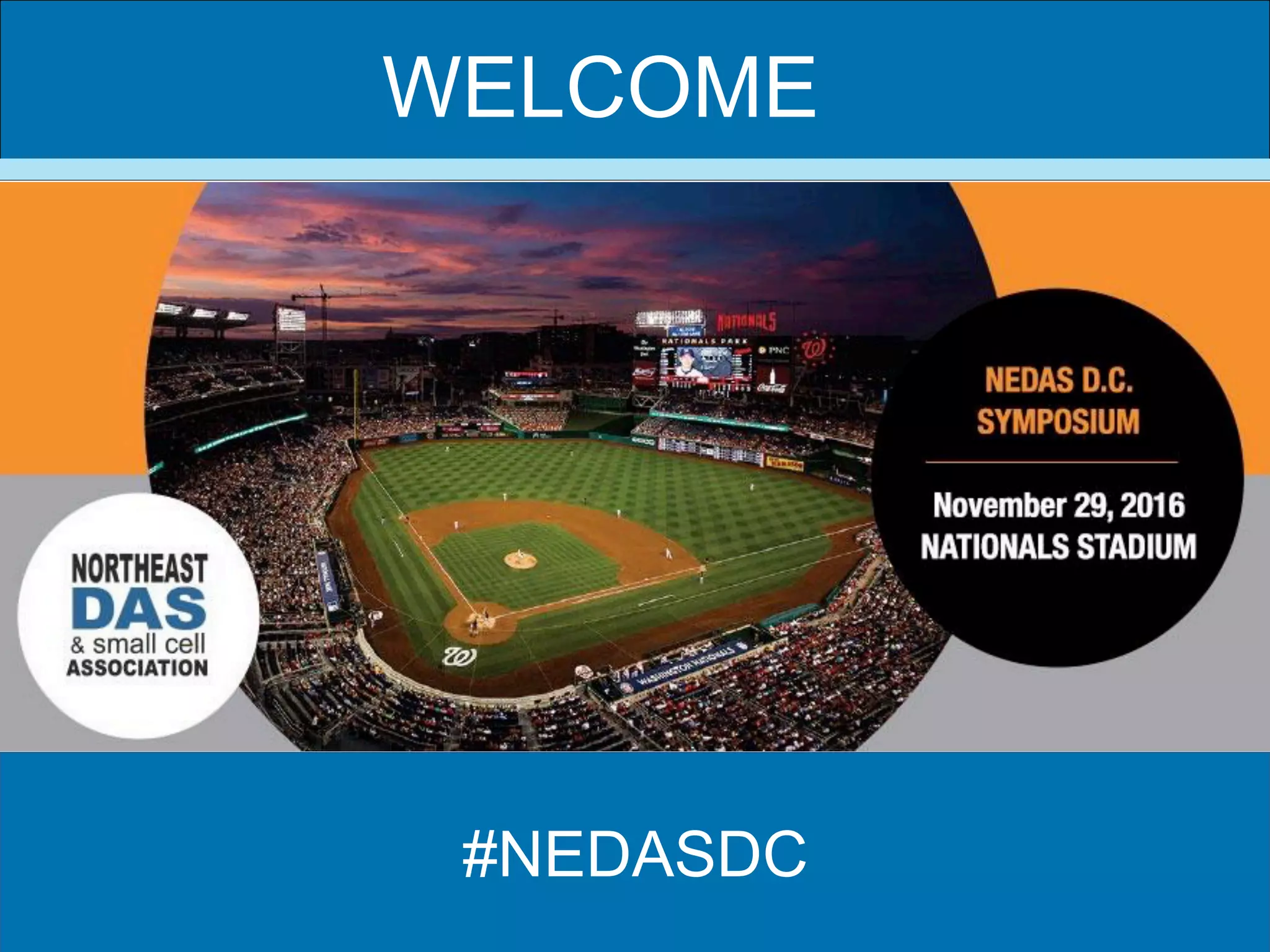
WELCOME
#NEDASDC
U.S. In-building Wireless Equipment
Market:
5-Year Demand Outlook
Meet the Panel
John	
  Celentano	
  
Analyst/Consultant
Skyline Marketing Group
Moderator
Ken	
  Rehbehn	
  
Principal Analyst,
Wireless Infrastructure
451 Research
Chris	
  Wixom	
  
Sr. Director-Strategic Accounts
Corning
Dominic	
  Villecco	
  
President
V-COMM
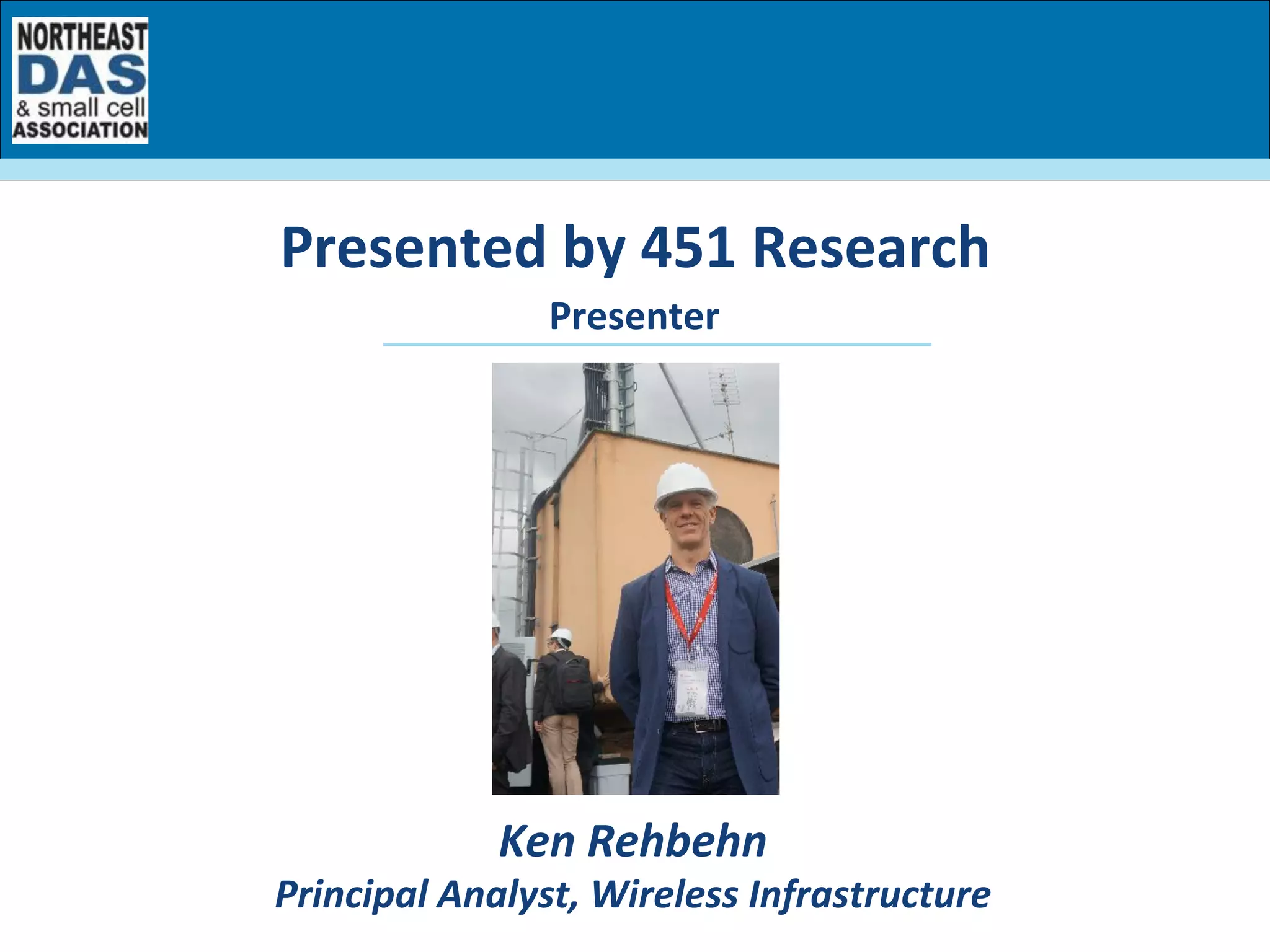
Presenter	
  
Presented	
  by	
  451	
  Research	
  
Ken	
  Rehbehn	
  
Principal	
  Analyst,	
  Wireless	
  Infrastructure	
  
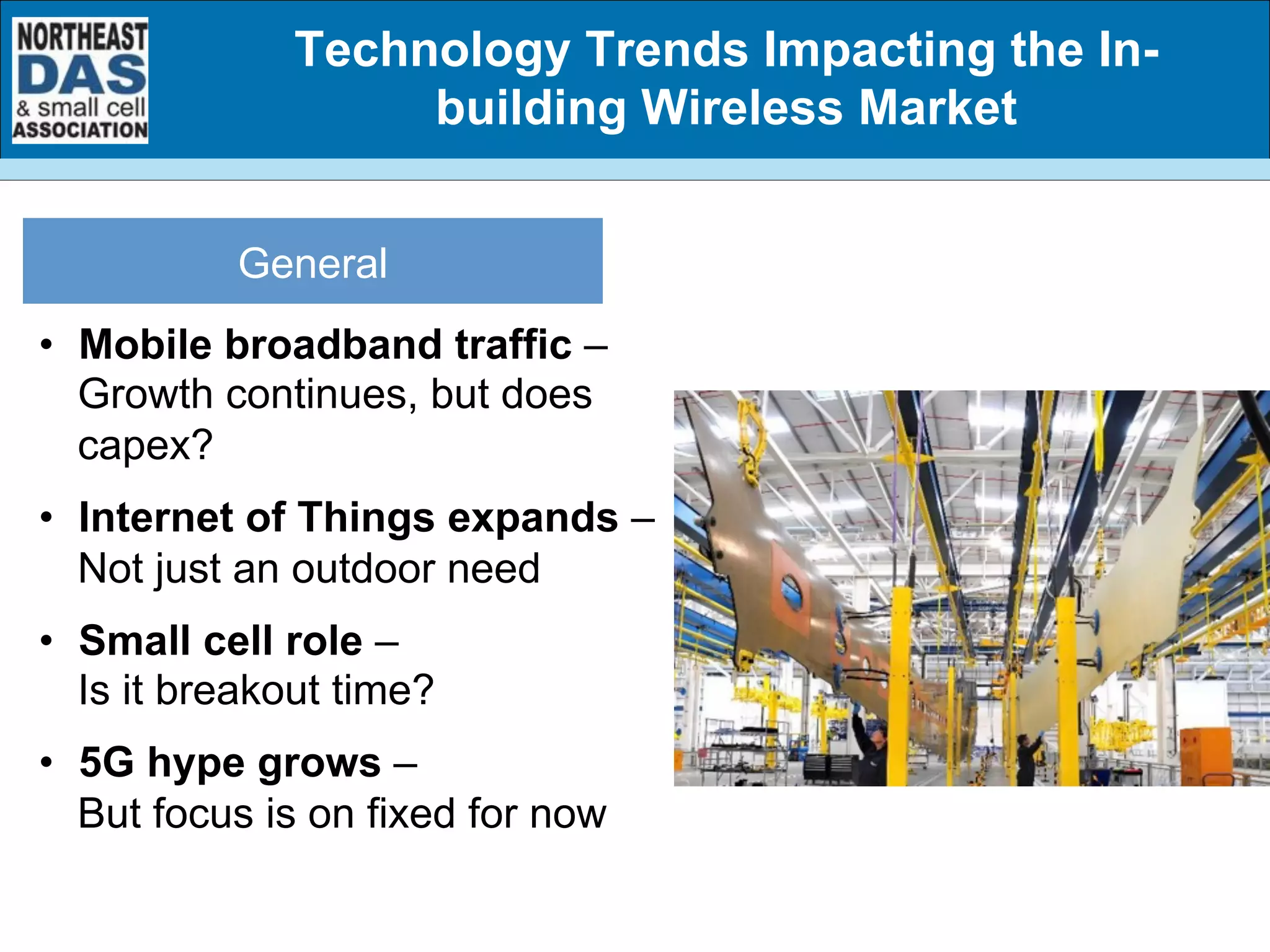
•  Mobile broadband traffic –
Growth continues, but does
capex?
•  Internet of Things expands –
Not just an outdoor need
•  Small cell role –
Is it breakout time?
•  5G hype grows –
But focus is on fixed for now
General
Technology Trends Impacting the In-
building Wireless Market
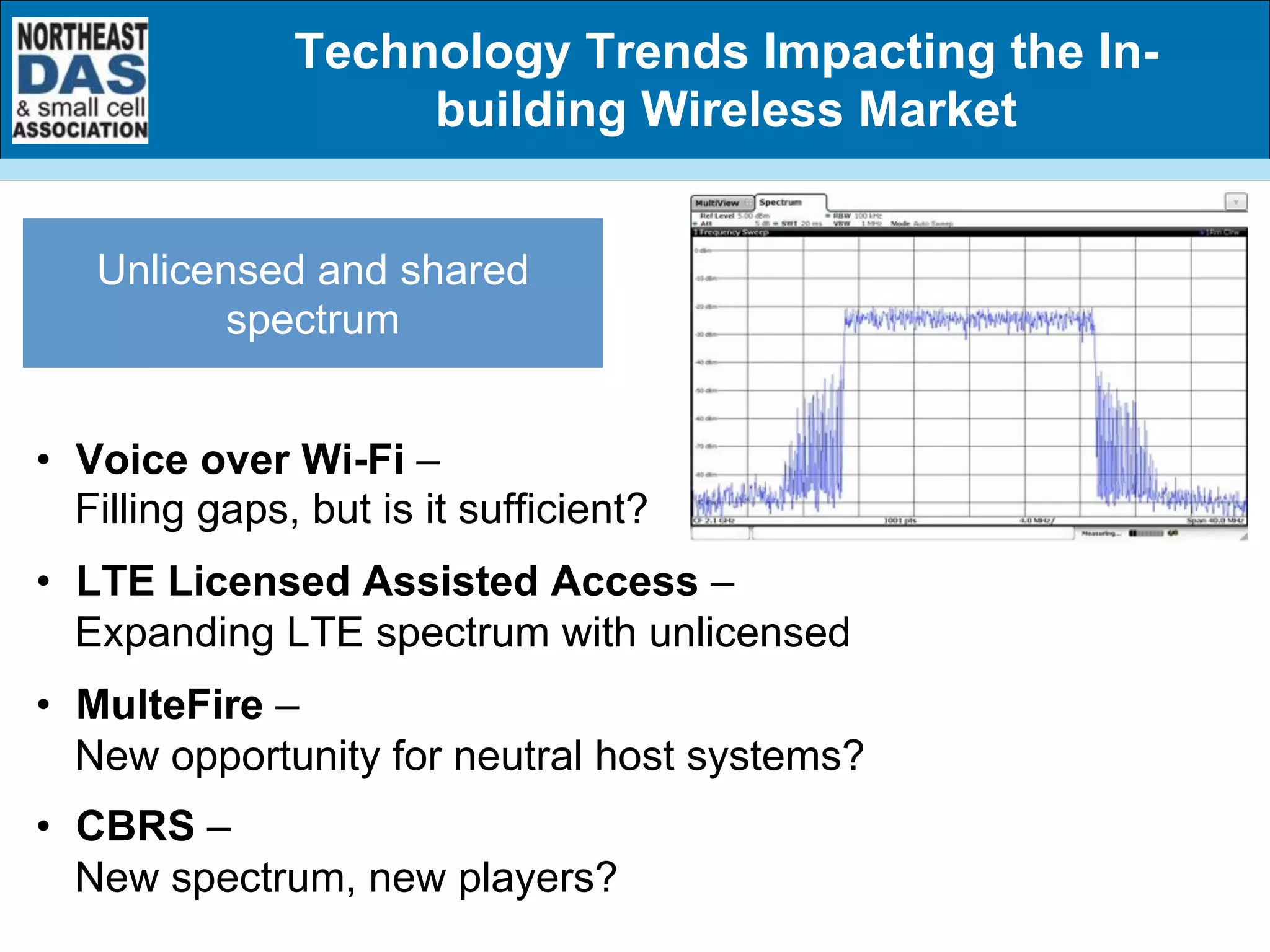
•  Voice over Wi-Fi –
Filling gaps, but is it sufficient?
•  LTE Licensed Assisted Access –
Expanding LTE spectrum with unlicensed
•  MulteFire –
New opportunity for neutral host systems?
•  CBRS –
New spectrum, new players?
Unlicensed and shared
spectrum
Technology Trends Impacting the In-
building Wireless Market
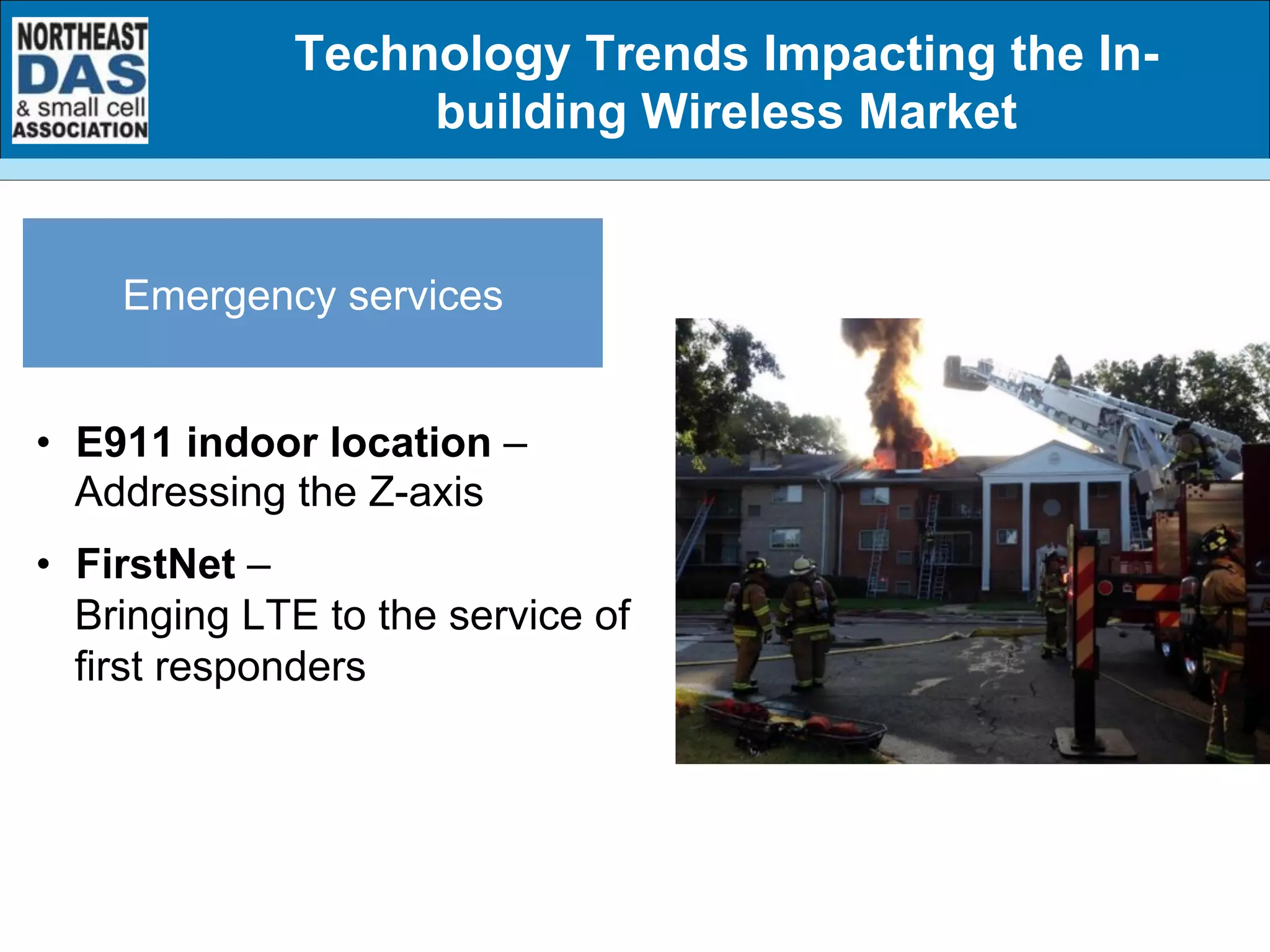
•  E911 indoor location –
Addressing the Z-axis
•  FirstNet –
Bringing LTE to the service of
first responders
Emergency services
Technology Trends Impacting the In-
building Wireless Market
Presenter	
  
Presented	
  by	
  Skyline	
  Marke7ng	
  Group	
  
John	
  Celentano	
  
Wireless	
  Market	
  Analyst/MarkeBng	
  Consultant	
  	
  
U.S. Commercial Buildings Installed Base
Source: EIA-CBECS, 2012, our estimates
© 2016. Skyline Marketing Group. All rights reserved.
Tier 1 [8,000]
Tier 2 [128,000]
Tier 3 [199,000]
Tier 4 [5,222,000]
500,000+ sf
<885,000 sf>
100,000-500,000 sf
<210,000 sf>
50,000-100,000 sf
<70,000 sf>
Under 50,000 sf
<16,000 sf>
IBW Complexity
Hi
Lo
Total = 5.6 million buildings
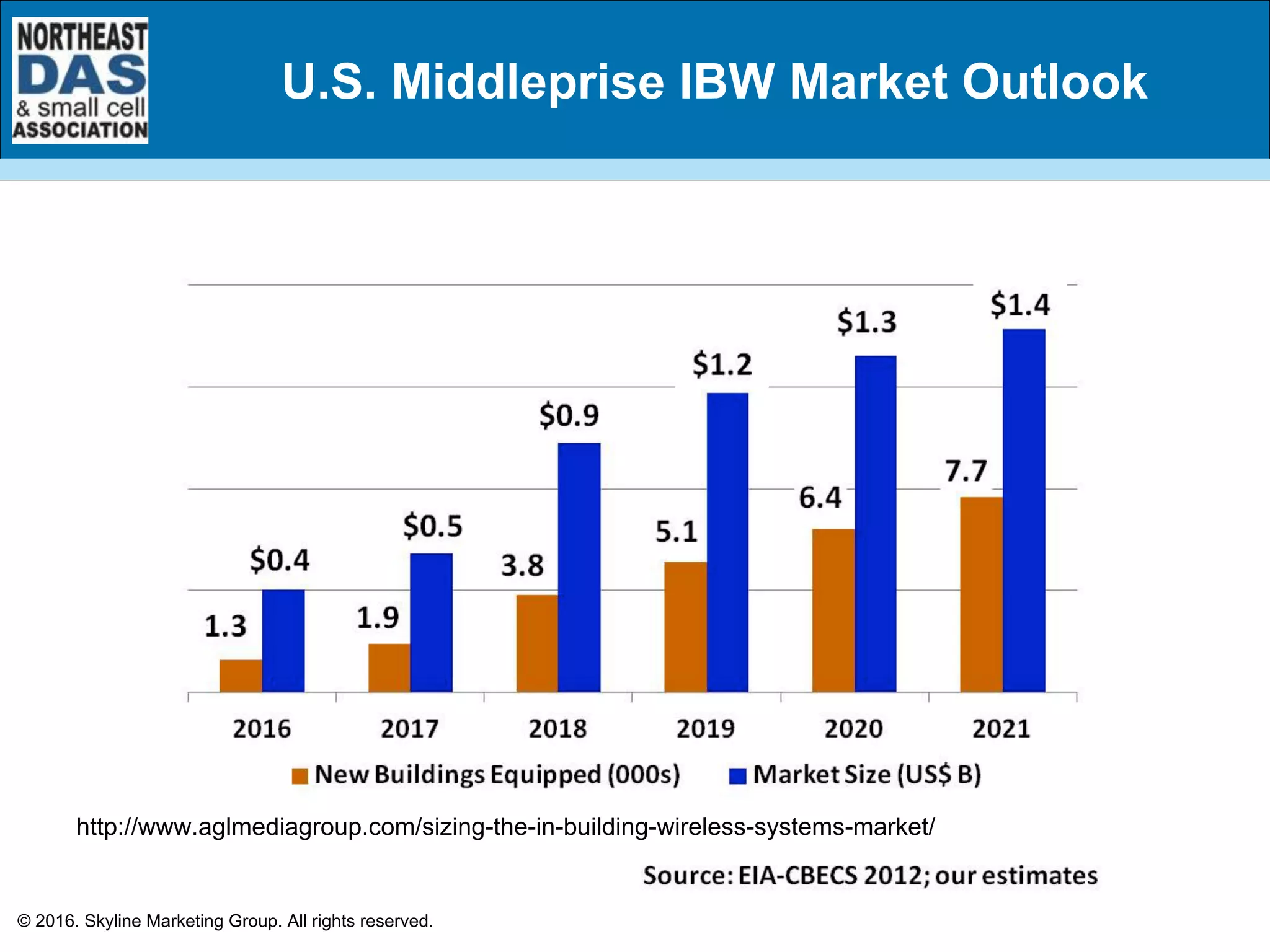
U.S. Middleprise IBW Market Outlook
© 2016. Skyline Marketing Group. All rights reserved.
http://www.aglmediagroup.com/sizing-the-in-building-wireless-systems-market/
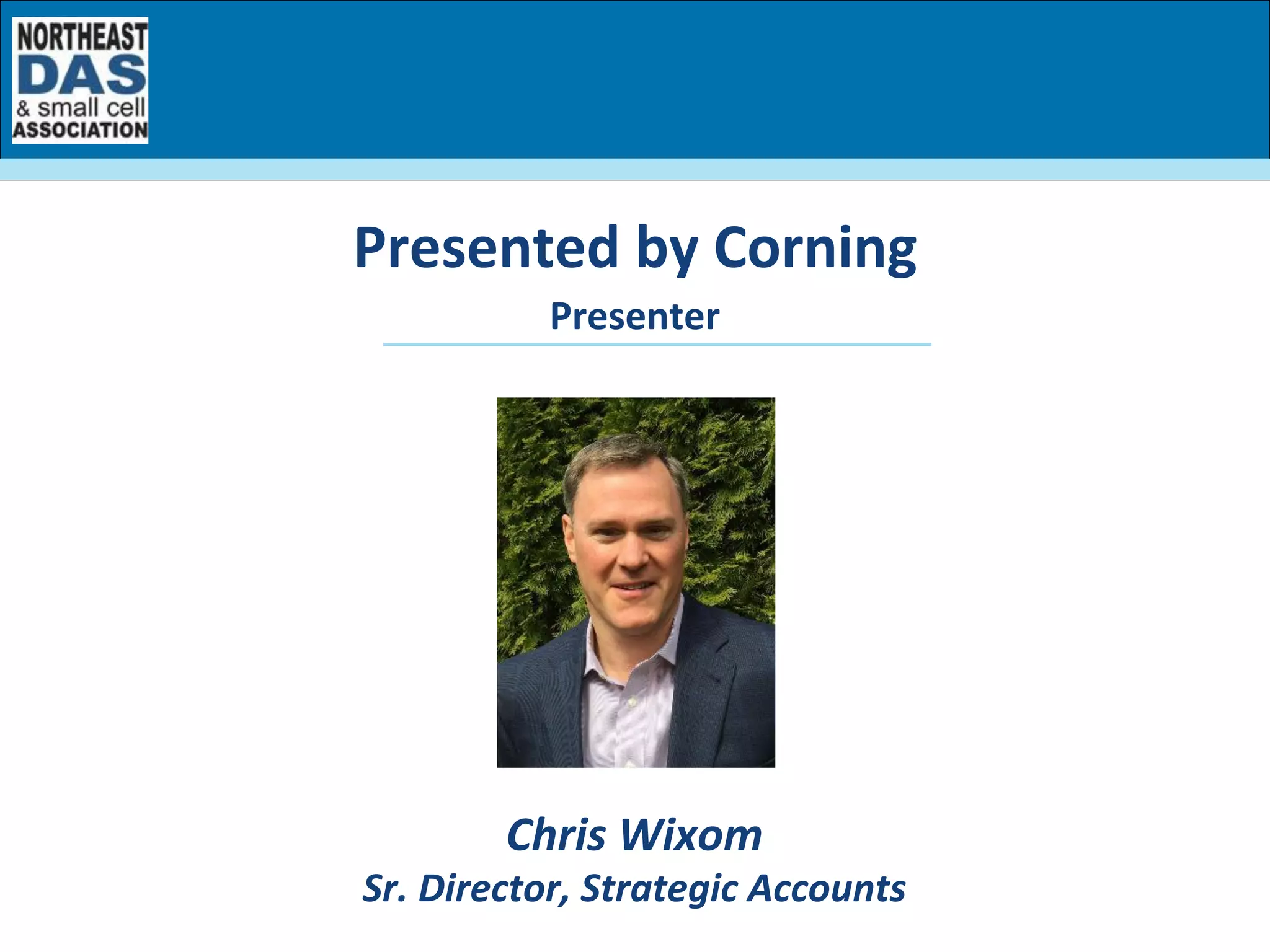
Presenter	
  
Chris	
  Wixom	
  
Sr.	
  Director,	
  Strategic	
  Accounts	
  	
  
Presented	
  by	
  Corning	
  
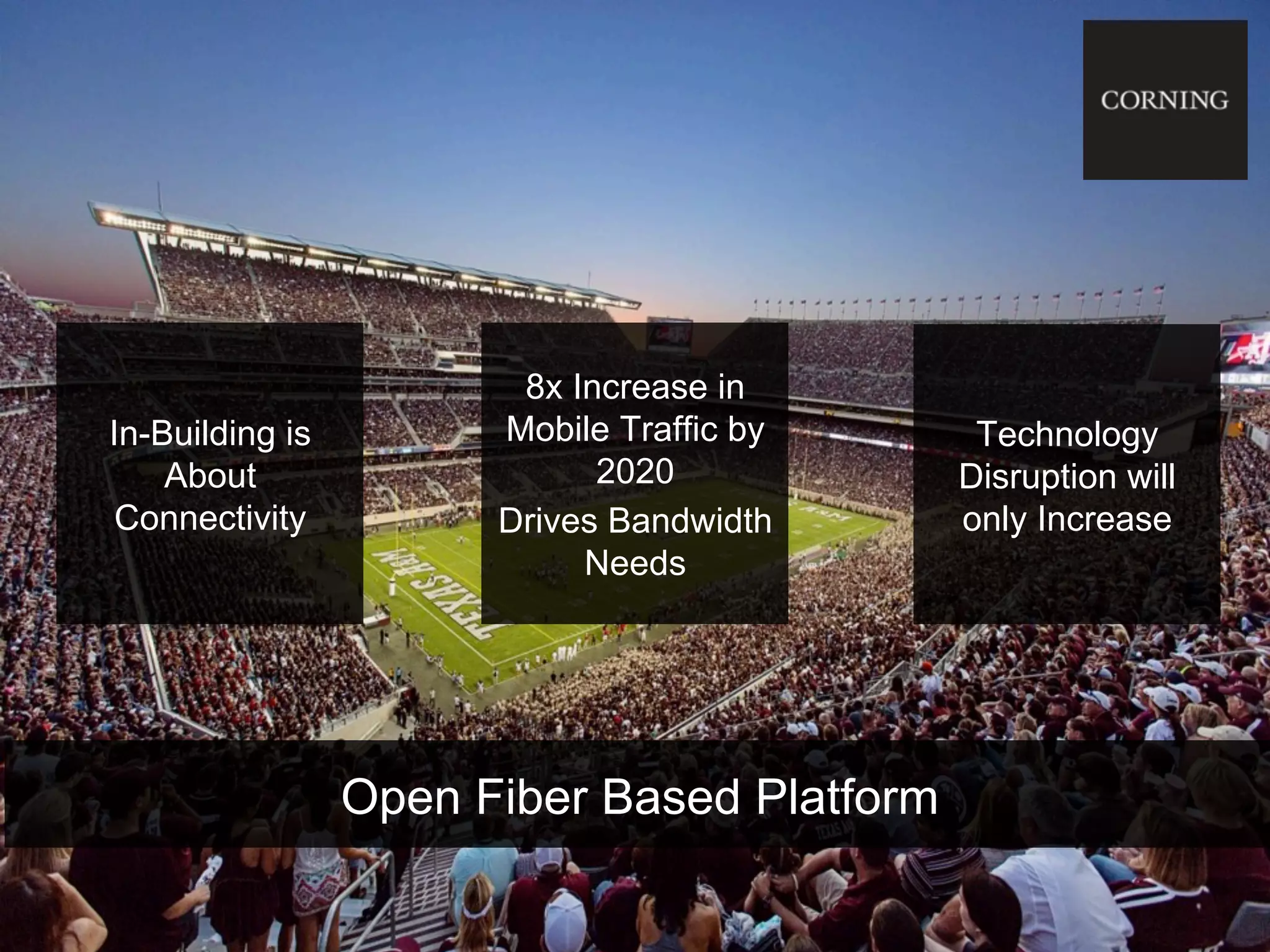
Open Fiber Based Platform
In-Building is
About
Connectivity
8x Increase in
Mobile Traffic by
2020
Drives Bandwidth
Needs
Technology
Disruption will
only Increase
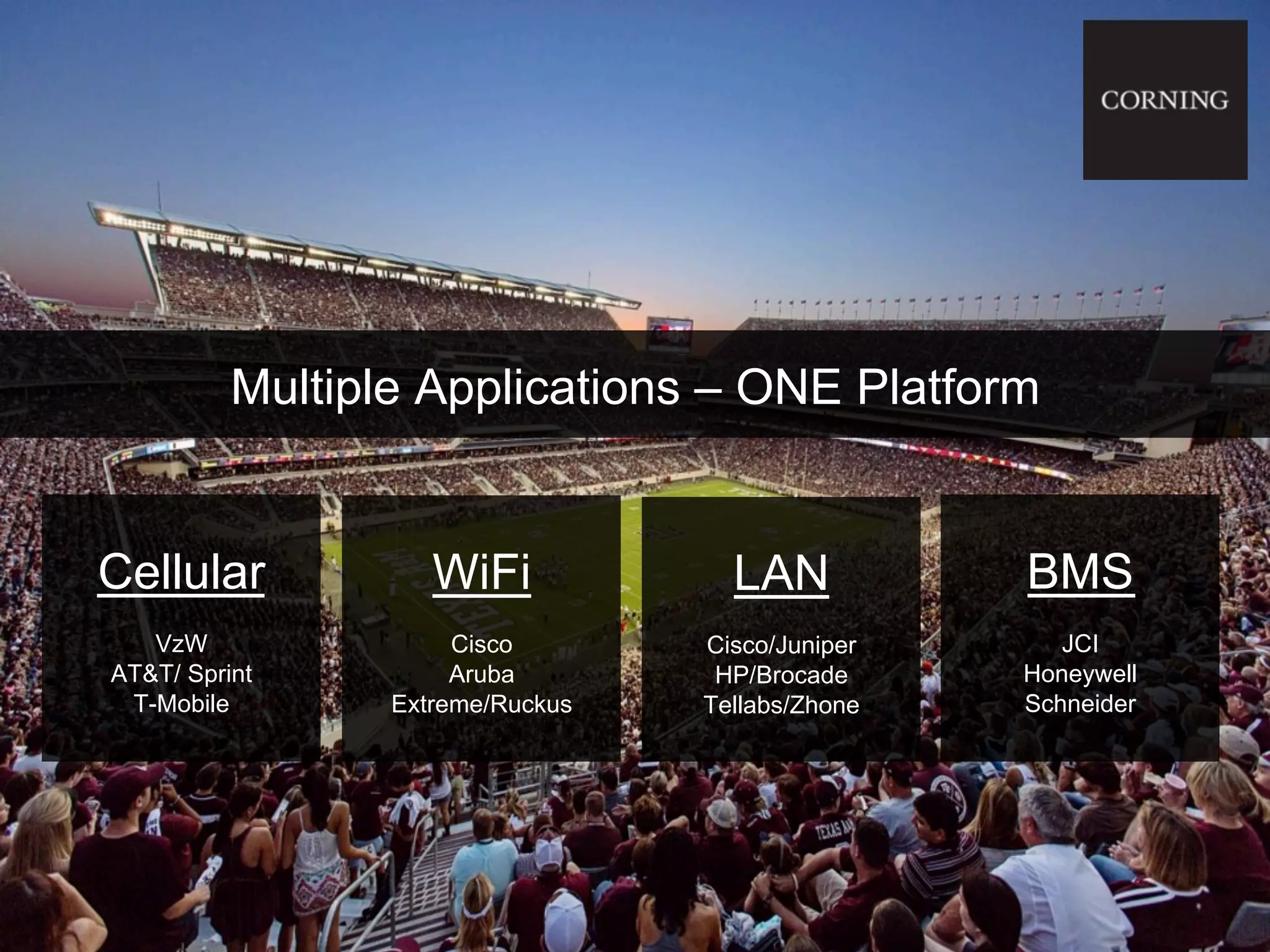
Multiple Applications – ONE Platform
Cellular
VzW
AT&T/ Sprint
T-Mobile
WiFi
Cisco
Aruba
Extreme/Ruckus
LAN
Cisco/Juniper
HP/Brocade
Tellabs/Zhone
BMS
JCI
Honeywell
Schneider
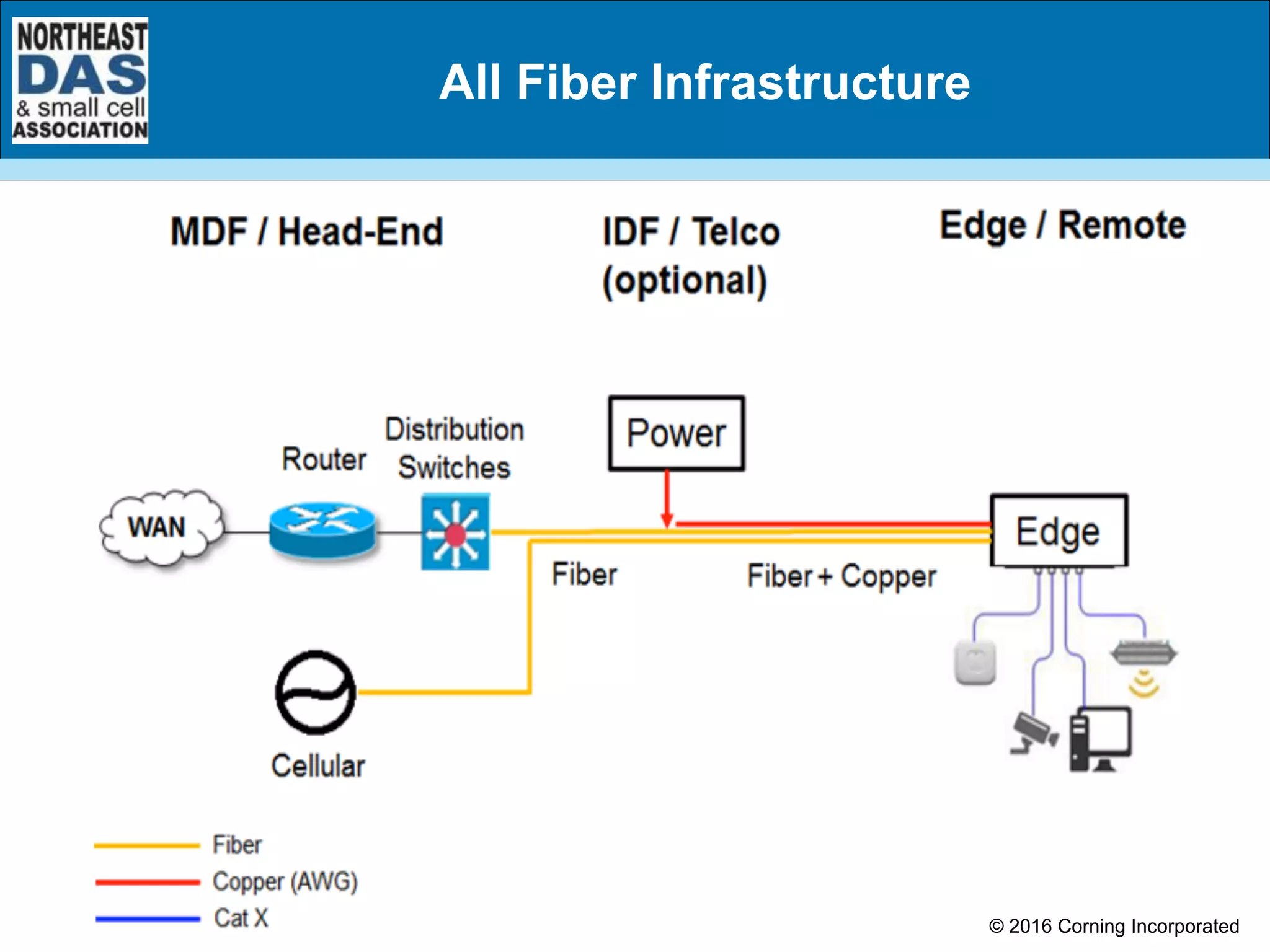
All Fiber Infrastructure
© 2016 Corning Incorporated
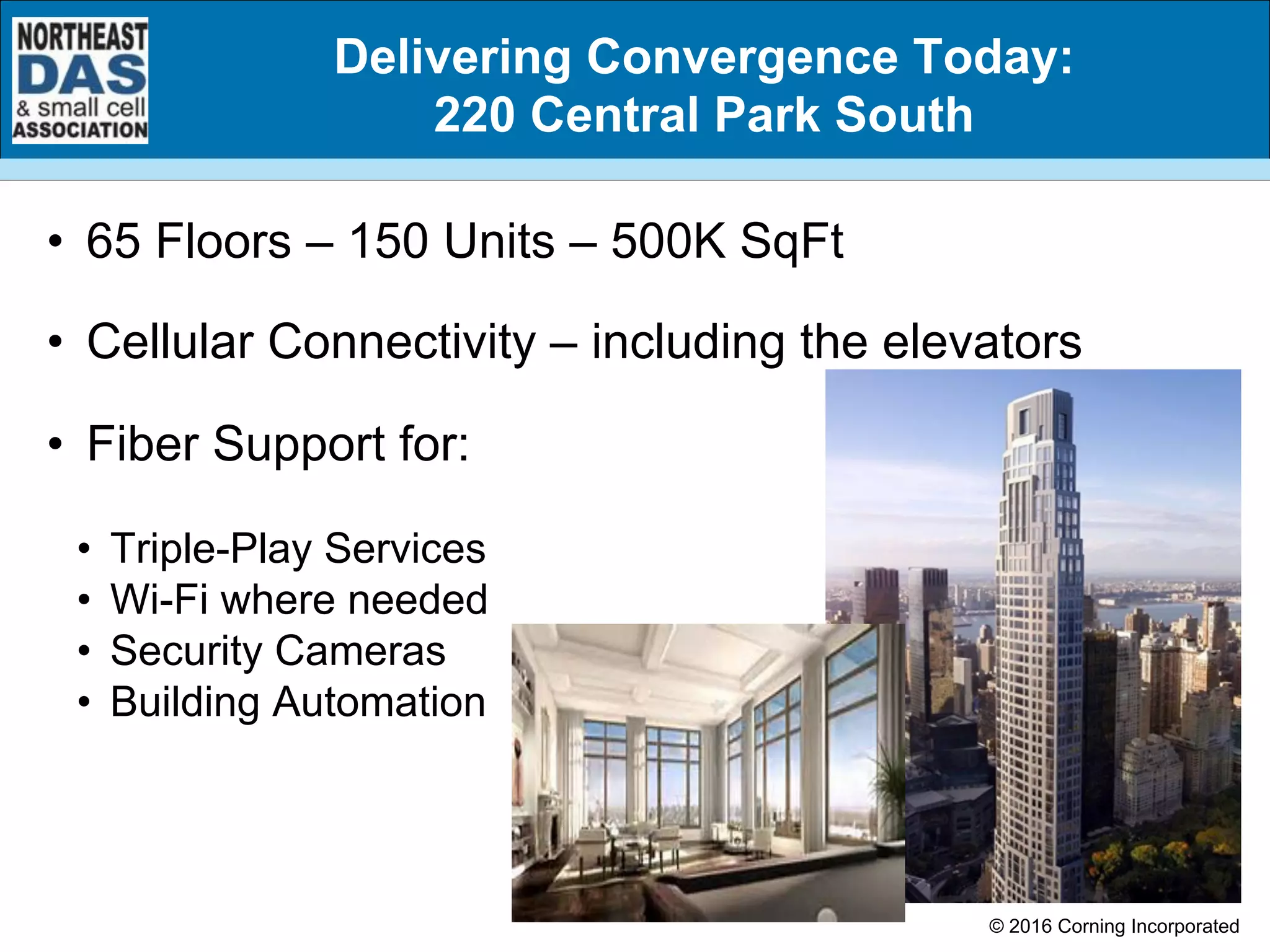
Delivering Convergence Today:
220 Central Park South
•  65 Floors – 150 Units – 500K SqFt
•  Cellular Connectivity – including the elevators
•  Fiber Support for:
•  Triple-Play Services
•  Wi-Fi where needed
•  Security Cameras
•  Building Automation
© 2016 Corning Incorporated
Presenter	
  
Dominic	
  Villecco	
  
President	
  
Presented	
  by	
  V-­‐COMM	
  
IBW Deployment Considerations
•  Since 4G LTE, capacity is a bigger driver than coverage
•  4G LTE data growth >100% year over year - cannot grow the
network at same rate
•  “Cell Edge” problem must be managed to grow network
•  Signal to Noise ratio is key for increased throughput/capacity
•  Offloading existing network with closer proximity network is key
to increasing capacity
•  “Middle-prise” buildings must keep costs in check, to maintain
viability of in-building systems – cannot keep building the same
way
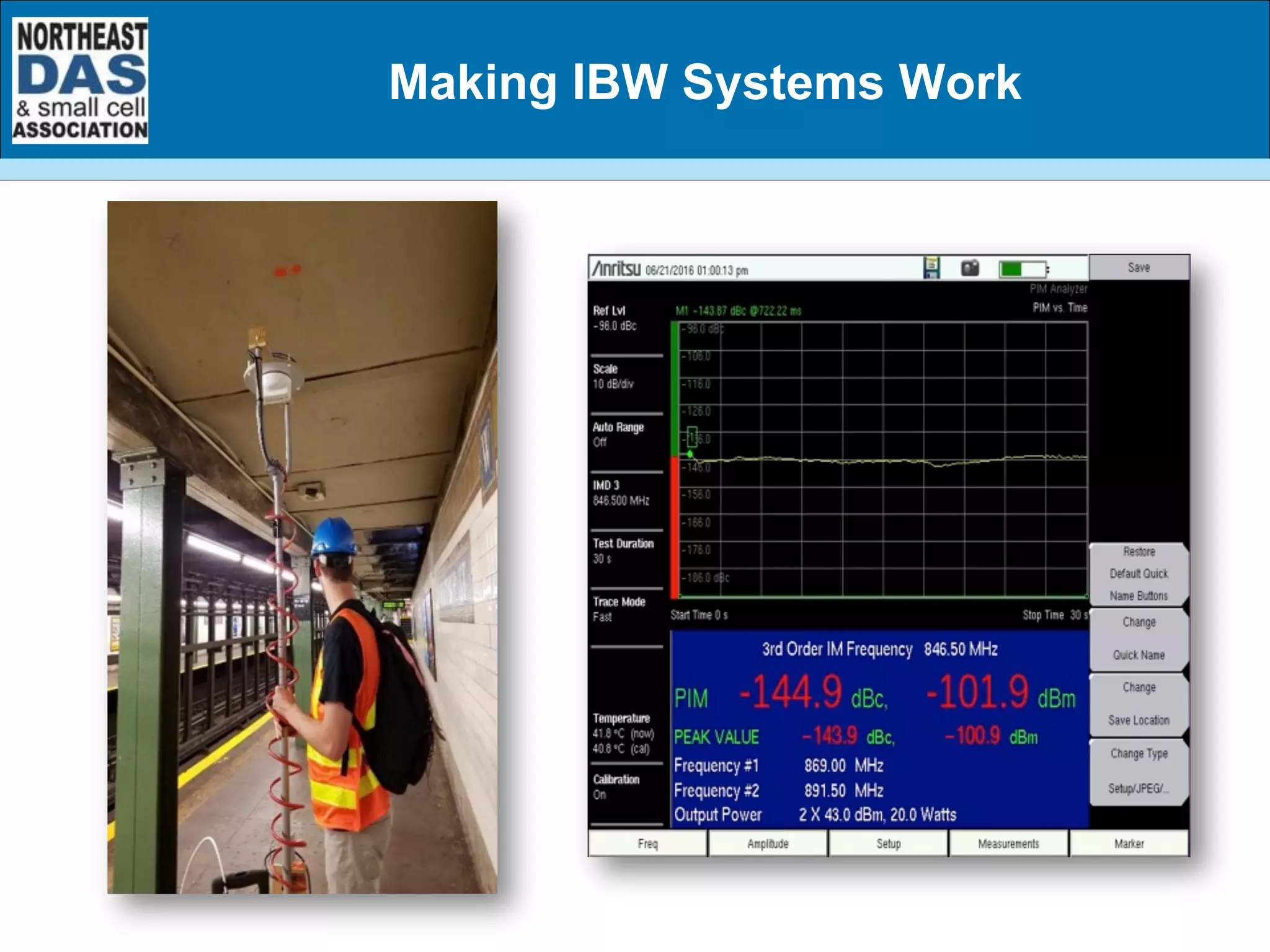
Making IBW Systems Work
Thank you!
Event Produced by:#NEDASDC
http://www.nedas.com
Thank You to Our Media Partners
Mark	
  H.	
  Parr	
  
President	
  &	
  CEO	
  
Presented	
  by	
  
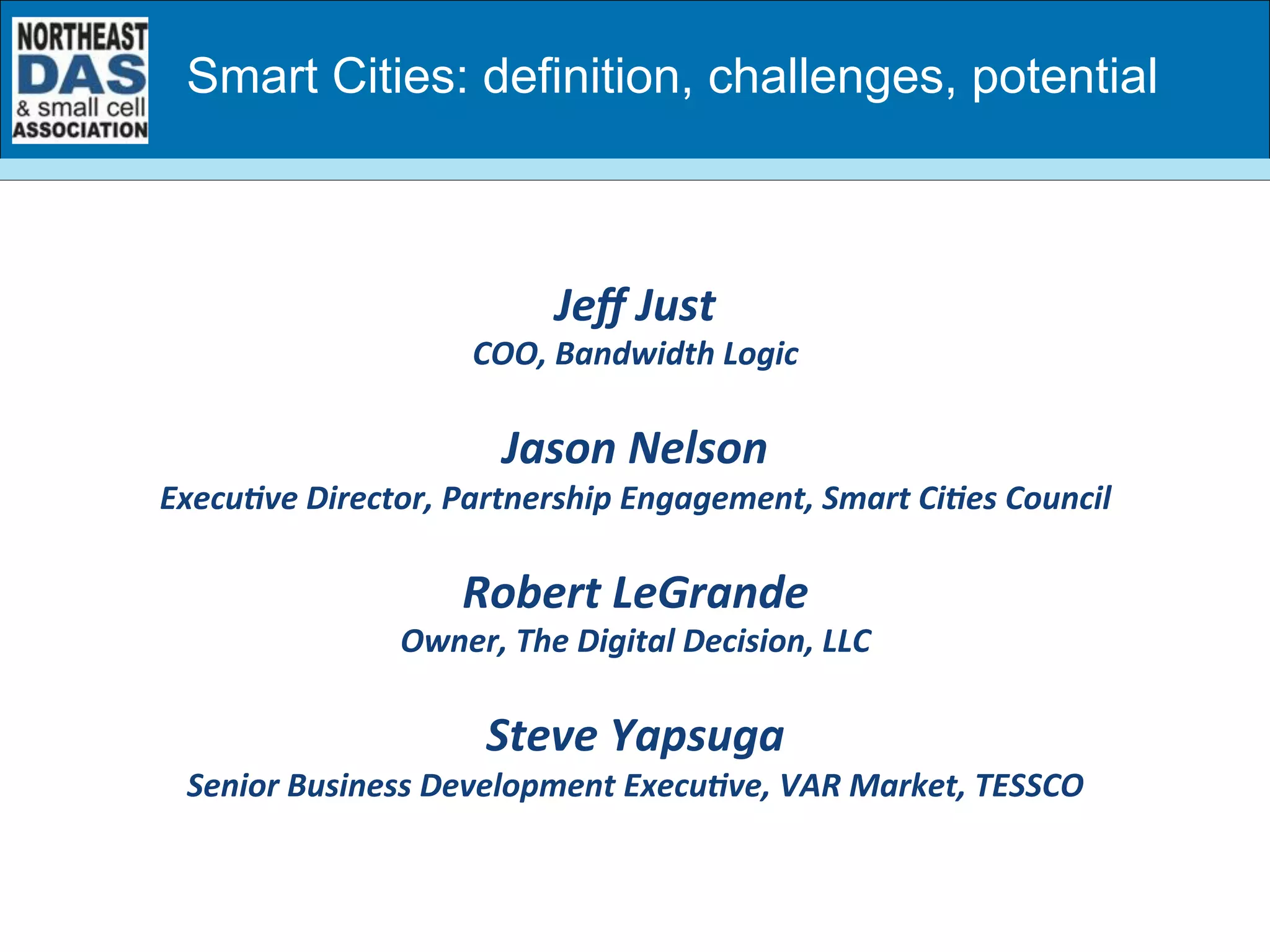
Smart Cities: definition, challenges, potential
Jeff	
  Just	
  	
  
COO,	
  Bandwidth	
  Logic	


Jason	
  Nelson	
  
ExecuBve	
  Director,	
  Partnership	
  Engagement,	
  Smart	
  CiBes	
  Council	


Robert	
  LeGrande	
  
Owner,	
  The	
  Digital	
  Decision,	
  LLC	


Steve	
  Yapsuga	
  
Senior	
  Business	
  Development	
  ExecuBve,	
  VAR	
  Market,	
  TESSCO	
  
Smart Cities: definition, challenges, potential
Presenter	
  
Steve	
  Yapsuga	
  
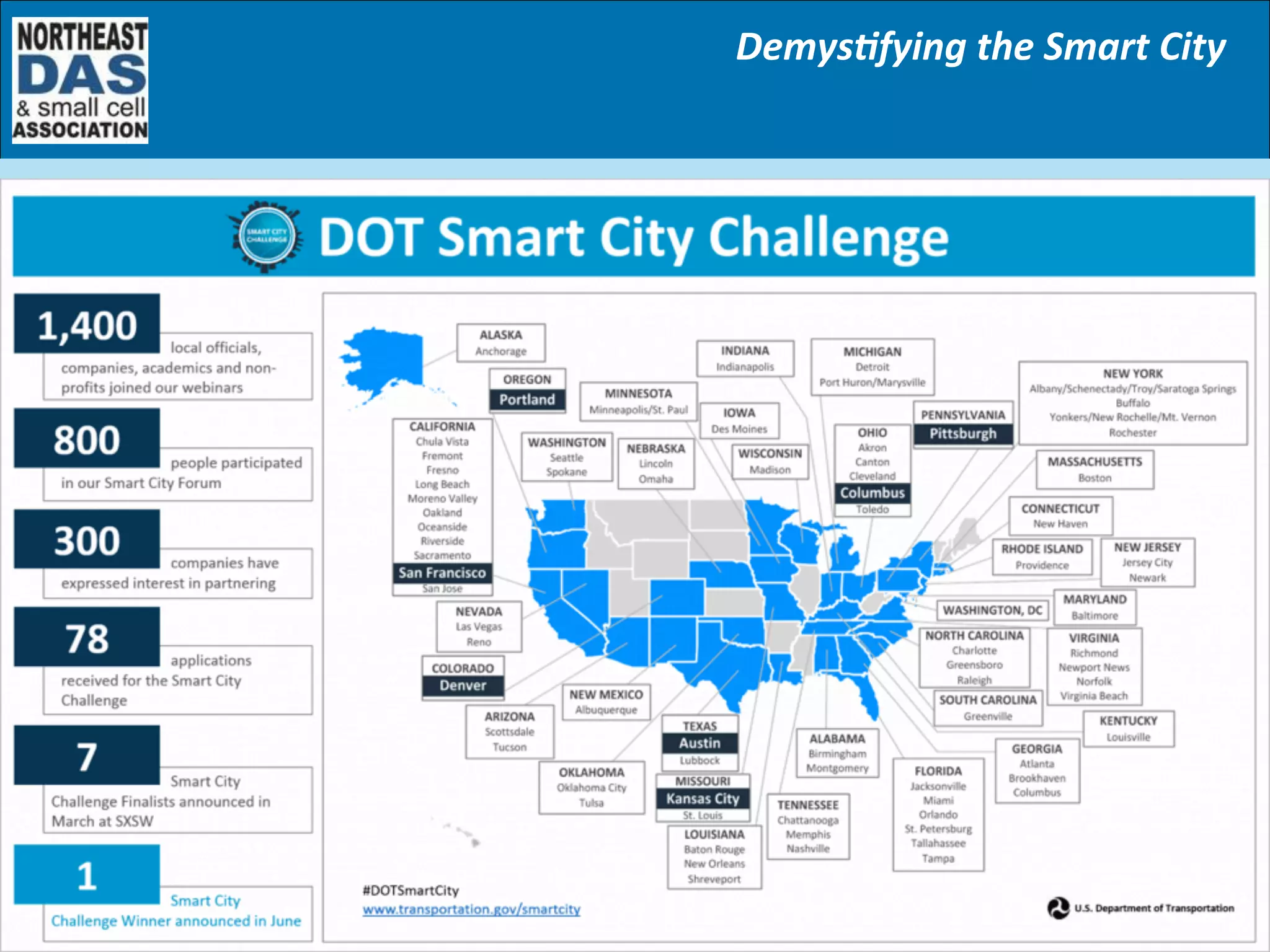
DemysBfying	
  the	
  Smart	
  City	


Thank You to Our Tabletop Sponsors
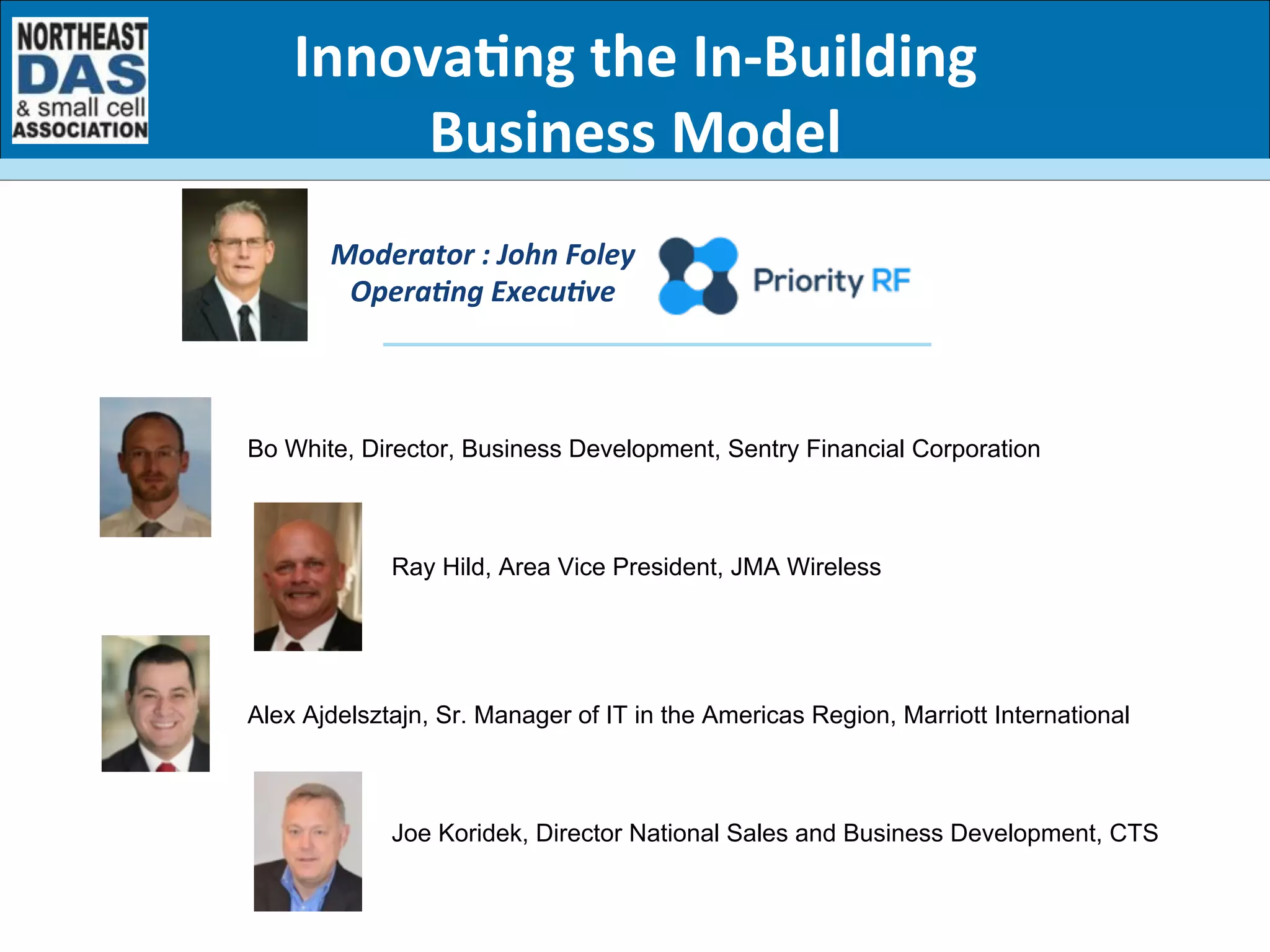
Moderator	
  :	
  John	
  Foley	
  
OperaBng	
  ExecuBve	
  
Innova7ng	
  the	
  In-­‐Building	
  
Business	
  Model	
  
Bo White, Director, Business Development, Sentry Financial Corporation
Ray Hild, Area Vice President, JMA Wireless
Alex Ajdelsztajn, Sr. Manager of IT in the Americas Region, Marriott International
Joe Koridek, Director National Sales and Business Development, CTS
Thank You to Our Charging Station
Sponsor
Mike	
  Collado	
  
Principal	
  Consultant	
  
5	
  Key	
  Trends	
  and	
  How	
  They’ll	
  Impact	
  	
  
the	
  In-­‐Building	
  Wireless	
  Ecosystem	
  in	
  2017	
  (and	
  Beyond)	
  
5	
  Key	
  Trends	
  and	
  How	
  They’ll	
  Impact	
  	
  
the	
  In-­‐Building	
  Wireless	
  Ecosystem	
  in	
  2017	
  (and	
  Beyond)	
  
Trend	
  #1:	
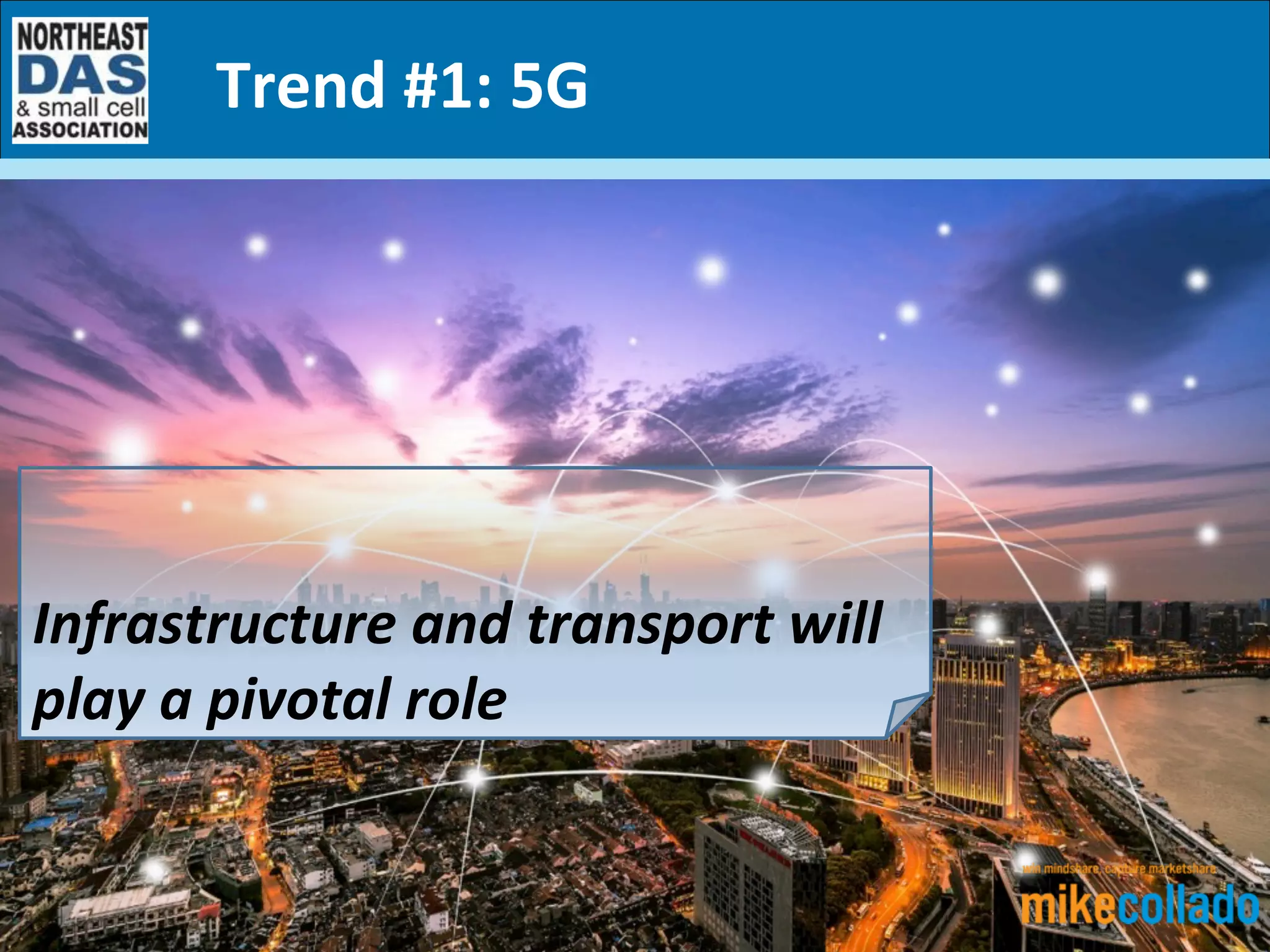
  5G	


Infrastructure	
  and	
  transport	
  will	
  
play	
  a	
  pivotal	
  role	
  
Trend	
  #2:	
  3.5	
  GHz	
  CBRS	


CBRS	
  could	
  bridge	
  the	
  divide	
  between	
  
carriers	
  and	
  enterprises	
  
Mike	
  Collado	
  
Principal	
  Consultant	
  
5	
  Key	
  Trends	
  and	
  How	
  They’ll	
  Impact	
  	
  
the	
  In-­‐Building	
  Wireless	
  Ecosystem	
  in	
  2017	
  (and	
  Beyond)	
  
Trend	
  #3:	
  Public	
  Safety	
  &	
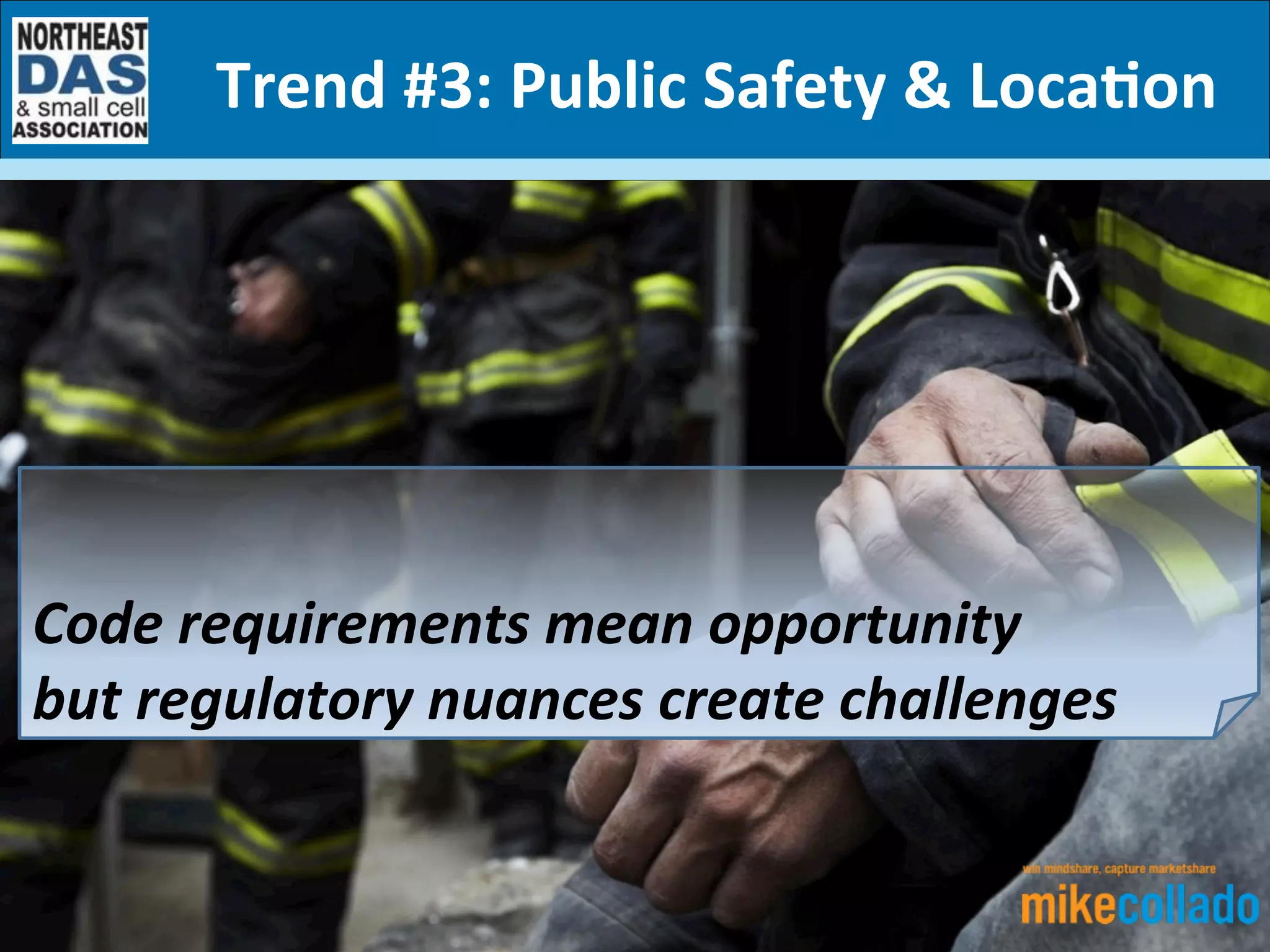
  Loca7on	


Code	
  requirements	
  mean	
  opportunity	
  	
  
but	
  regulatory	
  nuances	
  create	
  challenges	
  
Trend	
  #4:	
  Tier	
  2	
  Venues	


Tier	
  1	
  go-­‐to-­‐market	
  strategies	
  don’t	
  
translate	
  to	
  the	
  Tier	
  2	
  Market	
  
5	
  Key	
  Trends	
  and	
  How	
  They’ll	
  Impact	
  	
  
the	
  In-­‐Building	
  Wireless	
  Ecosystem	
  in	
  2017	
  (and	
  Beyond)	


Tier	
  2	
  may	
  be	
  the	
  “buzz”	
  
but	
  Tier	
  1	
  is	
  the	
  “biz”	
  
Trend	
  #5:	
  Tier	
  1	
  Venues	
  
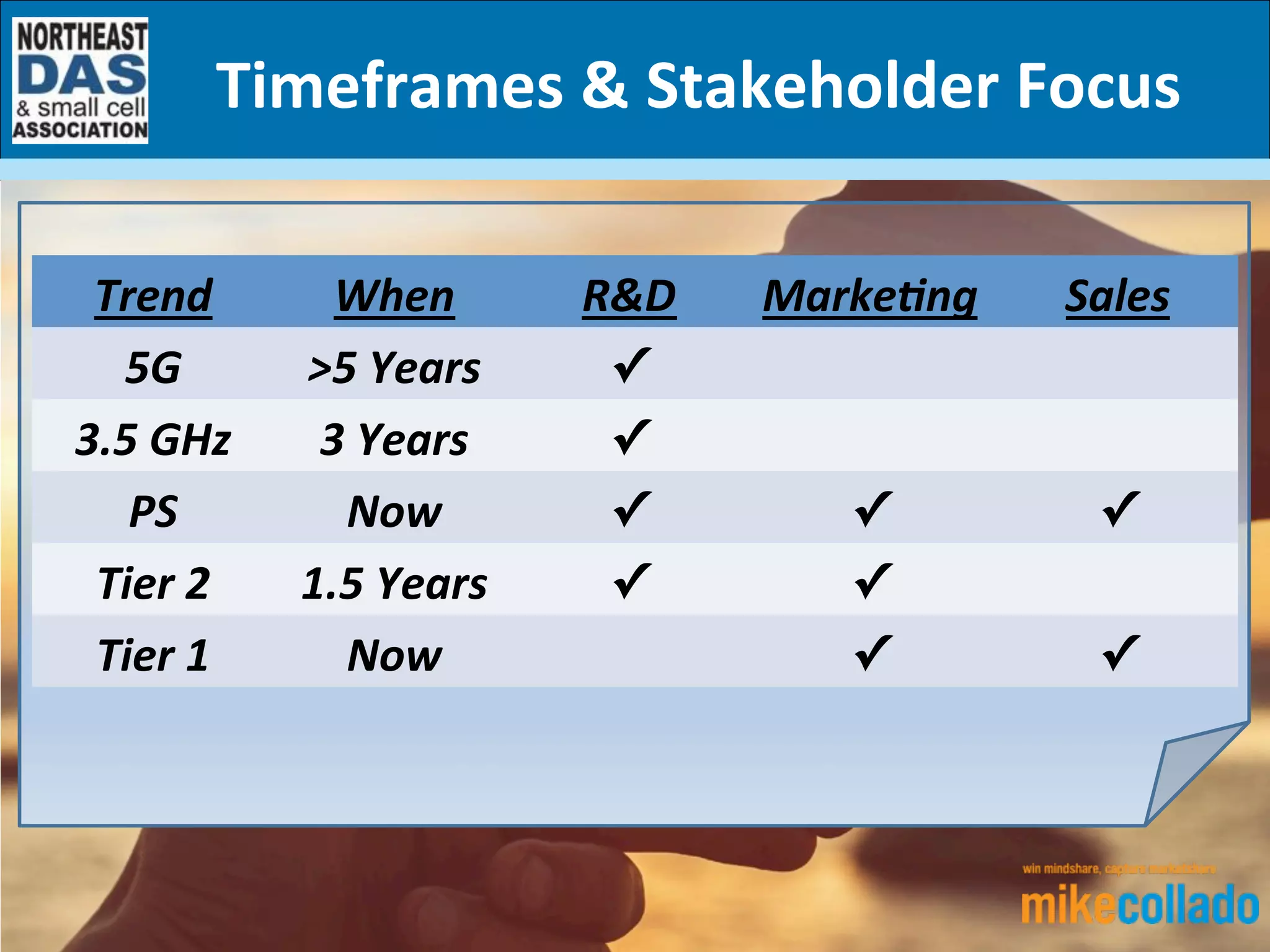
Trend	
   When	
   R&D	
   MarkeBng	
   Sales	
  
5G	
   >5	
  Years	
   ✓	
  
3.5	
  GHz	
   3	
  Years	
   ✓	
  
PS	
   Now	
   ✓	
   ✓	
   ✓	
  
Tier	
  2	
   1.5	
  Years	
   ✓	
   ✓	
  
Tier	
  1	
   Now	
   ✓	
   ✓	
  
Timeframes	
  &	
  Stakeholder	
  Focus	


mike@mikecollado.net	
  
571-­‐216-­‐2404	
  
Thank	
  You!	
  
Thank You to Our Raffle Sponsors
Presenter	
  
Bob	
  Langston	
  
ADRF	
  
Regional	
  Sales	
  Manager	
  
Public	
  Safety	
  Distributed	
  Antenna	
  Systems	
  
Will	
  Ruffin	
  	
  
Vision	
  Technologies	
  
NaBonal	
  Account	
  Manager	
  
I.  What	
  is	
  Driving	
  Public	
  Safety	
  DAS?	
  
II.  NFPA	
  Compliance	
  
III.  Frequency	
  Bands	
  /	
  Technologies	
  
IV.  Case	
  Studies	
  
Agenda	
  
Needs	
  Analysis	
  
Contac7ng	
  the	
  Local	
  AHJ	
  
NFPA	
  72	
  Fire	
  Code	
  Sec7on	
  500	
  
Interpreta7on	
  for	
  Coverage	
  and	
  Tes7ng	


PS	
  DAS	
  Requirements	
  
Consider	
  This:	


❑  The	
  Frequencies	
  Required	
  	
  
❑  Coverage	
  	
  
❑  Design	
  
❑  Passive	
  vs	
  AcGve	
  System	
  
❑  Fire	
  RaGngs	
  2	
  hour	
  |	
  4	
  Hour	
  
❑  AestheGc	
  and	
  Architectural	
  Requirements	
  
❑  Working	
  Hours:	
  DayGme,	
  AOer	
  Hours	
  
❑  Preferred	
  Low	
  Voltage	
  Contractor	
  
❑  Union/Non-­‐Union	
  Labor;	
  Prevailing	
  Wages	
  
 
In-­‐Building	
  Coverage	
  
Focus	
  of	
  AHJ	


  -­‐	
  Enforcement	
  via	
  Occupancy	
  Permits	
  
Building	
  Owner’s	
  Requirements	
  
It	
  Depends	
  on	
  the	
  Local	
  Jurisdic7on	
  
Improving	
  Communica7ons	
  
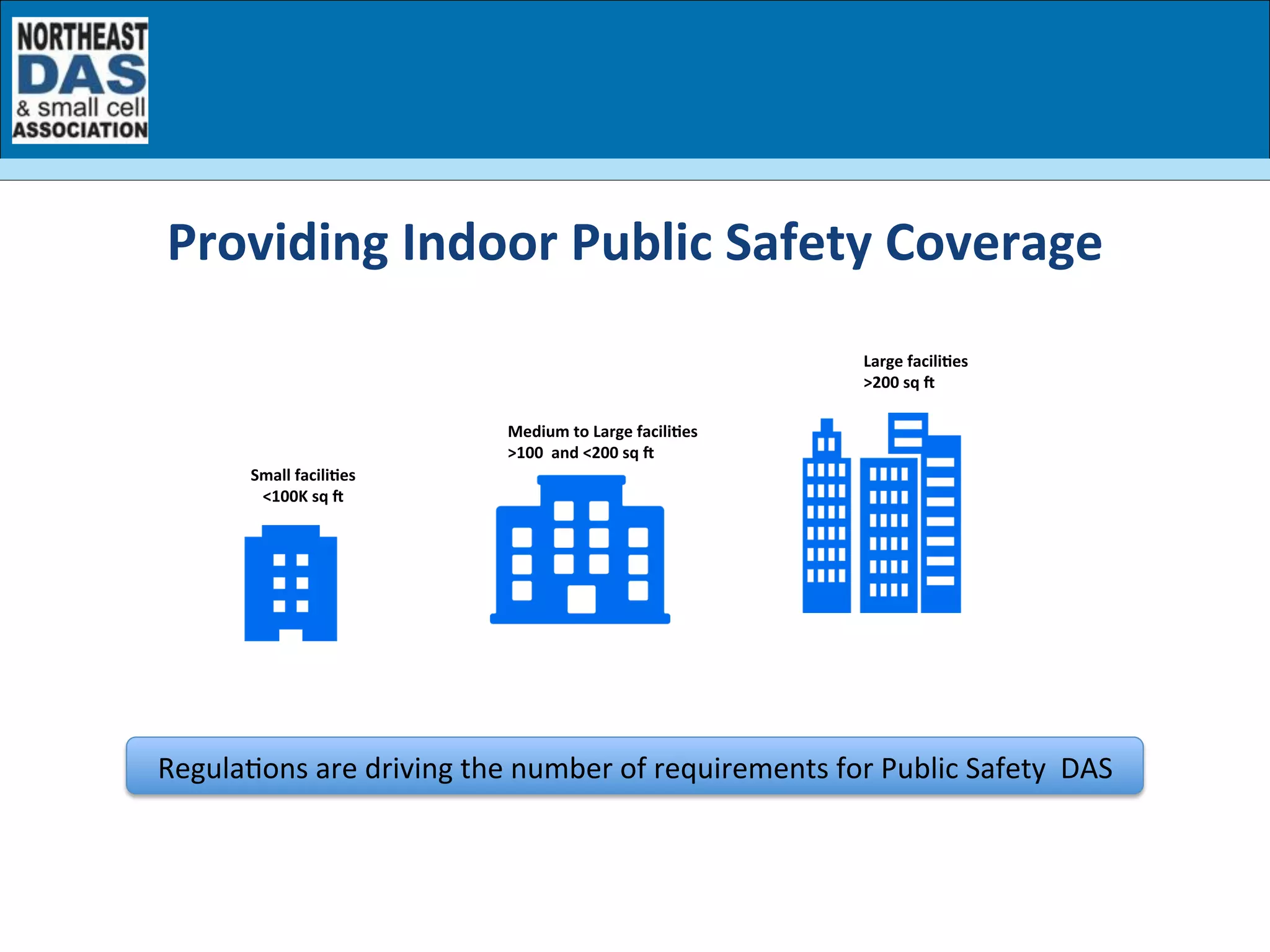
RegulaGons	
  are	
  driving	
  the	
  number	
  of	
  requirements	
  for	
  Public	
  Safety	
  	
  DAS	
  
Small	
  facili7es	
  	
  
<100K	
  sq	
  _	
  
Medium	
  to	
  Large	
  facili7es	
  
>100	
  	
  and	
  <200	
  sq	
  _	
  
Large	
  facili7es	
  
>200	
  sq	
  _	
  
Providing	
  Indoor	
  Public	
  Safety	
  Coverage	
  
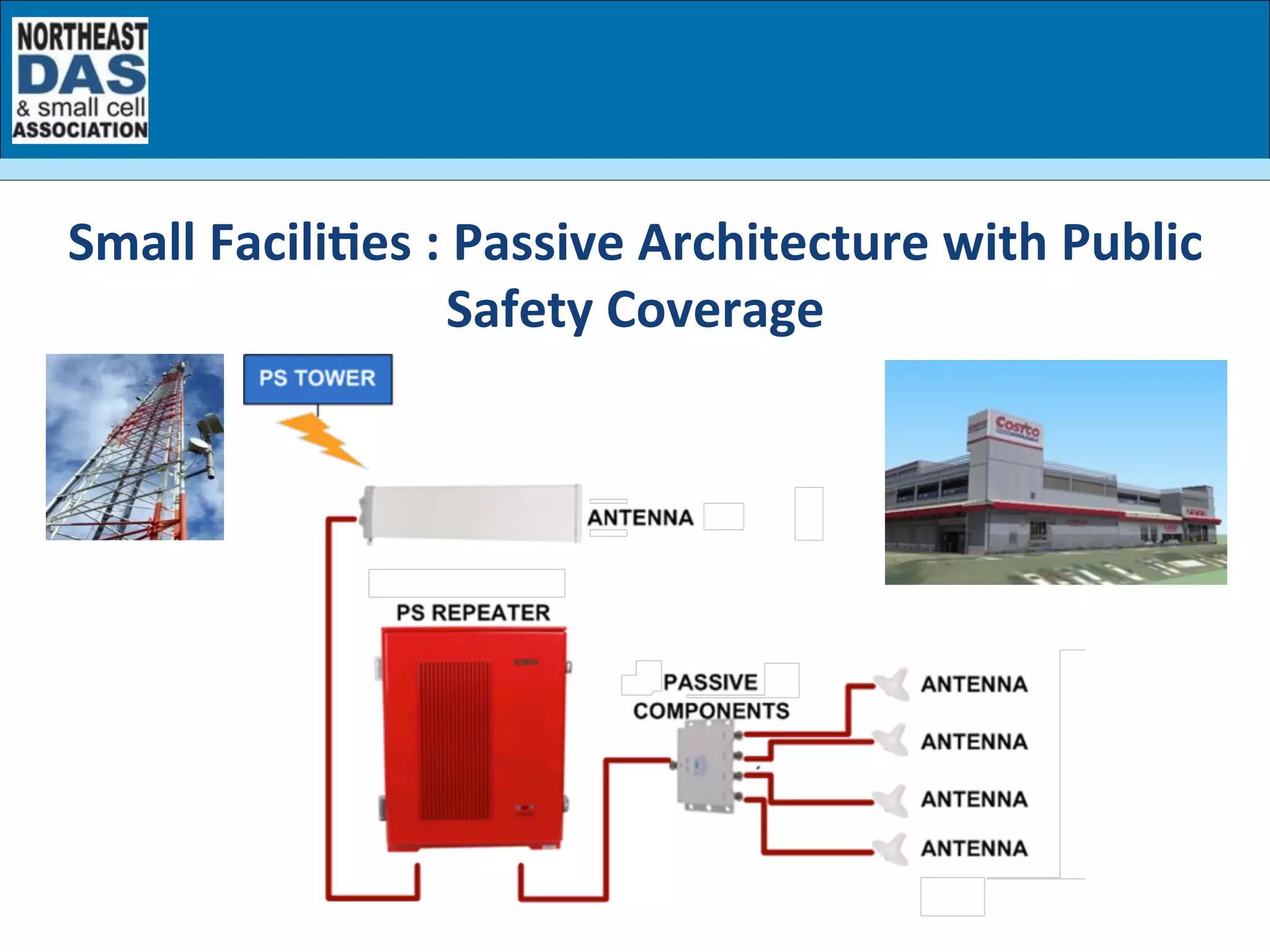
Small	
  Facili7es	
  :	
  Passive	
  Architecture	
  with	
  Public	
  
Safety	
  Coverage	
  
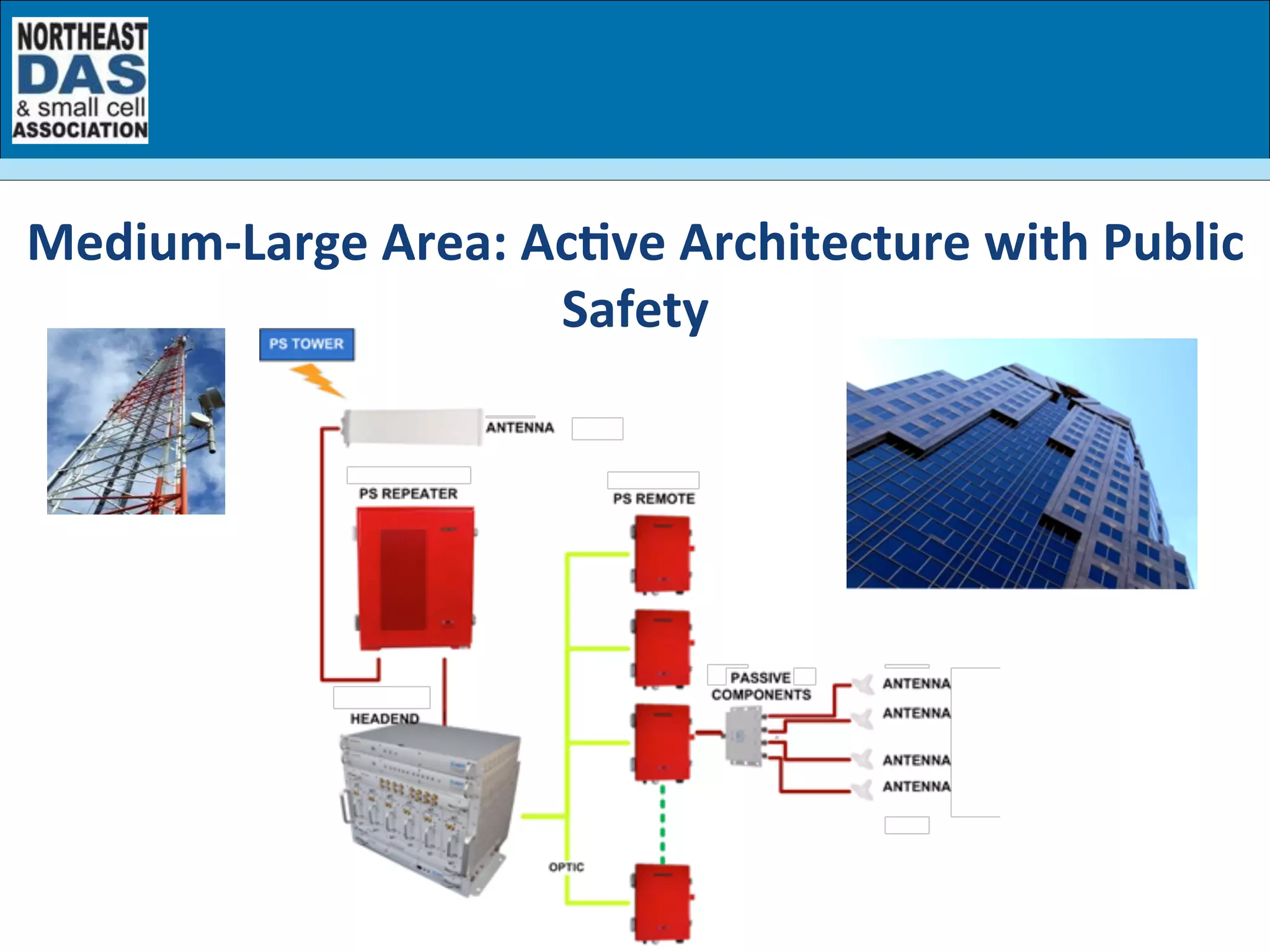
Medium-­‐Large	
  Area:	
  Ac7ve	
  Architecture	
  with	
  Public	
  
Safety	
  
Large	
  Area:	
  Neutral	
  Host	
  -­‐Ac7ve	
  Architecture	
  	
  
NFPA	
  Compliance	


•  System	
  Coverage:	
  99%	
  coverage	
  in	
  criGcal	
  areas	
  designated	
  
by	
  the	
  local	
  fire	
  department	
  
•  -­‐95	
  dB	
  Minimum	
  signal	
  Strength:	
  IFC	
  and	
  NFPA	
  requires	
  -­‐95	
  
dB	
  of	
  signal	
  level	
  regardless	
  of	
  the	
  frequency	
  
•  NEMA-­‐4	
  Enclosures:	
  Dust,	
  water,	
  and	
  corrosion-­‐proof	
  NEMA	
  
4	
  compliant	
  housing	
  
•  System	
  Monitoring	
  Alarms:	
  	
  to	
  provide	
  real-­‐Gme	
  monitoring	
  
of	
  system’s	
  readiness.	
  Power/Baery	
  /Antenna	
  /Equipment	
  
failure/	
  baery	
  charging	
  
•  Babery	
  Backup:	
  In	
  case	
  of	
  main	
  power	
  failure	
  (likely	
  at	
  a	
  
fire),	
  12/24	
  hours	
  of	
  run-­‐Gme	
  (minimum)	
  	
  
•  Antenna	
  Isola7on.	
  NFPA	
  sGpulates	
  antenna	
  isolaGon	
  
requirement	
  of	
  15	
  dB	
  higher	
  than	
  the	
  gain	
  of	
  the	
  amplifier.	
  	
  
•  Class	
  A	
  or	
  Class	
  B	
  Amplifier:	
  channelized	
  or	
  wideband	


NFPA	
  -­‐	
  Compliance	
  
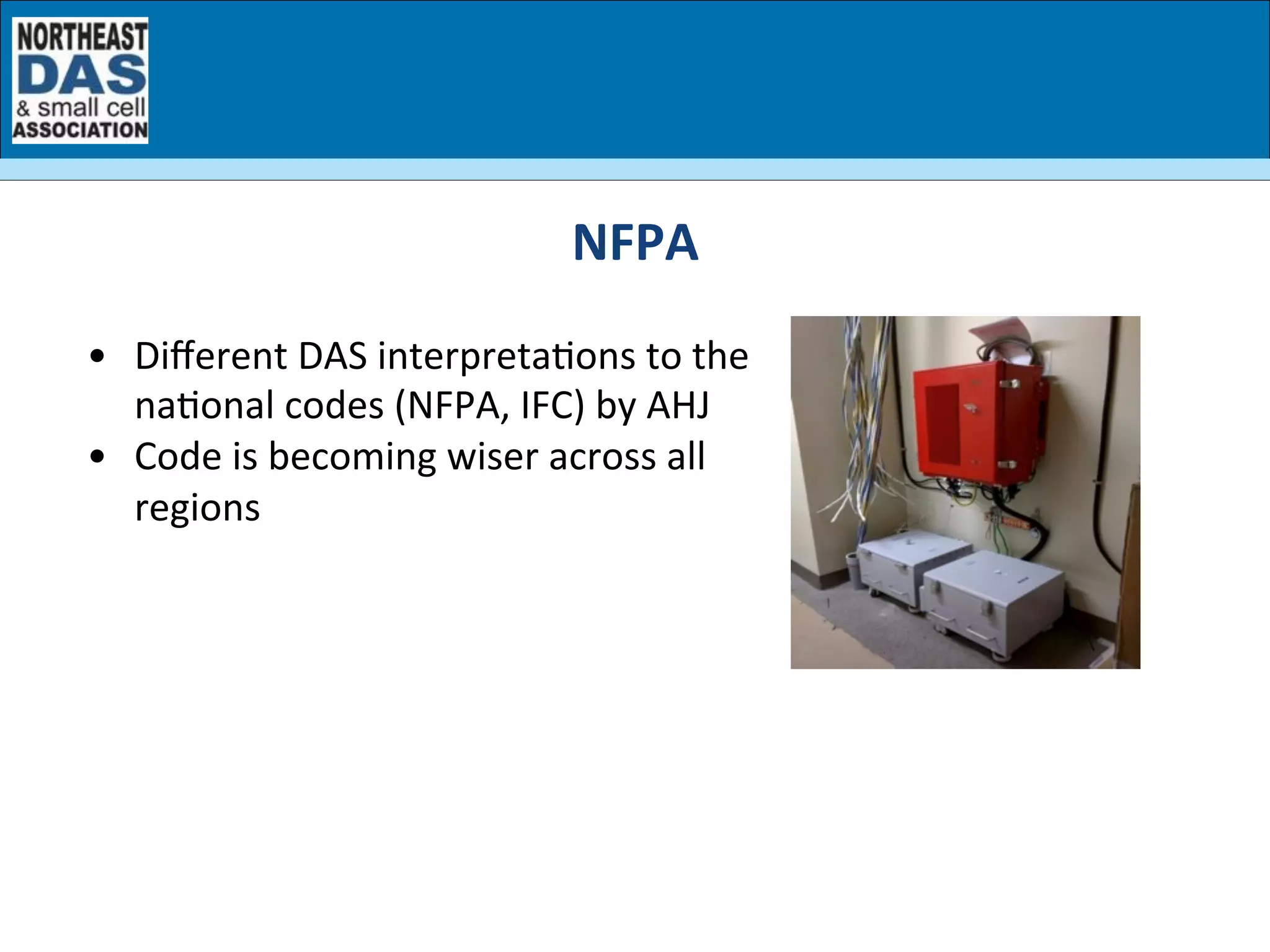
•  Different	
  DAS	
  interpretaGons	
  to	
  the	
  
naGonal	
  codes	
  (NFPA,	
  IFC)	
  by	
  AHJ	
  
•  Code	
  is	
  becoming	
  wiser	
  across	
  all	
  
regions	
  
NFPA	
  	
  
Frequency	
  Bands	
  and	
  Technologies	


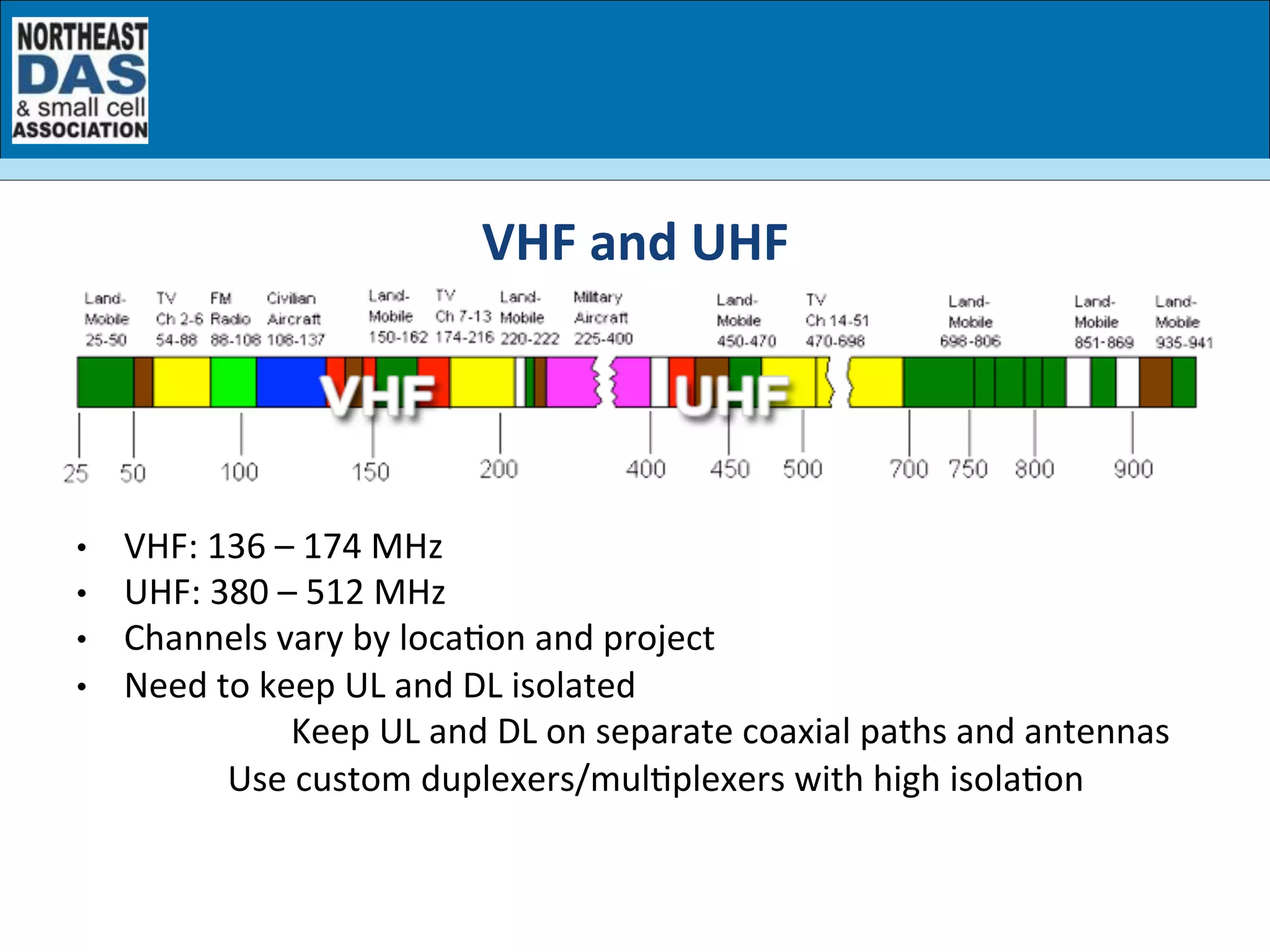
•  VHF:	
  136	
  –	
  174	
  MHz	
  
•  UHF:	
  380	
  –	
  512	
  MHz	
  
•  Channels	
  vary	
  by	
  locaGon	
  and	
  project	
  
•  Need	
  to	
  keep	
  UL	
  and	
  DL	
  isolated	


  Keep	
  UL	
  and	
  DL	
  on	
  separate	
  coaxial	
  paths	
  and	
  antennas	


  Use	
  custom	
  duplexers/mulGplexers	
  with	
  high	
  isolaGon	


VHF	
  and	
  UHF	
  
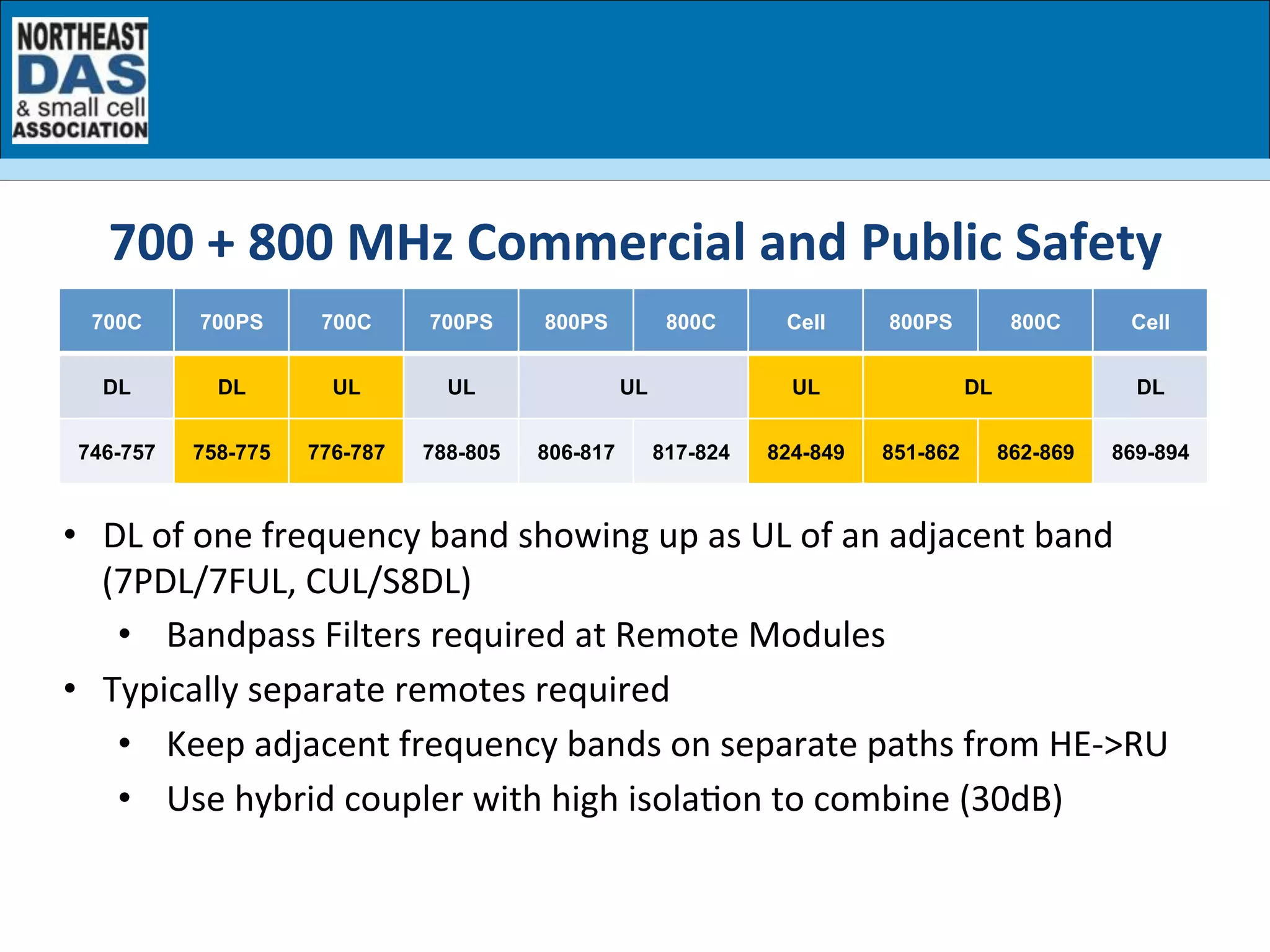
700C 700PS 700C 700PS 800PS 800C Cell 800PS 800C Cell
DL DL UL UL UL UL DL DL
746-757 758-775 776-787 788-805 806-817 817-824 824-849 851-862 862-869 869-894
•  DL	
  of	
  one	
  frequency	
  band	
  showing	
  up	
  as	
  UL	
  of	
  an	
  adjacent	
  band	
  
(7PDL/7FUL,	
  CUL/S8DL)	
  
•  Bandpass	
  Filters	
  required	
  at	
  Remote	
  Modules	
  
•  Typically	
  separate	
  remotes	
  required	
  	
  
•  Keep	
  adjacent	
  frequency	
  bands	
  on	
  separate	
  paths	
  from	
  HE-­‐>RU	
  
•  Use	
  hybrid	
  coupler	
  with	
  high	
  isolaGon	
  to	
  combine	
  (30dB)	
  
700	
  +	
  800	
  MHz	
  Commercial	
  and	
  Public	
  Safety	
  
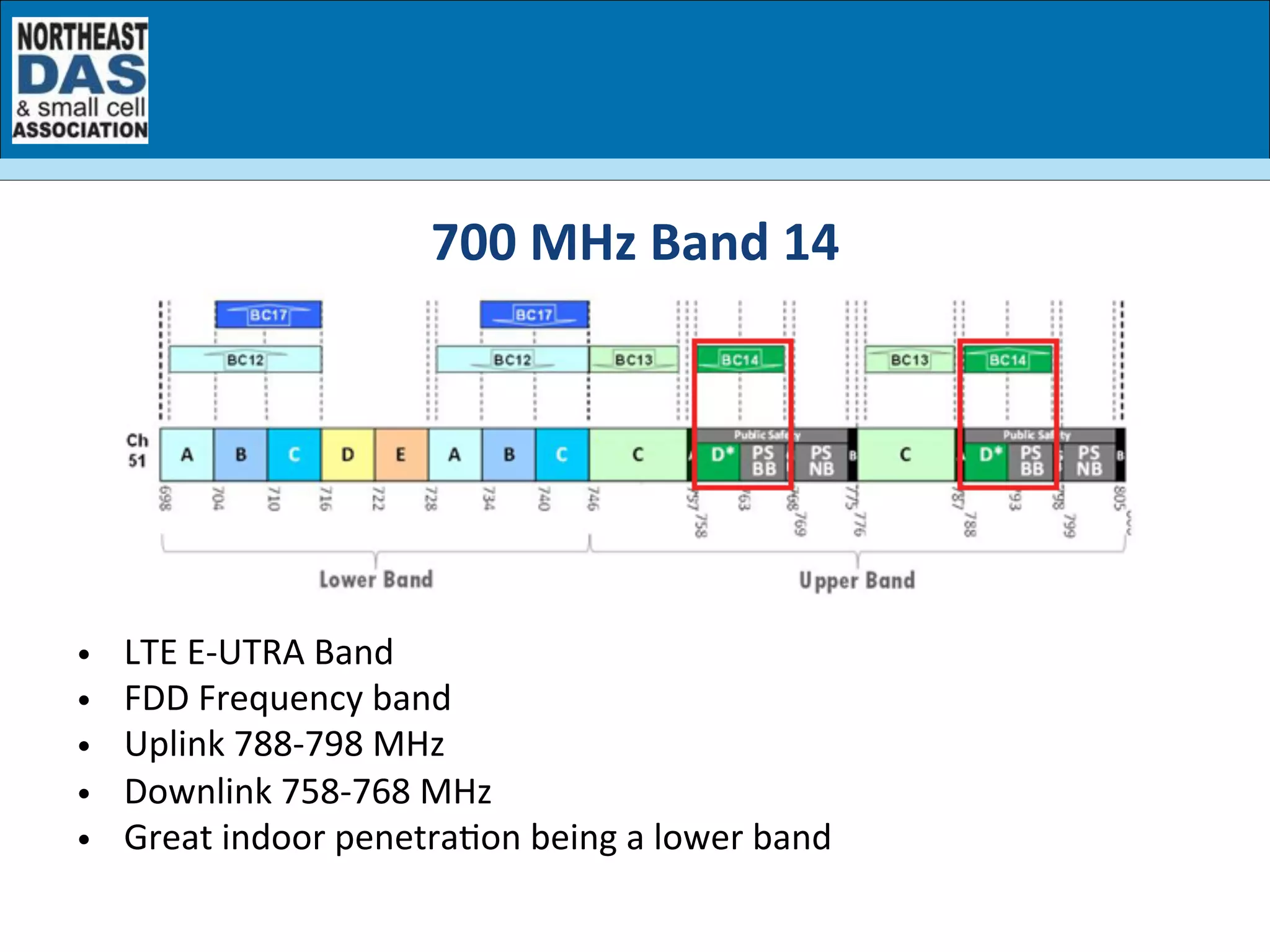
•  LTE	
  E-­‐UTRA	
  Band	
  
•  FDD	
  Frequency	
  band	
  
•  Uplink	
  788-­‐798	
  MHz	
  
•  Downlink	
  758-­‐768	
  MHz	
  
•  Great	
  indoor	
  penetraGon	
  being	
  a	
  lower	
  band	
  
700	
  MHz	
  Band	
  14	
  
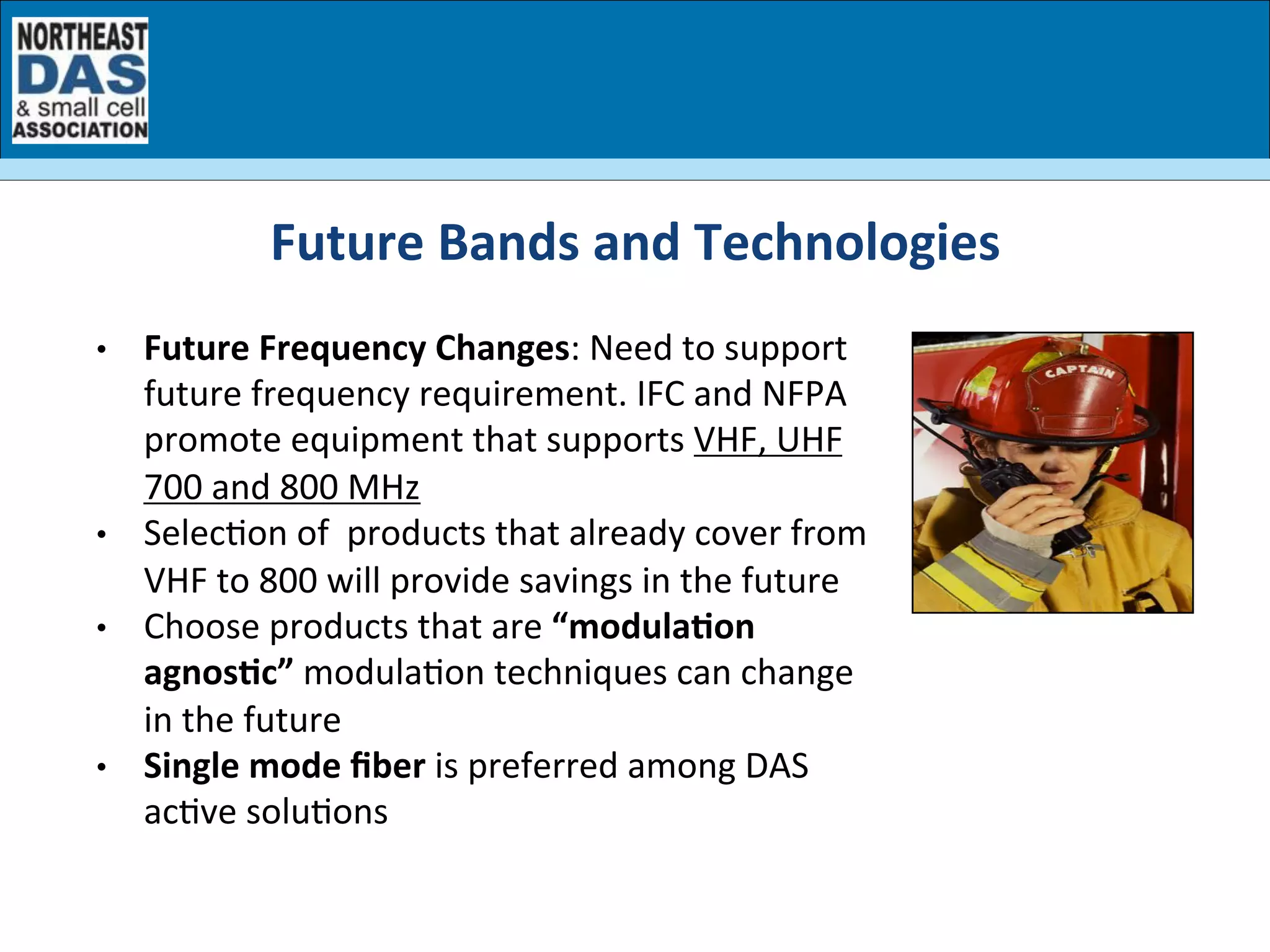
•  Future	
  Frequency	
  Changes:	
  Need	
  to	
  support	
  
future	
  frequency	
  requirement.	
  IFC	
  and	
  NFPA	
  
promote	
  equipment	
  that	
  supports	
  VHF,	
  UHF	
  
700	
  and	
  800	
  MHz	
  
•  SelecGon	
  of	
  	
  products	
  that	
  already	
  cover	
  from	
  
VHF	
  to	
  800	
  will	
  provide	
  savings	
  in	
  the	
  future	
  
•  Choose	
  products	
  that	
  are	
  “modula7on	
  	
  
agnos7c”	
  modulaGon	
  techniques	
  can	
  change	
  
in	
  the	
  future	
  
•  Single	
  mode	
  fiber	
  is	
  preferred	
  among	
  DAS	
  
acGve	
  soluGons	


Future	
  Bands	
  and	
  Technologies	
  	
  
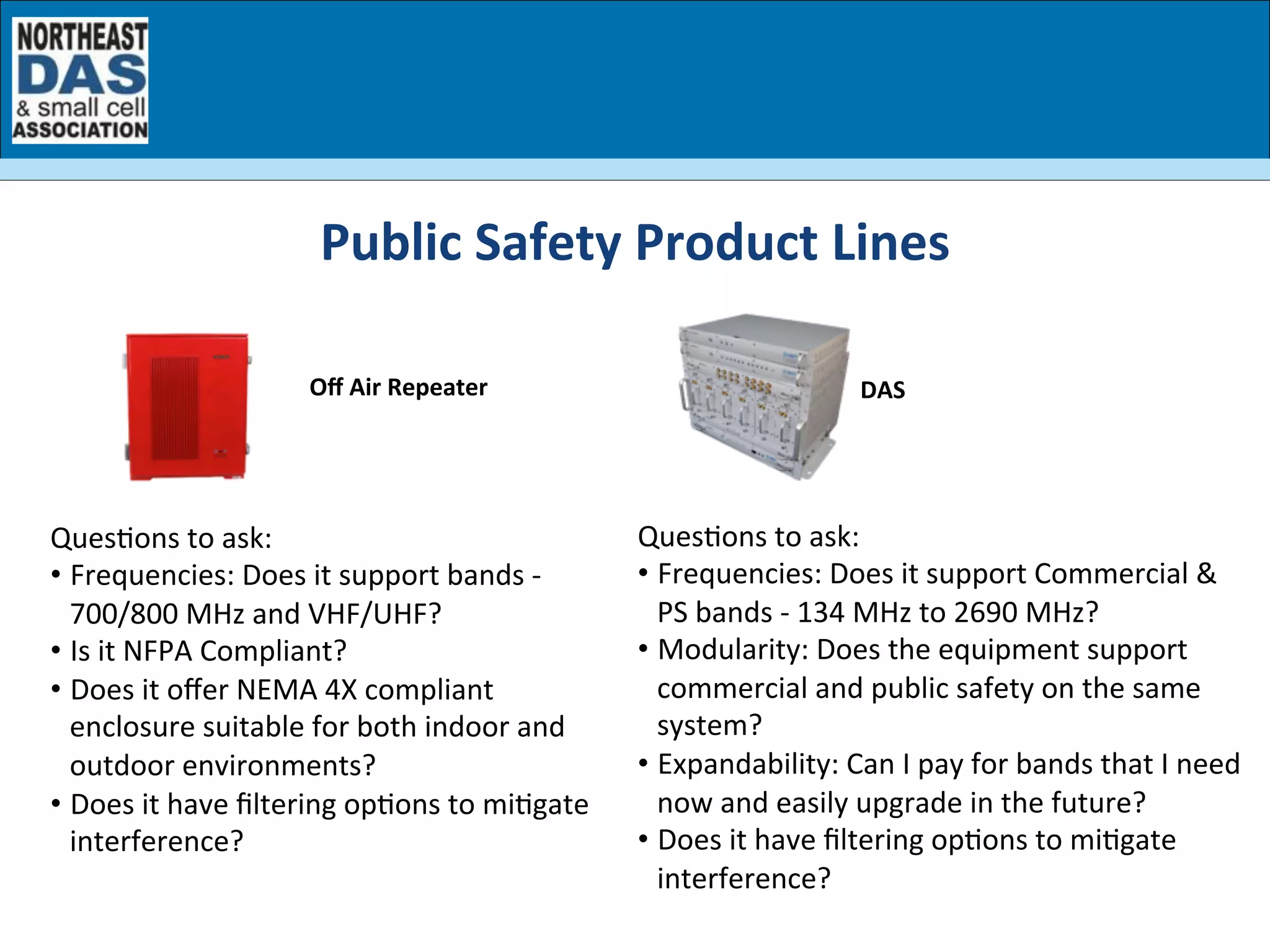
DAS	
  
QuesGons	
  to	
  ask:	
  	
  
• Frequencies:	
  Does	
  it	
  support	
  Commercial	
  &	
  
PS	
  bands	
  -­‐	
  134	
  MHz	
  to	
  2690	
  MHz?	
  
• Modularity:	
  Does	
  the	
  equipment	
  support	
  
commercial	
  and	
  public	
  safety	
  on	
  the	
  same	
  
system?	
  
• Expandability:	
  Can	
  I	
  pay	
  for	
  bands	
  that	
  I	
  need	
  
now	
  and	
  easily	
  upgrade	
  in	
  the	
  future?	
  
• Does	
  it	
  have	
  filtering	
  opGons	
  to	
  miGgate	
  
interference?	
  
Off	
  Air	
  Repeater	
  
QuesGons	
  to	
  ask:	
  	
  
• Frequencies:	
  Does	
  it	
  support	
  bands	
  -­‐	
  
700/800	
  MHz	
  and	
  VHF/UHF?	
  
• Is	
  it	
  NFPA	
  Compliant?	


• Does	
  it	
  offer	
  NEMA	
  4X	
  compliant	
  
enclosure	
  suitable	
  for	
  both	
  indoor	
  and	
  
outdoor	
  environments?	
  
• Does	
  it	
  have	
  filtering	
  opGons	
  to	
  miGgate	
  
interference?	
  
Public	
  Safety	
  Product	
  Lines	
  
Public Safety DAS – Critical Coverage Requirement
Case	
  Studies	
  
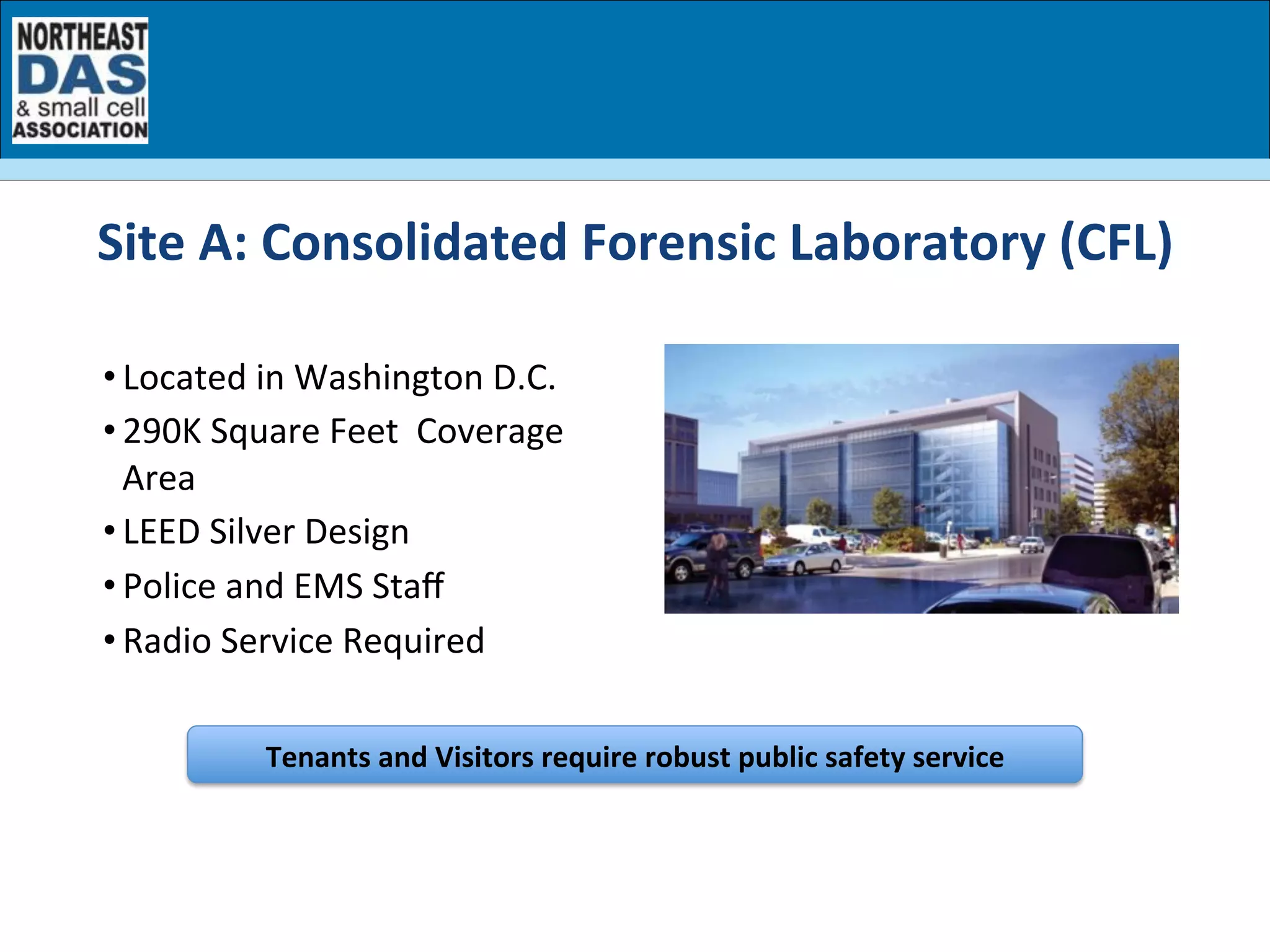
• Located	
  in	
  Washington	
  D.C.	
  
• 290K	
  Square	
  Feet	
  	
  Coverage	
  
Area	
  	
  
• LEED	
  Silver	
  Design	
  
• Police	
  and	
  EMS	
  Staff	
  
• Radio	
  Service	
  Required	
  
Tenants	
  and	
  Visitors	
  require	
  robust	
  public	
  safety	
  service	
  	
  
Site	
  A:	
  Consolidated	
  Forensic	
  Laboratory	
  (CFL)	
  
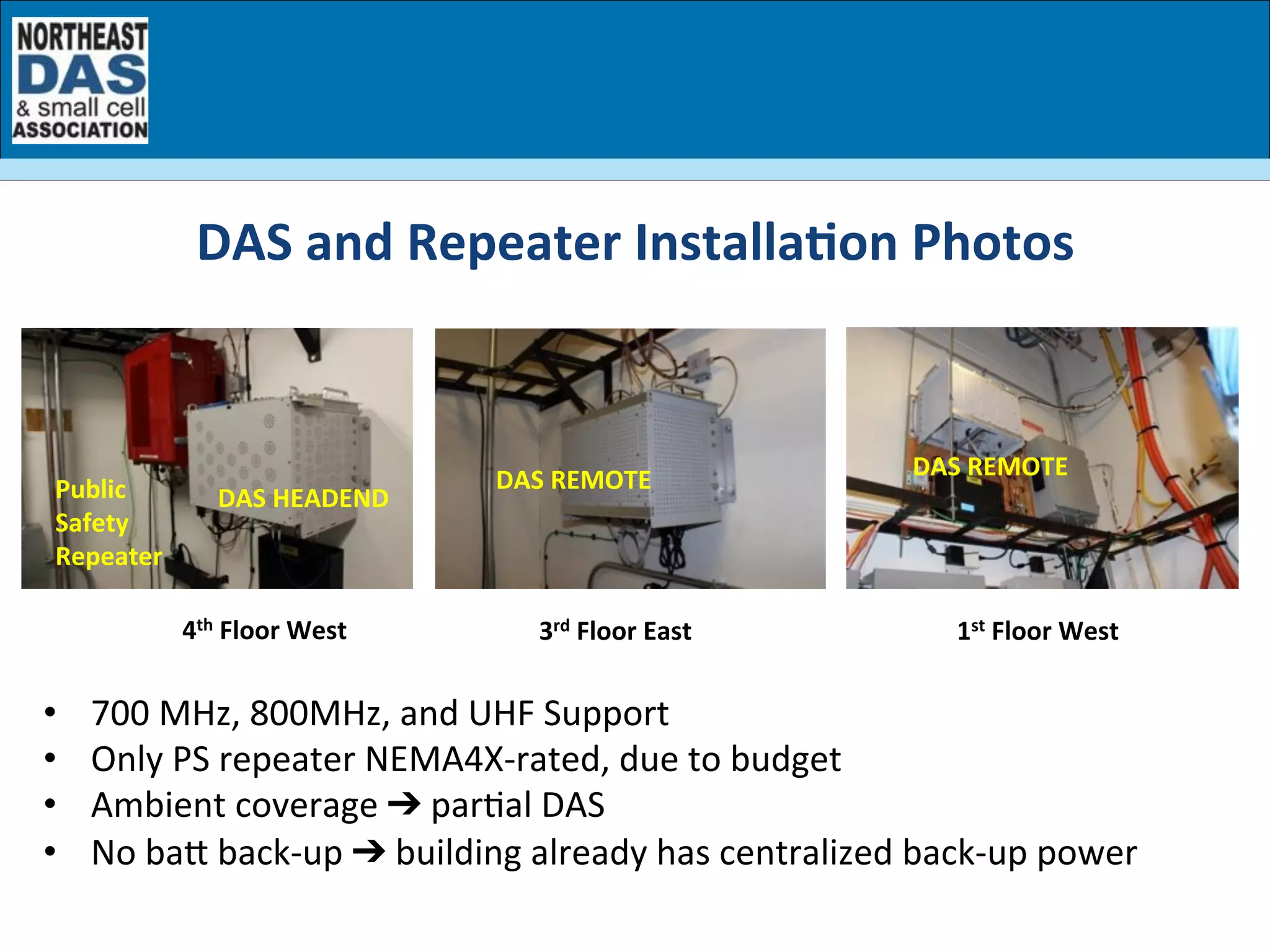
DAS	
  HEADEND	
  Public	
  
Safety	
  
Repeater	
  
DAS	
  REMOTE	
   DAS	
  REMOTE	
  
3rd	
  Floor	
  East	
   1st	
  Floor	
  West	
  4th	
  Floor	
  West	
  
DAS	
  and	
  Repeater	
  Installa7on	
  Photos	
  
•  700	
  MHz,	
  800MHz,	
  and	
  UHF	
  Support	
  
•  Only	
  PS	
  repeater	
  NEMA4X-­‐rated,	
  due	
  to	
  budget	
  
•  Ambient	
  coverage	
  ➔	
  parGal	
  DAS	
  
•  No	
  ba	
  back-­‐up	
  ➔	
  building	
  already	
  has	
  centralized	
  back-­‐up	
  power	
  
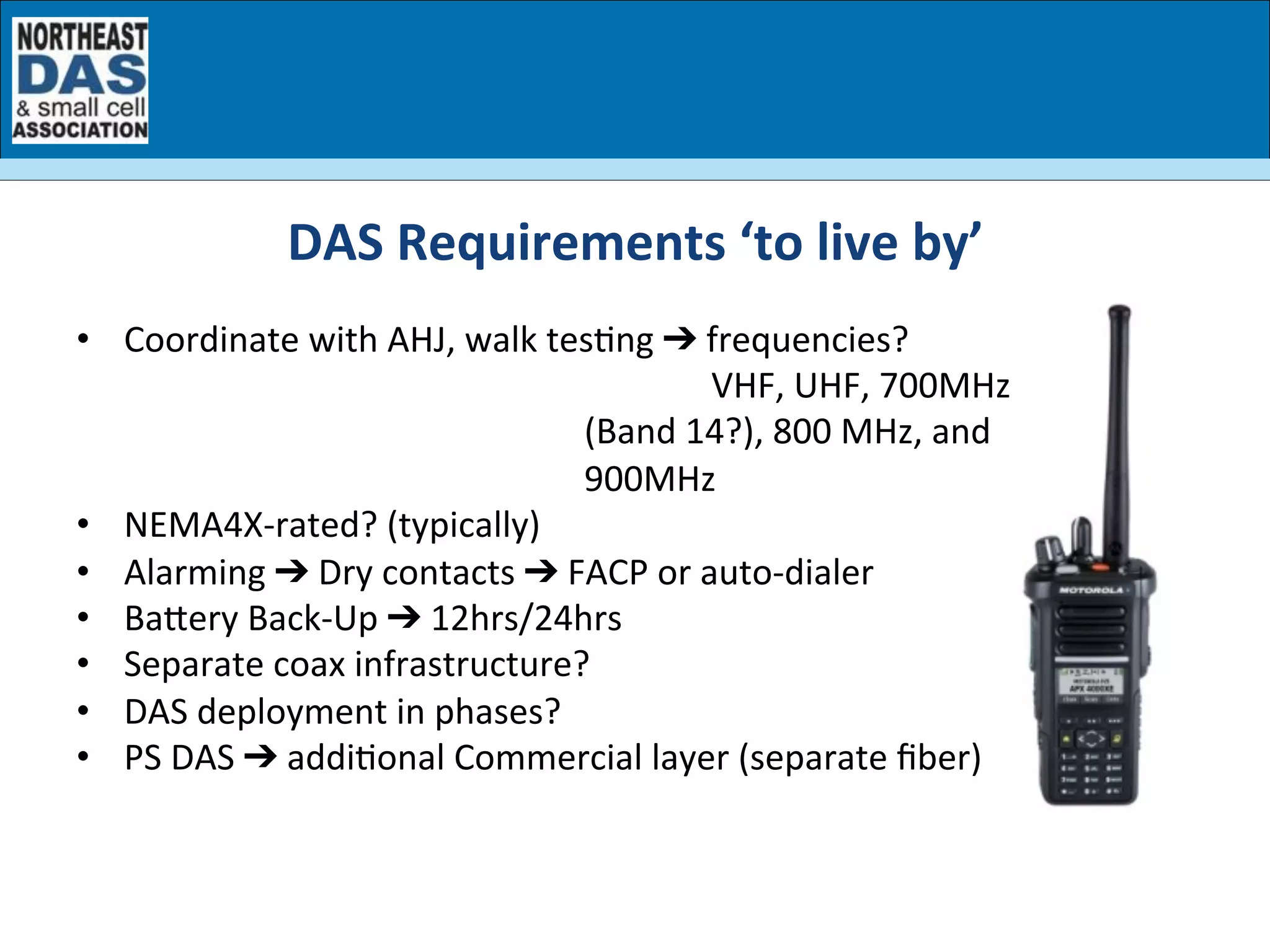
•  Coordinate	
  with	
  AHJ,	
  walk	
  tesGng	
  ➔	
  frequencies?	


  VHF,	
  UHF,	
  700MHz	
  
(Band	
  14?),	
  800	
  MHz,	
  and	
  
900MHz	
  
•  NEMA4X-­‐rated?	
  (typically)	
  
•  Alarming	
  ➔	
  Dry	
  contacts	
  ➔	
  FACP	
  or	
  auto-­‐dialer	
  
•  Baery	
  Back-­‐Up	
  ➔	
  12hrs/24hrs	
  
•  Separate	
  coax	
  infrastructure?	
  
•  DAS	
  deployment	
  in	
  phases?	
  
•  PS	
  DAS	
  ➔	
  addiGonal	
  Commercial	
  layer	
  (separate	
  fiber)	
  
DAS	
  Requirements	
  ‘to	
  live	
  by’	
  
Thank	
  You.	
  	
  
For	
  more	
  informaGon,	
  contact	
  sales@adrOech.com	
  AND	
  
info@visiontech.biz	


866-­‐746-­‐1122	
  |	
  410.424.2208	
  
hp://www.visiontech.biz	
  |	
  hp://www.DAS-­‐Cell.com	


Thank You to Our Lanyard Sponsor
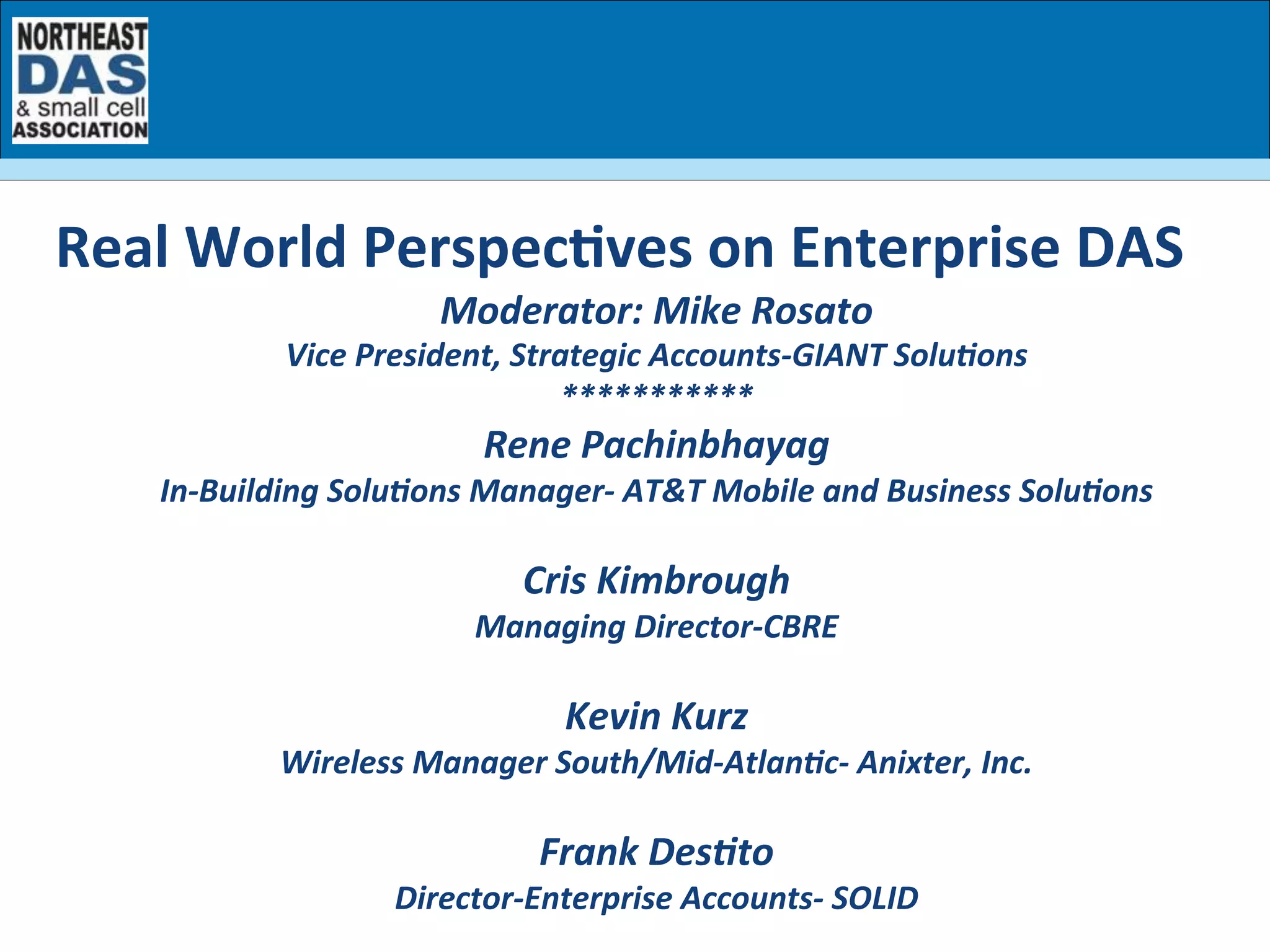
Moderator:	
  Mike	
  Rosato	
  
Vice	
  President,	
  Strategic	
  Accounts-­‐GIANT	
  SoluBons	
  
***********	
  
Rene	
  Pachinbhayag	
  
In-­‐Building	
  SoluBons	
  Manager-­‐	
  AT&T	
  Mobile	
  and	
  Business	
  SoluBons	


Cris	
  Kimbrough	
  
Managing	
  Director-­‐CBRE	


Kevin	
  Kurz	
  
Wireless	
  Manager	
  South/Mid-­‐AtlanBc-­‐	
  Anixter,	
  Inc.	


Frank	
  DesBto	
  
Director-­‐Enterprise	
  Accounts-­‐	
  SOLID	


Real	
  World	
  Perspec7ves	
  on	
  Enterprise	
  DAS	
  
Thank You to Our Silver Networking
Sponsors


Presented	
  by:	
  Scoj	
  Gregory	
  
Director	
  of	
  MarkeBng	
  -­‐	
  SOLiD	


Strategies	
  for	
  Dealing	
  with	
  Aging	
  DAS	
  
Infrastructure	
  
GOLD
PLATINUM
SILVER
Thank You to Our Annual Sponsors
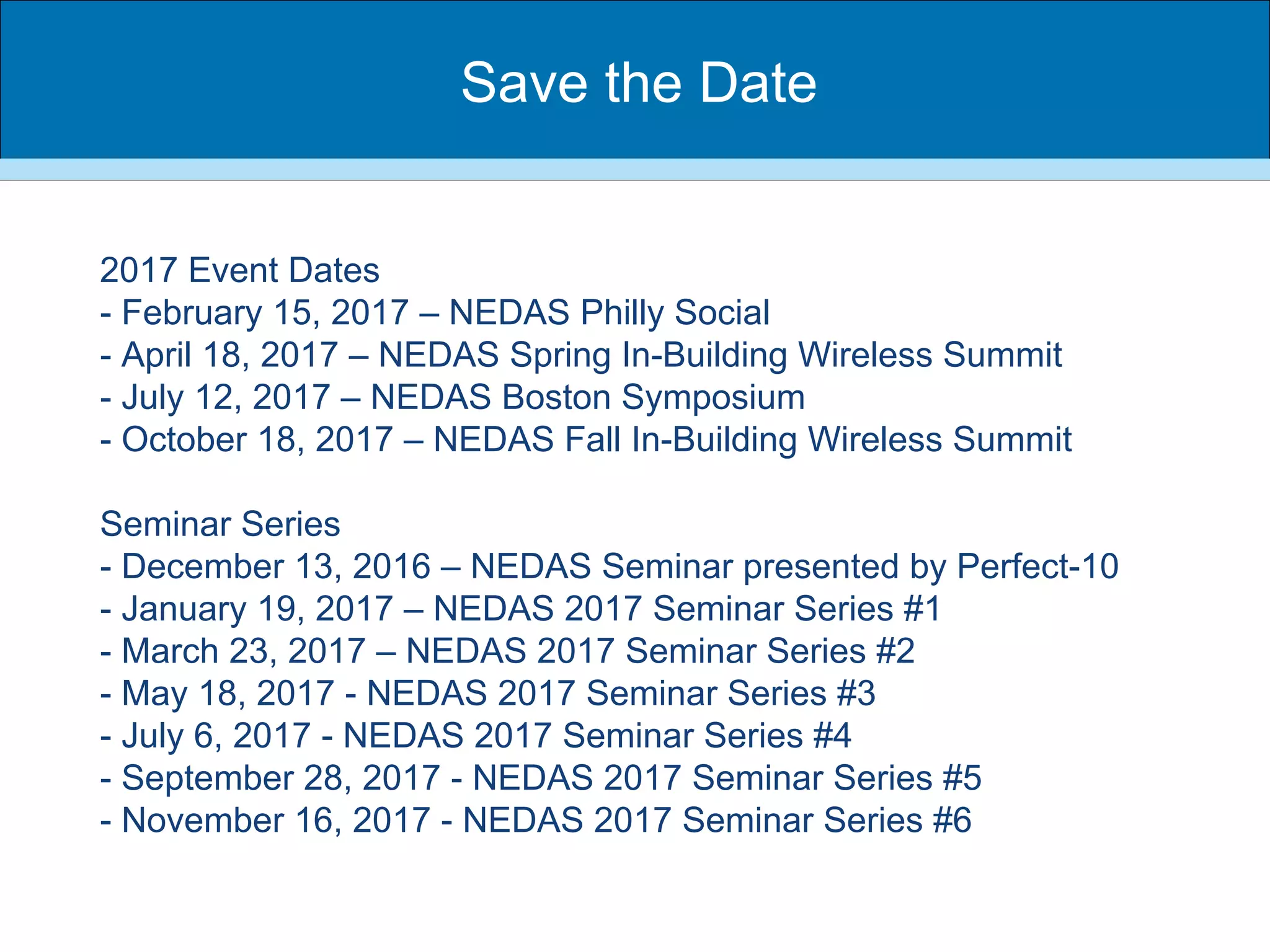
2017 Event Dates
- February 15, 2017 – NEDAS Philly Social
- April 18, 2017 – NEDAS Spring In-Building Wireless Summit
- July 12, 2017 – NEDAS Boston Symposium
- October 18, 2017 – NEDAS Fall In-Building Wireless Summit
Seminar Series
- December 13, 2016 – NEDAS Seminar presented by Perfect-10
- January 19, 2017 – NEDAS 2017 Seminar Series #1
- March 23, 2017 – NEDAS 2017 Seminar Series #2
- May 18, 2017 - NEDAS 2017 Seminar Series #3
- July 6, 2017 - NEDAS 2017 Seminar Series #4
- September 28, 2017 - NEDAS 2017 Seminar Series #5
- November 16, 2017 - NEDAS 2017 Seminar Series #6
Save the Date

NEDAS DC - November 29, 2016 Presentations

  • 1.
  • 2.
    U.S. In-building WirelessEquipment Market: 5-Year Demand Outlook
  • 3.
    Meet the Panel John  Celentano   Analyst/Consultant Skyline Marketing Group Moderator Ken  Rehbehn   Principal Analyst, Wireless Infrastructure 451 Research Chris  Wixom   Sr. Director-Strategic Accounts Corning Dominic  Villecco   President V-COMM
  • 4.
    Presenter   Presented  by  451  Research   Ken  Rehbehn   Principal  Analyst,  Wireless  Infrastructure  
  • 5.
    •  Mobile broadbandtraffic – Growth continues, but does capex? •  Internet of Things expands – Not just an outdoor need •  Small cell role – Is it breakout time? •  5G hype grows – But focus is on fixed for now General Technology Trends Impacting the In- building Wireless Market
  • 6.
    •  Voice overWi-Fi – Filling gaps, but is it sufficient? •  LTE Licensed Assisted Access – Expanding LTE spectrum with unlicensed •  MulteFire – New opportunity for neutral host systems? •  CBRS – New spectrum, new players? Unlicensed and shared spectrum Technology Trends Impacting the In- building Wireless Market
  • 7.
    •  E911 indoorlocation – Addressing the Z-axis •  FirstNet – Bringing LTE to the service of first responders Emergency services Technology Trends Impacting the In- building Wireless Market
  • 8.
    Presenter   Presented  by  Skyline  Marke7ng  Group   John  Celentano   Wireless  Market  Analyst/MarkeBng  Consultant    
  • 9.
    U.S. Commercial BuildingsInstalled Base Source: EIA-CBECS, 2012, our estimates © 2016. Skyline Marketing Group. All rights reserved. Tier 1 [8,000] Tier 2 [128,000] Tier 3 [199,000] Tier 4 [5,222,000] 500,000+ sf <885,000 sf> 100,000-500,000 sf <210,000 sf> 50,000-100,000 sf <70,000 sf> Under 50,000 sf <16,000 sf> IBW Complexity Hi Lo Total = 5.6 million buildings
  • 10.
    U.S. Middleprise IBWMarket Outlook © 2016. Skyline Marketing Group. All rights reserved. http://www.aglmediagroup.com/sizing-the-in-building-wireless-systems-market/
  • 11.
    Presenter   Chris  Wixom   Sr.  Director,  Strategic  Accounts     Presented  by  Corning  
  • 12.
    Open Fiber BasedPlatform In-Building is About Connectivity 8x Increase in Mobile Traffic by 2020 Drives Bandwidth Needs Technology Disruption will only Increase
  • 13.
    Multiple Applications –ONE Platform Cellular VzW AT&T/ Sprint T-Mobile WiFi Cisco Aruba Extreme/Ruckus LAN Cisco/Juniper HP/Brocade Tellabs/Zhone BMS JCI Honeywell Schneider
  • 14.
    All Fiber Infrastructure ©2016 Corning Incorporated
  • 15.
    Delivering Convergence Today: 220Central Park South •  65 Floors – 150 Units – 500K SqFt •  Cellular Connectivity – including the elevators •  Fiber Support for: •  Triple-Play Services •  Wi-Fi where needed •  Security Cameras •  Building Automation © 2016 Corning Incorporated
  • 16.
    Presenter   Dominic  Villecco   President   Presented  by  V-­‐COMM  
  • 17.
    IBW Deployment Considerations • Since 4G LTE, capacity is a bigger driver than coverage •  4G LTE data growth >100% year over year - cannot grow the network at same rate •  “Cell Edge” problem must be managed to grow network •  Signal to Noise ratio is key for increased throughput/capacity •  Offloading existing network with closer proximity network is key to increasing capacity •  “Middle-prise” buildings must keep costs in check, to maintain viability of in-building systems – cannot keep building the same way
  • 18.
  • 19.
  • 20.
  • 21.
    Mark  H.  Parr   President  &  CEO   Presented  by   Smart Cities: definition, challenges, potential
  • 22.
    Jeff  Just     COO,  Bandwidth  Logic     Jason  Nelson   ExecuBve  Director,  Partnership  Engagement,  Smart  CiBes  Council     Robert  LeGrande   Owner,  The  Digital  Decision,  LLC     Steve  Yapsuga   Senior  Business  Development  ExecuBve,  VAR  Market,  TESSCO   Smart Cities: definition, challenges, potential
  • 23.
    Presenter   Steve  Yapsuga   DemysBfying  the  Smart  City      
  • 24.
    Thank You toOur Tabletop Sponsors
  • 25.
    Moderator  :  John  Foley   OperaBng  ExecuBve   Innova7ng  the  In-­‐Building   Business  Model   Bo White, Director, Business Development, Sentry Financial Corporation Ray Hild, Area Vice President, JMA Wireless Alex Ajdelsztajn, Sr. Manager of IT in the Americas Region, Marriott International Joe Koridek, Director National Sales and Business Development, CTS
  • 26.
    Thank You toOur Charging Station Sponsor
  • 27.
    Mike  Collado   Principal  Consultant   5  Key  Trends  and  How  They’ll  Impact     the  In-­‐Building  Wireless  Ecosystem  in  2017  (and  Beyond)  
  • 28.
    5  Key  Trends  and  How  They’ll  Impact     the  In-­‐Building  Wireless  Ecosystem  in  2017  (and  Beyond)   Trend  #1:  5G       Infrastructure  and  transport  will   play  a  pivotal  role  
  • 29.
    Trend  #2:  3.5  GHz  CBRS       CBRS  could  bridge  the  divide  between   carriers  and  enterprises  
  • 30.
    Mike  Collado   Principal  Consultant   5  Key  Trends  and  How  They’ll  Impact     the  In-­‐Building  Wireless  Ecosystem  in  2017  (and  Beyond)   Trend  #3:  Public  Safety  &  Loca7on       Code  requirements  mean  opportunity     but  regulatory  nuances  create  challenges  
  • 31.
    Trend  #4:  Tier  2  Venues       Tier  1  go-­‐to-­‐market  strategies  don’t   translate  to  the  Tier  2  Market  
  • 32.
    5  Key  Trends  and  How  They’ll  Impact     the  In-­‐Building  Wireless  Ecosystem  in  2017  (and  Beyond)       Tier  2  may  be  the  “buzz”   but  Tier  1  is  the  “biz”   Trend  #5:  Tier  1  Venues  
  • 33.
    Trend   When   R&D   MarkeBng   Sales   5G   >5  Years   ✓   3.5  GHz   3  Years   ✓   PS   Now   ✓   ✓   ✓   Tier  2   1.5  Years   ✓   ✓   Tier  1   Now   ✓   ✓   Timeframes  &  Stakeholder  Focus  
  • 34.
  • 35.
    Thank You toOur Raffle Sponsors
  • 36.
    Presenter   Bob  Langston   ADRF   Regional  Sales  Manager   Public  Safety  Distributed  Antenna  Systems   Will  Ruffin     Vision  Technologies   NaBonal  Account  Manager  
  • 37.
    I.  What  is  Driving  Public  Safety  DAS?   II.  NFPA  Compliance   III.  Frequency  Bands  /  Technologies   IV.  Case  Studies   Agenda  
  • 38.
    Needs  Analysis   Contac7ng  the  Local  AHJ   NFPA  72  Fire  Code  Sec7on  500   Interpreta7on  for  Coverage  and  Tes7ng     PS  DAS  Requirements  
  • 39.
    Consider  This:     ❑  The  Frequencies  Required     ❑  Coverage     ❑  Design   ❑  Passive  vs  AcGve  System   ❑  Fire  RaGngs  2  hour  |  4  Hour   ❑  AestheGc  and  Architectural  Requirements   ❑  Working  Hours:  DayGme,  AOer  Hours   ❑  Preferred  Low  Voltage  Contractor   ❑  Union/Non-­‐Union  Labor;  Prevailing  Wages  
  • 40.
      In-­‐Building  Coverage   Focus  of  AHJ                        -­‐  Enforcement  via  Occupancy  Permits   Building  Owner’s  Requirements   It  Depends  on  the  Local  Jurisdic7on   Improving  Communica7ons  
  • 41.
    RegulaGons  are  driving  the  number  of  requirements  for  Public  Safety    DAS   Small  facili7es     <100K  sq  _   Medium  to  Large  facili7es   >100    and  <200  sq  _   Large  facili7es   >200  sq  _   Providing  Indoor  Public  Safety  Coverage  
  • 42.
    Small  Facili7es  :  Passive  Architecture  with  Public   Safety  Coverage  
  • 43.
    Medium-­‐Large  Area:  Ac7ve  Architecture  with  Public   Safety  
  • 44.
    Large  Area:  Neutral  Host  -­‐Ac7ve  Architecture    
  • 45.
  • 46.
    •  System  Coverage:  99%  coverage  in  criGcal  areas  designated   by  the  local  fire  department   •  -­‐95  dB  Minimum  signal  Strength:  IFC  and  NFPA  requires  -­‐95   dB  of  signal  level  regardless  of  the  frequency   •  NEMA-­‐4  Enclosures:  Dust,  water,  and  corrosion-­‐proof  NEMA   4  compliant  housing   •  System  Monitoring  Alarms:    to  provide  real-­‐Gme  monitoring   of  system’s  readiness.  Power/Baery  /Antenna  /Equipment   failure/  baery  charging   •  Babery  Backup:  In  case  of  main  power  failure  (likely  at  a   fire),  12/24  hours  of  run-­‐Gme  (minimum)     •  Antenna  Isola7on.  NFPA  sGpulates  antenna  isolaGon   requirement  of  15  dB  higher  than  the  gain  of  the  amplifier.     •  Class  A  or  Class  B  Amplifier:  channelized  or  wideband       NFPA  -­‐  Compliance  
  • 47.
    •  Different  DAS  interpretaGons  to  the   naGonal  codes  (NFPA,  IFC)  by  AHJ   •  Code  is  becoming  wiser  across  all   regions   NFPA    
  • 48.
    Frequency  Bands  and  Technologies    
  • 49.
    •  VHF:  136  –  174  MHz   •  UHF:  380  –  512  MHz   •  Channels  vary  by  locaGon  and  project   •  Need  to  keep  UL  and  DL  isolated                        Keep  UL  and  DL  on  separate  coaxial  paths  and  antennas                                      Use  custom  duplexers/mulGplexers  with  high  isolaGon     VHF  and  UHF  
  • 50.
    700C 700PS 700C700PS 800PS 800C Cell 800PS 800C Cell DL DL UL UL UL UL DL DL 746-757 758-775 776-787 788-805 806-817 817-824 824-849 851-862 862-869 869-894 •  DL  of  one  frequency  band  showing  up  as  UL  of  an  adjacent  band   (7PDL/7FUL,  CUL/S8DL)   •  Bandpass  Filters  required  at  Remote  Modules   •  Typically  separate  remotes  required     •  Keep  adjacent  frequency  bands  on  separate  paths  from  HE-­‐>RU   •  Use  hybrid  coupler  with  high  isolaGon  to  combine  (30dB)   700  +  800  MHz  Commercial  and  Public  Safety  
  • 51.
    •  LTE  E-­‐UTRA  Band   •  FDD  Frequency  band   •  Uplink  788-­‐798  MHz   •  Downlink  758-­‐768  MHz   •  Great  indoor  penetraGon  being  a  lower  band   700  MHz  Band  14  
  • 52.
    •  Future  Frequency  Changes:  Need  to  support   future  frequency  requirement.  IFC  and  NFPA   promote  equipment  that  supports  VHF,  UHF   700  and  800  MHz   •  SelecGon  of    products  that  already  cover  from   VHF  to  800  will  provide  savings  in  the  future   •  Choose  products  that  are  “modula7on     agnos7c”  modulaGon  techniques  can  change   in  the  future   •  Single  mode  fiber  is  preferred  among  DAS   acGve  soluGons         Future  Bands  and  Technologies    
  • 53.
    DAS   QuesGons  to  ask:     • Frequencies:  Does  it  support  Commercial  &   PS  bands  -­‐  134  MHz  to  2690  MHz?   • Modularity:  Does  the  equipment  support   commercial  and  public  safety  on  the  same   system?   • Expandability:  Can  I  pay  for  bands  that  I  need   now  and  easily  upgrade  in  the  future?   • Does  it  have  filtering  opGons  to  miGgate   interference?   Off  Air  Repeater   QuesGons  to  ask:     • Frequencies:  Does  it  support  bands  -­‐   700/800  MHz  and  VHF/UHF?   • Is  it  NFPA  Compliant?       • Does  it  offer  NEMA  4X  compliant   enclosure  suitable  for  both  indoor  and   outdoor  environments?   • Does  it  have  filtering  opGons  to  miGgate   interference?   Public  Safety  Product  Lines  
  • 54.
    Public Safety DAS– Critical Coverage Requirement Case  Studies  
  • 55.
    • Located  in  Washington  D.C.   • 290K  Square  Feet    Coverage   Area     • LEED  Silver  Design   • Police  and  EMS  Staff   • Radio  Service  Required   Tenants  and  Visitors  require  robust  public  safety  service     Site  A:  Consolidated  Forensic  Laboratory  (CFL)  
  • 56.
    DAS  HEADEND  Public   Safety   Repeater   DAS  REMOTE   DAS  REMOTE   3rd  Floor  East   1st  Floor  West  4th  Floor  West   DAS  and  Repeater  Installa7on  Photos   •  700  MHz,  800MHz,  and  UHF  Support   •  Only  PS  repeater  NEMA4X-­‐rated,  due  to  budget   •  Ambient  coverage  ➔  parGal  DAS   •  No  ba  back-­‐up  ➔  building  already  has  centralized  back-­‐up  power  
  • 57.
    •  Coordinate  with  AHJ,  walk  tesGng  ➔  frequencies?        VHF,  UHF,  700MHz   (Band  14?),  800  MHz,  and   900MHz   •  NEMA4X-­‐rated?  (typically)   •  Alarming  ➔  Dry  contacts  ➔  FACP  or  auto-­‐dialer   •  Baery  Back-­‐Up  ➔  12hrs/24hrs   •  Separate  coax  infrastructure?   •  DAS  deployment  in  phases?   •  PS  DAS  ➔  addiGonal  Commercial  layer  (separate  fiber)   DAS  Requirements  ‘to  live  by’  
  • 58.
    Thank  You.     For  more  informaGon,  contact  sales@adrOech.com  AND   info@visiontech.biz     866-­‐746-­‐1122  |  410.424.2208   hp://www.visiontech.biz  |  hp://www.DAS-­‐Cell.com    
  • 59.
    Thank You toOur Lanyard Sponsor
  • 60.
    Moderator:  Mike  Rosato   Vice  President,  Strategic  Accounts-­‐GIANT  SoluBons   ***********   Rene  Pachinbhayag   In-­‐Building  SoluBons  Manager-­‐  AT&T  Mobile  and  Business  SoluBons     Cris  Kimbrough   Managing  Director-­‐CBRE     Kevin  Kurz   Wireless  Manager  South/Mid-­‐AtlanBc-­‐  Anixter,  Inc.     Frank  DesBto   Director-­‐Enterprise  Accounts-­‐  SOLID     Real  World  Perspec7ves  on  Enterprise  DAS  
  • 61.
    Thank You toOur Silver Networking Sponsors
  • 62.
                  Presented  by:  Scoj  Gregory   Director  of  MarkeBng  -­‐  SOLiD         Strategies  for  Dealing  with  Aging  DAS   Infrastructure  
  • 63.
  • 64.
    2017 Event Dates -February 15, 2017 – NEDAS Philly Social - April 18, 2017 – NEDAS Spring In-Building Wireless Summit - July 12, 2017 – NEDAS Boston Symposium - October 18, 2017 – NEDAS Fall In-Building Wireless Summit Seminar Series - December 13, 2016 – NEDAS Seminar presented by Perfect-10 - January 19, 2017 – NEDAS 2017 Seminar Series #1 - March 23, 2017 – NEDAS 2017 Seminar Series #2 - May 18, 2017 - NEDAS 2017 Seminar Series #3 - July 6, 2017 - NEDAS 2017 Seminar Series #4 - September 28, 2017 - NEDAS 2017 Seminar Series #5 - November 16, 2017 - NEDAS 2017 Seminar Series #6 Save the Date