Change
Management
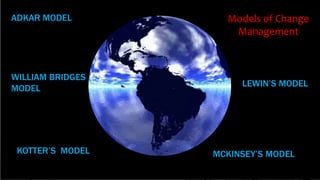
Models of Change Management
Guidelines for facilitating change
Total quality management
Business process Reengineering
CHANGE MANAGEMENTIS AN
APPROACH TO
TRANSITIONING INDIVIDUALS,
TEAMS & ORGANISATIONS TO
A DESIRED STATE.
Managers make change real for their people.
Change demands a solid plan with clear direction.
WILLIAM BRIDGES
MODEL
KOTTER’S MODEL
LEWIN’S MODEL
ADKAR MODEL
MCKINSEY’S MODEL
Models of Change
Management
A = Awareness of the need for change
D = Desire to participate and support the change
K = knowledge on how to change
A = ability to implement required skills & behaviours
R = reinforcement to sustain the change
Developed in 1998
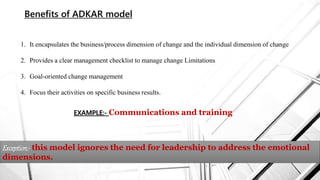
Benefits of ADKAR model
Exception:- this model ignores the need for leadership to address the emotional
dimensions.
1. It encapsulates the business/process dimension of change and the individual dimension of change
2. Provides a clear management checklist to manage change Limitations
3. Goal-oriented change management
4. Focus their activities on specific business results.
EXAMPLE:- Communications and training
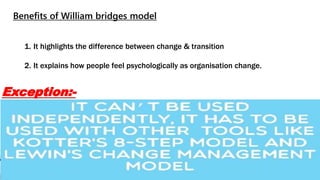
1. It highlights the difference between change & transition
2. It explains how people feel psychologically as organisation change.
Benefits of William bridges model
Exception:-
1. It can be used successfully to obtain buy-in from key employees.
2. It fits well on top of traditional organisation structures.
Exception:-
Benefits of Kotter’s model
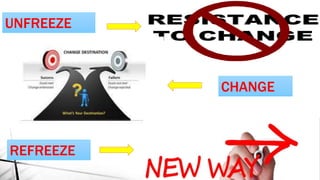
UNFREEZE
REFREEZE
CHANGE
Benefits of models
Exception:-
1. It identified that the majority of people prefer to function within zones of comfort.
2. It is easy to use & a lot of companies prefer it to enact major changes.
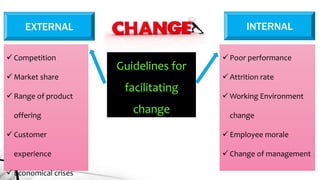
Guidelines for
facilitating
change
EXTERNAL INTERNAL
 Competition
 Market share
 Range of product
offering
 Customer
experience
 Economical crises
 Poor performance
 Attrition rate
 Working Environment
change
 Employee morale
 Change of management
Measure change progress
Communicate with team
Identify short term steps
and people’s roles
Understand
employee’s
psychology for
change
Define change
strategies
Create a change baseline
The banker will answer” service”
The healthcare worker will answer “quality health care”
The hotel employee will answer “customer satisfaction”
The manufacturer will simply answer “quality product”
TOTAL QUALITY MANAGEMENT
TQM is the integration of all functions and processes within an organization in order to
achieve continuous improvement of the quality of goods and services.
Integrated organizational effort designed to improve quality of processes at
every business level.
• Meeting the customers requirements is the primary objective and the key to
organizational survival and growth.
• The second objective of TQM is continuous improvement of quality. The
management should stimulate the employees in becoming increasingly
competent and creative.
• Third, TQM aims at developing the relationship of openness and trust among the
employees at all levels in the organisation.
Objectives of TQM
Benefits of TQM
Greater customer loyalty
Market share improvement
Higher stock prices
Reduced service calls
Higher prices
Greater productivity
“Actions are direct reflection of one’s intentions”
Cost of Quality
Prevention costs – cost of
preparing and implementing
a quality plan
Appraisal costs – cost of testing,
evaluating and inspecting quality
Internal failure costs – cost of
scrap, rework, and material
losses
External failure costs – cost of
failure at customer site, including
returns, repairs and recalls
Business process Reengineering{BPR}
BPR is the fundamental rethinking and
redesign of business processes to achieve
dramatic improvements in critical,
contemporary measures of performance,
such as cost, quality, service and speed.
(Hammer & Champy, 1993)
An organizational make-over.
Requirement of BPR
• Change
• Competition
• customer
Pooja Singh
Roll No:-26

Change management

  • 1.
  • 2.
    Models of ChangeManagement Guidelines for facilitating change Total quality management Business process Reengineering
  • 3.
    CHANGE MANAGEMENTIS AN APPROACHTO TRANSITIONING INDIVIDUALS, TEAMS & ORGANISATIONS TO A DESIRED STATE. Managers make change real for their people. Change demands a solid plan with clear direction.
  • 4.
    WILLIAM BRIDGES MODEL KOTTER’S MODEL LEWIN’SMODEL ADKAR MODEL MCKINSEY’S MODEL Models of Change Management
  • 5.
    A = Awarenessof the need for change D = Desire to participate and support the change K = knowledge on how to change A = ability to implement required skills & behaviours R = reinforcement to sustain the change Developed in 1998
  • 6.
    Benefits of ADKARmodel Exception:- this model ignores the need for leadership to address the emotional dimensions. 1. It encapsulates the business/process dimension of change and the individual dimension of change 2. Provides a clear management checklist to manage change Limitations 3. Goal-oriented change management 4. Focus their activities on specific business results. EXAMPLE:- Communications and training
  • 9.
    1. It highlightsthe difference between change & transition 2. It explains how people feel psychologically as organisation change. Benefits of William bridges model Exception:-
  • 12.
    1. It canbe used successfully to obtain buy-in from key employees. 2. It fits well on top of traditional organisation structures. Exception:- Benefits of Kotter’s model
  • 14.
  • 15.
    Benefits of models Exception:- 1.It identified that the majority of people prefer to function within zones of comfort. 2. It is easy to use & a lot of companies prefer it to enact major changes.
  • 18.
    Guidelines for facilitating change EXTERNAL INTERNAL Competition  Market share  Range of product offering  Customer experience  Economical crises  Poor performance  Attrition rate  Working Environment change  Employee morale  Change of management
  • 19.
    Measure change progress Communicatewith team Identify short term steps and people’s roles Understand employee’s psychology for change Define change strategies Create a change baseline
  • 20.
    The banker willanswer” service” The healthcare worker will answer “quality health care” The hotel employee will answer “customer satisfaction” The manufacturer will simply answer “quality product” TOTAL QUALITY MANAGEMENT TQM is the integration of all functions and processes within an organization in order to achieve continuous improvement of the quality of goods and services. Integrated organizational effort designed to improve quality of processes at every business level.
  • 21.
    • Meeting thecustomers requirements is the primary objective and the key to organizational survival and growth. • The second objective of TQM is continuous improvement of quality. The management should stimulate the employees in becoming increasingly competent and creative. • Third, TQM aims at developing the relationship of openness and trust among the employees at all levels in the organisation. Objectives of TQM
  • 22.
    Benefits of TQM Greatercustomer loyalty Market share improvement Higher stock prices Reduced service calls Higher prices Greater productivity “Actions are direct reflection of one’s intentions”
  • 23.
    Cost of Quality Preventioncosts – cost of preparing and implementing a quality plan Appraisal costs – cost of testing, evaluating and inspecting quality Internal failure costs – cost of scrap, rework, and material losses External failure costs – cost of failure at customer site, including returns, repairs and recalls
  • 24.
    Business process Reengineering{BPR} BPRis the fundamental rethinking and redesign of business processes to achieve dramatic improvements in critical, contemporary measures of performance, such as cost, quality, service and speed. (Hammer & Champy, 1993) An organizational make-over.
  • 25.
    Requirement of BPR •Change • Competition • customer
  • 27.