The hydraulic press,orhydrostaticpress, was inventedby JosephBrahamandis therefore
sometimescalled theBrahampress. It consistsessentiallyoftwo cylinders each filled with
liquid andeachfitted witha piston;thecylinders areconnectedby a pipe also filled with the
liquid. One cylinderis ofsmalldiameter,the otherof largediameter. Accordingto Pascal’s,
pressureexerted onthe smallerpistonis transmittedundiminishedthroughthe liquidto
thesurface ofthe largerpiston,which is forced upward. Althoughthepressure (forceper
unit ofarea) is thesameforbothpistons,thetotalupwardforce on thelargerpistonis as
manytimes greaterthantheforce onthe smallerpistonasthe area ofthelarger pistonis
greaterthanthearea of thesmallerpiston.If, forexample, the smallerpistonhas anarea of
2 sq. in.anda force of100 lb. is exerted onit, then theforce onthe largerpistonhavingan
area of50 sq.in.would be 2,500 lb. (100×50/2= 2,500).However, when the pistonsmove,the
distancethesmallerpistontravelsis proportionatelygreaterthanthedistancethelarger
pistontravels,satisfyingthelawof conservationofenergy. If thesmallerpistonmoves25in.,
thelarger onewill onlymove1 in.The hydraulic press is used, forexample, to formthree-
dimensionalobjectsfrom sheet metalandplastics andtocompress largeobjects. The
hydraulic jack, alsoan applicationofPascal'slaw, is used toexert large forces ortolift heavy
loads.
1. Principal of hydraulic press
2.Working of hydraulic press
3.Information about their parts
4.Application of the hydraulic press
5.Conclusion
6. Source of information
The hydraulic press depends on Pascal's principle:
the pressure throughout a closed system is constant. One part of the
system is a piston acting as a pump, with modest mechanical force
acting on a small cross-sectional area; the other part is a piston with
a larger area which generates a correspondingly large mechanical force.
Only small-diameter tubing (which more easily resists pressure) is
needed if the pump is separated from the press cylinder. Pascal’s law:
Pressure on a confined fluid is transmitted undiminished and acts with
equal force on equal areas and at 90 degrees to the container wall.
A fluid, such as oil, is displaced when either piston is pushed inward.
Since the fluid is incompressible, the volume that the small piston
displaces is equal to the volume displaced by the large piston. This
causes a difference in the length of displacement, which is proportional
to the ratio of areas of the heads of the pistons given that volume =
area X length. Therefore, the small piston must be moved a large
distance to get the large piston to move significantly. The distance the
large piston will move is the distance that the small piston is moved
divided by the ratio of the areas of the heads of the pistons. This is
how energy, in the form of work in this case, is conserved and
the Law of Conservation of Energy is satisfied. Work is force applied
over a distance, and since the force is increased on the larger piston,
the distance the force is applied over must be decreased.
Braham’s basic idea is also exploited in hydroforming.
Hydraulic press is the most efficient form of presses. It applies hydraulic
mechanism for applying a large lifting force or compressive force. The press has
one or more than one hydraulic pump and hydraulic cylinder. Hydraulic press also
allows easily configured job parameters like travel distance, force and return
position to perform a variety of jobs. Various levels of sophistication and technical
advancement are available including simple mechanical switches and digitally
programmable control.
Hydraulic press works on Savannah's principle, which states - “pressure
throughout a closed system is constant.” In hydraulic press, there is a piston at
one end of the system having a small cross-sectional area. This piston is driven
by a lever. The other end of the system has small-diameter tubing. When a fluid is
displaced, either of the pistons is pushed inward. Small piston displaces a smaller
amount of volume than the large piston for a given distance of movement. The
displaced fluid volume is proportional to the ratio of pistons' head areas. Hence,
smaller piston moves a large distance to move large piston significantly. The large
piston movement distance is equal to small piston movement distance divided by
the ratio of the pistons' head areas.
For illustration, if the ratio of the pistons' head areas is 5 and a force of 100
Newton is applied on small piston, it will produce a force of 500 Newton on the
large piston. The smaller piston should be pushed at least 50 cm to get the large
piston to rise 10 cm. As the force is increasing on the larger piston, the distance
must be decreased. This way, it also follows the principle of conversation of
energy. For instance, the work done by small piston is 50 Joules (100 newton’s
multiplied by 0.5 meter), which the equal to the work is done by large piston, 500
newton’s multiplied by 0.1 meter.
Hydraulic presses are a powerful class of machine tools; they derive the
energy they deliver through hydraulic pressure. Fluid pressure, in a
particular chamber, can be increased or decreased by the use of pumps, and
valves. Sometimes devices and systems may be used to increase the capacity
of the pumps in more powerful presses. These presses can operate over a long
distance and at a constant speed. Hydraulic presses are generally slower
relative to other press machine types. This involves longer contact with the
work; therefore the cooling of the work can be an issue when hot forming a
part with hydraulic force. Hydraulic presses are capable of being the most
powerful class of presses. Some may be as large as buildings, and can deliver
awesome pressure. The largest hydraulic presses are capable of applying
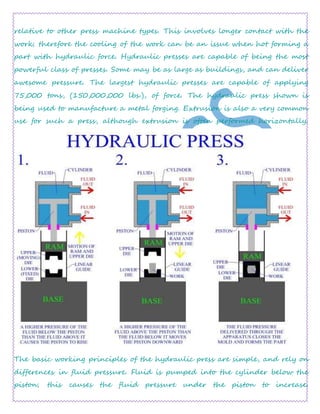
75,000 tons, (150,000,000 lbs.), of force. The hydraulic press shown is
being used to manufacture a metal forging. Extrusion is also a very common
use for such a press, although extrusion is often performed horizontally.
The basic working principles of the hydraulic press are simple, and rely on
differences in fluid pressure. Fluid is pumped into the cylinder below the
piston; this causes the fluid pressure under the piston to increase.
Simultaneously, fluid is pumped out of the top channel, causing the fluid
pressure above the piston to decrease. A higher pressure of the fluid below
the piston than the fluid above it causes the piston to rise. In the next step,
fluid is pumped out from below the piston, causing the pressure under the
piston to decrease. Simultaneously, fluid is pumped into the cylinder from
the top; this increases the fluid pressure above the piston. A higher pressure
of the fluid above the piston, than the fluid below it, moves the piston
downward.
MULTIPRESSES: are used for equipment stamping, to assemble one part to another; to form
miscellaneous items such as filter cans; to compact powered material; trim excess metal on a part such as
transmission housing; or even produce controlled fish, chicken or other portions of food. The presses are
used in literally thousands of applications.
STAMPING PRESSES: MULTIPRESSES are all well-suited to stamping applications, and many of the
industries that actively use our presses apply them for their stamping press needs. For most stamping
press applications MULTIPRESSES are the top choice for their reliability, precision and power. One
advantage of MULTIPRESS hydraulic stamping presses is the constant press force during the stroke in the
stamping process.
MULTIPRESS MARKETS:
APPLIANCES: MULTIPRESSES are used extensively in this industry, making many electrical parts
used in the manufacture of such items as ranges, refrigerators, washing machines, kitchen appliances,
hand powered tools as well as stamped and formed panels for these items.
AUTOMOTIVE: MULTIPRESSES are used by car and truck part manufacturers for original equipment
and aftermarket products. The presses are used in the manufacture of exhaust systems, seat belt retractors,
windshield wiper blades, air bags, carburetors, fuel injection sensors, gear assemblies, bearing assemblies,
clutch friction material bonding, and in stamping and forming operations.
CERAMIC AND ABRASIVES: Applications in the industries include compacting grinding wheels,
powered metal parts, glass products, Teflon bearing materials, clay products and magnetic materials.
These products are produced by applying a substantial amount of force to form an object from powder or
other loose granular substances.
ELECTRICAL: Many plugs, housings, switches and thermostats used in electrical installations, as well as
electrically operated products such as motors and electrical appliances, are produced by MULTIPRESS
equipment.
FOOD COMPACTION: MULTIPRESSES are used to compact and package many food products; the
most familiar being meat, cheese and fish products.
GOVERNMENT/MILITARY: The United States Government uses MULTIPRESSES for arsenal work
such as shell loading and fuses assemblies, compaction of fuel cells and food pellets for use on
submarines.
Beveling shearing/piercing process has been developed at a lab base hydraulic
press and has been successfully used for piercing holes for AHSS.
The maximum shearing force can be significantly reduced more than 50%
when a beveling angle is used during shearing. The shearing force depends also
upon the die clearance during shearing.
The optimal shearing condition results in more than 60% improvement in the
whole expansion ratio when compared to conventional flat head punching
process.
The optimized shearing condition for piercing and shearing AHSS is the
combination of a beveling angle between 3 and 6 degree and a 17% die
clearance and the shearing direction parallel to the material rolling direction.
 https://en.wikipedia.org/wiki/Hydraulic_press
 http://www.infoplease.com/encyclopedia/science/hy
draulic-machine-hydrostatic-devices.html
 http://www.santecindia.com/hydraulic-presses-
how-it-works.html
 http://thelibraryofmanufacturing.com/presses.html
 http://www.multipress.com/applications
 https://www.google.co.in/?gfe_rd=cr&ei=ULS9VpzKHP
OK8QehioDYCg&gws_rd=ssl#q=conclusion+of+hydra
ulic+press
Chandan

Chandan

  • 2.
    The hydraulic press,orhydrostaticpress,was inventedby JosephBrahamandis therefore sometimescalled theBrahampress. It consistsessentiallyoftwo cylinders each filled with liquid andeachfitted witha piston;thecylinders areconnectedby a pipe also filled with the liquid. One cylinderis ofsmalldiameter,the otherof largediameter. Accordingto Pascal’s, pressureexerted onthe smallerpistonis transmittedundiminishedthroughthe liquidto thesurface ofthe largerpiston,which is forced upward. Althoughthepressure (forceper unit ofarea) is thesameforbothpistons,thetotalupwardforce on thelargerpistonis as manytimes greaterthantheforce onthe smallerpistonasthe area ofthelarger pistonis greaterthanthearea of thesmallerpiston.If, forexample, the smallerpistonhas anarea of 2 sq. in.anda force of100 lb. is exerted onit, then theforce onthe largerpistonhavingan area of50 sq.in.would be 2,500 lb. (100×50/2= 2,500).However, when the pistonsmove,the distancethesmallerpistontravelsis proportionatelygreaterthanthedistancethelarger
  • 3.
    pistontravels,satisfyingthelawof conservationofenergy. Ifthesmallerpistonmoves25in., thelarger onewill onlymove1 in.The hydraulic press is used, forexample, to formthree- dimensionalobjectsfrom sheet metalandplastics andtocompress largeobjects. The hydraulic jack, alsoan applicationofPascal'slaw, is used toexert large forces ortolift heavy loads. 1. Principal of hydraulic press 2.Working of hydraulic press 3.Information about their parts 4.Application of the hydraulic press 5.Conclusion 6. Source of information
  • 4.
    The hydraulic pressdepends on Pascal's principle: the pressure throughout a closed system is constant. One part of the system is a piston acting as a pump, with modest mechanical force acting on a small cross-sectional area; the other part is a piston with a larger area which generates a correspondingly large mechanical force. Only small-diameter tubing (which more easily resists pressure) is needed if the pump is separated from the press cylinder. Pascal’s law: Pressure on a confined fluid is transmitted undiminished and acts with equal force on equal areas and at 90 degrees to the container wall. A fluid, such as oil, is displaced when either piston is pushed inward. Since the fluid is incompressible, the volume that the small piston
  • 5.
    displaces is equalto the volume displaced by the large piston. This causes a difference in the length of displacement, which is proportional to the ratio of areas of the heads of the pistons given that volume = area X length. Therefore, the small piston must be moved a large distance to get the large piston to move significantly. The distance the large piston will move is the distance that the small piston is moved divided by the ratio of the areas of the heads of the pistons. This is how energy, in the form of work in this case, is conserved and the Law of Conservation of Energy is satisfied. Work is force applied over a distance, and since the force is increased on the larger piston, the distance the force is applied over must be decreased. Braham’s basic idea is also exploited in hydroforming.
  • 6.
    Hydraulic press isthe most efficient form of presses. It applies hydraulic mechanism for applying a large lifting force or compressive force. The press has one or more than one hydraulic pump and hydraulic cylinder. Hydraulic press also allows easily configured job parameters like travel distance, force and return position to perform a variety of jobs. Various levels of sophistication and technical advancement are available including simple mechanical switches and digitally programmable control.
  • 7.
    Hydraulic press workson Savannah's principle, which states - “pressure throughout a closed system is constant.” In hydraulic press, there is a piston at one end of the system having a small cross-sectional area. This piston is driven by a lever. The other end of the system has small-diameter tubing. When a fluid is displaced, either of the pistons is pushed inward. Small piston displaces a smaller amount of volume than the large piston for a given distance of movement. The displaced fluid volume is proportional to the ratio of pistons' head areas. Hence, smaller piston moves a large distance to move large piston significantly. The large piston movement distance is equal to small piston movement distance divided by the ratio of the pistons' head areas. For illustration, if the ratio of the pistons' head areas is 5 and a force of 100 Newton is applied on small piston, it will produce a force of 500 Newton on the large piston. The smaller piston should be pushed at least 50 cm to get the large
  • 8.
    piston to rise10 cm. As the force is increasing on the larger piston, the distance must be decreased. This way, it also follows the principle of conversation of energy. For instance, the work done by small piston is 50 Joules (100 newton’s multiplied by 0.5 meter), which the equal to the work is done by large piston, 500 newton’s multiplied by 0.1 meter. Hydraulic presses are a powerful class of machine tools; they derive the energy they deliver through hydraulic pressure. Fluid pressure, in a particular chamber, can be increased or decreased by the use of pumps, and valves. Sometimes devices and systems may be used to increase the capacity of the pumps in more powerful presses. These presses can operate over a long distance and at a constant speed. Hydraulic presses are generally slower
  • 9.
    relative to otherpress machine types. This involves longer contact with the work; therefore the cooling of the work can be an issue when hot forming a part with hydraulic force. Hydraulic presses are capable of being the most powerful class of presses. Some may be as large as buildings, and can deliver awesome pressure. The largest hydraulic presses are capable of applying 75,000 tons, (150,000,000 lbs.), of force. The hydraulic press shown is being used to manufacture a metal forging. Extrusion is also a very common use for such a press, although extrusion is often performed horizontally. The basic working principles of the hydraulic press are simple, and rely on differences in fluid pressure. Fluid is pumped into the cylinder below the piston; this causes the fluid pressure under the piston to increase.
  • 10.
    Simultaneously, fluid ispumped out of the top channel, causing the fluid pressure above the piston to decrease. A higher pressure of the fluid below the piston than the fluid above it causes the piston to rise. In the next step, fluid is pumped out from below the piston, causing the pressure under the piston to decrease. Simultaneously, fluid is pumped into the cylinder from the top; this increases the fluid pressure above the piston. A higher pressure of the fluid above the piston, than the fluid below it, moves the piston downward. MULTIPRESSES: are used for equipment stamping, to assemble one part to another; to form miscellaneous items such as filter cans; to compact powered material; trim excess metal on a part such as transmission housing; or even produce controlled fish, chicken or other portions of food. The presses are used in literally thousands of applications. STAMPING PRESSES: MULTIPRESSES are all well-suited to stamping applications, and many of the industries that actively use our presses apply them for their stamping press needs. For most stamping press applications MULTIPRESSES are the top choice for their reliability, precision and power. One advantage of MULTIPRESS hydraulic stamping presses is the constant press force during the stroke in the stamping process. MULTIPRESS MARKETS: APPLIANCES: MULTIPRESSES are used extensively in this industry, making many electrical parts used in the manufacture of such items as ranges, refrigerators, washing machines, kitchen appliances, hand powered tools as well as stamped and formed panels for these items. AUTOMOTIVE: MULTIPRESSES are used by car and truck part manufacturers for original equipment and aftermarket products. The presses are used in the manufacture of exhaust systems, seat belt retractors, windshield wiper blades, air bags, carburetors, fuel injection sensors, gear assemblies, bearing assemblies, clutch friction material bonding, and in stamping and forming operations. CERAMIC AND ABRASIVES: Applications in the industries include compacting grinding wheels, powered metal parts, glass products, Teflon bearing materials, clay products and magnetic materials.
  • 11.
    These products areproduced by applying a substantial amount of force to form an object from powder or other loose granular substances. ELECTRICAL: Many plugs, housings, switches and thermostats used in electrical installations, as well as electrically operated products such as motors and electrical appliances, are produced by MULTIPRESS equipment. FOOD COMPACTION: MULTIPRESSES are used to compact and package many food products; the most familiar being meat, cheese and fish products. GOVERNMENT/MILITARY: The United States Government uses MULTIPRESSES for arsenal work such as shell loading and fuses assemblies, compaction of fuel cells and food pellets for use on submarines.
  • 12.
    Beveling shearing/piercing processhas been developed at a lab base hydraulic press and has been successfully used for piercing holes for AHSS. The maximum shearing force can be significantly reduced more than 50% when a beveling angle is used during shearing. The shearing force depends also upon the die clearance during shearing. The optimal shearing condition results in more than 60% improvement in the whole expansion ratio when compared to conventional flat head punching process.
  • 13.
    The optimized shearingcondition for piercing and shearing AHSS is the combination of a beveling angle between 3 and 6 degree and a 17% die clearance and the shearing direction parallel to the material rolling direction.  https://en.wikipedia.org/wiki/Hydraulic_press  http://www.infoplease.com/encyclopedia/science/hy draulic-machine-hydrostatic-devices.html  http://www.santecindia.com/hydraulic-presses- how-it-works.html  http://thelibraryofmanufacturing.com/presses.html  http://www.multipress.com/applications  https://www.google.co.in/?gfe_rd=cr&ei=ULS9VpzKHP OK8QehioDYCg&gws_rd=ssl#q=conclusion+of+hydra ulic+press