
Prepare by :-
Shivkumar Panjabi 1
Prepare by :- Shivkumar Panjabi
 Introduction.
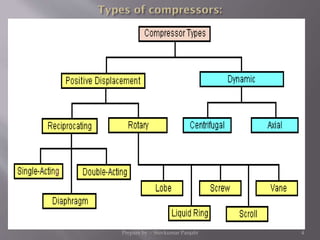
 Types of compressors.
 Positive displacement compressors.
 Dynamic compressors.
 Reciprocating & screw compressors.
 Centrifugal compressors.
 Applications of compressors in industries.
 Conclusion & references.
Prepare by :- Shivkumar Panjabi 2
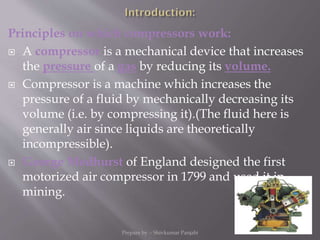
Principles on which compressors work:
 A compressor is a mechanical device that increases
the pressure of a gas by reducing its volume.
 Compressor is a machine which increases the
pressure of a fluid by mechanically decreasing its
volume (i.e. by compressing it).(The fluid here is
generally air since liquids are theoretically
incompressible).
 George Medhurst of England designed the first
motorized air compressor in 1799 and used it in
mining.
Prepare by :- Shivkumar Panjabi 3
Prepare by :- Shivkumar Panjabi 4
 In the positive-displacement type, a given quantity of
air or gas is trapped in a compression chamber and
the volume it occupies is mechanically reduced,
causing a corresponding rise in pressure prior to
discharge. At constant speed, the air flow remains
essentially constant with variations in discharge
pressure.
Ex: Reciprocating compressors, screw compressors, vane
compressors & so on.
Prepare by :- Shivkumar Panjabi 5
 Dynamic compressors impart velocity energy to
continuously flowing air or gas by means of
impellers rotating at very high speeds. The velocity
energy is changed into pressure energy both by the
impellers and the discharge volutes or diffusers. In
the centrifugal-type dynamic compressors, the shape
of the impeller blades determines the relationship
between air flow and the pressure (or head) generate.
Ex: centrifugal compressors, axial compressors.
Prepare by :- Shivkumar Panjabi 6
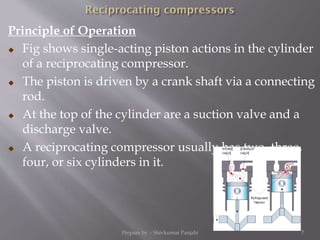
Principle of Operation
 Fig shows single-acting piston actions in the cylinder
of a reciprocating compressor.
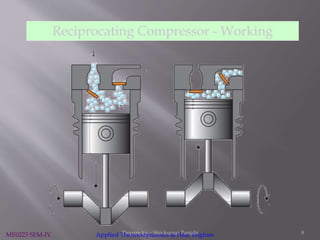
 The piston is driven by a crank shaft via a connecting
rod.
 At the top of the cylinder are a suction valve and a
discharge valve.
 A reciprocating compressor usually has two, three,
four, or six cylinders in it.
Prepare by :- Shivkumar Panjabi 7
Reciprocating Compressor - Working
ME0223 SEM-IV Applied Thermodynamics & Heat EnginesPrepare by :- Shivkumar Panjabi 8
Prepare by :- Shivkumar Panjabi 9
Prepare by :- Shivkumar Panjabi 10
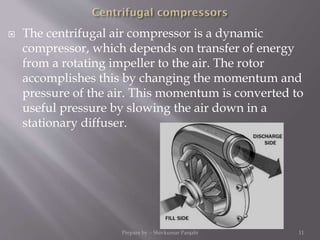
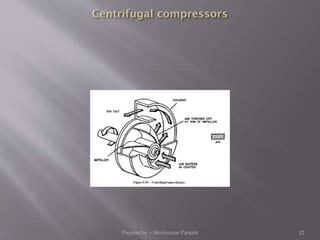
 The centrifugal air compressor is a dynamic
compressor, which depends on transfer of energy
from a rotating impeller to the air. The rotor
accomplishes this by changing the momentum and
pressure of the air. This momentum is converted to
useful pressure by slowing the air down in a
stationary diffuser.
Prepare by :- Shivkumar Panjabi 11
Prepare by :- Shivkumar Panjabi 12
AXIAL COMPRESSORS
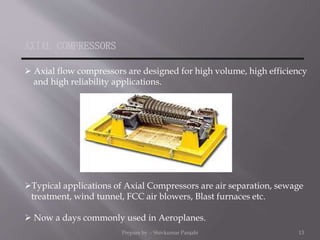
 Axial flow compressors are designed for high volume, high efficiency
and high reliability applications.
Typical applications of Axial Compressors are air separation, sewage
treatment, wind tunnel, FCC air blowers, Blast furnaces etc.
 Now a days commonly used in Aeroplanes.
Prepare by :- Shivkumar Panjabi 13
Continued . . . .
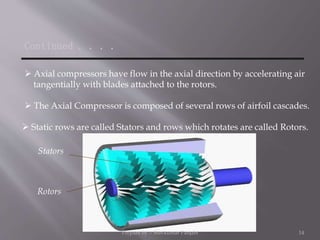
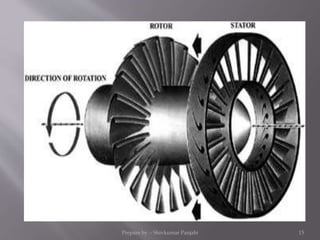
 Axial compressors have flow in the axial direction by accelerating air
tangentially with blades attached to the rotors.
 The Axial Compressor is composed of several rows of airfoil cascades.
 Static rows are called Stators and rows which rotates are called Rotors.
Rotors
Stators
Prepare by :- Shivkumar Panjabi 14
Prepare by :- Shivkumar Panjabi 15
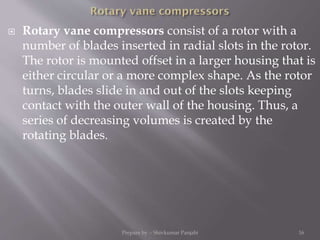
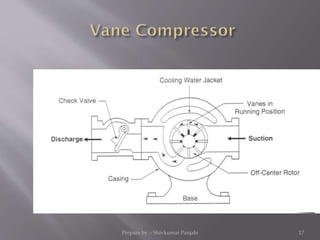
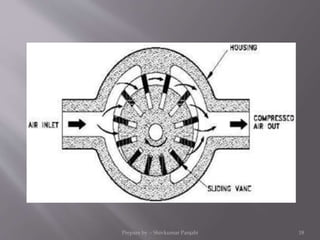
 Rotary vane compressors consist of a rotor with a
number of blades inserted in radial slots in the rotor.
The rotor is mounted offset in a larger housing that is
either circular or a more complex shape. As the rotor
turns, blades slide in and out of the slots keeping
contact with the outer wall of the housing. Thus, a
series of decreasing volumes is created by the
rotating blades.
Prepare by :- Shivkumar Panjabi 16
Prepare by :- Shivkumar Panjabi 17
Prepare by :- Shivkumar Panjabi 18
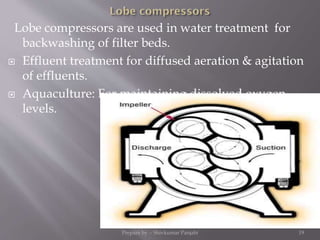
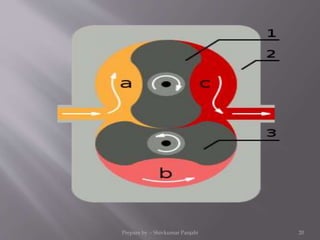
Lobe compressors are used in water treatment for
backwashing of filter beds.
 Effluent treatment for diffused aeration & agitation
of effluents.
 Aquaculture: For maintaining dissolved oxygen
levels.
Prepare by :- Shivkumar Panjabi 19
Prepare by :- Shivkumar Panjabi 20
 These devices are known for operating more
smoothly, quietly, and reliably than conventional
compressors .
 The absence of pistons for gas compression enables
scroll compressors to reach 100% volumetric
efficiency, leading to reduced energy costs.
 Their weight and footprint are considerably smaller
compared to other bulkier types of compressors.
 scroll compressors have been used food and fruit
refrigeration, truck transportation, marine containers
air-conditioning applications.
Prepare by :- Shivkumar Panjabi 21
Thank
you for
your
attention

Air compressor

  • 1.
    Prepare by :- ShivkumarPanjabi 1 Prepare by :- Shivkumar Panjabi
  • 2.
     Introduction.  Typesof compressors.  Positive displacement compressors.  Dynamic compressors.  Reciprocating & screw compressors.  Centrifugal compressors.  Applications of compressors in industries.  Conclusion & references. Prepare by :- Shivkumar Panjabi 2
  • 3.
    Principles on whichcompressors work:  A compressor is a mechanical device that increases the pressure of a gas by reducing its volume.  Compressor is a machine which increases the pressure of a fluid by mechanically decreasing its volume (i.e. by compressing it).(The fluid here is generally air since liquids are theoretically incompressible).  George Medhurst of England designed the first motorized air compressor in 1799 and used it in mining. Prepare by :- Shivkumar Panjabi 3
  • 4.
    Prepare by :-Shivkumar Panjabi 4
  • 5.
     In thepositive-displacement type, a given quantity of air or gas is trapped in a compression chamber and the volume it occupies is mechanically reduced, causing a corresponding rise in pressure prior to discharge. At constant speed, the air flow remains essentially constant with variations in discharge pressure. Ex: Reciprocating compressors, screw compressors, vane compressors & so on. Prepare by :- Shivkumar Panjabi 5
  • 6.
     Dynamic compressorsimpart velocity energy to continuously flowing air or gas by means of impellers rotating at very high speeds. The velocity energy is changed into pressure energy both by the impellers and the discharge volutes or diffusers. In the centrifugal-type dynamic compressors, the shape of the impeller blades determines the relationship between air flow and the pressure (or head) generate. Ex: centrifugal compressors, axial compressors. Prepare by :- Shivkumar Panjabi 6
  • 7.
    Principle of Operation Fig shows single-acting piston actions in the cylinder of a reciprocating compressor.  The piston is driven by a crank shaft via a connecting rod.  At the top of the cylinder are a suction valve and a discharge valve.  A reciprocating compressor usually has two, three, four, or six cylinders in it. Prepare by :- Shivkumar Panjabi 7
  • 8.
    Reciprocating Compressor -Working ME0223 SEM-IV Applied Thermodynamics & Heat EnginesPrepare by :- Shivkumar Panjabi 8
  • 9.
    Prepare by :-Shivkumar Panjabi 9
  • 10.
    Prepare by :-Shivkumar Panjabi 10
  • 11.
     The centrifugalair compressor is a dynamic compressor, which depends on transfer of energy from a rotating impeller to the air. The rotor accomplishes this by changing the momentum and pressure of the air. This momentum is converted to useful pressure by slowing the air down in a stationary diffuser. Prepare by :- Shivkumar Panjabi 11
  • 12.
    Prepare by :-Shivkumar Panjabi 12
  • 13.
    AXIAL COMPRESSORS  Axialflow compressors are designed for high volume, high efficiency and high reliability applications. Typical applications of Axial Compressors are air separation, sewage treatment, wind tunnel, FCC air blowers, Blast furnaces etc.  Now a days commonly used in Aeroplanes. Prepare by :- Shivkumar Panjabi 13
  • 14.
    Continued . .. .  Axial compressors have flow in the axial direction by accelerating air tangentially with blades attached to the rotors.  The Axial Compressor is composed of several rows of airfoil cascades.  Static rows are called Stators and rows which rotates are called Rotors. Rotors Stators Prepare by :- Shivkumar Panjabi 14
  • 15.
    Prepare by :-Shivkumar Panjabi 15
  • 16.
     Rotary vanecompressors consist of a rotor with a number of blades inserted in radial slots in the rotor. The rotor is mounted offset in a larger housing that is either circular or a more complex shape. As the rotor turns, blades slide in and out of the slots keeping contact with the outer wall of the housing. Thus, a series of decreasing volumes is created by the rotating blades. Prepare by :- Shivkumar Panjabi 16
  • 17.
    Prepare by :-Shivkumar Panjabi 17
  • 18.
    Prepare by :-Shivkumar Panjabi 18
  • 19.
    Lobe compressors areused in water treatment for backwashing of filter beds.  Effluent treatment for diffused aeration & agitation of effluents.  Aquaculture: For maintaining dissolved oxygen levels. Prepare by :- Shivkumar Panjabi 19
  • 20.
    Prepare by :-Shivkumar Panjabi 20
  • 21.
     These devicesare known for operating more smoothly, quietly, and reliably than conventional compressors .  The absence of pistons for gas compression enables scroll compressors to reach 100% volumetric efficiency, leading to reduced energy costs.  Their weight and footprint are considerably smaller compared to other bulkier types of compressors.  scroll compressors have been used food and fruit refrigeration, truck transportation, marine containers air-conditioning applications. Prepare by :- Shivkumar Panjabi 21
  • 22.