Conformity &
Deviance
Conformity & Deviance
Alignment is coursed through the process of
socialization, where members of society starting
from birth are exposed to the norms, values, and
idiosyncrasies of their culture. When the alignment
becomes complete and lasting, conformity is the
anticipated behavior to follow.
Goals in society are achieved through various
means. If goals are achieved using unconventional
means, this may generate deviance.
Deviance
Deviance is a behavior that
departs significantly from social
expectations. It is a rule-
breaking behavior of some kind
which fails to conform to the
norms and expectations of a
particular society or social
group.
e.g. rebellion, drug use, theft, murder,
excessive alcohol use, assault
Variability of
Deviance
Deviance cannot by objectively identified but
are subjective and require contextual
standards.
This is because rules are socially created, not
individually imposed. It is not just the
behavior, but the social response of the
group.
The study of deviance can be divided into:
1.The study of why people violate
laws/norms
2.The study of how society reacts to this
violation
Example:
Conformity Examples
Dress Code: Wearing business attire in a
corporate environment because everyone
else does.
Standing in Line: Following the unspoken
rule of lining up in order for services, like at a
movie theater or grocery store.
Peer Pressure in School: A student joining a
study group or club because their friends are
in it.
Social Media Trends: Participating in popular
challenges or trends on social media to fit in
with peers.
Observing Quiet in Libraries: Remaining
silent or whispering in a library because it’s
expected in that environment.
Example:
Deviance
Skipping the Line: Cutting ahead in a line, disregarding
social norms around fairness and patience.
1.Non-Traditional Dress: Wearing casual attire in a
formal setting or an unconventional style that goes
against typical fashion norms.
2.Speaking Out: Voicing a controversial opinion in a
group setting where everyone else agrees with a
different viewpoint.
3.Breaking Curfew: A teenager staying out past the
agreed time with their parents, ignoring household
rules.
4.Protesting: Participating in a protest or
demonstration that challenges established rules or
policies, especially when it’s against the law to assemble
Activity:
Create a scenario where Conformity and
Deviance is present.
In conclusion: Share how you felt in both
roles and explore the consequences of each
choice.
Group Activity:
Discuss the following theoretical
interpretations of deviance and explain a
short summary of what you’ve understood
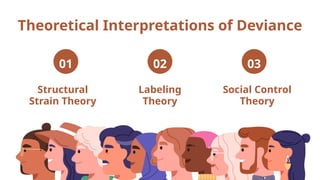
Theoretical Interpretations of Deviance
01 02 03
Structural
Strain Theory
Labeling
Theory
Social Control
Theory
Structural Strain Theory
This theory offered by Robert Merton
believes that deviance is caused by the gap
between cultural goals and the means
people have available to achieve these.
When society fails to provide appropriate
means, there is imbalance between goals
and means, causing deviance.
Merton’s 5 categories of people
(in relation to cultural goals and means)
Conformists
• believe in the goals and means
• follow rules
Ritualists
• do not believe in goals but believe in means
Innovators
• accept goals but reject means
• disregard conventional means in attaining wealth
• also known as criminals
Retreatists
• reject goals and means
• avoids both without replacing with own
countercultural forces
Rebels
• reject goals and means
• substitute new goals and means
Structural Strain Theory
Labeling Theory
This theory indicates that society's assigning
of labels to individuals or certain groups can
have an effect on their behavior.
This theory holds the assumption that no act
is intrinsically criminal. Definitions of
criminality are established by those in power.
Those who represent the forces of law and
order (e.g. police, authorities) provide main
source of labeling. Many of the rules that
define deviance and the context in which
deviant behavior is labeled as deviant are
framed by the dominant groups to the
subordinate groups.
Social Control Theory
Developed by Travis Hirschi, it is a type of
functionalist theory that suggest that
deviance occurs when a person's or a
group's attachment to social bonds is
weakened. According to this view, people
care about what others think of them and
conform to social expectations because
of their attachments to others and what
others expect of them.
Social Control
To prevent deviance, society has means to
assure conformity. Measures of social
control (mechanisms, rules, rewards,
consequences) are applied when conformity
is lacking/weak. These are pervasive and
invasive, that individuals don’t realize their
conformity is due to these pressures.
Institutions are control structures.
Family Schools, church, legal frameworks
→
of the state, media
Effective socialization makes conformity an
internally driven motivation, while externally
driven conformity always engages in the
mechanisms of social control.
UDHR
When individuals become members of society,
they submit to the norms of society. One of the
dangers of becoming a member of society is one
is forced to adopt and adapt to society’s
standards in exchange for being a beneficiary of
the common good.
However, the pursuance of the common good
should not be a cause for the violation o the
rights of individuals. It is in this context that the
United Nations Universal Declaration of
Human Rights (UDHR) becomes a vital
document. It outlines the entitlements of all
individuals to human dignity and the rights we
possess that are essential elements in pursuing
the common good.
UDHR in detail Pages 136-141
→
Quiz!
#1 / MC
This theory offered by Robert Merton believes that deviance
is caused by the gap between cultural goals and the means
people have available to achieve these.
a. Structural Strain Theory
b. Labelling Theory
c. Social Control Theory
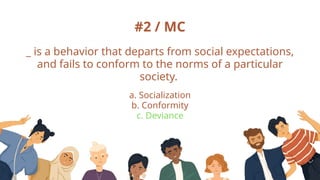
#2 / MC
_ is a behavior that departs from social expectations,
and fails to conform to the norms of a particular
society.
a. Socialization
b. Conformity
c. Deviance
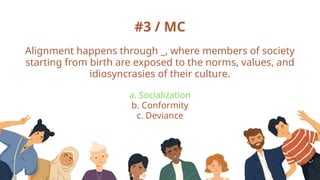
#3 / MC
Alignment happens through _, where members of society
starting from birth are exposed to the norms, values, and
idiosyncrasies of their culture.
a. Socialization
b. Conformity
c. Deviance
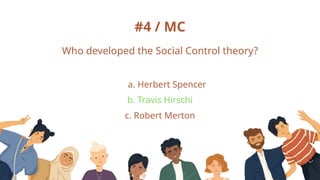
#4 / MC
Who developed the Social Control theory?
a. Herbert Spencer
b. Travis Hirschi
c. Robert Merton
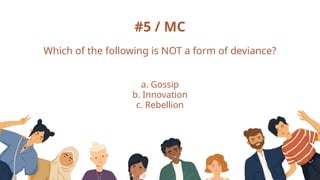
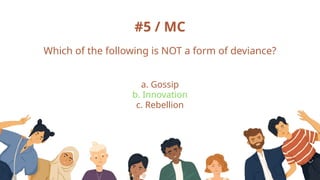
#5 / MC
Which of the following is NOT a form of deviance?
a. Gossip
b. Innovation
c. Rebellion
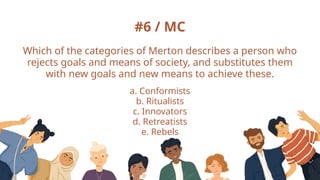
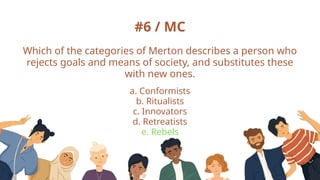
#6 / MC
Which of the categories of Merton describes a person who
rejects goals and means of society, and substitutes them
with new goals and new means to achieve these.
a. Conformists
b. Ritualists
c. Innovators
d. Retreatists
e. Rebels
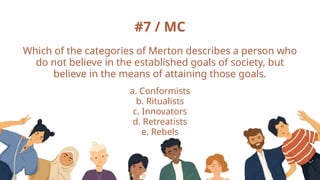
#7 / MC
Which of the categories of Merton describes a person who
do not believe in the established goals of society, but
believe in the means of attaining those goals.
a. Conformists
b. Ritualists
c. Innovators
d. Retreatists
e. Rebels
#8 / Identification
This document outlines the entitlements of all individuals to
human dignity and the rights we possess that are essential
elements in pursuing the common good.
#9 / Identification
It focuses on a different set of postulations about deviance
and begins with the assumption that no act is intrinsically
criminal
#10 / Identification
It is a theory that suggests that deviance occurs when a
person's or a group's attachment to social bonds is
weakened.
Answer Key
#1 / MC
This theory was offered by Robert Merton. He believes that
deviance is caused by the gap between cultural goals and
the means people have available to achieve these.
a. Structural Strain Theory
b. Labelling Theory
c. Social Control Theory
#2 / MC
_ is a behavior that departs from social expectations,
and fails to conform to the norms of a particular
society.
a. Socialization
b. Conformity
c. Deviance
#3 / MC
Alignment happens through _, where members of society
starting from birth are exposed to the norms, values, and
idiosyncrasies of their culture.
a. Socialization
b. Conformity
c. Deviance
#4 / MC
Who developed the Social Control theory?
c. Robert Merton
a. Herbert Spencer
b. Travis Hirschi
#5 / MC
Which of the following is NOT a form of deviance?
a. Gossip
b. Innovation
c. Rebellion
#6 / MC
Which of the categories of Merton describes a person who
rejects goals and means of society, and substitutes these
with new ones.
a. Conformists
b. Ritualists
c. Innovators
d. Retreatists
e. Rebels
#7 / MC
Which of the categories of Merton describes a person who
do not believe in the established goals of society, but
believe in the means of attaining those goals.
a. Conformists
b. Ritualists
c. Innovators
d. Retreatists
e. Rebels
#8 / Identification
This document outlines the entitlements of all individuals to
human dignity and the rights we possess that are essential
elements in pursuing the common good.

United Nations Universal Declaration of Human Rights (UDHR)
#9 / Identification
It focuses on a different set of postulations about deviance
and begins with the assumption that no act is intrinsically
criminal
Labeling theory
#10 / Identification
Social Control Theory
It is a theory that suggests that deviance occurs when a
person's or a group's attachment to social bonds is
weakened.
Thank you!

Conformity and Deviance - UCSP 2 - midterm

  • 1.
  • 2.
    Conformity & Deviance Alignmentis coursed through the process of socialization, where members of society starting from birth are exposed to the norms, values, and idiosyncrasies of their culture. When the alignment becomes complete and lasting, conformity is the anticipated behavior to follow. Goals in society are achieved through various means. If goals are achieved using unconventional means, this may generate deviance.
  • 3.
    Deviance Deviance is abehavior that departs significantly from social expectations. It is a rule- breaking behavior of some kind which fails to conform to the norms and expectations of a particular society or social group. e.g. rebellion, drug use, theft, murder, excessive alcohol use, assault
  • 4.
    Variability of Deviance Deviance cannotby objectively identified but are subjective and require contextual standards. This is because rules are socially created, not individually imposed. It is not just the behavior, but the social response of the group. The study of deviance can be divided into: 1.The study of why people violate laws/norms 2.The study of how society reacts to this violation
  • 5.
    Example: Conformity Examples Dress Code:Wearing business attire in a corporate environment because everyone else does. Standing in Line: Following the unspoken rule of lining up in order for services, like at a movie theater or grocery store. Peer Pressure in School: A student joining a study group or club because their friends are in it. Social Media Trends: Participating in popular challenges or trends on social media to fit in with peers. Observing Quiet in Libraries: Remaining silent or whispering in a library because it’s expected in that environment.
  • 6.
    Example: Deviance Skipping the Line:Cutting ahead in a line, disregarding social norms around fairness and patience. 1.Non-Traditional Dress: Wearing casual attire in a formal setting or an unconventional style that goes against typical fashion norms. 2.Speaking Out: Voicing a controversial opinion in a group setting where everyone else agrees with a different viewpoint. 3.Breaking Curfew: A teenager staying out past the agreed time with their parents, ignoring household rules. 4.Protesting: Participating in a protest or demonstration that challenges established rules or policies, especially when it’s against the law to assemble
  • 7.
    Activity: Create a scenariowhere Conformity and Deviance is present. In conclusion: Share how you felt in both roles and explore the consequences of each choice.
  • 8.
    Group Activity: Discuss thefollowing theoretical interpretations of deviance and explain a short summary of what you’ve understood
  • 9.
    Theoretical Interpretations ofDeviance 01 02 03 Structural Strain Theory Labeling Theory Social Control Theory
  • 10.
    Structural Strain Theory Thistheory offered by Robert Merton believes that deviance is caused by the gap between cultural goals and the means people have available to achieve these. When society fails to provide appropriate means, there is imbalance between goals and means, causing deviance.
  • 11.
    Merton’s 5 categoriesof people (in relation to cultural goals and means) Conformists • believe in the goals and means • follow rules Ritualists • do not believe in goals but believe in means Innovators • accept goals but reject means • disregard conventional means in attaining wealth • also known as criminals Retreatists • reject goals and means • avoids both without replacing with own countercultural forces Rebels • reject goals and means • substitute new goals and means Structural Strain Theory
  • 12.
    Labeling Theory This theoryindicates that society's assigning of labels to individuals or certain groups can have an effect on their behavior. This theory holds the assumption that no act is intrinsically criminal. Definitions of criminality are established by those in power. Those who represent the forces of law and order (e.g. police, authorities) provide main source of labeling. Many of the rules that define deviance and the context in which deviant behavior is labeled as deviant are framed by the dominant groups to the subordinate groups.
  • 13.
    Social Control Theory Developedby Travis Hirschi, it is a type of functionalist theory that suggest that deviance occurs when a person's or a group's attachment to social bonds is weakened. According to this view, people care about what others think of them and conform to social expectations because of their attachments to others and what others expect of them.
  • 14.
    Social Control To preventdeviance, society has means to assure conformity. Measures of social control (mechanisms, rules, rewards, consequences) are applied when conformity is lacking/weak. These are pervasive and invasive, that individuals don’t realize their conformity is due to these pressures. Institutions are control structures. Family Schools, church, legal frameworks → of the state, media Effective socialization makes conformity an internally driven motivation, while externally driven conformity always engages in the mechanisms of social control.
  • 15.
    UDHR When individuals becomemembers of society, they submit to the norms of society. One of the dangers of becoming a member of society is one is forced to adopt and adapt to society’s standards in exchange for being a beneficiary of the common good. However, the pursuance of the common good should not be a cause for the violation o the rights of individuals. It is in this context that the United Nations Universal Declaration of Human Rights (UDHR) becomes a vital document. It outlines the entitlements of all individuals to human dignity and the rights we possess that are essential elements in pursuing the common good. UDHR in detail Pages 136-141 →

  • 16.
  • 17.
    #1 / MC Thistheory offered by Robert Merton believes that deviance is caused by the gap between cultural goals and the means people have available to achieve these. a. Structural Strain Theory b. Labelling Theory c. Social Control Theory
  • 18.
    #2 / MC _is a behavior that departs from social expectations, and fails to conform to the norms of a particular society. a. Socialization b. Conformity c. Deviance
  • 19.
    #3 / MC Alignmenthappens through _, where members of society starting from birth are exposed to the norms, values, and idiosyncrasies of their culture. a. Socialization b. Conformity c. Deviance
  • 20.
    #4 / MC Whodeveloped the Social Control theory? a. Herbert Spencer b. Travis Hirschi c. Robert Merton
  • 21.
    #5 / MC Whichof the following is NOT a form of deviance? a. Gossip b. Innovation c. Rebellion
  • 22.
    #6 / MC Whichof the categories of Merton describes a person who rejects goals and means of society, and substitutes them with new goals and new means to achieve these. a. Conformists b. Ritualists c. Innovators d. Retreatists e. Rebels
  • 23.
    #7 / MC Whichof the categories of Merton describes a person who do not believe in the established goals of society, but believe in the means of attaining those goals. a. Conformists b. Ritualists c. Innovators d. Retreatists e. Rebels
  • 24.
    #8 / Identification Thisdocument outlines the entitlements of all individuals to human dignity and the rights we possess that are essential elements in pursuing the common good.

  • 25.
    #9 / Identification Itfocuses on a different set of postulations about deviance and begins with the assumption that no act is intrinsically criminal
  • 26.
    #10 / Identification Itis a theory that suggests that deviance occurs when a person's or a group's attachment to social bonds is weakened.
  • 27.
  • 28.
    #1 / MC Thistheory was offered by Robert Merton. He believes that deviance is caused by the gap between cultural goals and the means people have available to achieve these. a. Structural Strain Theory b. Labelling Theory c. Social Control Theory
  • 29.
    #2 / MC _is a behavior that departs from social expectations, and fails to conform to the norms of a particular society. a. Socialization b. Conformity c. Deviance
  • 30.
    #3 / MC Alignmenthappens through _, where members of society starting from birth are exposed to the norms, values, and idiosyncrasies of their culture. a. Socialization b. Conformity c. Deviance
  • 31.
    #4 / MC Whodeveloped the Social Control theory? c. Robert Merton a. Herbert Spencer b. Travis Hirschi
  • 32.
    #5 / MC Whichof the following is NOT a form of deviance? a. Gossip b. Innovation c. Rebellion
  • 33.
    #6 / MC Whichof the categories of Merton describes a person who rejects goals and means of society, and substitutes these with new ones. a. Conformists b. Ritualists c. Innovators d. Retreatists e. Rebels
  • 34.
    #7 / MC Whichof the categories of Merton describes a person who do not believe in the established goals of society, but believe in the means of attaining those goals. a. Conformists b. Ritualists c. Innovators d. Retreatists e. Rebels
  • 35.
    #8 / Identification Thisdocument outlines the entitlements of all individuals to human dignity and the rights we possess that are essential elements in pursuing the common good. United Nations Universal Declaration of Human Rights (UDHR)
  • 36.
    #9 / Identification Itfocuses on a different set of postulations about deviance and begins with the assumption that no act is intrinsically criminal Labeling theory
  • 37.
    #10 / Identification SocialControl Theory It is a theory that suggests that deviance occurs when a person's or a group's attachment to social bonds is weakened.
  • 38.