©Pearson Education, Inc., publishing as Pearson Prentice Hall. All rights reserved.
160
READING CHECK
What industries were helped
by the increase in automobile
ownership?
VOCABULARY STRATEGY
What does the word innovation
mean in the underlined sen-
tence? Look for context clues in
the surrounding words, phrases,
and sentences. Circle any words
or phrases in the paragraph
that help you figure out what
innovation means.
READING SKILL
Identify SupportingDetails Look
at your concept web. Select one
supporting detail fromthe web
and write a sentence explaining
this detail.
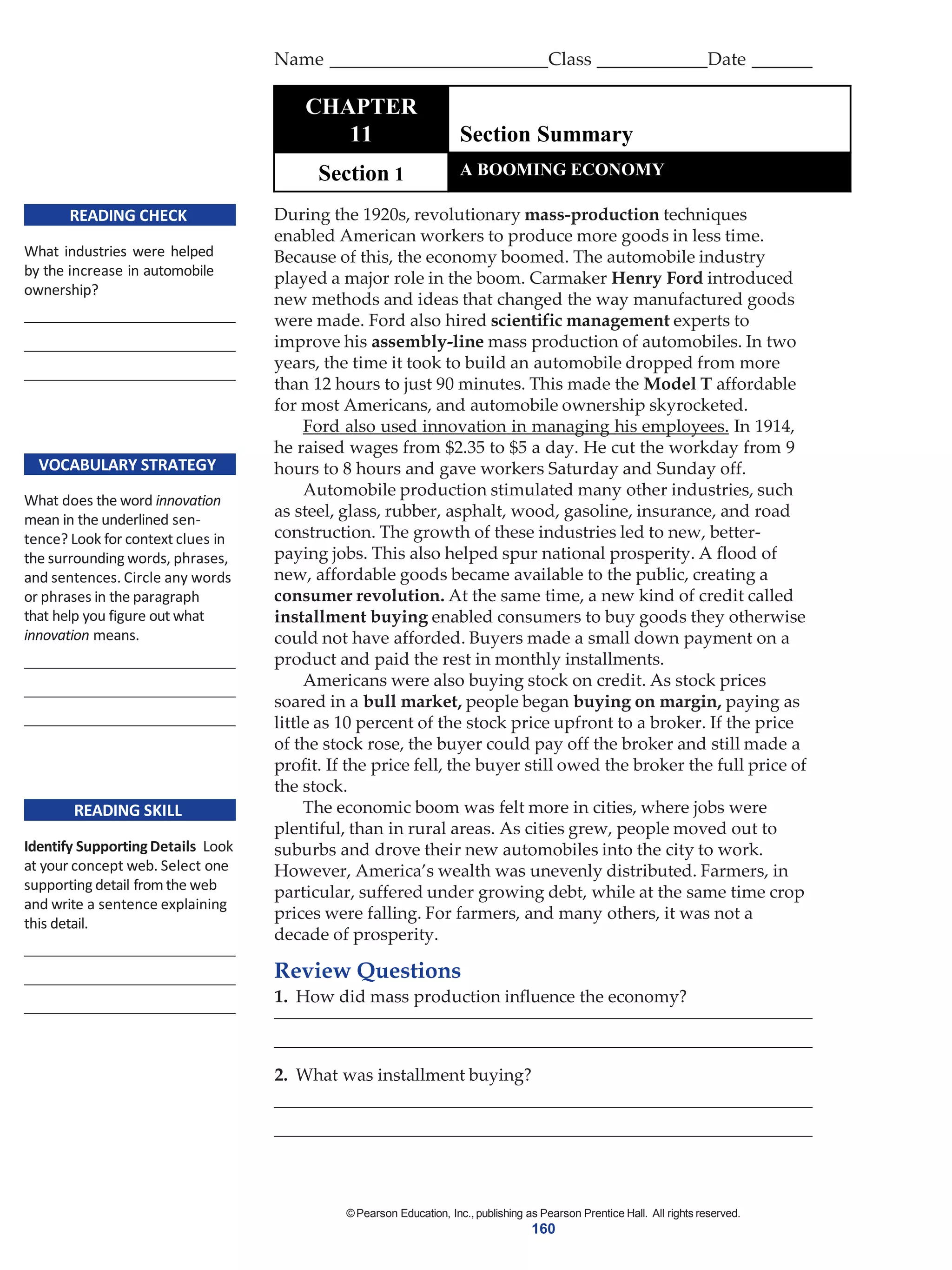
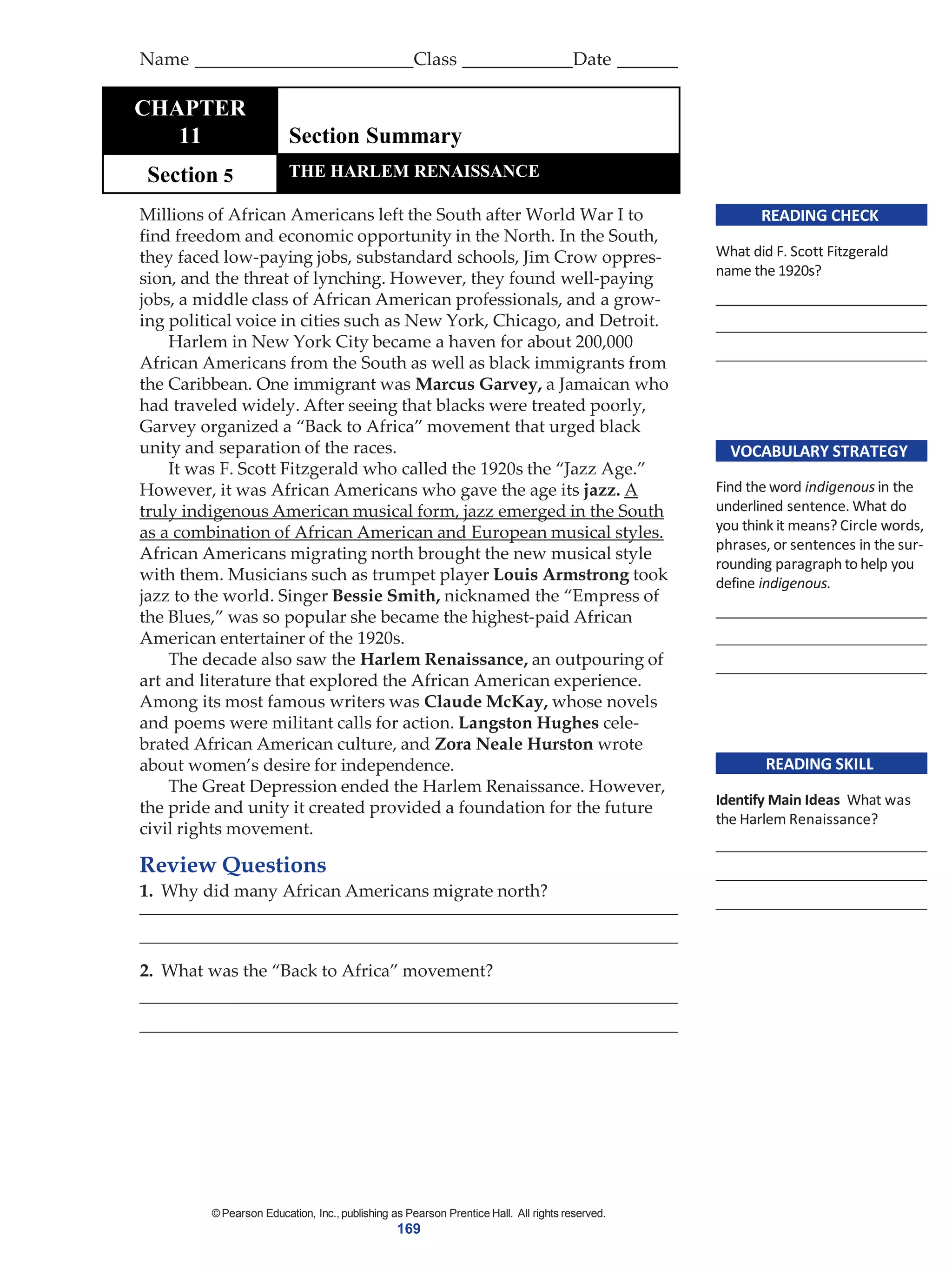
During the 1920s, revolutionary mass-production techniques
enabled American workers to produce more goods in less time.
Because of this, the economy boomed. The automobile industry
played a major role in the boom. Carmaker Henry Ford introduced
new methods and ideas that changed the way manufactured goods
were made. Ford also hired scientific management experts to
improve his assembly-line mass production of automobiles. In two
years, the time it took to build an automobile dropped from more
than 12 hours to just 90 minutes. This made the Model T affordable
for most Americans, and automobile ownership skyrocketed.
Ford also used innovation in managing his employees. In 1914,
he raised wages from $2.35 to $5 a day. He cut the workday from 9
hours to 8 hours and gave workers Saturday and Sunday off.
Automobile production stimulated many other industries, such
as steel, glass, rubber, asphalt, wood, gasoline, insurance, and road
construction. The growth of these industries led to new, better-
paying jobs. This also helped spur national prosperity. A flood of
new, affordable goods became available to the public, creating a
consumer revolution. At the same time, a new kind of credit called
installment buying enabled consumers to buy goods they otherwise
could not have afforded. Buyers made a small down payment on a
product and paid the rest in monthly installments.
Americans were also buying stock on credit. As stock prices
soared in a bull market, people began buying on margin, paying as
little as 10 percent of the stock price upfront to a broker. If the price
of the stock rose, the buyer could pay off the broker and still made a
profit. If the price fell, the buyer still owed the broker the full price of
the stock.
The economic boom was felt more in cities, where jobs were
plentiful, than in rural areas. As cities grew, people moved out to
suburbs and drove their new automobiles into the city to work.
However, America’s wealth was unevenly distributed. Farmers, in
particular, suffered under growing debt, while at the same time crop
prices were falling. For farmers, and many others, it was not a
decade of prosperity.
Review Questions
1. How did mass production influence the economy?
2. What was installment buying?
Name Class Date
CHAPTER
11 Section Summary
Section 1 A BOOMING ECONOMY
©Pearson Education, Inc., publishing as Pearson Prentice Hall. All rights reserved.
162
READING CHECK
What was the purpose of the
Kellogg-Briand Pact?
VOCABULARY STRATEGY
Find the word incentives in the
underlined sentence. Money,
rewards, and praise are some-
times used as incentives. What
is the meaning of incentives?
READING SKILL
Compare and Contrast Look at
the diagram comparing similari-
ties and differences between
Presidents Harding and Coolidge.
How did their differences influ-
ence their presidencies?
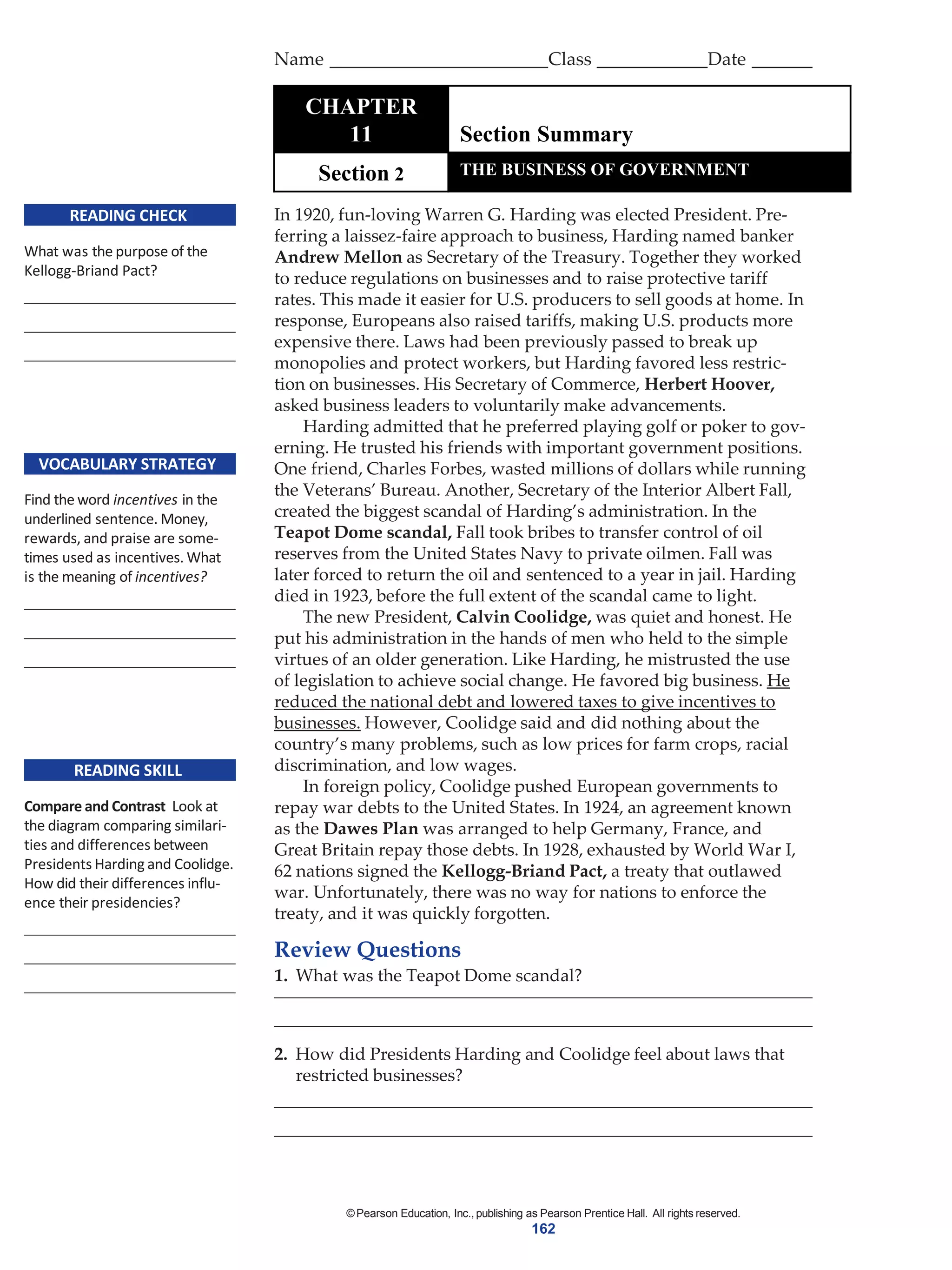
In 1920, fun-loving Warren G. Harding was elected President. Pre-
ferring a laissez-faire approach to business, Harding named banker
Andrew Mellon as Secretary of the Treasury. Together they worked
to reduce regulations on businesses and to raise protective tariff
rates. This made it easier for U.S. producers to sell goods at home. In
response, Europeans also raised tariffs, making U.S. products more
expensive there. Laws had been previously passed to break up
monopolies and protect workers, but Harding favored less restric-
tion on businesses. His Secretary of Commerce, Herbert Hoover,
asked business leaders to voluntarily make advancements.
Harding admitted that he preferred playing golf or poker to gov-
erning. He trusted his friends with important government positions.
One friend, Charles Forbes, wasted millions of dollars while running
the Veterans’ Bureau. Another, Secretary of the Interior Albert Fall,
created the biggest scandal of Harding’s administration. In the
Teapot Dome scandal, Fall took bribes to transfer control of oil
reserves from the United States Navy to private oilmen. Fall was
later forced to return the oil and sentenced to a year in jail. Harding
died in 1923, before the full extent of the scandal came to light.
The new President, Calvin Coolidge, was quiet and honest. He
put his administration in the hands of men who held to the simple
virtues of an older generation. Like Harding, he mistrusted the use
of legislation to achieve social change. He favored big business. He
reduced the national debt and lowered taxes to give incentives to
businesses. However, Coolidge said and did nothing about the
country’s many problems, such as low prices for farm crops, racial
discrimination, and low wages.
In foreign policy, Coolidge pushed European governments to
repay war debts to the United States. In 1924, an agreement known
as the Dawes Plan was arranged to help Germany, France, and
Great Britain repay those debts. In 1928, exhausted by World War I,
62 nations signed the Kellogg-Briand Pact, a treaty that outlawed
war. Unfortunately, there was no way for nations to enforce the
treaty, and it was quickly forgotten.
Review Questions
1. What was the Teapot Dome scandal?
2. How did Presidents Harding and Coolidge feel about laws that
restricted businesses?
Name Class Date
CHAPTER
11 Section Summary
Section 2 THE BUSINESS OF GOVERNMENT
©Pearson Education, Inc., publishing as Pearson Prentice Hall. All rights reserved.
164
READING CHECK
What did the Eighteenth
Amendmentforbid?
VOCABULARY STRATEGY
What does the word imperial
mean in the underlined sen-
tence? Look for context clues in
the surrounding words and
phrases. Circle any words or
phrases in the paragraph that
help you figure out what
imperial means.
READING SKILL
Contrast Select an issue that
divided Americans. Contrast the
ways rural and urban Americans
felt about this issue.
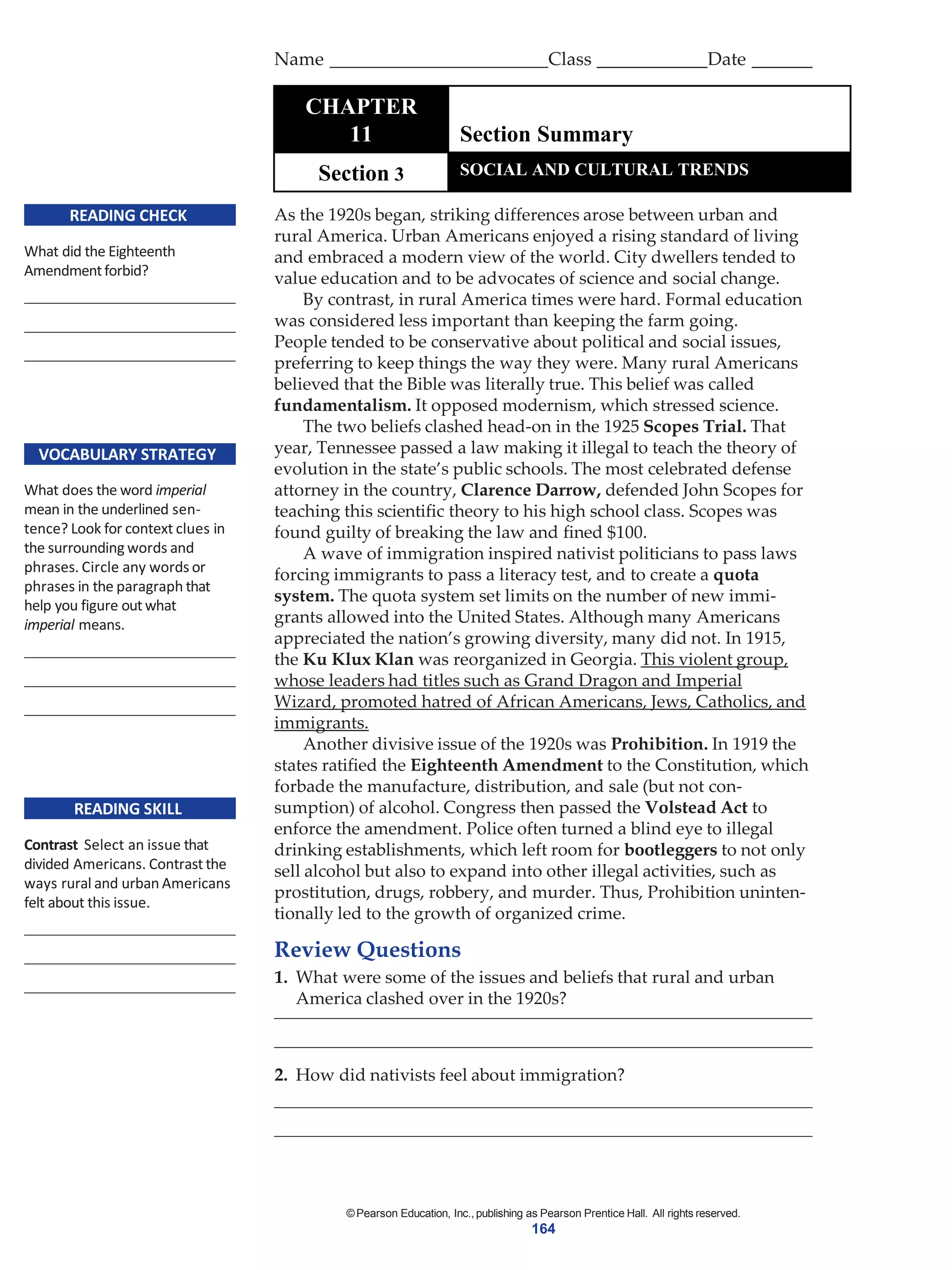
As the 1920s began, striking differences arose between urban and
rural America. Urban Americans enjoyed a rising standard of living
and embraced a modern view of the world. City dwellers tended to
value education and to be advocates of science and social change.
By contrast, in rural America times were hard. Formal education
was considered less important than keeping the farm going.
People tended to be conservative about political and social issues,
preferring to keep things the way they were. Many rural Americans
believed that the Bible was literally true. This belief was called
fundamentalism. It opposed modernism, which stressed science.
The two beliefs clashed head-on in the 1925 Scopes Trial. That
year, Tennessee passed a law making it illegal to teach the theory of
evolution in the state’s public schools. The most celebrated defense
attorney in the country, Clarence Darrow, defended John Scopes for
teaching this scientific theory to his high school class. Scopes was
found guilty of breaking the law and fined $100.
A wave of immigration inspired nativist politicians to pass laws
forcing immigrants to pass a literacy test, and to create a quota
system. The quota system set limits on the number of new immi-
grants allowed into the United States. Although many Americans
appreciated the nation’s growing diversity, many did not. In 1915,
the Ku Klux Klan was reorganized in Georgia. This violent group,
whose leaders had titles such as Grand Dragon and Imperial
Wizard, promoted hatred of African Americans, Jews, Catholics, and
immigrants.
Another divisive issue of the 1920s was Prohibition. In 1919 the
states ratified the Eighteenth Amendment to the Constitution, which
forbade the manufacture, distribution, and sale (but not con-
sumption) of alcohol. Congress then passed the Volstead Act to
enforce the amendment. Police often turned a blind eye to illegal
drinking establishments, which left room for bootleggers to not only
sell alcohol but also to expand into other illegal activities, such as
prostitution, drugs, robbery, and murder. Thus, Prohibition uninten-
tionally led to the growth of organized crime.
Review Questions
1. What were some of the issues and beliefs that rural and urban
America clashed over in the 1920s?
2. How did nativists feel about immigration?
Name Class Date
CHAPTER
11 Section Summary
Section 3 SOCIAL AND CULTURAL TRENDS
©Pearson Education, Inc., publishing as Pearson Prentice Hall. All rights reserved.
167
READING CHECK
Who developeda theory about
behavior and the unconscious?
VOCABULARY STRATEGY
What does the word sociological
mean in the underlined sen-
tence? The termsocio means
“relating to society.” The term
–ology usually refers to a type of
study. Use these definitions to
help you figure out the meaning
of sociological.
READING SKILL
Summarize List three ways
American culture changed in the
1920s.
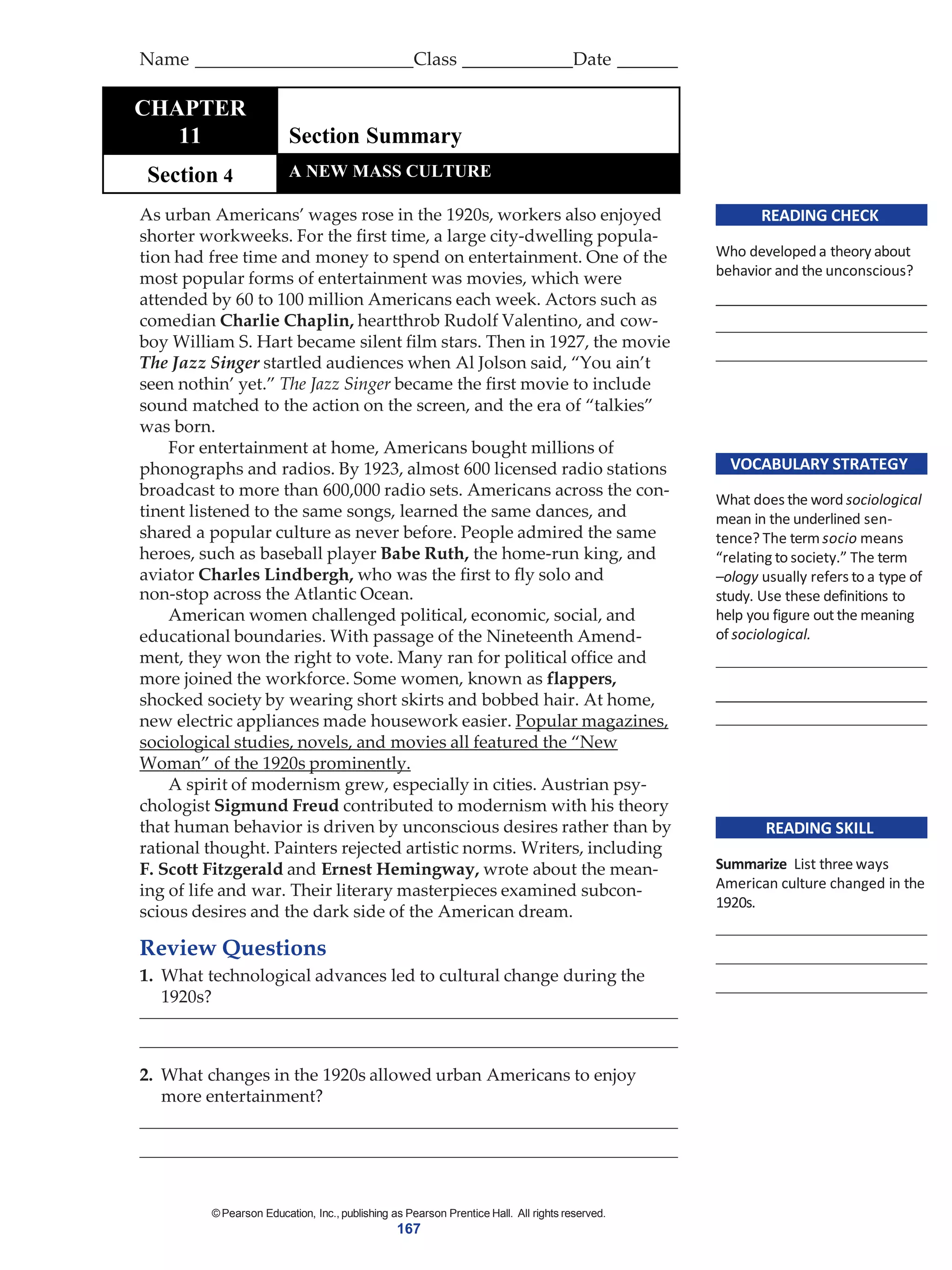
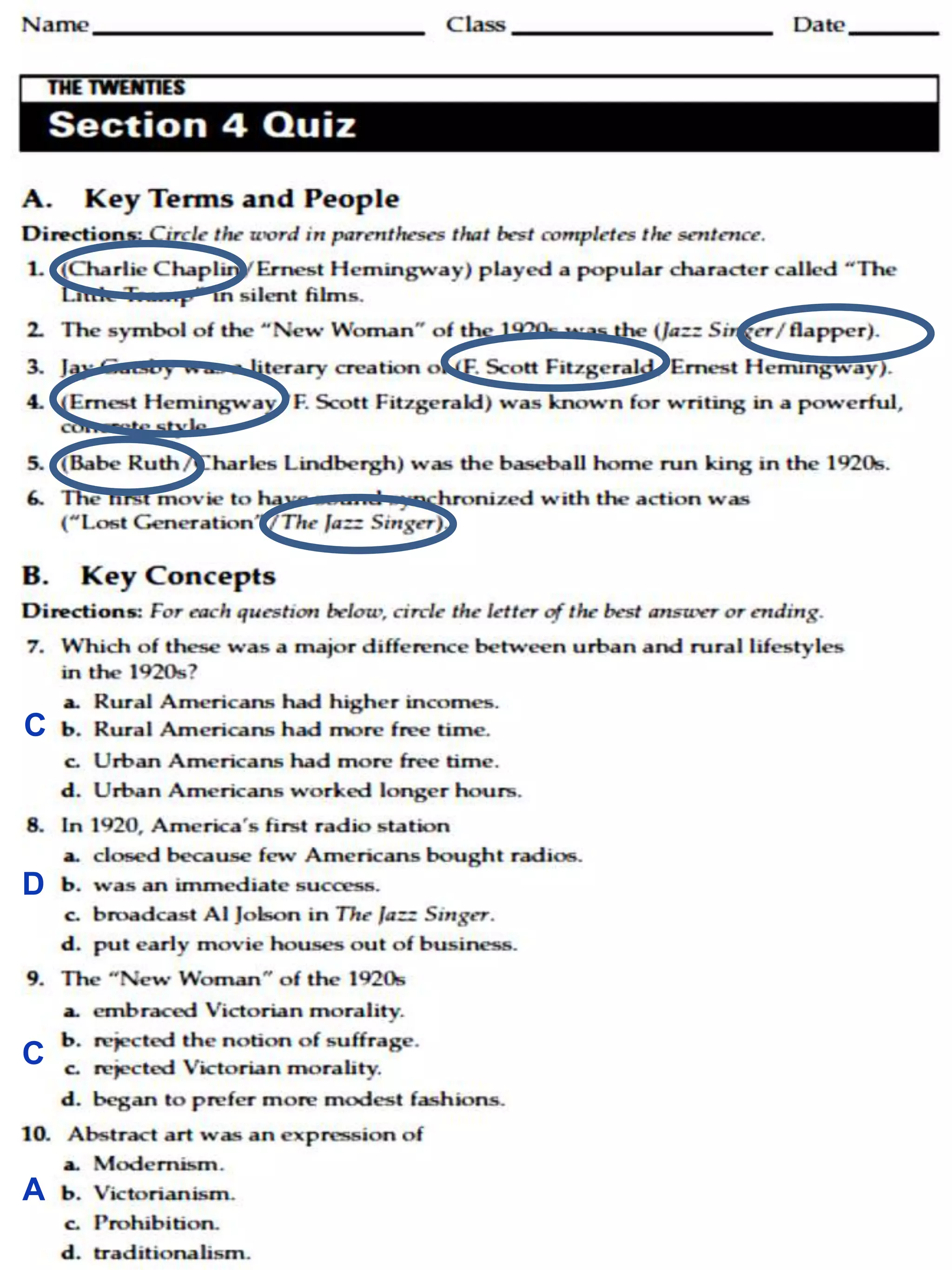
As urban Americans’ wages rose in the 1920s, workers also enjoyed
shorter workweeks. For the first time, a large city-dwelling popula-
tion had free time and money to spend on entertainment. One of the
most popular forms of entertainment was movies, which were
attended by 60 to 100 million Americans each week. Actors such as
comedian Charlie Chaplin, heartthrob Rudolf Valentino, and cow-
boy William S. Hart became silent film stars. Then in 1927, the movie
The Jazz Singer startled audiences when Al Jolson said, “You ain’t
seen nothin’ yet.” The Jazz Singer became the first movie to include
sound matched to the action on the screen, and the era of “talkies”
was born.
For entertainment at home, Americans bought millions of
phonographs and radios. By 1923, almost 600 licensed radio stations
broadcast to more than 600,000 radio sets. Americans across the con-
tinent listened to the same songs, learned the same dances, and
shared a popular culture as never before. People admired the same
heroes, such as baseball player Babe Ruth, the home-run king, and
aviator Charles Lindbergh, who was the first to fly solo and
non-stop across the Atlantic Ocean.
American women challenged political, economic, social, and
educational boundaries. With passage of the Nineteenth Amend-
ment, they won the right to vote. Many ran for political office and
more joined the workforce. Some women, known as flappers,
shocked society by wearing short skirts and bobbed hair. At home,
new electric appliances made housework easier. Popular magazines,
sociological studies, novels, and movies all featured the “New
Woman” of the 1920s prominently.
A spirit of modernism grew, especially in cities. Austrian psy-
chologist Sigmund Freud contributed to modernism with his theory
that human behavior is driven by unconscious desires rather than by
rational thought. Painters rejected artistic norms. Writers, including
F. Scott Fitzgerald and Ernest Hemingway, wrote about the mean-
ing of life and war. Their literary masterpieces examined subcon-
scious desires and the dark side of the American dream.
Review Questions
1. What technological advances led to cultural change during the
1920s?
2. What changes in the 1920s allowed urban Americans to enjoy
more entertainment?
Name Class Date
TCHAPTER
11 Section Summary
Section 4 A NEW MASS CULTURE
©Pearson Education, Inc., publishing as Pearson Prentice Hall. All rights reserved.
169
READING CHECK
What did F. Scott Fitzgerald
name the 1920s?
VOCABULARY STRATEGY
Find the word indigenous in the
underlined sentence. What do
you think it means? Circle words,
phrases, or sentences in the sur-
rounding paragraph to help you
define indigenous.
READING SKILL
Identify Main Ideas What was
the Harlem Renaissance?
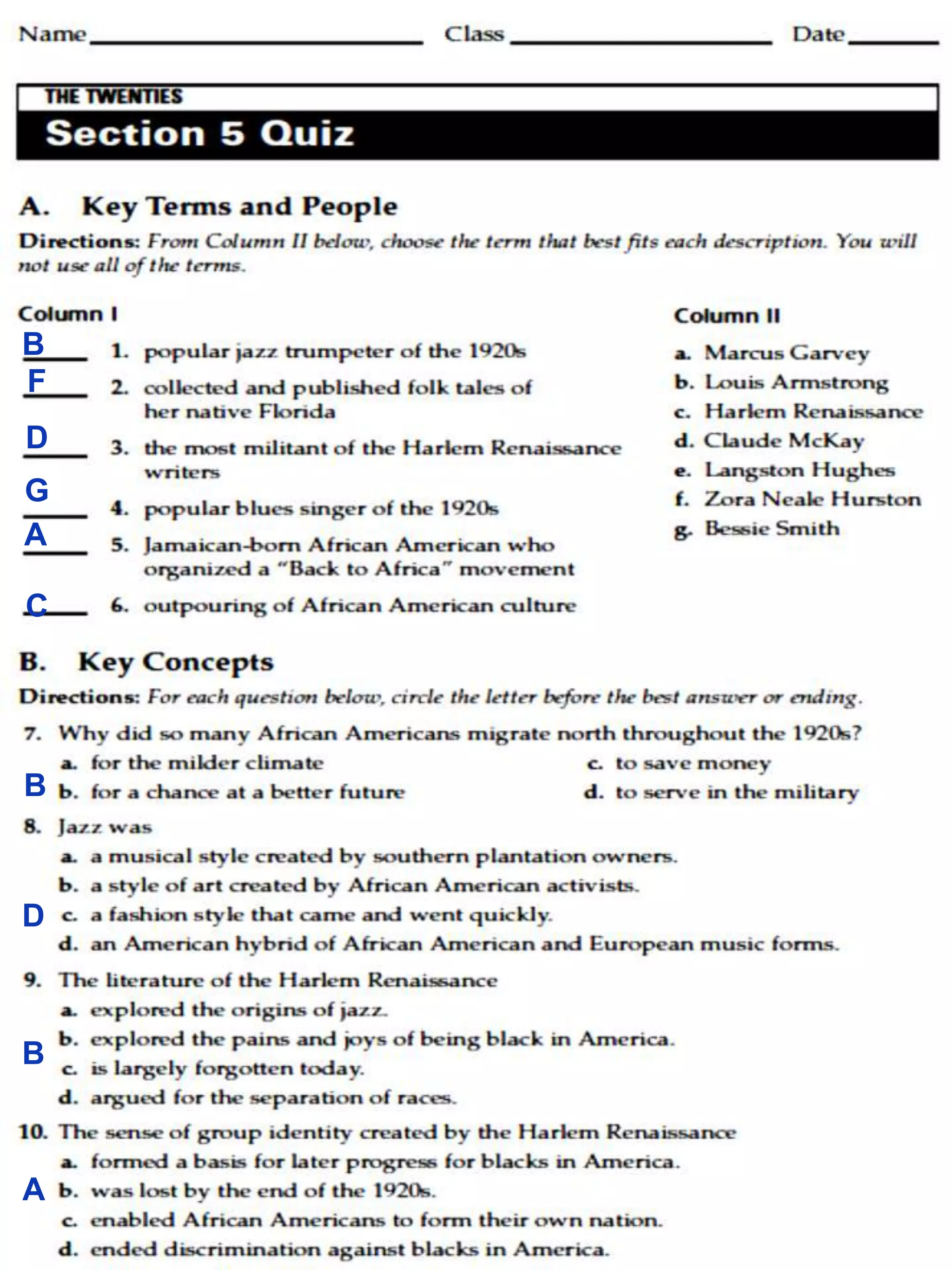
Millions of African Americans left the South after World War I to
find freedom and economic opportunity in the North. In the South,
they faced low-paying jobs, substandard schools, Jim Crow oppres-
sion, and the threat of lynching. However, they found well-paying
jobs, a middle class of African American professionals, and a grow-
ing political voice in cities such as New York, Chicago, and Detroit.
Harlem in New York City became a haven for about 200,000
African Americans from the South as well as black immigrants from
the Caribbean. One immigrant was Marcus Garvey, a Jamaican who
had traveled widely. After seeing that blacks were treated poorly,
Garvey organized a “Back to Africa” movement that urged black
unity and separation of the races.
It was F. Scott Fitzgerald who called the 1920s the “Jazz Age.”
However, it was African Americans who gave the age its jazz. A
truly indigenous American musical form, jazz emerged in the South
as a combination of African American and European musical styles.
African Americans migrating north brought the new musical style
with them. Musicians such as trumpet player Louis Armstrong took
jazz to the world. Singer Bessie Smith, nicknamed the “Empress of
the Blues,” was so popular she became the highest-paid African
American entertainer of the 1920s.
The decade also saw the Harlem Renaissance, an outpouring of
art and literature that explored the African American experience.
Among its most famous writers was Claude McKay, whose novels
and poems were militant calls for action. Langston Hughes cele-
brated African American culture, and Zora Neale Hurston wrote
about women’s desire for independence.
The Great Depression ended the Harlem Renaissance. However,
the pride and unity it created provided a foundation for the future
civil rights movement.
Review Questions
1. Why did many African Americans migrate north?
2. What was the “Back to Africa” movement?
Name Class Date
TCHAPTER
11 Section Summary
Section 5 THE HARLEM RENAISSANCE
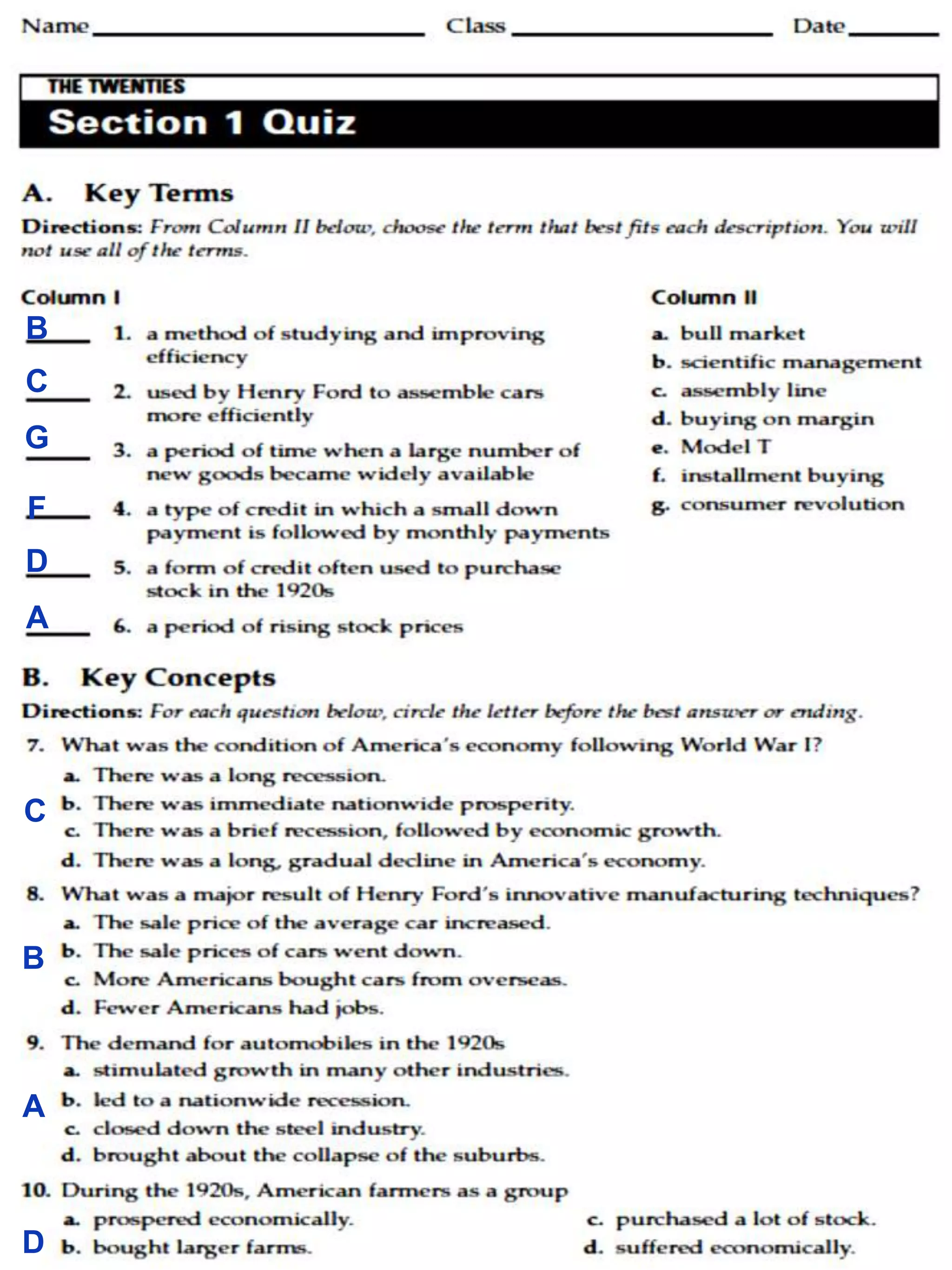
B
C
G
F
D
A
C
B
A
D
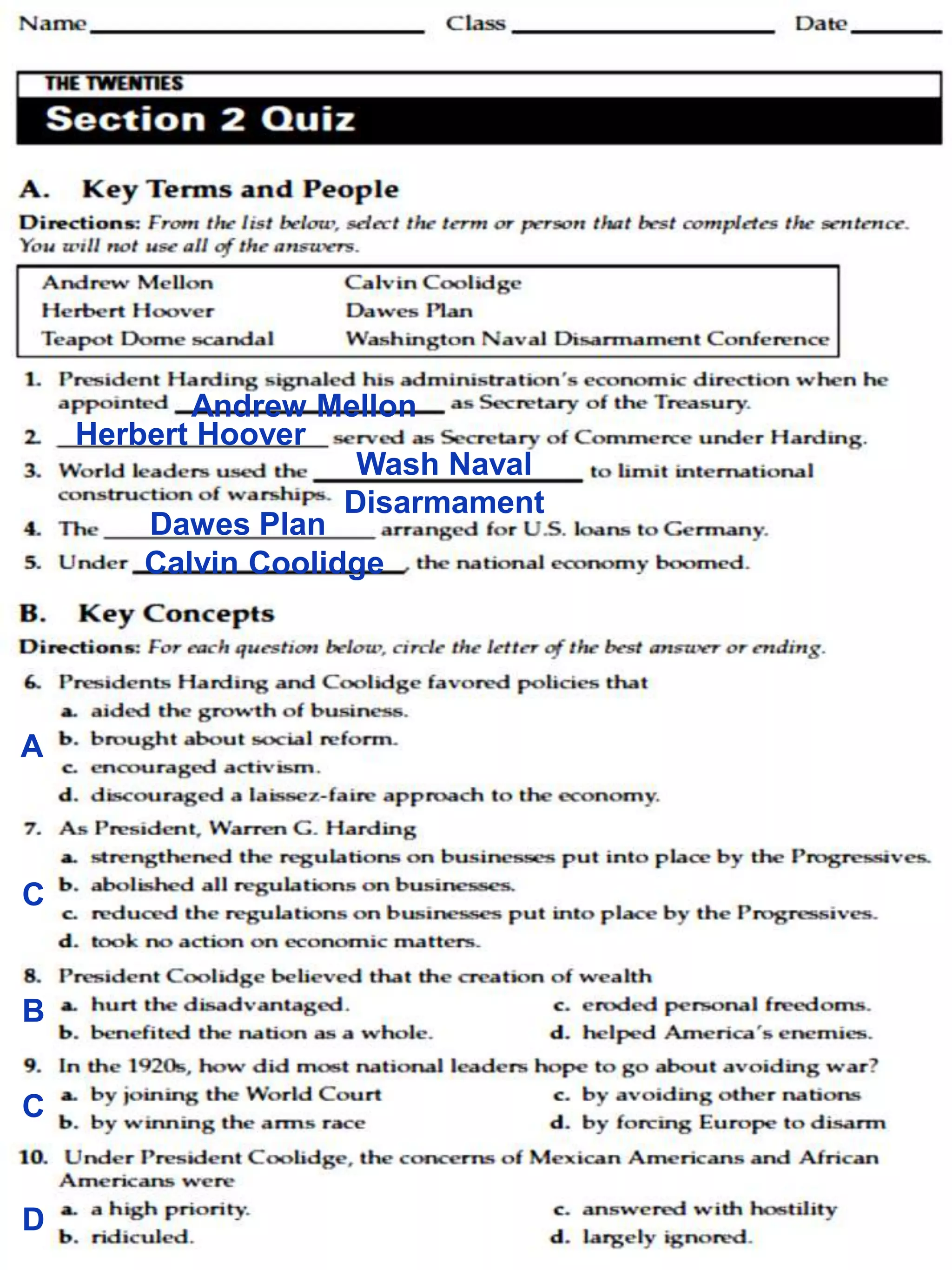
Andrew Mellon
Herbert Hoover
Wash Naval
Disarmament
Dawes Plan
Calvin Coolidge
A
C
B
C
D
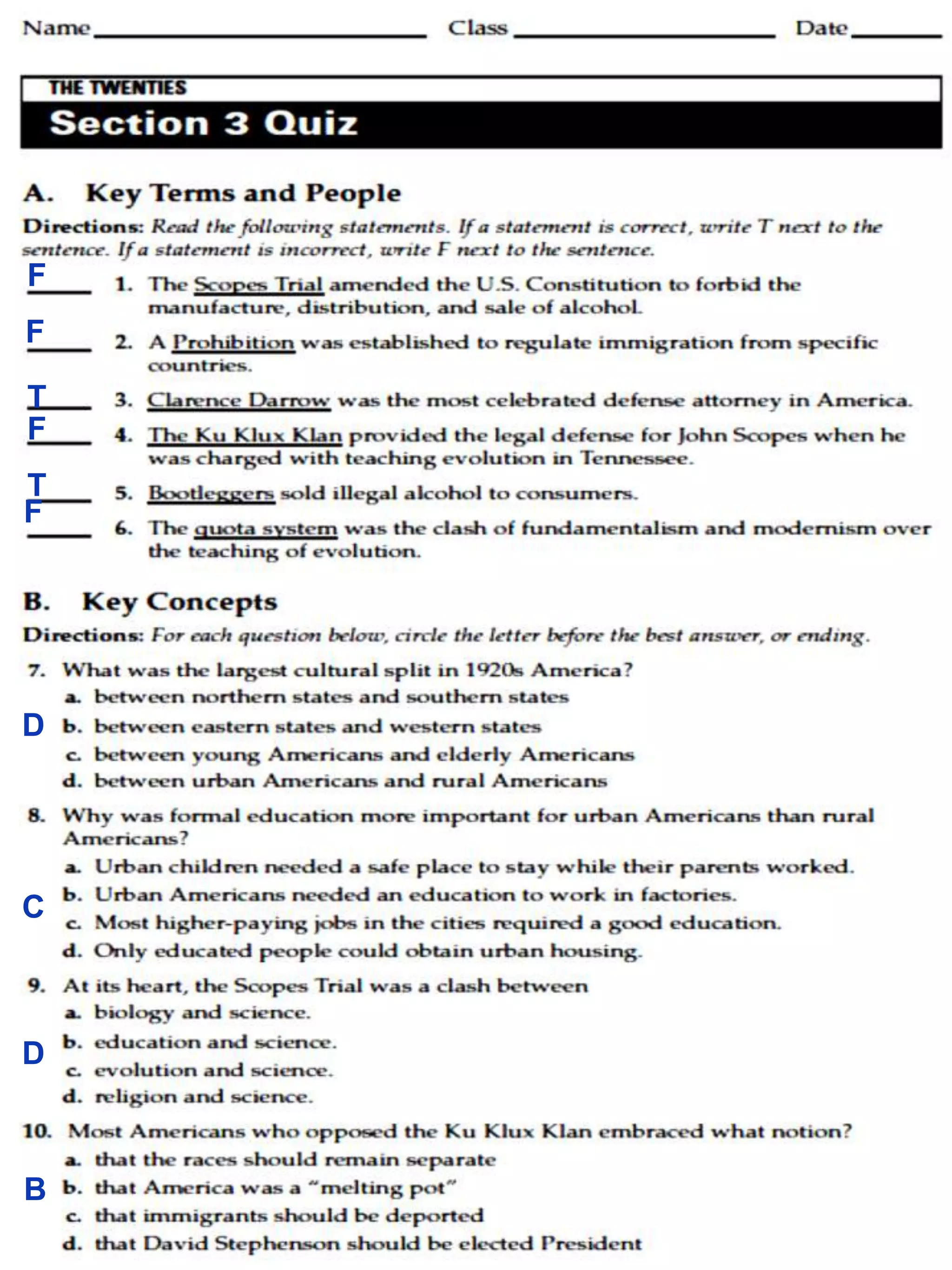
F
F
T
F
T
D
F
C
D
B
C
D
C
A
B
F
D
G
A
C
B
D
B
A

Ch11 rg 3 web

  • 1.
    ©Pearson Education, Inc.,publishing as Pearson Prentice Hall. All rights reserved. 160 READING CHECK What industries were helped by the increase in automobile ownership? VOCABULARY STRATEGY What does the word innovation mean in the underlined sen- tence? Look for context clues in the surrounding words, phrases, and sentences. Circle any words or phrases in the paragraph that help you figure out what innovation means. READING SKILL Identify SupportingDetails Look at your concept web. Select one supporting detail fromthe web and write a sentence explaining this detail. During the 1920s, revolutionary mass-production techniques enabled American workers to produce more goods in less time. Because of this, the economy boomed. The automobile industry played a major role in the boom. Carmaker Henry Ford introduced new methods and ideas that changed the way manufactured goods were made. Ford also hired scientific management experts to improve his assembly-line mass production of automobiles. In two years, the time it took to build an automobile dropped from more than 12 hours to just 90 minutes. This made the Model T affordable for most Americans, and automobile ownership skyrocketed. Ford also used innovation in managing his employees. In 1914, he raised wages from $2.35 to $5 a day. He cut the workday from 9 hours to 8 hours and gave workers Saturday and Sunday off. Automobile production stimulated many other industries, such as steel, glass, rubber, asphalt, wood, gasoline, insurance, and road construction. The growth of these industries led to new, better- paying jobs. This also helped spur national prosperity. A flood of new, affordable goods became available to the public, creating a consumer revolution. At the same time, a new kind of credit called installment buying enabled consumers to buy goods they otherwise could not have afforded. Buyers made a small down payment on a product and paid the rest in monthly installments. Americans were also buying stock on credit. As stock prices soared in a bull market, people began buying on margin, paying as little as 10 percent of the stock price upfront to a broker. If the price of the stock rose, the buyer could pay off the broker and still made a profit. If the price fell, the buyer still owed the broker the full price of the stock. The economic boom was felt more in cities, where jobs were plentiful, than in rural areas. As cities grew, people moved out to suburbs and drove their new automobiles into the city to work. However, America’s wealth was unevenly distributed. Farmers, in particular, suffered under growing debt, while at the same time crop prices were falling. For farmers, and many others, it was not a decade of prosperity. Review Questions 1. How did mass production influence the economy? 2. What was installment buying? Name Class Date CHAPTER 11 Section Summary Section 1 A BOOMING ECONOMY
  • 2.
    ©Pearson Education, Inc.,publishing as Pearson Prentice Hall. All rights reserved. 162 READING CHECK What was the purpose of the Kellogg-Briand Pact? VOCABULARY STRATEGY Find the word incentives in the underlined sentence. Money, rewards, and praise are some- times used as incentives. What is the meaning of incentives? READING SKILL Compare and Contrast Look at the diagram comparing similari- ties and differences between Presidents Harding and Coolidge. How did their differences influ- ence their presidencies? In 1920, fun-loving Warren G. Harding was elected President. Pre- ferring a laissez-faire approach to business, Harding named banker Andrew Mellon as Secretary of the Treasury. Together they worked to reduce regulations on businesses and to raise protective tariff rates. This made it easier for U.S. producers to sell goods at home. In response, Europeans also raised tariffs, making U.S. products more expensive there. Laws had been previously passed to break up monopolies and protect workers, but Harding favored less restric- tion on businesses. His Secretary of Commerce, Herbert Hoover, asked business leaders to voluntarily make advancements. Harding admitted that he preferred playing golf or poker to gov- erning. He trusted his friends with important government positions. One friend, Charles Forbes, wasted millions of dollars while running the Veterans’ Bureau. Another, Secretary of the Interior Albert Fall, created the biggest scandal of Harding’s administration. In the Teapot Dome scandal, Fall took bribes to transfer control of oil reserves from the United States Navy to private oilmen. Fall was later forced to return the oil and sentenced to a year in jail. Harding died in 1923, before the full extent of the scandal came to light. The new President, Calvin Coolidge, was quiet and honest. He put his administration in the hands of men who held to the simple virtues of an older generation. Like Harding, he mistrusted the use of legislation to achieve social change. He favored big business. He reduced the national debt and lowered taxes to give incentives to businesses. However, Coolidge said and did nothing about the country’s many problems, such as low prices for farm crops, racial discrimination, and low wages. In foreign policy, Coolidge pushed European governments to repay war debts to the United States. In 1924, an agreement known as the Dawes Plan was arranged to help Germany, France, and Great Britain repay those debts. In 1928, exhausted by World War I, 62 nations signed the Kellogg-Briand Pact, a treaty that outlawed war. Unfortunately, there was no way for nations to enforce the treaty, and it was quickly forgotten. Review Questions 1. What was the Teapot Dome scandal? 2. How did Presidents Harding and Coolidge feel about laws that restricted businesses? Name Class Date CHAPTER 11 Section Summary Section 2 THE BUSINESS OF GOVERNMENT
  • 3.
    ©Pearson Education, Inc.,publishing as Pearson Prentice Hall. All rights reserved. 164 READING CHECK What did the Eighteenth Amendmentforbid? VOCABULARY STRATEGY What does the word imperial mean in the underlined sen- tence? Look for context clues in the surrounding words and phrases. Circle any words or phrases in the paragraph that help you figure out what imperial means. READING SKILL Contrast Select an issue that divided Americans. Contrast the ways rural and urban Americans felt about this issue. As the 1920s began, striking differences arose between urban and rural America. Urban Americans enjoyed a rising standard of living and embraced a modern view of the world. City dwellers tended to value education and to be advocates of science and social change. By contrast, in rural America times were hard. Formal education was considered less important than keeping the farm going. People tended to be conservative about political and social issues, preferring to keep things the way they were. Many rural Americans believed that the Bible was literally true. This belief was called fundamentalism. It opposed modernism, which stressed science. The two beliefs clashed head-on in the 1925 Scopes Trial. That year, Tennessee passed a law making it illegal to teach the theory of evolution in the state’s public schools. The most celebrated defense attorney in the country, Clarence Darrow, defended John Scopes for teaching this scientific theory to his high school class. Scopes was found guilty of breaking the law and fined $100. A wave of immigration inspired nativist politicians to pass laws forcing immigrants to pass a literacy test, and to create a quota system. The quota system set limits on the number of new immi- grants allowed into the United States. Although many Americans appreciated the nation’s growing diversity, many did not. In 1915, the Ku Klux Klan was reorganized in Georgia. This violent group, whose leaders had titles such as Grand Dragon and Imperial Wizard, promoted hatred of African Americans, Jews, Catholics, and immigrants. Another divisive issue of the 1920s was Prohibition. In 1919 the states ratified the Eighteenth Amendment to the Constitution, which forbade the manufacture, distribution, and sale (but not con- sumption) of alcohol. Congress then passed the Volstead Act to enforce the amendment. Police often turned a blind eye to illegal drinking establishments, which left room for bootleggers to not only sell alcohol but also to expand into other illegal activities, such as prostitution, drugs, robbery, and murder. Thus, Prohibition uninten- tionally led to the growth of organized crime. Review Questions 1. What were some of the issues and beliefs that rural and urban America clashed over in the 1920s? 2. How did nativists feel about immigration? Name Class Date CHAPTER 11 Section Summary Section 3 SOCIAL AND CULTURAL TRENDS
  • 4.
    ©Pearson Education, Inc.,publishing as Pearson Prentice Hall. All rights reserved. 167 READING CHECK Who developeda theory about behavior and the unconscious? VOCABULARY STRATEGY What does the word sociological mean in the underlined sen- tence? The termsocio means “relating to society.” The term –ology usually refers to a type of study. Use these definitions to help you figure out the meaning of sociological. READING SKILL Summarize List three ways American culture changed in the 1920s. As urban Americans’ wages rose in the 1920s, workers also enjoyed shorter workweeks. For the first time, a large city-dwelling popula- tion had free time and money to spend on entertainment. One of the most popular forms of entertainment was movies, which were attended by 60 to 100 million Americans each week. Actors such as comedian Charlie Chaplin, heartthrob Rudolf Valentino, and cow- boy William S. Hart became silent film stars. Then in 1927, the movie The Jazz Singer startled audiences when Al Jolson said, “You ain’t seen nothin’ yet.” The Jazz Singer became the first movie to include sound matched to the action on the screen, and the era of “talkies” was born. For entertainment at home, Americans bought millions of phonographs and radios. By 1923, almost 600 licensed radio stations broadcast to more than 600,000 radio sets. Americans across the con- tinent listened to the same songs, learned the same dances, and shared a popular culture as never before. People admired the same heroes, such as baseball player Babe Ruth, the home-run king, and aviator Charles Lindbergh, who was the first to fly solo and non-stop across the Atlantic Ocean. American women challenged political, economic, social, and educational boundaries. With passage of the Nineteenth Amend- ment, they won the right to vote. Many ran for political office and more joined the workforce. Some women, known as flappers, shocked society by wearing short skirts and bobbed hair. At home, new electric appliances made housework easier. Popular magazines, sociological studies, novels, and movies all featured the “New Woman” of the 1920s prominently. A spirit of modernism grew, especially in cities. Austrian psy- chologist Sigmund Freud contributed to modernism with his theory that human behavior is driven by unconscious desires rather than by rational thought. Painters rejected artistic norms. Writers, including F. Scott Fitzgerald and Ernest Hemingway, wrote about the mean- ing of life and war. Their literary masterpieces examined subcon- scious desires and the dark side of the American dream. Review Questions 1. What technological advances led to cultural change during the 1920s? 2. What changes in the 1920s allowed urban Americans to enjoy more entertainment? Name Class Date TCHAPTER 11 Section Summary Section 4 A NEW MASS CULTURE
  • 5.
    ©Pearson Education, Inc.,publishing as Pearson Prentice Hall. All rights reserved. 169 READING CHECK What did F. Scott Fitzgerald name the 1920s? VOCABULARY STRATEGY Find the word indigenous in the underlined sentence. What do you think it means? Circle words, phrases, or sentences in the sur- rounding paragraph to help you define indigenous. READING SKILL Identify Main Ideas What was the Harlem Renaissance? Millions of African Americans left the South after World War I to find freedom and economic opportunity in the North. In the South, they faced low-paying jobs, substandard schools, Jim Crow oppres- sion, and the threat of lynching. However, they found well-paying jobs, a middle class of African American professionals, and a grow- ing political voice in cities such as New York, Chicago, and Detroit. Harlem in New York City became a haven for about 200,000 African Americans from the South as well as black immigrants from the Caribbean. One immigrant was Marcus Garvey, a Jamaican who had traveled widely. After seeing that blacks were treated poorly, Garvey organized a “Back to Africa” movement that urged black unity and separation of the races. It was F. Scott Fitzgerald who called the 1920s the “Jazz Age.” However, it was African Americans who gave the age its jazz. A truly indigenous American musical form, jazz emerged in the South as a combination of African American and European musical styles. African Americans migrating north brought the new musical style with them. Musicians such as trumpet player Louis Armstrong took jazz to the world. Singer Bessie Smith, nicknamed the “Empress of the Blues,” was so popular she became the highest-paid African American entertainer of the 1920s. The decade also saw the Harlem Renaissance, an outpouring of art and literature that explored the African American experience. Among its most famous writers was Claude McKay, whose novels and poems were militant calls for action. Langston Hughes cele- brated African American culture, and Zora Neale Hurston wrote about women’s desire for independence. The Great Depression ended the Harlem Renaissance. However, the pride and unity it created provided a foundation for the future civil rights movement. Review Questions 1. Why did many African Americans migrate north? 2. What was the “Back to Africa” movement? Name Class Date TCHAPTER 11 Section Summary Section 5 THE HARLEM RENAISSANCE
  • 6.
  • 7.
    Andrew Mellon Herbert Hoover WashNaval Disarmament Dawes Plan Calvin Coolidge A C B C D
  • 8.
  • 9.
  • 10.