CH. 4 - WEATHERING


     Chapter 2
Types of Weathering
Processes

1) Mechanical Weathering
- rx break down into smaller
    pieces
- little or no chemical alteration
Types of Weathering
Processes

2) Chemical Weathering
- alters crystalline structure and/or
  composition of minerals
- new minerals formed or minerals
  dissolve
Types of Mechanical
Weathering

1) Frost wedging
- most effective in climates with
   freeze/thaw cycles
Ex: high altitudes, mid-latitudes
Granite boulder
Talus slope
Types of Mechanical
Weathering

2) Unloading
- caused by a decrease in
  pressure
- effective on large bodies of
  intrusive igneous rocks
Unloading

Rocks expand & crack parallel to
  surface (“sheeting”)
- produce rounded mountains
  called exfoliation domes
Ex: Yosemite National Park, CA
      Stone Mountain, GA
Unloading
Yosemite
Half Dome is
an exfoliation
dome cut in
half by large
glaciers
during the Ice
Age
Types of Mechanical
Weathering

3) Abrasion
- grinding by friction
- usually done by water: rivers,
  waves, glaciers
- process by which rivers & glaciers
  carve their own valleys
Types of Mechanical
Weathering

4) Organic Activity
Ex: root wedging
Mechanical Weathering

Where would it be most
   significant?
a) Amazon Rain Forest
b) Peoria, IL
c) North Pole
Chemical Weathering

New minerals formed or old ones
  dissolve
Agents:
1)Oxygen - abundant and reactive
  Atomic Number = 8
Oxygen

Ex: Mafic mineral + oxygen = iron
                            oxide
Hornblende + Oxygen = Hematite
Agents of Chemical Weathering

2) Acid – destroys crystalline
   structure
Ex: How granite weathers (p. 89)
Feldspar + acid = clay mineral
Clay minerals = most common
   weathering product of silicates
Clay Minerals

Family of minerals
Microscopic sheet silicates (like
 mini-micas)
Ex: kaolinite
Sources of Acid:

a) Volcanic eruptions
Volcanic acids

Hot springs where water circulates
 near magma chambers
Ex: Yellowstone
National Park
Sources of Acid

b) Mine Drainage
- sulfur-bearing minerals react with
  water to form sulfuric acid
Ex: Pyrite = FeS2 (iron sulfide)
   Galena = PbS (lead sulfide)
Open Pit Mine
Sources of Acid

c) Air pollution
Coal-burning power plants release
  sulfur into atmosphere
- produce sulfuric acid (acid rain)
1990
 Clean Air Act Amendments

Requires power plants to reduce
   pollutants
1) Install “scrubbers” in
   smokestacks
2) Burn lower sulfur-content coal
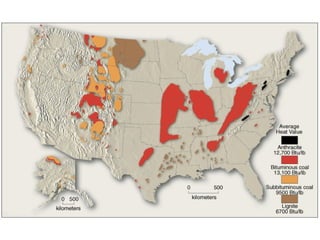
Map of U.S. coal deposits
Chemical Weathering

Environmental conditions that
 enhance chemical weathering:
1)
2)
Chemical Weathering

Where would it be most
  significant?
a) Amazon Rain Forest
b) Peoria, IL
c) North Pole
Working together:

Mechanical weathering creates
 smaller pieces w/ larger surface
 areas
Weathering Products

Original Mineral      Product
Hornblende          Clay minerals
Feldspar            Clay minerals
Biotite/muscovite   Clay minerals
Quartz              Quartz
Stable minerals at surface


1) _______________________
2) _______________________
Factors controlling rate of
weathering

1) Particle size
_________ particles = faster
   chemical weathering
_________ particles = faster
   mechanical weathering
Factors controlling rate of
weathering

2) Composition
Which weathers faster in warm
 humid climate: basalt or
 granite?
Basalt = _____; Granite = _____
Factors controlling rate of
weathering

3) Climate
Ex: Limestone in humid climate
- chemical weathering dominates
- rolling hills
- lots of caves & sinkholes
Climate

Ex: Limestone in arid climate
- mechanical weathering
  dominates
- steep cliffs with talus slopes

04_weathering_students_revised