Properties of Water Physical States only natural substance that occurs naturally in three states on the earth’s surface Heat Capacity Highest of all common solids and liquids Surface Tension Highest of all common liquids Latent Heat of Fusion Highest of all common substances Compressibility Virtually incompressible as a liquid Density Density of seawater is controlled by temperature, salinity and pressure Liquid has maximum density at +4 o C; solid phase has lower density!
Properties of Water (cont’) Radiative Properties transparent to visible wavelengths virtually opaque to many infrared wavelengths large range of albedo possible water  10 % (daily average)  Ice   30 to 40% Snow   20 to 95% Cloud   30 to 90%
Molecular Structure of Water Water's unique molecular structure and hydrogen bonds enable all 3 phases to exist in earth's atmosphere. Sublimation & deposition describe the non-incremental changes between solid and vapor phases. water molecule ice
Energy associated with phase change Sublimation Deposition
Why does it take so much energy to evaporate water? In the liquid state, adjacent water molecules  attract  one another “ -” charge on O attracted to “+” charge on H we call this  hydrogen bonding This same hydrogen bond accounts for  surface tension  on a free water surface column of water “sticks together”
Sublimation –  evaporate ice directly to water vapor Take one gram of ice at zero degrees centigrade Energy required to change the phase of one gram of ice to vapor: Add  80 calories to melt the ice Add 100 calories to raise the temperature to 100 degrees C Add 540 calories to evaporate the liquid Total Energy  ADDED  for sublimation of 1 gram of ice: 80 + 100 + 540 = 720  calories
Deposition –   convert vapor directly to ice Take one gram of water vapor at 100 degrees Centigrade Release 540 calories to condense Release 100 calories to cool temperature of liquid to  o C Release  80 calories to freeze water Total energy  RELEASED  for deposition of 1 gram of ice   540 + 100 + 80  =  720  calories
Water vapor pressure Molecules in an air parcel  all contribute to pressure Each subset of molecules (e.g., N 2 , O 2 , H 2 O) exerts a  partial pressure The  VAPOR PRESSURE ,  e , is the pressure exerted by water vapor molecules in the air similar to atmospheric pressure, but due only to the water vapor molecules often expressed in mbar (2-30 mbar common at surface)
Water vapor saturation Water molecules  move  between the liquid and gas phases When the rate of water molecules entering the liquid equals the rate leaving the liquid, we have  equilibrium The air is said to be  saturated  with water vapor at this point Equilibrium does not mean no exchange occurs
Relationship between e S  and T The saturation vapor pressure of water increases with temperature At  higher T, faster  water molecules in liquid escape more frequently causing  equilibrium water vapor concentration to rise We sometimes say “ warmer air can hold more water ” There is also a vapor pressure of water over an ice surface The saturation vapor pressure above solid ice is less than above liquid water
e S  vs T schematic Saturation vapor pressure depends upon temperature
How do we express the amount of water vapor in an air parcel? Absolute humidity mass of water vapor/volume of air (g/m 3 ) changes when air parcel volume changes Specific humidity mass of water vapor/mass of air (g/kg) Mixing ratio mass of water vapor/mass of dry air (g/kg) Specific humidity and mixing ratio remain constant as long as water vapor is not added/removed to/from air parcel Dew point temperature
Expressing the water vapor pressure Relative Humidity (RH) is ratio of actual vapor pressure to saturation vapor pressure 100 * e/e S Range: 0-100% (+) Air with RH > 100% is supersaturated RH can be  changed  by Changes in  water vapor  content, e Changes in  temperature , which alter e S
Dewpoint Temperatures Dewpoint is a measure of the water vapor content of    the air It is  not a measure of temperature !
Which environment has higher water vapor content?
Why is the southwest coast of the US hot and dry while the Gulf coast is hot and moist? Both are adjacent to large bodies of water Both experience onshore wind flow on a regular basis Why does one have a desert like climate and the other ample moisture and rainfall?
Humidity reflects water temps The cold water temperatures  typically found off the west coast  of continents are a result of oceanic  upwelling  which ocean currents typically cause in these locations
Water vapor is distributed throughout the atmosphere Generally largest amounts are found close to the surface, decreasing aloft Closest to the source -  evaporation  from ground, plants, lakes and ocean Warmer air can  hold more water vapor  than colder air
 
 
Take-Away Points Weather is driven by unequal solar heating and cooling Air motions are affected by the Coriolis Effect and “centrifugal” force High and Low Pressure Systems Air flows parallel to pressure contours (Geostrophic winds) Air masses meet along sharp boundaries or fronts Weather is inherently chaotic and that limits our ability to forecast it
The Seasons
Uneven solar heating on Earth Solar energy in high latitudes: Has a larger “footprint” Is reflected to a greater extent Passes through more atmosphere Is less than that received in low latitudes
Earth’s seasons Earth’s axis is tilted 23½ º  from vertical Northern and Southern Hemispheres are alternately tilted toward and away from the Sun Causes longer days and more intense solar radiation during summer
Oceanic heat flow A net heat gain is experienced in low latitudes A net heat loss is experienced in high latitudes Heat gain and loss are balanced by oceanic and atmospheric circulation
Physical properties of the atmosphere: Composition (dry air) Percent Gas Trace All others 0.036% Carbon dioxide (CO 2 ) 0.9% Argon (Ar) 20.9% Oxygen (O 2 ) 78.1% Nitrogen (N 2 )
Physical properties of the atmosphere: Temperature Troposphere is: Lowermost part of the atmosphere Where most weather occurs Temperature of  troposphere cools with increasing altitude
Physical properties of the atmosphere: Density Warm, low density air rises Cool, high density air sinks Creates circular- moving loop of air (convection cell)
Physical properties of the atmosphere: Water vapor Cool air cannot hold much water vapor, so is typically dry Warm air can hold more water vapor, so is typically moist Water vapor decreases the density of air
Physical properties of the atmosphere: Pressure A column of cool, dense air causes high pressure at the surface, which will lead to sinking air A column of warm, less dense air causes low pressure at the surface, which will lead to rising air
Physical properties of the atmosphere: Movement Air always moves from high-pressure regions toward low-pressure regions Moving air is called wind
The Coriolis effect The Coriolis effect Is a result of Earth’s rotation Causes moving objects to follow curved paths: In Northern Hemisphere, curvature is to right In Southern Hemisphere, curvature is to left Changes with latitude: No Coriolis effect at Equator Maximum Coriolis effect at poles
A merry-go-round as an example of the Coriolis effect To an observer above the merry-go-round, objects travel straight To an observer on the merry-go-round, objects follow curved paths
The Coriolis effect on Earth As Earth rotates, different latitudes travel at different speeds The change in speed with latitude causes the Coriolis effect Figure 6-9a
Missile paths demonstrate the Coriolis effect  Two missiles are fired toward a target in the Northern Hemisphere  Both missiles curve to the right Figure 6-9b
Wind belts of the world Figure 6-10
Characteristics of wind belts and boundaries Polar high pressure Polar easterlies Polar front Prevailing westerlies Horse latitudes Trade winds Doldrums Wind belt or boundary name High press. boundary Polar (90 º) Cool easterly winds 60-90 º Low press. boundary 60 º Mid-latitude winds 30-60 º High press. boundary 30 º Persistent easterlies 5-30 º Low press. boundary Equatorial (0-5 º) Characteristic Region/Latitude
Coriolis effect influences air movement Northern Hemisphere winds curve to the right as they move from high to low pressure Causes wind to circulate: Clockwise around high-pressure regions Counterclockwise around low-pressure regions
Air masses that affect U.S. weather
Origin and paths of tropical cyclones Tropical cyclones are intense low pressure storms created by: Warm water Moist air Coriolis effect Includes: Hurricanes Cyclones Typhoons
Hurricane occurrence Hurricanes have wind speeds of at least 120 kilometers (74 miles) per hour Worldwide, about 100 storms grow to hurricane status each year In the Northern Hemisphere, h urricane season is generally between June 1 and November 30
Hurricane structure Hurricanes have: Circular cloud bands that produce torrential rain The ability to move into the mid-latitudes A central eye
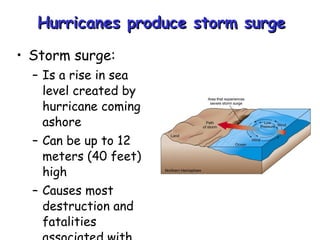
Hurricanes produce storm surge Storm surge: Is a rise in sea level created by hurricane coming ashore Can be up to 12 meters (40 feet) high Causes most destruction and fatalities associated with hurricanes
Climate regions of the ocean
How a greenhouse works Sunlight passes through the clear covering of a greenhouse It converts to longer wavelength heat energy Heat cannot pass through the covering and is trapped inside
The heating of Earth’s atmosphere
Anthropogenic gases that contribute to the greenhouse effect 8% CFC-12 4% CFC-11 8% Tropospheric ozone (O 3 ) 5% Nitrous oxide (N 2 O) 15% Methane (CH 4 ) 60% Carbon dioxide (CO 2 ) Relative contribution Greenhouse Gas
Carbon dioxide is increasing in the atmosphere As a result of human activities, carbon dioxide in the atmosphere has increased by 30% since 200 years ago
Earth’s average temperature is rising Earth’s average surface temperature has risen at least 0.6°C (1.1°F) in the last 130 years May be related to increase in atmospheric carbon dioxide
Predicted changes with increased greenhouse warming Higher than normal sea surface temperatures that could affect world climate More severe droughts or increased precipitation Water contamination and outbreaks of water-borne diseases Longer and more intense heat waves Shifts in the distribution of plants and animals Potential melting or enlargement of polar ice caps
Atmospheric Circulation 1. Weather is driven by unequal solar heating and cooling
Asymmetric Earth 1. Weather is driven by unequal solar heating and cooling
Atmospheric Circulation 1. Weather is driven by unequal solar heating and cooling
Zonal and Meridional Flow 1. Weather is driven by unequal solar heating and cooling
Semi-Permanent Features, January 1. Weather is driven by unequal solar heating and cooling
Semi-Permanent Features, July 1. Weather is driven by unequal solar heating and cooling
Rotation Effects 2. Air motions are affected by the Coriolis Effect and “centrifugal” force
The Coriolis Effect Due to moving on a rotating earth Things on equator are moving faster than points near poles Affects: Winds Ocean Currents Tides 2. Air motions are affected by the Coriolis Effect and “centrifugal” force
The Coriolis Effect Things moving toward the equator are deflected  west Things moving poleward are deflected  east Deflected to Right in Northern Hemisphere Deflected to Left in Southern Hemisphere 2. Air motions are affected by the Coriolis Effect and “centrifugal” force
The Coriolis Effect 2. Air motions are affected by the Coriolis Effect and “centrifugal” force
“Centrifugal” Force Does Not Exist When anything turns, the only forces that act are in the direction of the turn These forces are called  centripetal  (center-seeking) force “Centrifugal” force is an illusion “Centrifugal” force is due to inertia and centripetal force opposing each other 2. Air motions are affected by the Coriolis Effect and “centrifugal” force
High Pressure Systems 3. High and Low Pressure Systems
High Pressure Systems Air flows out from center Spin clockwise in Northern Hemisphere No air mixing Stable, fair weather Sinking Air, few clouds Long duration can result in inversions, pollution Winter: often extreme cold Cold Air is Dense Clear Skies and Radiational Cooling 3. High and Low Pressure Systems
Low Pressure Systems 3. High and Low Pressure Systems
Why Counterclockwise? 3. High and Low Pressure Systems
Low Pressure Systems Air flows in toward center Spin counter-clockwise in Northern Hemisphere Mixes air of different properties Associated with fronts Stormy, sometimes violent weather Passage often results in sharp change in weather conditions 3. High and Low Pressure Systems
Geostrophic Winds As air flows in or out of pressure cells, Coriolis Effect deflects it At surface, friction limits the deflection. Winds blow about 45 degree angles to isobars Aloft, friction not a factor Deflection continues until limited by pressure gradient (winds can’t go against pressure) Winds blow  parallel  to contours This is called  geostrophic  flow
Geostrophic Flow
Geostrophic Flow
Geostrophic Flow 4. Air flows parallel to pressure contours (Geostrophic winds)
1905 Weather Map of US
First U.S. Weather Map With Fronts
Fronts and Low Pressure Systems 5. Air masses meet along sharp boundaries or fronts
Fronts 5. Air masses meet along sharp boundaries or fronts
Warm Fronts 5. Air masses meet along sharp boundaries or fronts
Warm Fronts Gradual Onset Warm Air over Cool Air Little Turbulence Weather Rarely Violent 5. Air masses meet along sharp boundaries or fronts
Cold Fronts 5. Air masses meet along sharp boundaries or fronts
Cold Fronts Abrupt Onset Cold Air Lifting Warm Air Considerable Turbulence Weather Sometimes Violent Thunderstorms Common Can Spawn Tornadoes 5. Air masses meet along sharp boundaries or fronts
Old Low Pressure Systems 5. Air masses meet along sharp boundaries or fronts
Occluded Fronts 5. Air masses meet along sharp boundaries or fronts
Occluded Fronts Two fronts merge Any two types of front can occlude Most common: Cold Front overtakes Warm Front Starts off like a warm front, finishes like a cold front 5. Air masses meet along sharp boundaries or fronts
Weather Prediction 5. Air masses meet along sharp boundaries or fronts
Chaos x
Chaos Theory Does Not Mean: Cloned Dinosaurs will run amok Systems do not follow physical laws Systems behave with wild unpredictability Systems do not have limits Phenomena cannot be predicted 6. Weather is inherently chaotic and that limits our ability to forecast it
Chaos Theory Does Mean: Small differences compound over time There are limits to how accurately phenomena can be predicted Examples: Weather The Planets Traffic 6. Weather is inherently chaotic and that limits our ability to forecast it
 
Who Cares About Water Anyways? Phase changes of water important for energy transport in atmosphere Clouds! Precipitation!
Overview Cloud:  Collection of liquid water drops or ice crystals Clouds form as 1) Water vapor condenses onto small particles known as condensation nuclei  to form liquid water drops, or 2) Water vapor deposits onto small particles known as ice nuclei that allow for ice crystal formation  In a cloud, water can be present in all three phases at the same time
Hydrologic Cycle Global precipitation = Global evaporation
Terms Evaporation:  liquid water molecules break bonds with other molecules to escape to gaseous phase Condensation:  Water vapor returns to liquid state Sublimation:  Ice changes directly to water vapor Deposition:  Water vapor changes directly to ice Transpiration:  Plants releasing water vapor into air
Temperature and Evaporation Evaporation occurs when liquid water molecules gain enough kinetic energy to break bonds The higher the temperature of water, the higher the kinetic energy of its molecules, thus the higher the evaporation rate Evaporation is a cooling process
Balance of Evaporation & Condensation Net Condensation:  Condensation exceeds evaporation Net Evaporation:  Evaporation exceeds condensation Vapor Pressure:  Water vapor’s contribution to total pressure
 
Equilibrium Vapor Pressure & Temperature
Birth of Clouds Relative Humidity: ( vapor pressure / equilibrium vapor pressure) * 100  At saturation (rate of condensation = rate of evaporation), RH = 100% Clouds form when RH exceeds 100% by a few tenths of a percent Water vapor condenses onto CCN…some hygroscopic, meaning they attract water vapor In summer, when RH exceeds 80%, net condensation occurs on some particles (pollution), leading to haze…associated with poor air quality
 
Mechanisms to induce cloud formation For clouds to form, there must be net condensation We can get this by cooling the air As temperature lowers, molecular speeds decrease, and water vapor gathers near CCN The amount of cooling needed is inversely proportional to the amount of water vapor in the air
Fog Formation by Cooling Air
Cooling via lifting Air pressure (density) decreases with height Rising air parcels expand, cooling as they do work on environment If vapor pressure = equilibrium vapor pressure => condensation
Clouds due to Lifting
Orographic Lifting: Lifting by Terrain Windward side of mountain, facing prevailing wind, is extremely wet Leeward side, sheltered from wind, very dry…known as rain shadow
Clouds due to Terrain
Orographic Lifting: California
Mixing Warm & Cold Air Masses
Assessing Air’s Moisture Content Problems with RH because denominator depends on temperature Cold, dry air masses can have a high RH, even if they hold little water vapor Relative humidity varies with time of day
Dew Point: Absolute measure of water vapor Dew Point:  Temperature air must be cooled (at constant pressure) to reach saturation Less than or equal to temperature  Higher the dew point, more water vapor in air Frost point if air temperature below 32ºF Measured with a hygrometer or sling psychrometer Changes by evaporating water into air, mixing drier air from above, wind blowing in moist or dry air from another region (air dries behind cold front, moistens before cold front)
Applying Dew Point to Weather Forecasting 1) Cloud Base Height Temperature of rising air decreases faster than dew point…has a decent chance of eventually reaching dew point 2) First-Guess Low Temperature 3) Severe Weather High dew points indicate enhanced risk
The Earth’s Hydrologic Cycle

Hydrology presentation on rainfall

  • 1.
    Properties of WaterPhysical States only natural substance that occurs naturally in three states on the earth’s surface Heat Capacity Highest of all common solids and liquids Surface Tension Highest of all common liquids Latent Heat of Fusion Highest of all common substances Compressibility Virtually incompressible as a liquid Density Density of seawater is controlled by temperature, salinity and pressure Liquid has maximum density at +4 o C; solid phase has lower density!
  • 2.
    Properties of Water(cont’) Radiative Properties transparent to visible wavelengths virtually opaque to many infrared wavelengths large range of albedo possible water 10 % (daily average) Ice 30 to 40% Snow 20 to 95% Cloud 30 to 90%
  • 3.
    Molecular Structure ofWater Water's unique molecular structure and hydrogen bonds enable all 3 phases to exist in earth's atmosphere. Sublimation & deposition describe the non-incremental changes between solid and vapor phases. water molecule ice
  • 4.
    Energy associated withphase change Sublimation Deposition
  • 5.
    Why does ittake so much energy to evaporate water? In the liquid state, adjacent water molecules attract one another “ -” charge on O attracted to “+” charge on H we call this hydrogen bonding This same hydrogen bond accounts for surface tension on a free water surface column of water “sticks together”
  • 6.
    Sublimation – evaporate ice directly to water vapor Take one gram of ice at zero degrees centigrade Energy required to change the phase of one gram of ice to vapor: Add 80 calories to melt the ice Add 100 calories to raise the temperature to 100 degrees C Add 540 calories to evaporate the liquid Total Energy ADDED for sublimation of 1 gram of ice: 80 + 100 + 540 = 720 calories
  • 7.
    Deposition – convert vapor directly to ice Take one gram of water vapor at 100 degrees Centigrade Release 540 calories to condense Release 100 calories to cool temperature of liquid to o C Release 80 calories to freeze water Total energy RELEASED for deposition of 1 gram of ice 540 + 100 + 80 = 720 calories
  • 8.
    Water vapor pressureMolecules in an air parcel all contribute to pressure Each subset of molecules (e.g., N 2 , O 2 , H 2 O) exerts a partial pressure The VAPOR PRESSURE , e , is the pressure exerted by water vapor molecules in the air similar to atmospheric pressure, but due only to the water vapor molecules often expressed in mbar (2-30 mbar common at surface)
  • 9.
    Water vapor saturationWater molecules move between the liquid and gas phases When the rate of water molecules entering the liquid equals the rate leaving the liquid, we have equilibrium The air is said to be saturated with water vapor at this point Equilibrium does not mean no exchange occurs
  • 10.
    Relationship between eS and T The saturation vapor pressure of water increases with temperature At higher T, faster water molecules in liquid escape more frequently causing equilibrium water vapor concentration to rise We sometimes say “ warmer air can hold more water ” There is also a vapor pressure of water over an ice surface The saturation vapor pressure above solid ice is less than above liquid water
  • 11.
    e S vs T schematic Saturation vapor pressure depends upon temperature
  • 12.
    How do weexpress the amount of water vapor in an air parcel? Absolute humidity mass of water vapor/volume of air (g/m 3 ) changes when air parcel volume changes Specific humidity mass of water vapor/mass of air (g/kg) Mixing ratio mass of water vapor/mass of dry air (g/kg) Specific humidity and mixing ratio remain constant as long as water vapor is not added/removed to/from air parcel Dew point temperature
  • 13.
    Expressing the watervapor pressure Relative Humidity (RH) is ratio of actual vapor pressure to saturation vapor pressure 100 * e/e S Range: 0-100% (+) Air with RH > 100% is supersaturated RH can be changed by Changes in water vapor content, e Changes in temperature , which alter e S
  • 14.
    Dewpoint Temperatures Dewpointis a measure of the water vapor content of the air It is not a measure of temperature !
  • 15.
    Which environment hashigher water vapor content?
  • 16.
    Why is thesouthwest coast of the US hot and dry while the Gulf coast is hot and moist? Both are adjacent to large bodies of water Both experience onshore wind flow on a regular basis Why does one have a desert like climate and the other ample moisture and rainfall?
  • 17.
    Humidity reflects watertemps The cold water temperatures typically found off the west coast of continents are a result of oceanic upwelling which ocean currents typically cause in these locations
  • 18.
    Water vapor isdistributed throughout the atmosphere Generally largest amounts are found close to the surface, decreasing aloft Closest to the source - evaporation from ground, plants, lakes and ocean Warmer air can hold more water vapor than colder air
  • 19.
  • 20.
  • 21.
    Take-Away Points Weatheris driven by unequal solar heating and cooling Air motions are affected by the Coriolis Effect and “centrifugal” force High and Low Pressure Systems Air flows parallel to pressure contours (Geostrophic winds) Air masses meet along sharp boundaries or fronts Weather is inherently chaotic and that limits our ability to forecast it
  • 22.
  • 23.
    Uneven solar heatingon Earth Solar energy in high latitudes: Has a larger “footprint” Is reflected to a greater extent Passes through more atmosphere Is less than that received in low latitudes
  • 24.
    Earth’s seasons Earth’saxis is tilted 23½ º from vertical Northern and Southern Hemispheres are alternately tilted toward and away from the Sun Causes longer days and more intense solar radiation during summer
  • 25.
    Oceanic heat flowA net heat gain is experienced in low latitudes A net heat loss is experienced in high latitudes Heat gain and loss are balanced by oceanic and atmospheric circulation
  • 26.
    Physical properties ofthe atmosphere: Composition (dry air) Percent Gas Trace All others 0.036% Carbon dioxide (CO 2 ) 0.9% Argon (Ar) 20.9% Oxygen (O 2 ) 78.1% Nitrogen (N 2 )
  • 27.
    Physical properties ofthe atmosphere: Temperature Troposphere is: Lowermost part of the atmosphere Where most weather occurs Temperature of troposphere cools with increasing altitude
  • 28.
    Physical properties ofthe atmosphere: Density Warm, low density air rises Cool, high density air sinks Creates circular- moving loop of air (convection cell)
  • 29.
    Physical properties ofthe atmosphere: Water vapor Cool air cannot hold much water vapor, so is typically dry Warm air can hold more water vapor, so is typically moist Water vapor decreases the density of air
  • 30.
    Physical properties ofthe atmosphere: Pressure A column of cool, dense air causes high pressure at the surface, which will lead to sinking air A column of warm, less dense air causes low pressure at the surface, which will lead to rising air
  • 31.
    Physical properties ofthe atmosphere: Movement Air always moves from high-pressure regions toward low-pressure regions Moving air is called wind
  • 32.
    The Coriolis effectThe Coriolis effect Is a result of Earth’s rotation Causes moving objects to follow curved paths: In Northern Hemisphere, curvature is to right In Southern Hemisphere, curvature is to left Changes with latitude: No Coriolis effect at Equator Maximum Coriolis effect at poles
  • 33.
    A merry-go-round asan example of the Coriolis effect To an observer above the merry-go-round, objects travel straight To an observer on the merry-go-round, objects follow curved paths
  • 34.
    The Coriolis effecton Earth As Earth rotates, different latitudes travel at different speeds The change in speed with latitude causes the Coriolis effect Figure 6-9a
  • 35.
    Missile paths demonstratethe Coriolis effect Two missiles are fired toward a target in the Northern Hemisphere Both missiles curve to the right Figure 6-9b
  • 36.
    Wind belts ofthe world Figure 6-10
  • 37.
    Characteristics of windbelts and boundaries Polar high pressure Polar easterlies Polar front Prevailing westerlies Horse latitudes Trade winds Doldrums Wind belt or boundary name High press. boundary Polar (90 º) Cool easterly winds 60-90 º Low press. boundary 60 º Mid-latitude winds 30-60 º High press. boundary 30 º Persistent easterlies 5-30 º Low press. boundary Equatorial (0-5 º) Characteristic Region/Latitude
  • 38.
    Coriolis effect influencesair movement Northern Hemisphere winds curve to the right as they move from high to low pressure Causes wind to circulate: Clockwise around high-pressure regions Counterclockwise around low-pressure regions
  • 39.
    Air masses thataffect U.S. weather
  • 40.
    Origin and pathsof tropical cyclones Tropical cyclones are intense low pressure storms created by: Warm water Moist air Coriolis effect Includes: Hurricanes Cyclones Typhoons
  • 41.
    Hurricane occurrence Hurricaneshave wind speeds of at least 120 kilometers (74 miles) per hour Worldwide, about 100 storms grow to hurricane status each year In the Northern Hemisphere, h urricane season is generally between June 1 and November 30
  • 42.
    Hurricane structure Hurricaneshave: Circular cloud bands that produce torrential rain The ability to move into the mid-latitudes A central eye
  • 43.
    Hurricanes produce stormsurge Storm surge: Is a rise in sea level created by hurricane coming ashore Can be up to 12 meters (40 feet) high Causes most destruction and fatalities associated with hurricanes
  • 44.
  • 45.
    How a greenhouseworks Sunlight passes through the clear covering of a greenhouse It converts to longer wavelength heat energy Heat cannot pass through the covering and is trapped inside
  • 46.
    The heating ofEarth’s atmosphere
  • 47.
    Anthropogenic gases thatcontribute to the greenhouse effect 8% CFC-12 4% CFC-11 8% Tropospheric ozone (O 3 ) 5% Nitrous oxide (N 2 O) 15% Methane (CH 4 ) 60% Carbon dioxide (CO 2 ) Relative contribution Greenhouse Gas
  • 48.
    Carbon dioxide isincreasing in the atmosphere As a result of human activities, carbon dioxide in the atmosphere has increased by 30% since 200 years ago
  • 49.
    Earth’s average temperatureis rising Earth’s average surface temperature has risen at least 0.6°C (1.1°F) in the last 130 years May be related to increase in atmospheric carbon dioxide
  • 50.
    Predicted changes withincreased greenhouse warming Higher than normal sea surface temperatures that could affect world climate More severe droughts or increased precipitation Water contamination and outbreaks of water-borne diseases Longer and more intense heat waves Shifts in the distribution of plants and animals Potential melting or enlargement of polar ice caps
  • 51.
    Atmospheric Circulation 1.Weather is driven by unequal solar heating and cooling
  • 52.
    Atmospheric Circulation 1.Weather is driven by unequal solar heating and cooling
  • 53.
    Asymmetric Earth 1.Weather is driven by unequal solar heating and cooling
  • 54.
    Asymmetric Earth 1.Weather is driven by unequal solar heating and cooling
  • 55.
    Atmospheric Circulation 1.Weather is driven by unequal solar heating and cooling
  • 56.
    Zonal and MeridionalFlow 1. Weather is driven by unequal solar heating and cooling
  • 57.
    Semi-Permanent Features, January1. Weather is driven by unequal solar heating and cooling
  • 58.
    Semi-Permanent Features, July1. Weather is driven by unequal solar heating and cooling
  • 59.
    Rotation Effects 2.Air motions are affected by the Coriolis Effect and “centrifugal” force
  • 60.
    The Coriolis EffectDue to moving on a rotating earth Things on equator are moving faster than points near poles Affects: Winds Ocean Currents Tides 2. Air motions are affected by the Coriolis Effect and “centrifugal” force
  • 61.
    The Coriolis EffectThings moving toward the equator are deflected west Things moving poleward are deflected east Deflected to Right in Northern Hemisphere Deflected to Left in Southern Hemisphere 2. Air motions are affected by the Coriolis Effect and “centrifugal” force
  • 62.
    The Coriolis Effect2. Air motions are affected by the Coriolis Effect and “centrifugal” force
  • 63.
    The Coriolis Effect2. Air motions are affected by the Coriolis Effect and “centrifugal” force
  • 64.
    The Coriolis Effect2. Air motions are affected by the Coriolis Effect and “centrifugal” force
  • 65.
    “Centrifugal” Force DoesNot Exist When anything turns, the only forces that act are in the direction of the turn These forces are called centripetal (center-seeking) force “Centrifugal” force is an illusion “Centrifugal” force is due to inertia and centripetal force opposing each other 2. Air motions are affected by the Coriolis Effect and “centrifugal” force
  • 66.
    High Pressure Systems3. High and Low Pressure Systems
  • 67.
    High Pressure SystemsAir flows out from center Spin clockwise in Northern Hemisphere No air mixing Stable, fair weather Sinking Air, few clouds Long duration can result in inversions, pollution Winter: often extreme cold Cold Air is Dense Clear Skies and Radiational Cooling 3. High and Low Pressure Systems
  • 68.
    Low Pressure Systems3. High and Low Pressure Systems
  • 69.
    Why Counterclockwise? 3.High and Low Pressure Systems
  • 70.
    Low Pressure SystemsAir flows in toward center Spin counter-clockwise in Northern Hemisphere Mixes air of different properties Associated with fronts Stormy, sometimes violent weather Passage often results in sharp change in weather conditions 3. High and Low Pressure Systems
  • 71.
    Geostrophic Winds Asair flows in or out of pressure cells, Coriolis Effect deflects it At surface, friction limits the deflection. Winds blow about 45 degree angles to isobars Aloft, friction not a factor Deflection continues until limited by pressure gradient (winds can’t go against pressure) Winds blow parallel to contours This is called geostrophic flow
  • 72.
  • 73.
  • 74.
    Geostrophic Flow 4.Air flows parallel to pressure contours (Geostrophic winds)
  • 75.
  • 76.
    First U.S. WeatherMap With Fronts
  • 77.
    Fronts and LowPressure Systems 5. Air masses meet along sharp boundaries or fronts
  • 78.
    Fronts 5. Airmasses meet along sharp boundaries or fronts
  • 79.
    Warm Fronts 5.Air masses meet along sharp boundaries or fronts
  • 80.
    Warm Fronts GradualOnset Warm Air over Cool Air Little Turbulence Weather Rarely Violent 5. Air masses meet along sharp boundaries or fronts
  • 81.
    Cold Fronts 5.Air masses meet along sharp boundaries or fronts
  • 82.
    Cold Fronts AbruptOnset Cold Air Lifting Warm Air Considerable Turbulence Weather Sometimes Violent Thunderstorms Common Can Spawn Tornadoes 5. Air masses meet along sharp boundaries or fronts
  • 83.
    Old Low PressureSystems 5. Air masses meet along sharp boundaries or fronts
  • 84.
    Occluded Fronts 5.Air masses meet along sharp boundaries or fronts
  • 85.
    Occluded Fronts Twofronts merge Any two types of front can occlude Most common: Cold Front overtakes Warm Front Starts off like a warm front, finishes like a cold front 5. Air masses meet along sharp boundaries or fronts
  • 86.
    Weather Prediction 5.Air masses meet along sharp boundaries or fronts
  • 87.
    Weather Prediction 5.Air masses meet along sharp boundaries or fronts
  • 88.
    Weather Prediction 5.Air masses meet along sharp boundaries or fronts
  • 89.
  • 90.
    Chaos Theory DoesNot Mean: Cloned Dinosaurs will run amok Systems do not follow physical laws Systems behave with wild unpredictability Systems do not have limits Phenomena cannot be predicted 6. Weather is inherently chaotic and that limits our ability to forecast it
  • 91.
    Chaos Theory DoesMean: Small differences compound over time There are limits to how accurately phenomena can be predicted Examples: Weather The Planets Traffic 6. Weather is inherently chaotic and that limits our ability to forecast it
  • 92.
  • 93.
    Who Cares AboutWater Anyways? Phase changes of water important for energy transport in atmosphere Clouds! Precipitation!
  • 94.
    Overview Cloud: Collection of liquid water drops or ice crystals Clouds form as 1) Water vapor condenses onto small particles known as condensation nuclei to form liquid water drops, or 2) Water vapor deposits onto small particles known as ice nuclei that allow for ice crystal formation In a cloud, water can be present in all three phases at the same time
  • 95.
    Hydrologic Cycle Globalprecipitation = Global evaporation
  • 96.
    Terms Evaporation: liquid water molecules break bonds with other molecules to escape to gaseous phase Condensation: Water vapor returns to liquid state Sublimation: Ice changes directly to water vapor Deposition: Water vapor changes directly to ice Transpiration: Plants releasing water vapor into air
  • 97.
    Temperature and EvaporationEvaporation occurs when liquid water molecules gain enough kinetic energy to break bonds The higher the temperature of water, the higher the kinetic energy of its molecules, thus the higher the evaporation rate Evaporation is a cooling process
  • 98.
    Balance of Evaporation& Condensation Net Condensation: Condensation exceeds evaporation Net Evaporation: Evaporation exceeds condensation Vapor Pressure: Water vapor’s contribution to total pressure
  • 99.
  • 100.
  • 101.
    Birth of CloudsRelative Humidity: ( vapor pressure / equilibrium vapor pressure) * 100 At saturation (rate of condensation = rate of evaporation), RH = 100% Clouds form when RH exceeds 100% by a few tenths of a percent Water vapor condenses onto CCN…some hygroscopic, meaning they attract water vapor In summer, when RH exceeds 80%, net condensation occurs on some particles (pollution), leading to haze…associated with poor air quality
  • 102.
  • 103.
    Mechanisms to inducecloud formation For clouds to form, there must be net condensation We can get this by cooling the air As temperature lowers, molecular speeds decrease, and water vapor gathers near CCN The amount of cooling needed is inversely proportional to the amount of water vapor in the air
  • 104.
    Fog Formation byCooling Air
  • 105.
    Cooling via liftingAir pressure (density) decreases with height Rising air parcels expand, cooling as they do work on environment If vapor pressure = equilibrium vapor pressure => condensation
  • 106.
  • 107.
    Orographic Lifting: Liftingby Terrain Windward side of mountain, facing prevailing wind, is extremely wet Leeward side, sheltered from wind, very dry…known as rain shadow
  • 108.
  • 109.
  • 110.
    Mixing Warm &Cold Air Masses
  • 111.
    Assessing Air’s MoistureContent Problems with RH because denominator depends on temperature Cold, dry air masses can have a high RH, even if they hold little water vapor Relative humidity varies with time of day
  • 112.
    Dew Point: Absolutemeasure of water vapor Dew Point: Temperature air must be cooled (at constant pressure) to reach saturation Less than or equal to temperature Higher the dew point, more water vapor in air Frost point if air temperature below 32ºF Measured with a hygrometer or sling psychrometer Changes by evaporating water into air, mixing drier air from above, wind blowing in moist or dry air from another region (air dries behind cold front, moistens before cold front)
  • 113.
    Applying Dew Pointto Weather Forecasting 1) Cloud Base Height Temperature of rising air decreases faster than dew point…has a decent chance of eventually reaching dew point 2) First-Guess Low Temperature 3) Severe Weather High dew points indicate enhanced risk
  • 114.