Chapter 7 – Design and Implementation
Chapter 7 Design and Implementation 1
30/10/2014
Topics covered
✧ Design and implementation
✧ Implementation issues
✧ Open source development
Chapter 7 Design and Implementation 2
30/10/2014
Design and implementation
✧ Software design and implementation is the stage in the
software engineering process at which an executable
software system is developed.
✧ Software design and implementation activities are
invariably inter-leaved.
▪ Software design is a creative activity in which you identify
software components and their relationships, based on a
customer’s requirements.
▪ Implementation is the process of realizing the design as a
program.
Chapter 7 Design and Implementation 3
30/10/2014
Design models
✧ Design models show the objects and object classes and
relationships between these entities.
✧ There are two kinds of design model:
▪ Structural models describe the static structure of the system in
terms of object classes and relationships.
▪ Dynamic models describe the dynamic interactions between
objects.
Chapter 7 Design and Implementation 4
30/10/2014
Build or buy
✧ In a wide range of domains, it is now possible to buy
off-the-shelf systems (COTS) that can be adapted and
tailored to the users’ requirements.
▪ For example, if you want to implement a medical records system,
you can buy a package that is already used in hospitals. It can
be cheaper and faster to use this approach rather than
developing a system in a conventional programming language.
✧ When you develop an application in this way, the design
process becomes concerned with how to use the
configuration features of that system to deliver the
system requirements.
Chapter 7 Design and Implementation 5
30/10/2014
Implementation issues
Chapter 7 Design and Implementation 6
30/10/2014
Implementation issues
✧ Focus here is not on programming, although this is
obviously important, but on other implementation issues
that are often not covered in programming texts:
▪ Reuse Most modern software is constructed by reusing existing
components or systems. When you are developing software, you
should make as much use as possible of existing code.
▪ Configuration management During the development process,
you have to keep track of the many different versions of each
software component in a configuration management system.
▪ Host-target development Production software does not usually
execute on the same computer as the software development
environment. Rather, you develop it on one computer (the host
system) and execute it on a separate computer (the target
system).
Chapter 7 Design and Implementation 7
30/10/2014
Reuse
✧ From the 1960s to the 1990s, most new software was
developed from scratch, by writing all code in a
high-level programming language.
▪ The only significant reuse or software was the reuse of functions
and objects in programming language libraries.
✧ Costs and schedule pressure mean that this approach
became increasingly unviable, especially for commercial
and Internet-based systems.
✧ An approach to development based around the reuse of
existing software emerged and is now generally used for
business and scientific software.
Chapter 7 Design and Implementation 8
30/10/2014
Reuse levels
✧ The abstraction level
▪ At this level, you don’t reuse software directly but use knowledge
of successful abstractions in the design of your software.
✧ The object level
▪ At this level, you directly reuse objects from a library rather than
writing the code yourself.
✧ The component level
▪ Components are collections of objects and object classes that
you reuse in application systems.
✧ The system level
▪ At this level, you reuse entire application systems.
Chapter 7 Design and Implementation 9
30/10/2014
Software reuse
Chapter 7 Design and Implementation 10
30/10/2014
Reuse costs
✧ The costs of the time spent in looking for software to
reuse and assessing whether or not it meets your needs.
✧ Where applicable, the costs of buying the reusable
software. For large off-the-shelf systems, these costs
can be very high.
✧ The costs of adapting and configuring the reusable
software components or systems to reflect the
requirements of the system that you are developing.
✧ The costs of integrating reusable software elements with
each other (if you are using software from different
sources) and with the new code that you have
developed.
Chapter 7 Design and Implementation 11
30/10/2014
Configuration management
✧ Configuration management is the name given to the
general process of managing a changing software
system.
✧ The aim of configuration management is to support the
system integration process so that all developers can
access the project code and documents in a controlled
way, find out what changes have been made, and
compile and link components to create a system.
✧ See also Chapter 25.
Chapter 7 Design and Implementation 12
30/10/2014
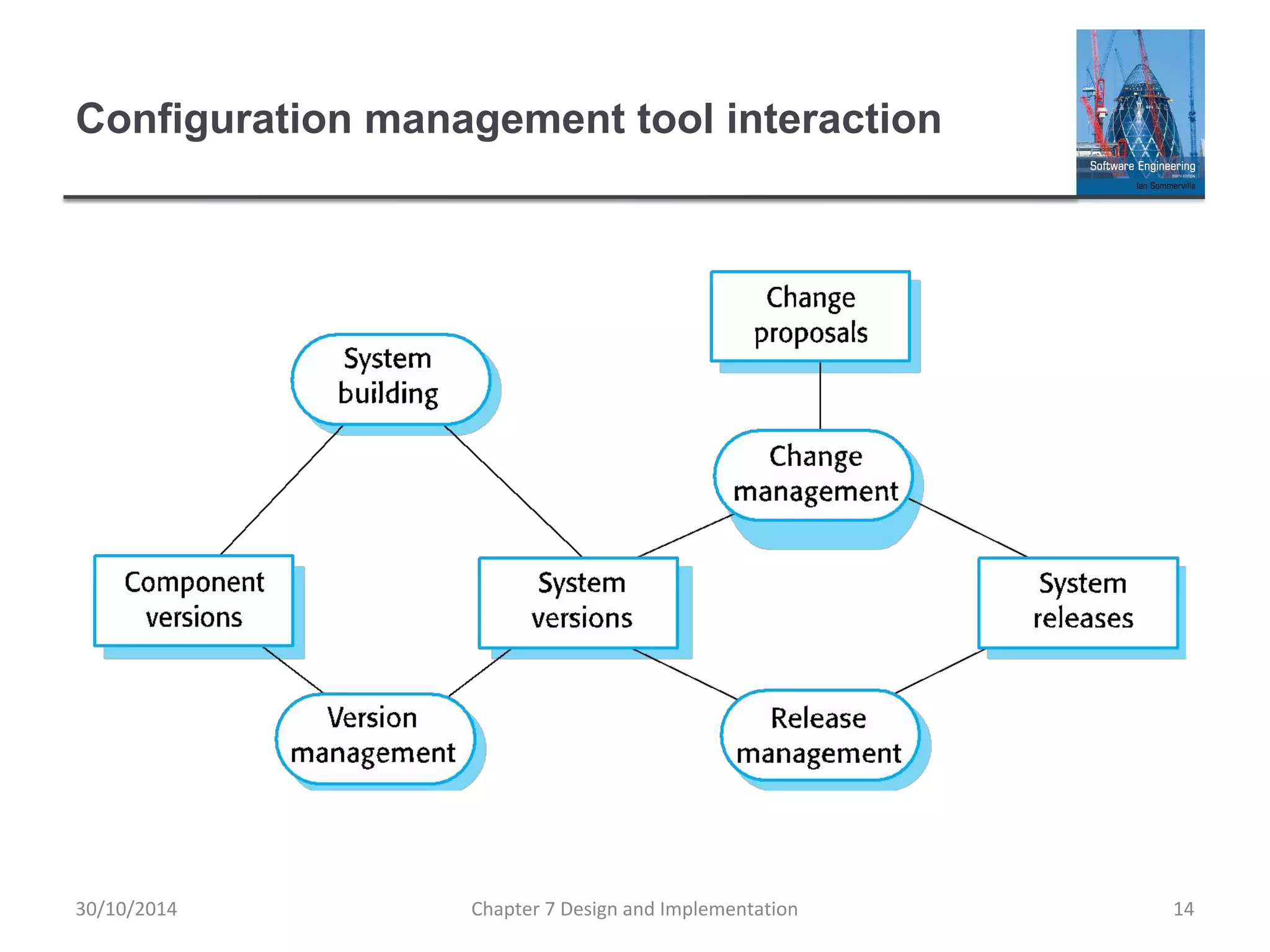
Configuration management activities
✧ Version management, where support is provided to keep track
of the different versions of software components. Version
management systems include facilities to coordinate
development by several programmers.
✧ System integration, where support is provided to help
developers define what versions of components are used to
create each version of a system. This description is then used
to build a system automatically by compiling and linking the
required components.
✧ Problem tracking, where support is provided to allow users to
report bugs and other problems, and to allow all developers to
see who is working on these problems and when they are
fixed.
Chapter 7 Design and Implementation 13
30/10/2014
Configuration management tool interaction
Chapter 7 Design and Implementation 14
30/10/2014
Host-target development
✧ Most software is developed on one computer (the host),
but runs on a separate machine (the target).
✧ More generally, we can talk about a development
platform and an execution platform.
▪ A platform is more than just hardware.
▪ It includes the installed operating system plus other supporting
software such as a database management system or, for
development platforms, an interactive development environment.
✧ Development platform usually has different installed
software than execution platform; these platforms may
have different architectures.
Chapter 7 Design and Implementation 15
30/10/2014
Host-target development
Chapter 7 Design and Implementation 16
30/10/2014
Development platform tools
✧ An integrated compiler and syntax-directed editing
system that allows you to create, edit and compile code.
✧ A language debugging system.
✧ Graphical editing tools, such as tools to edit UML
models.
✧ Testing tools, such as Junit that can automatically run a
set of tests on a new version of a program.
✧ Project support tools that help you organize the code for
different development projects.
Chapter 7 Design and Implementation 17
30/10/2014
Integrated development environments (IDEs)
✧ Software development tools are often grouped to create
an integrated development environment (IDE).
✧ An IDE is a set of software tools that supports different
aspects of software development, within some common
framework and user interface.
✧ IDEs are created to support development in a specific
programming language such as Java. The language IDE
may be developed specially, or may be an instantiation
of a general-purpose IDE, with specific language-support
tools.
Chapter 7 Design and Implementation 18
30/10/2014
Component/system deployment factors
✧ If a component is designed for a specific hardware architecture, or
relies on some other software system, it must obviously be deployed
on a platform that provides the required hardware and software
support.
✧ High availability systems may require components to be deployed
on more than one platform. This means that, in the event of platform
failure, an alternative implementation of the component is available.
✧ If there is a high level of communications traffic between
components, it usually makes sense to deploy them on the same
platform or on platforms that are physically close to one other. This
reduces the delay between the time a message is sent by one
component and received by another.
Chapter 7 Design and Implementation 19
30/10/2014
Open source development
Chapter 7 Design and Implementation 20
30/10/2014
Open source development
✧ Open source development is an approach to software
development in which the source code of a software
system is published and volunteers are invited to
participate in the development process
✧ Its roots are in the Free Software Foundation
(www.fsf.org), which advocates that source code should
not be proprietary but rather should always be available
for users to examine and modify as they wish.
✧ Open source software extended this idea by using the
Internet to recruit a much larger population of volunteer
developers. Many of them are also users of the code.
Chapter 7 Design and Implementation 21
30/10/2014
Open source systems
✧ The best-known open source product is, of course, the
Linux operating system which is widely used as a server
system and, increasingly, as a desktop environment.
✧ Other important open source products are Java, the
Apache web server and the mySQL database
management system.
Chapter 7 Design and Implementation 22
30/10/2014
Open source issues
✧ Should the product that is being developed make use of
open source components?
✧ Should an open source approach be used for the
software’s development?
Chapter 7 Design and Implementation 23
30/10/2014
Open source business
✧ More and more product companies are using an open
source approach to development.
✧ Their business model is not reliant on selling a software
product but on selling support for that product.
✧ They believe that involving the open source community
will allow software to be developed more cheaply, more
quickly and will create a community of users for the
software.
Chapter 7 Design and Implementation 24
30/10/2014
Open source licensing
✧ A fundamental principle of open-source development is
that source code should be freely available, this does not
mean that anyone can do as they wish with that code.
▪ Legally, the developer of the code (either a company or an
individual) still owns the code. They can place restrictions on
how it is used by including legally binding conditions in an open
source software license.
▪ Some open source developers believe that if an open source
component is used to develop a new system, then that system
should also be open source.
▪ Others are willing to allow their code to be used without this
restriction. The developed systems may be proprietary and sold
as closed source systems.
Chapter 7 Design and Implementation 25
30/10/2014
License management
✧ Establish a system for maintaining information about
open-source components that are downloaded and used.
✧ Be aware of the different types of licenses and
understand how a component is licensed before it is
used.
✧ Be aware of evolution pathways for components.
✧ Educate people about open source.
✧ Have auditing systems in place.
✧ Participate in the open source community.
Chapter 7 Design and Implementation 26
30/10/2014
Key points
✧ Software design and implementation are inter-leaved activities. The
level of detail in the design depends on the type of system and
whether you are using a plan-driven or agile approach.
✧ The process of object-oriented design includes activities to design
the system architecture, identify objects in the system, describe the
design using different object models and document the component
interfaces.
✧ A range of different models may be produced during an
object-oriented design process. These include static models (class
models, generalization models, association models) and dynamic
models (sequence models, state machine models).
✧ Component interfaces must be defined precisely so that other
objects can use them. A UML interface stereotype may be used to
define interfaces.
Chapter 7 Design and Implementation 27
30/10/2014
Key points
✧ When developing software, you should always consider the
possibility of reusing existing software, either as components,
services or complete systems.
✧ Configuration management is the process of managing changes to
an evolving software system. It is essential when a team of people
are cooperating to develop software.
✧ Most software development is host-target development. You use an
IDE on a host machine to develop the software, which is transferred
to a target machine for execution.
✧ Open source development involves making the source code of a
system publicly available. This means that many people can
propose changes and improvements to the software.
Chapter 7 Design and Implementation 28
30/10/2014

Ch7.pdf

  • 1.
    Chapter 7 –Design and Implementation Chapter 7 Design and Implementation 1 30/10/2014
  • 2.
    Topics covered ✧ Designand implementation ✧ Implementation issues ✧ Open source development Chapter 7 Design and Implementation 2 30/10/2014
  • 3.
    Design and implementation ✧Software design and implementation is the stage in the software engineering process at which an executable software system is developed. ✧ Software design and implementation activities are invariably inter-leaved. ▪ Software design is a creative activity in which you identify software components and their relationships, based on a customer’s requirements. ▪ Implementation is the process of realizing the design as a program. Chapter 7 Design and Implementation 3 30/10/2014
  • 4.
    Design models ✧ Designmodels show the objects and object classes and relationships between these entities. ✧ There are two kinds of design model: ▪ Structural models describe the static structure of the system in terms of object classes and relationships. ▪ Dynamic models describe the dynamic interactions between objects. Chapter 7 Design and Implementation 4 30/10/2014
  • 5.
    Build or buy ✧In a wide range of domains, it is now possible to buy off-the-shelf systems (COTS) that can be adapted and tailored to the users’ requirements. ▪ For example, if you want to implement a medical records system, you can buy a package that is already used in hospitals. It can be cheaper and faster to use this approach rather than developing a system in a conventional programming language. ✧ When you develop an application in this way, the design process becomes concerned with how to use the configuration features of that system to deliver the system requirements. Chapter 7 Design and Implementation 5 30/10/2014
  • 6.
    Implementation issues Chapter 7Design and Implementation 6 30/10/2014
  • 7.
    Implementation issues ✧ Focushere is not on programming, although this is obviously important, but on other implementation issues that are often not covered in programming texts: ▪ Reuse Most modern software is constructed by reusing existing components or systems. When you are developing software, you should make as much use as possible of existing code. ▪ Configuration management During the development process, you have to keep track of the many different versions of each software component in a configuration management system. ▪ Host-target development Production software does not usually execute on the same computer as the software development environment. Rather, you develop it on one computer (the host system) and execute it on a separate computer (the target system). Chapter 7 Design and Implementation 7 30/10/2014
  • 8.
    Reuse ✧ From the1960s to the 1990s, most new software was developed from scratch, by writing all code in a high-level programming language. ▪ The only significant reuse or software was the reuse of functions and objects in programming language libraries. ✧ Costs and schedule pressure mean that this approach became increasingly unviable, especially for commercial and Internet-based systems. ✧ An approach to development based around the reuse of existing software emerged and is now generally used for business and scientific software. Chapter 7 Design and Implementation 8 30/10/2014
  • 9.
    Reuse levels ✧ Theabstraction level ▪ At this level, you don’t reuse software directly but use knowledge of successful abstractions in the design of your software. ✧ The object level ▪ At this level, you directly reuse objects from a library rather than writing the code yourself. ✧ The component level ▪ Components are collections of objects and object classes that you reuse in application systems. ✧ The system level ▪ At this level, you reuse entire application systems. Chapter 7 Design and Implementation 9 30/10/2014
  • 10.
    Software reuse Chapter 7Design and Implementation 10 30/10/2014
  • 11.
    Reuse costs ✧ Thecosts of the time spent in looking for software to reuse and assessing whether or not it meets your needs. ✧ Where applicable, the costs of buying the reusable software. For large off-the-shelf systems, these costs can be very high. ✧ The costs of adapting and configuring the reusable software components or systems to reflect the requirements of the system that you are developing. ✧ The costs of integrating reusable software elements with each other (if you are using software from different sources) and with the new code that you have developed. Chapter 7 Design and Implementation 11 30/10/2014
  • 12.
    Configuration management ✧ Configurationmanagement is the name given to the general process of managing a changing software system. ✧ The aim of configuration management is to support the system integration process so that all developers can access the project code and documents in a controlled way, find out what changes have been made, and compile and link components to create a system. ✧ See also Chapter 25. Chapter 7 Design and Implementation 12 30/10/2014
  • 13.
    Configuration management activities ✧Version management, where support is provided to keep track of the different versions of software components. Version management systems include facilities to coordinate development by several programmers. ✧ System integration, where support is provided to help developers define what versions of components are used to create each version of a system. This description is then used to build a system automatically by compiling and linking the required components. ✧ Problem tracking, where support is provided to allow users to report bugs and other problems, and to allow all developers to see who is working on these problems and when they are fixed. Chapter 7 Design and Implementation 13 30/10/2014
  • 14.
    Configuration management toolinteraction Chapter 7 Design and Implementation 14 30/10/2014
  • 15.
    Host-target development ✧ Mostsoftware is developed on one computer (the host), but runs on a separate machine (the target). ✧ More generally, we can talk about a development platform and an execution platform. ▪ A platform is more than just hardware. ▪ It includes the installed operating system plus other supporting software such as a database management system or, for development platforms, an interactive development environment. ✧ Development platform usually has different installed software than execution platform; these platforms may have different architectures. Chapter 7 Design and Implementation 15 30/10/2014
  • 16.
    Host-target development Chapter 7Design and Implementation 16 30/10/2014
  • 17.
    Development platform tools ✧An integrated compiler and syntax-directed editing system that allows you to create, edit and compile code. ✧ A language debugging system. ✧ Graphical editing tools, such as tools to edit UML models. ✧ Testing tools, such as Junit that can automatically run a set of tests on a new version of a program. ✧ Project support tools that help you organize the code for different development projects. Chapter 7 Design and Implementation 17 30/10/2014
  • 18.
    Integrated development environments(IDEs) ✧ Software development tools are often grouped to create an integrated development environment (IDE). ✧ An IDE is a set of software tools that supports different aspects of software development, within some common framework and user interface. ✧ IDEs are created to support development in a specific programming language such as Java. The language IDE may be developed specially, or may be an instantiation of a general-purpose IDE, with specific language-support tools. Chapter 7 Design and Implementation 18 30/10/2014
  • 19.
    Component/system deployment factors ✧If a component is designed for a specific hardware architecture, or relies on some other software system, it must obviously be deployed on a platform that provides the required hardware and software support. ✧ High availability systems may require components to be deployed on more than one platform. This means that, in the event of platform failure, an alternative implementation of the component is available. ✧ If there is a high level of communications traffic between components, it usually makes sense to deploy them on the same platform or on platforms that are physically close to one other. This reduces the delay between the time a message is sent by one component and received by another. Chapter 7 Design and Implementation 19 30/10/2014
  • 20.
    Open source development Chapter7 Design and Implementation 20 30/10/2014
  • 21.
    Open source development ✧Open source development is an approach to software development in which the source code of a software system is published and volunteers are invited to participate in the development process ✧ Its roots are in the Free Software Foundation (www.fsf.org), which advocates that source code should not be proprietary but rather should always be available for users to examine and modify as they wish. ✧ Open source software extended this idea by using the Internet to recruit a much larger population of volunteer developers. Many of them are also users of the code. Chapter 7 Design and Implementation 21 30/10/2014
  • 22.
    Open source systems ✧The best-known open source product is, of course, the Linux operating system which is widely used as a server system and, increasingly, as a desktop environment. ✧ Other important open source products are Java, the Apache web server and the mySQL database management system. Chapter 7 Design and Implementation 22 30/10/2014
  • 23.
    Open source issues ✧Should the product that is being developed make use of open source components? ✧ Should an open source approach be used for the software’s development? Chapter 7 Design and Implementation 23 30/10/2014
  • 24.
    Open source business ✧More and more product companies are using an open source approach to development. ✧ Their business model is not reliant on selling a software product but on selling support for that product. ✧ They believe that involving the open source community will allow software to be developed more cheaply, more quickly and will create a community of users for the software. Chapter 7 Design and Implementation 24 30/10/2014
  • 25.
    Open source licensing ✧A fundamental principle of open-source development is that source code should be freely available, this does not mean that anyone can do as they wish with that code. ▪ Legally, the developer of the code (either a company or an individual) still owns the code. They can place restrictions on how it is used by including legally binding conditions in an open source software license. ▪ Some open source developers believe that if an open source component is used to develop a new system, then that system should also be open source. ▪ Others are willing to allow their code to be used without this restriction. The developed systems may be proprietary and sold as closed source systems. Chapter 7 Design and Implementation 25 30/10/2014
  • 26.
    License management ✧ Establisha system for maintaining information about open-source components that are downloaded and used. ✧ Be aware of the different types of licenses and understand how a component is licensed before it is used. ✧ Be aware of evolution pathways for components. ✧ Educate people about open source. ✧ Have auditing systems in place. ✧ Participate in the open source community. Chapter 7 Design and Implementation 26 30/10/2014
  • 27.
    Key points ✧ Softwaredesign and implementation are inter-leaved activities. The level of detail in the design depends on the type of system and whether you are using a plan-driven or agile approach. ✧ The process of object-oriented design includes activities to design the system architecture, identify objects in the system, describe the design using different object models and document the component interfaces. ✧ A range of different models may be produced during an object-oriented design process. These include static models (class models, generalization models, association models) and dynamic models (sequence models, state machine models). ✧ Component interfaces must be defined precisely so that other objects can use them. A UML interface stereotype may be used to define interfaces. Chapter 7 Design and Implementation 27 30/10/2014
  • 28.
    Key points ✧ Whendeveloping software, you should always consider the possibility of reusing existing software, either as components, services or complete systems. ✧ Configuration management is the process of managing changes to an evolving software system. It is essential when a team of people are cooperating to develop software. ✧ Most software development is host-target development. You use an IDE on a host machine to develop the software, which is transferred to a target machine for execution. ✧ Open source development involves making the source code of a system publicly available. This means that many people can propose changes and improvements to the software. Chapter 7 Design and Implementation 28 30/10/2014