Software Reuse
1
Chapter 16 Software reuse (summerville 9th
edition)
Topics covered
 The reuse landscape
 Application frameworks
 Software product lines
 COTS product reuse
Chapter 16 Software reuse 2
Software reuse
Reuse-based software engineering
 Application system reuse
 The whole of an application system may be reused either by
incorporating it without change into other systems (COTS reuse)
or by developing application families.
 Component reuse
 Components of an application from sub-systems to single objects
may be reused. Covered in Chapter 17.
 Object and function reuse
 Software components that implement a single well-defined object
or function may be reused.
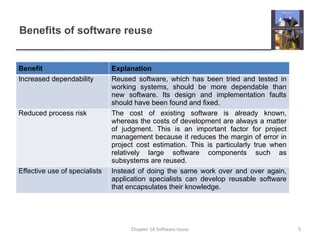
Benefits of software reuse
Benefit Explanation
Increased dependability Reused software, which has been tried and tested in
working systems, should be more dependable than
new software. Its design and implementation faults
should have been found and fixed.
Reduced process risk The cost of existing software is already known,
whereas the costs of development are always a matter
of judgment. This is an important factor for project
management because it reduces the margin of error in
project cost estimation. This is particularly true when
relatively large software components such as
subsystems are reused.
Effective use of specialists Instead of doing the same work over and over again,
application specialists can develop reusable software
that encapsulates their knowledge.
5
Chapter 16 Software reuse
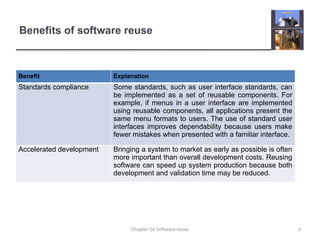
Benefits of software reuse
Benefit Explanation
Standards compliance Some standards, such as user interface standards, can
be implemented as a set of reusable components. For
example, if menus in a user interface are implemented
using reusable components, all applications present the
same menu formats to users. The use of standard user
interfaces improves dependability because users make
fewer mistakes when presented with a familiar interface.
Accelerated development Bringing a system to market as early as possible is often
more important than overall development costs. Reusing
software can speed up system production because both
development and validation time may be reduced.
6
Chapter 16 Software reuse
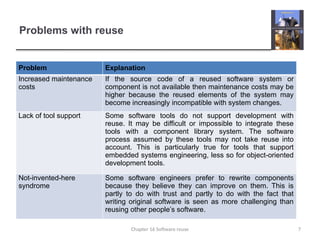
Problems with reuse
Problem Explanation
Increased maintenance
costs
If the source code of a reused software system or
component is not available then maintenance costs may be
higher because the reused elements of the system may
become increasingly incompatible with system changes.
Lack of tool support Some software tools do not support development with
reuse. It may be difficult or impossible to integrate these
tools with a component library system. The software
process assumed by these tools may not take reuse into
account. This is particularly true for tools that support
embedded systems engineering, less so for object-oriented
development tools.
Not-invented-here
syndrome
Some software engineers prefer to rewrite components
because they believe they can improve on them. This is
partly to do with trust and partly to do with the fact that
writing original software is seen as more challenging than
reusing other people’s software.
7
Chapter 16 Software reuse
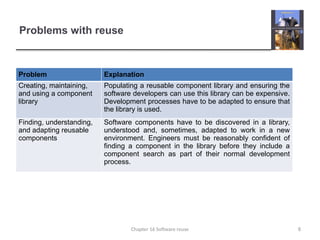
Problems with reuse
Problem Explanation
Creating, maintaining,
and using a component
library
Populating a reusable component library and ensuring the
software developers can use this library can be expensive.
Development processes have to be adapted to ensure that
the library is used.
Finding, understanding,
and adapting reusable
components
Software components have to be discovered in a library,
understood and, sometimes, adapted to work in a new
environment. Engineers must be reasonably confident of
finding a component in the library before they include a
component search as part of their normal development
process.
8
Chapter 16 Software reuse
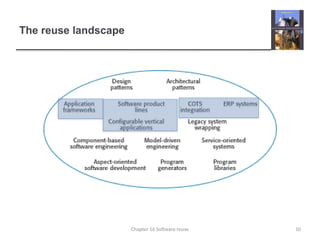
The reuse landscape
The reuse landscape
10
Chapter 16 Software reuse
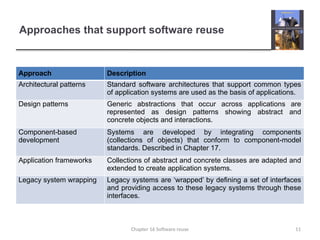
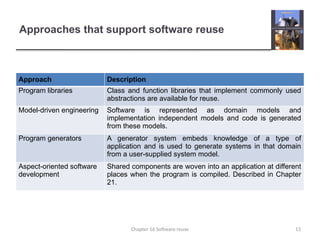
Approaches that support software reuse
Approach Description
Architectural patterns Standard software architectures that support common types
of application systems are used as the basis of applications.
Design patterns Generic abstractions that occur across applications are
represented as design patterns showing abstract and
concrete objects and interactions.
Component-based
development
Systems are developed by integrating components
(collections of objects) that conform to component-model
standards. Described in Chapter 17.
Application frameworks Collections of abstract and concrete classes are adapted and
extended to create application systems.
Legacy system wrapping Legacy systems are ‘wrapped’ by defining a set of interfaces
and providing access to these legacy systems through these
interfaces.
11
Chapter 16 Software reuse
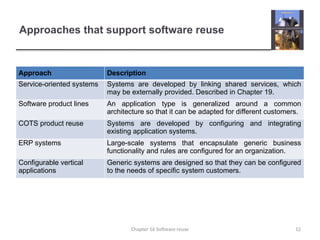
Approaches that support software reuse
Approach Description
Service-oriented systems Systems are developed by linking shared services, which
may be externally provided. Described in Chapter 19.
Software product lines An application type is generalized around a common
architecture so that it can be adapted for different customers.
COTS product reuse Systems are developed by configuring and integrating
existing application systems.
ERP systems Large-scale systems that encapsulate generic business
functionality and rules are configured for an organization.
Configurable vertical
applications
Generic systems are designed so that they can be configured
to the needs of specific system customers.
12
Chapter 16 Software reuse
Approaches that support software reuse
Approach Description
Program libraries Class and function libraries that implement commonly used
abstractions are available for reuse.
Model-driven engineering Software is represented as domain models and
implementation independent models and code is generated
from these models.
Program generators A generator system embeds knowledge of a type of
application and is used to generate systems in that domain
from a user-supplied system model.
Aspect-oriented software
development
Shared components are woven into an application at different
places when the program is compiled. Described in Chapter
21.
13
Chapter 16 Software reuse
Reuse planning factors
Application frameworks
Framework classes
Web application frameworks
 Support the construction of dynamic websites as a front-
end for web applications.
 WAFs are now available for all of the commonly used
web programming languages e.g. Java, Python, Ruby,
etc.
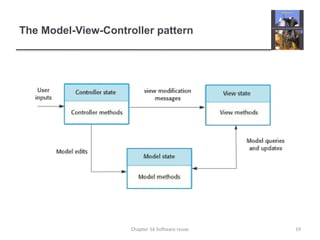
 Interaction model is based on the Model-View-Controller
composite pattern.
Chapter 16 Software reuse 17
Model-view controller
The Model-View-Controller pattern
19
Chapter 16 Software reuse
WAF features
 Security
 WAFs may include classes to help implement user authentication (login) and
access.
 Dynamic web pages
 Classes are provided to help you define web page templates and to populate
these dynamically from the system database.
 Database support
 The framework may provide classes that provide an abstract interface to different
databases.
 Session management
 Classes to create and manage sessions (a number of interactions with the
system by a user) are usually part of a WAF.
 User interaction
 Most web frameworks now provide AJAX support (Holdener, 2008), which allows
more interactive web pages to be created.
Chapter 16 Software reuse 20
Key points
 Most new business software systems are now developed by reusing
knowledge and code from previously implemented systems.
 There are many different ways to reuse software. These range from
the reuse of classes and methods in libraries to the reuse of
complete application systems.
 The advantages of software reuse are lower costs, faster software
development and lower risks. System dependability is increased.
Specialists can be used more effectively by concentrating their
expertise on the design of reusable components.
 Application frameworks are collections of concrete and abstract
objects that are designed for reuse through specialization and the
addition of new objects. They usually incorporate good design
practice through design patterns.
Chapter 16 Software reuse 21
Software product lines
Application frameworks and product lines
 Application frameworks rely on object-oriented features
such as polymorphism to implement extensions. Product
lines need not be object-oriented (e.g. embedded
software for a mobile phone)
 Application frameworks focus on providing technical
rather than domain-specific support. Product lines
embed domain and platform information.
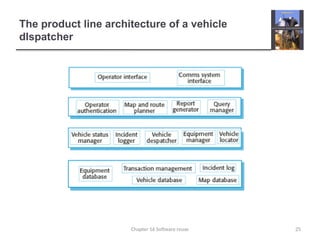
 Product lines often control applications for equipment.
 Software product lines are made up of a family of
applications, usually owned by the same organization.
Chapter 16 Software reuse 23
Product line specialisation
The product line architecture of a vehicle
dIspatcher
25
Chapter 16 Software reuse
Vehicle dispatching
Product line configuration
COTS product reuse
 A commercial-off-the-shelf (COTS) product is a software
system that can be adapted for different customers
without changing the source code of the system.
 COTS systems have generic features and so can be
used/reused in different environments.
 COTS products are adapted by using built-in
configuration mechanisms that allow the functionality of
the system to be tailored to specific customer needs.
 For example, in a hospital patient record system, separate input
forms and output reports might be defined for different types of
patient.
Chapter 16 Software reuse 28
Benefits of COTS reuse
 As with other types of reuse, more rapid deployment of a reliable
system may be possible.
 It is possible to see what functionality is provided by the applications
and so it is easier to judge whether or not they are likely to be
suitable.
 Some development risks are avoided by using existing software.
However, this approach has its own risks, as I discuss below.
 Businesses can focus on their core activity without having to devote
a lot of resources to IT systems development.
 As operating platforms evolve, technology updates may be
simplified as these are the responsibility of the COTS product
vendor rather than the customer.
Chapter 16 Software reuse 29
Problems of COTS reuse
 Requirements usually have to be adapted to reflect the
functionality and mode of operation of the COTS product.
 The COTS product may be based on assumptions that are
practically impossible to change.
 Choosing the right COTS system for an enterprise can be a
difficult process, especially as many COTS products are not
well documented.
 There may be a lack of local expertise to support systems
development.
 The COTS product vendor controls system support and
evolution.
Chapter 16 Software reuse 30
ERP systems
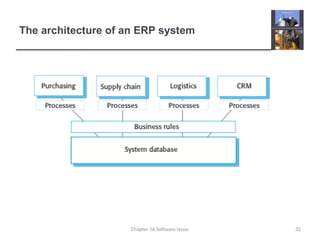
The architecture of an ERP system
32
Chapter 16 Software reuse
ERP architecture
 A number of modules to support different business
functions.
 A defined set of business processes, associated with
each module, which relate to activities in that module.
 A common database that maintains information about all
related business functions.
 A set of business rules that apply to all data in the
database.
Chapter 16 Software reuse 33
ERP configuration
 Selecting the required functionality from the system.
 Establishing a data model that defines how the organization’s
data will be structured in the system database.
 Defining business rules that apply to that data.
 Defining the expected interactions with external systems.
 Designing the input forms and the output reports generated by
the system.
 Designing new business processes that conform to the
underlying process model supported by the system.
 Setting parameters that define how the system is deployed on
its underlying platform.
Chapter 16 Software reuse 34
COTS integrated systems
 COTS-integrated systems are applications that include
two or more COTS products and/or legacy application
systems.
 You may use this approach when there is no single
COTS system that meets all of your needs or when you
wish to integrate a new COTS product with systems that
you already use.
Chapter 16 Software reuse 35
Design choices
 Which COTS products offer the most appropriate
functionality?
 Typically, there will be several COTS products available, which
can be combined in different ways.
 How will data be exchanged?
 Different products normally use unique data structures and
formats. You have to write adaptors that convert from one
representation to another.
 What features of a product will actually be used?
 COTS products may include more functionality than you need
and functionality may be duplicated across different products.
Chapter 16 Software reuse 36
Key points
 Software product lines are related applications that are developed from a
common base. This generic system is adapted to meet specific
requirements for functionality, target platform or operational configuration.
 COTS product reuse is concerned with the reuse of large-scale, off-the-shelf
systems. These provide a lot of functionality and their reuse can radically
reduce costs and development time. Systems may be developed by
configuring a single, generic COTS product or by integrating two or more
COTS products.
 Enterprise Resource Planning systems are examples of large-scale COTS
reuse. You create an instance of an ERP system by configuring a generic
system with information about the customer’s business processes and
rules.
 Potential problems with COTS-based reuse include lack of control over
functionality and performance, lack of control over system evolution, the
need for support from external vendors and difficulties in ensuring that
systems can inter-operate.
Chapter 16 Software reuse 37

for Software engineering students Lecture(15-16)Software-Reuse (1).pptx

  • 1.
    Software Reuse 1 Chapter 16Software reuse (summerville 9th edition)
  • 2.
    Topics covered  Thereuse landscape  Application frameworks  Software product lines  COTS product reuse Chapter 16 Software reuse 2
  • 3.
  • 4.
    Reuse-based software engineering Application system reuse  The whole of an application system may be reused either by incorporating it without change into other systems (COTS reuse) or by developing application families.  Component reuse  Components of an application from sub-systems to single objects may be reused. Covered in Chapter 17.  Object and function reuse  Software components that implement a single well-defined object or function may be reused.
  • 5.
    Benefits of softwarereuse Benefit Explanation Increased dependability Reused software, which has been tried and tested in working systems, should be more dependable than new software. Its design and implementation faults should have been found and fixed. Reduced process risk The cost of existing software is already known, whereas the costs of development are always a matter of judgment. This is an important factor for project management because it reduces the margin of error in project cost estimation. This is particularly true when relatively large software components such as subsystems are reused. Effective use of specialists Instead of doing the same work over and over again, application specialists can develop reusable software that encapsulates their knowledge. 5 Chapter 16 Software reuse
  • 6.
    Benefits of softwarereuse Benefit Explanation Standards compliance Some standards, such as user interface standards, can be implemented as a set of reusable components. For example, if menus in a user interface are implemented using reusable components, all applications present the same menu formats to users. The use of standard user interfaces improves dependability because users make fewer mistakes when presented with a familiar interface. Accelerated development Bringing a system to market as early as possible is often more important than overall development costs. Reusing software can speed up system production because both development and validation time may be reduced. 6 Chapter 16 Software reuse
  • 7.
    Problems with reuse ProblemExplanation Increased maintenance costs If the source code of a reused software system or component is not available then maintenance costs may be higher because the reused elements of the system may become increasingly incompatible with system changes. Lack of tool support Some software tools do not support development with reuse. It may be difficult or impossible to integrate these tools with a component library system. The software process assumed by these tools may not take reuse into account. This is particularly true for tools that support embedded systems engineering, less so for object-oriented development tools. Not-invented-here syndrome Some software engineers prefer to rewrite components because they believe they can improve on them. This is partly to do with trust and partly to do with the fact that writing original software is seen as more challenging than reusing other people’s software. 7 Chapter 16 Software reuse
  • 8.
    Problems with reuse ProblemExplanation Creating, maintaining, and using a component library Populating a reusable component library and ensuring the software developers can use this library can be expensive. Development processes have to be adapted to ensure that the library is used. Finding, understanding, and adapting reusable components Software components have to be discovered in a library, understood and, sometimes, adapted to work in a new environment. Engineers must be reasonably confident of finding a component in the library before they include a component search as part of their normal development process. 8 Chapter 16 Software reuse
  • 9.
  • 10.
  • 11.
    Approaches that supportsoftware reuse Approach Description Architectural patterns Standard software architectures that support common types of application systems are used as the basis of applications. Design patterns Generic abstractions that occur across applications are represented as design patterns showing abstract and concrete objects and interactions. Component-based development Systems are developed by integrating components (collections of objects) that conform to component-model standards. Described in Chapter 17. Application frameworks Collections of abstract and concrete classes are adapted and extended to create application systems. Legacy system wrapping Legacy systems are ‘wrapped’ by defining a set of interfaces and providing access to these legacy systems through these interfaces. 11 Chapter 16 Software reuse
  • 12.
    Approaches that supportsoftware reuse Approach Description Service-oriented systems Systems are developed by linking shared services, which may be externally provided. Described in Chapter 19. Software product lines An application type is generalized around a common architecture so that it can be adapted for different customers. COTS product reuse Systems are developed by configuring and integrating existing application systems. ERP systems Large-scale systems that encapsulate generic business functionality and rules are configured for an organization. Configurable vertical applications Generic systems are designed so that they can be configured to the needs of specific system customers. 12 Chapter 16 Software reuse
  • 13.
    Approaches that supportsoftware reuse Approach Description Program libraries Class and function libraries that implement commonly used abstractions are available for reuse. Model-driven engineering Software is represented as domain models and implementation independent models and code is generated from these models. Program generators A generator system embeds knowledge of a type of application and is used to generate systems in that domain from a user-supplied system model. Aspect-oriented software development Shared components are woven into an application at different places when the program is compiled. Described in Chapter 21. 13 Chapter 16 Software reuse
  • 14.
  • 15.
  • 16.
  • 17.
    Web application frameworks Support the construction of dynamic websites as a front- end for web applications.  WAFs are now available for all of the commonly used web programming languages e.g. Java, Python, Ruby, etc.  Interaction model is based on the Model-View-Controller composite pattern. Chapter 16 Software reuse 17
  • 18.
  • 19.
  • 20.
    WAF features  Security WAFs may include classes to help implement user authentication (login) and access.  Dynamic web pages  Classes are provided to help you define web page templates and to populate these dynamically from the system database.  Database support  The framework may provide classes that provide an abstract interface to different databases.  Session management  Classes to create and manage sessions (a number of interactions with the system by a user) are usually part of a WAF.  User interaction  Most web frameworks now provide AJAX support (Holdener, 2008), which allows more interactive web pages to be created. Chapter 16 Software reuse 20
  • 21.
    Key points  Mostnew business software systems are now developed by reusing knowledge and code from previously implemented systems.  There are many different ways to reuse software. These range from the reuse of classes and methods in libraries to the reuse of complete application systems.  The advantages of software reuse are lower costs, faster software development and lower risks. System dependability is increased. Specialists can be used more effectively by concentrating their expertise on the design of reusable components.  Application frameworks are collections of concrete and abstract objects that are designed for reuse through specialization and the addition of new objects. They usually incorporate good design practice through design patterns. Chapter 16 Software reuse 21
  • 22.
  • 23.
    Application frameworks andproduct lines  Application frameworks rely on object-oriented features such as polymorphism to implement extensions. Product lines need not be object-oriented (e.g. embedded software for a mobile phone)  Application frameworks focus on providing technical rather than domain-specific support. Product lines embed domain and platform information.  Product lines often control applications for equipment.  Software product lines are made up of a family of applications, usually owned by the same organization. Chapter 16 Software reuse 23
  • 24.
  • 25.
    The product linearchitecture of a vehicle dIspatcher 25 Chapter 16 Software reuse
  • 26.
  • 27.
  • 28.
    COTS product reuse A commercial-off-the-shelf (COTS) product is a software system that can be adapted for different customers without changing the source code of the system.  COTS systems have generic features and so can be used/reused in different environments.  COTS products are adapted by using built-in configuration mechanisms that allow the functionality of the system to be tailored to specific customer needs.  For example, in a hospital patient record system, separate input forms and output reports might be defined for different types of patient. Chapter 16 Software reuse 28
  • 29.
    Benefits of COTSreuse  As with other types of reuse, more rapid deployment of a reliable system may be possible.  It is possible to see what functionality is provided by the applications and so it is easier to judge whether or not they are likely to be suitable.  Some development risks are avoided by using existing software. However, this approach has its own risks, as I discuss below.  Businesses can focus on their core activity without having to devote a lot of resources to IT systems development.  As operating platforms evolve, technology updates may be simplified as these are the responsibility of the COTS product vendor rather than the customer. Chapter 16 Software reuse 29
  • 30.
    Problems of COTSreuse  Requirements usually have to be adapted to reflect the functionality and mode of operation of the COTS product.  The COTS product may be based on assumptions that are practically impossible to change.  Choosing the right COTS system for an enterprise can be a difficult process, especially as many COTS products are not well documented.  There may be a lack of local expertise to support systems development.  The COTS product vendor controls system support and evolution. Chapter 16 Software reuse 30
  • 31.
  • 32.
    The architecture ofan ERP system 32 Chapter 16 Software reuse
  • 33.
    ERP architecture  Anumber of modules to support different business functions.  A defined set of business processes, associated with each module, which relate to activities in that module.  A common database that maintains information about all related business functions.  A set of business rules that apply to all data in the database. Chapter 16 Software reuse 33
  • 34.
    ERP configuration  Selectingthe required functionality from the system.  Establishing a data model that defines how the organization’s data will be structured in the system database.  Defining business rules that apply to that data.  Defining the expected interactions with external systems.  Designing the input forms and the output reports generated by the system.  Designing new business processes that conform to the underlying process model supported by the system.  Setting parameters that define how the system is deployed on its underlying platform. Chapter 16 Software reuse 34
  • 35.
    COTS integrated systems COTS-integrated systems are applications that include two or more COTS products and/or legacy application systems.  You may use this approach when there is no single COTS system that meets all of your needs or when you wish to integrate a new COTS product with systems that you already use. Chapter 16 Software reuse 35
  • 36.
    Design choices  WhichCOTS products offer the most appropriate functionality?  Typically, there will be several COTS products available, which can be combined in different ways.  How will data be exchanged?  Different products normally use unique data structures and formats. You have to write adaptors that convert from one representation to another.  What features of a product will actually be used?  COTS products may include more functionality than you need and functionality may be duplicated across different products. Chapter 16 Software reuse 36
  • 37.
    Key points  Softwareproduct lines are related applications that are developed from a common base. This generic system is adapted to meet specific requirements for functionality, target platform or operational configuration.  COTS product reuse is concerned with the reuse of large-scale, off-the-shelf systems. These provide a lot of functionality and their reuse can radically reduce costs and development time. Systems may be developed by configuring a single, generic COTS product or by integrating two or more COTS products.  Enterprise Resource Planning systems are examples of large-scale COTS reuse. You create an instance of an ERP system by configuring a generic system with information about the customer’s business processes and rules.  Potential problems with COTS-based reuse include lack of control over functionality and performance, lack of control over system evolution, the need for support from external vendors and difficulties in ensuring that systems can inter-operate. Chapter 16 Software reuse 37