Chapter 18 – Service-oriented Software Engineering
26/11/2014
Chapter 18 Service-oriented software
engineering
1
Topics covered
 Service-oriented architectures
 RESTful services
 Service engineering
 Service composition
26/11/2014
Chapter 18 Service-oriented software
engineering
2
Web services
 A web service is an instance of a more general notion of
a service:
“an act or performance offered by one party to another. Although
the process may be tied to a physical product, the performance
is essentially intangible and does not normally result in
ownership of any of the factors of production”.
 The essence of a service, therefore, is that the provision
of the service is independent of the application using the
service.
 Service providers can develop specialized services and
offer these to a range of service users from different
organizations.
26/11/2014
Chapter 18 Service-oriented software
engineering
3
Reusable services
 Services are reusable components that are independent
(no requires interface) and are loosely coupled.
 A web service is:
 A loosely coupled, reusable software component that
encapsulates discrete functionality, which may be distributed and
programmatically accessed. A web service is a service that is
accessed using standard Internet and XML-based protocols.
 Services are platform and implementation-language
independent
26/11/2014
Chapter 18 Service-oriented software
engineering
4
Benefits of service-oriented apprach
 Services can be offered by any service provider inside or
outside of an organisation so organizations can create
applications by integrating services from a range of
providers.
 The service provider makes information about the
service public so that any authorised user can use the
service.
 Applications can delay the binding of services until they
are deployed or until execution. This means that
applications can be reactive and adapt their operation to
cope with changes to their execution environment.
26/11/2014
Chapter 18 Service-oriented software
engineering
5
Benefits of a service-oriented approach
 Opportunistic construction of new services is possible. A
service provider may recognise new services that can be
created by linking existing services in innovative ways.
 Service users can pay for services according to their use
rather than their provision. Instead of buying a rarely-
used component, the application developers can use an
external service that will be paid for only when required.
 Applications can be made smaller, which is particularly
important for mobile devices with limited processing and
memory capabilities. Computationally-intensive
processing can be offloaded to external services.
26/11/2014
Chapter 18 Service-oriented software
engineering
6
Services scenario
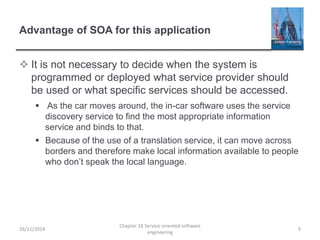
 An in-car information system provides drivers with
information on weather, road traffic conditions, local
information etc. This is linked to car audio system so that
information is delivered as a signal on a specific channel.
 The car is equipped with GPS receiver to discover its
position and, based on that position, the system
accesses a range of information services. Information
may be delivered in the driver’s specified language.
26/11/2014
Chapter 18 Service-oriented software
engineering
7
A service-based, in-car information system
26/11/2014
Chapter 18 Service-oriented software
engineering
8
Advantage of SOA for this application
 It is not necessary to decide when the system is
programmed or deployed what service provider should
be used or what specific services should be accessed.
 As the car moves around, the in-car software uses the service
discovery service to find the most appropriate information
service and binds to that.
 Because of the use of a translation service, it can move across
borders and therefore make local information available to people
who don’t speak the local language.
26/11/2014
Chapter 18 Service-oriented software
engineering
9
Service-oriented software engineering
 As significant a development as object-oriented
development.
 Building applications based on services allows
companies and other organizations to cooperate and
make use of each other’s business functions.
 Service-based applications may be constructed by
linking services from various providers using either a
standard programming language or a specialized
workflow language.
26/11/2014
Chapter 18 Service-oriented software
engineering
10
Service-oriented architecture
26/11/2014
Chapter 18 Service-oriented software
engineering
11
Service-oriented architectures
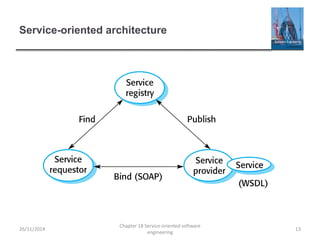
 A means of developing distributed systems where the
components are stand-alone services
 Services may execute on different computers from
different service providers
 Standard protocols have been developed to support
service communication and information exchange
26/11/2014
Chapter 18 Service-oriented software
engineering
12
Service-oriented architecture
26/11/2014
Chapter 18 Service-oriented software
engineering
13
Benefits of SOA
 Services can be provided locally or outsourced to
external providers
 Services are language-independent
 Investment in legacy systems can be preserved
 Inter-organisational computing is facilitated through
simplified information exchange
26/11/2014
Chapter 18 Service-oriented software
engineering
14
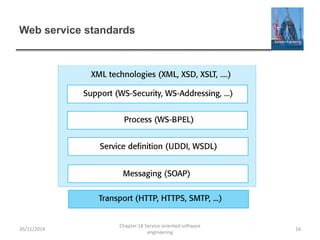
Key standards
 SOAP
 A message exchange standard that supports service
communication
 WSDL (Web Service Definition Language)
 This standard allows a service interface and its bindings to be
defined
 WS-BPEL
 A standard for workflow languages used to define service
composition
26/11/2014
Chapter 18 Service-oriented software
engineering
15
Web service standards
26/11/2014
Chapter 18 Service-oriented software
engineering
16
Service-oriented software engineering
 Existing approaches to software engineering have to
evolve to reflect the service-oriented approach to
software development
 Service engineering. The development of dependable, reusable
services
• Software development for reuse
 Software development with services. The development of
dependable software where services are the fundamental
components
• Software development with reuse
26/11/2014
Chapter 18 Service-oriented software
engineering
17
Services as reusable components
 A service can be defined as:
 A loosely-coupled, reusable software component that
encapsulates discrete functionality which may be distributed and
programmatically accessed. A web service is a service that is
accessed using standard Internet and XML-based protocols
 A critical distinction between a service and a component
as defined in CBSE is that services are independent
 Services do not have a ‘requires’ interface
 Services rely on message-based communication with messages
expressed in XML
26/11/2014
Chapter 18 Service-oriented software
engineering
18
Web service description language
 The service interface is defined in a service description
expressed in WSDL (Web Service Description
Language).
 The WSDL specification defines
 What operations the service supports and the format of the
messages that are sent and received by the service
 How the service is accessed - that is, the binding maps the
abstract interface onto a concrete set of protocols
 Where the service is located. This is usually expressed as a URI
(Universal Resource Identifier)
26/11/2014
Chapter 18 Service-oriented software
engineering
19
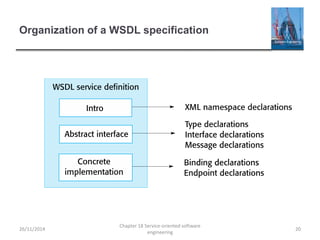
Organization of a WSDL specification
26/11/2014
Chapter 18 Service-oriented software
engineering
20
WSDL specification components
 The ‘what’ part of a WSDL document, called an interface,
specifies what operations the service supports, and
defines the format of the messages that are sent and
received by the service.
 The ‘how’ part of a WSDL document, called a binding,
maps the abstract interface to a concrete set of
protocols. The binding specifies the technical details of
how to communicate with a Web service.
 The ‘where’ part of a WSDL document describes the
location of a specific Web service implementation (its
endpoint).
26/11/2014
Chapter 18 Service-oriented software
engineering
21
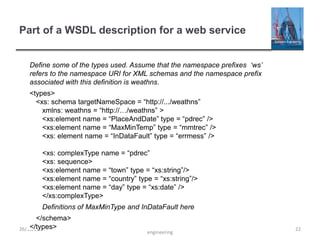
Part of a WSDL description for a web service
26/11/2014
Chapter 18 Service-oriented software
engineering
22
Define some of the types used. Assume that the namespace prefixes ‘ws’
refers to the namespace URI for XML schemas and the namespace prefix
associated with this definition is weathns.
<types>
<xs: schema targetNameSpace = “http://.../weathns”
xmlns: weathns = “http://…/weathns” >
<xs:element name = “PlaceAndDate” type = “pdrec” />
<xs:element name = “MaxMinTemp” type = “mmtrec” />
<xs: element name = “InDataFault” type = “errmess” />
<xs: complexType name = “pdrec”
<xs: sequence>
<xs:element name = “town” type = “xs:string”/>
<xs:element name = “country” type = “xs:string”/>
<xs:element name = “day” type = “xs:date” />
</xs:complexType>
Definitions of MaxMinType and InDataFault here
</schema>
</types>
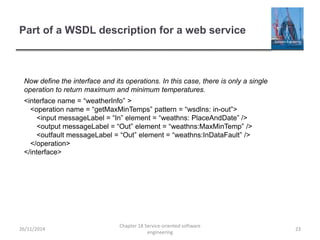
Part of a WSDL description for a web service
26/11/2014
Chapter 18 Service-oriented software
engineering
23
Now define the interface and its operations. In this case, there is only a single
operation to return maximum and minimum temperatures.
<interface name = “weatherInfo” >
<operation name = “getMaxMinTemps” pattern = “wsdlns: in-out”>
<input messageLabel = “In” element = “weathns: PlaceAndDate” />
<output messageLabel = “Out” element = “weathns:MaxMinTemp” />
<outfault messageLabel = “Out” element = “weathns:InDataFault” />
</operation>
</interface>
RESTful services
26/11/2014
Chapter 18 Service-oriented software
engineering
24
RESTful web services
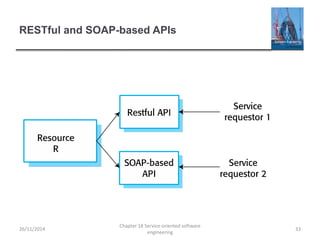
 Current web services standards have been criticized as
‘heavyweight’ standards that are over-general and inefficient.
 REST (REpresentational State Transfer) is an architectural
style based on transferring representations of resources from
a server to a client.
 This style underlies the web as a whole and is simpler than
SOAP/WSDL for implementing web services.
 RESTful services involve a lower overhead than so-called ‘big
web services’ and are used by many organizations
implementing service-based systems.
26/11/2014
Chapter 18 Service-oriented software
engineering
25
Resources
 The fundamental element in a RESTful architecture is a
resource.
 Essentially, a resource is simply a data element such as
a catalog, a medical record, or a document, such as this
book chapter.
 In general, resources may have multiple representations
i.e. they can exist in different formats.
 MS WORD
 PDF
 Quark XPress
26/11/2014
Chapter 18 Service-oriented software
engineering
26
Resource operations
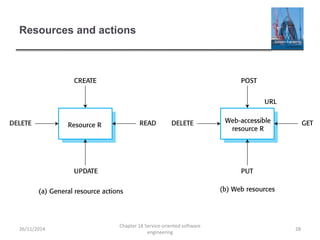
 Create – bring the resource into existence.
 Read – return a representation of the resource.
 Update – change the value of the resource.
 Delete – make the resource inaccessible.
26/11/2014
Chapter 18 Service-oriented software
engineering
27
Resources and actions
26/11/2014
Chapter 18 Service-oriented software
engineering
28
Operation functionality
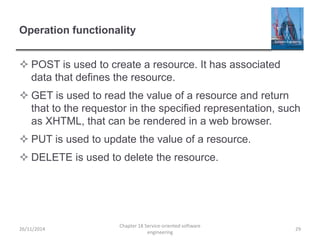
 POST is used to create a resource. It has associated
data that defines the resource.
 GET is used to read the value of a resource and return
that to the requestor in the specified representation, such
as XHTML, that can be rendered in a web browser.
 PUT is used to update the value of a resource.
 DELETE is used to delete the resource.
26/11/2014
Chapter 18 Service-oriented software
engineering
29
Resource access
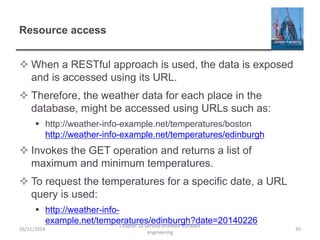
 When a RESTful approach is used, the data is exposed
and is accessed using its URL.
 Therefore, the weather data for each place in the
database, might be accessed using URLs such as:
 http://weather-info-example.net/temperatures/boston
http://weather-info-example.net/temperatures/edinburgh
 Invokes the GET operation and returns a list of
maximum and minimum temperatures.
 To request the temperatures for a specific date, a URL
query is used:
 http://weather-info-
example.net/temperatures/edinburgh?date=20140226
26/11/2014
Chapter 18 Service-oriented software
engineering
30
Query results
 The response to a GET request in a RESTful service
may include URLs.
 If the response to a request is a set of resources, then
the URL of each of these may be included.
 http://weather-info-example.net/temperatures/edinburgh-scotland
http://weather-info-example.net/temperatures/edinburgh-
australia
http://weather-info-example.net/temperatures/edinburgh-
maryland
26/11/2014
Chapter 18 Service-oriented software
engineering
31
Disadvantages of RESTful approach
 When a service has a complex interface and is not a
simple resource, it can be difficult to design a set of
RESTful services to represent this.
 There are no standards for RESTful interface description
so service users must rely on informal documentation to
understand the interface.
 When you use RESTful services, you have to implement
your own infrastructure for monitoring and managing the
quality of service and the service reliability.
26/11/2014
Chapter 18 Service-oriented software
engineering
32
RESTful and SOAP-based APIs
26/11/2014
Chapter 18 Service-oriented software
engineering
33
Service engineering
26/11/2014
Chapter 18 Service-oriented software
engineering
34
Service engineering
 The process of developing services for reuse in service-
oriented applications
 The service has to be designed as a reusable
abstraction that can be used in different systems.
 Generally useful functionality associated with that
abstraction must be designed and the service must be
robust and reliable.
 The service must be documented so that it can be
discovered and understood by potential users.
26/11/2014
Chapter 18 Service-oriented software
engineering
35
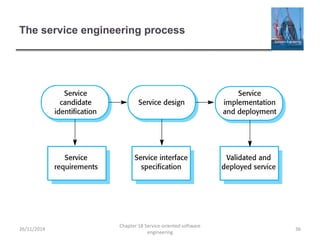
The service engineering process
26/11/2014
Chapter 18 Service-oriented software
engineering
36
Stages of service engineering
 Service candidate identification, where you identify
possible services that might be implemented and define
the service requirements.
 Service design, where you design the logical service
interface and its implementation interfaces (SOAP and/or
RESTful)
 Service implementation and deployment, where you
implement and test the service and make it available for
use.
26/11/2014
Chapter 18 Service-oriented software
engineering
37
Service candidate identification
 Services should support business processes.
 Service candidate identification involves understanding
an organization’s business processes to decide which
reusable services could support these processes.
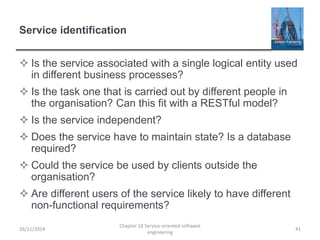
 Three fundamental types of service
 Utility services that implement general functionality used by
different business processes.
 Business services that are associated with a specific business
function e.g., in a university, student registration.
 Coordination services that support composite processes such as
ordering.
26/11/2014
Chapter 18 Service-oriented software
engineering
38
Task and entity-oriented services
 Task-oriented services are those associated with some
activity.
 Entity-oriented services are like objects. They are
associated with a business entity such as a job
application form.
 Utility or business services may be entity- or task-
oriented, coordination services are always task-oriented.
26/11/2014
Chapter 18 Service-oriented software
engineering
39
Service classification
Utility Business Coordination
Task Currency converter
Employee locator
Validate claim form
Check credit rating
Process expense
claim
Pay external supplier
Entity Document style
checker
Web form to XML
converter
Expenses form
Student application
form
26/11/2014
Chapter 18 Service-oriented software
engineering
40
Service identification
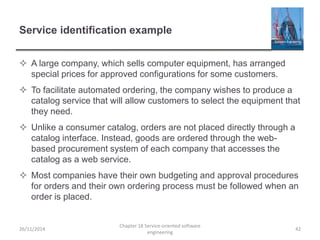
 Is the service associated with a single logical entity used
in different business processes?
 Is the task one that is carried out by different people in
the organisation? Can this fit with a RESTful model?
 Is the service independent?
 Does the service have to maintain state? Is a database
required?
 Could the service be used by clients outside the
organisation?
 Are different users of the service likely to have different
non-functional requirements?
26/11/2014
Chapter 18 Service-oriented software
engineering
41
Service identification example
 A large company, which sells computer equipment, has arranged
special prices for approved configurations for some customers.
 To facilitate automated ordering, the company wishes to produce a
catalog service that will allow customers to select the equipment that
they need.
 Unlike a consumer catalog, orders are not placed directly through a
catalog interface. Instead, goods are ordered through the web-
based procurement system of each company that accesses the
catalog as a web service.
 Most companies have their own budgeting and approval procedures
for orders and their own ordering process must be followed when an
order is placed.
26/11/2014
Chapter 18 Service-oriented software
engineering
42
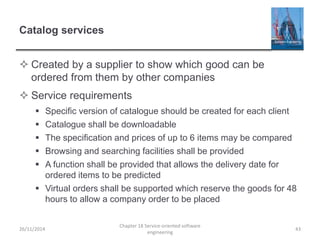
Catalog services
 Created by a supplier to show which good can be
ordered from them by other companies
 Service requirements
 Specific version of catalogue should be created for each client
 Catalogue shall be downloadable
 The specification and prices of up to 6 items may be compared
 Browsing and searching facilities shall be provided
 A function shall be provided that allows the delivery date for
ordered items to be predicted
 Virtual orders shall be supported which reserve the goods for 48
hours to allow a company order to be placed
26/11/2014
Chapter 18 Service-oriented software
engineering
43
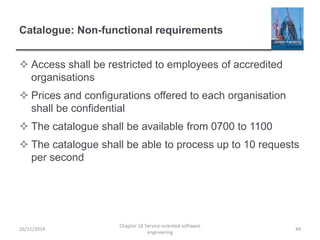
Catalogue: Non-functional requirements
 Access shall be restricted to employees of accredited
organisations
 Prices and configurations offered to each organisation
shall be confidential
 The catalogue shall be available from 0700 to 1100
 The catalogue shall be able to process up to 10 requests
per second
26/11/2014
Chapter 18 Service-oriented software
engineering
44
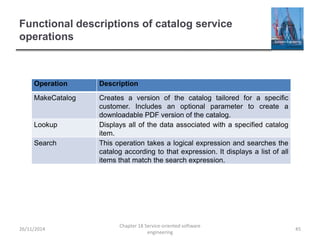
Functional descriptions of catalog service
operations
Operation Description
MakeCatalog Creates a version of the catalog tailored for a specific
customer. Includes an optional parameter to create a
downloadable PDF version of the catalog.
Lookup Displays all of the data associated with a specified catalog
item.
Search This operation takes a logical expression and searches the
catalog according to that expression. It displays a list of all
items that match the search expression.
26/11/2014
Chapter 18 Service-oriented software
engineering
45
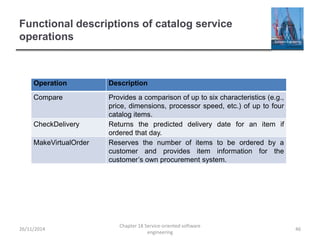
Functional descriptions of catalog service
operations
Operation Description
Compare Provides a comparison of up to six characteristics (e.g.,
price, dimensions, processor speed, etc.) of up to four
catalog items.
CheckDelivery Returns the predicted delivery date for an item if
ordered that day.
MakeVirtualOrder Reserves the number of items to be ordered by a
customer and provides item information for the
customer’s own procurement system.
26/11/2014
Chapter 18 Service-oriented software
engineering
46
Service interface design
 Involves thinking about the operations associated with
the service and the messages exchanged
 The number of messages exchanged to complete a
service request should normally be minimised.
 Service state information may have to be included in
messages
26/11/2014
Chapter 18 Service-oriented software
engineering
47
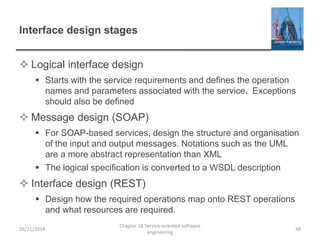
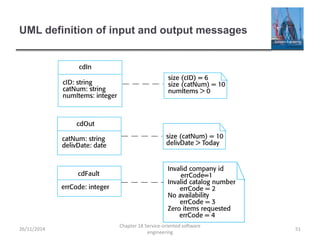
Interface design stages
 Logical interface design
 Starts with the service requirements and defines the operation
names and parameters associated with the service. Exceptions
should also be defined
 Message design (SOAP)
 For SOAP-based services, design the structure and organisation
of the input and output messages. Notations such as the UML
are a more abstract representation than XML
 The logical specification is converted to a WSDL description
 Interface design (REST)
 Design how the required operations map onto REST operations
and what resources are required.
26/11/2014
Chapter 18 Service-oriented software
engineering
48
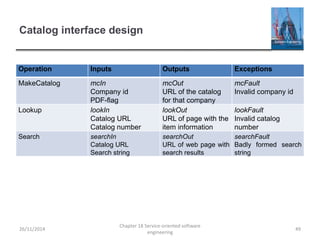
Catalog interface design
Operation Inputs Outputs Exceptions
MakeCatalog mcIn
Company id
PDF-flag
mcOut
URL of the catalog
for that company
mcFault
Invalid company id
Lookup lookIn
Catalog URL
Catalog number
lookOut
URL of page with the
item information
lookFault
Invalid catalog
number
Search searchIn
Catalog URL
Search string
searchOut
URL of web page with
search results
searchFault
Badly formed search
string
26/11/2014
Chapter 18 Service-oriented software
engineering
49
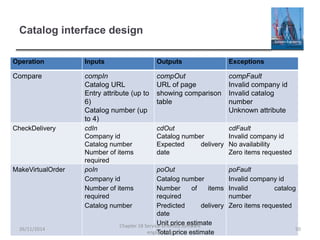
Catalog interface design
Operation Inputs Outputs Exceptions
Compare compIn
Catalog URL
Entry attribute (up to
6)
Catalog number (up
to 4)
compOut
URL of page
showing comparison
table
compFault
Invalid company id
Invalid catalog
number
Unknown attribute
CheckDelivery cdIn
Company id
Catalog number
Number of items
required
cdOut
Catalog number
Expected delivery
date
cdFault
Invalid company id
No availability
Zero items requested
MakeVirtualOrder poIn
Company id
Number of items
required
Catalog number
poOut
Catalog number
Number of items
required
Predicted delivery
date
Unit price estimate
Total price estimate
poFault
Invalid company id
Invalid catalog
number
Zero items requested
26/11/2014
Chapter 18 Service-oriented software
engineering
50
UML definition of input and output messages
26/11/2014
Chapter 18 Service-oriented software
engineering
51
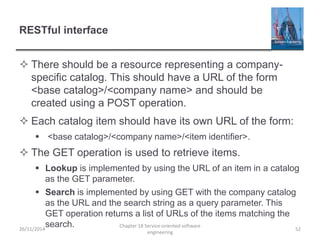
RESTful interface
 There should be a resource representing a company-
specific catalog. This should have a URL of the form
<base catalog>/<company name> and should be
created using a POST operation.
 Each catalog item should have its own URL of the form:
 <base catalog>/<company name>/<item identifier>.
 The GET operation is used to retrieve items.
 Lookup is implemented by using the URL of an item in a catalog
as the GET parameter.
 Search is implemented by using GET with the company catalog
as the URL and the search string as a query parameter. This
GET operation returns a list of URLs of the items matching the
search.26/11/2014
Chapter 18 Service-oriented software
engineering
52
RESTful interface
 The Compare operation can be implemented as a
sequence of GET operations, to retrieve the individual
items, followed by a POST operation to create the
comparison table and a final GET operation to return this
to the user.
 The CheckDelivery and MakeVirtualOrder operations
require an additional resource, representing a virtual
order.
 A POST operation is used to create this resource with the
number of items required. The company id is used to
automatically fill in the order form and the delivery date is
calculated. This can then be retrieved using a GET operation.
26/11/2014
Chapter 18 Service-oriented software
engineering
53
Service implementation and deployment
 Programming services using a standard programming
language or a workflow language
 Services then have to be tested by creating input
messages and checking that the output messages
produced are as expected
 Deployment involves publicising the service and
installing it on a web server. Current servers provide
support for service installation
26/11/2014
Chapter 18 Service-oriented software
engineering
54
Legacy system services
 Services can be implemented by implementing a service
interface to existing legacy systems
 Legacy systems offer extensive functionality and this can
reduce the cost of service implementation
 External applications can access this functionality
through the service interfaces
26/11/2014
Chapter 18 Service-oriented software
engineering
55
Service descriptions
 Information about your business, contact details, etc.
This is important for trust reasons. Users of a service
have to be confident that it will not behave maliciously.
 An informal description of the functionality provided by
the service. This helps potential users to decide if the
service is what they want.
 A description of how to use the services SOAP-based
and RESTful.
 Subscription information that allows users to register for
information about updates to the service.
26/11/2014
Chapter 18 Service-oriented software
engineering
56
Service composition
26/11/2014
Chapter 18 Service-oriented software
engineering
57
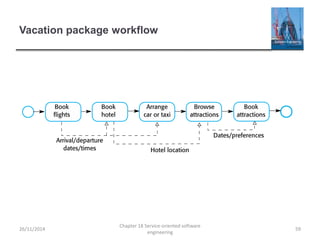
Software development with services
 Existing services are composed and configured to create
new composite services and applications
 The basis for service composition is often a workflow
 Workflows are logical sequences of activities that, together,
model a coherent business process
 For example, provide a travel reservation services which allows
flights, car hire and hotel bookings to be coordinated
26/11/2014
Chapter 18 Service-oriented software
engineering
58
Vacation package workflow
26/11/2014
Chapter 18 Service-oriented software
engineering
59
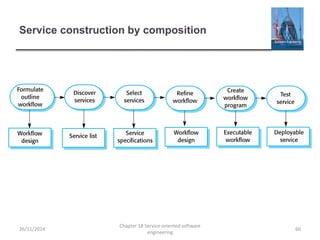
Service construction by composition
26/11/2014
Chapter 18 Service-oriented software
engineering
60
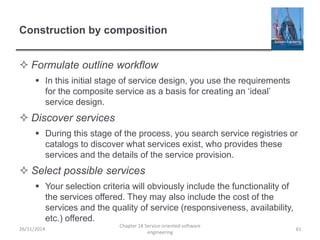
Construction by composition
 Formulate outline workflow
 In this initial stage of service design, you use the requirements
for the composite service as a basis for creating an ‘ideal’
service design.
 Discover services
 During this stage of the process, you search service registries or
catalogs to discover what services exist, who provides these
services and the details of the service provision.
 Select possible services
 Your selection criteria will obviously include the functionality of
the services offered. They may also include the cost of the
services and the quality of service (responsiveness, availability,
etc.) offered.
26/11/2014
Chapter 18 Service-oriented software
engineering
61
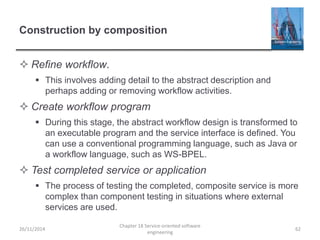
Construction by composition
 Refine workflow.
 This involves adding detail to the abstract description and
perhaps adding or removing workflow activities.
 Create workflow program
 During this stage, the abstract workflow design is transformed to
an executable program and the service interface is defined. You
can use a conventional programming language, such as Java or
a workflow language, such as WS-BPEL.
 Test completed service or application
 The process of testing the completed, composite service is more
complex than component testing in situations where external
services are used.
26/11/2014
Chapter 18 Service-oriented software
engineering
62
Workflow design and implementation
 WS-BPEL is an XML-standard for workflow specification.
However, WS-BPEL descriptions are long and
unreadable
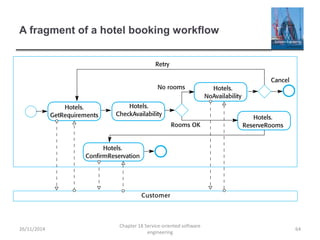
 Graphical workflow notations, such as BPMN, are more
readable and WS-BPEL can be generated from them
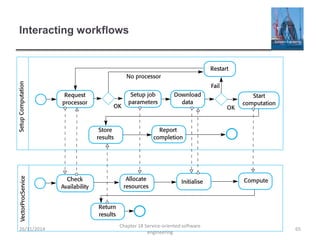
 In inter-organisational systems, separate workflows are
created for each organisation and linked through
message exchange.
 Workflows can be used with both SOAP-based and
RESTful services.
26/11/2014
Chapter 18 Service-oriented software
engineering
63
A fragment of a hotel booking workflow
26/11/2014
Chapter 18 Service-oriented software
engineering
64
Interacting workflows
26/11/2014
Chapter 18 Service-oriented software
engineering
65
Testing service compositions
 Testing is intended to find defects and demonstrate that
a system meets its functional and non-functional
requirements.
 Service testing is difficult as (external) services are
‘black-boxes’. Testing techniques that rely on the
program source code cannot be used.
26/11/2014
Chapter 18 Service-oriented software
engineering
66
Service testing problems
 External services may be modified by the service provider
thus invalidating tests which have been completed.
 Dynamic binding means that the service used in an
application may vary - the application tests are not, therefore,
reliable.
 The non-functional behaviour of the service is unpredictable
because it depends on load.
 If services have to be paid for as used, testing a service may
be expensive.
 It may be difficult to invoke compensating actions in external
services as these may rely on the failure of other services
which cannot be simulated.
26/11/2014
Chapter 18 Service-oriented software
engineering
67
Key points
 Service-oriented architecture is an approach to software engineering
where reusable, standardized services are the basic building blocks
for application systems.
 Services may be implemented within a service-oriented architecture
using a set of XML-based web service standards. These include
standards for service communication, interface definition and service
enactment in workflows.
 Alternatively, a RESTful architecture may be used which is based on
resources and standard operations on these resources.
 A RESTful approach uses the http and https protocols for service
communication and maps operations on the standard http verbs
POST, GET, PUT and DELETE.
26/11/2014
Chapter 18 Service-oriented software
engineering
68
Key points
 Utility services provide general-purpose functionality;
business services implement part of a business process;
coordination services coordinate service execution.
 Service engineering involves identifying candidate
services for implementation, defining service interfaces
and implementing, testing and deploying services.
 The development of software using services involves
composing and configuring services to create new
composite services and systems.
 Graphical workflow languages, such as BPMN, may be
used to describe a business process and the services
used in that process.
26/11/2014
Chapter 18 Service-oriented software
engineering
69

Ch18 service oriented software engineering

  • 1.
    Chapter 18 –Service-oriented Software Engineering 26/11/2014 Chapter 18 Service-oriented software engineering 1
  • 2.
    Topics covered  Service-orientedarchitectures  RESTful services  Service engineering  Service composition 26/11/2014 Chapter 18 Service-oriented software engineering 2
  • 3.
    Web services  Aweb service is an instance of a more general notion of a service: “an act or performance offered by one party to another. Although the process may be tied to a physical product, the performance is essentially intangible and does not normally result in ownership of any of the factors of production”.  The essence of a service, therefore, is that the provision of the service is independent of the application using the service.  Service providers can develop specialized services and offer these to a range of service users from different organizations. 26/11/2014 Chapter 18 Service-oriented software engineering 3
  • 4.
    Reusable services  Servicesare reusable components that are independent (no requires interface) and are loosely coupled.  A web service is:  A loosely coupled, reusable software component that encapsulates discrete functionality, which may be distributed and programmatically accessed. A web service is a service that is accessed using standard Internet and XML-based protocols.  Services are platform and implementation-language independent 26/11/2014 Chapter 18 Service-oriented software engineering 4
  • 5.
    Benefits of service-orientedapprach  Services can be offered by any service provider inside or outside of an organisation so organizations can create applications by integrating services from a range of providers.  The service provider makes information about the service public so that any authorised user can use the service.  Applications can delay the binding of services until they are deployed or until execution. This means that applications can be reactive and adapt their operation to cope with changes to their execution environment. 26/11/2014 Chapter 18 Service-oriented software engineering 5
  • 6.
    Benefits of aservice-oriented approach  Opportunistic construction of new services is possible. A service provider may recognise new services that can be created by linking existing services in innovative ways.  Service users can pay for services according to their use rather than their provision. Instead of buying a rarely- used component, the application developers can use an external service that will be paid for only when required.  Applications can be made smaller, which is particularly important for mobile devices with limited processing and memory capabilities. Computationally-intensive processing can be offloaded to external services. 26/11/2014 Chapter 18 Service-oriented software engineering 6
  • 7.
    Services scenario  Anin-car information system provides drivers with information on weather, road traffic conditions, local information etc. This is linked to car audio system so that information is delivered as a signal on a specific channel.  The car is equipped with GPS receiver to discover its position and, based on that position, the system accesses a range of information services. Information may be delivered in the driver’s specified language. 26/11/2014 Chapter 18 Service-oriented software engineering 7
  • 8.
    A service-based, in-carinformation system 26/11/2014 Chapter 18 Service-oriented software engineering 8
  • 9.
    Advantage of SOAfor this application  It is not necessary to decide when the system is programmed or deployed what service provider should be used or what specific services should be accessed.  As the car moves around, the in-car software uses the service discovery service to find the most appropriate information service and binds to that.  Because of the use of a translation service, it can move across borders and therefore make local information available to people who don’t speak the local language. 26/11/2014 Chapter 18 Service-oriented software engineering 9
  • 10.
    Service-oriented software engineering As significant a development as object-oriented development.  Building applications based on services allows companies and other organizations to cooperate and make use of each other’s business functions.  Service-based applications may be constructed by linking services from various providers using either a standard programming language or a specialized workflow language. 26/11/2014 Chapter 18 Service-oriented software engineering 10
  • 11.
    Service-oriented architecture 26/11/2014 Chapter 18Service-oriented software engineering 11
  • 12.
    Service-oriented architectures  Ameans of developing distributed systems where the components are stand-alone services  Services may execute on different computers from different service providers  Standard protocols have been developed to support service communication and information exchange 26/11/2014 Chapter 18 Service-oriented software engineering 12
  • 13.
    Service-oriented architecture 26/11/2014 Chapter 18Service-oriented software engineering 13
  • 14.
    Benefits of SOA Services can be provided locally or outsourced to external providers  Services are language-independent  Investment in legacy systems can be preserved  Inter-organisational computing is facilitated through simplified information exchange 26/11/2014 Chapter 18 Service-oriented software engineering 14
  • 15.
    Key standards  SOAP A message exchange standard that supports service communication  WSDL (Web Service Definition Language)  This standard allows a service interface and its bindings to be defined  WS-BPEL  A standard for workflow languages used to define service composition 26/11/2014 Chapter 18 Service-oriented software engineering 15
  • 16.
    Web service standards 26/11/2014 Chapter18 Service-oriented software engineering 16
  • 17.
    Service-oriented software engineering Existing approaches to software engineering have to evolve to reflect the service-oriented approach to software development  Service engineering. The development of dependable, reusable services • Software development for reuse  Software development with services. The development of dependable software where services are the fundamental components • Software development with reuse 26/11/2014 Chapter 18 Service-oriented software engineering 17
  • 18.
    Services as reusablecomponents  A service can be defined as:  A loosely-coupled, reusable software component that encapsulates discrete functionality which may be distributed and programmatically accessed. A web service is a service that is accessed using standard Internet and XML-based protocols  A critical distinction between a service and a component as defined in CBSE is that services are independent  Services do not have a ‘requires’ interface  Services rely on message-based communication with messages expressed in XML 26/11/2014 Chapter 18 Service-oriented software engineering 18
  • 19.
    Web service descriptionlanguage  The service interface is defined in a service description expressed in WSDL (Web Service Description Language).  The WSDL specification defines  What operations the service supports and the format of the messages that are sent and received by the service  How the service is accessed - that is, the binding maps the abstract interface onto a concrete set of protocols  Where the service is located. This is usually expressed as a URI (Universal Resource Identifier) 26/11/2014 Chapter 18 Service-oriented software engineering 19
  • 20.
    Organization of aWSDL specification 26/11/2014 Chapter 18 Service-oriented software engineering 20
  • 21.
    WSDL specification components The ‘what’ part of a WSDL document, called an interface, specifies what operations the service supports, and defines the format of the messages that are sent and received by the service.  The ‘how’ part of a WSDL document, called a binding, maps the abstract interface to a concrete set of protocols. The binding specifies the technical details of how to communicate with a Web service.  The ‘where’ part of a WSDL document describes the location of a specific Web service implementation (its endpoint). 26/11/2014 Chapter 18 Service-oriented software engineering 21
  • 22.
    Part of aWSDL description for a web service 26/11/2014 Chapter 18 Service-oriented software engineering 22 Define some of the types used. Assume that the namespace prefixes ‘ws’ refers to the namespace URI for XML schemas and the namespace prefix associated with this definition is weathns. <types> <xs: schema targetNameSpace = “http://.../weathns” xmlns: weathns = “http://…/weathns” > <xs:element name = “PlaceAndDate” type = “pdrec” /> <xs:element name = “MaxMinTemp” type = “mmtrec” /> <xs: element name = “InDataFault” type = “errmess” /> <xs: complexType name = “pdrec” <xs: sequence> <xs:element name = “town” type = “xs:string”/> <xs:element name = “country” type = “xs:string”/> <xs:element name = “day” type = “xs:date” /> </xs:complexType> Definitions of MaxMinType and InDataFault here </schema> </types>
  • 23.
    Part of aWSDL description for a web service 26/11/2014 Chapter 18 Service-oriented software engineering 23 Now define the interface and its operations. In this case, there is only a single operation to return maximum and minimum temperatures. <interface name = “weatherInfo” > <operation name = “getMaxMinTemps” pattern = “wsdlns: in-out”> <input messageLabel = “In” element = “weathns: PlaceAndDate” /> <output messageLabel = “Out” element = “weathns:MaxMinTemp” /> <outfault messageLabel = “Out” element = “weathns:InDataFault” /> </operation> </interface>
  • 24.
    RESTful services 26/11/2014 Chapter 18Service-oriented software engineering 24
  • 25.
    RESTful web services Current web services standards have been criticized as ‘heavyweight’ standards that are over-general and inefficient.  REST (REpresentational State Transfer) is an architectural style based on transferring representations of resources from a server to a client.  This style underlies the web as a whole and is simpler than SOAP/WSDL for implementing web services.  RESTful services involve a lower overhead than so-called ‘big web services’ and are used by many organizations implementing service-based systems. 26/11/2014 Chapter 18 Service-oriented software engineering 25
  • 26.
    Resources  The fundamentalelement in a RESTful architecture is a resource.  Essentially, a resource is simply a data element such as a catalog, a medical record, or a document, such as this book chapter.  In general, resources may have multiple representations i.e. they can exist in different formats.  MS WORD  PDF  Quark XPress 26/11/2014 Chapter 18 Service-oriented software engineering 26
  • 27.
    Resource operations  Create– bring the resource into existence.  Read – return a representation of the resource.  Update – change the value of the resource.  Delete – make the resource inaccessible. 26/11/2014 Chapter 18 Service-oriented software engineering 27
  • 28.
    Resources and actions 26/11/2014 Chapter18 Service-oriented software engineering 28
  • 29.
    Operation functionality  POSTis used to create a resource. It has associated data that defines the resource.  GET is used to read the value of a resource and return that to the requestor in the specified representation, such as XHTML, that can be rendered in a web browser.  PUT is used to update the value of a resource.  DELETE is used to delete the resource. 26/11/2014 Chapter 18 Service-oriented software engineering 29
  • 30.
    Resource access  Whena RESTful approach is used, the data is exposed and is accessed using its URL.  Therefore, the weather data for each place in the database, might be accessed using URLs such as:  http://weather-info-example.net/temperatures/boston http://weather-info-example.net/temperatures/edinburgh  Invokes the GET operation and returns a list of maximum and minimum temperatures.  To request the temperatures for a specific date, a URL query is used:  http://weather-info- example.net/temperatures/edinburgh?date=20140226 26/11/2014 Chapter 18 Service-oriented software engineering 30
  • 31.
    Query results  Theresponse to a GET request in a RESTful service may include URLs.  If the response to a request is a set of resources, then the URL of each of these may be included.  http://weather-info-example.net/temperatures/edinburgh-scotland http://weather-info-example.net/temperatures/edinburgh- australia http://weather-info-example.net/temperatures/edinburgh- maryland 26/11/2014 Chapter 18 Service-oriented software engineering 31
  • 32.
    Disadvantages of RESTfulapproach  When a service has a complex interface and is not a simple resource, it can be difficult to design a set of RESTful services to represent this.  There are no standards for RESTful interface description so service users must rely on informal documentation to understand the interface.  When you use RESTful services, you have to implement your own infrastructure for monitoring and managing the quality of service and the service reliability. 26/11/2014 Chapter 18 Service-oriented software engineering 32
  • 33.
    RESTful and SOAP-basedAPIs 26/11/2014 Chapter 18 Service-oriented software engineering 33
  • 34.
    Service engineering 26/11/2014 Chapter 18Service-oriented software engineering 34
  • 35.
    Service engineering  Theprocess of developing services for reuse in service- oriented applications  The service has to be designed as a reusable abstraction that can be used in different systems.  Generally useful functionality associated with that abstraction must be designed and the service must be robust and reliable.  The service must be documented so that it can be discovered and understood by potential users. 26/11/2014 Chapter 18 Service-oriented software engineering 35
  • 36.
    The service engineeringprocess 26/11/2014 Chapter 18 Service-oriented software engineering 36
  • 37.
    Stages of serviceengineering  Service candidate identification, where you identify possible services that might be implemented and define the service requirements.  Service design, where you design the logical service interface and its implementation interfaces (SOAP and/or RESTful)  Service implementation and deployment, where you implement and test the service and make it available for use. 26/11/2014 Chapter 18 Service-oriented software engineering 37
  • 38.
    Service candidate identification Services should support business processes.  Service candidate identification involves understanding an organization’s business processes to decide which reusable services could support these processes.  Three fundamental types of service  Utility services that implement general functionality used by different business processes.  Business services that are associated with a specific business function e.g., in a university, student registration.  Coordination services that support composite processes such as ordering. 26/11/2014 Chapter 18 Service-oriented software engineering 38
  • 39.
    Task and entity-orientedservices  Task-oriented services are those associated with some activity.  Entity-oriented services are like objects. They are associated with a business entity such as a job application form.  Utility or business services may be entity- or task- oriented, coordination services are always task-oriented. 26/11/2014 Chapter 18 Service-oriented software engineering 39
  • 40.
    Service classification Utility BusinessCoordination Task Currency converter Employee locator Validate claim form Check credit rating Process expense claim Pay external supplier Entity Document style checker Web form to XML converter Expenses form Student application form 26/11/2014 Chapter 18 Service-oriented software engineering 40
  • 41.
    Service identification  Isthe service associated with a single logical entity used in different business processes?  Is the task one that is carried out by different people in the organisation? Can this fit with a RESTful model?  Is the service independent?  Does the service have to maintain state? Is a database required?  Could the service be used by clients outside the organisation?  Are different users of the service likely to have different non-functional requirements? 26/11/2014 Chapter 18 Service-oriented software engineering 41
  • 42.
    Service identification example A large company, which sells computer equipment, has arranged special prices for approved configurations for some customers.  To facilitate automated ordering, the company wishes to produce a catalog service that will allow customers to select the equipment that they need.  Unlike a consumer catalog, orders are not placed directly through a catalog interface. Instead, goods are ordered through the web- based procurement system of each company that accesses the catalog as a web service.  Most companies have their own budgeting and approval procedures for orders and their own ordering process must be followed when an order is placed. 26/11/2014 Chapter 18 Service-oriented software engineering 42
  • 43.
    Catalog services  Createdby a supplier to show which good can be ordered from them by other companies  Service requirements  Specific version of catalogue should be created for each client  Catalogue shall be downloadable  The specification and prices of up to 6 items may be compared  Browsing and searching facilities shall be provided  A function shall be provided that allows the delivery date for ordered items to be predicted  Virtual orders shall be supported which reserve the goods for 48 hours to allow a company order to be placed 26/11/2014 Chapter 18 Service-oriented software engineering 43
  • 44.
    Catalogue: Non-functional requirements Access shall be restricted to employees of accredited organisations  Prices and configurations offered to each organisation shall be confidential  The catalogue shall be available from 0700 to 1100  The catalogue shall be able to process up to 10 requests per second 26/11/2014 Chapter 18 Service-oriented software engineering 44
  • 45.
    Functional descriptions ofcatalog service operations Operation Description MakeCatalog Creates a version of the catalog tailored for a specific customer. Includes an optional parameter to create a downloadable PDF version of the catalog. Lookup Displays all of the data associated with a specified catalog item. Search This operation takes a logical expression and searches the catalog according to that expression. It displays a list of all items that match the search expression. 26/11/2014 Chapter 18 Service-oriented software engineering 45
  • 46.
    Functional descriptions ofcatalog service operations Operation Description Compare Provides a comparison of up to six characteristics (e.g., price, dimensions, processor speed, etc.) of up to four catalog items. CheckDelivery Returns the predicted delivery date for an item if ordered that day. MakeVirtualOrder Reserves the number of items to be ordered by a customer and provides item information for the customer’s own procurement system. 26/11/2014 Chapter 18 Service-oriented software engineering 46
  • 47.
    Service interface design Involves thinking about the operations associated with the service and the messages exchanged  The number of messages exchanged to complete a service request should normally be minimised.  Service state information may have to be included in messages 26/11/2014 Chapter 18 Service-oriented software engineering 47
  • 48.
    Interface design stages Logical interface design  Starts with the service requirements and defines the operation names and parameters associated with the service. Exceptions should also be defined  Message design (SOAP)  For SOAP-based services, design the structure and organisation of the input and output messages. Notations such as the UML are a more abstract representation than XML  The logical specification is converted to a WSDL description  Interface design (REST)  Design how the required operations map onto REST operations and what resources are required. 26/11/2014 Chapter 18 Service-oriented software engineering 48
  • 49.
    Catalog interface design OperationInputs Outputs Exceptions MakeCatalog mcIn Company id PDF-flag mcOut URL of the catalog for that company mcFault Invalid company id Lookup lookIn Catalog URL Catalog number lookOut URL of page with the item information lookFault Invalid catalog number Search searchIn Catalog URL Search string searchOut URL of web page with search results searchFault Badly formed search string 26/11/2014 Chapter 18 Service-oriented software engineering 49
  • 50.
    Catalog interface design OperationInputs Outputs Exceptions Compare compIn Catalog URL Entry attribute (up to 6) Catalog number (up to 4) compOut URL of page showing comparison table compFault Invalid company id Invalid catalog number Unknown attribute CheckDelivery cdIn Company id Catalog number Number of items required cdOut Catalog number Expected delivery date cdFault Invalid company id No availability Zero items requested MakeVirtualOrder poIn Company id Number of items required Catalog number poOut Catalog number Number of items required Predicted delivery date Unit price estimate Total price estimate poFault Invalid company id Invalid catalog number Zero items requested 26/11/2014 Chapter 18 Service-oriented software engineering 50
  • 51.
    UML definition ofinput and output messages 26/11/2014 Chapter 18 Service-oriented software engineering 51
  • 52.
    RESTful interface  Thereshould be a resource representing a company- specific catalog. This should have a URL of the form <base catalog>/<company name> and should be created using a POST operation.  Each catalog item should have its own URL of the form:  <base catalog>/<company name>/<item identifier>.  The GET operation is used to retrieve items.  Lookup is implemented by using the URL of an item in a catalog as the GET parameter.  Search is implemented by using GET with the company catalog as the URL and the search string as a query parameter. This GET operation returns a list of URLs of the items matching the search.26/11/2014 Chapter 18 Service-oriented software engineering 52
  • 53.
    RESTful interface  TheCompare operation can be implemented as a sequence of GET operations, to retrieve the individual items, followed by a POST operation to create the comparison table and a final GET operation to return this to the user.  The CheckDelivery and MakeVirtualOrder operations require an additional resource, representing a virtual order.  A POST operation is used to create this resource with the number of items required. The company id is used to automatically fill in the order form and the delivery date is calculated. This can then be retrieved using a GET operation. 26/11/2014 Chapter 18 Service-oriented software engineering 53
  • 54.
    Service implementation anddeployment  Programming services using a standard programming language or a workflow language  Services then have to be tested by creating input messages and checking that the output messages produced are as expected  Deployment involves publicising the service and installing it on a web server. Current servers provide support for service installation 26/11/2014 Chapter 18 Service-oriented software engineering 54
  • 55.
    Legacy system services Services can be implemented by implementing a service interface to existing legacy systems  Legacy systems offer extensive functionality and this can reduce the cost of service implementation  External applications can access this functionality through the service interfaces 26/11/2014 Chapter 18 Service-oriented software engineering 55
  • 56.
    Service descriptions  Informationabout your business, contact details, etc. This is important for trust reasons. Users of a service have to be confident that it will not behave maliciously.  An informal description of the functionality provided by the service. This helps potential users to decide if the service is what they want.  A description of how to use the services SOAP-based and RESTful.  Subscription information that allows users to register for information about updates to the service. 26/11/2014 Chapter 18 Service-oriented software engineering 56
  • 57.
    Service composition 26/11/2014 Chapter 18Service-oriented software engineering 57
  • 58.
    Software development withservices  Existing services are composed and configured to create new composite services and applications  The basis for service composition is often a workflow  Workflows are logical sequences of activities that, together, model a coherent business process  For example, provide a travel reservation services which allows flights, car hire and hotel bookings to be coordinated 26/11/2014 Chapter 18 Service-oriented software engineering 58
  • 59.
    Vacation package workflow 26/11/2014 Chapter18 Service-oriented software engineering 59
  • 60.
    Service construction bycomposition 26/11/2014 Chapter 18 Service-oriented software engineering 60
  • 61.
    Construction by composition Formulate outline workflow  In this initial stage of service design, you use the requirements for the composite service as a basis for creating an ‘ideal’ service design.  Discover services  During this stage of the process, you search service registries or catalogs to discover what services exist, who provides these services and the details of the service provision.  Select possible services  Your selection criteria will obviously include the functionality of the services offered. They may also include the cost of the services and the quality of service (responsiveness, availability, etc.) offered. 26/11/2014 Chapter 18 Service-oriented software engineering 61
  • 62.
    Construction by composition Refine workflow.  This involves adding detail to the abstract description and perhaps adding or removing workflow activities.  Create workflow program  During this stage, the abstract workflow design is transformed to an executable program and the service interface is defined. You can use a conventional programming language, such as Java or a workflow language, such as WS-BPEL.  Test completed service or application  The process of testing the completed, composite service is more complex than component testing in situations where external services are used. 26/11/2014 Chapter 18 Service-oriented software engineering 62
  • 63.
    Workflow design andimplementation  WS-BPEL is an XML-standard for workflow specification. However, WS-BPEL descriptions are long and unreadable  Graphical workflow notations, such as BPMN, are more readable and WS-BPEL can be generated from them  In inter-organisational systems, separate workflows are created for each organisation and linked through message exchange.  Workflows can be used with both SOAP-based and RESTful services. 26/11/2014 Chapter 18 Service-oriented software engineering 63
  • 64.
    A fragment ofa hotel booking workflow 26/11/2014 Chapter 18 Service-oriented software engineering 64
  • 65.
    Interacting workflows 26/11/2014 Chapter 18Service-oriented software engineering 65
  • 66.
    Testing service compositions Testing is intended to find defects and demonstrate that a system meets its functional and non-functional requirements.  Service testing is difficult as (external) services are ‘black-boxes’. Testing techniques that rely on the program source code cannot be used. 26/11/2014 Chapter 18 Service-oriented software engineering 66
  • 67.
    Service testing problems External services may be modified by the service provider thus invalidating tests which have been completed.  Dynamic binding means that the service used in an application may vary - the application tests are not, therefore, reliable.  The non-functional behaviour of the service is unpredictable because it depends on load.  If services have to be paid for as used, testing a service may be expensive.  It may be difficult to invoke compensating actions in external services as these may rely on the failure of other services which cannot be simulated. 26/11/2014 Chapter 18 Service-oriented software engineering 67
  • 68.
    Key points  Service-orientedarchitecture is an approach to software engineering where reusable, standardized services are the basic building blocks for application systems.  Services may be implemented within a service-oriented architecture using a set of XML-based web service standards. These include standards for service communication, interface definition and service enactment in workflows.  Alternatively, a RESTful architecture may be used which is based on resources and standard operations on these resources.  A RESTful approach uses the http and https protocols for service communication and maps operations on the standard http verbs POST, GET, PUT and DELETE. 26/11/2014 Chapter 18 Service-oriented software engineering 68
  • 69.
    Key points  Utilityservices provide general-purpose functionality; business services implement part of a business process; coordination services coordinate service execution.  Service engineering involves identifying candidate services for implementation, defining service interfaces and implementing, testing and deploying services.  The development of software using services involves composing and configuring services to create new composite services and systems.  Graphical workflow languages, such as BPMN, may be used to describe a business process and the services used in that process. 26/11/2014 Chapter 18 Service-oriented software engineering 69