Chapter 16
The Conduct of
Monetary Policy:
Strategy and
Tactics
© 2016 Pearson Education, Inc. All rights reserved.16-2
Preview
• This chapter examines the goals of
monetary policy and then considers one of
the most important strategies for the
conduct of monetary policy, inflation
targeting
© 2016 Pearson Education, Inc. All rights reserved.16-3
Learning Objectives
• Define and recognize the importance of a
nominal anchor.
• Identify the six potential goals that
monetary policymakers may pursue.
• Summarize the distinctions between
hierarchical and dual mandates.
• Compare and contrast the advantages and
disadvantages of inflation targeting.
• Identify the key changes made over time to
the Federal Reserve monetary policy
strategy.
© 2016 Pearson Education, Inc. All rights reserved.16-4
Learning Objectives
• List the four lessons learned from the global
financial crisis and discuss what they mean
to inflation targeting.
• Summarize the arguments for and against
central bank policy response to asset-price
bubbles.
• Describe and assess the four criteria for
choosing a policy instrument.
• Interpret and assess the performance of the
Taylor rule as a hypothetical policy
instrument for setting the federal funds rate.
© 2016 Pearson Education, Inc. All rights reserved.16-5
The Price Stability Goal and the
Nominal Anchor
• Over the past few decades, policy makers
throughout the world have become increasingly
aware of the social and economic costs of
inflation and more concerned with maintaining a
stable price level as a goal of economic policy.
• The role of a nominal anchor: a nominal
variable, such as the inflation rate or the money
supply, which ties down the price level to
achieve price stability
• The time-inconsistency problem
© 2016 Pearson Education, Inc. All rights reserved.16-6
Other Goals of Monetary Policy
• Five other goals are continually mentioned
by central bank officials when they discuss
the objectives of monetary policy:
1. High employment and output stability
2. Economic growth
3. Stability of financial markets
4. Interest-rate stability
5. Stability in foreign exchange markets
© 2016 Pearson Education, Inc. All rights reserved.16-7
Should Price Stability Be the
Primary Goal of Monetary Policy?
• Hierarchical Versus Dual Mandates:
– Hierarchical mandates put the goal of price stability
first, and then say that as long as it is achieved other
goals can be pursued
– Dual mandates are aimed to achieve two coequal
objectives: price stability and maximum employment
(output stability)
• Price Stability as the Primary, Long-Run Goal
of Monetary Policy
– Either type of mandate is acceptable as long as it
operates to make price stability the primary goal in the
long run but not the short run.
© 2016 Pearson Education, Inc. All rights reserved.16-8
Inflation Targeting
• Public announcement of medium-term
numerical target for inflation
• Institutional commitment to price stability as
the primary, long-run goal of monetary policy
and a commitment to achieve the inflation
goal
• Information-inclusive approach in which many
variables are used in making decisions
• Increased transparency of the strategy
• Increased accountability of the central bank
© 2016 Pearson Education, Inc. All rights reserved.16-9
• New Zealand (effective in 1990)
– Inflation was brought down and remained within the
target most of the time.
– Growth has generally been high and unemployment
has come down significantly.
• Canada (1991)
– Inflation decreased since 1991; some costs in term
of unemployment
• United Kingdom (1992)
– Inflation has been close to its target.
– Growth has been strong and unemployment has
been decreasing.
Inflation Targeting
© 2016 Pearson Education, Inc. All rights reserved.16-10
Figure 1
Inflation Rates
and Inflation
Targets for
New Zealand,
Canada, and
the United
Kingdom,
1980–2014
© 2016 Pearson Education, Inc. All rights reserved.16-11
• Advantages:
– Does not rely on one variable to achieve target
– Easily understood
– Reduces potential of falling in time-
inconsistency trap
– Stresses transparency and accountability
• Disadvantages:
– Delayed signaling
– Too much rigidity
– Potential for increased output fluctuations
– Low economic growth during disinflation
Inflation Targeting
© 2016 Pearson Education, Inc. All rights reserved.16-12
The Evolution of the Federal Reserve’s
Monetary Policy Strategy
• The United States has achieved excellent
macroeconomic performance (including low and
stable inflation) until the onset of the global
financial crisis without using an explicit nominal
anchor such as an inflation target.
• History:
– Fed began to announce publicly targets for money supply
growth in 1975
– Paul Volker (1979) focused more in nonborrowed reserves
– Greenspan announced in July 1993 that the Fed would not
use any monetary aggregates as a guide for conducting
monetary policy
© 2016 Pearson Education, Inc. All rights reserved.16-13
The Evolution of the Federal Reserve’s
Monetary Policy Strategy
• There is no explicit nominal anchor in the
form of an overriding concern for the Fed.
• Forward looking behavior and periodic
“preemptive strikes”
• The goal is to prevent inflation from getting
started.
© 2016 Pearson Education, Inc. All rights reserved.16-14
The Evolution of the Federal Reserve’s
Monetary Policy Strategy
• Advantages
– Uses many sources of information
– Demonstrated success
• Disadvantages
– Lack of accountability
– Inconsistent with democratic principles
© 2016 Pearson Education, Inc. All rights reserved.16-15
The Fed’s “Just Do It” Monetary
Policy Strategy
• Advantages of the Fed’s “Just Do It” Approach:
– forward-looking behavior and stress on price
stability also help to discourage overly
expansionary monetary policy, thereby
ameliorating the time-inconsistency problem
• Disadvantages of the Fed’s “Just Do It” Approach:
– lack of transparency; strong dependence on the
preferences, skills, and trustworthiness of the
individuals in charge of the central bank
© 2016 Pearson Education, Inc. All rights reserved.16-16
Lessons for Monetary Policy Strategy
from the Global Financial Crisis
1. Developments in the financial sector have a far
greater impact on economic activity than was
earlier realized.
1. The zero-lower-bound on interest rates can be a
serious problem.
1. The cost of cleaning up after a financial crisis is
very high.
1. Price and output stability do not ensure financial
stability.
© 2016 Pearson Education, Inc. All rights reserved.16-17
Lessons for Monetary Policy Strategy
from the Global Financial Crisis
• How should Central banks respond to asset
price bubbles?
– Asset-price bubble: pronounced increase in asset prices
that depart from fundamental values, which eventually
burst.
• Types of asset-price bubbles
– Credit-driven bubbles
• Subprime financial crisis
– Bubbles driven solely by irrational
exuberance
© 2016 Pearson Education, Inc. All rights reserved.16-18
Should central banks respond to
bubbles?
• Strong argument for not responding to
bubbles driven by irrational exuberance
• Bubbles are easier to identify when asset
prices and credit are increasing rapidly at
the same time.
• Monetary policy should not be used to prick
bubbles.
© 2016 Pearson Education, Inc. All rights reserved.16-19
• Macropudential policy: regulatory policy
to affect what is happening in credit markets
in the aggregate.
• Monetary policy: Central banks and other
regulators should not have a laissez-faire
attitude and let credit-driven bubbles
proceed without any reaction.
Should central banks respond to
bubbles?
© 2016 Pearson Education, Inc. All rights reserved.16-20
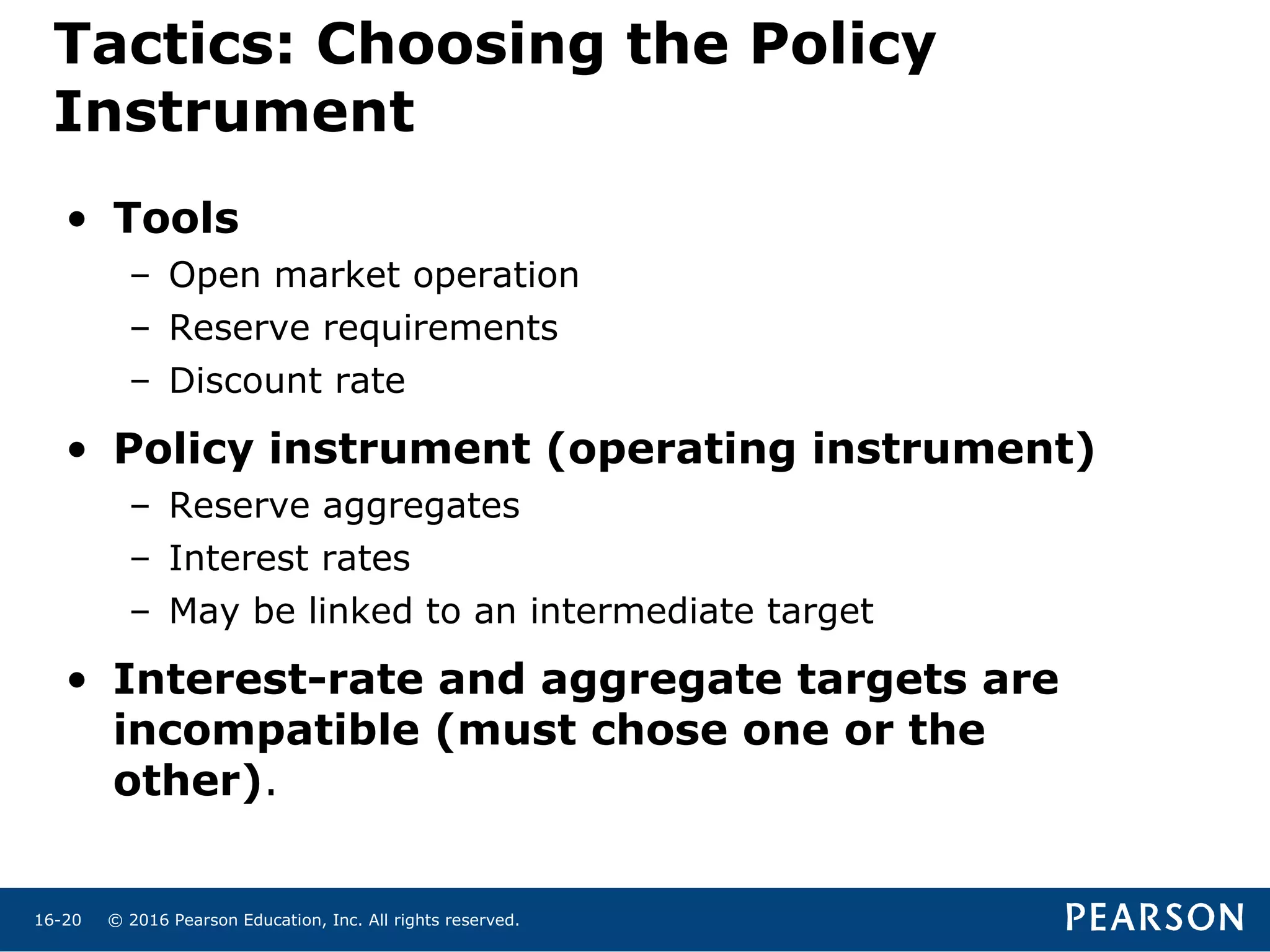
Tactics: Choosing the Policy
Instrument
• Tools
– Open market operation
– Reserve requirements
– Discount rate
• Policy instrument (operating instrument)
– Reserve aggregates
– Interest rates
– May be linked to an intermediate target
• Interest-rate and aggregate targets are
incompatible (must chose one or the
other).
© 2016 Pearson Education, Inc. All rights reserved.16-21
Figure 2 Linkages Between Central Bank Tools,
Policy Instruments, Intermediate Targets, and
Goals of Monetary Policy
Open Market Operations
Discount Policy
Reserve Requirements
Interest on Reserves
Large-scale Asset
Purchases
Forward Guidance
Tools of the
Central Bank
Policy
Instruments
Intermediate
Targets
Goals
Monetary Aggregates
(M1, M2)
Interest rates
(short-term and
long-term)
Price Stability
High Employment
Economic Growth
Financial Market Stability
Interest-Rate Stability
Foreign Exchange Market
Stability
Reserve Aggregates
(reserves, nonborrowed
reserves, monetary base,
nonborrowed base)
Interest rates
(short-term such as
federal funds rates)
© 2016 Pearson Education, Inc. All rights reserved.16-22
Figure 3 Result of Targeting on
Nonborrowed Reserves
Step 1. A rightward or leftward shift
in the demand curve for reserves …
Quantity of
Reserves, R
′′ffi
*
ffi
Federal
Funds Rate
di
ori
′ffi
Rs
NBR*
Step 2. leads to fluctuations in the
federal funds rate between ′ ′′and .ff ffi i
Rd*
Rd′′
Rd′
© 2016 Pearson Education, Inc. All rights reserved.16-23
Figure 4 Result of Targeting on the
Federal Funds Rate
*
ffi Federal Funds
Rates Target, *
ffi
d*
R
s
R
id
ier
Federal
Funds Rate
Quantity of
Reserves, R
NBR*′NBR ′′NBR
Step 1. A rightward or leftward
shift in the demand curve for
reserves…
Step 2. lead the central bank to
shift the supply curve of reserves
so that the federal rate does not
change…
Step 3. with the result that non-
borrowed reserves fluctuate
between NBR′ff and NBR′′ff.
′′d
R
′d
R
© 2016 Pearson Education, Inc. All rights reserved.16-24
Criteria for Choosing the Policy
Instrument
• Observability and Measurability
• Controllability
• Predictable effect on Goals
© 2016 Pearson Education, Inc. All rights reserved.16-25
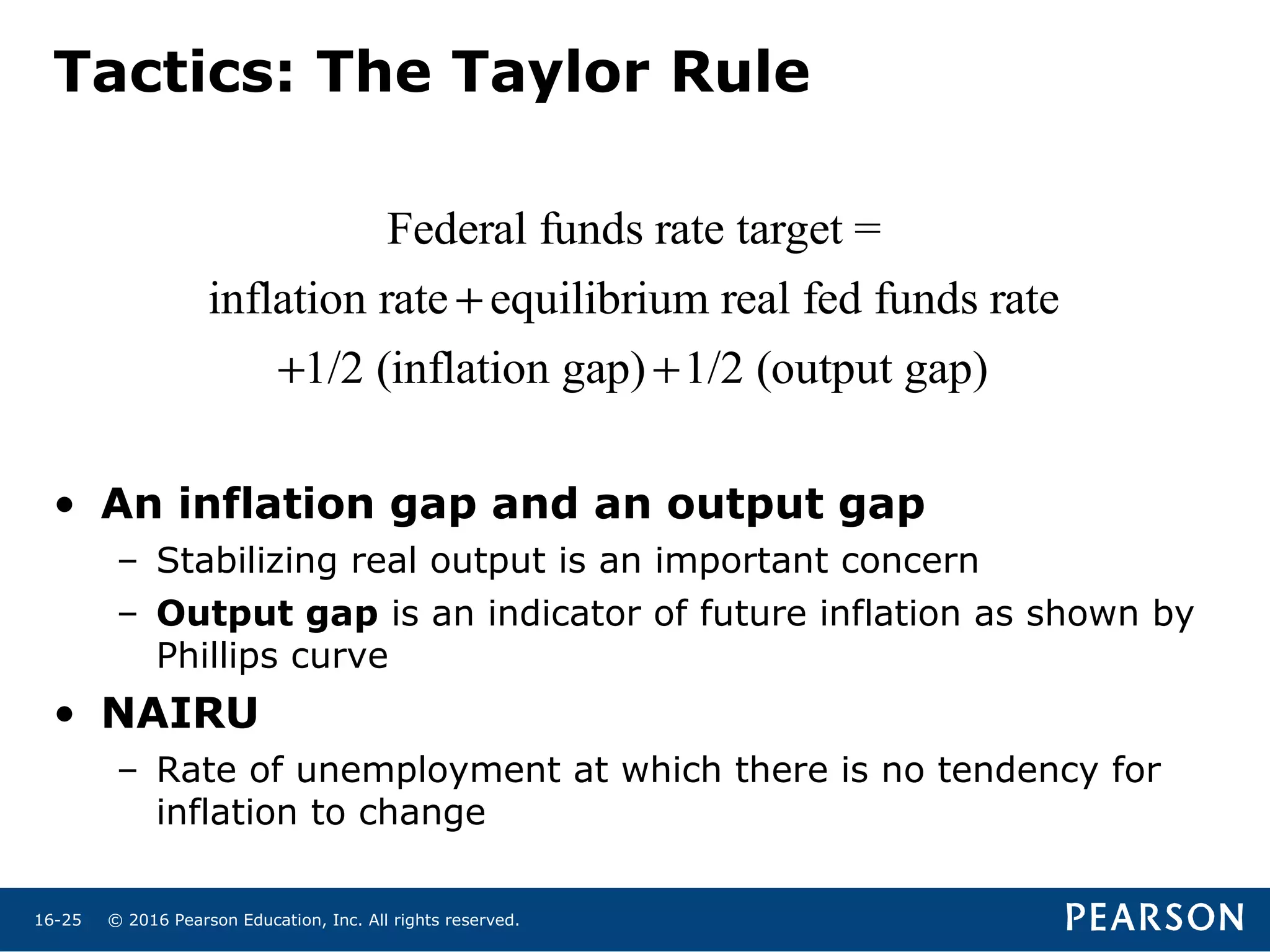
Tactics: The Taylor Rule
Federal funds rate target =
inflation rate + equilibrium real fed funds rate
+1/2 (inflation gap) +1/2 (output gap)
• An inflation gap and an output gap
– Stabilizing real output is an important concern
– Output gap is an indicator of future inflation as shown by
Phillips curve
• NAIRU
– Rate of unemployment at which there is no tendency for
inflation to change
© 2016 Pearson Education, Inc. All rights reserved.16-26
Figure 5 The Taylor Rule for the
Federal Funds Rate, 1970–2014
Source: Federal Reserve Bank of St. Louis, FRED database: http://research.stlouisfed.org/fred2/.

Ch16 mish11 embfm

  • 1.
    Chapter 16 The Conductof Monetary Policy: Strategy and Tactics
  • 2.
    © 2016 PearsonEducation, Inc. All rights reserved.16-2 Preview • This chapter examines the goals of monetary policy and then considers one of the most important strategies for the conduct of monetary policy, inflation targeting
  • 3.
    © 2016 PearsonEducation, Inc. All rights reserved.16-3 Learning Objectives • Define and recognize the importance of a nominal anchor. • Identify the six potential goals that monetary policymakers may pursue. • Summarize the distinctions between hierarchical and dual mandates. • Compare and contrast the advantages and disadvantages of inflation targeting. • Identify the key changes made over time to the Federal Reserve monetary policy strategy.
  • 4.
    © 2016 PearsonEducation, Inc. All rights reserved.16-4 Learning Objectives • List the four lessons learned from the global financial crisis and discuss what they mean to inflation targeting. • Summarize the arguments for and against central bank policy response to asset-price bubbles. • Describe and assess the four criteria for choosing a policy instrument. • Interpret and assess the performance of the Taylor rule as a hypothetical policy instrument for setting the federal funds rate.
  • 5.
    © 2016 PearsonEducation, Inc. All rights reserved.16-5 The Price Stability Goal and the Nominal Anchor • Over the past few decades, policy makers throughout the world have become increasingly aware of the social and economic costs of inflation and more concerned with maintaining a stable price level as a goal of economic policy. • The role of a nominal anchor: a nominal variable, such as the inflation rate or the money supply, which ties down the price level to achieve price stability • The time-inconsistency problem
  • 6.
    © 2016 PearsonEducation, Inc. All rights reserved.16-6 Other Goals of Monetary Policy • Five other goals are continually mentioned by central bank officials when they discuss the objectives of monetary policy: 1. High employment and output stability 2. Economic growth 3. Stability of financial markets 4. Interest-rate stability 5. Stability in foreign exchange markets
  • 7.
    © 2016 PearsonEducation, Inc. All rights reserved.16-7 Should Price Stability Be the Primary Goal of Monetary Policy? • Hierarchical Versus Dual Mandates: – Hierarchical mandates put the goal of price stability first, and then say that as long as it is achieved other goals can be pursued – Dual mandates are aimed to achieve two coequal objectives: price stability and maximum employment (output stability) • Price Stability as the Primary, Long-Run Goal of Monetary Policy – Either type of mandate is acceptable as long as it operates to make price stability the primary goal in the long run but not the short run.
  • 8.
    © 2016 PearsonEducation, Inc. All rights reserved.16-8 Inflation Targeting • Public announcement of medium-term numerical target for inflation • Institutional commitment to price stability as the primary, long-run goal of monetary policy and a commitment to achieve the inflation goal • Information-inclusive approach in which many variables are used in making decisions • Increased transparency of the strategy • Increased accountability of the central bank
  • 9.
    © 2016 PearsonEducation, Inc. All rights reserved.16-9 • New Zealand (effective in 1990) – Inflation was brought down and remained within the target most of the time. – Growth has generally been high and unemployment has come down significantly. • Canada (1991) – Inflation decreased since 1991; some costs in term of unemployment • United Kingdom (1992) – Inflation has been close to its target. – Growth has been strong and unemployment has been decreasing. Inflation Targeting
  • 10.
    © 2016 PearsonEducation, Inc. All rights reserved.16-10 Figure 1 Inflation Rates and Inflation Targets for New Zealand, Canada, and the United Kingdom, 1980–2014
  • 11.
    © 2016 PearsonEducation, Inc. All rights reserved.16-11 • Advantages: – Does not rely on one variable to achieve target – Easily understood – Reduces potential of falling in time- inconsistency trap – Stresses transparency and accountability • Disadvantages: – Delayed signaling – Too much rigidity – Potential for increased output fluctuations – Low economic growth during disinflation Inflation Targeting
  • 12.
    © 2016 PearsonEducation, Inc. All rights reserved.16-12 The Evolution of the Federal Reserve’s Monetary Policy Strategy • The United States has achieved excellent macroeconomic performance (including low and stable inflation) until the onset of the global financial crisis without using an explicit nominal anchor such as an inflation target. • History: – Fed began to announce publicly targets for money supply growth in 1975 – Paul Volker (1979) focused more in nonborrowed reserves – Greenspan announced in July 1993 that the Fed would not use any monetary aggregates as a guide for conducting monetary policy
  • 13.
    © 2016 PearsonEducation, Inc. All rights reserved.16-13 The Evolution of the Federal Reserve’s Monetary Policy Strategy • There is no explicit nominal anchor in the form of an overriding concern for the Fed. • Forward looking behavior and periodic “preemptive strikes” • The goal is to prevent inflation from getting started.
  • 14.
    © 2016 PearsonEducation, Inc. All rights reserved.16-14 The Evolution of the Federal Reserve’s Monetary Policy Strategy • Advantages – Uses many sources of information – Demonstrated success • Disadvantages – Lack of accountability – Inconsistent with democratic principles
  • 15.
    © 2016 PearsonEducation, Inc. All rights reserved.16-15 The Fed’s “Just Do It” Monetary Policy Strategy • Advantages of the Fed’s “Just Do It” Approach: – forward-looking behavior and stress on price stability also help to discourage overly expansionary monetary policy, thereby ameliorating the time-inconsistency problem • Disadvantages of the Fed’s “Just Do It” Approach: – lack of transparency; strong dependence on the preferences, skills, and trustworthiness of the individuals in charge of the central bank
  • 16.
    © 2016 PearsonEducation, Inc. All rights reserved.16-16 Lessons for Monetary Policy Strategy from the Global Financial Crisis 1. Developments in the financial sector have a far greater impact on economic activity than was earlier realized. 1. The zero-lower-bound on interest rates can be a serious problem. 1. The cost of cleaning up after a financial crisis is very high. 1. Price and output stability do not ensure financial stability.
  • 17.
    © 2016 PearsonEducation, Inc. All rights reserved.16-17 Lessons for Monetary Policy Strategy from the Global Financial Crisis • How should Central banks respond to asset price bubbles? – Asset-price bubble: pronounced increase in asset prices that depart from fundamental values, which eventually burst. • Types of asset-price bubbles – Credit-driven bubbles • Subprime financial crisis – Bubbles driven solely by irrational exuberance
  • 18.
    © 2016 PearsonEducation, Inc. All rights reserved.16-18 Should central banks respond to bubbles? • Strong argument for not responding to bubbles driven by irrational exuberance • Bubbles are easier to identify when asset prices and credit are increasing rapidly at the same time. • Monetary policy should not be used to prick bubbles.
  • 19.
    © 2016 PearsonEducation, Inc. All rights reserved.16-19 • Macropudential policy: regulatory policy to affect what is happening in credit markets in the aggregate. • Monetary policy: Central banks and other regulators should not have a laissez-faire attitude and let credit-driven bubbles proceed without any reaction. Should central banks respond to bubbles?
  • 20.
    © 2016 PearsonEducation, Inc. All rights reserved.16-20 Tactics: Choosing the Policy Instrument • Tools – Open market operation – Reserve requirements – Discount rate • Policy instrument (operating instrument) – Reserve aggregates – Interest rates – May be linked to an intermediate target • Interest-rate and aggregate targets are incompatible (must chose one or the other).
  • 21.
    © 2016 PearsonEducation, Inc. All rights reserved.16-21 Figure 2 Linkages Between Central Bank Tools, Policy Instruments, Intermediate Targets, and Goals of Monetary Policy Open Market Operations Discount Policy Reserve Requirements Interest on Reserves Large-scale Asset Purchases Forward Guidance Tools of the Central Bank Policy Instruments Intermediate Targets Goals Monetary Aggregates (M1, M2) Interest rates (short-term and long-term) Price Stability High Employment Economic Growth Financial Market Stability Interest-Rate Stability Foreign Exchange Market Stability Reserve Aggregates (reserves, nonborrowed reserves, monetary base, nonborrowed base) Interest rates (short-term such as federal funds rates)
  • 22.
    © 2016 PearsonEducation, Inc. All rights reserved.16-22 Figure 3 Result of Targeting on Nonborrowed Reserves Step 1. A rightward or leftward shift in the demand curve for reserves … Quantity of Reserves, R ′′ffi * ffi Federal Funds Rate di ori ′ffi Rs NBR* Step 2. leads to fluctuations in the federal funds rate between ′ ′′and .ff ffi i Rd* Rd′′ Rd′
  • 23.
    © 2016 PearsonEducation, Inc. All rights reserved.16-23 Figure 4 Result of Targeting on the Federal Funds Rate * ffi Federal Funds Rates Target, * ffi d* R s R id ier Federal Funds Rate Quantity of Reserves, R NBR*′NBR ′′NBR Step 1. A rightward or leftward shift in the demand curve for reserves… Step 2. lead the central bank to shift the supply curve of reserves so that the federal rate does not change… Step 3. with the result that non- borrowed reserves fluctuate between NBR′ff and NBR′′ff. ′′d R ′d R
  • 24.
    © 2016 PearsonEducation, Inc. All rights reserved.16-24 Criteria for Choosing the Policy Instrument • Observability and Measurability • Controllability • Predictable effect on Goals
  • 25.
    © 2016 PearsonEducation, Inc. All rights reserved.16-25 Tactics: The Taylor Rule Federal funds rate target = inflation rate + equilibrium real fed funds rate +1/2 (inflation gap) +1/2 (output gap) • An inflation gap and an output gap – Stabilizing real output is an important concern – Output gap is an indicator of future inflation as shown by Phillips curve • NAIRU – Rate of unemployment at which there is no tendency for inflation to change
  • 26.
    © 2016 PearsonEducation, Inc. All rights reserved.16-26 Figure 5 The Taylor Rule for the Federal Funds Rate, 1970–2014 Source: Federal Reserve Bank of St. Louis, FRED database: http://research.stlouisfed.org/fred2/.