Monetary Policy

    The Basics
What is Monetary Policy?
• The actions the Federal Reserve takes to
  manage the money supply and interest rates
  to pursue macroeconomic policy goals.
  – Goals of Monetary Policy
     •   Price stability
     •   High employment
     •   Stability of financial markets and institutions
     •   Economic growth
Price Stability
• Rising prices erode the value of money as a
  medium of exchange and a store of value.
• Increase in inflation rate results in a rise in
  prices.
• Decrease in inflation rate results in a decrease
  in prices.
• Keeping the inflation rate stable helps keep
  prices stable.
High Employment
• Unemployed workers contribute to reducing
  GDP below its potential level.
• Unemployment causes financial distress and
  decreases self-esteem of workers who lack
  jobs.
  – Lack of job results in less spending/more saving
    which decreases demand and causes inflation and
    prices to rise.
Stability of Financial Markets and
               Institutions
• The Fed promotes this so that an efficient
  flow of funds from savers to borrowers will
  occur.
  – Resources are lost when they are not efficient in
    matching savers and borrowers.
  – Firms with the potential to produce valuable
    goods and services cannot obtain the financing
    they need.
  – Savers waste resources looking for satisfactory
    investments.
Economic Growth
• Stable growth allows households and firms to
  plan accurately and encourages the long-run
  investment needed to sustain growth.
  – Provide incentives for saving for larger pool of
    investment funds
  – Provide direct incentives for business investment
Monetary Policy Targets
• The Fed cannot effect unemployment and
  inflation rates directly.
• The Fed uses variables that it can affect
  directly and that affect variables like real GDP,
  employment, and price level.
• Two main targets:
  – Money supply
  – Interest rate
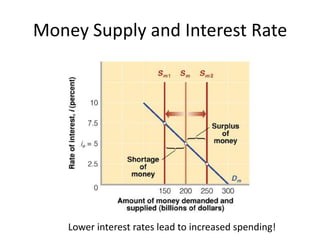
Money Supply and Interest Rate


    Lower interest rates lead to increased spending!
Choosing a Monetary Policy Target
• The fed can either choose money supply or
  interest rate.
  – Typically focus on interest rate
• There are many kinds of interest rates.
  – The Fed targets federal funds rate.
     • The interest rate banks charge each other for loans.
        – Determined by the supply of reserves relative to the demand
          for them.
     • The Fed can increase/decrease supply of bank reserves
       through open market operations and set a target for
       the federal funds rate.
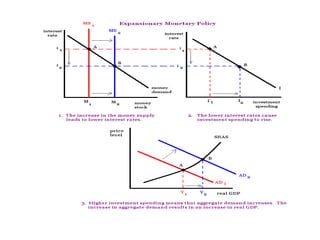
• Expansionary Monetary Policy
  – The Federal Reserve’s increasing the money
    supply and decreasing interest rates to increase
    real GDP.
  – Used during a recession when unemployment is a
    problem.
  – To increase the money supply, the Federal Reserve
    can:
     • buy government bonds (an open market purchase)
     • lower the discount rate
     • lower the reserve requirement
Too Low for Zero?
• If the Fed must reduce the federal funds rate to
  nearly zero then Quantitative Easing is tried.
  – The buying financial assets from commercial
    banks and other private institutions with newly
    created money in order to inject a pre-
    determined quantity of money into the economy.
  – Although more money is floating around, there is still
    a fixed amount of goods for sale. This will eventually
    lead to higher prices or inflation.
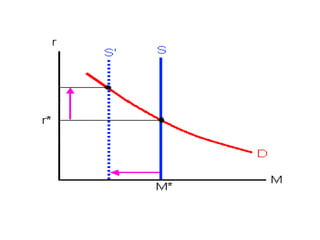
• Contractionary Monetary Policy
  – The Federal Reserve’s adjusting the money supply
    to increase the interest rates to reduce inflation.
  – Used when inflation is the problem.
  – To decrease the money supply, the Federal
    Reserve can:
     • sell government bonds (an open market sale)
     • raise the discount rate
     • raise the reserve requirement
Inflation Targeting
• Conducting monetary policy so as to commit
  the central bank to achieving a publicly
  announced level of inflation.
Can the Fed Eliminate Recessions?
• The best the Fed can do is to keep recessions
  shorter and milder then they would be
  otherwise.
  – Offsetting the effects of the business cycle
  – Timing is essential
     • If the Fed too early or late in recognizing a recession
       and implementing a policy then it could destabilize the
       economy.

Monetary Policy

  • 1.
    Monetary Policy The Basics
  • 2.
    What is MonetaryPolicy? • The actions the Federal Reserve takes to manage the money supply and interest rates to pursue macroeconomic policy goals. – Goals of Monetary Policy • Price stability • High employment • Stability of financial markets and institutions • Economic growth
  • 3.
    Price Stability • Risingprices erode the value of money as a medium of exchange and a store of value. • Increase in inflation rate results in a rise in prices. • Decrease in inflation rate results in a decrease in prices. • Keeping the inflation rate stable helps keep prices stable.
  • 4.
    High Employment • Unemployedworkers contribute to reducing GDP below its potential level. • Unemployment causes financial distress and decreases self-esteem of workers who lack jobs. – Lack of job results in less spending/more saving which decreases demand and causes inflation and prices to rise.
  • 5.
    Stability of FinancialMarkets and Institutions • The Fed promotes this so that an efficient flow of funds from savers to borrowers will occur. – Resources are lost when they are not efficient in matching savers and borrowers. – Firms with the potential to produce valuable goods and services cannot obtain the financing they need. – Savers waste resources looking for satisfactory investments.
  • 6.
    Economic Growth • Stablegrowth allows households and firms to plan accurately and encourages the long-run investment needed to sustain growth. – Provide incentives for saving for larger pool of investment funds – Provide direct incentives for business investment
  • 7.
    Monetary Policy Targets •The Fed cannot effect unemployment and inflation rates directly. • The Fed uses variables that it can affect directly and that affect variables like real GDP, employment, and price level. • Two main targets: – Money supply – Interest rate
  • 8.
    Money Supply andInterest Rate Lower interest rates lead to increased spending!
  • 9.
    Choosing a MonetaryPolicy Target • The fed can either choose money supply or interest rate. – Typically focus on interest rate • There are many kinds of interest rates. – The Fed targets federal funds rate. • The interest rate banks charge each other for loans. – Determined by the supply of reserves relative to the demand for them. • The Fed can increase/decrease supply of bank reserves through open market operations and set a target for the federal funds rate.
  • 10.
    • Expansionary MonetaryPolicy – The Federal Reserve’s increasing the money supply and decreasing interest rates to increase real GDP. – Used during a recession when unemployment is a problem. – To increase the money supply, the Federal Reserve can: • buy government bonds (an open market purchase) • lower the discount rate • lower the reserve requirement
  • 11.
    Too Low forZero? • If the Fed must reduce the federal funds rate to nearly zero then Quantitative Easing is tried. – The buying financial assets from commercial banks and other private institutions with newly created money in order to inject a pre- determined quantity of money into the economy. – Although more money is floating around, there is still a fixed amount of goods for sale. This will eventually lead to higher prices or inflation.
  • 13.
    • Contractionary MonetaryPolicy – The Federal Reserve’s adjusting the money supply to increase the interest rates to reduce inflation. – Used when inflation is the problem. – To decrease the money supply, the Federal Reserve can: • sell government bonds (an open market sale) • raise the discount rate • raise the reserve requirement
  • 15.
    Inflation Targeting • Conductingmonetary policy so as to commit the central bank to achieving a publicly announced level of inflation.
  • 16.
    Can the FedEliminate Recessions? • The best the Fed can do is to keep recessions shorter and milder then they would be otherwise. – Offsetting the effects of the business cycle – Timing is essential • If the Fed too early or late in recognizing a recession and implementing a policy then it could destabilize the economy.