Chapter 9
Banking and
the Management
of Financial
Institutions
© 2016 Pearson Education, Inc. All rights reserved.10-2
Preview
• This chapter examines how banks attempt
to maximize their profits.
• Although the discussion that follows focuses
primarily on commercial banks, many of the
same principles apply to other financial
intermediaries as well.
© 2016 Pearson Education, Inc. All rights reserved.10-3
Learning Objectives
• Summarize the features of a bank balance
sheet.
• Apply changes to a bank’s assets and
liabilities on a T-account.
• Identify ways in which banks can manage
their assets and liabilities to maximize profit.
© 2016 Pearson Education, Inc. All rights reserved.10-4
Learning Objectives
• List the ways in which banks deal with credit
risk.
• Apply gap and duration analysis and identify
interest-rate risk.
• Examine off-balance sheet activities.
© 2016 Pearson Education, Inc. All rights reserved.10-5
The Bank Balance Sheet
• Liabilities:
– Checkable deposits
– Nontransaction deposits
– Borrowings
– Bank capital
© 2016 Pearson Education, Inc. All rights reserved.10-6
The Bank Balance Sheet
• Assets:
– Reserves
– Cash items in process of collection
– Deposits at other banks
– Securities
– Loans
– Other assets
© 2016 Pearson Education, Inc. All rights reserved.10-7
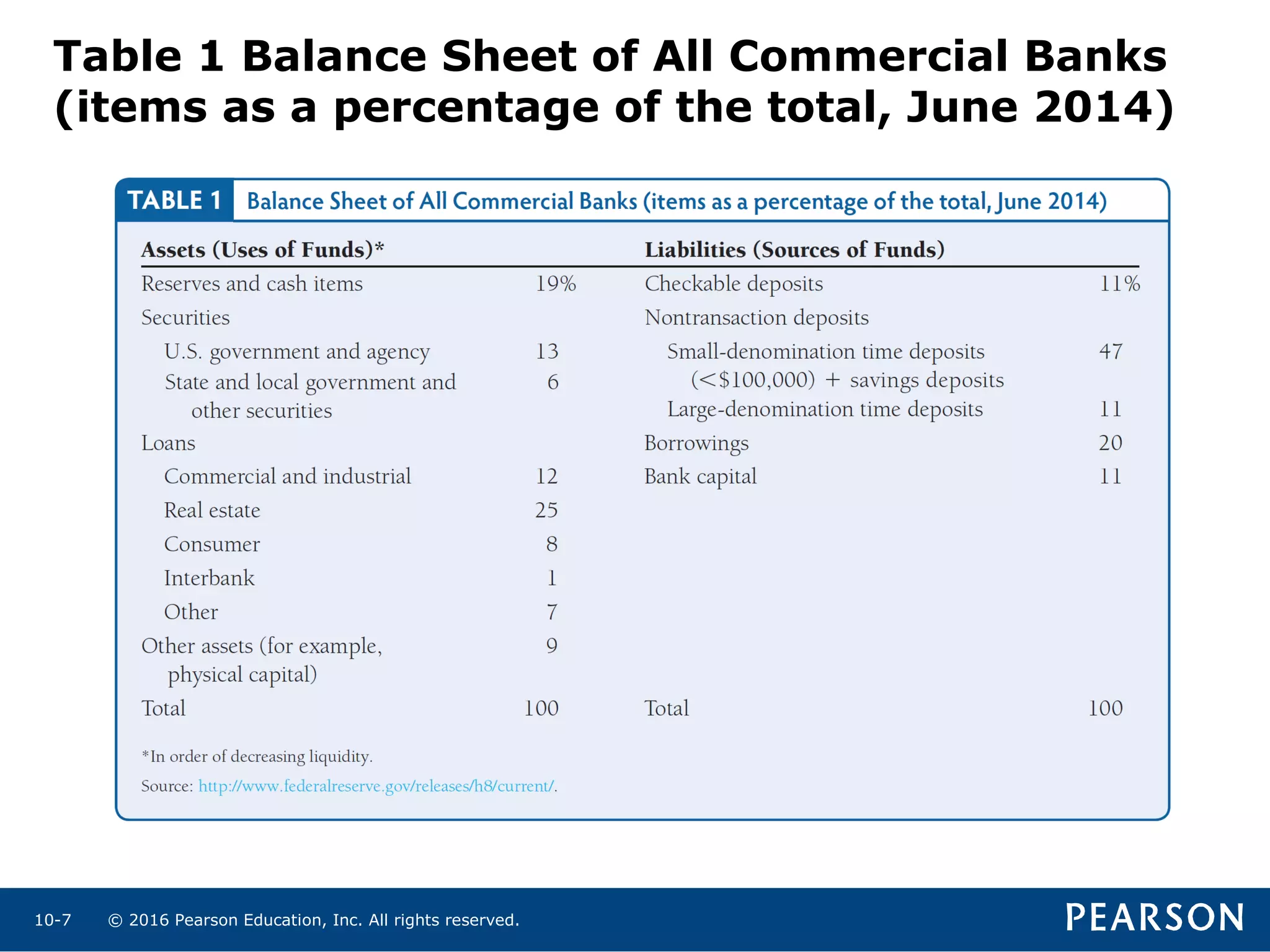
Table 1 Balance Sheet of All Commercial Banks
(items as a percentage of the total, June 2014)
© 2016 Pearson Education, Inc. All rights reserved.10-8
Basic Banking
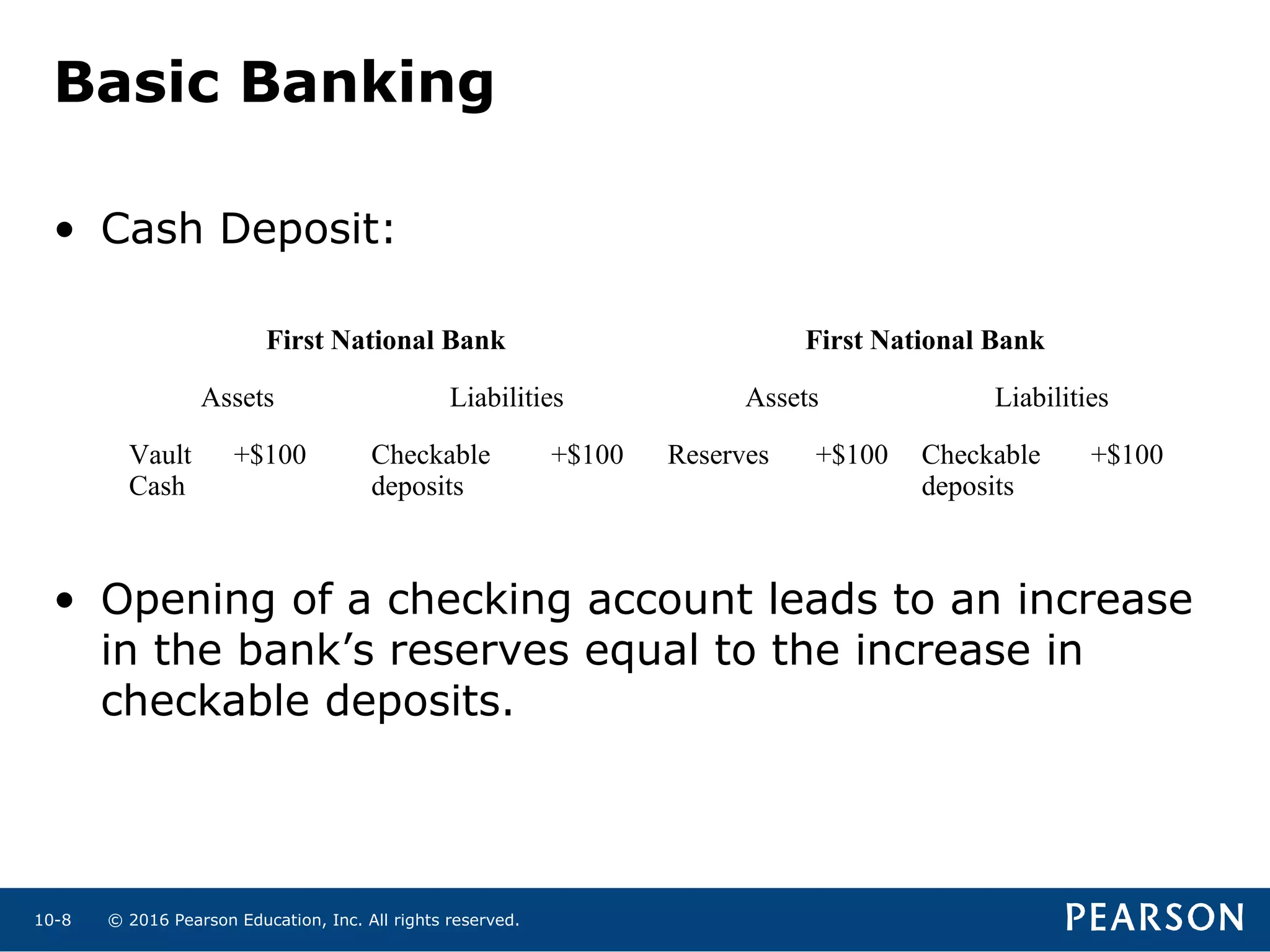
• Cash Deposit:
• Opening of a checking account leads to an increase
in the bank’s reserves equal to the increase in
checkable deposits.
First National Bank First National Bank
Assets Liabilities Assets Liabilities
Vault
Cash
+$100 Checkable
deposits
+$100 Reserves +$100 Checkable
deposits
+$100
© 2016 Pearson Education, Inc. All rights reserved.10-9
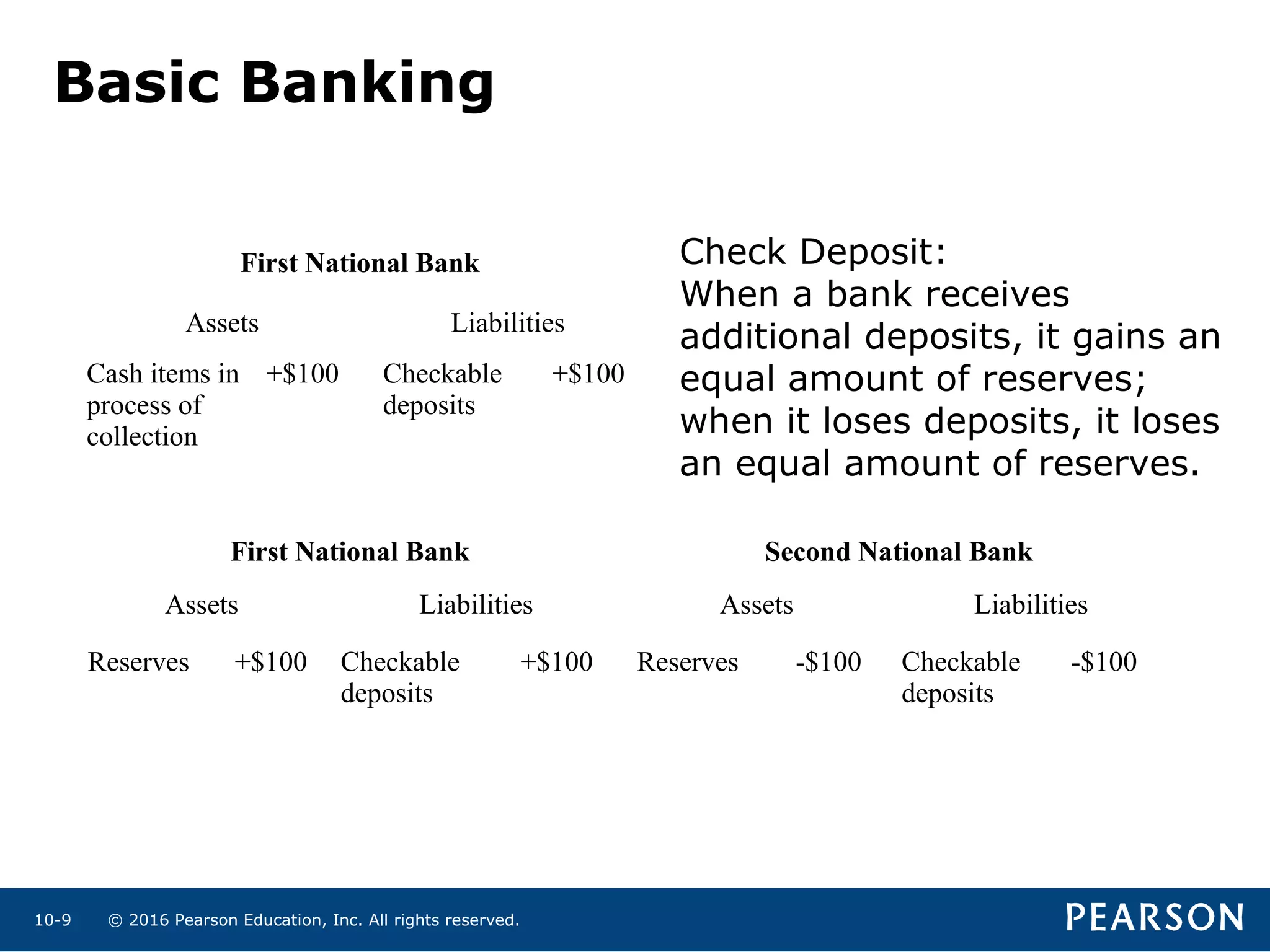
Basic Banking
First National Bank Second National Bank
Assets Liabilities Assets Liabilities
Reserves +$100 Checkable
deposits
+$100 Reserves -$100 Checkable
deposits
-$100
First National Bank
Assets Liabilities
Cash items in
process of
collection
+$100 Checkable
deposits
+$100
Check Deposit:
When a bank receives
additional deposits, it gains an
equal amount of reserves;
when it loses deposits, it loses
an equal amount of reserves.
© 2016 Pearson Education, Inc. All rights reserved.10-10
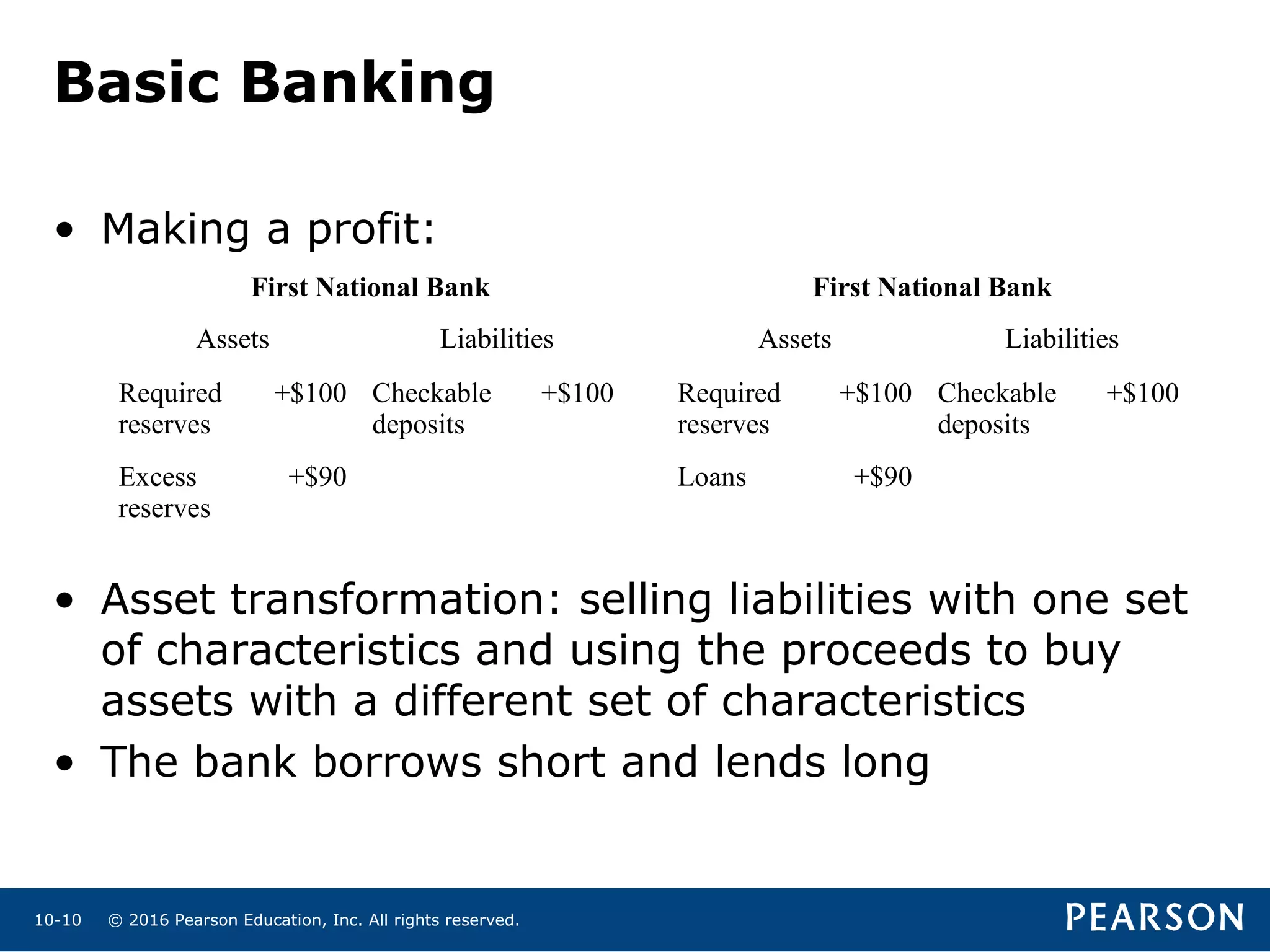
Basic Banking
• Making a profit:
• Asset transformation: selling liabilities with one set
of characteristics and using the proceeds to buy
assets with a different set of characteristics
• The bank borrows short and lends long
First National Bank First National Bank
Assets Liabilities Assets Liabilities
Required
reserves
+$100 Checkable
deposits
+$100 Required
reserves
+$100 Checkable
deposits
+$100
Excess
reserves
+$90 Loans +$90
© 2016 Pearson Education, Inc. All rights reserved.10-11
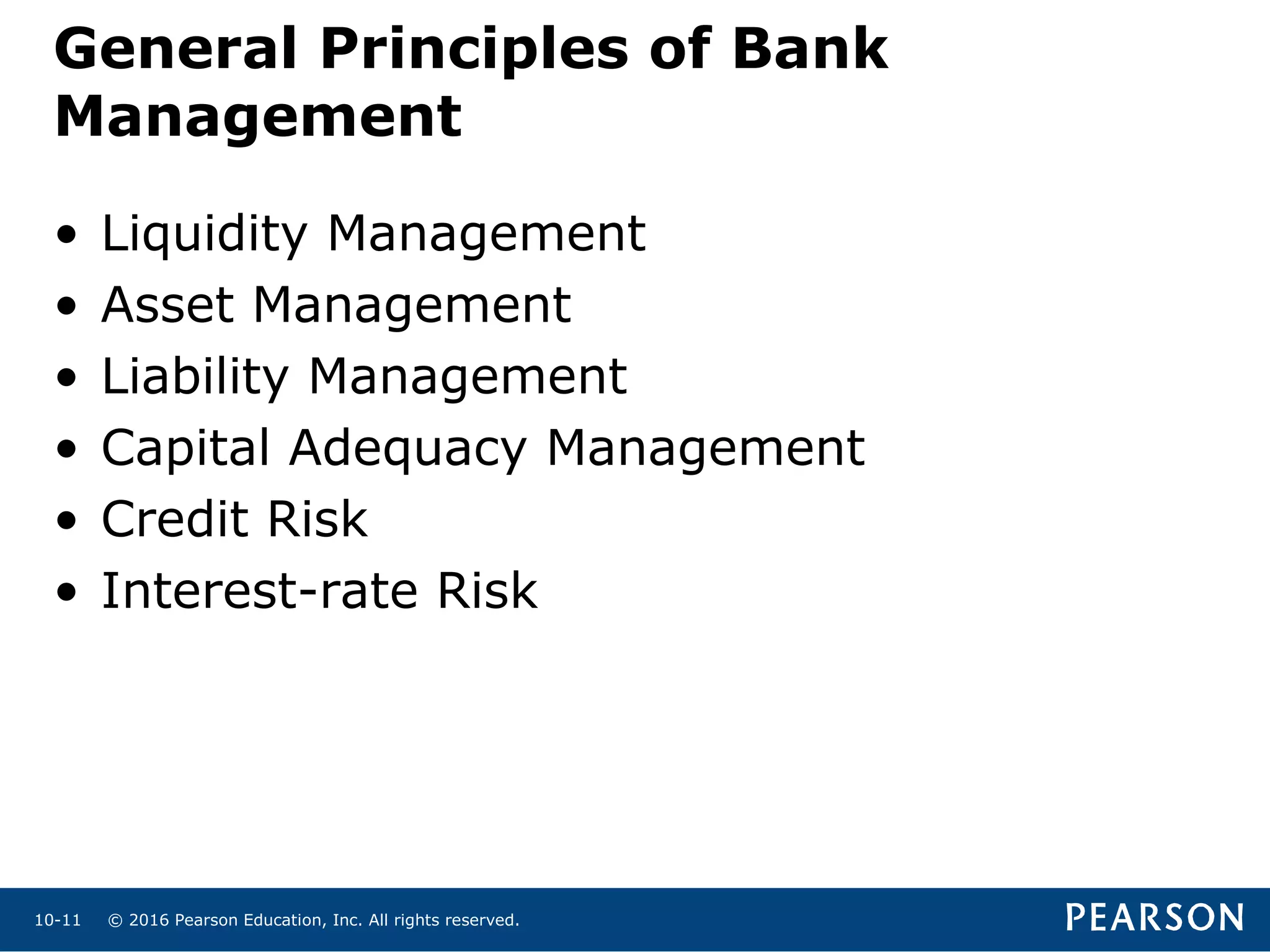
General Principles of Bank
Management
• Liquidity Management
• Asset Management
• Liability Management
• Capital Adequacy Management
• Credit Risk
• Interest-rate Risk
© 2016 Pearson Education, Inc. All rights reserved.10-12
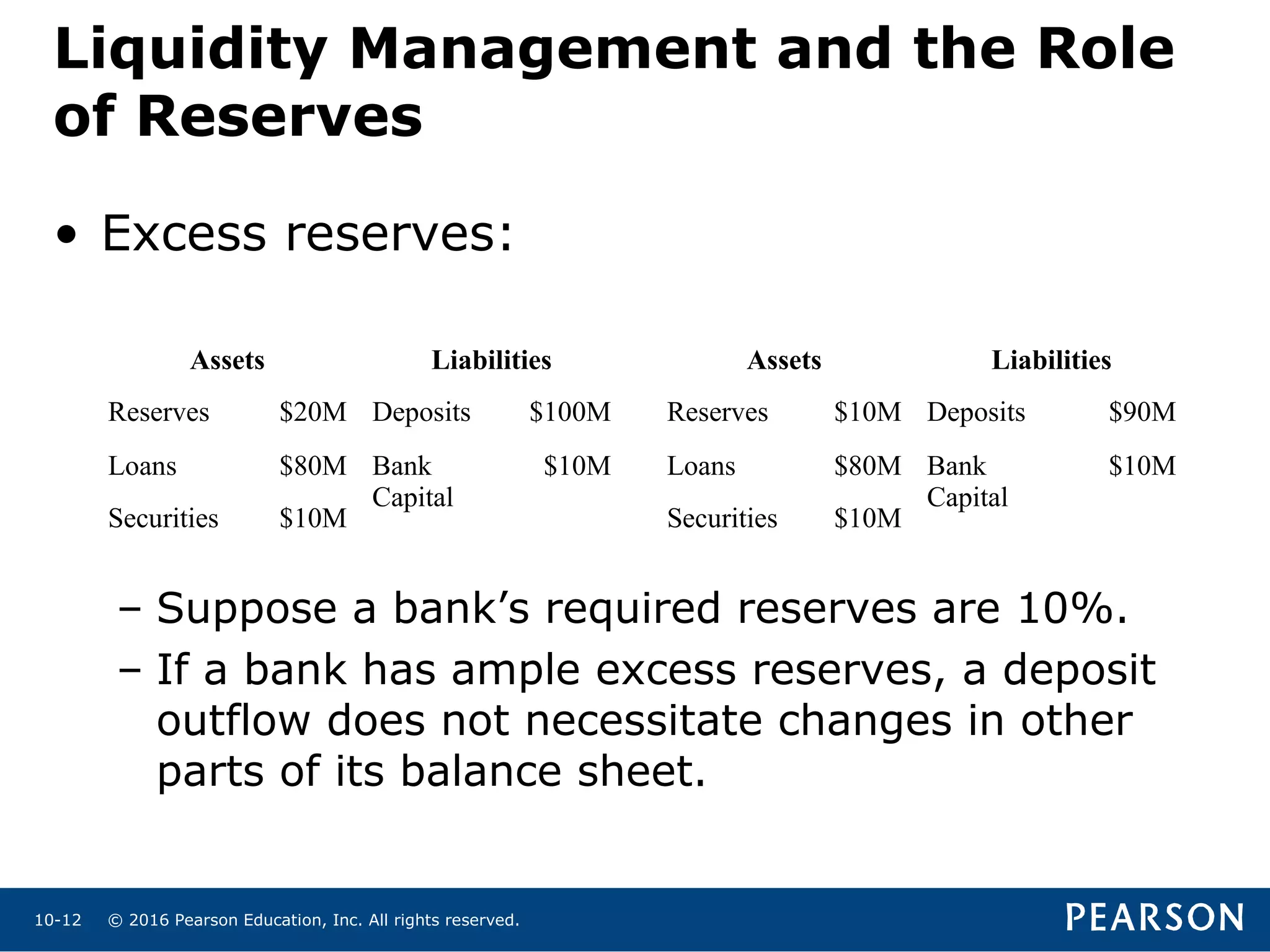
Liquidity Management and the Role
of Reserves
• Excess reserves:
– Suppose a bank’s required reserves are 10%.
– If a bank has ample excess reserves, a deposit
outflow does not necessitate changes in other
parts of its balance sheet.
Assets Liabilities Assets Liabilities
Reserves $20M Deposits $100M Reserves $10M Deposits $90M
Loans $80M Bank
Capital
$10M Loans $80M Bank
Capital
$10M
Securities $10M Securities $10M
© 2016 Pearson Education, Inc. All rights reserved.10-13
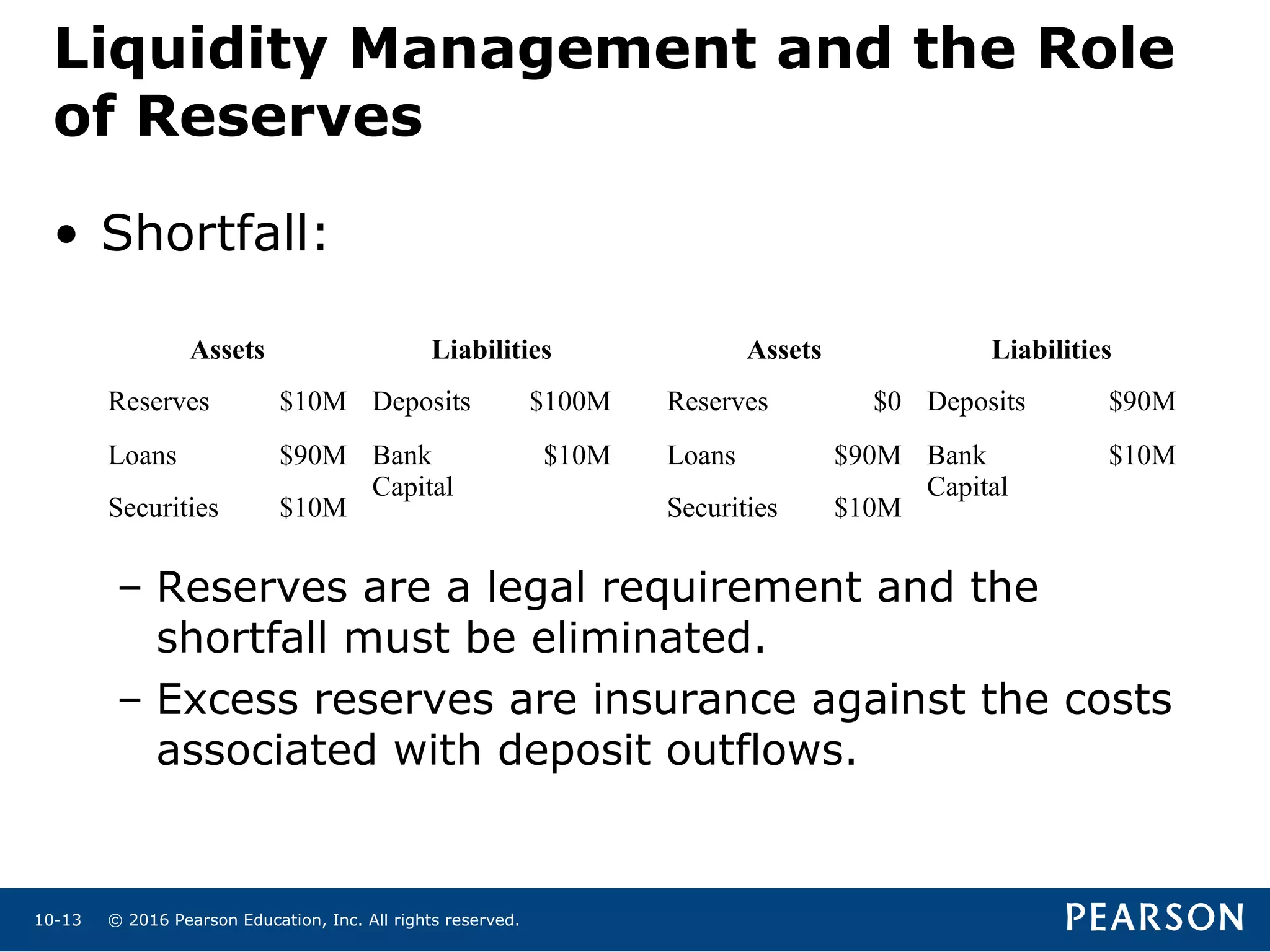
• Shortfall:
– Reserves are a legal requirement and the
shortfall must be eliminated.
– Excess reserves are insurance against the costs
associated with deposit outflows.
Assets Liabilities Assets Liabilities
Reserves $10M Deposits $100M Reserves $0 Deposits $90M
Loans $90M Bank
Capital
$10M Loans $90M Bank
Capital
$10M
Securities $10M Securities $10M
Liquidity Management and the Role
of Reserves
© 2016 Pearson Education, Inc. All rights reserved.10-14
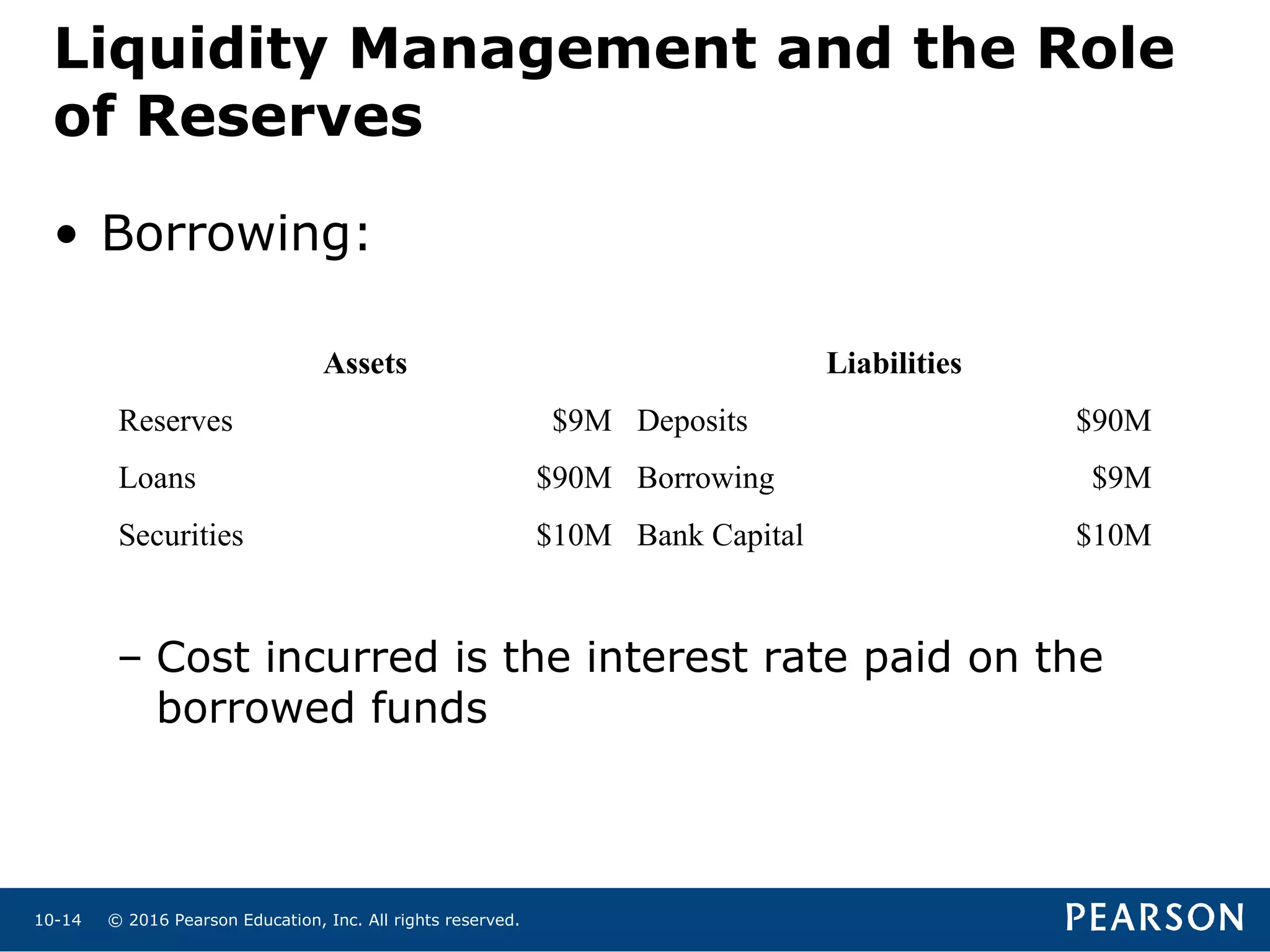
• Borrowing:
– Cost incurred is the interest rate paid on the
borrowed funds
Assets Liabilities
Reserves $9M Deposits $90M
Loans $90M Borrowing $9M
Securities $10M Bank Capital $10M
Liquidity Management and the Role
of Reserves
© 2016 Pearson Education, Inc. All rights reserved.10-15
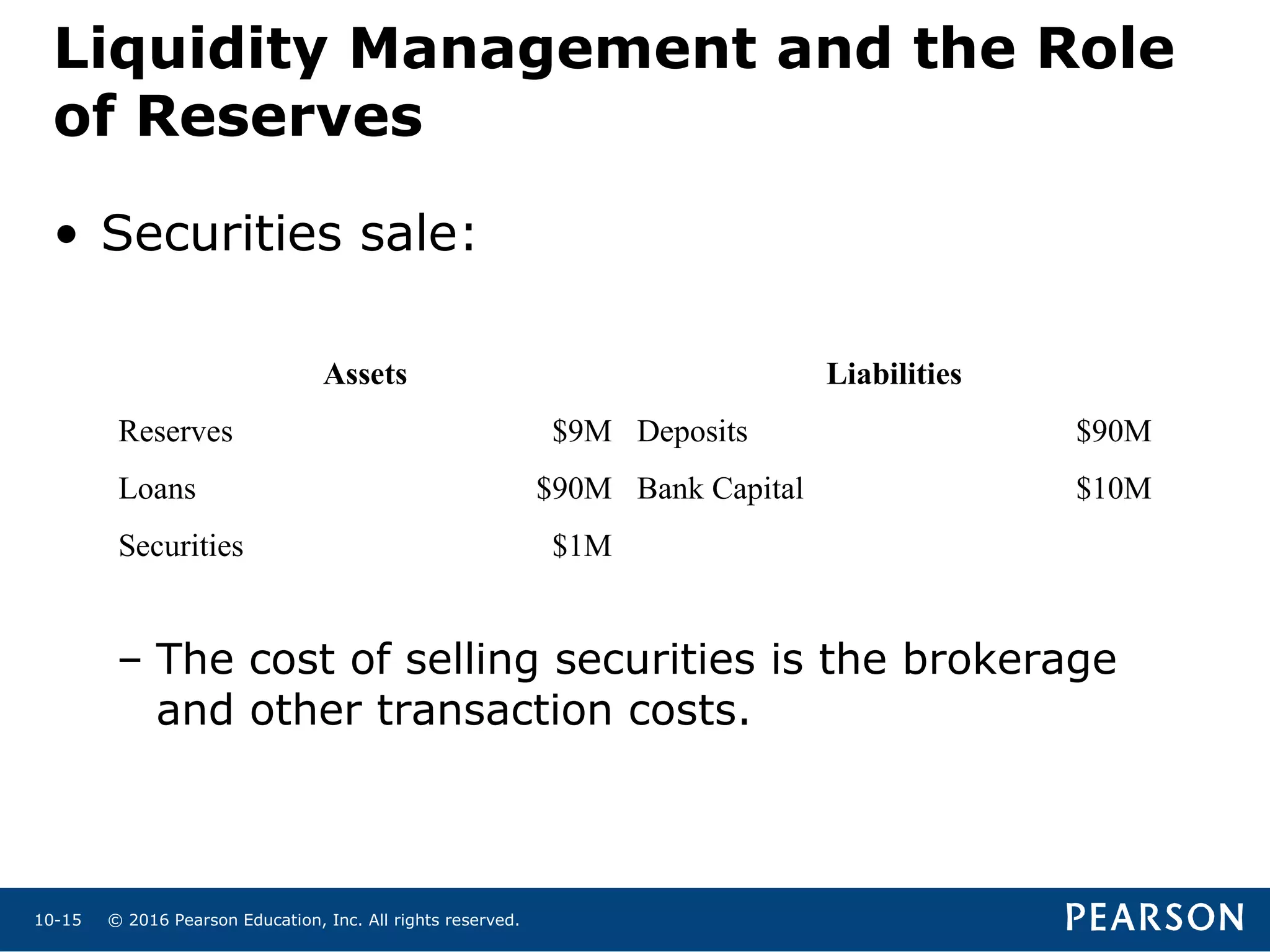
• Securities sale:
– The cost of selling securities is the brokerage
and other transaction costs.
Assets Liabilities
Reserves $9M Deposits $90M
Loans $90M Bank Capital $10M
Securities $1M
Liquidity Management and the Role
of Reserves
© 2016 Pearson Education, Inc. All rights reserved.10-16
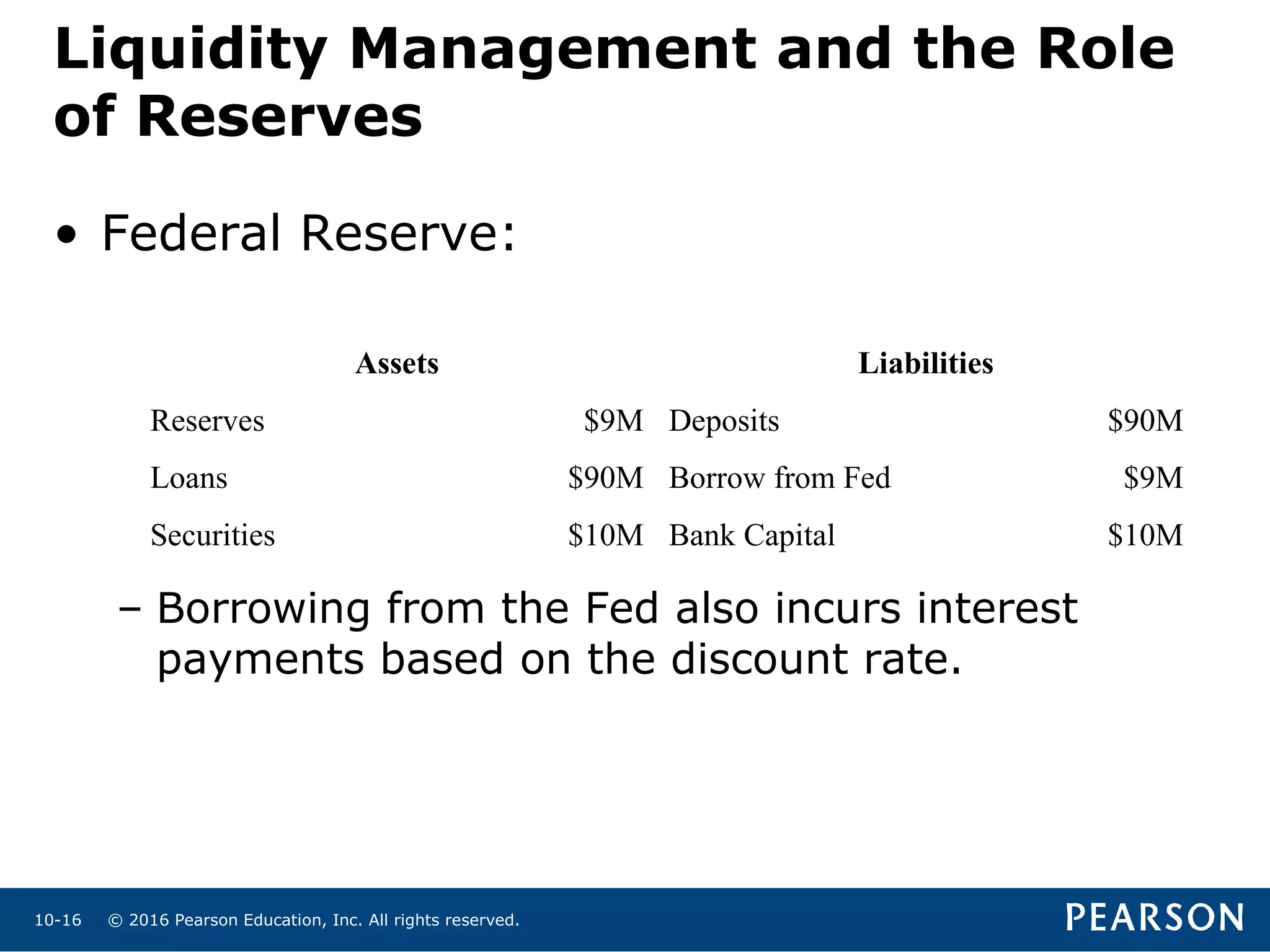
• Federal Reserve:
– Borrowing from the Fed also incurs interest
payments based on the discount rate.
Assets Liabilities
Reserves $9M Deposits $90M
Loans $90M Borrow from Fed $9M
Securities $10M Bank Capital $10M
Liquidity Management and the Role
of Reserves
© 2016 Pearson Education, Inc. All rights reserved.10-17
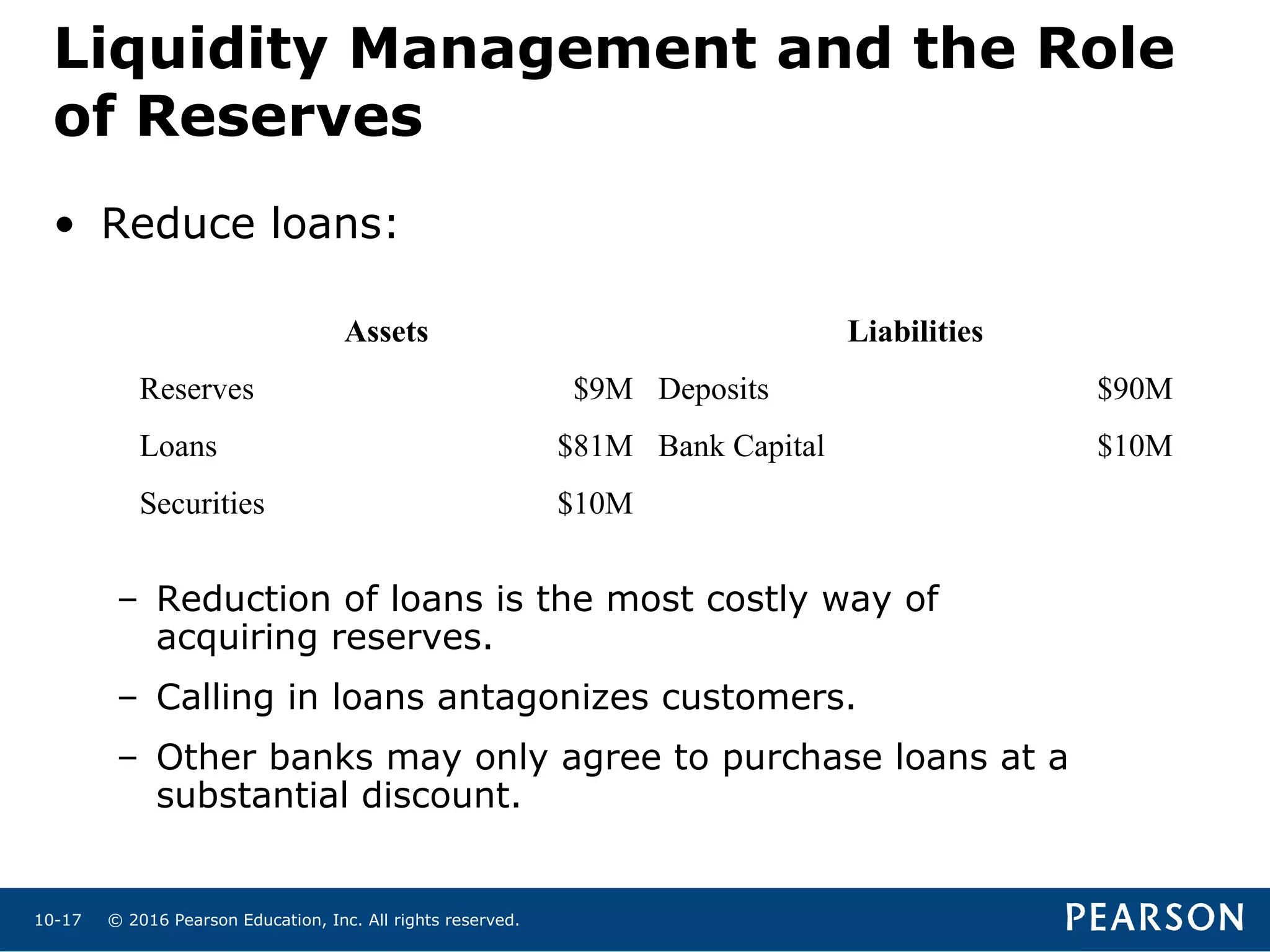
• Reduce loans:
– Reduction of loans is the most costly way of
acquiring reserves.
– Calling in loans antagonizes customers.
– Other banks may only agree to purchase loans at a
substantial discount.
Assets Liabilities
Reserves $9M Deposits $90M
Loans $81M Bank Capital $10M
Securities $10M
Liquidity Management and the Role
of Reserves
© 2016 Pearson Education, Inc. All rights reserved.10-18
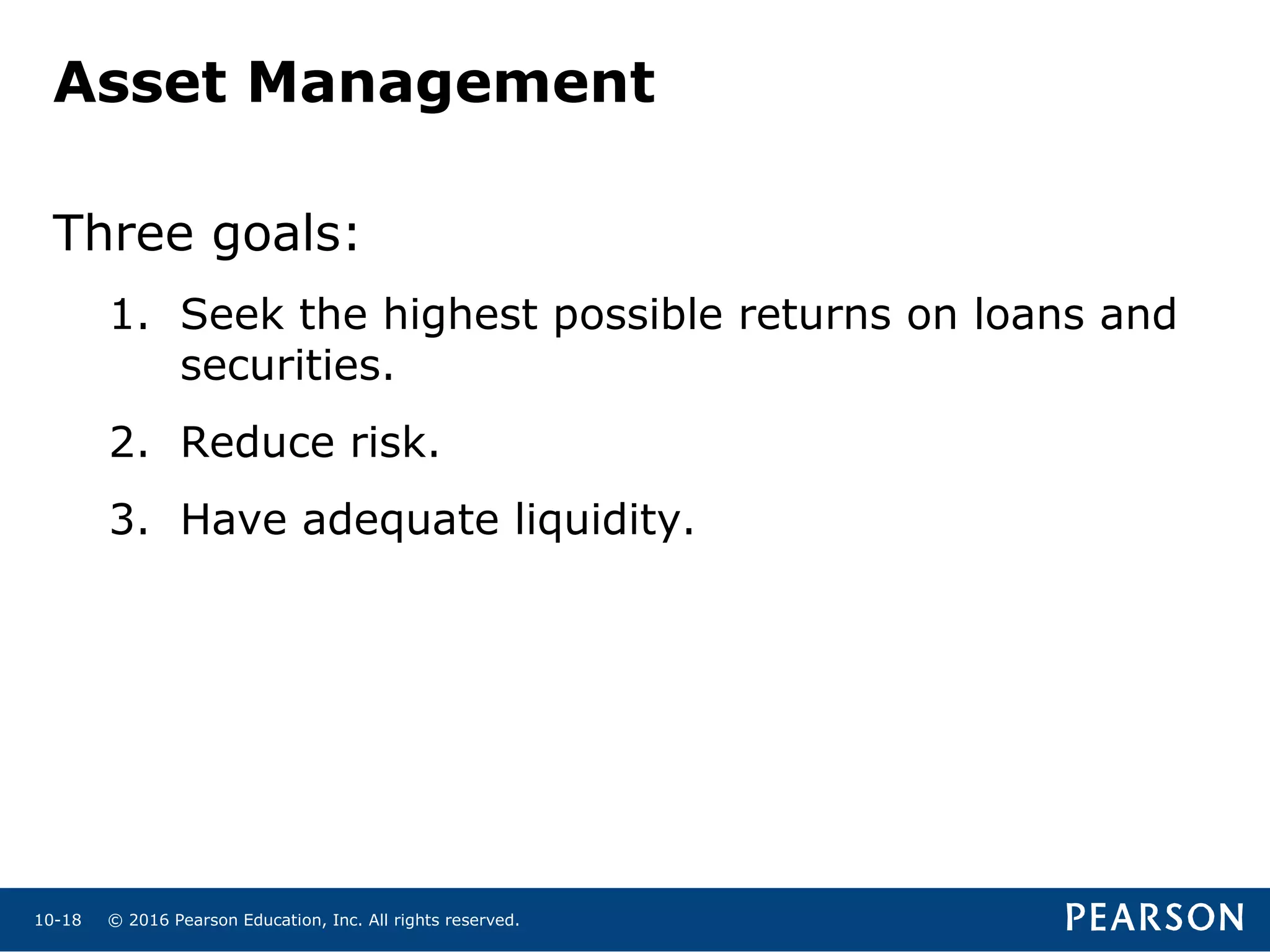
Asset Management
Three goals:
1. Seek the highest possible returns on loans and
securities.
2. Reduce risk.
3. Have adequate liquidity.
© 2016 Pearson Education, Inc. All rights reserved.10-19
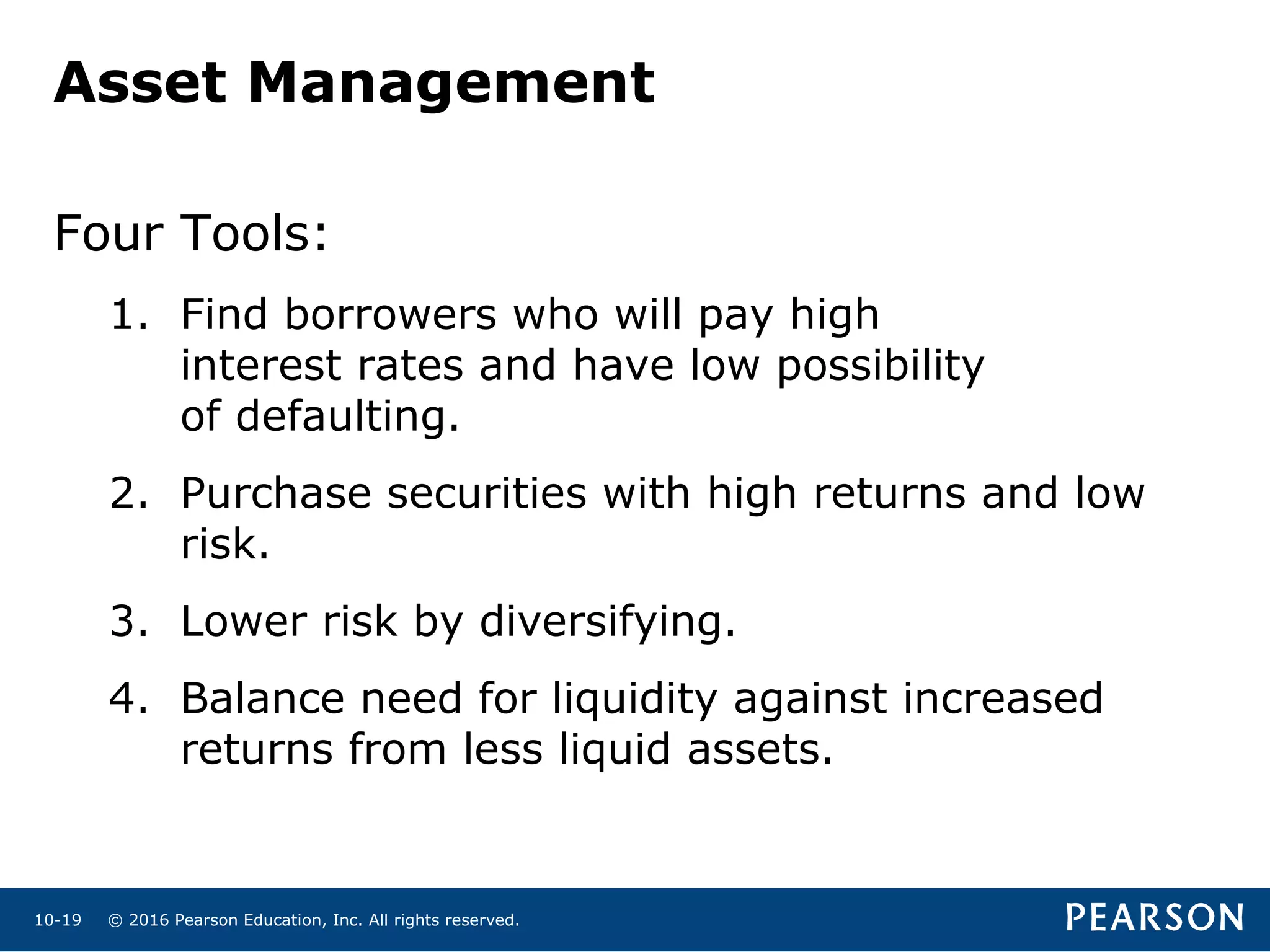
Asset Management
Four Tools:
1. Find borrowers who will pay high
interest rates and have low possibility
of defaulting.
2. Purchase securities with high returns and low
risk.
3. Lower risk by diversifying.
4. Balance need for liquidity against increased
returns from less liquid assets.
© 2016 Pearson Education, Inc. All rights reserved.10-20
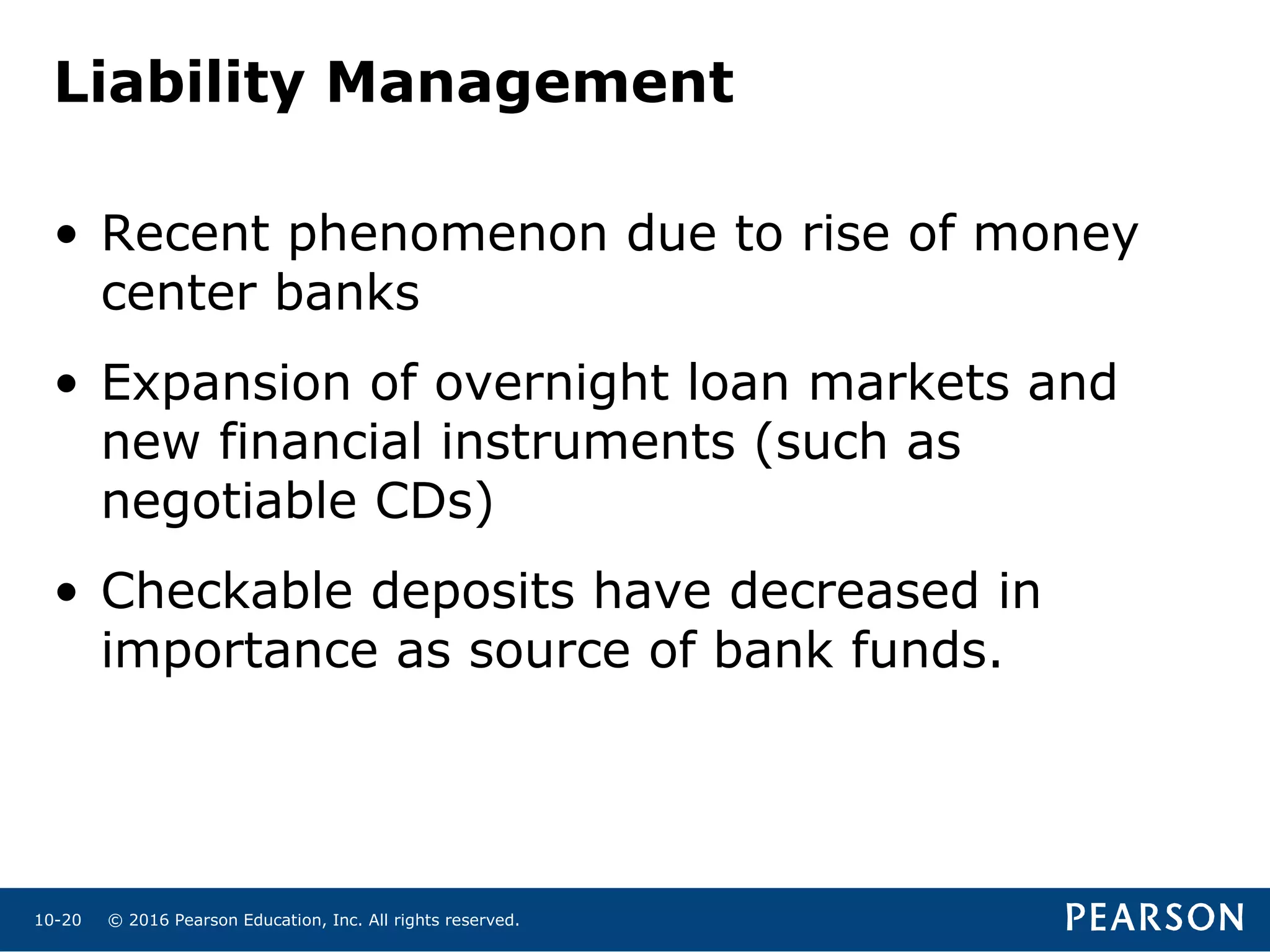
Liability Management
• Recent phenomenon due to rise of money
center banks
• Expansion of overnight loan markets and
new financial instruments (such as
negotiable CDs)
• Checkable deposits have decreased in
importance as source of bank funds.
© 2016 Pearson Education, Inc. All rights reserved.10-21
Capital Adequacy Management
• Bank capital helps prevent bank failure.
• The amount of capital affects return for the
owners (equity holders) of the bank.
• Regulatory requirement
© 2016 Pearson Education, Inc. All rights reserved.10-22
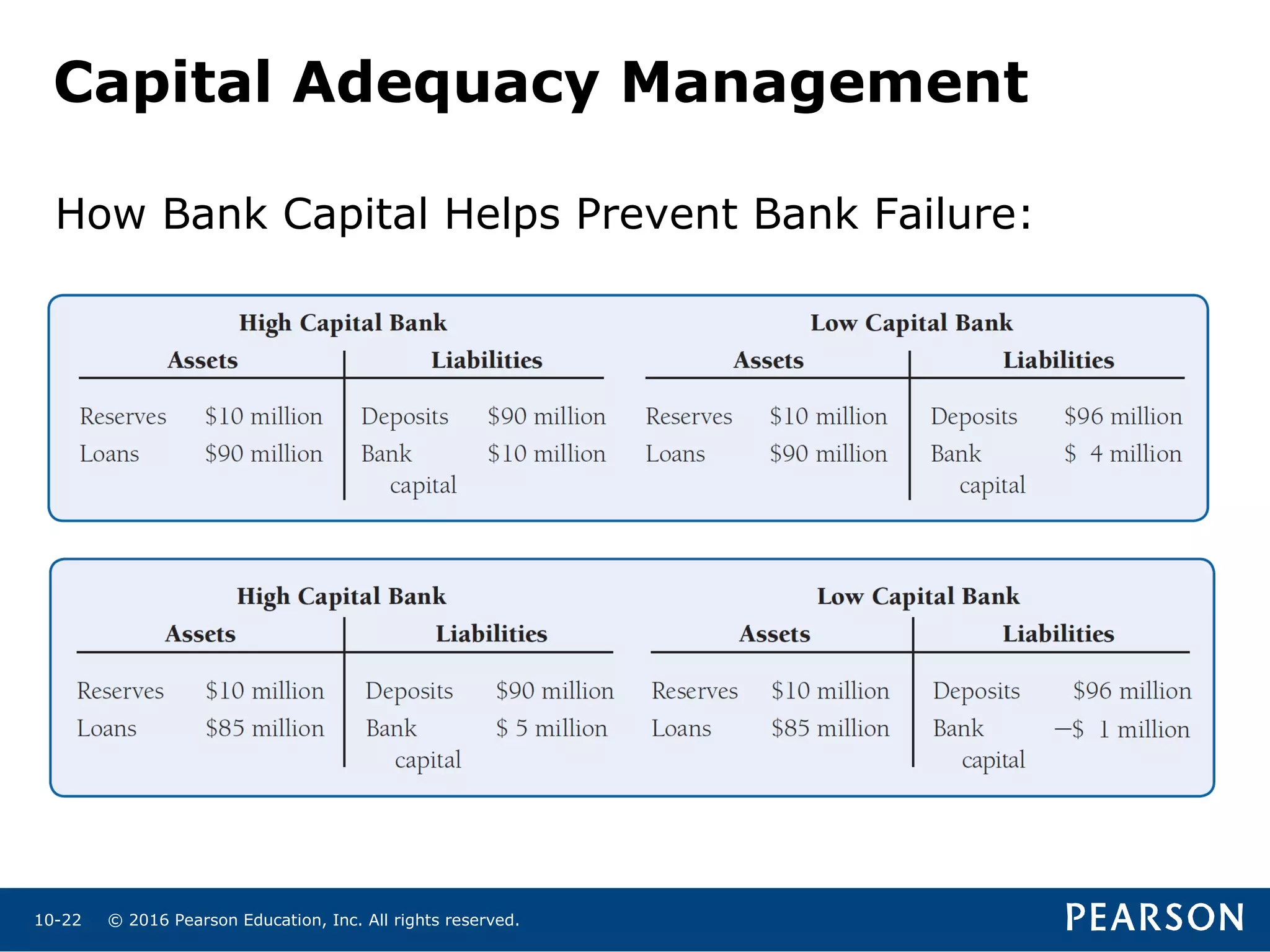
How Bank Capital Helps Prevent Bank Failure:
Capital Adequacy Management
© 2016 Pearson Education, Inc. All rights reserved.10-23
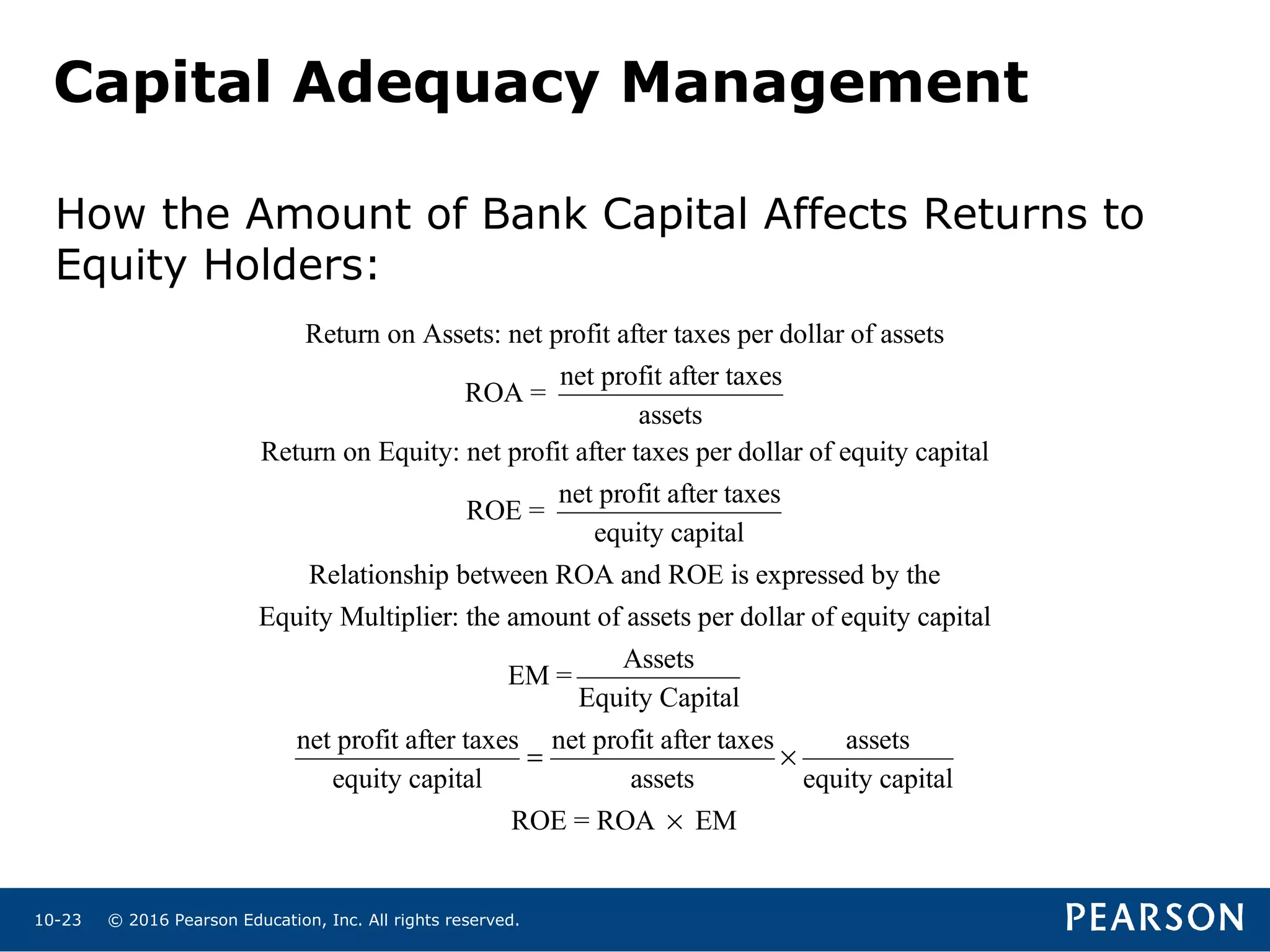
Return on Assets: net profit after taxes per dollar of assets
ROA =
net profit after taxes
assets
Return on Equity: net profit after taxes per dollar of equity capital
ROE =
net profit after taxes
equity capital
Relationship between ROA and ROE is expressed by the
Equity Multiplier: the amount of assets per dollar of equity capital
EM =
Assets
Equity Capital
net profit after taxes
equity capital
=
net profit after taxes
assets
×
assets
equity capital
ROE = ROA × EM
How the Amount of Bank Capital Affects Returns to
Equity Holders:
Capital Adequacy Management
© 2016 Pearson Education, Inc. All rights reserved.10-24
• Trade-off between safety and returns to
equity holders:
– Benefits the owners of a bank by making their
investment safe
– Costly to owners of a bank because the higher
the bank capital, the lower the return on equity
– Choice depends on the state of the economy and
levels of confidence
Capital Adequacy Management
© 2016 Pearson Education, Inc. All rights reserved.10-25
Application: How a Capital Crunch Caused a
Credit Crunch During the Global Financial Crisis
• Shortfalls of bank capital led to slower
credit growth:
– Huge losses for banks from their holdings of
securities backed by residential mortgages.
– Losses reduced bank capital
• Banks could not raise much capital on a
weak economy, and had to tighten their
lending standards and reduce lending.
© 2016 Pearson Education, Inc. All rights reserved.10-26
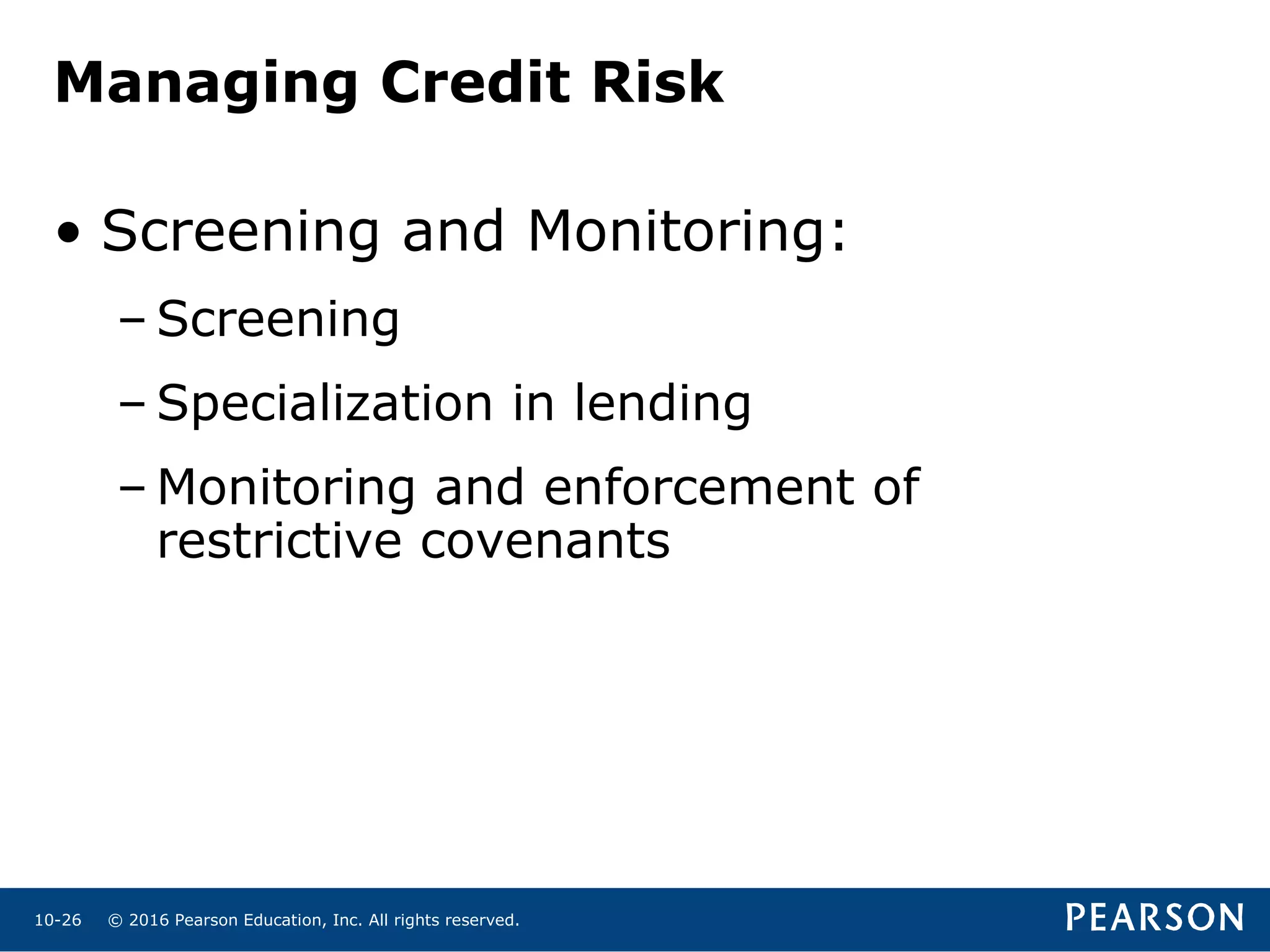
Managing Credit Risk
• Screening and Monitoring:
– Screening
– Specialization in lending
– Monitoring and enforcement of
restrictive covenants
© 2016 Pearson Education, Inc. All rights reserved.10-27
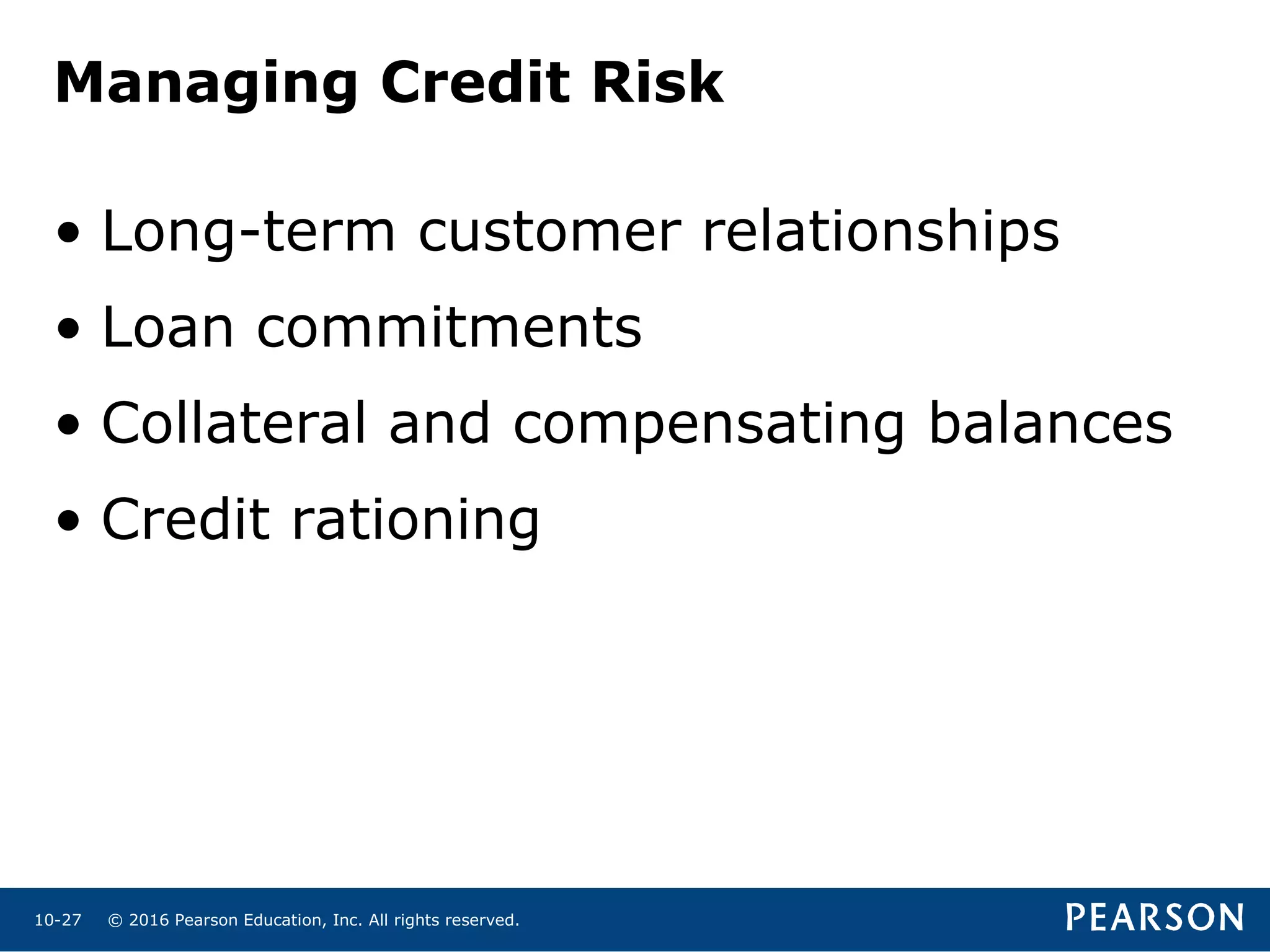
Managing Credit Risk
• Long-term customer relationships
• Loan commitments
• Collateral and compensating balances
• Credit rationing
© 2016 Pearson Education, Inc. All rights reserved.10-28
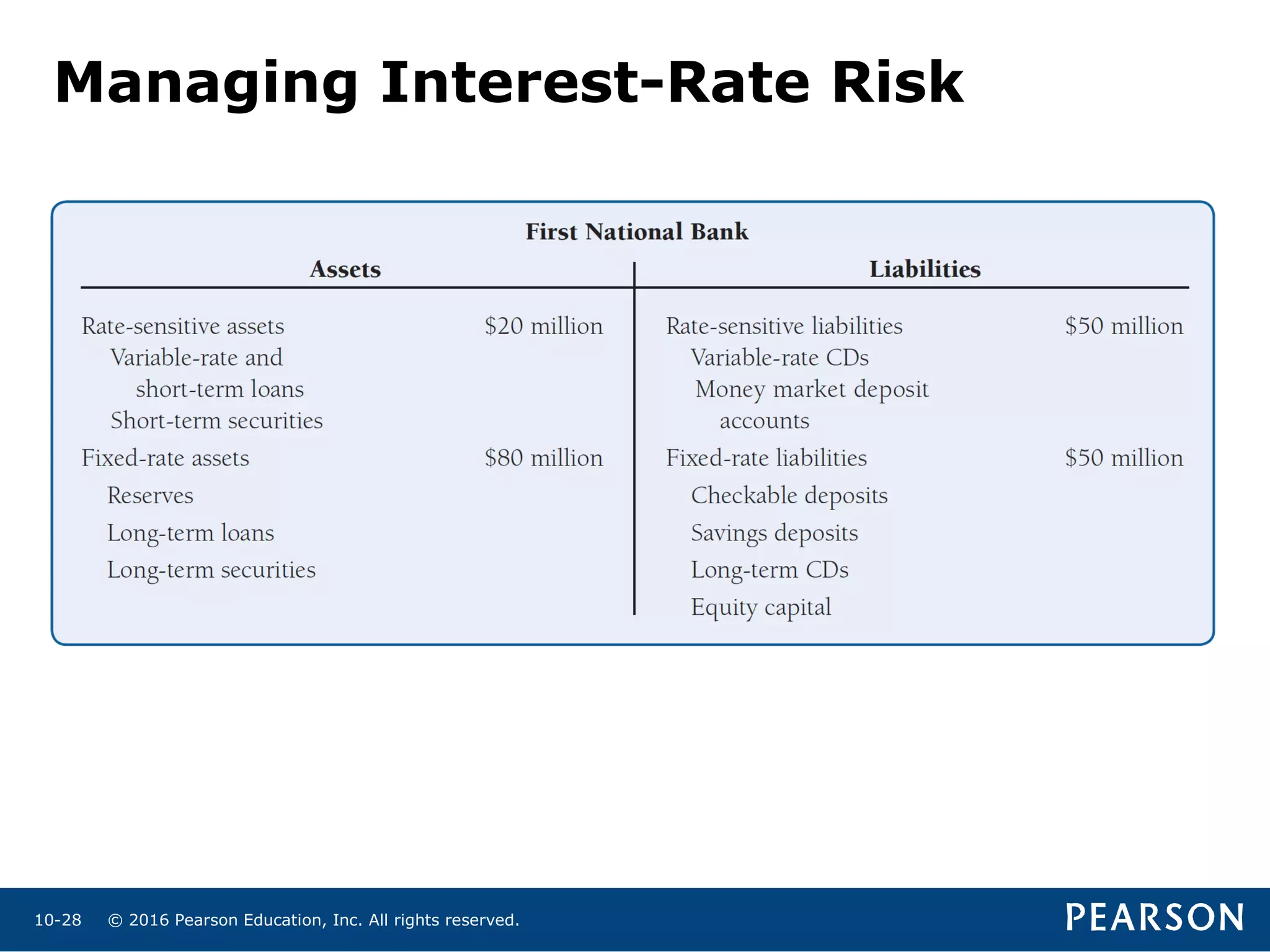
Managing Interest-Rate Risk
• If a bank has more rate-sensitive liabilities than
assets, a rise in interest rates will reduce bank
profits and a decline in interest rates will raise bank
profits.
© 2016 Pearson Education, Inc. All rights reserved.10-29
Gap and Duration Analysis
• Basic gap analysis:
(rate sensitive assets - rate sensitive liabilities) x interest rates = in bank
profit
• Maturity bucked approach:
– Measures the gap for several maturity
subintervals
• Standardized gap analysis:
– Accounts for different degrees of rate sensitivity
∆ ∆
© 2016 Pearson Education, Inc. All rights reserved.10-30
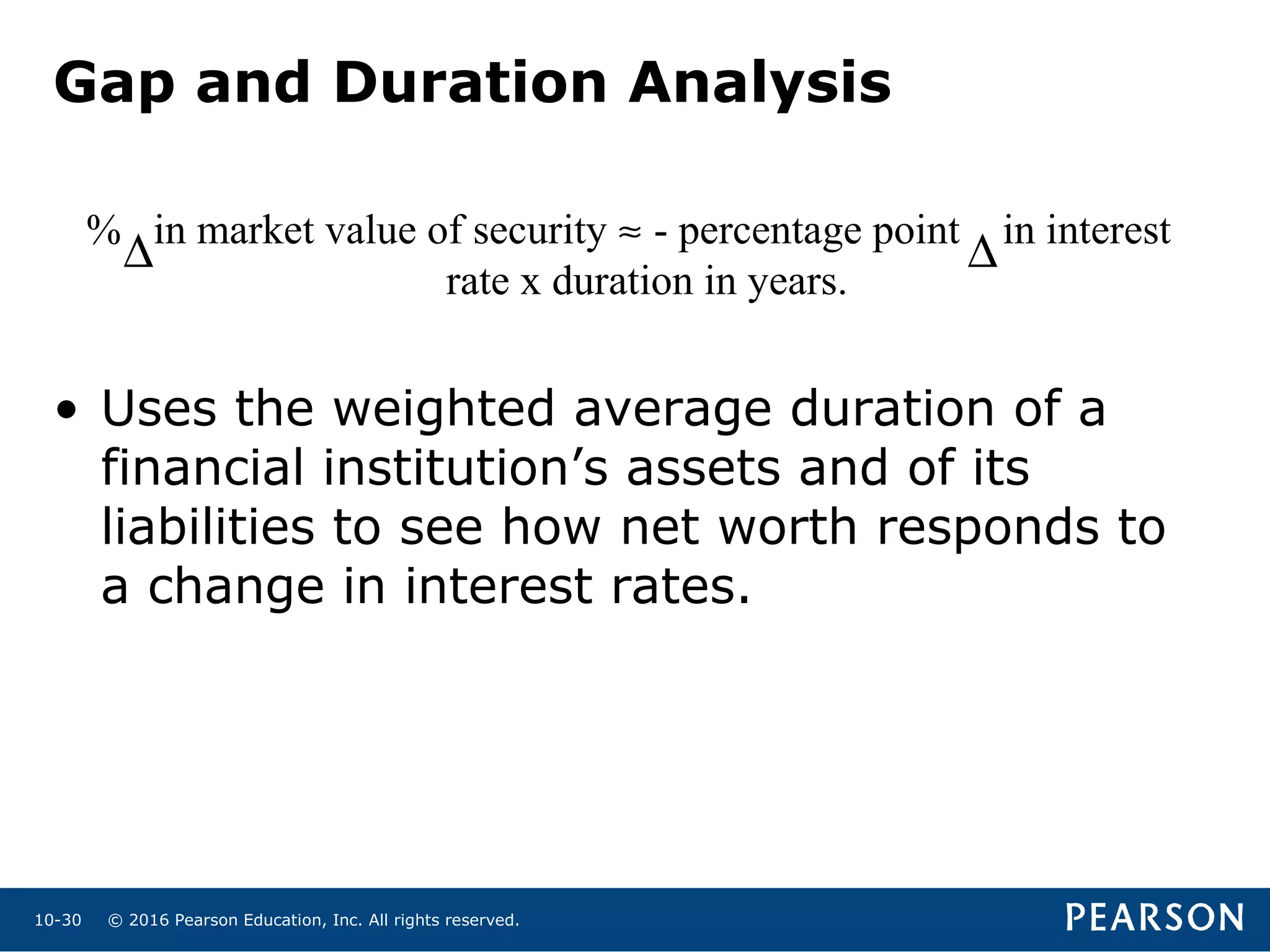
% in market value of security ≈ - percentage point in interest
rate x duration in years.
• Uses the weighted average duration of a
financial institution’s assets and of its
liabilities to see how net worth responds to
a change in interest rates.
∆ ∆
Gap and Duration Analysis
© 2016 Pearson Education, Inc. All rights reserved.10-31
Off-Balance-Sheet Activities
• Loan sales (secondary loan participation)
• Generation of fee income. Examples:
– Servicing mortgage-backed securities
– Creating SIVs (structured investment vehicles)
which can potentially expose banks to risk, as it
happened in the global financial crisis
© 2016 Pearson Education, Inc. All rights reserved.10-32
Off-Balance-Sheet Activities
• Trading activities and risk management
techniques:
– Financial futures, options for debt instruments,
interest rate swaps, transactions in the foreign
exchange market and speculation
– Principal-agent problem arises
© 2016 Pearson Education, Inc. All rights reserved.10-33
Off-Balance-Sheet Activities
• Internal controls to reduce the principal-
agent problem:
– Separation of trading activities and bookkeeping
– Limits on exposure
– Value-at-risk
– Stress testing

Ch09 mish11 embfm

  • 1.
    Chapter 9 Banking and theManagement of Financial Institutions
  • 2.
    © 2016 PearsonEducation, Inc. All rights reserved.10-2 Preview • This chapter examines how banks attempt to maximize their profits. • Although the discussion that follows focuses primarily on commercial banks, many of the same principles apply to other financial intermediaries as well.
  • 3.
    © 2016 PearsonEducation, Inc. All rights reserved.10-3 Learning Objectives • Summarize the features of a bank balance sheet. • Apply changes to a bank’s assets and liabilities on a T-account. • Identify ways in which banks can manage their assets and liabilities to maximize profit.
  • 4.
    © 2016 PearsonEducation, Inc. All rights reserved.10-4 Learning Objectives • List the ways in which banks deal with credit risk. • Apply gap and duration analysis and identify interest-rate risk. • Examine off-balance sheet activities.
  • 5.
    © 2016 PearsonEducation, Inc. All rights reserved.10-5 The Bank Balance Sheet • Liabilities: – Checkable deposits – Nontransaction deposits – Borrowings – Bank capital
  • 6.
    © 2016 PearsonEducation, Inc. All rights reserved.10-6 The Bank Balance Sheet • Assets: – Reserves – Cash items in process of collection – Deposits at other banks – Securities – Loans – Other assets
  • 7.
    © 2016 PearsonEducation, Inc. All rights reserved.10-7 Table 1 Balance Sheet of All Commercial Banks (items as a percentage of the total, June 2014)
  • 8.
    © 2016 PearsonEducation, Inc. All rights reserved.10-8 Basic Banking • Cash Deposit: • Opening of a checking account leads to an increase in the bank’s reserves equal to the increase in checkable deposits. First National Bank First National Bank Assets Liabilities Assets Liabilities Vault Cash +$100 Checkable deposits +$100 Reserves +$100 Checkable deposits +$100
  • 9.
    © 2016 PearsonEducation, Inc. All rights reserved.10-9 Basic Banking First National Bank Second National Bank Assets Liabilities Assets Liabilities Reserves +$100 Checkable deposits +$100 Reserves -$100 Checkable deposits -$100 First National Bank Assets Liabilities Cash items in process of collection +$100 Checkable deposits +$100 Check Deposit: When a bank receives additional deposits, it gains an equal amount of reserves; when it loses deposits, it loses an equal amount of reserves.
  • 10.
    © 2016 PearsonEducation, Inc. All rights reserved.10-10 Basic Banking • Making a profit: • Asset transformation: selling liabilities with one set of characteristics and using the proceeds to buy assets with a different set of characteristics • The bank borrows short and lends long First National Bank First National Bank Assets Liabilities Assets Liabilities Required reserves +$100 Checkable deposits +$100 Required reserves +$100 Checkable deposits +$100 Excess reserves +$90 Loans +$90
  • 11.
    © 2016 PearsonEducation, Inc. All rights reserved.10-11 General Principles of Bank Management • Liquidity Management • Asset Management • Liability Management • Capital Adequacy Management • Credit Risk • Interest-rate Risk
  • 12.
    © 2016 PearsonEducation, Inc. All rights reserved.10-12 Liquidity Management and the Role of Reserves • Excess reserves: – Suppose a bank’s required reserves are 10%. – If a bank has ample excess reserves, a deposit outflow does not necessitate changes in other parts of its balance sheet. Assets Liabilities Assets Liabilities Reserves $20M Deposits $100M Reserves $10M Deposits $90M Loans $80M Bank Capital $10M Loans $80M Bank Capital $10M Securities $10M Securities $10M
  • 13.
    © 2016 PearsonEducation, Inc. All rights reserved.10-13 • Shortfall: – Reserves are a legal requirement and the shortfall must be eliminated. – Excess reserves are insurance against the costs associated with deposit outflows. Assets Liabilities Assets Liabilities Reserves $10M Deposits $100M Reserves $0 Deposits $90M Loans $90M Bank Capital $10M Loans $90M Bank Capital $10M Securities $10M Securities $10M Liquidity Management and the Role of Reserves
  • 14.
    © 2016 PearsonEducation, Inc. All rights reserved.10-14 • Borrowing: – Cost incurred is the interest rate paid on the borrowed funds Assets Liabilities Reserves $9M Deposits $90M Loans $90M Borrowing $9M Securities $10M Bank Capital $10M Liquidity Management and the Role of Reserves
  • 15.
    © 2016 PearsonEducation, Inc. All rights reserved.10-15 • Securities sale: – The cost of selling securities is the brokerage and other transaction costs. Assets Liabilities Reserves $9M Deposits $90M Loans $90M Bank Capital $10M Securities $1M Liquidity Management and the Role of Reserves
  • 16.
    © 2016 PearsonEducation, Inc. All rights reserved.10-16 • Federal Reserve: – Borrowing from the Fed also incurs interest payments based on the discount rate. Assets Liabilities Reserves $9M Deposits $90M Loans $90M Borrow from Fed $9M Securities $10M Bank Capital $10M Liquidity Management and the Role of Reserves
  • 17.
    © 2016 PearsonEducation, Inc. All rights reserved.10-17 • Reduce loans: – Reduction of loans is the most costly way of acquiring reserves. – Calling in loans antagonizes customers. – Other banks may only agree to purchase loans at a substantial discount. Assets Liabilities Reserves $9M Deposits $90M Loans $81M Bank Capital $10M Securities $10M Liquidity Management and the Role of Reserves
  • 18.
    © 2016 PearsonEducation, Inc. All rights reserved.10-18 Asset Management Three goals: 1. Seek the highest possible returns on loans and securities. 2. Reduce risk. 3. Have adequate liquidity.
  • 19.
    © 2016 PearsonEducation, Inc. All rights reserved.10-19 Asset Management Four Tools: 1. Find borrowers who will pay high interest rates and have low possibility of defaulting. 2. Purchase securities with high returns and low risk. 3. Lower risk by diversifying. 4. Balance need for liquidity against increased returns from less liquid assets.
  • 20.
    © 2016 PearsonEducation, Inc. All rights reserved.10-20 Liability Management • Recent phenomenon due to rise of money center banks • Expansion of overnight loan markets and new financial instruments (such as negotiable CDs) • Checkable deposits have decreased in importance as source of bank funds.
  • 21.
    © 2016 PearsonEducation, Inc. All rights reserved.10-21 Capital Adequacy Management • Bank capital helps prevent bank failure. • The amount of capital affects return for the owners (equity holders) of the bank. • Regulatory requirement
  • 22.
    © 2016 PearsonEducation, Inc. All rights reserved.10-22 How Bank Capital Helps Prevent Bank Failure: Capital Adequacy Management
  • 23.
    © 2016 PearsonEducation, Inc. All rights reserved.10-23 Return on Assets: net profit after taxes per dollar of assets ROA = net profit after taxes assets Return on Equity: net profit after taxes per dollar of equity capital ROE = net profit after taxes equity capital Relationship between ROA and ROE is expressed by the Equity Multiplier: the amount of assets per dollar of equity capital EM = Assets Equity Capital net profit after taxes equity capital = net profit after taxes assets × assets equity capital ROE = ROA × EM How the Amount of Bank Capital Affects Returns to Equity Holders: Capital Adequacy Management
  • 24.
    © 2016 PearsonEducation, Inc. All rights reserved.10-24 • Trade-off between safety and returns to equity holders: – Benefits the owners of a bank by making their investment safe – Costly to owners of a bank because the higher the bank capital, the lower the return on equity – Choice depends on the state of the economy and levels of confidence Capital Adequacy Management
  • 25.
    © 2016 PearsonEducation, Inc. All rights reserved.10-25 Application: How a Capital Crunch Caused a Credit Crunch During the Global Financial Crisis • Shortfalls of bank capital led to slower credit growth: – Huge losses for banks from their holdings of securities backed by residential mortgages. – Losses reduced bank capital • Banks could not raise much capital on a weak economy, and had to tighten their lending standards and reduce lending.
  • 26.
    © 2016 PearsonEducation, Inc. All rights reserved.10-26 Managing Credit Risk • Screening and Monitoring: – Screening – Specialization in lending – Monitoring and enforcement of restrictive covenants
  • 27.
    © 2016 PearsonEducation, Inc. All rights reserved.10-27 Managing Credit Risk • Long-term customer relationships • Loan commitments • Collateral and compensating balances • Credit rationing
  • 28.
    © 2016 PearsonEducation, Inc. All rights reserved.10-28 Managing Interest-Rate Risk • If a bank has more rate-sensitive liabilities than assets, a rise in interest rates will reduce bank profits and a decline in interest rates will raise bank profits.
  • 29.
    © 2016 PearsonEducation, Inc. All rights reserved.10-29 Gap and Duration Analysis • Basic gap analysis: (rate sensitive assets - rate sensitive liabilities) x interest rates = in bank profit • Maturity bucked approach: – Measures the gap for several maturity subintervals • Standardized gap analysis: – Accounts for different degrees of rate sensitivity ∆ ∆
  • 30.
    © 2016 PearsonEducation, Inc. All rights reserved.10-30 % in market value of security ≈ - percentage point in interest rate x duration in years. • Uses the weighted average duration of a financial institution’s assets and of its liabilities to see how net worth responds to a change in interest rates. ∆ ∆ Gap and Duration Analysis
  • 31.
    © 2016 PearsonEducation, Inc. All rights reserved.10-31 Off-Balance-Sheet Activities • Loan sales (secondary loan participation) • Generation of fee income. Examples: – Servicing mortgage-backed securities – Creating SIVs (structured investment vehicles) which can potentially expose banks to risk, as it happened in the global financial crisis
  • 32.
    © 2016 PearsonEducation, Inc. All rights reserved.10-32 Off-Balance-Sheet Activities • Trading activities and risk management techniques: – Financial futures, options for debt instruments, interest rate swaps, transactions in the foreign exchange market and speculation – Principal-agent problem arises
  • 33.
    © 2016 PearsonEducation, Inc. All rights reserved.10-33 Off-Balance-Sheet Activities • Internal controls to reduce the principal- agent problem: – Separation of trading activities and bookkeeping – Limits on exposure – Value-at-risk – Stress testing