
CHAPTER THIRTEEN TEACHING LEARNING STRATEGIES, CONTENT, AND STUDY SKILLS
 
Motivation Motivation to learn or participate is essential to the success of any intervention approach. For an intervention to be effective for a student with learning problems, the individual must be motivated. For adolescents with learning problems, it’s a roadblock to school success.
Motivation to Participate The adage “ You can lead a horse to water, but you can’t make him drink.” May be altered to … “ Although you can’t make a horse drink the water, you can salt the hay.”
Examples of Extrinsic Motivation Time for listening to music on a CD or MP3 player Tokens for progress on academics Tangible reinforcers such as restaurant coupons, magazines, and movie tickets Exemption from some homework or assignments Extra time for a break or lunch
Extrinsic Motivation (cont’d) The most useful techniques include: token economies contingency contracting verbal feedback
Motivation Strategies To promote development of active and independent learners, some motivation strategies attempt to teach self-control skills including: Goal setting Self-recording of progress Self-evaluation Self-reinforcement
Tactics to Enhance Intrinsic Motivation Enhance student’s perception that learning is worthwhile, and discuss the relevance (real-life applications). Obtain a commitment to options that the student values and indicates a desire to pursue (i.e. contractural agreement). Schedule conferences with student to enhance his/her role in making choices and negotiating agreements. Provide feedback that conveys student progress.
Learning Strategies A learning strategies approach helps students with learning problems cope with the complex demands of the secondary curriculum. Definition of learning strategies:  “Techniques, principles, or rules that enable a student to learn, to solve problems, and to complete tasks independently.” (Deshler and Colleagues at the University of Kansas Center for Research on Learning)
The Goal The goal of  strategy development  is to identify strategies that are optimally effective and efficient. The goal of  strategy instruction  is to teach the strategies effectively and efficiently.
Learning Strategies Curriculum (University of Kansas Center for Research on Learning) The manuals advise teachers on how to provide intensive instruction to adolescents with learning problems and how to promote the acquisition, storage, and expression of information and demonstration of competence through instruction in learning strategies.
Features of Effective Learning Strategies Effective and efficient learning strategies share critical features in the parameters of content, design, and usefulness. All strategies use a mnemonic (i.e. acronym) to organize the strategy steps and assist the student to remember the content and order of the steps.
Instructional Procedures Instructional stages that are used to teach adolescents with learning problems a variety of skills and strategies: Stage 1:  Pretest and make commitments Stage 2:  Describe the strategy Stage 3:  Model the strategy Stage 4:  Verbal elaboration and rehearsal
Instructional Stages (cont’d) Stage 5:  Controlled practice and feedback Stage 6:  Advanced practice and feedback Stage 7:  Confirm acquisition and make generalization commitments Stage 8:  Generalization
Acquisition and Generalization of Skills and Strategies 1.  The student should be committed to learning the strategy and fully understand the purpose and benefits. 2.  The physical and mental actions covered in the strategy should be fully described and explained. 3.  The student should be taught to remember the strategy to facilitate the process of self-instruction. 4.  The student should understand the process of learning the strategy and participate in goal-setting activities. 5.  Multiple models of the strategy should be provided, and an appropriate balance between physical and mental activities involved in the strategy should be achieved.
Acquisition and Generalization of Skills and Strategies (cont’d) 6.  The student should be enlisted in the model and become a full participant in guiding the strategy instructional process. 7.  The strategy should be understood fully and memorized before practice in the strategy is initiated. 8.  Practice should begin with controlled guided practice and conclude with advanced independent practice. 9.  A measurement system should provide ongoing information that will demonstrate to the student and the teacher that the strategy is being learned and used and that the demands of the setting are being met. 10.  Though generalization should be promoted throughout the strategy acquisition process, specific efforts to promote generalization should follow strategy acquisition.
Content Instruction In most educational programs, adolescents with learning problems spend the majority of their school day in general education classes. The general education teacher must individualize and modify instruction to accommodate the needs of students with learning problems.
Content Instruction (cont’d) The accommodations requested from special educators may include altering either how content should be delivered or evaluated or the nature or quantity of the the content that the teacher expects students to master. Inclusion teachers use numerous  instructional   alternatives  to help these students, often referred to as: Accommodation techniques Compensatory techniques Instructional adaptations
Problem-Solving Sequence for General & Special Educators Determine the requirements for “making it” in the general class. Specify the course requirements that the student is not satisfying. Identify factors hindering the student’s performance. Brainstorm possible classroom accommodations. Select a plan of action. Implement the plan. Evaluate the plan.
Content Enhancements Content enhancements are techniques that enable the teacher to help students identify, organize, comprehend, and retain critical information. Enhancements can be used to: make abstract information more concrete connect new knowledge with familiar knowledge highlight relationships an organizational structures within the information to be presented draw the unmotivated learner’s attention to the information
Content Enhancements (cont’d) HOWEVER, simply using a content enhancement as part of a lesson  cannot  be viewed as an effective practice.  Research indicates that the teacher must help the student see how the enhancement is working and enlist each student’s active involvement and support in using the enhancement in the learning process.
Types of Content Enhancements (Hudson, Lignugaris-Kraft, and Miller 1993) 1.  Advance organizers 2. Visual displays 3. Study guides 4. Mnemonic devices 5. Audio recordings 6. Computer-assisted instruction 7. Peer-mediated instruction
Adapting Materials Developing parallel curriculum Simplifying texts Using audio texts
Assignments Research in the area of homework indicates that the more time a student spends working on homework, the higher the student’s achievement.  HOWEVER, to ensure the positive benefits of homework, the assignments must be appropriate for the students’s ability and achievement levels.
More Research on Assignments Research findings on different types of assignment and the assignment-completion process indicate that creating better-structured and better-organized assignments may not improve the assignment-completion process if students’ interest or motivation is not addressed.
Tutoring At the secondary level, earning academic credits is a major instructional concern.  Some special education teachers teach and assign credit for course content or provide tutoring in subject areas required for graduation.
Tutoring (cont’d) Carlson (1995) suggests that guidelines or standards are needed for implementing and evaluating tutoring. 3 principles for tutoring instruction: Instruction should be powerful. Instruction should result in long-range benefits to the learner. Teacher expectations for learner performance should be high.
Testing Students with learning problems frequently have difficulty displaying their knowledge or skills on tests.  Modifications in test formats often help them perform better.
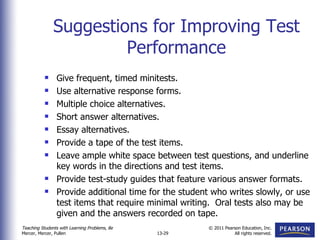
Suggestions for Improving Test Performance Give frequent, timed minitests. Use alternative response forms. Multiple choice alternatives. Short answer alternatives. Essay alternatives. Provide a tape of the test items. Leave ample white space between test questions, and underline key words in the directions and test items. Provide test-study guides that feature various answer formats. Provide additional time for the student who writes slowly, or use test items that require minimal writing.  Oral tests also may be given and the answers recorded on tape.
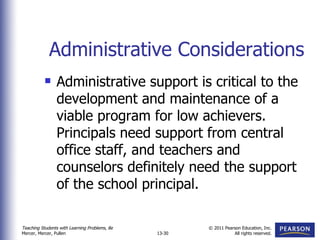
Administrative Considerations Administrative support is critical to the development and maintenance of a viable program for low achievers.  Principals need support from central office staff, and teachers and counselors definitely need the support of the school principal.
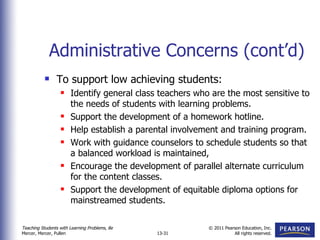
Administrative Concerns (cont’d) To support low achieving students: Identify general class teachers who are the most sensitive to the needs of students with learning problems. Support the development of a homework hotline. Help establish a parental involvement and training program. Work with guidance counselors to schedule students so that a balanced workload is maintained, Encourage the development of parallel alternate curriculum for the content classes. Support the development of equitable diploma options for mainstreamed students.
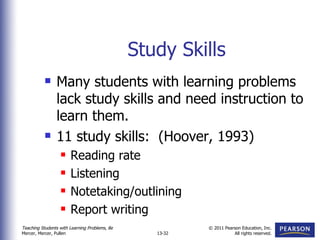
Study Skills Many students with learning problems lack study skills and need instruction to learn them. 11 study skills:  (Hoover, 1993) Reading rate Listening Notetaking/outlining Report writing
11 Study Skills (cont’d) Oral presentation Graphic aids Test taking Library use Reference/dictionary use Time management Self-management of behavior
Preparatory Study Skills Activities for developing time management Activities for developing self-management
Acquisition Study Skills Activities for listening and notetaking Activities for developing skills in textbook usage Activities for developing reading and study skills Activities for developing reading and notetaking skills Activities for developing skills in using visual aids Sequential study methods
Recall Study Skills Activities for developing study-rehearsal skills Activities for developing mnemonic devices
Expression Study Skills Activities for developing test-taking skills Activities for developing written expression skills Activities for developing oral presentation skills

Ch13LectPP

  • 1.
    CHAPTER THIRTEEN TEACHINGLEARNING STRATEGIES, CONTENT, AND STUDY SKILLS
  • 2.
  • 3.
    Motivation Motivation tolearn or participate is essential to the success of any intervention approach. For an intervention to be effective for a student with learning problems, the individual must be motivated. For adolescents with learning problems, it’s a roadblock to school success.
  • 4.
    Motivation to ParticipateThe adage “ You can lead a horse to water, but you can’t make him drink.” May be altered to … “ Although you can’t make a horse drink the water, you can salt the hay.”
  • 5.
    Examples of ExtrinsicMotivation Time for listening to music on a CD or MP3 player Tokens for progress on academics Tangible reinforcers such as restaurant coupons, magazines, and movie tickets Exemption from some homework or assignments Extra time for a break or lunch
  • 6.
    Extrinsic Motivation (cont’d)The most useful techniques include: token economies contingency contracting verbal feedback
  • 7.
    Motivation Strategies Topromote development of active and independent learners, some motivation strategies attempt to teach self-control skills including: Goal setting Self-recording of progress Self-evaluation Self-reinforcement
  • 8.
    Tactics to EnhanceIntrinsic Motivation Enhance student’s perception that learning is worthwhile, and discuss the relevance (real-life applications). Obtain a commitment to options that the student values and indicates a desire to pursue (i.e. contractural agreement). Schedule conferences with student to enhance his/her role in making choices and negotiating agreements. Provide feedback that conveys student progress.
  • 9.
    Learning Strategies Alearning strategies approach helps students with learning problems cope with the complex demands of the secondary curriculum. Definition of learning strategies: “Techniques, principles, or rules that enable a student to learn, to solve problems, and to complete tasks independently.” (Deshler and Colleagues at the University of Kansas Center for Research on Learning)
  • 10.
    The Goal Thegoal of strategy development is to identify strategies that are optimally effective and efficient. The goal of strategy instruction is to teach the strategies effectively and efficiently.
  • 11.
    Learning Strategies Curriculum(University of Kansas Center for Research on Learning) The manuals advise teachers on how to provide intensive instruction to adolescents with learning problems and how to promote the acquisition, storage, and expression of information and demonstration of competence through instruction in learning strategies.
  • 12.
    Features of EffectiveLearning Strategies Effective and efficient learning strategies share critical features in the parameters of content, design, and usefulness. All strategies use a mnemonic (i.e. acronym) to organize the strategy steps and assist the student to remember the content and order of the steps.
  • 13.
    Instructional Procedures Instructionalstages that are used to teach adolescents with learning problems a variety of skills and strategies: Stage 1: Pretest and make commitments Stage 2: Describe the strategy Stage 3: Model the strategy Stage 4: Verbal elaboration and rehearsal
  • 14.
    Instructional Stages (cont’d)Stage 5: Controlled practice and feedback Stage 6: Advanced practice and feedback Stage 7: Confirm acquisition and make generalization commitments Stage 8: Generalization
  • 15.
    Acquisition and Generalizationof Skills and Strategies 1. The student should be committed to learning the strategy and fully understand the purpose and benefits. 2. The physical and mental actions covered in the strategy should be fully described and explained. 3. The student should be taught to remember the strategy to facilitate the process of self-instruction. 4. The student should understand the process of learning the strategy and participate in goal-setting activities. 5. Multiple models of the strategy should be provided, and an appropriate balance between physical and mental activities involved in the strategy should be achieved.
  • 16.
    Acquisition and Generalizationof Skills and Strategies (cont’d) 6. The student should be enlisted in the model and become a full participant in guiding the strategy instructional process. 7. The strategy should be understood fully and memorized before practice in the strategy is initiated. 8. Practice should begin with controlled guided practice and conclude with advanced independent practice. 9. A measurement system should provide ongoing information that will demonstrate to the student and the teacher that the strategy is being learned and used and that the demands of the setting are being met. 10. Though generalization should be promoted throughout the strategy acquisition process, specific efforts to promote generalization should follow strategy acquisition.
  • 17.
    Content Instruction Inmost educational programs, adolescents with learning problems spend the majority of their school day in general education classes. The general education teacher must individualize and modify instruction to accommodate the needs of students with learning problems.
  • 18.
    Content Instruction (cont’d)The accommodations requested from special educators may include altering either how content should be delivered or evaluated or the nature or quantity of the the content that the teacher expects students to master. Inclusion teachers use numerous instructional alternatives to help these students, often referred to as: Accommodation techniques Compensatory techniques Instructional adaptations
  • 19.
    Problem-Solving Sequence forGeneral & Special Educators Determine the requirements for “making it” in the general class. Specify the course requirements that the student is not satisfying. Identify factors hindering the student’s performance. Brainstorm possible classroom accommodations. Select a plan of action. Implement the plan. Evaluate the plan.
  • 20.
    Content Enhancements Contentenhancements are techniques that enable the teacher to help students identify, organize, comprehend, and retain critical information. Enhancements can be used to: make abstract information more concrete connect new knowledge with familiar knowledge highlight relationships an organizational structures within the information to be presented draw the unmotivated learner’s attention to the information
  • 21.
    Content Enhancements (cont’d)HOWEVER, simply using a content enhancement as part of a lesson cannot be viewed as an effective practice. Research indicates that the teacher must help the student see how the enhancement is working and enlist each student’s active involvement and support in using the enhancement in the learning process.
  • 22.
    Types of ContentEnhancements (Hudson, Lignugaris-Kraft, and Miller 1993) 1. Advance organizers 2. Visual displays 3. Study guides 4. Mnemonic devices 5. Audio recordings 6. Computer-assisted instruction 7. Peer-mediated instruction
  • 23.
    Adapting Materials Developingparallel curriculum Simplifying texts Using audio texts
  • 24.
    Assignments Research inthe area of homework indicates that the more time a student spends working on homework, the higher the student’s achievement. HOWEVER, to ensure the positive benefits of homework, the assignments must be appropriate for the students’s ability and achievement levels.
  • 25.
    More Research onAssignments Research findings on different types of assignment and the assignment-completion process indicate that creating better-structured and better-organized assignments may not improve the assignment-completion process if students’ interest or motivation is not addressed.
  • 26.
    Tutoring At thesecondary level, earning academic credits is a major instructional concern. Some special education teachers teach and assign credit for course content or provide tutoring in subject areas required for graduation.
  • 27.
    Tutoring (cont’d) Carlson(1995) suggests that guidelines or standards are needed for implementing and evaluating tutoring. 3 principles for tutoring instruction: Instruction should be powerful. Instruction should result in long-range benefits to the learner. Teacher expectations for learner performance should be high.
  • 28.
    Testing Students withlearning problems frequently have difficulty displaying their knowledge or skills on tests. Modifications in test formats often help them perform better.
  • 29.
    Suggestions for ImprovingTest Performance Give frequent, timed minitests. Use alternative response forms. Multiple choice alternatives. Short answer alternatives. Essay alternatives. Provide a tape of the test items. Leave ample white space between test questions, and underline key words in the directions and test items. Provide test-study guides that feature various answer formats. Provide additional time for the student who writes slowly, or use test items that require minimal writing. Oral tests also may be given and the answers recorded on tape.
  • 30.
    Administrative Considerations Administrativesupport is critical to the development and maintenance of a viable program for low achievers. Principals need support from central office staff, and teachers and counselors definitely need the support of the school principal.
  • 31.
    Administrative Concerns (cont’d)To support low achieving students: Identify general class teachers who are the most sensitive to the needs of students with learning problems. Support the development of a homework hotline. Help establish a parental involvement and training program. Work with guidance counselors to schedule students so that a balanced workload is maintained, Encourage the development of parallel alternate curriculum for the content classes. Support the development of equitable diploma options for mainstreamed students.
  • 32.
    Study Skills Manystudents with learning problems lack study skills and need instruction to learn them. 11 study skills: (Hoover, 1993) Reading rate Listening Notetaking/outlining Report writing
  • 33.
    11 Study Skills(cont’d) Oral presentation Graphic aids Test taking Library use Reference/dictionary use Time management Self-management of behavior
  • 34.
    Preparatory Study SkillsActivities for developing time management Activities for developing self-management
  • 35.
    Acquisition Study SkillsActivities for listening and notetaking Activities for developing skills in textbook usage Activities for developing reading and study skills Activities for developing reading and notetaking skills Activities for developing skills in using visual aids Sequential study methods
  • 36.
    Recall Study SkillsActivities for developing study-rehearsal skills Activities for developing mnemonic devices
  • 37.
    Expression Study SkillsActivities for developing test-taking skills Activities for developing written expression skills Activities for developing oral presentation skills