Chapter - 5
Risk and Return: Portfolio
Theory and Assets Pricing
Models
2
Financial Management, Ninth Edition © I M Pandey
Vikas Publishing House Pvt. Ltd.
Chapter Objectives
 Discuss the concepts of portfolio risk and
return.
 Determine the relationship between risk and
return of portfolios.
 Highlight the difference between systematic
and unsystematic risks.
 Examine the logic of portfolio theory .
 Show the use of capital asset pricing model
(CAPM) in the valuation of securities.
 Explain the features and modus operandi of
the arbitrage pricing theory (APT).
3
Financial Management, Ninth Edition © I M Pandey
Vikas Publishing House Pvt. Ltd.
Introduction
 A portfolio is a bundle or a combination of
individual assets or securities.
 The portfolio theory provides a normative
approach to investors to make decisions to
invest their wealth in assets or securities
under risk.
 It is based on the assumption that investors are
risk-averse.
 The second assumption of the portfolio theory is
that the returns of assets are normally distributed.
4
Financial Management, Ninth Edition © I M Pandey
Vikas Publishing House Pvt. Ltd.
Portfolio Return: Two-Asset Case
 The return of a portfolio is equal to the
weighted average of the returns of individual
assets (or securities) in the portfolio with
weights being equal to the proportion of
investment value in each asset.
Expected return on portfolio weight of security × expected return on security
weight of security × expected return on security
X X
Y Y


5
Financial Management, Ninth Edition © I M Pandey
Vikas Publishing House Pvt. Ltd.
Portfolio Risk: Two-Asset Case
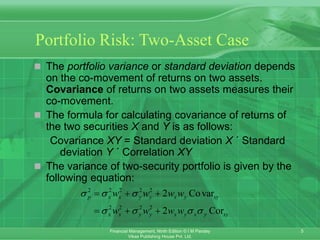
 The portfolio variance or standard deviation depends
on the co-movement of returns on two assets.
Covariance of returns on two assets measures their
co-movement.
 The formula for calculating covariance of returns of
the two securities X and Y is as follows:
Covariance XY = Standard deviation X ´ Standard
deviation Y ´ Correlation XY
 The variance of two-security portfolio is given by the
following equation:
2 2 2 2 2
2 2 2 2
2 Covar
2 Cor
p x x y y x y xy
x x y y x y x y xy
w w w w
w w w w
  
   
  
  
6
Financial Management, Ninth Edition © I M Pandey
Vikas Publishing House Pvt. Ltd.
Minimum Variance Portfolio
 w* is the optimum proportion of investment in
security X. Investment in Y will be: 1 – w*.
2
2 2
Cov
*
2Cov
y xy
x y xy
w

 


 
7
Financial Management, Ninth Edition © I M Pandey
Vikas Publishing House Pvt. Ltd.
Portfolio Risk Depends on Correlation
between Assets
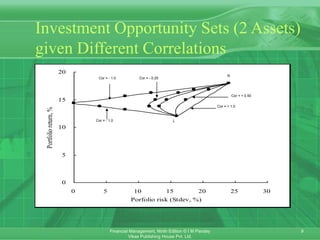
 When correlation coefficient of returns on
individual securities is perfectly positive (i.e.,
cor = 1.0), then there is no advantage of
diversification.
 The weighted standard deviation of returns
on individual securities is equal to the
standard deviation of the portfolio.
 We may therefore conclude that
diversification always reduces risk provided
the correlation coefficient is less than 1.
8
Financial Management, Ninth Edition © I M Pandey
Vikas Publishing House Pvt. Ltd.
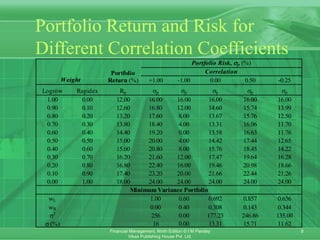
Portfolio Return and Risk for
Different Correlation Coefficients
Portfolio Risk, p (%)
Correlation
Weight
Portfolio
Return (%) +1.00 -1.00 0.00 0.50 -0.25
Logrow Rapidex Rp p p p p p
1.00 0.00 12.00 16.00 16.00 16.00 16.00 16.00
0.90 0.10 12.60 16.80 12.00 14.60 15.74 13.99
0.80 0.20 13.20 17.60 8.00 13.67 15.76 12.50
0.70 0.30 13.80 18.40 4.00 13.31 16.06 11.70
0.60 0.40 14.40 19.20 0.00 13.58 16.63 11.76
0.50 0.50 15.00 20.00 4.00 14.42 17.44 12.65
0.40 0.60 15.60 20.80 8.00 15.76 18.45 14.22
0.30 0.70 16.20 21.60 12.00 17.47 19.64 16.28
0.20 0.80 16.80 22.40 16.00 19.46 20.98 18.66
0.10 0.90 17.40 23.20 20.00 21.66 22.44 21.26
0.00 1.00 18.00 24.00 24.00 24.00 24.00 24.00
Minimum Variance Portfolio
wL 1.00 0.60 0.692 0.857 0.656
wR 0.00 0.40 0.308 0.143 0.344
2
256 0.00 177.23 246.86 135.00
 (%) 16 0.00 13.31 15.71 11.62
9
Financial Management, Ninth Edition © I M Pandey
Vikas Publishing House Pvt. Ltd.
Investment Opportunity Sets (2 Assets)
given Different Correlations
0
5
10
15
20
0 5 10 15 20 25 30
Porfolio risk (Stdev, %)
Portfolio
return,
%
Cor = - 1.0
Cor = - 0.25
Cor = + 1.0
Cor = + 0.50
Cor = - 1.0
L
R
10
Financial Management, Ninth Edition © I M Pandey
Vikas Publishing House Pvt. Ltd.
Mean-Variance Criterion
 A risk-averse investor will prefer a portfolio
with the highest expected return for a given
level of risk or prefer a portfolio with the
lowest level of risk for a given level of
expected return. In portfolio theory, this is
referred to as the principle of dominance.
11
Financial Management, Ninth Edition © I M Pandey
Vikas Publishing House Pvt. Ltd.
Investment Opportunity Set:
The N-Asset Case
 An efficient portfolio
is one that has the
highest expected
returns for a given level
of risk. The efficient
frontier is the frontier
formed by the set of
efficient portfolios. All
other portfolios, which
lie outside the efficient
frontier, are inefficient
portfolios.
Risk, 
Return
A
P
Q
B
C
D
x
x
x
x
x
x
x
R
12
Financial Management, Ninth Edition © I M Pandey
Vikas Publishing House Pvt. Ltd.
Risk Diversification: Systematic
and Unsystematic Risk
 Risk has two parts:
 Systematic risk arises on account of the economy-wide
uncertainties and the tendency of individual securities to move
together with changes in the market. This part of risk cannot be
reduced through diversification. It is also known as market
risk.
 Unsystematic risk arises from the unique uncertainties of
individual securities. It is also called unique risk. Unsystematic
risk can be totally reduced through diversification.
 Total risk = Systematic risk + Unsystematic risk
 Systematic risk is the covariance of the individual
securities in the portfolio. The difference between variance
and covariance is the diversifiable or unsystematic risk.
13
Financial Management, Ninth Edition © I M Pandey
Vikas Publishing House Pvt. Ltd.
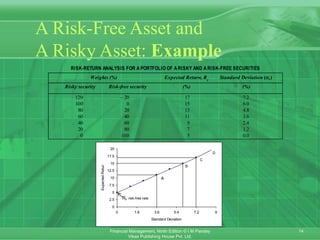
A Risk-Free Asset and a Risky Asset
 A risk-free asset or security has a zero
variance or standard deviation.
 Return and risk when we combine a risk-free
and a risky asset:
( ) ( ) (1 )
p j f
E R wE R w R
  
p j
w
 

14
Financial Management, Ninth Edition © I M Pandey
Vikas Publishing House Pvt. Ltd.
A Risk-Free Asset and
A Risky Asset: Example
RISK-RETURN ANALYSIS FOR A PORTFOLIO OF A RISKY AND A RISK-FREE SECURITIES
Weights (%) Expected Return, Rp
Standard Deviation (p)
Risky security Risk-free security (%) (%)
120 – 20 17 7.2
100 0 15 6.0
80 20 13 4.8
60 40 11 3.6
40 60 9 2.4
20 80 7 1.2
0 100 5 0.0
0
2.5
5
7.5
10
12.5
15
17.5
20
0 1.8 3.6 5.4 7.2 9
Standard Deviation
Expected
Return
A
B
C
D
Rf, risk-free rate
15
Financial Management, Ninth Edition © I M Pandey
Vikas Publishing House Pvt. Ltd.
Multiple Risky Assets and
A Risk-Free Asset
 We can combine earlier
figures to illustrate the
feasible portfolios consisting
of the risk-free security and
the portfolios of risky
securities.
 We draw three lines from the
risk-free rate (5%) to three
portfolios. Each line shows
the manner in which capital
is allocated. This line is
called the capital allocation
line (CAL).
 The capital market line
(CML) is an efficient set of
risk-free and risky securities,
and it shows the risk-return
trade-off in the market
equilibrium.
Risk, 
Return
B
M
Q
(
N
O
L
R
Capital Market Line (CML)
Capital Allocation Lines
(CALs)
P
16
Financial Management, Ninth Edition © I M Pandey
Vikas Publishing House Pvt. Ltd.
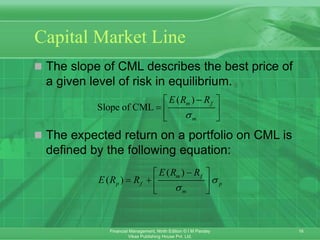
Capital Market Line
 The slope of CML describes the best price of
a given level of risk in equilibrium.
 The expected return on a portfolio on CML is
defined by the following equation:
( )
Slope of CML
m f
m
E R R


 
  
 
( )
( )
m f
p f p
m
E R R
E R R 


 
   
 
17
Financial Management, Ninth Edition © I M Pandey
Vikas Publishing House Pvt. Ltd.
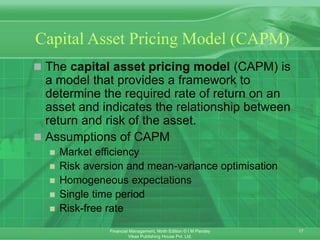
Capital Asset Pricing Model (CAPM)
 The capital asset pricing model (CAPM) is
a model that provides a framework to
determine the required rate of return on an
asset and indicates the relationship between
return and risk of the asset.
 Assumptions of CAPM
 Market efficiency
 Risk aversion and mean-variance optimisation
 Homogeneous expectations
 Single time period
 Risk-free rate
18
Financial Management, Ninth Edition © I M Pandey
Vikas Publishing House Pvt. Ltd.
Characteristics Line: Market
Return vs. Alpha’s Return
 We plot the combinations of
four possible returns of
Alpha and market. They are
shown as four points. The
combinations of the
expected returns points
(22.5%, 27.5% and –12.5%,
20%) are also shown in the
figure. We join these two
points to form a line. This
line is called the
characteristics line. The
slope of the characteristics
line is the sensitivity
coefficient, which, as stated
earlier, is referred to as
beta.
-30.0
-25.0
-20.0
-15.0
-10.0
-5.0
0.0
5.0
10.0
15.0
20.0
25.0
30.0
35.0
-20.0 -15.0 -10.0 -5.0 0.0 5.0 10.0 15.0 20.0 25.0 30.0
Market
Return
Alpha's
Return
*
*
19
Financial Management, Ninth Edition © I M Pandey
Vikas Publishing House Pvt. Ltd.
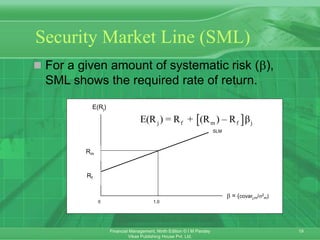
Security Market Line (SML)
 For a given amount of systematic risk (),
SML shows the required rate of return.
 = (covarj,m/2
m)
SLM
E(Rj)
Rm
Rf
1.0
0
 
j f m f j
E(R ) = R + (R ) – R β
20
Financial Management, Ninth Edition © I M Pandey
Vikas Publishing House Pvt. Ltd.
Implications of CAPM
 Investors will always combine a risk-free asset with a
market portfolio of risky assets. They will invest in risky
assets in proportion to their market value.
 Investors will be compensated only for that risk which
they cannot diversify. This is the market-related
(systematic) risk.
 Beta, which is a ratio of the covariance between the
asset returns and the market returns divided by the
market variance, is the most appropriate measure of
an asset’s risk.
 Investors can expect returns from their investment
according to the risk. This implies a linear relationship
between the asset’s expected return and its beta.
21
Financial Management, Ninth Edition © I M Pandey
Vikas Publishing House Pvt. Ltd.
Limitations of CAPM
 It is based on unrealistic assumptions.
 It is difficult to test the validity of CAPM.
 Betas do not remain stable over time.
22
Financial Management, Ninth Edition © I M Pandey
Vikas Publishing House Pvt. Ltd.
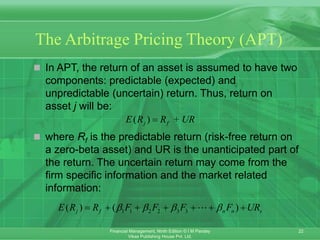
The Arbitrage Pricing Theory (APT)
 In APT, the return of an asset is assumed to have two
components: predictable (expected) and
unpredictable (uncertain) return. Thus, return on
asset j will be:
 where Rf is the predictable return (risk-free return on
a zero-beta asset) and UR is the unanticipated part of
the return. The uncertain return may come from the
firm specific information and the market related
information:
( ) +
j f
E R R UR

1 1 2 2 3 3
( ) ( )
j f n n s
E R R F F F F UR
   
      
23
Financial Management, Ninth Edition © I M Pandey
Vikas Publishing House Pvt. Ltd.
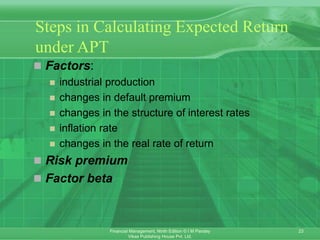
Steps in Calculating Expected Return
under APT
 Factors:
 industrial production
 changes in default premium
 changes in the structure of interest rates
 inflation rate
 changes in the real rate of return
 Risk premium
 Factor beta

Ch_05 - Risk and Return Valuation Theory.ppt

  • 1.
    Chapter - 5 Riskand Return: Portfolio Theory and Assets Pricing Models
  • 2.
    2 Financial Management, NinthEdition © I M Pandey Vikas Publishing House Pvt. Ltd. Chapter Objectives  Discuss the concepts of portfolio risk and return.  Determine the relationship between risk and return of portfolios.  Highlight the difference between systematic and unsystematic risks.  Examine the logic of portfolio theory .  Show the use of capital asset pricing model (CAPM) in the valuation of securities.  Explain the features and modus operandi of the arbitrage pricing theory (APT).
  • 3.
    3 Financial Management, NinthEdition © I M Pandey Vikas Publishing House Pvt. Ltd. Introduction  A portfolio is a bundle or a combination of individual assets or securities.  The portfolio theory provides a normative approach to investors to make decisions to invest their wealth in assets or securities under risk.  It is based on the assumption that investors are risk-averse.  The second assumption of the portfolio theory is that the returns of assets are normally distributed.
  • 4.
    4 Financial Management, NinthEdition © I M Pandey Vikas Publishing House Pvt. Ltd. Portfolio Return: Two-Asset Case  The return of a portfolio is equal to the weighted average of the returns of individual assets (or securities) in the portfolio with weights being equal to the proportion of investment value in each asset. Expected return on portfolio weight of security × expected return on security weight of security × expected return on security X X Y Y  
  • 5.
    5 Financial Management, NinthEdition © I M Pandey Vikas Publishing House Pvt. Ltd. Portfolio Risk: Two-Asset Case  The portfolio variance or standard deviation depends on the co-movement of returns on two assets. Covariance of returns on two assets measures their co-movement.  The formula for calculating covariance of returns of the two securities X and Y is as follows: Covariance XY = Standard deviation X ´ Standard deviation Y ´ Correlation XY  The variance of two-security portfolio is given by the following equation: 2 2 2 2 2 2 2 2 2 2 Covar 2 Cor p x x y y x y xy x x y y x y x y xy w w w w w w w w             
  • 6.
    6 Financial Management, NinthEdition © I M Pandey Vikas Publishing House Pvt. Ltd. Minimum Variance Portfolio  w* is the optimum proportion of investment in security X. Investment in Y will be: 1 – w*. 2 2 2 Cov * 2Cov y xy x y xy w       
  • 7.
    7 Financial Management, NinthEdition © I M Pandey Vikas Publishing House Pvt. Ltd. Portfolio Risk Depends on Correlation between Assets  When correlation coefficient of returns on individual securities is perfectly positive (i.e., cor = 1.0), then there is no advantage of diversification.  The weighted standard deviation of returns on individual securities is equal to the standard deviation of the portfolio.  We may therefore conclude that diversification always reduces risk provided the correlation coefficient is less than 1.
  • 8.
    8 Financial Management, NinthEdition © I M Pandey Vikas Publishing House Pvt. Ltd. Portfolio Return and Risk for Different Correlation Coefficients Portfolio Risk, p (%) Correlation Weight Portfolio Return (%) +1.00 -1.00 0.00 0.50 -0.25 Logrow Rapidex Rp p p p p p 1.00 0.00 12.00 16.00 16.00 16.00 16.00 16.00 0.90 0.10 12.60 16.80 12.00 14.60 15.74 13.99 0.80 0.20 13.20 17.60 8.00 13.67 15.76 12.50 0.70 0.30 13.80 18.40 4.00 13.31 16.06 11.70 0.60 0.40 14.40 19.20 0.00 13.58 16.63 11.76 0.50 0.50 15.00 20.00 4.00 14.42 17.44 12.65 0.40 0.60 15.60 20.80 8.00 15.76 18.45 14.22 0.30 0.70 16.20 21.60 12.00 17.47 19.64 16.28 0.20 0.80 16.80 22.40 16.00 19.46 20.98 18.66 0.10 0.90 17.40 23.20 20.00 21.66 22.44 21.26 0.00 1.00 18.00 24.00 24.00 24.00 24.00 24.00 Minimum Variance Portfolio wL 1.00 0.60 0.692 0.857 0.656 wR 0.00 0.40 0.308 0.143 0.344 2 256 0.00 177.23 246.86 135.00  (%) 16 0.00 13.31 15.71 11.62
  • 9.
    9 Financial Management, NinthEdition © I M Pandey Vikas Publishing House Pvt. Ltd. Investment Opportunity Sets (2 Assets) given Different Correlations 0 5 10 15 20 0 5 10 15 20 25 30 Porfolio risk (Stdev, %) Portfolio return, % Cor = - 1.0 Cor = - 0.25 Cor = + 1.0 Cor = + 0.50 Cor = - 1.0 L R
  • 10.
    10 Financial Management, NinthEdition © I M Pandey Vikas Publishing House Pvt. Ltd. Mean-Variance Criterion  A risk-averse investor will prefer a portfolio with the highest expected return for a given level of risk or prefer a portfolio with the lowest level of risk for a given level of expected return. In portfolio theory, this is referred to as the principle of dominance.
  • 11.
    11 Financial Management, NinthEdition © I M Pandey Vikas Publishing House Pvt. Ltd. Investment Opportunity Set: The N-Asset Case  An efficient portfolio is one that has the highest expected returns for a given level of risk. The efficient frontier is the frontier formed by the set of efficient portfolios. All other portfolios, which lie outside the efficient frontier, are inefficient portfolios. Risk,  Return A P Q B C D x x x x x x x R
  • 12.
    12 Financial Management, NinthEdition © I M Pandey Vikas Publishing House Pvt. Ltd. Risk Diversification: Systematic and Unsystematic Risk  Risk has two parts:  Systematic risk arises on account of the economy-wide uncertainties and the tendency of individual securities to move together with changes in the market. This part of risk cannot be reduced through diversification. It is also known as market risk.  Unsystematic risk arises from the unique uncertainties of individual securities. It is also called unique risk. Unsystematic risk can be totally reduced through diversification.  Total risk = Systematic risk + Unsystematic risk  Systematic risk is the covariance of the individual securities in the portfolio. The difference between variance and covariance is the diversifiable or unsystematic risk.
  • 13.
    13 Financial Management, NinthEdition © I M Pandey Vikas Publishing House Pvt. Ltd. A Risk-Free Asset and a Risky Asset  A risk-free asset or security has a zero variance or standard deviation.  Return and risk when we combine a risk-free and a risky asset: ( ) ( ) (1 ) p j f E R wE R w R    p j w   
  • 14.
    14 Financial Management, NinthEdition © I M Pandey Vikas Publishing House Pvt. Ltd. A Risk-Free Asset and A Risky Asset: Example RISK-RETURN ANALYSIS FOR A PORTFOLIO OF A RISKY AND A RISK-FREE SECURITIES Weights (%) Expected Return, Rp Standard Deviation (p) Risky security Risk-free security (%) (%) 120 – 20 17 7.2 100 0 15 6.0 80 20 13 4.8 60 40 11 3.6 40 60 9 2.4 20 80 7 1.2 0 100 5 0.0 0 2.5 5 7.5 10 12.5 15 17.5 20 0 1.8 3.6 5.4 7.2 9 Standard Deviation Expected Return A B C D Rf, risk-free rate
  • 15.
    15 Financial Management, NinthEdition © I M Pandey Vikas Publishing House Pvt. Ltd. Multiple Risky Assets and A Risk-Free Asset  We can combine earlier figures to illustrate the feasible portfolios consisting of the risk-free security and the portfolios of risky securities.  We draw three lines from the risk-free rate (5%) to three portfolios. Each line shows the manner in which capital is allocated. This line is called the capital allocation line (CAL).  The capital market line (CML) is an efficient set of risk-free and risky securities, and it shows the risk-return trade-off in the market equilibrium. Risk,  Return B M Q ( N O L R Capital Market Line (CML) Capital Allocation Lines (CALs) P
  • 16.
    16 Financial Management, NinthEdition © I M Pandey Vikas Publishing House Pvt. Ltd. Capital Market Line  The slope of CML describes the best price of a given level of risk in equilibrium.  The expected return on a portfolio on CML is defined by the following equation: ( ) Slope of CML m f m E R R          ( ) ( ) m f p f p m E R R E R R           
  • 17.
    17 Financial Management, NinthEdition © I M Pandey Vikas Publishing House Pvt. Ltd. Capital Asset Pricing Model (CAPM)  The capital asset pricing model (CAPM) is a model that provides a framework to determine the required rate of return on an asset and indicates the relationship between return and risk of the asset.  Assumptions of CAPM  Market efficiency  Risk aversion and mean-variance optimisation  Homogeneous expectations  Single time period  Risk-free rate
  • 18.
    18 Financial Management, NinthEdition © I M Pandey Vikas Publishing House Pvt. Ltd. Characteristics Line: Market Return vs. Alpha’s Return  We plot the combinations of four possible returns of Alpha and market. They are shown as four points. The combinations of the expected returns points (22.5%, 27.5% and –12.5%, 20%) are also shown in the figure. We join these two points to form a line. This line is called the characteristics line. The slope of the characteristics line is the sensitivity coefficient, which, as stated earlier, is referred to as beta. -30.0 -25.0 -20.0 -15.0 -10.0 -5.0 0.0 5.0 10.0 15.0 20.0 25.0 30.0 35.0 -20.0 -15.0 -10.0 -5.0 0.0 5.0 10.0 15.0 20.0 25.0 30.0 Market Return Alpha's Return * *
  • 19.
    19 Financial Management, NinthEdition © I M Pandey Vikas Publishing House Pvt. Ltd. Security Market Line (SML)  For a given amount of systematic risk (), SML shows the required rate of return.  = (covarj,m/2 m) SLM E(Rj) Rm Rf 1.0 0   j f m f j E(R ) = R + (R ) – R β
  • 20.
    20 Financial Management, NinthEdition © I M Pandey Vikas Publishing House Pvt. Ltd. Implications of CAPM  Investors will always combine a risk-free asset with a market portfolio of risky assets. They will invest in risky assets in proportion to their market value.  Investors will be compensated only for that risk which they cannot diversify. This is the market-related (systematic) risk.  Beta, which is a ratio of the covariance between the asset returns and the market returns divided by the market variance, is the most appropriate measure of an asset’s risk.  Investors can expect returns from their investment according to the risk. This implies a linear relationship between the asset’s expected return and its beta.
  • 21.
    21 Financial Management, NinthEdition © I M Pandey Vikas Publishing House Pvt. Ltd. Limitations of CAPM  It is based on unrealistic assumptions.  It is difficult to test the validity of CAPM.  Betas do not remain stable over time.
  • 22.
    22 Financial Management, NinthEdition © I M Pandey Vikas Publishing House Pvt. Ltd. The Arbitrage Pricing Theory (APT)  In APT, the return of an asset is assumed to have two components: predictable (expected) and unpredictable (uncertain) return. Thus, return on asset j will be:  where Rf is the predictable return (risk-free return on a zero-beta asset) and UR is the unanticipated part of the return. The uncertain return may come from the firm specific information and the market related information: ( ) + j f E R R UR  1 1 2 2 3 3 ( ) ( ) j f n n s E R R F F F F UR           
  • 23.
    23 Financial Management, NinthEdition © I M Pandey Vikas Publishing House Pvt. Ltd. Steps in Calculating Expected Return under APT  Factors:  industrial production  changes in default premium  changes in the structure of interest rates  inflation rate  changes in the real rate of return  Risk premium  Factor beta